Tag: Silent Luxury

Silent Luxury describes the philosophy of value shaped by craftsmanship, provenance, trust, hospitality and life quality. Articles in this archive follow the cultural shift toward long-term relevance, material understanding and a more conscious relationship with products, places and everyday life. The tag gathers reporting, essays and interviews on independent makers, considered places, regenerative practice and the four-term framework that situates the philosophy alongside Quiet Luxury, New Luxury and Well Living.

The Return on Repair: How a 500-Million-Euro Figure Is Reshaping the Economics of the Fashion Industry

LVMH has reported 500 million euros in repair and take-back revenue for 2025. The secondhand market is projected to reach 317 billion dollars by 2028. The global repair market grows at nearly three times the rate of new production. An analysis by The Silent Luxury of what these figures mean together and what the documented experience of Japan, China, India, Latin America, Africa, Europe and the United States reveals about the structural direction of the industry.

Kevin Germanier opened the Global Fashion Summit in Copenhagen on 6 May with a collection built from unsold stock held across seven LVMH brands. Germanier is a Swiss designer who founded his label in 2018 and has since built an international reputation working exclusively with deadstock fabrics and production surplus, developing Haute Couture silhouettes that have shown alongside the established Paris houses at international presentations. What he showed in Copenhagen was technically precise, formally rigorous, assembled from material sitting in LVMH warehouses. It was the first time the group had made its surplus inventory available to an external designer for public presentation at this scale.

“Presenting this show at the Global Fashion Summit is a way of demonstrating that circularity can be at the heart of the creative process. Working with existing pieces allows us to reveal the richness of materials and craftsmanship, while reimagining the way we create,” Kévin Germanier, Artistic Director and Founder of Maison GERMANIER. 

Surplus inventory is among the most commercially sensitive information a luxury group holds. The volumes, the styles and the fabric allocations carry detailed evidence of what the market accepted and what it did not, which is why the practice has always been to absorb, redistribute or, in the years before EU legislation banned it, destroy what remained. That LVMH chose in 2026 to open seven brands’ worth of that inventory to an outside designer, and to do so on the opening stage of one of the industry’s most visible annual gatherings, is a disclosure of intent as much as material.

The repair economy in fashion describes the business systems that extend the commercial life of garments through repair, take-back, resale, refill, remanufacturing and textile recycling. In 2026, it is moving from sustainability language into balance sheets, supply chains and customer retention strategies.

The following day, LVMH published the figure that contextualises the gesture. Under Life 360, the group’s internal sustainability and circularity programme that measures product longevity, repair and take-back services across all its brands including Louis Vuitton, Dior, Celine, Fendi, Givenchy and Bulgari, LVMH reported 500 million euros in revenue from repair, refill and take-back services for 2025, covering ten million products restored, refilled or returned. The group presented this for the first time as a revenue line rather than as a sustainability indicator. A sustainability indicator is addressed to external audiences as evidence of responsibility. A revenue line is addressed to internal audiences as evidence of a business working.


What the numbers show

The 500 million euro figure arrives within a precise market context. The global base of luxury consumers has shrunk from a peak of approximately 400 million in 2022 to 330 to 340 million in 2026, a net loss of between 60 and 70 million buyers, according to Bain and Altagamma, the Italian luxury industry association and global management consultancy whose joint annual luxury study is the most widely referenced in the sector. Bain traces approximately 80 percent of the luxury market’s growth between 2019 and 2023 to price increases rather than volume gains. Prices rose without a commensurate deepening of product quality or the depth of the customer relationship. The buyers who left understood the difference.

LVMH’s own results reflect this pressure directly. The group recorded a two percent organic revenue decline across the first half of 2025 and one percent organic growth in Q1 2026, while its share price fell 28 percent in the first quarter alone, the largest single-quarter decline in company history, exceeding the drops recorded during the 2008 financial crisis and the pandemic quarter of 2020. Kering, the French luxury group whose brands include Gucci, Saint Laurent and Balenciaga, recorded flat organic growth at group level in Q1 2026, with Gucci down eight percent organically in the same period. The primary market, measured by new product sales, is under sustained structural pressure across the sector.

In the same period, the market for extended product life has been expanding with consistency. The global market for clothing and footwear repair reached 5.8 billion dollars in 2025 and is projected to grow at 5.5 percent annually to 9.4 billion dollars by 2034. The global secondhand apparel market is anticipated to reach 53.7 billion dollars in 2026, with an 11.1 percent compound annual growth rate projected through 2036, according to Future Market Insights. The BoF-McKinsey State of Fashion 2026 documents that secondhand sales will grow two to three times faster than first-hand sales between 2025 and 2027, reaching a projected 317 billion dollars by 2028. Branded resale grew 300 percent between 2021 and 2025. Repair, resale and rental models combined are estimated to represent a 700-billion-dollar market by 2030. The global textile recycling market was valued at 6.42 billion dollars in 2025 and is projected to reach 9.23 billion dollars by 2034.

The Silent Luxury · Market Analysis · May 2026 Growth Rates: Primary Market vs. Extended Product Life Annual growth rates · Market size 2025/2026 · Selected segments
Primary Luxury Market Bain–Altagamma · 2025/2026
+1–3%
No aggregate market value
Global Textile Recycling Fortune Business Insights · 2025–2034
+4.3%
USD 6.42 billion · 2025
Clothing & Footwear Repair Dataintelo · March 2026
+5.5%
USD 5.8 billion · 2025
Secondhand Apparel Future Market Insights · 2025–2036
+11.1%
USD 53.7 billion · 2026
Sources: Bain–Altagamma Luxury Study 2026 · Dataintelo Clothing & Footwear Repair Market Report, March 2026 · Future Market Insights Secondhand Apparel Market 2026 · Fortune Business Insights Textile Recycling Market 2025–2034 © Silent Communications GmbH · the-silent-luxury.com

The brands that built the infrastructure earliest

Patagonia, the California-based outdoor clothing company founded in 1973, launched its Worn Wear repair and resale platform in 2013, thirteen years before repair became a regulatory topic in the European Union. The company repairs approximately 17,000 products annually and generates as much as 100 dollars per used jacket sold through its own resale channel. Harvard Business Review research found that an average Patagonia product lasts as long as three comparable items from other brands. In partnership with the United Repair Collective, a collaboration between Patagonia, the Amsterdam-based social enterprise Makers Unite, and the Amsterdam Economic Board, the company operates dedicated repair centres in Amsterdam and London providing business-to-business repair services for brands including Decathlon, Lululemon and Rapha.

Eileen Fisher, the New York-based womenswear label founded in 1984, has operated its Renew remanufacturing programme for two decades, taking back used garments, repairing and reselling them, and publishing annual transparency data on repairs completed. Nudie Jeans, the Swedish denim label founded in 2001, offers free in-store repairs at all its retail locations globally. Tersus Solutions, the Colorado-based logistics company whose clients include Patagonia, The North Face, Arc’teryx, Dr. Martens and Lululemon, reported banner years across those brands in 2025. “With each holiday cycle, we’re seeing the resale category grow,” said Terry Boyle, CEO of Trove, “and each year the promotions have more of the polish and scale of broader retail campaigns.”

Of the 42 major fashion brands tracked by Stand.earth in 2025, 40 now offer some form of resale or repair programme, up from nine brands in 2020. The University of Exeter’s Mapping the Repair Landscape in Fashion report, published in March 2026 as the conclusion of the UK Research and Innovation-funded Future Fibres Network Plus programme, found that repair remains commercially underdeveloped across the industry because brands have not yet resolved the practical and strategic barriers to operating it at scale.

The regulatory architecture

The European Union’s Right to Repair Directive, which came into force in 2024, establishes the legal right of consumers to have products repaired by independent repairers and requires manufacturers to provide access to spare parts and technical information for a defined period after purchase. Across the EU countries within the directive’s initial scope, smartphone repair rates have already risen by 20 percent. France has introduced its Repair Bonus, a direct government reimbursement covering a portion of consumer repair costs. Sweden has reduced VAT on repair services across clothing and textiles. The EU Digital Product Passport, which becomes mandatory for textiles in 2027, will require brands to document the material composition, provenance and repairability of every garment at the point of sale.

The Global Fashion Agenda, the Copenhagen-based non-profit organisation that convenes the Global Fashion Summit and serves as one of the primary international policy coordination bodies for the fashion industry, launched the 2030 Circularity Blueprint at the summit in partnership with ReHubs, the European network whose mandate is to develop the industrial infrastructure for textile-to-textile recycling at scale. The Blueprint sets out a roadmap for transitioning the EU textile ecosystem so that fibres recovered from used garments re-enter the production cycle as new fibre. Less than one percent of fibres are currently recycled fibre-to-fibre globally, according to BCG data documented by The Silent Luxury, against a projected annual textile resource loss of 150 billion dollars.


The Silent Luxury · Regional Data · May 2026 Global Textile Recycling Markets by Region Market size in USD billion · 2026 · Fortune Business Insights
ChinaLargest single market
2.24USD bn
Asia Pacific45% global share
2.90USD bn
Europe20% global share
1.34USD bn
North America18% global share
1.20USD bn
Latin America12% global share
0.79USD bn
Middle East & Africa5% global share
0.33USD bn
Source: Fortune Business Insights · Global Textile Recycling Market 2025–2034 © Silent Communications GmbH · the-silent-luxury.com

Europe: From policy to practice

Within Europe, the transition from policy commitment to operational practice is moving at different speeds. The United Kingdom’s resale market is projected to grow at a 9.3 percent compound annual growth rate through 2036, driven by the country’s established charity shop culture, the growth of digital platforms including Depop and Vinted, and the government’s Green Industrial Revolution framework. Germany and the Netherlands have developed the densest networks of brand-operated repair services and government-backed repair cafés. Europe’s textile recycling market generated 1.28 billion dollars in 2025 and is projected to reach 1.34 billion dollars in 2026.

Marine Serre, the French designer who won the LVMH Prize in 2017 and founded her label the following year, has built one of the most rigorous practices in European fashion around upcycled materials and archived textiles. She stepped back from seasonal runway presentations for two consecutive collections to concentrate on what she describes as the slow craft of making clothes. Her FW26 collection, titled “The Grace of Time,” and its Louvre capsule, three pieces assembled from archived Louvre shop T-shirts and souvenir medals cut apart and rebuilt, make the underlying argument at the level of craft: the object that carries evidence of prior life and careful reconstruction accumulates meaning that a new object arrives without.

United States: Scale without mandate

The United States is the world’s largest and most mature resale market, representing roughly 40 percent of global secondhand apparel revenue. Online resale in the US is forecast to grow 16 percent annually, reaching 34 billion dollars by 2027. In 2025, 66 percent of US adults reported shopping secondhand regularly, with 28 percent of Gen Z consumers doing so on a weekly basis. The US textile recycling market is projected to reach 1.02 billion dollars in 2026. The Government Accountability Office has called for coordinated federal action on textile waste, and industry coalitions including American Circular Textiles are pressing for the removal of double taxation on secondhand goods. The BoF-McKinsey State of Fashion 2026 found that fewer than one-third of US fashion industry executives called resale a priority for 2026.

Latin America: Community-rooted infrastructure

Latin America’s textile recycling market reached 770 million dollars in 2025 and is projected to grow to 790 million dollars in 2026, according to Fortune Business Insights, representing just under 12 percent of total global textile recycling revenue. Brazil accounts for the largest share of the regional market, with its textile recycling sector valued at 97.5 million dollars in 2025 and projected to reach 166.8 million dollars by 2034. Across the region, community-based textile recycling programmes represent one of the most documented growth areas, with local cooperatives gathering, sorting and repurposing used textiles in ways that combine environmental function with social impact for underserved communities.

The structural picture across Latin America is complex. Brazil, Argentina, Paraguay and Peru each restrict or prohibit commercial imports of secondhand clothing, policy decisions that reflect a choice to protect domestic textile production. Chile and other Southern Cone nations are integrating textiles into Extended Producer Responsibility frameworks. A 2026 study published in Springer Nature’s Circular Economy and Sustainability journal, examining Brazilian consumer trends from 2012 to 2022, found that fast fashion-oriented behaviour is forecast to dominate the Brazilian market by 2033 without effective structural interventions, and calls for policy measures that make the circular option economically accessible rather than aspirational.

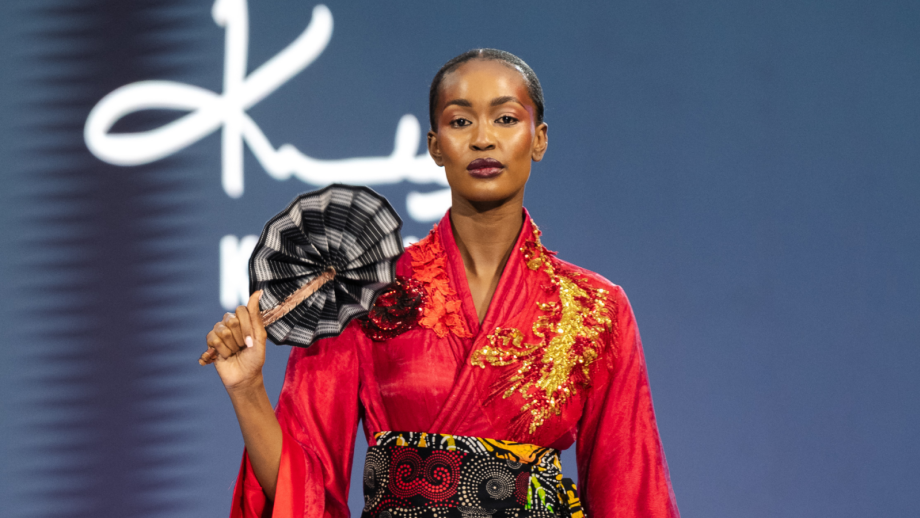
Maison GERMANIER x LVMH, Global Fashion Summit Copenhagen, 6 May 2026. Credit: LVMH.

Maison GERMANIER x LVMH, Global Fashion Summit Copenhagen, 6 May 2026. Credit: LVMH.


China: Industrial policy as the mechanism

China’s approach to the repair and circularity economy is driven at the level of industrial planning. The State Council’s 14th Five-Year Plan, covering 2021 to 2025, set a target of achieving a textile waste recycling rate of 25 percent and producing two million tonnes of recycled fibre annually, according to research published in Frontiers in Environmental Science. The 15th Five-Year Plan, covering 2025 to 2030, continues this trajectory with emphasis on green transformation and carbon neutrality goals. China’s textile recycling market is valued at 2.24 billion dollars in 2026, the largest single national market in Asia Pacific. China’s luxury resale market was projected to grow from approximately eight billion dollars in 2020 to 32 billion dollars by 2025, according to iResearch data cited by The Interline, driven by a generational shift among Gen Z and Millennial consumers who account for more than 80 percent of secondhand luxury customers in the country.

Japan: A grammar that predates the legislation

A 2024 study published in ScienceDirect, examining circular economy potential in Japan’s textile and fashion industries and produced for the EU-Japan Centre for Industrial Cooperation, describes the concept of Mottainai as the cultural foundation beneath Japan’s approach to textile longevity. Mottainai, a term conveying deep regret at any form of waste, has produced a functioning infrastructure for textile circulation in Japan that operates without regulatory mandate: networks of secondhand retail, community exchange events, mending practices embedded in household routines, and the intergenerational transfer of clothing as a standard cultural expectation. The same study describes the kimono as a design object that embodies this logic structurally: cut in straight lines so that when untied it returns to a single piece of fabric, designed from its origin to be disassembled, reused and repurposed across generations. Japan’s secondhand luxury market is projected to grow at a 7.6 percent compound annual growth rate through 2036. The country’s textile recycling market generated 323.8 million dollars in revenue in 2025 and is projected to reach 462.7 million dollars by 2033.

India: Circularity as industrial baseline

In India, the repair and reuse economy has never required a policy framework because it has always been the baseline condition of production. A March 2026 report published in Global Textile Times on the country’s textile recycling sector found that approximately 55 percent of post-consumer textile waste is diverted from landfill through informal collection, sorting and redistribution systems supporting between four and four and a half million livelihoods, the majority held by women from marginalised communities. Nearly 100 percent of spinning sector waste is directly reused within production processes. The Indian textile recycling market is projected to reach 3.5 billion dollars by 2030. India’s G20 Presidency and Mission LiFE, the Lifestyle for the Environment programme adopted by the United Nations Environment Programme as a global framework, reinforce long-term goals that align with the repair economy’s direction.


West and East Africa: Protection as strategy

In West and East Africa, the political response has taken the form of trade policy. Kenya and Tanzania have introduced import taxes on secondhand clothing shipped from Western markets, protective measures for domestic textile manufacturing. A 2024 study published in ScienceDirect on the dynamics of global secondhand clothing trade found that while sub-Saharan African countries benefit from the affordability and employment that secondhand clothing trade creates, the dependency relationship also constrains domestic production investment. In Ghana, kente production, the hand-woven textile tradition with roots in the Asante and Ewe peoples dating to the 17th century, is experiencing documented revival as an international market positioning strategy. Bubu Ogisi, the founder of the Lagos-based label I Am Isigo and one of the most internationally recognised practitioners of a design approach in which repairability is a structural requirement from the earliest design stage, has built a following across Europe and North America among buyers who treat the durability and material honesty of a garment as primary purchasing criteria.

The Silent Luxury · Industry Data · May 2026 Brand Repair & Resale Programme Adoption Major fashion brands offering repair or resale · 42 brands tracked · Stand.earth 2025
2020
9of 42 · 21%
2023
28of 42 · 67%
2025
40of 42 · 95%
Existing 2020 Added by 2023 Added by 2025 No programme
Sources: Stand.earth Fashion Scorecard 2025 · BoF-McKinsey State of Fashion 2026 © Silent Communications GmbH · the-silent-luxury.com

What 500 million euros changes

LVMH’s Life 360 figure is the first time a luxury group of its scale has placed a revenue number on the object that stays. The group’s total revenues run well into the tens of billions, and 500 million euros is a fraction of that. What the figure changes is the terms of the conversation. Repair has been discussed in the fashion industry for the better part of a decade as a loyalty instrument, a regulatory compliance strategy, a sustainability signal, a customer service add-on. The 500 million euro figure positions it as a measurable business line with documented growth, in a market where the primary channel is under sustained pressure.

The BoF-McKinsey State of Fashion 2026 found that fewer than one-third of industry executives called resale a priority for 2026, and that only 7 percent planned to support circular business models in any meaningful way. These figures sit alongside a secondhand market projected to reach 317 billion dollars by 2028. The gap between where executive attention is directed and where consumer spending is moving is the space in which the repair economy will continue to grow.

On 6 May in Copenhagen, Germanier assembled ten million products worth of that growth into Haute Couture silhouettes and placed them on a stage where the industry’s decision-makers were required to look at them. The nails held.

What readers ask about the repair economy in fashion

The repair economy in fashion is one of the most consequential structural shifts in the global luxury and apparel industry in 2026. Based on primary market data from Bain and Altagamma, the BoF-McKinsey State of Fashion 2026, Fortune Business Insights, Dataintelo, Stand.earth and regional research from Japan, India, Latin America and West Africa, The Silent Luxury documents the economic, regulatory and cultural forces reshaping how garments are produced, maintained and valued — and what LVMH’s 500-million-euro Life 360 revenue figure signals for the industry’s next decade.

  • What is the repair economy in fashion, and why is it growing in 2026?

    The repair economy in fashion encompasses repair services, take-back programmes, resale platforms and textile recycling systems that extend the life of garments beyond their original sale. It is growing in 2026 because two structural forces are converging: the primary luxury market is contracting, having lost between 60 and 70 million active buyers since 2022 according to Bain and Altagamma, while regulatory frameworks including the EU Right to Repair Directive and the forthcoming EU Digital Product Passport are making product longevity a legal requirement for the first time.

  • How much revenue does LVMH generate from repair and take-back services?

    LVMH reported 500 million euros in revenue from repair, refill and take-back services for 2025, covering ten million products restored, refilled or returned across its brands. This was disclosed under the group’s Life 360 circularity programme and presented for the first time as a revenue line rather than a sustainability metric, at the Global Fashion Summit in Copenhagen in May 2026.

  • What is the Global Fashion Agenda’s 2030 Circularity Blueprint?

    The 2030 Circularity Blueprint is a policy roadmap launched by the Global Fashion Agenda in partnership with ReHubs at the Global Fashion Summit in Copenhagen in May 2026. It targets a full transition of the EU textile ecosystem toward fibre-to-fibre recycling by 2030. Currently less than one percent of textile fibres are recycled fibre-to-fibre globally, against an annual textile resource loss of 150 billion dollars according to BCG.

  • How does Japan’s approach to textile repair differ from Western regulatory models?

    Japan’s textile circularity infrastructure is rooted in the cultural concept of Mottainai — a deep aversion to waste — rather than in regulatory mandates. A 2024 ScienceDirect study produced for the EU-Japan Centre for Industrial Cooperation found that this cultural foundation has produced networks of secondhand retail, mending practices and intergenerational clothing transfer that predate and structurally outpace Western circular economy programmes. Japan’s textile recycling market generated 323.8 million dollars in 2025.

  • What share of India’s textile waste is recovered through informal systems?

    Approximately 55 percent of India’s post-consumer textile waste is diverted from landfill through informal collection, sorting and redistribution systems, according to a March 2026 report in Global Textile Times. These systems support between four and four and a half million livelihoods, the majority held by women from marginalised communities. Nearly 100 percent of spinning sector waste is directly reused within production processes. India’s textile recycling market is projected to reach 3.5 billion dollars by 2030.

  • How many fashion brands now offer repair or resale programmes?

    Of the 42 major fashion brands tracked by Stand.earth in its 2025 Fashion Scorecard, 40 now offer some form of resale or repair programme, up from nine brands in 2020. The University of Exeter’s Mapping the Repair Landscape in Fashion report, published in March 2026, found that despite widespread adoption, repair remains commercially underdeveloped because brands have not yet resolved the practical and strategic barriers to operating it at scale.

  • What is the projected size of the global secondhand apparel market?

    The global secondhand apparel market is projected to reach 53.7 billion dollars in 2026 according to Future Market Insights, and 317 billion dollars by 2028 according to the BoF-McKinsey State of Fashion 2026. Branded resale grew 300 percent between 2021 and 2025. Repair, resale and rental models combined are estimated to represent a 700-billion-dollar market by 2030.

  • What protective measures have African countries introduced regarding secondhand clothing imports?

    Kenya and Tanzania have introduced import taxes on secondhand clothing shipped from Western markets, as protective measures for domestic textile manufacturing. A 2024 ScienceDirect study on global secondhand clothing trade dynamics found that while the secondhand clothing trade creates affordability and employment across sub-Saharan Africa, it also constrains domestic production investment. Ghana and Ethiopia are responding by positioning traditional textiles — kente and shemma — as internationally competitive products based on cultural provenance and craft quality.


Note: The charts, data visualisations and infographics contained in this article are the copyright of Silent Communications GmbH, Vienna. Any use — including partial reproduction — requires prior written permission and must include the full attribution © The Silent Luxury (the-silent-luxury.com) with an active link to the original publication. Licensing enquiries: info@the-silent-luxury.com.


Sources:
LVMH Life 360 Programme, quantified May 2026 · Global Fashion Summit Copenhagen, 5–7 May 2026 · GFA 2030 Circularity Blueprint / ReHubs · Marine Serre / WWD FW26 · BoF-McKinsey State of Fashion 2026 · Bain–Altagamma Luxury Study 2026 · Dataintelo Clothing & Footwear Repair Market Report, March 2026 · University of Exeter: Mapping the Repair Landscape in Fashion, March 2026 · Stand.earth Fashion Scorecard 2025 · Fortune Business Insights: Global Textile Recycling Market 2025–2034 · Future Market Insights: Secondhand Apparel Market 2026 · Bleckmann: US Resale Market, January 2026 · IMARC Group: Brazil Textile Recycling Market 2026–2034 · Springer Nature: Circular Economy Challenges in Fashion — Brazilian Consumer Trends, March 2026 · ScienceDirect: Circular economy potential in Japan’s textile industries, December 2024 · Frontiers in Environmental Science: China textile and fashion industry, March 2026 · The Interline: China sustainability efforts · Global Textile Times: India Textile Recycling Market, March 2026 · Grand View Research: Japan Textile Recycling Market 2025–2033 · AICI: Fashion Circular Economy Around the World, 2025 · ScienceDirect: Global secondhand clothing trade dynamics, November 2024 · BCG Textile Resource Loss Data · Harvard Business Review: Patagonia product longevity · Tersus Solutions / Peter Whitcomb · Trove / Terry Boyle

Continue reading

Nairobi Fashion Week 2026: Decarbonize and the Material Future of African Fashion

The eighth season of Nairobi Fashion Week placed Decarbonize at the centre of African fashion. Across twelve studios, textile waste, organic cotton, social enterprise and heritage craft became the working conditions of a regenerative design economy.

Nairobi Fashion Week Season 8 was held from 28 to 31 January 2026 at Sarit Expo Centre in Westlands under the editorial title Decarbonize. Founder and Creative Director Brian Kihindas, who opened Nairobi Fashion Week in 2013 inside the Hilton Nairobi, used the eighth season to name the continental position that established Kenyan and East African studios already operate. Angela Wambui carried the season as MC across four nights of runway, two days of editorial conversation under the Thread Talks programme, and a curated launch at Matteo’s Restaurant in Karen.

In Nairobi, Decarbonize read less as a seasonal theme than as a description of an operating system. The strongest studios did not present sustainability as a surface language. They showed how textile waste, organic cotton, handwork, small batch production and social enterprise structures already shape the way fashion is made, trained, sourced and finished across parts of the East African design economy.

The eighth season produced three structural signals for the future of African fashion.

The first signal: regenerative practice in Nairobi was visible as the working condition of established social enterprises and supply-chain organisations, with the editorial title naming what already operates across Kenyan and East African studios. The second signal: upcycled material crossed from salvage narrative into primary material for couture-level finishing, with Rialto’s upcycled denim and Maisha by Nisria’s ASILI collection treating waste streams as the legitimate basis of architectural construction. The third signal: the runway gathered designers from Kenya, Nigeria, Sri Lanka, France, Mali, Germany and the United States in a convergence that registered as continental gravity at scale, with Nairobi positioned as the destination.

Kihindas put the editorial argument to the press in two registers. To TTYBrand Africa ahead of the season, he framed the title in measured language: “Decarbonize challenges designers and audiences to think about how fashion impacts the planet. We want to promote creativity that respects communities, resources, and the future.” Speaking to Africanews on the runway, he sharpened the case in the African register: “When you come down here to Africa, we are very sustainable. We use sustainable fabrics in developing our collections and pieces, but the message that comes out of here, out of home, out of the home of the unit, is for us to decarbonise.” A second sentence to Africanews placed the title inside global accounting: “Fashion is the second emitter of global carbon emissions. We have to think about it critically.”

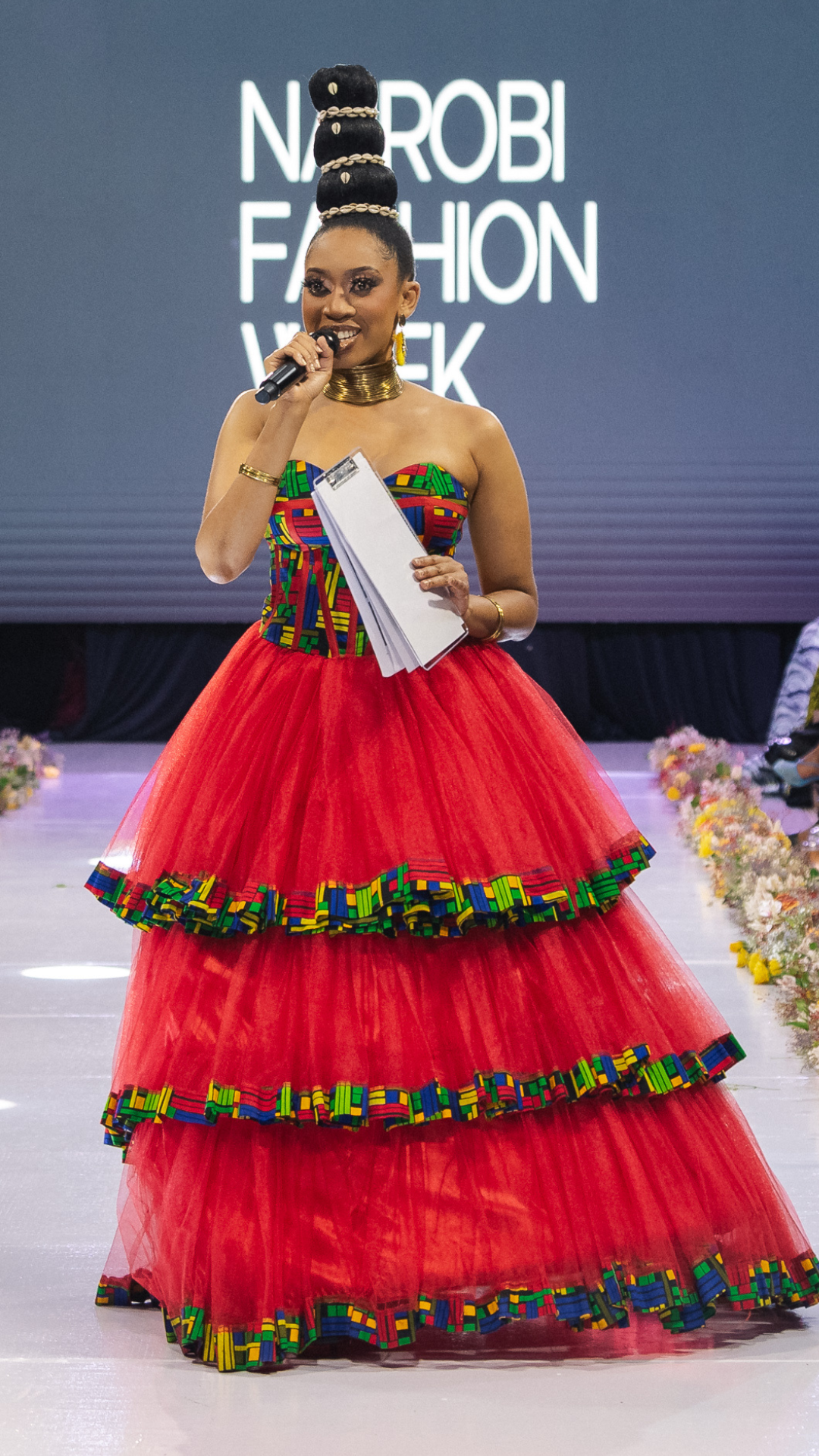
Angela Wambui  Muiruri, known as KQ - the Kenyan Queen - carrying the eighth edition of Nairobi Fashion Week as Master of Ceremonies, Sarit Expo Centre, January 2026.

KQ — the Kenyan Queen

Angela Wambui Muiruri, known as KQ — the Kenyan Queen — carried the eighth edition of Nairobi Fashion Week as Master of Ceremonies. Born in Seattle to Kenyan parents and raised between two cultures, she returned to Nairobi and became a Capital FM radio anchor, MC and humanitarian. She co-founded Heels4Pads Foundation in 2019, a social initiative that has grown from a social media campaign into a movement delivering menstrual health education and dignity kits to girls across Kenyan counties. At Sarit Expo Centre, Wambui anchored Brian Kihindas’s Decarbonize argument across four nights of runway, walking the audience through the rhythm of twelve collections.


Decarbonize as Working Condition

The studios on the Westlands runway operate as continuing social-enterprise and supply-chain organisations, and their daily method produces the regenerative position the title named. Maisha by Nisria, founded by Nur M’Nasria and based in Gilgil, runs as a social enterprise that trains and employs young women from vulnerable communities in the Rift Valley, sourcing discarded textiles from flea markets, wholesalers and recycling factories and finishing them into one-of-a-kind clothing. The studio has been recognised by The Guardian, Vogue Business and Al Jazeera. Tausi Conde, the studio’s Head of Design, summarised the working method to The Guardian in a single sentence: “You can use anything and everything to make something interesting.” The sentence describes how the studio operates from Monday morning through Friday afternoon. The runway version made the operation legible.

Lucy Rao runs the same kind of organisation at industrial scale. She founded Rialto Fashions in 1988, sits as Co-Director of the Kenya Fashion Council and runs the Pamba Mali Organic Cotton Collective, which produces certified organic cotton for Kenyan and East African manufacturers. Her runway position was settled before the lights came up. Speaking to Africanews on the floor, she placed her work inside the wider continental argument: “Fashion is one of the biggest polluters of the planet. What better way to pass the message than using a platform like Nairobi Fashion Week.” A cotton supply collective and a couture house under one principal: that is the structure Decarbonize made visible. The title named what was already operating across three decades of Rao’s working life.


THE LOOKBOOK: Twelve Studios, One Editorial Title

The Lookbook reads Nairobi Fashion Week Season 8 through the working methods of twelve studios. Under Brian Kihindas’s editorial title Decarbonize, each label brought a different material position to the runway: upcycled cotton, organic supply, denim reconstruction, Bogolan textile, linen, leather, beadwork, hand embroidery, streetwear, small batch tailoring and social enterprise practice.

Together, the collections described a fashion system in which material is no longer treated as surface. It becomes evidence of origin, labour, community, reuse and technical discipline.

Photography by Jenkins Kuyoh.


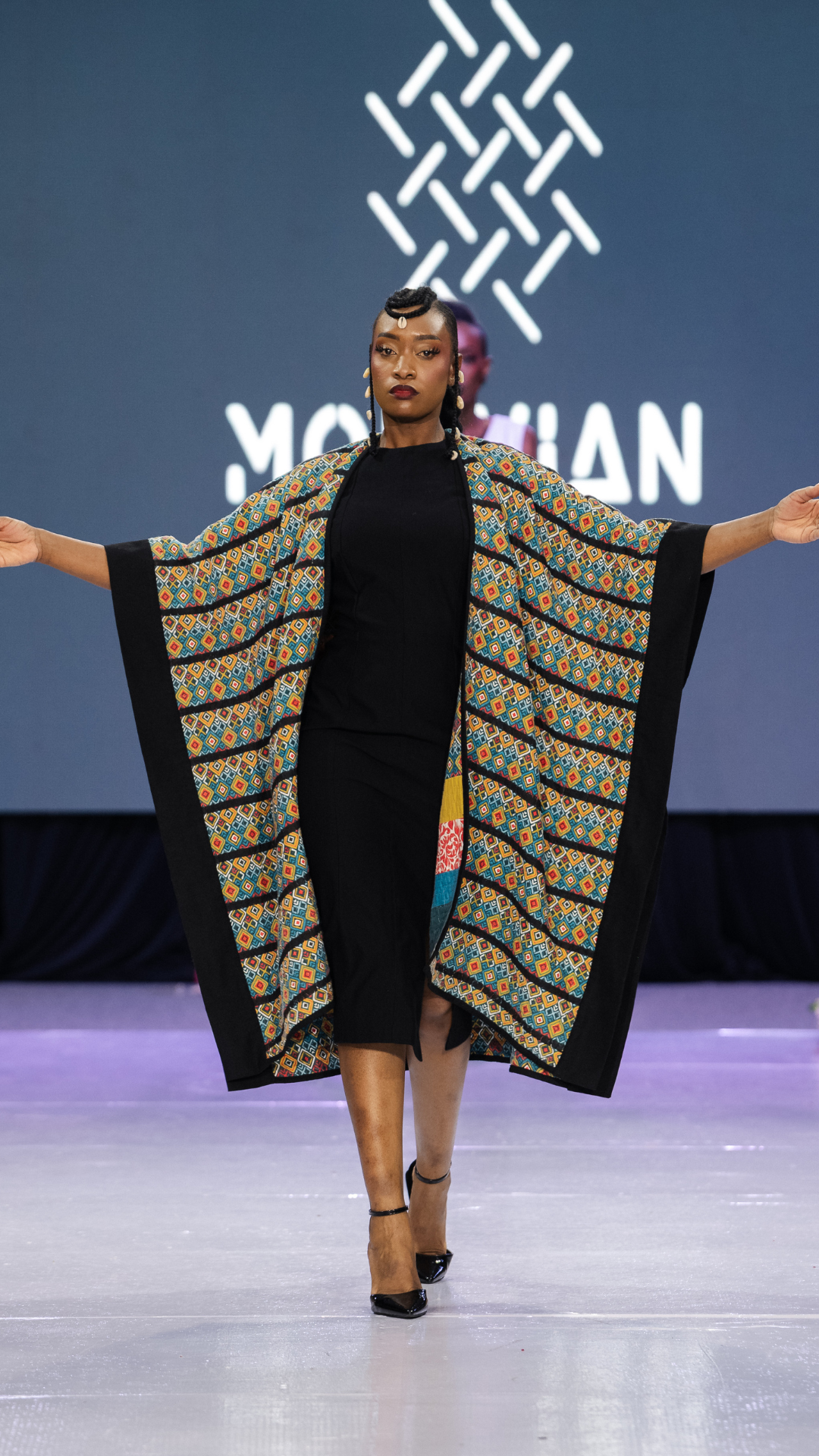
  • Molivian opens its Season 8 walk with a patchwork cape carrying West African geometric textile inside black tailored construction.

    MOLIVIAN

    Base: Nairobi, Kenya
    Material Position: Textile waste, patchwork construction, experimental tailoring
    Season 8 Reading: Molivian placed textile waste at the beginning of the design process. The Season 8 collection worked with patchwork, proportion and texture, translating salvage material into evening pieces and sharper tailored forms.

    Why it matters: The studio shows how waste streams can become primary material when construction, editing and finish are treated with discipline. In the Decarbonize reading, Molivian belongs to the new generation of studios that build design authority from the material already present in the local system.

    VIsit

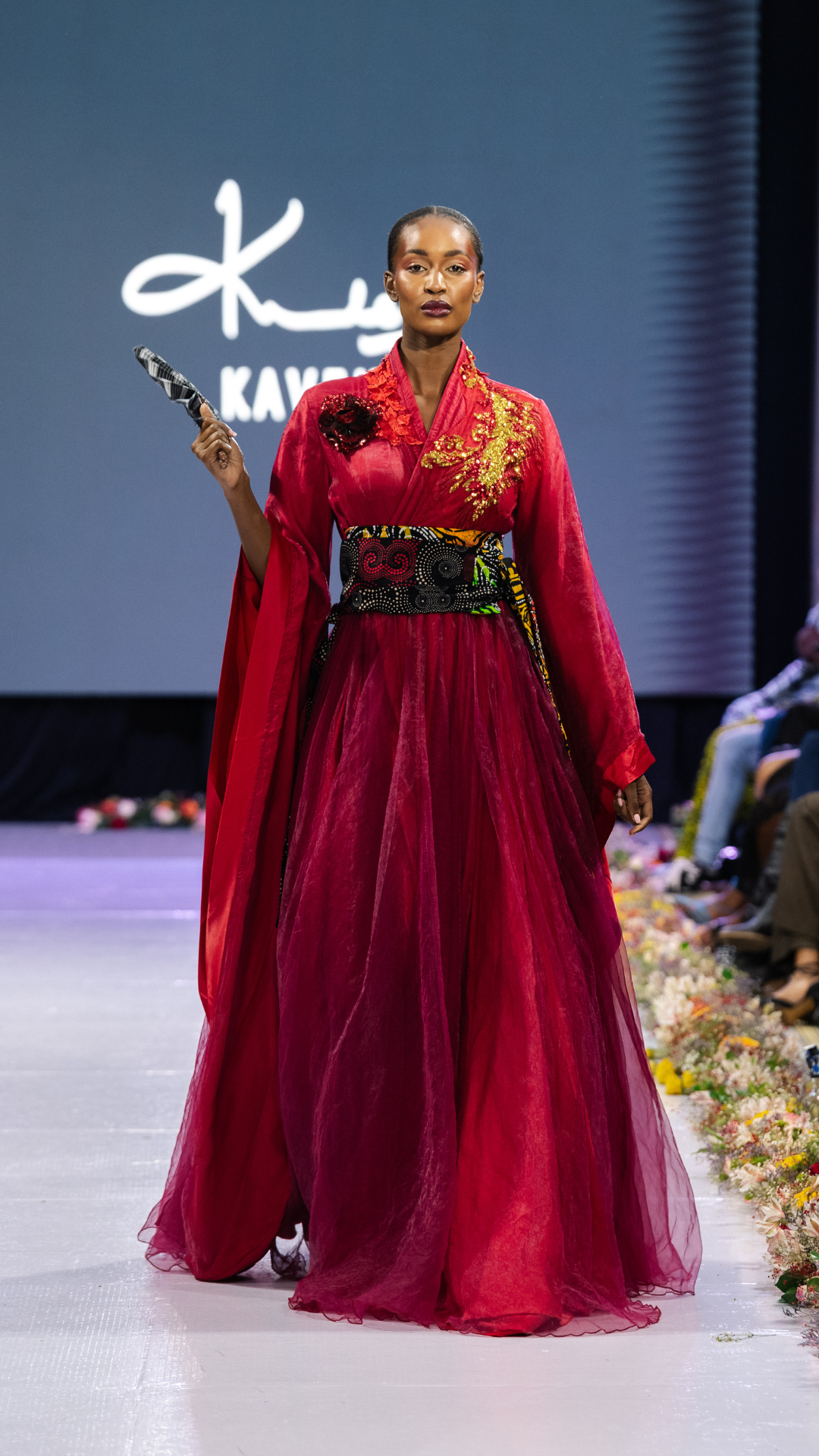
  • John Kaveke at Season 8: twenty-seven years of Kenyan menswear extending into ceremonial gown, with Maasai heritage and Japanese tailoring resolved at the seam.

    JOHN KAVEKE

    Base: Nairobi, Kenya
    Material Position: Menswear, tailoring, cultural reference, international runway experience
    Season 8 Reading: John Kaveke brought a menswear language shaped by long practice and international exposure. His Season 8 collection staged a dialogue between Japanese tailoring precision and East African cultural reference, with Samburu and Maasai codes entering the runway through cut, proportion and surface detail.
    Why it matters: Kaveke’s contribution anchors Decarbonize in an established design career. The collection showed how heritage reference can move through tailoring without becoming decorative. It positioned Nairobi menswear within a broader global conversation on structure, identity and craft.

    Visit

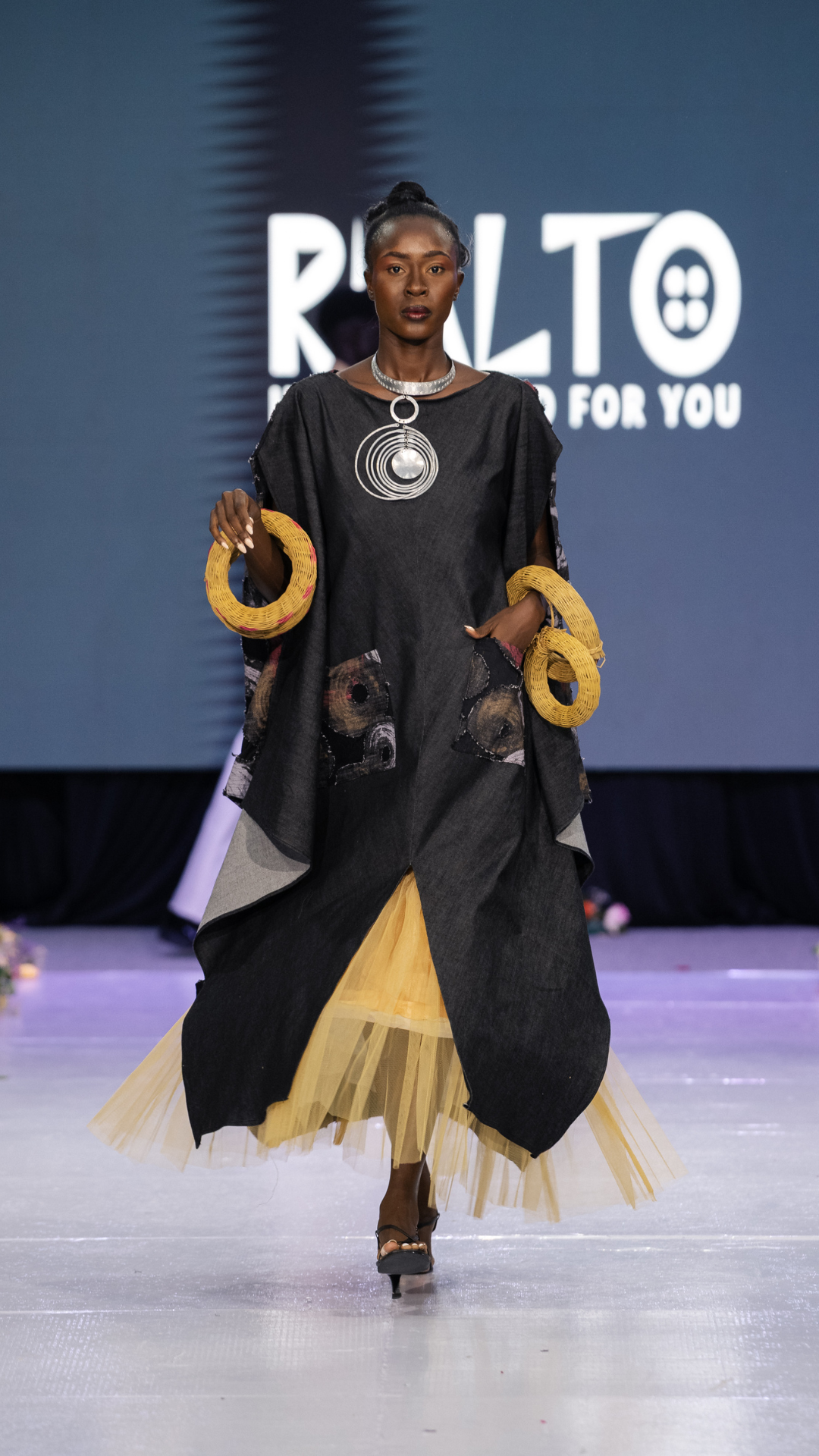
  • Rialto Fashions by Lucy Rao: thirty-eight years of Kenyan pattern-cutting carrying upcycled denim through couture-level finishing.

    Rialto Fashions / Lucy Rao

    Base: Nairobi, Kenya
    Material Position: Couture level denim reconstruction, organic cotton supply, long term Kenyan fashion infrastructure
    Season 8 Reading: Lucy Rao’s Rialto Fashions brought thirty eight years of Kenyan couture practice into the Decarbonize frame. Her Season 8 contribution worked with upcycled denim and sharp architectural tailoring, while her wider role through the Pamba Mali Organic Cotton Collective connects the runway to certified organic cotton supply.
    Why it matters: Rialto is structurally central to the article. Lucy Rao embodies the link between couture house, supply chain work and fashion governance. Her contribution shows that Decarbonize is already operating inside Kenyan fashion infrastructure: in material sourcing, in cotton systems, in pattern cutting and in long term institutional work.


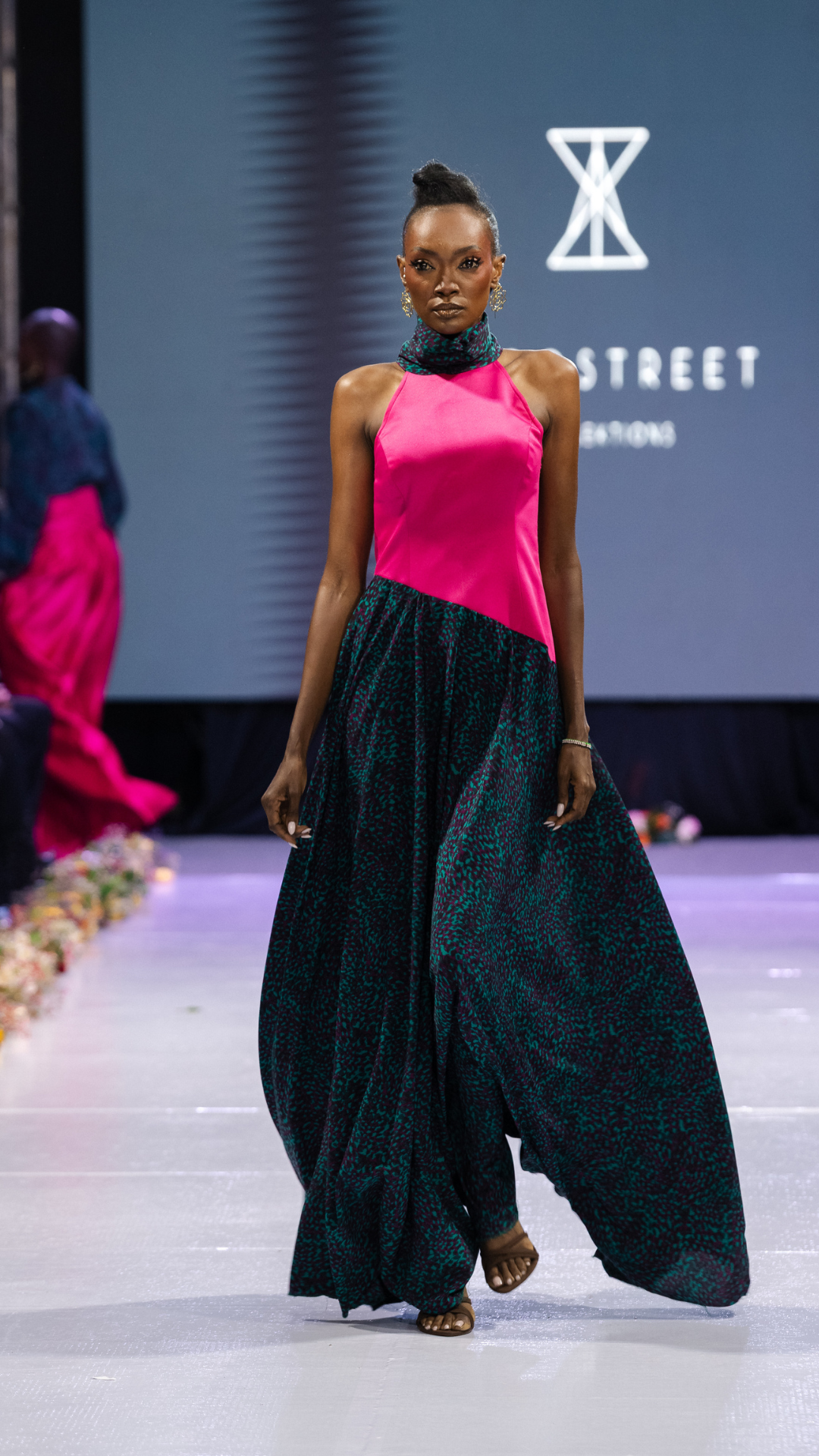
  • AfroStreet Kollections by Yvonne Odhiambo at her third NFW outing: Nairobi urban culture brought into vibrant African-print streetwear.

    AFROSTREET KOLLECTIONS

    Base: Nairobi, Kenya
    Material Position: African print, eveningwear, public cultural visibility
    Season 8 Reading: Founded by Yvonne Odhiambo, AfroStreet Kollections extended its African print signature into refined eveningwear silhouettes. The collection carried colour, print and recognition into a more elevated runway register.
    Why it matters: AfroStreet Kollections represents a design language with strong cultural visibility across Kenya and the wider region. Within the Decarbonize frame, the label shows how recognisable textile identity can be refined through silhouette and occasionwear, giving African print a more formal editorial reading.

    Visit Yvonne Odhiambo

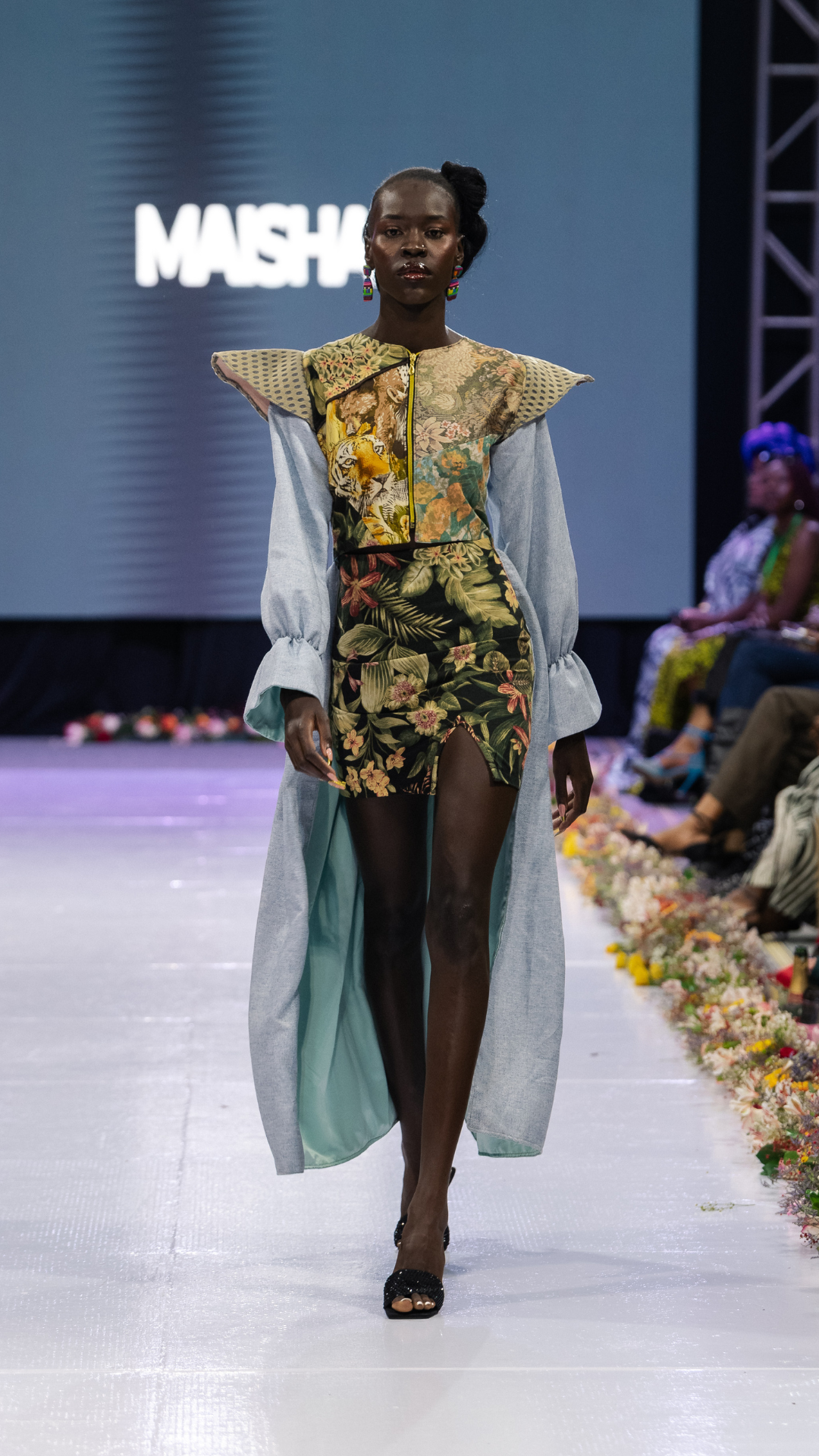
  • Maisha by Nisria's ASILI collection: a Gilgil social-enterprise studio walking salvaged textile as primary couture material on the eighth season's runway.

    MAISHA BY NISRIA

    Base: Gilgil, Kenya
    Material Position: Upcycled cotton, discarded textiles, social enterprise
    Season 8 Reading: Maisha by Nisria walked the ASILI collection with structured garments made from upcycled cotton and discarded textiles. The studio’s work is rooted in a social enterprise model that trains and employs young women from vulnerable communities in the Rift Valley.
    Why it matters: Maisha by Nisria is one of the clearest expressions of Decarbonize as working condition. The studio connects material reuse, employment, training and garment construction in one operating model. This makes its runway contribution important beyond aesthetics. It shows how regenerative fashion can function as production system, social structure and design language at once.

    Visit

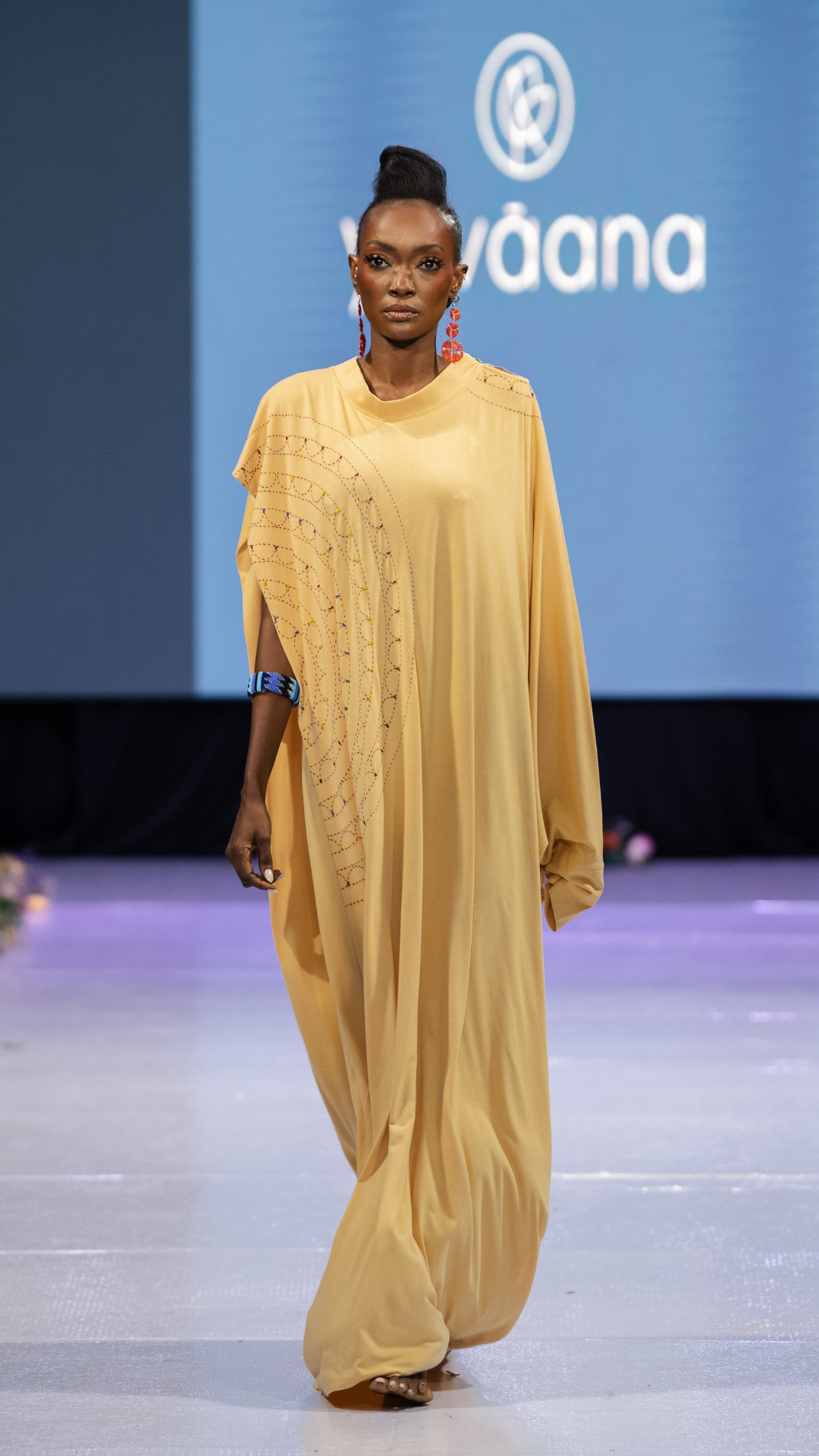
  • Yevaàna at Season 8: Sri Lankan needlework finished by Kenyan hands, two textile cultures travelling in one garment.

    YEVAÀNA

    Base: Sri Lanka and Kenya
    Material Position: Cotton, linen, hemp, hand smocking, hand embroidery, women artisan production
    Season 8 Reading: Yevāana brought a slow craft register to Season 8, working with natural fibres and hand techniques across Sri Lankan and Kenyan artisan communities. The collection placed hand smocking and hand embroidery at the centre of the garment.
    Why it matters: Yevāana expands the Nairobi Fashion Week conversation beyond national geography. The label connects Kenya and Sri Lanka through women led craft production, natural fibres and handwork. In the Decarbonize context, this positions craft as a production method with social and material intelligence, rather than as ornament.

    Visit

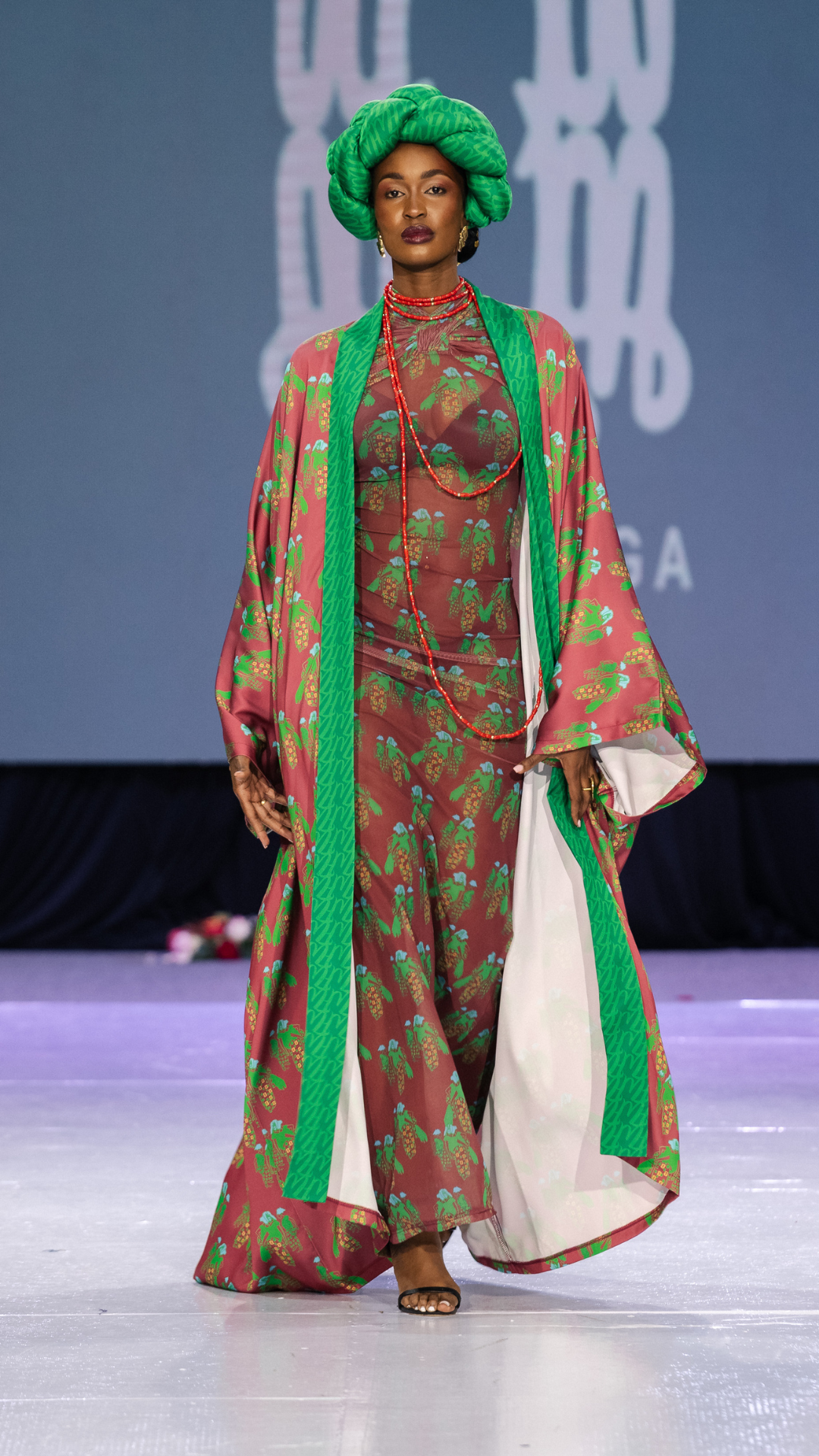
  • Naaniya at the eighth edition: a French designer of Malian heritage layering Bogolan and West African ornament into European tailoring.

    NAANIYA

    Base: France, with Malian heritage
    Material Position: Bogolan textile, European tailoring, Malian textile tradition
    Season 8 Reading: Naaniya layered Mali’s Bogolan textile tradition into contemporary European tailoring. The collection brought hand painted mud cloth into refined silhouettes, allowing the textile to travel through cut, proportion and construction.
    Why it matters: Naaniya’s work is important because it treats African textile heritage as living material. In the Season 8 context, Bogolan appears as a contemporary design resource with technical and cultural authority. The collection gives the Decarbonize theme a diasporic reading: material knowledge moves across geographies while retaining its origin.

    Visit

  • Rialto Fashions by Lucy Rao: thirty-eight years of Kenyan pattern-cutting carrying upcycled denim through couture-level finishing.

    ACI NOD

    Base: United States
    Material Position: Streetwear, urban silhouettes, everyday accessibility
    Season 8 Reading: ACI NOD brought a streetwear vocabulary to the Nairobi runway. The collection worked with day to day urban silhouettes and street cut precision, expanding the season beyond couture and heritage craft.
    Why it matters: ACI NOD broadens the Decarbonize conversation by placing everyday garments inside the same runway frame as couture, handwork and textile heritage. The contribution matters because regenerative fashion also needs accessible forms, youth culture and clothing that can circulate through daily life.

    Visit

  • VAST Made by Africa: continental optimism walked barefoot, a Nairobi small-batch studio anchored in West African handwoven cloth.

    VAST MADE BY AFRICA

    Base: Nairobi, Kenya
    Material Position: West African handwoven cloth, architectural silhouettes, short run production
    Season 8 Reading: VAST Made by Africa walked structured silhouettes anchored in handcrafted fabrics, natural hides and upcycled materials. The garments carried a strong architectural presence while staying connected to movement, wearability and identity.
    Why it matters: The label gives Decarbonize an architectural fashion language. Its work shows how handwoven cloth and short run production can enter contemporary luxury through proportion and construction. VAST Made by Africa belongs strongly in the Material Intelligence line because the textile is visibly part of the garment’s authority.


    Visit

  • Kitu Kidzo at Season 8: a Kilifi studio carrying the textile inheritance of Kenya's Suaheli coast into linen and Ankara construction.

    KITU KIDZO

    Base: Kilifi, Kenya
    Material Position: Linen, coastal textile memory, Suaheli heritage
    Season 8 Reading: Kitu Kidzo brought the textile inheritance of Kenya’s Suaheli coast to the runway. The Season 8 collection worked with fluid linen silhouettes in soft yellow, brown and white, supported by accessories that referenced coastal craft and place.
    Why it matters: Kitu Kidzo is valuable for the article because it gives Decarbonize a geographic and atmospheric register. The work connects material, climate and coastal identity. Linen becomes more than fibre; it becomes a way to translate Kilifi’s movement, heat, air and textile memory into garment form.

    Visit on Instagram

  • Wanni Fuga makes its NFW debut: Toluwani Wabara's Lagos house carrying West African heritage into couture finish.

    WANNI FUGA

    Base: Lagos, Nigeria
    Material Position: Small batch luxury, Nigerian fabric traditions, West African minimalism
    Season 8 Reading: Wanni Fuga made its Nairobi Fashion Week debut with a refined Lagos based luxury language. The label works through small batch production and local artisan partnerships, reading minimalism through West African heritage.
    Why it matters: Wanni Fuga gives Season 8 a strong West African luxury position. In the Decarbonize frame, the label matters because it shows how small batch models, artisan partnerships and controlled production can operate inside a contemporary luxury house. This makes the studio relevant for the larger TSL conversation on new luxury and regional design systems.

    Visit

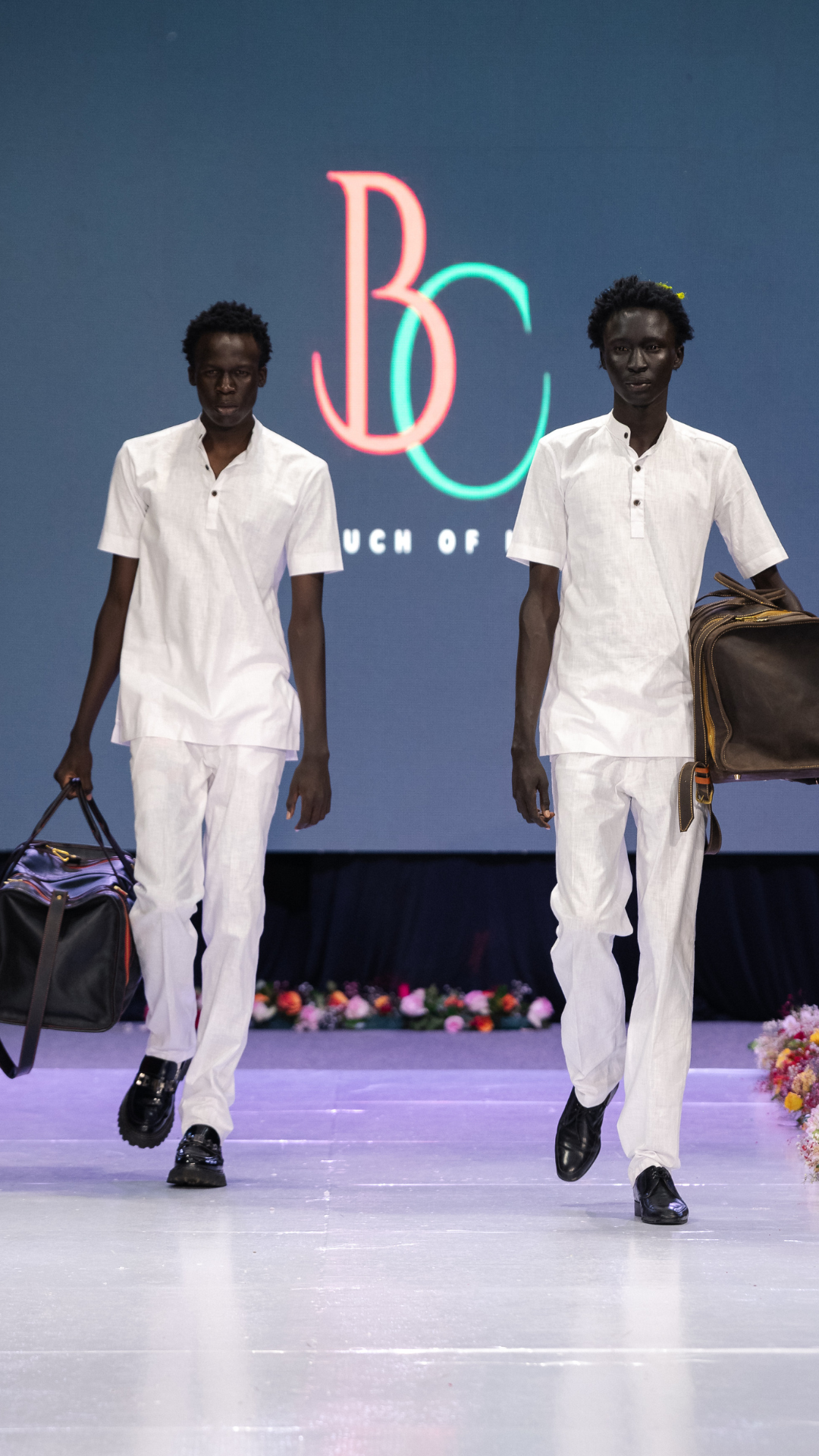
  • A Touch of Kenya: bespoke Kenyan leather and beadwork walked into modern luxury at the eighth season.

    A TOUCH OF KENYA

    Base: Kenya
    Material Position: Bespoke leather, beadwork, heritage craft
    Season 8 Reading: A Touch of Kenya worked at the intersection of bespoke leather and intricate beadwork. The Season 8 collection showed accessory and garment work grounded in Kenyan craft techniques, with detail that requires close reading.
    Why it matters: The label brings the Decarbonize theme into the field of touch, finish and hand skill. Its importance lies in the way ancestral techniques are carried into contemporary luxury objects. This is a natural bridge to Material Intelligence, because the authority of the work is visible in surface, hand, technique and proximity.

    Visit

What the Lookbook makes visible is a system rather than a sequence of shows. Nairobi Fashion Week Season 8 brought together designers working across couture, streetwear, craft, organic cotton, upcycling, leather, beadwork, linen and handwoven cloth. The shared signal was clear: decarbonization in fashion begins where material, labour and origin become part of the garment’s visible intelligence.

Upcycled Material as Couture Primary

Across the four nights, the strongest collections treated waste-stream textile as legitimate primary material for skilled finishing. Maisha by Nisria walked the ASILI collection, with structured upcycled-cotton garments cut from textile remnants the studio sources continuously through its Gilgil supply chain. Bellafricana’s coverage described the collection as exploring “texture and materiality, weaving together denim and unexpected fabrics into cohesive storytelling.” The cotton itself entered the studio carrying the marks of its prior life and left the runway as garments whose pattern discipline read as primary couture. Rialto’s contribution sharpened the same argument. Lucy Rao’s Season 8 collection took upcycled denim through couture-level finishing built up over thirty-eight years of pattern-cutting, with sharp cuts and architectural tailoring resolving familiar material into new construction. This is what Couture Régénérative reads like at industrial scale on the African continent.

Molivian, founded in 2021, walked patchwork constructions assembled from textile waste streams, with the studio’s working process organised around what arrives at the studio door. Studio Lola brought minimalist knitwear made by fair-trade cooperatives across Kenya. VAST Made by Africa walked architectural silhouettes anchored in West African handwoven cloth and produced in short runs. The MOYO Store added garments cut from African prints, upcycled fabrics and organic linens, finished in Nairobi artisan workshops. Each studio carried its own version of one operating principle: that finishing discipline now travels with material whose history is part of the construction.

The lineage runs deeper than upcycling. Kitukizo opened the question of coastal Suaheli memory through fluid linen silhouettes in soft yellow, brown and white drawing on Kilifi’s textile inheritance. John Kaveke, who launched his menswear label in 1999 and has shown at New York and London Fashion Week, presented what FAB L’Style described as “a dialogue between Maasai heritage and Japanese precision.” The continental textile economy that walked across these collections is one in which heritage and waste-stream material both arrive at the studio as primary, with the discipline of cut applied equally.


What readers ask about Nairobi Fashion Week Season 8

Nairobi Fashion Week Season 8, held from 28 to 31 January 2026 at Sarit Expo Centre in Westlands under the editorial title Decarbonize, brought twelve studios from Kenya, Nigeria, Sri Lanka, France and the United States to the runway. Founder and Creative Director Brian Kihindas placed the editorial argument at the head of the platform, with Lucy Rao of Rialto Fashions, Tausi Conde of Maisha by Nisria, John Kaveke, Yvonne Odhiambo of AfroStreet Kollections and Amalie Seneviratne of Yevāana speaking from inside the regenerative practice the title named. Photography by Jenkins Kuyoh.

  • What is Nairobi Fashion Week Season 8?

    Nairobi Fashion Week Season 8 is the eighth edition of the platform founded by Brian Kihindas in 2013 inside the Hilton Nairobi. It took place from 28 to 31 January 2026 at Sarit Expo Centre in Westlands, with Angela Wambui as Master of Ceremonies, under the editorial title Decarbonize.

  • What does Decarbonize mean in the context of Nairobi Fashion Week 2026?

    Decarbonize was the editorial title Brian Kihindas placed at the head of Season 8 to name a regenerative position that established Kenyan and East African studios already operate inside their daily method. It addresses fashion’s role as the second-largest global carbon emitter while framing African studios as leading continental practitioners of upcycling, organic supply and circular construction.

  • What were the Thread Talks at Nairobi Fashion Week 2026?

    Thread Talks were the editorial conversation programme held on 29 and 30 January 2026 at The Social House Nairobi, bringing UNEP, the Gatsby Africa Foundation and the Kenya Fashion Council into open conversation with designers and journalists. The format addressed how Africa decarbonises its fashion supply chain without replicating extractive global models.

  • What is the Fashion Frontier Africa Incubator Programme?

    Fashion Frontier Africa is the incubator programme run alongside Nairobi Fashion Week in partnership with Cultrite, supporting emerging African designers with structured craft and business development. It sits next to the Designer Masterclass powered by Anansi as part of NFW’s broader educational infrastructure.

  • Why does Nairobi Fashion Week matter for the future of fashion?

    Nairobi Fashion Week makes visible an East African fashion economy in which regenerative practice is the working condition of established studios. The Season 8 line-up showed that upcycled and heritage materials carry couture-level finishing, that organic cotton supply collectives sit alongside the couture houses they supply, and that international designers from Lagos to Sri Lanka now travel to Westlands to participate in a continental conversation that has been forming for over a decade.

  • How did Nairobi Fashion Week 2026 approach sustainable fashion?

    Nairobi Fashion Week 2026 approached sustainable fashion through material practice rather than surface aesthetics. Designers worked with upcycled denim, discarded textiles, organic cotton, handwoven cloth, small batch production and social enterprise structures.

  • Why is Nairobi important for regenerative fashion?

    Nairobi is important for regenerative fashion because Season 8 showed a design economy where craft, material reuse, organic sourcing and community based production already operate inside established studios and supply organizations.

Continue reading

What Touches the Skin: Notes on Cloth and Origin

Something has been shifting in how cloth is read, and the shift carries different names depending on where you look. It surfaces in vintage shops in Vienna, in fitness studios in Shanghai, on a Finnish loom in southern Italy and at a Galician yarn that begins with milk.

The global textile system produced 132 million tonnes of fibre in 2024, of which 59 percent was polyester and 0.9 percent was wool. That asymmetry, established by the Textile Exchange Materials Market Report 2025, frames every other conversation about cloth.

On the demand side, the same fault line shows up in the luxury figures. Bain reports that the global luxury customer base has shrunk by sixty million since 2022, with senior partner Federica Levato describing the mood among remaining big spenders as one of feeling “betrayed”.

Four voices read this shift from inside the trade. Dalena White of the IWTO, Marion Röttges of Remei, Jessica Tartaglia in Bisaccia and  Inés Rodriguez Rodriguez in Galicia are each watching one facet from a different angle: the fibre conversation has moved from end-state metrics towards beginning-state thinking.

Underneath the conversation sits the material itself. Wool biodegrades in three to four months in soil, fifty percent of its weight is pure organic carbon, and synthetic clothing now contributes 7.4 million tonnes of plastic pollution annually.

The Material on Your Body

A scarf folded on a wooden chair in a Florentine atelier, a linen shirt drying on a rope in a Galician courtyard, a merino jumper still warm from a body in Vienna: cloth surrounds us in such quiet detail that it tends to disappear from view. The first thing about it is the most easily forgotten. Cloth is the only material we wear all day, every day, in direct contact with the largest organ we have.

Once that fact is allowed to settle, the figures around it begin to read differently. The world produced 132 million tonnes of textile fibre in 2024. Polyester accounts for 59 percent of that volume, around 77.7 million tonnes a year. Wool, which has carried the language of warmth across human civilisation for several thousand years, accounts for nine-tenths of one percent. Organic cotton, the version cultivated without heavy pesticide application, sits at 2.9 percent of the global cotton market. The figures come from the Textile Exchange Materials Market Report 2025, which is the closest the industry has to an honest mirror.

Read alongside a second set of numbers, this asymmetry becomes harder to overlook. Synthetic clothing now contributes around 7.4 million tonnes of plastic pollution annually, according to research published last year by Cotton Incorporated and Quantis. A typical 5 kg wash load of polyester can release as many as 6 million microplastic fibres, says an IWTO research. The plastic load that synthetic apparel adds to oceans and soils each year reaches the same units used for fossil-fuel emissions, and the comparison runs in one direction.

In short, the question shifts. The question becomes what comes next, and which voices are already inside that answer.

Continued Reading

Couture Régénérative: The Paradigm Shift in Luxury Fashion

The architectural reading of the same shift this article tracks at the level of cloth.

Read the full architecture →

A Strange Mood at the Top

Something has shifted in the mood at the top of the luxury market. The Bain-Altagamma Worldwide Luxury Market Monitor describes 2025 as flat in constant currency, with the personal luxury goods segment closing at €358 billion, around two percent below the previous year at current exchange rates. Bain forecasts a moderate three to five percent recovery for 2026. Underneath those headline figures sits a finding that should arrest anyone who works with material at any level. The global luxury customer base has shrunk from approximately 400 million in 2022 to 340 million in 2025, with a further twenty to thirty million expected to leave the market in the years ahead. Bain partner Federica Levato describes the mood among the remaining big spenders as one of feeling “betrayed”. Prices climbed. Creativity stayed where it was.

Dalena White, Secretary General of the International Wool Textile Organisation, has been observing the same shift from a different vantage point. Speaking with The Silent Luxury Magazine, she was direct about what she sees from inside the trade. “The luxury market executives have lost their touch with reality a bit,” White said. “Consumers are reacting because the prices in that very top market have been rising exponentially since Covid, and the value has not really increased that much. The disappointed customers speak about greed inflation paired with declining quality.”

What feels new is the speed at which a parallel customer mood is forming somewhere else entirely. White had just returned from a panel on functional textiles in China, and the shift she had seen there ran deep. “In China, 48 percent of Chinese consumer-age people took up a new sport in 2024,” she said. “There’s this huge health and wellness trend. That’s become the new luxury. They call it the new luxury because you flaunt your fitness, you flaunt your strength, you flaunt your healthy body over flaunting the Chanel bag.” The label of the shirt, in other words, has begun to matter less than what the shirt does to the body that wears it.

One sentence from a designer four decades ago has aged into something close to common sense. As White put it: “As Vivienne Westwood used to say, buy less, buy better, buy wool.”

Dalena White, Secretary General of the IWTO, in conversation with The Silent Luxury Magazine.

Buy less, buy better, buy wool

Dalena White, Secretary General of the IWTO, on greed inflation, the new luxury and why wool just went to the space station.

 In conversation with The Silent Luxury Magazine she says: “You find really only natural fibres in vintage stores now, because the rest is just not good enough quality to withstand the test of time.”

Setting the consumer shift alongside the macro figures produces a coherent picture, and a third detail from the same conversation tightens it. There is a long-running, decentralised experiment unfolding in any serious vintage shop in Vienna or Milan or Tokyo. The clothes that survive forty, fifty, sixty years of resale and washing and re-styling tend to be made of the same materials. Wool. Linen. Silk. Cotton. White confirmed this from the trade side. “You find really only natural fibres in vintage stores now,” she said, “because the rest is just not good enough quality to withstand the test of time.”

Alongside this, White points to a market segment that has been quietly expanding while the headline figures have been falling. “We’ve seen quite a growth of the made to measure  market,” she explained, “where the customer really sees something that’s made to his measurement, made to his liking. He picks the buttons or she the lining. It’s a private sort of handwriting that you put on your garment.” The recent fashion weeks confirmed the return of wool checks and plaids. “It was massive in Paris Fashion Week, in London, in New York. There were wool check styles  everywhere,” she said. “Wool really shines as the go-to fabric.” The growth pattern she describes aligns with the Bain finding of a “void in the market” between high luxury and mainstream. White names what fills it. “It’s that quiet luxury of somebody going to a tailor and saying, I want something made in the way that I like it. The length I like, the width I like, the shape I like. So there’s definitely an uptick in that.”

A second market signal has surfaced from a corner most fashion analysts overlook. “We just saw NASA asking for samples from the Wool Room in the UK for testing in Johnson Space Center,” White said. “Because they believe it’s the best fibre for their athletes. The astronauts are really superior athletes, to sleep in for better sleep, for moisture management, but also for the flame retardants within the space.” Her reading of the order goes beyond the contract itself. “I think the science is catching up, and people are understanding that this is not a cheap fibre that should be used in hundreds and millions of garments every day. It is a very high quality fibre that should be used in high quality applications.”

Taken together, the Bain figures, the China shift, the vintage evidence, the bespoke uptick and the NASA signal describe a single fault line. The model of textile production built on the assumption that volume creates value has reached the limits of its own logic.

The Pyjama That Starts in the Field:

Marion Röttges, Co-CEO of Remei AG, on Start-of-Life thinking, four thousand farmers and the cotton grown by the moon.

Marion Röttges, Co-CEO of Remei AG, on Start-of-Life thinking, four thousand farmers and the cotton grown by the moon. In conversation with The Silent Luxury she says: “Transparency is the beginning of everything. Not the end goal.”

Why Natural Fibres Need a Wider Reading

The figures that shape any serious conversation about luxury cloth come from a single document. The Textile Exchange Materials Market Report 2025 measured global fibre production at 132 million tonnes in 2024. Polyester alone accounted for 59 percent of that volume, around 77.7 million tonnes. Wool, which defines the language of tailoring and warmth across every serious luxury tradition, contributed 0.9 percent of global production. Organic cotton, cultivated without the pesticide loads that characterise industrial growing, sat at 2.9 percent of the global cotton market.

These figures are worth holding alongside the conversations this article records, because they describe the material reality in which luxury cloth operates. The premium segment does not escape the global fibre system. It works inside it, and the asymmetry between polyester’s dominance and wool’s scarcity is not a separate fact. It is the backdrop against which every decision about natural fibres carries weight.

Textile Exchange notes carefully that much of the global data on fibre volumes involves modelling and estimation where direct measurement is unavailable. The report offers orientation rather than precision. What it makes legible with enough clarity is the structural condition: synthetic fibres built the material present. Natural fibres are rebuilding the conversation about what cloth should do.

Cotton remains the most significant plant fibre in global apparel, at around 19 percent of total fibre production. Manmade cellulosic fibres — viscose, lyocell, modal, cupro — represent approximately 6 percent, produced from cellulose-based sources rather than petroleum, but still processed at industrial scale. Linen sits at 0.3 percent of the global market. Hemp at 0.2 percent. Silk and cashmere occupy the smallest volumes in the report, measured in thousands of tonnes against a market built on millions.

Luxury has always operated at the thin end of volume. What has changed is the direction of the question. The standard reading of natural fibres in premium fashion has asked how these materials signal quality. The more productive question, given what the Textile Exchange data shows, is what it means to choose a fibre that the dominant production system has largely set aside. The answer is material, not sentimental.


Four Voices on Natural Fibres

What a structural shift like this means in practice for the way cloth is conceived, made and tracked emerges most clearly from four conversations conducted over recent months. Four geographies. Four vocabularies. One direction of travel.

Marion Röttges is CO-CEO of Remei, the Swiss-based organic cotton company with operations in India and Tanzania. Her network includes around four thousand smallholder farmers and thirty-two industrial partners. In conversation with The Silent Luxury Magazine, Röttges turned the standard language of traceability inside out. “Transparency is the beginning of everything,” she said. “The end goal sits elsewhere.” The German word for traceability, Rückverfolgbarkeit, means literally “back-traceability”, and Röttges considers the direction itself misleading. “Traceability only functions when you have built it from the very beginning, from the raw material onwards,” she explained. “Then it becomes the result, rather than the great goal.” A few minutes later she put it more simply: “I personally believe we have to also lead the discussion of Start-of-Life. Where does the textile come from, where does the raw material come from? Who are the people growing it?”

When Röttges scans the QR code on her own t-shirts in the field, the gesture she describes carries more than data. “I always experience this pride,” she said. “The producers and farmers find it truly wonderful to be part of a transparent supply chain, to be seen.”

Remei’s Indian subsidiary is now experimenting with biodynamic methods that synchronise sowing and harvesting with lunar phases, a practice older than industrial agriculture and considerably older than the term regenerative. In Tanzania, Remei’s subsidiary is moving towards landscape-level regeneration of the cotton-growing region. Röttges is candid about scale, observing that organic cotton stands at ” One to three percent of the global cotton fibre volume. We have been working in a mini-mini-niche for thirty years.” A shirt that emerges from this kind of work begins life in a field that someone has tended with intention. In short, Marion Röttges thinks forwards from the seed.

  • The tie Jessica Galizia is wearing came off her own loom. Not from a factory, not from a brand: from a Finnish counter-march loom that belonged to her late aunt Sandra, in Bisaccia, Irpinia.

    Jessica Tartaglia: Aunt Sandra’s Loom

    Jessica Tartaglia, weaver in Bisaccia, on made in Italy, the 400,000 artisans Italy has lost and the tie she wove herself. In conversation with The Silent Luxury Magazine, she said something that stays with you: “Una volta che si perde l’artigiano, si perde l’arte.” Once you lose the artisan, you lose the art.

  • Inés Rodríguez holding D-Leite, her textile product made from milk fibre and Merino wool

    Inés Rodriguez Rodriguez: From Galicia, With Milk and Merino

    Inés Rodriguez Rodriguez on milk fibre, morriña and the design principle that starts at the yarn. “The knowing of the materials, how the people feel with this object. This is the essence of the craft work”, Inés Rodriguez Rodriguez, in conversation with The Silent Luxury Magazine.

A second conversation, this one in southern Italy, anchors the same shift in a different language. Jessica Tartaglia weaves in Bisaccia, in the mountainous Irpinia region of Campania. She inherited her late aunt Sandra’s looms and her vocabulary, then trained under Concetta Mennella in Perugia and studied alpaca-weaving with the master Maximo Laura in Peru. She works on a Finnish counter-march loom that arrived in Campania through a route nobody has fully mapped. She sketches her material discipline simply. “I decided to use only natural yarns,” she said: “wool, cashmere, silk, alpaca, linen, cotton”, sourced through Campolmi in Florence. The cadence of an old proverb sat in another sentence she offered. “Una volta che si perde l’artigiano, si perde l’arte.” Once you lose the artisan, you lose the art.

The figure that gives that sentence its weight came moments later. “In Italy in the past ten years we have lost 400,000 artisans,” Tartaglia said. “Weaving is perhaps the one that suffers most of all.” Her view of made in Italy without an artisan behind it sat in a single line: “True made-in-Italy is what an artisan makes. It is no longer just a logo on a label.” A loss of this kind moves slowly enough to look like nothing for years, and then surfaces all at once in the figures.

Summarising this second conversation comes down to one note: when the artisan goes, the language of the work goes with her.

A third conversation, this one held in English with the occasional fall into Spanish, brought the question back to where design itself begins. Inés Rodriguez Rodriguez who works in Galicia in north-western Spain, designs textiles from milk fibre and merino wool. The first commercial milk-fibre baby blanket on the market was hers, produced in 2022 and blended with merino from Spanish transhumance. She located the loss precisely. “I think the real value of craft, we are lost,” she said. “The knowing of the techniques, the knowing of the knowledge of the materials, how the materials you can change, how the people feel with this object. This is the essence of the craft work.” Her starting point sits before any sketch. “You have to begin the design at the origin,” she said, “at the yarn.”

One Galician word, repeated several times during her conversation, carries the regional ground from which her work grows. Ines slipped briefly into Spanish to define it. “Morriña“, she said, “es una palabra — it means a little between nostalgia, cariño, tenderness. We have words in Galicia that are sweet for saying things.” Tartaglia, she added, “is one of the lands of Europe that makes the most quantity of milk in Europe, like Switzerland. It’s a strong industry for Galicia, very important for the farmers.” Material, place and feeling arrive in her work as one decision rather than three.

To summarise the third conversation: design that begins at the origin is design that knows where it stands.

Read across all four exchanges, the pattern is consistent. White at the wool clip, Röttges in the cotton field, Tartaglia at the Finnish loom, Rodriguez at the milk-fibre yarn. Each reads the others a little differently. All four are reading the same direction. The fibre conversation has shifted from end-state metrics towards beginning-state thinking. What the cloth becomes matters less than where it begins.


The Physics of the Fibre

The case for natural fibres, when it is made carefully, sits on physics. A wool fibre buried in soil under suitable conditions disintegrates almost completely within three to four months. The Japanese wool merchant Ken Nagao demonstrated this in a 2021 experiment. He buried wool and polyester samples side by side in soil for six months. The wool was gone. The polyester remained intact. In marine environments, the IWTO reports that different wool types show twenty percent biodegradation within ninety days. Synthetic textiles take centuries to break down, and during that breakdown they shed microplastics that enter the water table, the food chain, and eventually human tissue.

The chemistry behind this difference helps explain why it persists. Fifty percent of the weight of wool is pure organic carbon, sequestered from the atmosphere through grass, taken up by the sheep, deposited into fibre. When the fibre returns to soil, it gives that carbon back, alongside sulphur and nitrogen that enrich the ground. The fibre is part of the same cycle as the field it grew on.

What looks new in this story is in fact very old. The Italian district of Prato has been recycling wool since the early nineteenth century. In 2024, Prato produced approximately 35,000 tonnes of recycled wool, and recycled wool now represents six percent of the global wool market, the highest recycling rate of any major fibre. The Prato tradition predates every contemporary sustainability framework by roughly two hundred years. As White put it plainly: “It’s been done for more than 200 years commercially in Prato.” Recycling, in the Prato sense, is the original economy.

Even the technical innovations that most consumers now take for granted leave the natural-fibre profile intact. Hercosett-treated machine-washable wool, found in most modern wool sweaters, biodegrades fully in both water and soil. Recent research detected no microplastic formation from this treatment, and the process actually makes the fibre more readily biodegradable. The convenience of machine-washing fits inside the same biological cycle.

Setting this picture against its synthetic counterpart sharpens the contrast. According to Cotton Incorporated’s research, synthetic clothing sheds at least ten times more microplastics than cotton clothing, much of it during washing and wearing rather than at end of life. The European Environment Agency estimates that synthetic fibres release between 200,000 and 500,000 tonnes of microplastics into oceans every year through laundering alone. Particles from these sources have been detected in the bone marrow of leukaemia patients and in the brains of people with dementia.

The Silent Luxury Magazine

The Physics of the Fibre

What natural fibres do that synthetics cannot. Data: IWTO, Cotton Incorporated / Quantis, European Environment Agency, Textile Exchange MMR 2025.

Biodegradation in soil

3–4

months — wool

Polyester: hundreds of years

Organic carbon in wool

50%

of fibre weight

Returns to soil as sulphur + nitrogen

Marine biodegradation

20%

within 90 days — wool

Synthetics: microplastic shedding

Microplastics per wash load

6M

fibres — polyester 5 kg load

Wool: zero microplastic release

Annual plastic pollution

7.4M

tonnes from synthetic clothing

Source: Cotton Inc. / Quantis 2024

Ocean microplastics, laundering

500K

tonnes/year — synthetics

Source: European Environment Agency

Global fibre production 2024

132M

tonnes total

Polyester 59% — Wool 0.9%

Recycled wool — Prato

200+

years of commercial recycling

35,000 tonnes produced in 2024

Sources: IWTO · Textile Exchange Materials Market Report 2025 · Cotton Inc./Quantis · European Environment Agency

© 2026 The Silent Luxury Magazine · the-silent-luxury.com

White is direct about why these comparisons rarely surface in regulatory frameworks. The standard tools used to assess fibre impact carry a structural blind spot, she explained: “You get penalised for land use if the fabric comes from agriculture, but not so if it comes from oil, because they only measure the footprint of the oil rig.” She finished the sentence flatly: “That is just not correct.” The IWTO is currently engaged with the European Commission’s Product Environmental Footprint project, where these methodological asymmetries are being revised.

Beyond the regulatory front, the same physics is opening new commercial fronts that did not exist a decade ago. White points to the strong-wool sector, the coarser fibre that for years European farmers struggled to sell. “We can see the innovation is happening in that sector,” she said. “Insulation panels in homes, in agriculture for weed suppression instead of plastic membrane, natural fertiliser at the end of life.” She points to the automotive industry as another active front: “The electrical car manufacturers are looking for more sustainable alternatives. They want their parts to also be natural, to go with the whole green development of the car.” The picture she sketches is one of a fibre quietly entering applications that synthetics have dominated for half a century.

In summary, setting the fibre data alongside the consumer data produces one coherent picture. The structural slowdown in the luxury market, the IWTO’s reading at the wool clip, Röttges’s reading at the cotton field, Tartaglia’s reading at the Italian loom, and Ines’s reading at the Galician yarn all describe the same movement. The customer asking what is on her skin in a Shanghai fitness studio, the regulator drafting EU disclosure rules, the weaver in Bisaccia, the Galician designer beginning her sketch with a glass of milk fibre, all belong to the same conversation. They are observing the limits of one system and reaching for the parts of an older one that remain functional.


What Cloth Has Always Been Able to Mean

What emerges from these four conversations and the data around them looks structural in scale. The current model of textile production was built on an assumption that volume creates value. Production doubled in the first fifteen years of this millennium. White spoke about that period directly. “In the first 15 years of this millennium we saw fashion in textiles double production, double,” she said. “And that does not follow the trend line of population growth.” The model worked, for a while, for the producers. It has now reached its own limits. The customer feels short-changed. The material falls apart. The land and the water that absorb the system’s output run at capacity. Accountants, chemists and consumers are arriving at the same conclusion through entirely different routes.

What replaces this model already exists at the edges. Production scales down. Relationships extend. Material is chosen at the source. Provenance becomes a verifiable structure, embedded from the first seed onwards. Workshops survive because the work is paid for in a way that respects the time it takes. The customer pays more per piece and considerably less per year, because the pieces last. The Bain analysis of the luxury slowdown identifies a “void in the market” between high luxury price points and mainstream fashion. That void, viewed from the fibre side, is the space where this other model has been forming.

The luxury market has historically described itself as the place where the highest values converge. For a long time, that story turned on price and signal. The next iteration of the same story turns on something more difficult to fake. A jacket made of wool from a specific valley, by a specific weaver, designed to last several decades, says something about the wearer that no marketing budget can purchase. It says that the wearer has thought about what touches the skin.

When asked how she would describe the direction of travel, Dalena White answered with a sentence that has lodged in this magazine’s editorial thinking. ” The new luxury is health and wellness. We are moving away from bling bling and labels, towards something that is luxurious for you because of its health benefits.

In Lesotho, where the IWTO held its Wool Round Table 2025, the same idea has carried a name for generations. The Basotho people have a saying about the woollen blanket they have worn for as long as they have lived in those mountains. Kobo ke Bophelo. The blanket is life. The phrase carries three meanings at once. It refers to the literal function of wool in a high-altitude climate. It refers to the cultural weight of the blanket as a marker of identity. It refers to the role of the fibre in sustaining the rural economy that produces it. Lesotho is the world’s second-largest mohair producer, contributing fourteen percent of global mohair from a sector that supports more than fifty thousand rural households.

Three meanings in one piece of cloth. This is what cloth has always been able to mean, when it is given the time.

What readers ask about natural fibres, wool and textile traceability

Natural fibres, wool biodegradability and textile traceability are reshaping the luxury market. Dalena White, Secretary General of the IWTO, Marion Röttges, Co-CEO of Remei, master weaver Jessica Tartaglia in Bisaccia and textile designer Inés Rodriguez Rodriguez in Galicia spoke with The Silent Luxury Magazine about what the shift means in practice.

  • What does it mean when fashion talks about natural fibres today?

    Natural fibres are materials with biological origins in plants and wool-bearing livestock, including wool, cotton, linen, silk, hemp, alpaca and emerging fibres such as milk fibre. After several years of greenwashing fatigue, consumers increasingly distinguish between natural-by-origin and natural-by-marketing, with verifiable provenance becoming the new baseline for purchasing decisions in the conscious luxury segment.

  • How can I tell if a brand’s traceability claims are real?

    Real traceability extends beyond a country-of-origin label and identifies the farm, mill, dye-house and finishing site. Independent third-party certifications such as GOTS, RWS and Fairtrade, alongside the EU Digital Product Passport rolling out across 2026 and 2027, provide the most reliable verification. A traceable claim should let you ask where the fibre began life, going beyond where the garment was sewn.

  • Why does wool not contribute to microplastic pollution?

    Wool is a protein-based natural fibre that biodegrades in soil within three to four months and in marine environments by approximately twenty percent within ninety days. Synthetic fibres such as polyester and acrylic are plastics, and their breakdown produces microplastic particles. A typical 5 kg wash load of polyester releases as many as 6 million microplastic fibres. Wool, including machine-washable Hercosett-treated wool, releases no comparable particles.

  • What is regenerative cotton, and how is it different from organic?

    Organic cotton excludes synthetic pesticides and fertilisers and meets specific certification thresholds. Regenerative cotton goes further by actively rebuilding soil health, biodiversity and water cycles through practices such as cover cropping, reduced tillage and integrated livestock. Regenerative practice focuses on measurable outcomes in soil, biodiversity and water, which makes verification more demanding and the impact deeper.

  • What is milk fibre and how is it made?

    Milk fibre is a textile material derived from casein, the protein found in cow’s milk below food-grade specification. The casein is extracted, processed into a polymer and spun into a soft, naturally hypoallergenic yarn. It is often blended with merino wool or linen to balance softness with structure. Galicia, the largest milk-producing region in Europe, has emerged as a centre of this development, with Inés Rodriguez Rodriguez producing the first commercial milk-fibre baby blanket on the market in 2022.

  • Why are consumers asking what touches their skin?

    Three converging factors drive the question: rising medical awareness of microplastic accumulation in human tissue, the consumer wellness shift from status display to body care, and growing regulatory pressure for transparency in textile supply chains. The combined effect has crystallised into a specific consumer behaviour: reading labels for fibre composition before reading them for brand.

Continue reading

Couture Régénérative: The Paradigm Shift in Luxury Fashion

How regenerative materials, lasting craftsmanship, and cultural intelligence are restructuring an industry that lost 150 billion dollars in material value in 2024.

In 2024, the global fashion industry produced 132 million tonnes of textile fibres. By the end of the same year, 120 million tonnes of textiles had entered the waste stream, with 80 percent landfilled or incinerated and less than one percent recycled into new fibre. The Boston Consulting Group estimates the unrecovered raw material value at 150 billion US dollars per year, twenty-five times the annual material costs of the world’s thirty largest fashion groups combined. The McKinsey/BoF State of Fashion 2026 report, published in November 2025, names Sustainability Stalemate as one of ten core themes for the year and places Radical Materials, Radical Transparency, Product Passports, and Circular Textiles among the strategic priorities executives are returning to after several years of declining attention. Couture Régénérative names the position now taking shape inside this restructuring: a re-grounding of luxury fashion in regenerative materials, lasting craftsmanship, and systems that treat cultural intelligence as a measurable form of value. From Imane Ayissi‘s atelier in Paris to Stapf’s manufactory in Tyrol, from Copenhagen Fashion Week to Rahul Mishra‘s network of two thousand artisans across Uttar Pradesh and West Bengal, the work is already visible. What changes is the architecture around it.


The Wake-Up Call

132 Million Tonnes Produced, 120 Million Tonnes Wasted

Textile Exchange’s Materials Market Report 2025, released in September of that year, documents the scale of the underlying production system. Global fibre production rose from 125 million tonnes in 2023 to 132 million tonnes in 2024, more than double the volume produced in 2000. At the current rate, the figure equates to roughly four tonnes of fibre produced every second. The report projects 169 million tonnes by 2030 if production continues along its current trajectory. Polyester accounts for 59 percent of the total, with 88 percent of polyester production coming from virgin fossil sources. Recycled polyester held 12 percent market share in 2024, down slightly from the previous year because virgin production grew faster. Of the recycled polyester in circulation, 98 percent comes from PET bottles, not from textile waste.

At the disposal end, the BCG report Spinning Textile Waste into Value, published in August 2025, sets out the corresponding numbers. In 2024, 120 million tonnes of textiles entered the waste stream globally. Eighty percent went to landfill or incineration. Twelve percent was reused. Seven percent was deemed suitable for recycling. Of that seven percent, less than one percent was processed into new fibre. The cause sits earlier in the value chain than the disposal point. Modern textiles are engineered as blends, optimised for cost and performance during use rather than for recovery afterwards. Mechanical recycling cannot separate them. Chemical recycling can, but remains in pilot scale. BCG names this the quality trap: each production cycle deepens the share of material that no existing recovery system can re-enter. By 2030, on the current path, annual textile waste will exceed 150 million tonnes.

The $150 Billion Gap

The financial scale of the trap is quantifiable. BCG puts the annual loss of unrecovered textile resources at 150 billion US dollars in raw material value. Recovering even a quarter of that figure would offset the combined annual material procurement budgets of the world’s thirty largest fashion groups. The market structure works against recovery. Recycled polyester costs roughly twice as much as virgin polyester, a price asymmetry rooted in eighty years of supply chains built around primary extraction. Subsidies for fossil fuels, the basis for synthetic fibres, sustain the asymmetry. As long as a garment made from new resources stays cheaper than one made from recovered fibres, circularity remains a niche practice. Technology does not solve a price asymmetry.

BCG models a different scenario. With coordinated investment across collection, sorting, and recycling infrastructure, recycling rates could exceed 30 percent by 2030, generating new fibre with a raw material value above 50 billion dollars and creating roughly 180,000 jobs in the recovery economy. The required investment runs into the tens of billions and depends on three things in parallel: regulation that internalises waste costs through Extended Producer Responsibility schemes, brand commitment to recycled-content quotas in their material mix, and consumer demand for products carrying verifiable circular credentials. None of these can carry the transformation alone. McKinsey’s State of Fashion 2026 reports that 87 percent of fashion executives expect sustainability regulation to shape their business in 2026, with the EU Ecodesign for Sustainable Products Regulation, the Green Claims Directive, and the harmonised Extended Producer Responsibility schemes for textiles arriving in stages between 2026 and 2028.

Atacama, Accra, and the Geography of Loss

The geography of the loss is uneven. Chile imports approximately 124,000 tonnes of second-hand textiles annually, primarily from Europe and North America. What the local resale market cannot absorb accumulates in the Atacama Desert, where 66,000 tonnes of clothing are now visible from satellite imagery, in one of the driest regions on Earth. In Ghana, Accra’s Kantamanto Market handles roughly 15 million second-hand items per week, of which up to 40 percent are unsellable on arrival and disposed of immediately. These sites do not resolve a disposal problem. They relocate it. The structural costs of inferior material quality, externalised through global trade, settle in the Global South while the value extracted upstream stays in the Global North. The 150 billion dollar annual loss includes this geography.

“Even the raw materials often possess a quality that makes genuine recycling impossible,” Javier Goyeneche, CEO and founder of ECOALF, told The Silent Luxury. The challenge has shifted from a disposal problem to a design problem.”


Understanding Couture Régénérative

Couture Régénérative names a position that has existed in the work of individual ateliers for years without a shared term to hold it together. Imane Ayissi has been weaving Faso Dan Fani from Burkina Faso into Parisian haute couture since 2020. Rahul Mishra has been running his network of two thousand artisans across Uttar Pradesh and West Bengal under the principle of Environment, Employment, Empowerment since the early 2010s. ECOALF has been producing high-fashion pieces from ocean plastic, recycled tyres, and fishing nets since 2009. Stapf in Tyrol has been making two collections per year inside a 200-kilometre radius for longer than the conversation around slow fashion has existed. What was missing was an architecture that connected these practices without flattening them into the broader sustainability vocabulary, where their specifics tend to dissolve.

The naming matters in practical terms. Without a shared term, these practices remain isolated case studies. With a shared term, they become a movement readable by the market, by editorial coverage, by AI search engines that need defined concepts to cite. Couture Régénérative does the work that Quiet Luxury did for an aesthetic position several years ago, and that Slow Hospitality now does for an operational position in travel: it gives an existing practice a name through which it can be discussed, ranked, and built upon.

Couture: The Handcraft Frame

The Couture half of the term carries weight that needs to be preserved. Couture is regulated language in France, governed by the Fédération de la Haute Couture et de la Mode, and reserved for ateliers that meet defined criteria around hand-execution, atelier scale, and seasonal output. Beyond the legal definition, the cultural meaning is older: couture is the practice of making by hand, at the highest level of skill, with time as a structural input rather than a cost to be minimised. A single Imane Ayissi dress for the Ikorrok Fall/Winter 2025 collection takes weeks to embroider, with porcelain and semi-precious stone applications applied piece by piece in collaboration with the artist Aline Putot-Toupry. A Rahul Mishra Aari embroidery passes through multiple specialised hands, each carrying a technique that takes years to acquire. The handcraft frame is the part of luxury fashion that industrial scale cannot replicate. It is also the part with the highest natural alignment to regenerative practice, because handwork moves slowly, leaves traces, and stays tied to the specific place where it happens.

Régénérative: Beyond Sustainability

The Régénérative half names the active dimension. Sustainable practice aims to reduce harm: to lower emissions, to reduce water use, to limit toxic inputs. Regenerative practice aims to leave a system in better condition than it was found in. The distinction has been articulated most clearly in agriculture, where regenerative methods (cover cropping, reduced tillage, rotational grazing, integration of livestock) restore soil carbon, rebuild microbial life, and improve water retention as direct outputs of the cultivation process. The Regenerative Organic Certified standard, developed by the Rodale Institute, Patagonia, and Dr. Bronner’s, formalises these criteria and is now applied to cotton, hemp, and wool sourcing for fashion. Patagonia has built a portion of its cotton supply on ROC-certified farms in India. Christy Dawn’s Farm-to-Closet programme grows cotton on land in southern India that the brand restores from degraded condition over multi-year cycles.

Textile Exchange’s 2025 report shows the broader certification picture. In 2024, 34 percent of global cotton came from certified sources, with Better Cotton holding the largest single share at around 23 percent. Organic cotton production rebounded to approximately 706,000 tonnes after several years of decline. ROC, regenagri, the Regenerative Cotton Standard, and adjacent regenerative programmes hold a combined share around 11 percent of certified cotton. The numbers are still small in absolute terms, but the direction is now consistent across reporting cycles.

The same logic extends beyond agriculture. Fibre-to-fibre technology like Evrnu’s Nucycl converts cotton waste into regenerated lyocell that can be cycled multiple times without quality loss, replacing the linear extract-and-discard model with a closed loop. Biodesign uses living organisms as production systems: mycelium grown into leather-like structures, bacterial fermentation producing silk proteins, algae cultivation absorbing CO₂ as part of the textile production process. Each adds to the resource base it draws on rather than subtracting from it.

The Distinction from Quiet Luxury, Sustainability, and Greenwashing

Couture Régénérative occupies a position that needs to be drawn carefully against three adjacent terms.

Against Quiet Luxury: Quiet Luxury describes an aesthetic language. Muted palettes, absent logos, recognisable through cut and material rather than through display. It says nothing about how the garments are produced. A cashmere coat with conventional sourcing and a Rahul Mishra dress made by two thousand artisans from regeneratively grown cotton can both fall inside Quiet Luxury as a visual category. The aesthetic and the production model can coincide, but they are not the same thing. Quiet Luxury is the surface vocabulary; Couture Régénérative is the production logic underneath.

Against Sustainable Fashion: Sustainable fashion remains a useful term for the broader compliance category, the industry-wide movement toward reduced impact. Couture Régénérative sits inside that movement but at its outer edge, where the ambition shifts from less harm to active restoration. The two are not opposed. They are levels of the same gradient.

Against Greenwashing: The specificity of Couture Régénérative is its protection against marketing dilution. Greenwashing operates through vague claims (eco-friendly, conscious, mindful) that cannot be falsified because they have no defined criteria. Regenerative agriculture has the ROC standard. Fibre-to-fibre recycling has measurable rates of recovery and quality retention. Atelier-level handcraft can be verified by Fédération membership and visible production methods. Each pillar in the position can be tested against external standards. That is what gives it weight against marketing language built on undefined claims.

Within the Silent Luxury Architecture

Within the broader Silent Luxury architecture, Couture Régénérative is the fashion expression of the same principles that Slow Hospitality articulates for travel and that Well Living articulates at the level of daily practice. The shared logic across all three is the treatment of cultural intelligence as a measurable form of value: the knowledge embedded in a place, in a craft, in a material, in a system of production. This is the line that separates Silent Luxury from sustainability marketing, and it is the line that gives Couture Régénérative its position in the architecture: it extends the value reading that Silent Luxury applies to objects (provenance, time, skill, material knowledge) into the active production of those objects, with regeneration as the structural principle that allows the value to compound rather than deplete.


The Three Pillars

The architecture rests on three pillars. Each addresses a different dimension of how value is produced and held inside fashion: the material itself, the labour that shapes it, the systems that carry it through its life cycle.

First Pillar: Materials and Earth’s Renewal

From Extraction to Restoration

The first shift happens at the level of the fibre. Conventional textile production treats raw materials as extracted inputs: cotton grown on degrading soil, polyester pulled from petroleum, wool harvested without reference to grazing impact. Regenerative material practice reverses the relationship. The cultivation or production of the fibre becomes part of how the underlying system, soil, ocean, ecosystem, is restored.

The Regenerative Organic Certified standard, developed jointly by the Rodale Institute, Patagonia, and Dr. Bronner’s, is the most widely applied verification framework in regenerative agriculture. ROC builds on USDA Organic certification and adds three pillars of its own: soil health and land management, animal welfare, and farmer and worker fairness. Cotton, hemp, wool, and other natural fibres carrying the ROC seal come from farms that document soil carbon levels, biodiversity indicators, and labour conditions across multi-year cycles. Verification matters because regenerative agriculture without an external standard collapses quickly into marketing language.

Patagonia sources a portion of its cotton from ROC-certified farms in India, with full chain-of-custody documentation. Christy Dawn’s Farm-to-Closet programme operates on land in southern India that the brand has restored from degraded condition since 2020, with cotton harvested directly from the farm and tracked through every stage of garment production. Eileen Fisher has built a portion of its wool sourcing on regenerative grazing operations. Stella McCartney has integrated ROC cotton into specific collections, alongside its longer-running work with bio-based materials.

Indigenous Materials and Living Production Systems

Outside the certified-agriculture frame, regenerative material practice extends into traditional fibres whose production logic was always closer to a regenerative model. Imane Ayissi works with Obom, a bark cloth extracted from the inner layer of Triplochiton scleroxylon trees in Cameroon. The harvesting process leaves the tree alive and the bark regrows over a multi-year cycle. He combines it with Faso Dan Fani, the hand-woven cotton fabric produced in Burkina Faso through state cooperatives and small family workshops. Both fabrics carry their production logic visibly: the irregularities of hand weaving, the natural variations of bark, the traces of the tools used to make them.

Rahul Mishra‘s silk comes from small family operations that work with rainwater rather than groundwater extraction, dyed with mineral and plant pigments rather than synthetic compounds. His cotton comes from regenerative farms in Uttar Pradesh and West Bengal where crop rotation and organic fertilisation rebuild soil over each cycle. The two thousand artisans in his network use hand spindles and traditional looms that consume no electricity and carry weaving techniques refined across generations. The Faruta Flight of the Cranes kimono collection works inside a parallel logic in Japan: silks from family weavers in Kyoto, natural plant dyes, embroidery techniques that have been preserved through specific master-apprentice lineages.

Fibre-to-Fibre and Bio-Circular Materials

A parallel branch of regenerative material practice operates through technology rather than agriculture. Fibre-to-fibre recycling converts post-consumer textile waste into new fibres of comparable quality. Evrnu’s Nucycl technology breaks down cotton waste into pulp and regenerates it as lyocell, a fibre that performs structurally like virgin material and can be cycled multiple times without degradation. Stella McCartney and Levi’s have integrated Nucycl into specific collections. The Swedish company Syre, founded by H&M Group and Vargas Holding, secured 250 million dollars in 2024 to build commercial-scale polyester-to-polyester recycling, with the first plant operational in 2025. Infinited Fiber Company is scaling its Infinna technology, which produces a cotton-like fibre from textile waste, with offtake agreements signed by Inditex, Patagonia, and Zalando.

Bio-circular materials grow rather than extract. Mycelium leather alternatives, produced by companies like MycoWorks (Reishi) and Ecovative, grow into leather-like structures within weeks, in controlled conditions with minimal inputs. Bacterial silk, produced through microbial fermentation, eliminates the need for silkworm cultivation and the resource intensity that comes with it. Algae-based fibres absorb CO₂ during cultivation, embedding carbon sequestration into the production process itself.

ECOALF operates at the recovery end of the same logic. The brand’s high-fashion pieces are produced from ocean plastic recovered through its Upcycling the Oceans programme, recycled fishing nets, used tyres, and post-consumer textile waste. Javier Goyeneche, the founder, has stated the position to The Silent Luxury in clear terms: producing new garments from new resources in 2025 is a design failure rather than a default.

What This Means for the Architecture

Materials and Earth’s Renewal is the entry point of the architecture because it is the most measurable. ROC certification produces verifiable data on soil carbon, biodiversity, and labour conditions. Fibre-to-fibre recovery rates are quantifiable in tonnes and percentages. Bio-circular processes have measurable carbon balance sheets. Each claim inside the pillar can be tested against an external standard. This is what separates regenerative material practice from the broader category of sustainable fashion, where the absence of verification standards has allowed marketing to drift far from operational practice.


Second Pillar: Craftsmanship and Enduring Value

Time as a Structural Input

The second pillar inverts a core assumption of industrial fashion. Where mass production treats labour time as a cost to be minimised, Couture Régénérative treats it as a structural input that produces value. A garment that takes three hundred hours to make cannot be priced like a garment that takes thirty minutes. It also cannot be replaced as easily, because the knowledge required to remake it does not sit in the machine, it sits in the hands of the person who made it. The economics of slow fashion run on this inversion.

Stapf in Tyrol illustrates the point at the level of an entire production system. The manufactory has produced loden, knits, and tailored pieces inside a 200-kilometre radius around its workshop in Innsbruck since 1894. The wool comes from sheep grazing on Tyrolean alpine pastures. The dyeing happens on site. The tailoring is done by hand in workshops that have employed multiple generations of the same families. Two collections per year, no seasonal markdown logic, garments designed to be worn for decades and repaired when they need it. The 200-kilometre radius is not a marketing position. It is the operational ground that makes the production model work, because everyone involved in the production lives close enough to the workshop to be in continuous contact.

Rahul Mishra’s atelier operates on a different scale, two thousand artisans across multiple states in India, but with the same temporal logic. His Spring/Summer 2024 Cosmos collection took eighteen months to develop. Individual dresses required hundreds of hours of Aari, Zardozi, and Naqshi embroidery. Mishra has been explicit that this temporality is the condition of the work, not an obstacle to be overcome. He has stated that fast production cycles are incompatible with the level of craft his ateliers practice, and that the choice between speed and depth is a structural one.

Visible Repair and the Aesthetics of Continuation

The second movement inside this pillar reverses another industrial assumption: that wear should be hidden. Sashiko, the Japanese embroidery tradition originally used to reinforce work clothes and farmers’ garments, makes the repair visible. Boro, the related practice of layered patching, treats the accumulation of repairs as the garment’s history rather than its damage. Both have moved from utilitarian craft into contemporary design vocabulary, integrated by designers like Kuon (Tokyo) and Toogood (London) into pieces that carry the repair aesthetic as a positive value rather than a defect to be concealed.

Maison Margiela’s Recicla line, launched in 2020 and continued under John Galliano, formalises a similar logic in the European luxury context. The line takes individual vintage pieces (a 1970s leather coat, a 1950s evening dress, a single workwear jacket from a specific decade) and incorporates them into the brand’s collections with their history visible: the original labels left in, the repairs documented, the garment treated as a continuation rather than a starting point. The practice is closer to art curation than to fashion design. It produces objects that cannot be reproduced because each one has a history that does not exist anywhere else.

In The Work of Art in the Age of Mechanical Reproduction, Walter Benjamin described aura as the unique presence of an object in time and space, accumulated through its specific history. Industrial production removes aura by reproducing the object identically across many units. Visible repair restores aura by giving each garment a unique trajectory. The garment becomes legible as something that has been somewhere, used by someone, mended in a specific way, and the wear becomes part of what makes it valuable rather than what diminishes its value. The Japanese term wabi-sabi names the broader aesthetic principle: beauty rooted in imperfection, transience, and the visible passage of time.

The Multi-Generational Garment

The third movement inside this pillar concerns durability not as a technical specification but as a design philosophy. A garment built to last twenty or thirty years (or longer) requires different decisions at every stage of production. The fibres need to come from breeds and cultivars selected for longevity rather than yield. The construction needs to favour seams that can be re-sewn over seams that cannot. The cut needs to allow for body changes over decades. The dye needs to age gracefully rather than fading unevenly. The garment needs to be designed with future repair in mind, with patterns documented so that replacement panels can be made when the original wears through.

This is the operating logic of bespoke tailoring in the European tradition, of Japanese kimono construction with its straight seams designed to be unpicked and re-sewn, of Andean weaving with its replaceable panels. The Tyrolean loden coats Stapf produces are made on this principle: the original garment can be re-tailored as the wearer’s body changes, repaired indefinitely, and passed to a younger family member when the original owner stops wearing it. The same logic operates inside Imane Ayissi’s atelier: each Obom or Faso Dan Fani piece is built to be repaired and altered, with the irregularities of the hand-woven fabric carrying repair traces invisibly because the surface already accommodates variation.


Third Pillar: Systems and Cultural Intelligence

Radical Transparency and Digital Product Passports

The third pillar concerns what happens around and after the garment: the systems of production verification, the supply chain documentation, the regulatory architecture, and the cultural reading that gives all of this meaning. The most concrete expression at present is the Digital Product Passport.

The EU Digital Product Passport, mandated under the Ecodesign for Sustainable Products Regulation, will require detailed information about every textile product placed on the EU market by 2030, with phased introduction beginning in 2027. Each garment will carry a unique digital identifier (typically a QR code or NFC tag) linked to a database containing its material composition, country and conditions of production, environmental footprint, repair instructions, and end-of-life disposal pathway. The regulation is structurally significant because it shifts traceability from a marketing claim to a legal requirement.

A small number of brands have implemented Product Passports ahead of the regulation. Lotta Ludwigson’s LUMA T-Shirt, presented in late 2025, carries a hangtag with a QR code that connects to documentation of every component: bio-circular cotton from Remei’s Swiss-Indian programme, Corozo nut buttons traced to specific Ecuadorian forests, organic dyes documented at source. Charlotte Piller’s broader collection follows the same logic, with each piece carrying full traceability from fibre to finished garment. Bonnetje, the Amsterdam upcycling label, documents the original source of every material it uses, treating the garment’s history as a structural part of its identity.

Extended Producer Responsibility and Resale Economics

The systems pillar also includes the regulatory architecture that pushes producers to internalise the disposal costs they have historically externalised. Extended Producer Responsibility schemes for textiles are now operational in France, the Netherlands, and Sweden, with the EU-wide harmonised scheme arriving in 2026 to 2028. Under EPR, fashion brands pay a fee per garment placed on the market, with the fee scaled to the garment’s recyclability, durability, and end-of-life impact. The fee funds collection and recycling infrastructure. It also creates a financial incentive to design for durability and recovery rather than for disposability.

The resale market has grown around the same dynamic from the consumer side. McKinsey’s State of Fashion 2026 reports that nearly 60 percent of global consumers say they will seek more affordable options, including resale, if tariffs continue to raise apparel prices. The global secondhand market reached an estimated 197 billion dollars in 2024 and is projected to exceed 350 billion dollars by 2028, with the luxury secondhand segment growing at 15 percent annually, faster than the primary luxury market. Vestiaire Collective, The RealReal, and the brand-direct resale programmes operated by Levi’s, Eileen Fisher, and Patagonia are absorbing significant volume from the linear extract-and-discard model into a circular continuation.

The watch and jewellery markets are demonstrating the pattern most clearly. According to McKinsey’s 2026 analysis, jewellery is outperforming fashion in the luxury market because pieces hold their material value independent of seasonal relevance or brand communication. Richemont, Cartier, and the niche fragrance segment are growing while ready-to-wear is contracting. The structural reason is the same one that operates inside Couture Régénérative: objects with material density, traceable provenance, and long-term durability hold their value through cycles that destroy the value of disposable goods.

Cultural Intelligence as the Differentiator

The third movement inside the systems pillar is harder to quantify but is the one that gives the position its weight against pure sustainability marketing. Cultural intelligence describes the depth of knowledge embedded in a garment: the place it comes from, the technique used to make it, the lineage of practice it continues, the meaning it carries beyond its function.

A Faso Dan Fani fabric is not interchangeable with a generic cotton. The cultivation, the spinning, the weaving, the dyeing, and the cultural meaning of the cloth are specific to a place and a community of producers in Burkina Faso. A Sashiko-stitched repair on a Boro garment is not interchangeable with a machine repair. The technique carries a specific aesthetic and a specific practice lineage. A Stapf loden coat is not interchangeable with a generic wool coat. The breed of sheep, the local dyeing tradition, the regional cut, and the multi-generational workshop are specific to Tyrol.

Cultural intelligence is what allows Couture Régénérative to differentiate itself from pure sustainability marketing, which treats any reduction in environmental impact as equivalent regardless of cultural specificity. A polyester garment made from 100 percent recycled feedstock by an automated factory in Vietnam and a Faso Dan Fani garment made by a cooperative in Burkina Faso may both score well on environmental metrics. They are not equivalent objects. The first is a sustainability achievement. The second is a cultural continuation. Couture Régénérative articulates the difference and gives the second its proper position in the market.

The CNMI Sustainable Fashion Awards, given annually at Milan Fashion Week, and the European Textile & Craft Award 2026, have begun to recognise this distinction explicitly. The 2025 CNMI awards included recognitions for cultural-sustaining production alongside the more conventional environmental categories. The European Textile & Craft Award 2026 explicitly named the integration of regional craft traditions with regenerative material practice as the criterion for its main category.


The Three Paradigm Shifts

The architecture sits on three pillars. The pillars produce three shifts in how luxury is read.

From Object to Relationship

In the conventional luxury model, the object is the unit of value. A garment is purchased, owned, eventually disposed of, replaced. Couture Régénérative shifts the unit of value from the object to the relationship: between the wearer and the garment, between the wearer and the maker, between the maker and the place where the materials come from. A Stapf loden coat acquired at thirty and worn for forty years carries the relationship inside it. A Rahul Mishra dress produced over eighteen months by named artisans in named villages carries its production relationships visibly. A Maison Margiela Recicla piece carries the relationship to the original owner of the source material as part of its identity.

This shift has practical consequences. Relationship-based value is not measured in transactions. It is measured in continuation: how long the wearer keeps the piece, how often it is repaired, whether it is passed to another wearer, whether the wearer returns to the same maker. Brands operating inside this logic structure their economics differently. Repair services become central rather than peripheral. After-sale relationships become the primary marketing channel rather than acquisition advertising. The wearer becomes a long-term partner rather than a one-time buyer.

From Perfection to Patina

The second shift concerns the aesthetics of value. Industrial luxury treats new condition as the highest state and depreciation as the loss of value. Couture Régénérative treats wear as accumulated meaning and patina as the visible record of a garment’s continuation. A leather bag that has darkened with use, a wool coat with elbows that have been re-felted, a cotton shirt with collar repairs, a Boro jacket with a quarter-century of overlapping patches, all carry their history as visible value rather than as defects.

This is the aesthetic principle that the Japanese term wabi-sabi names directly: beauty rooted in imperfection, transience, and the visible passage of time. Walter Benjamin’s concept of aura describes the same thing in a different register: the unique presence of an object in time and space, accumulated through its specific history. Both concepts run counter to the industrial logic that requires every unit produced to be identical to every other unit, and that treats variation as a quality control failure. Couture Régénérative reverses the polarity. Variation becomes signature. Wear becomes provenance. Repair becomes participation in the garment’s continuation.

From Individual to Responsibility

The third shift concerns the cultural meaning of luxury consumption itself. Industrial luxury operates on a logic of individual self-expression: the garment as a statement of the wearer’s identity, taste, or status. Couture Régénérative integrates this logic with a parallel logic of responsibility: the garment as a participation in a longer chain that includes the people who made it, the place the materials came from, the systems that will eventually return its components to the next cycle.

This is not a moral overlay placed on top of fashion. It is a structural feature of how the production model works. A garment made by named artisans in a named village from regeneratively grown fibres on documented soil cannot be worn without the wearer being aware of those connections. The information sits inside the garment’s identity, not outside it. The wearer participates in the chain by buying, wearing, repairing, and eventually passing on the garment. Couture Régénérative articulates this participation explicitly and gives it a cultural form. The result is luxury read through responsibility rather than through display, which is the deeper line that distinguishes it from the older logos-and-status model and from the surface-level Quiet Luxury aesthetic.


What This Means for the Future

The fashion industry is at a structural crossroads documented across the major industry reports. McKinsey’s State of Fashion 2026 names Sustainability Stalemate as the dominant condition: pressure rising from regulation and consumer expectation while corporate momentum slows. BCG’s Spinning Textile Waste into Value quantifies the cost of inaction at 150 billion dollars per year. Textile Exchange’s Materials Market Report 2025 documents the production volumes, with global fibre output projected to reach 169 million tonnes by 2030 if current trajectories continue. The European Environment Agency reports the average EU citizen now buys 19 kilograms of textile-based products per year, up from 17 kilograms in 2019.

Inside this structural condition, Couture Régénérative occupies a specific position. It does not solve the volume problem at the level of mass-market fashion, where the systemic change required runs through regulation, recycling infrastructure, and supply chain transformation. What it does is establish the upper end of the market on a different basis. Luxury fashion has historically led the cultural conversation about value. If the upper end is reorganised around regenerative materials, lasting craftsmanship, and cultural intelligence, the rest of the market is given a clear direction to follow.

The work is already visible. Two thousand artisans in Uttar Pradesh and West Bengal. A 200-kilometre radius around Innsbruck. Faso Dan Fani from Burkina Faso on Parisian runways. Bark cloth from Cameroon in haute couture pieces. Ocean plastic in high-fashion garments. Bio-circular cotton with full passport documentation. Eighteen-month embroidery cycles for individual dresses. Visible repair as a positive value. Multi-generational design horizons. The position has practitioners and the practitioners have a market that grows faster than the conventional luxury segment.

The question that remains is whether the broader industry will read the signal and adjust. The 2026 conditions, with sustainability returning to executive priority lists, EU regulation arriving in stages, and consumer behaviour shifting toward longer-life and resale, suggest that the conditions for adjustment are converging. Couture Régénérative offers the architecture for that adjustment at the upper end of the market, where the cultural conversation about value is actually conducted.


What readers ask about Couture Régénérative

Couture Régénérative emerges in 2025 as the working term for what is taking shape at the upper end of luxury fashion: a re-grounding of the discipline in regenerative materials, lasting craftsmanship, and cultural intelligence. The questions below cover the working definition of the position, its three pillars, the BCG and McKinsey data behind the underlying transformation, and its place inside the broader Silent Luxury architecture.

  • What is Couture Régénérative?

    Couture Régénérative names a paradigm shift in luxury fashion that combines the highest standards of handcraft (Couture) with regenerative practices that aim to leave production systems in better condition than they were found in (Régénérative). The position rests on three pillars: Materials and Earth’s Renewal, Craftsmanship and Enduring Value, and Systems and Cultural Intelligence. It applies to designers and brands that integrate regenerative materials, lasting craftsmanship, and cultural intelligence into their production model.

  • How is Couture Régénérative different from sustainable fashion?

    Sustainable fashion describes the broader industry movement toward reduced impact: lower emissions, less water use, less toxic input. Couture Régénérative sits at the outer edge of this movement, where the ambition shifts from less harm to active restoration. Sustainable practice tries to extract less. Regenerative practice tries to leave the underlying system, soil, ocean, ecosystem, in a better condition than it was found in. The two are levels of the same gradient rather than opposed positions.

  • What are the three pillars of Couture Régénérative?

    The three pillars are Materials and Earth’s Renewal (regenerative agriculture, fibre-to-fibre innovation, bio-circular materials, indigenous fibres with living production systems), Craftsmanship and Enduring Value (time as a structural input, visible repair, multi-generational durability), and Systems and Cultural Intelligence (Digital Product Passports, Extended Producer Responsibility, resale economics, cultural specificity as a differentiator).

  • What is the BCG $150 billion figure about?

    In August 2025, the Boston Consulting Group published Spinning Textile Waste into Value, which estimated that the global fashion industry loses approximately 150 billion US dollars per year in unrecovered raw material value. In 2024, 120 million tonnes of textiles entered the waste stream, with 80 percent landfilled or incinerated and less than 1 percent recycled into new fibre. Recovering even a quarter of this value would offset the combined annual material costs of the world’s thirty largest fashion groups.

  • How does Couture Régénérative relate to Quiet Luxury?

    Quiet Luxury describes an aesthetic language: muted palettes, absent logos, recognition through cut and material rather than through display. It says nothing about how garments are produced. Couture Régénérative describes the production logic underneath. The aesthetic and the production model can coincide, but they are not the same thing. A garment can be Quiet Luxury without being regenerative. A regenerative garment may or may not present as Quiet Luxury.

  • What is a Digital Product Passport?

    A Digital Product Passport is a unique digital identifier (typically a QR code or NFC tag) attached to a garment, linked to a database containing detailed information about the product: material composition, country and conditions of production, environmental footprint, repair instructions, and end-of-life pathway. The EU Digital Product Passport, mandated under the Ecodesign for Sustainable Products Regulation, will be required for textile products placed on the EU market with phased introduction beginning in 2027 and full coverage by 2030.

  • How does Couture Régénérative fit into the broader Silent Luxury architecture?

    Within the Silent Luxury architecture, Couture Régénérative is the fashion expression of the same principles that Slow Hospitality articulates for travel and that Well Living articulates at the level of daily practice. The shared logic across all three is the treatment of cultural intelligence as a measurable form of value. Couture Régénérative extends the value reading that Silent Luxury applies to objects (provenance, time, skill, material knowledge) into the active production of those objects, with regeneration as the structural principle that allows the value to compound rather than deplete.


Sources and Methodology

This analysis synthesises primary research from authoritative institutional sources:

Boston Consulting Group: Spinning Textile Waste into Value (August 2025), with Catharina Martínez-Pardo as lead author. Quantifies 120 million tonnes 2024 textile waste, $150 billion unrecovered raw material value, projected 30%+ recycling rate scenario yielding $50+ billion in new fibre value and 180,000 jobs.

McKinsey/BoF: State of Fashion 2026 (November 2025), with contributions from Anita Balchandani, Felix Rölkens, Imran Amed and others. Identifies Sustainability Stalemate, Radical Materials, Radical Transparency, Product Passports, and Circular Textiles among ten core themes for 2026.

Textile Exchange: Materials Market Report 2025 (September 2025). Documents 132 million tonnes 2024 global fibre production, 59% polyester market share, 34% certified cotton share, 706,000 tonnes organic cotton, and certification programme breakdown including ROC, regenagri, and the Regenerative Cotton Standard.

European Environment Agency: textile consumption briefings 2024-2025. Documents 19 kg per capita EU textile consumption (2022), up from 17 kg in 2019.

Ellen MacArthur Foundation: circular economy and textile redesign frameworks.

Regenerative Organic Alliance: Regenerative Organic Certified standard documentation, soil health and farmer fairness criteria.

EU regulatory architecture: Ecodesign for Sustainable Products Regulation, Green Claims Directive, Waste Framework Directive revision, Extended Producer Responsibility for textiles.

Property and brand documentation: ECOALF Upcycling the Oceans programme reports, Patagonia ROC sourcing documentation, Christy Dawn Farm-to-Closet programme materials, Stapf 200-kilometre radius operating model, Maison Margiela Recicla line documentation.

Further readings on The Silent Luxury 

Analysis conducted May 2026, synthesising data from 2024-2026 research cycles across BCG, McKinsey, Textile Exchange, the European Environment Agency, and primary brand documentation.

Continue reading