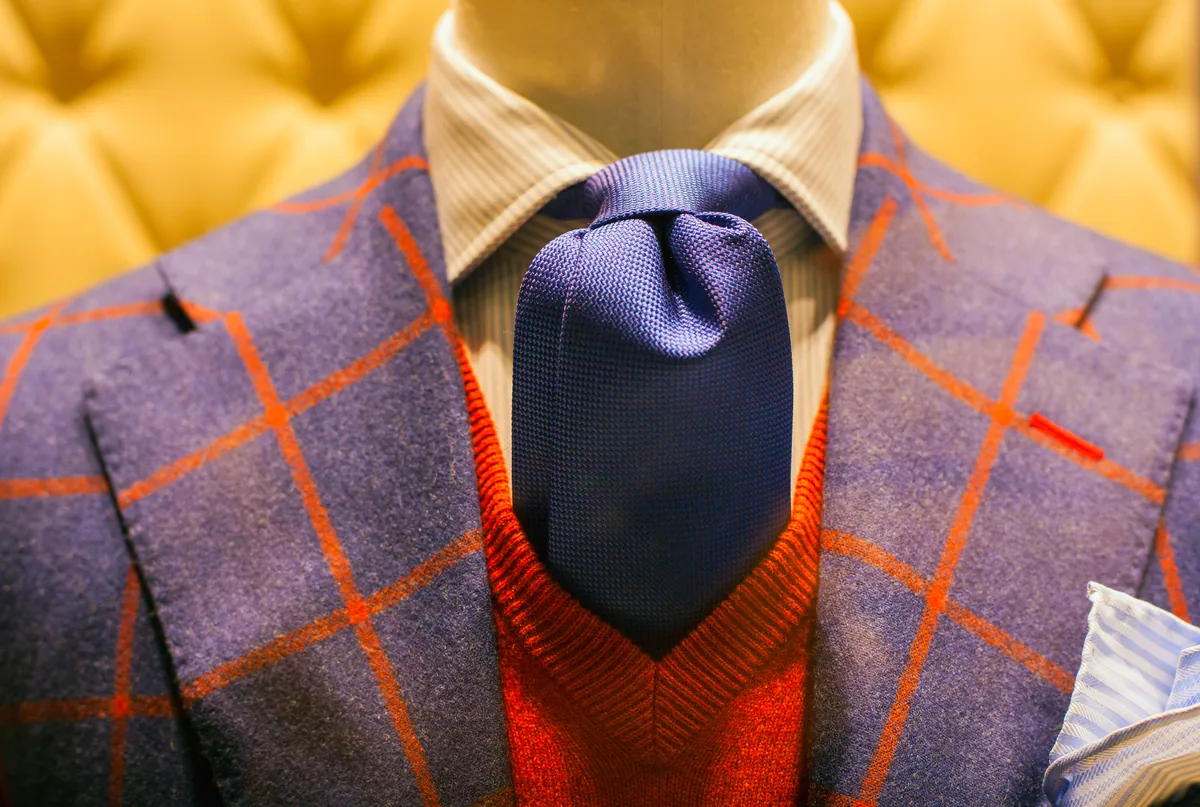
In an atelier in Bisaccia, a tie comes off a counter-march loom, woven from a wool sourced through a Florentine mill. Two thousand kilometres west, on the Atlantic coast of Spain, a baby blanket is finished from a yarn spun out of the casein of milk that never reached a dairy shelf. The two pieces share neither a material nor a method, and they arrive at the same place.
Jessica Tartaglia, working with natural fibres in Bisaccia in the Irpinia mountains of Campania, and Inés Rodriguez Rodriguez, working with milk fibre in Galicia, were both honoured at the European Textile and Craft Award 2026, where The Silent Luxury Magazine served as media partner. One spins casein from a regional milk surplus into a biodegradable fibre. The other weaves natural yarns on a loom inherited from her aunt. Both build the finished object outward from a material that already belongs to a place, and both treat inherited knowledge as the working ground for a new problem rather than a heritage to preserve.
Textile innovation, in this reading, does not begin with novelty alone. It begins when material knowledge, regional sourcing and inherited technique are applied to a present problem.
Jessica Tartaglia and Natural Fibres in Bisaccia
Bisaccia sits in the mountains of the Irpinia region, in southern Italy, in a town whose castle once housed a princess who worked as a weaver. Jessica Tartaglia works there with natural fibres alone, on a counter-march loom she inherited from her aunt Sandra, her first teacher. Her training continued in Perugia under Concetta Mennella, and she travelled to Peru, where she took a course in Andean tapestry weaving with the master Maximo Laura and learned to spin alpaca fibre at the Centro Tessile Tradizionale in Cusco. The yarns she works, wool, cashmere, silk, alpaca, linen and cotton, come primarily through Campolmi in Florence.
Her work rests on a single sentence. “Una volta che si perde l’artigiano, si perde l’arte.” Once you lose the artisan, you lose the art. The figure that gives the sentence its weight followed immediately. “In Italy in the past ten years we have lost 400,000 artisans. Weaving is perhaps the one that suffers most of all.” The number corresponds to data from the Confederazione Nazionale dell’Artigianato, and the loss accumulates quietly across years before it surfaces all at once. The knowledge held in a working atelier passes into the next pair of hands or out of circulation entirely, and that is the choice she reads in the figure.
Inés Rodriguez Rodriguez and Milk Fibre in Galicia
Two thousand kilometres west, on the Atlantic edge of Spain, a different material has taken shape. Galicia ranks among Europe’s largest milk-producing regions, comparable in scale to Switzerland. Most of that milk meets food-grade standards, and a small fraction sits below the threshold. From this fraction the casein protein can be extracted and spun into a textile fibre that is naturally hypoallergenic and biodegradable. Inés Rodriguez Rodriguez, the textile designer who built her atelier around the material, set out the principle that guides her work. “You have to begin the design at the origin, at the yarn.”
The first commercial milk-fibre baby blanket on the market was hers, produced in 2022 and blended with merino wool from Spanish transhumance. “The university said when it comes to nature in six months it’s not a problem,” she explained. The blanket biodegrades, and the child it covers rests against a hypoallergenic surface. She reads the value of the work the way Tartaglia does from the other end. “The real value of craft is the knowing of the techniques, the knowing of the knowledge of the materials, how the materials you can change, how the people feel with this obje
What Milk Fibre and Natural Yarn Reveal About Textile Innovation
What unites the two ateliers is the direction of motion. Both begin at the source, both work with materials drawn from their own region, and both build the finished object outward from that material. Tartaglia begins with the loom and the natural yarn. Inés begins with the milk and the merino. A wool length from Bisaccia holds the seed of the wool and the hand that wove it; a milk-fibre blanket from Galicia holds the casein of the regional milk and the merino of Spanish transhumance, and each returns in time to the soil it came from. The single principle the two trajectories meet on is that the object stays bound to its origin from the first decision to the last.
The European Textile and Craft Award 2026, where both were honoured, has begun to function as a quiet inventory of this kind of work across Europe. The Silent Luxury Magazine served as media partner for the award, and the conversations on which this piece rests took place around it.
Inherited Skill Turned to a Present Problem
The word innovation has been worn smooth by the technology sector. In textile, the work that matters applies inherited knowledge to a present problem: a wool length built to outlast its first wearer, a casein yarn drawn from a region that has handled milk for centuries. “In Spain people are thinking about my craft studio like a startup,” Inés said. “Knowledge is the technology.” The two ateliers read as current work rather than preserved heritage because the practice held in them is being turned toward biodegradable materials, regional sourcing and built-in longevity.
Both also share a reading of the relationship between craft and the next generation. Inés named it directly. “There is a little bit broken, and we have to find the language of the culture to make strong the craft for the new generation, not only nostalgia.” Tartaglia said it from the Italian side. “Senza la tradizione, l’innovazione è vuota. Senza l’innovazione, la tradizione muore.” Without tradition, innovation is empty. Without innovation, tradition dies.
More from The Silent Luxury on material, regeneration and the independent makers reshaping luxury: