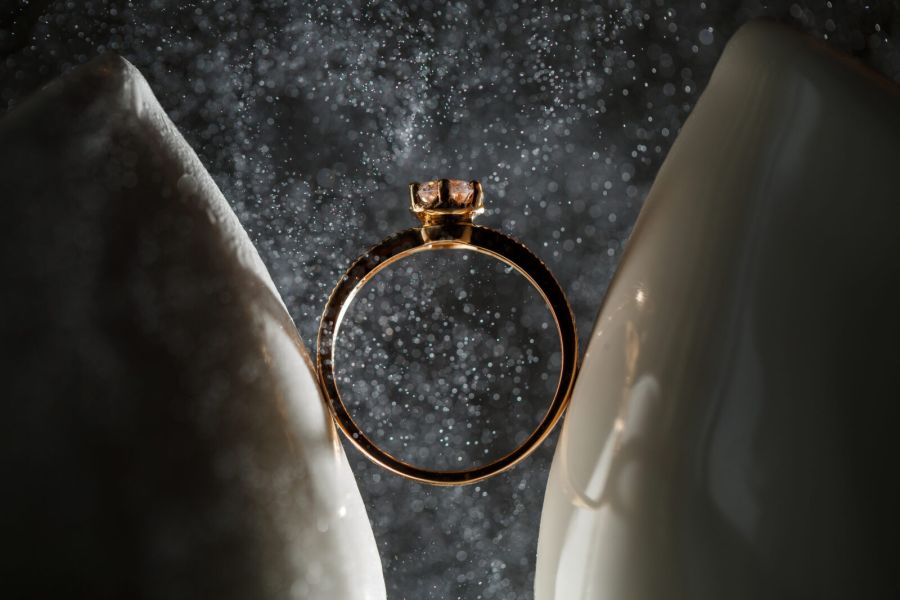
A ring between two shoes. Jewellery does not go out of season. It does not require a new collection to justify its existence. That is its structural advantage in 2026. | Photo: freepik.com
Why Is Jewellery Outperforming Fashion in the Luxury Market?
Jewellery leads the luxury market in 2026, as Richemont and Cartier convert a shift from logo-driven fashion toward intrinsic, material value into growth.
Eva Winterer
A ring or a bracelet holds its material value independent of seasonal relevance, brand communication or logo visibility. In an uncertain economic environment, jewellery functions as a store of value — and in a market polarising around genuine scarcity and craftsmanship, it sits naturally at the upper end of the hourglass.
Update · October 2026
The strength of the jewellery houses now reaches back to the mine. Richemont, the owner of Cartier, is in talks to join the consortium bidding for De Beers. The De Beers sale and what it gives Cartier’s owner ↗
Why Jewellery Holds Its Ground When Fashion Loses Its Footing
There is something precise about a piece of jewellery that fashion rarely achieves. It does not go out of season. It does not require a new collection to justify its existence. It does not need an influencer to explain its relevance. A ring sits on a finger for decades. A necklace passes from one generation to the next. The object carries its own argument.
This structural characteristic has become a strategic advantage in 2026. As the luxury market polarises along the lines of the hourglass economy, the categories that grow are those in which intrinsic value is legible, durable and independent of the communication cycle. Jewellery meets all three criteria. Fashion, under the pressure of elevated frequency and over-distribution, has struggled to meet any of them consistently.
How Richemont and High Jewellery Are Growing in Q1 2026
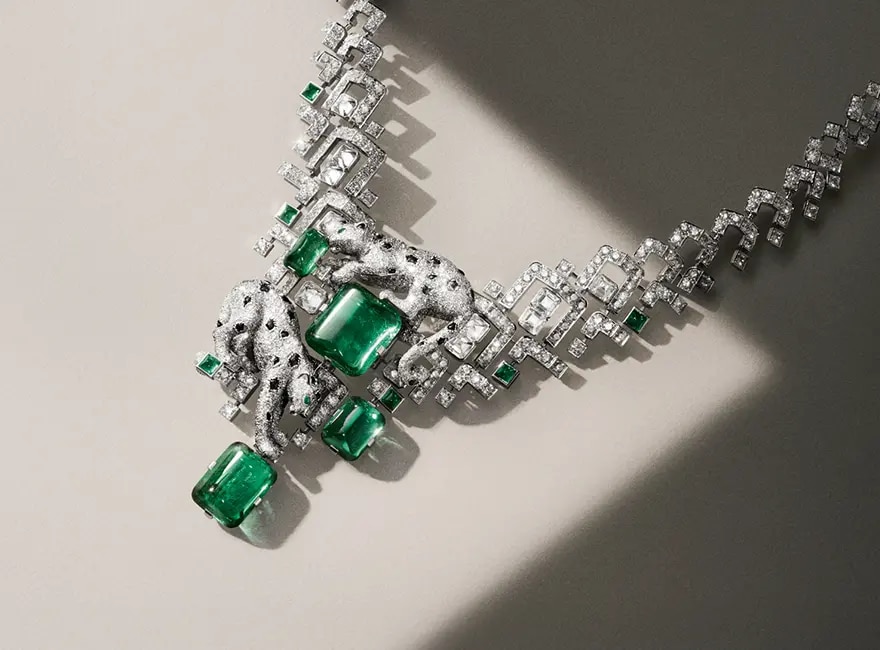
The Q1 2026 results confirm the pattern. Richemont, whose portfolio is anchored in high jewellery and precision watchmaking through Cartier, Van Cleef & Arpels and IWC, reported results that significantly outperformed the broader market. The jewellery houses at the upper end of the Richemont portfolio operate on production timelines measured in months and years, with stones selected individually and settings constructed by hand. The object that emerges from this process carries a material and temporal density that a fashion piece produced in a seasonal cycle rarely achieves.
Bain & Company’s luxury market research identifies jewellery and high watchmaking as the categories most resistant to the aspirational collapse that has hollowed out the fashion middle. The reasons are structural. Jewellery buyers at the upper end of the market are purchasing objects they understand as assets — pieces whose value holds, and in many cases appreciates, over time. This investment logic adds a layer of demand stability that fashion, with its inherent seasonality and trend dependency, cannot replicate.
For the full context of how market polarisation is reshaping category performance, the hourglass economy analysis maps the structural forces at work across the entire luxury spectrum.
Why Fashion Lost the Argument It Once Won Easily
Fashion’s relationship with value has always been more precarious than jewellery’s. A jacket, however beautifully constructed, carries a seasonal charge. It belongs to a moment. When that moment passes, its value as a cultural signal diminishes, even if its material quality endures. This is a structural vulnerability that the fashion sector managed for decades through the machinery of desire: the editorial narrative, the runway spectacle, the carefully controlled release that made each new piece feel necessary.
The machinery faltered when frequency overwhelmed it. When new collections arrive before the previous ones have been absorbed, when drops follow drops across multiple channels simultaneously, the narrative that makes fashion valuable — the story of why this piece, at this moment, means something — becomes impossible to sustain. As Eva Winterer, Publisher of The Silent Luxury, observed: the houses with a future replace the concept of the collection with the concept of the wardrobe. They are selling time.
Jewellery never needed this machinery to the same degree. Its value argument was always more material and less narrative. In 2026, this distinction has become a competitive advantage. The full structural analysis of the Q1 2026 results traces how this advantage is expressing itself across the earnings reports of the major conglomerates.
What the Rise of Niche Fragrance Tells Us About Sensory Value
The outperformance of jewellery is part of a broader pattern in which categories with high sensory density and low logo dependency are gaining ground. Niche fragrance is the clearest parallel. Givaudan, the world’s largest flavour and fragrance company, recorded 9.6 percent growth in its Fine Fragrances segment in Q1 2026. The scent carries no visible logo. Its value is experienced directly, without mediation. It cannot be photographed in a way that communicates the quality of the experience. These characteristics, which would seem to be limitations in a market driven by visibility, have become advantages in a market that is moving away from visibility as the primary value signal.
Jewellery shares this quality at a higher price point. The weight of a well-made ring on a finger, the particular quality of light on a hand-set stone — these are experiences that exist in the encounter between object and person, and that resist reproduction. In a market saturated with reproduced images, the irreproducible has become a form of scarcity.
Why Small Jewellery Houses Are Positioned for This Moment
The shift toward jewellery as a leading luxury category creates specific opportunities for owner-led, smaller jewellery houses — the segment that The Silent Luxury describes as the Local Soul of the luxury market. A small jewellery atelier with documented provenance, traceable materials and a direct relationship between maker and buyer embodies precisely the value proposition that the market is currently rewarding. It offers what the large conglomerates are attempting to reconstruct: credibility built through production decisions rather than communication budgets.
The structural moment for these houses is now. The Luxury Recalibration Blueprint 2026 maps the communication and positioning strategies through which owner-led luxury businesses can make their value legible to a market that is ready to receive it.