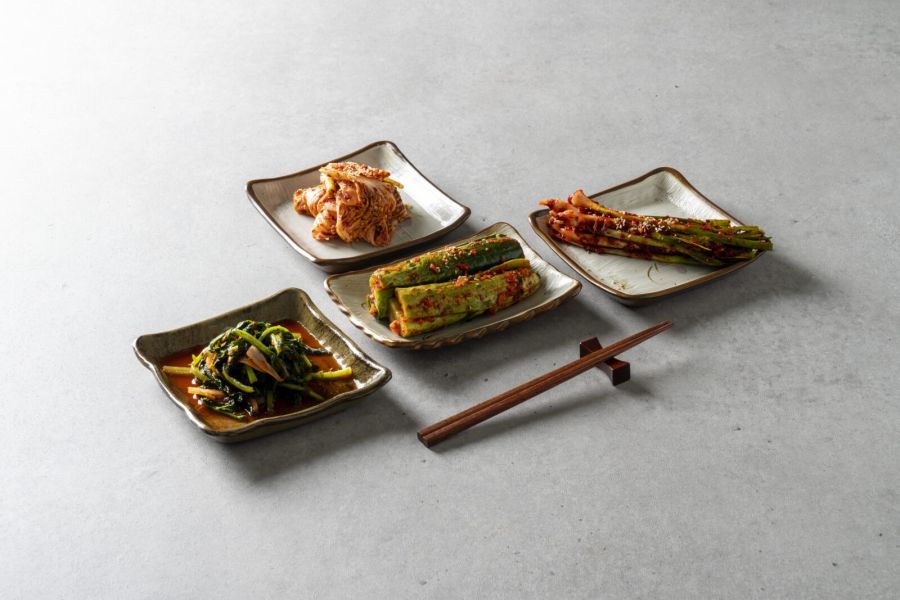
In the spring of 2026 the city of Busan printed a book. It runs to one hundred and forty-six restaurants, in Korean, English, Chinese and Japanese, and it is the kind of object a city usually produces to fill a rack near the ferry terminal. This one opens with the supplier before the restaurant. It traces thirteen dishes back through the markets and the boats that brought them, lingers on a single ingredient wholesaler named Dosi Nongsakkun, and finishes in the tripe alley behind the fish market. The restaurants almost arrive as an afterthought. What the book follows, from the cold water off the southern coast to the bowl on the table, is a chain, and the quiet suggestion running through it is that a person who follows the chain has understood the city.
Busan, Where Food Became the City’s Infrastructure
Busan has always been a city of arrival. It is the second city of South Korea and its largest port, a place shaped for centuries by movement and trade and the markets where the boats come in. The food carries that history at the table, in the wheat noodles a refugee population improvised when rice ran short, in the pork-bone soup that fed the dock workers, in the raw fish pulled from Jagalchi an hour before it is served. The guide is one half of what the city has been doing with all of this. The other half arrived in June, when Busan and its tourism office ran the Gourmet Selection, a month of twenty-six restaurants working in thirteen pairs, each pair cooking the other’s dishes or inventing something between them.
The pairings ignore every line a restaurant scene usually keeps, putting a ramen house with a wine bar, a Michelin kitchen with a vegan room, a Thai place with a kitchen named after an American military village. Several of the cooks hold a position in the Michelin Guide Busan, which this year lists fifty-five restaurants in the city and four stars among them. The Gourmet Selection set all of that to one side. A restaurant joined this year by filling in an application, an open door where fine dining usually keeps a velvet rope.
There is a small dining room on Dalmaji Hill, husband and wife, a Michelin star and a tasting menu built around pasta. They grow more than eighty percent of what they cook on the family farm. A star can find a place like that. It takes a city to grow one, restaurant by restaurant, supplier by supplier, and the guide is the map of where they have grown. Last year Busan passed three and a half million foreign visitors for the first time. When the city asks them what they enjoyed most, they say the food, every year, ahead of everything else, and eighty-five in a hundred say they want to come back.
There is a reason a chain like this holds, and it was set out this spring in a paper few people in the restaurant trade will have read. Solon Magrizos, who reviewed a hundred and nine studies on luxury and well-being for Psychology and Marketing, told The Silent Luxury that the experiences which stay with a person gather four things in one spot: “material, relational, temporal and place. A specific geography that cannot be moved or reproduced.” A meal that runs from the cold water off the southern coast to a bowl on Dalmaji Hill is exactly that, four things in one place on the map, which is the reason a person remembers Busan through what they ate there.
The Silent Luxury · Where the Value Is Forming
The Markets Beneath Two Local Life Systems
43.1%
Asia-Pacific’s share of global culinary tourism revenue in 2025, the largest of any region.
$4.19bn
The projected Brazilian luxury interior design market by 2032, up from 3.12 billion in 2023.
Sources: Research and Markets, Culinary Tourism 2026 · Credence Research, Brazil Luxury Interior Design 2025 · © Silent Communications GmbH
CASACOR, Where the Home Became the Question
Five thousand kilometres of ocean away, on the second of June, a park in the west of São Paulo opened its gates to a different kind of show. CASACOR has run for thirty-nine years, and this year it is back inside the Parque da Água Branca, a hundred and thirty-seven thousand square metres of listed public garden with a few surviving fragments of Atlantic forest. Seventy rooms, more than seventy-five architects and designers and gardeners, ten thousand square metres of it, and roughly four in ten of those metres left open so that the show and the ordinary Sunday life of the park move through each other.
The theme is Mente e Coração, mind and heart. The brief to the designers named the thing they were answering: the speed of everything, the flood of information, the low constant hum of being always reachable. Against that, the house is asked to do something houses were not always asked to do, to slow a person down and give their attention back, to be the place a person returns to in order to find the thread of their own life again, and to manage this through nothing more exotic than light, air, planting and the order of rooms.
The show opens with a hut. Paulo Azevedo built it at the threshold, a small structure of affective memory, made for sitting in before a visitor has seen a single finished interior. It is an odd way to begin a design fair, asking people to stop and remember before they admire, and like the application form in Busan, the oddness carries the meaning. The home that follows the hut is asked to be more than a surface. The garden the room opens onto, the relationship between a built space and a São Paulo sky, the planting chosen for this climate and no other, all of it belongs to São Paulo in a way that stays in São Paulo. CASACOR keeps the listed trees alive by raising the floors and setting the gardens in pots, and it sends nothing to landfill, the housekeeping of a fair that has begun to behave like a piece of civic infrastructure.
The numbers around a show like this have grown serious. The Global Wellness Institute counted wellness real estate, the part of building that arranges itself around how a room shapes a life, at eight hundred and seventy-six billion dollars in 2025, up from a hundred and fifty-one billion eight years earlier, and the fastest-growing thing in the whole wellness economy. Somewhere in the same research sits the figure that the room a person lives in shapes perhaps eighty-five percent of how their health turns out. A park full of rooms asking how a person wants to live is sitting, knowingly, on top of all of that.
Magrizos noticed something else in his studies that fits a show like this. The deeper good of an experience tends to arrive late, he told The Silent Luxury: “If the most meaningful eudaimonic effects show up after the invoice is settled, then the relationship after the transaction is where the value actually consolidates.” He was thinking of a house and its client, and it reads just as well for a park and its visitor. The CASACOR room does its real work weeks after the turnstile, in the person who goes home and changes one thing about how they live in their own.
Analysis · The Silent Luxury
Five Marks of a Local Life System
The signals that separate value formed in a place from a destination that only looks the part
Five marks that distinguish a local life system, with a description of each.
| No. |
Mark |
What it means |
| 1 |
The value rises out of the place itself |
It comes from the coastline, the market tradition, the climate and the way people there already live, from conditions no competitor can carry to another address. |
| 2 |
The value passes through a chain of real relationships |
It runs from the supplier to the table, or from the climate to the room, through a sequence of people a brand name cannot stand in for. |
| 3 |
The value grows as the gate opens |
Busan admitted restaurants to its Gourmet Selection by open application, and CASACOR leaves much of its route inside the public park. The worth widens with access where prestige usually narrows it. |
| 4 |
The value arrives after the visitor leaves |
The meal and the room do their lasting work later, in the traveller who returns, learns the markets, or changes one thing about how they live at home. |
| 5 |
The value shows its working in the open |
Own-farm produce, a zero-waste operation, listed trees kept alive. The proof is in the practice, not in the signage. |
Analysis: The Silent Luxury · June 2026 · Sources: Busan Metropolitan City 2026 · CASACOR São Paulo 2026 · Magrizos et al. 2026
Why the Value Stays in Place
The thing both cities have, and the thing the great houses spent during their years of growth, is that their value stays put. Magrizos has a quiet way of explaining the limit. His honest guess, he told The Silent Luxury, is “that there is a threshold of scale above which the eudaimonic pathway becomes structurally inaccessible, and that this threshold is lower than the industry would like to believe.” A brand crosses that line the moment it makes the encounter the same in every city, because sameness is the opposite of a thing that happens once, in one place. A city’s food and a country’s idea of home stay on the near side of the line, because they are made of the place itself. A luxury group can buy a heritage atelier, and the cold current off the Korean coast stays where it is. A developer can raise a wellness tower on any plot in the world, and the particular understanding between a São Paulo room and a São Paulo sky stays in São Paulo.
There is a trap, and Magrizos names it too. A house with two centuries behind it can still leave a guest cold if the visit is arranged for the camera and the maker is performing instead of working. The same waits for a city and a park. Busan could turn its food into a backdrop. São Paulo could let the theme thin into a mood. The thing that keeps them honest is the thing that built them, the supplier who is actually farming, the designer actually solving how a person should live under this particular sky, the relationship that was there before the visitor arrived and is still there after they leave.
This summer the work is real in both, a printed guide that begins with a fish supplier and a public park where seventy rooms ask, with some seriousness, how a person would like to come home. Neither can be bought, franchised or carried away in a bag, and that is the whole of their value. They stay where they are, and a person has to go to them.
The Silent Luxury thanks Solon Magrizos, whose research on the transformative nature of luxury consumption informs the reading above. His full conversation with The Silent Luxury appears in An Island Named Eudaimonia.
Sources
Busan Metropolitan City / Busan Tourism Organization, 2026 dining guide and Gourmet Selection (2026). Korea Times, koreatimes.co.kr. Korea Herald, koreaherald.com. Haps Korea, hapskorea.com. The MICHELIN Guide, Seoul & Busan 2026, guide.michelin.com. CASACOR São Paulo 2026 / Parque da Água Branca, casacor.abril.com.br. Research and Markets, Culinary Tourism Market (2026), researchandmarkets.com. Credence Research, Brazil Luxury Interior Design Market (2025), credenceresearch.com. Global Wellness Institute, Wellness Real Estate (12 May 2026), globalwellnessinstitute.org. Magrizos, Solon, Voutsa, Maria C. & Kastanakis, Minas N. “On the Transformative Nature of Luxury Consumption and Consumer Well-Being.” Psychology and Marketing, April 2026. DOI: 10.1002/mar.70139. The Silent Luxury editorial research, June 2026.