Tag: Paestum

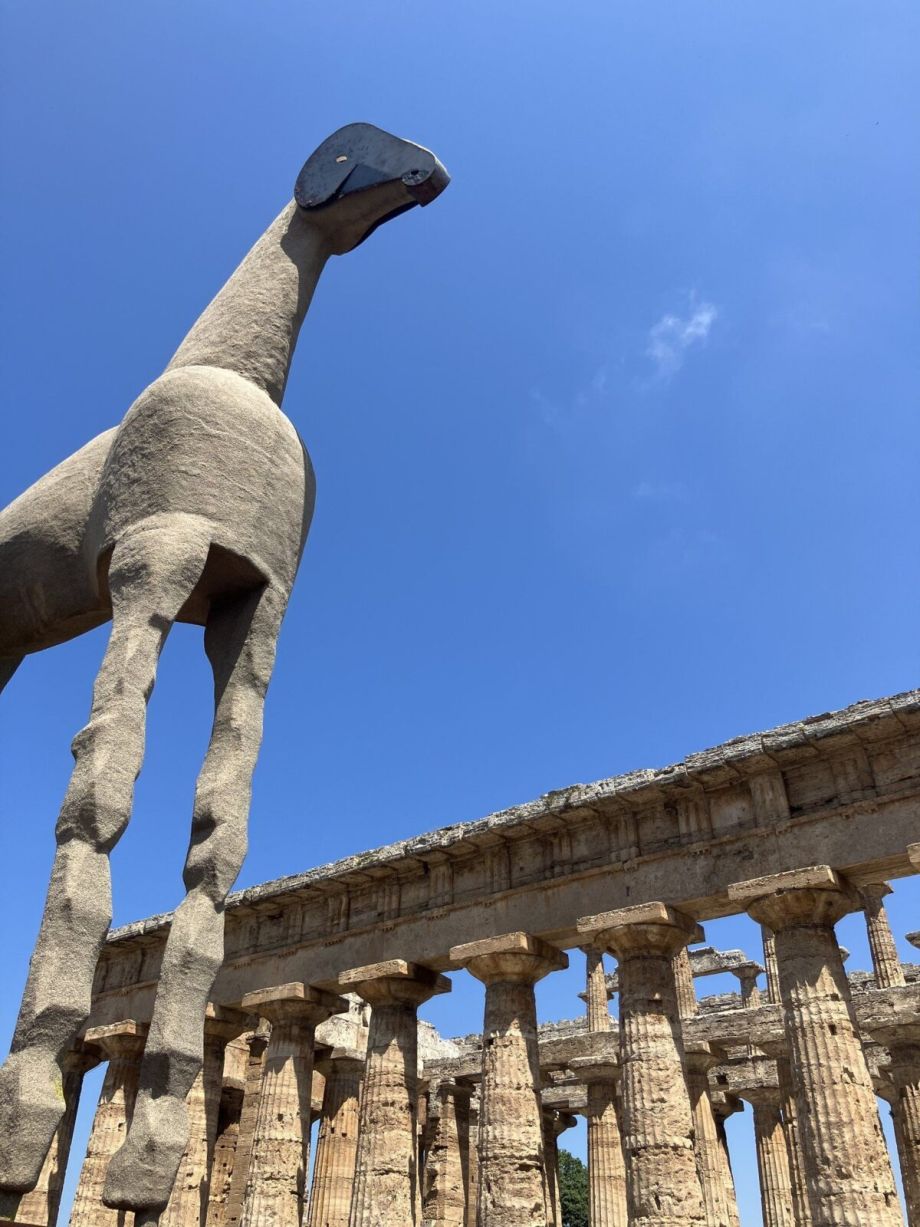
A sand sculpture of a horse before the columns of the Temple of Neptune at Paestum, the ancient Greek city of Poseidonia in the Cilento, southern Italy.

Cilento: Concentrates, Cycles, Continuity

In Italy’s Campania, south of the Amalfi Coast, the Cilento keeps a different pace. Across its dried figs, its buffalo, its wine and its silence, one principle stays constant. Quality grows where respect for nature, knowledge and origin comes first. Eva Winterer on a slow region.

The Cilento in Italy’s Campania runs on cycles. Santomiele in Prignano Cilento dries figs for weeks without acceleration. San Salvatore 1988, awarded Robert Parker’s Green Emblem in 2023, powers its winery from 750 buffalo. In Pisciotta, Maria Coppola’s Antica Menaica works a catching method from antiquity that an EU directive treats as industrial trawling. At Elea, Parmenides thought about permanence.

Forty minutes south of the glamorous, crowded Amalfi Coast, another way of living begins. The Cilento is a slow region, and slowness here is a way of life, and the phrase means what it says. It gives up nothing of the elation of the coastal landscape, the steep cliffs, the villages that fold themselves into the rock. It gives up nothing of life itself. Silent by nature describes it well.

I came to the Cilento after two rest days on the terrace of Borgo La Pietraia, two molars lighter, and began the exploration from there: the nature of the place, its philosophy, and a handful of the companies that express that philosophy in what they make. The journey turned out to be surprising, funny, sweat-soaked, full of small revelations, and quietly philosophical. Everything, it kept turning out, is connected.

Four words describe the whole region, and they returned at every stop. Rallenta. Cura. Memoria. Kalokagathia. Slow down. Care. Memory. And the old Greek idea of the good and the beautiful in a single word.


Santomiele in Prignano Cilento: The White Figs and the Sweetness of Antiquity

Leaving the almost hypnotic panorama of the Borgo behind, the first real finding came within a few kilometres: mountain roads, many of them, and more of them narrow, with fiercely steep climbs. A navigation system that occasionally surrendered. Somewhere near Prignano Cilento, reversing hopelessly into a lane that kept getting tighter, I heard a voice from an older man: “Mädchen, das geht sich schon aus.” Girl, you’ll make it. Waving directions, he guided me out.

That was just before the first company visit, at Santomiele in Prignano Cilento. Two surprises arrived at once. The first was the position of the place, high on a mountain ridge with a view across the foothills to the sea. The second was Santomiele itself, a company that turns a fruit thousands of years old into a sensory experience, its design as considered and inventive as the tradition of fig cultivation it draws on.
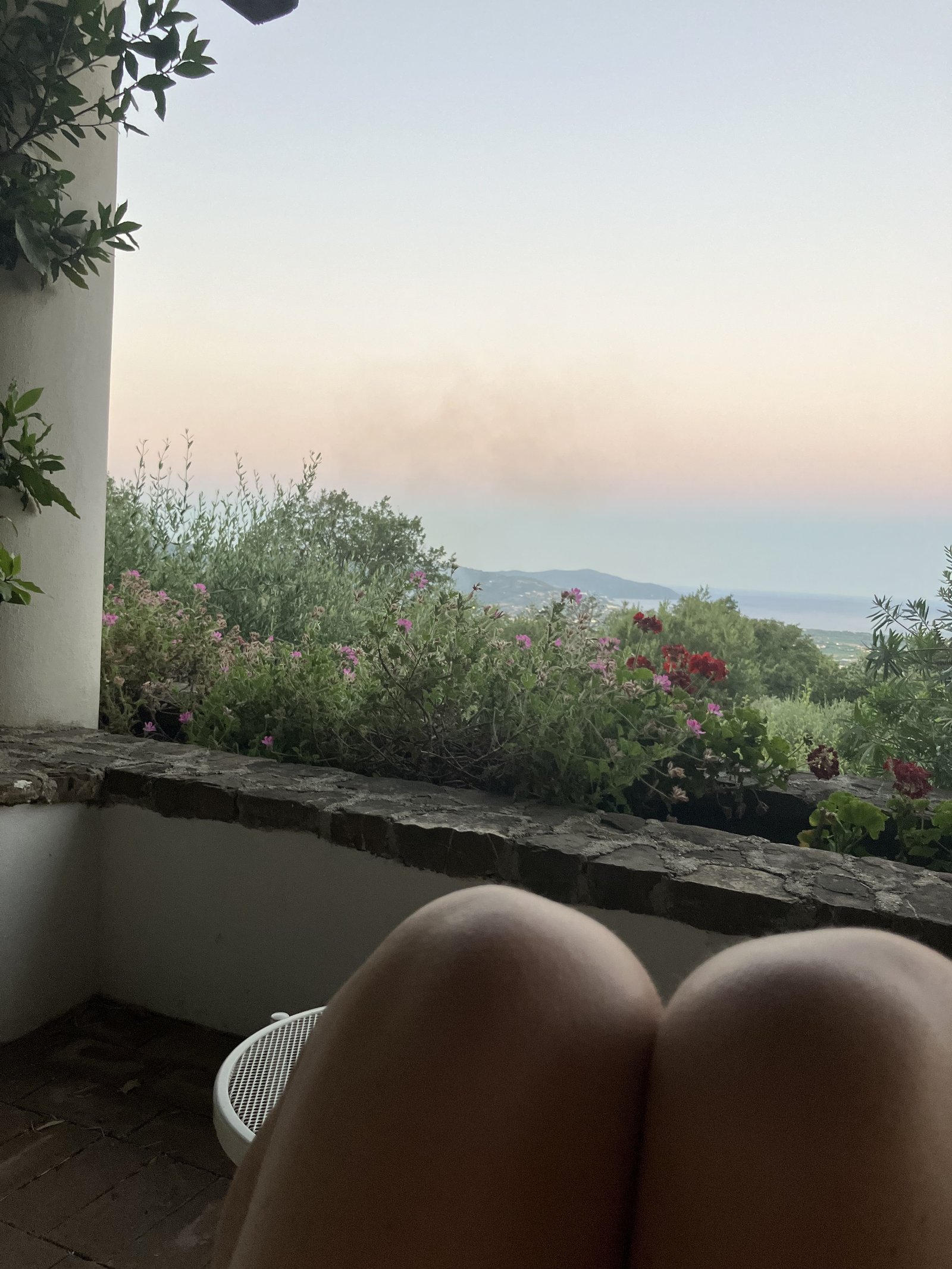
View across the Cilento plain from the terrace of Borgo La Pietraia at dusk, hills falling toward the sea.
Borgo La Pietraia. The two rest days before the region begins. Photo: Eva Winterer
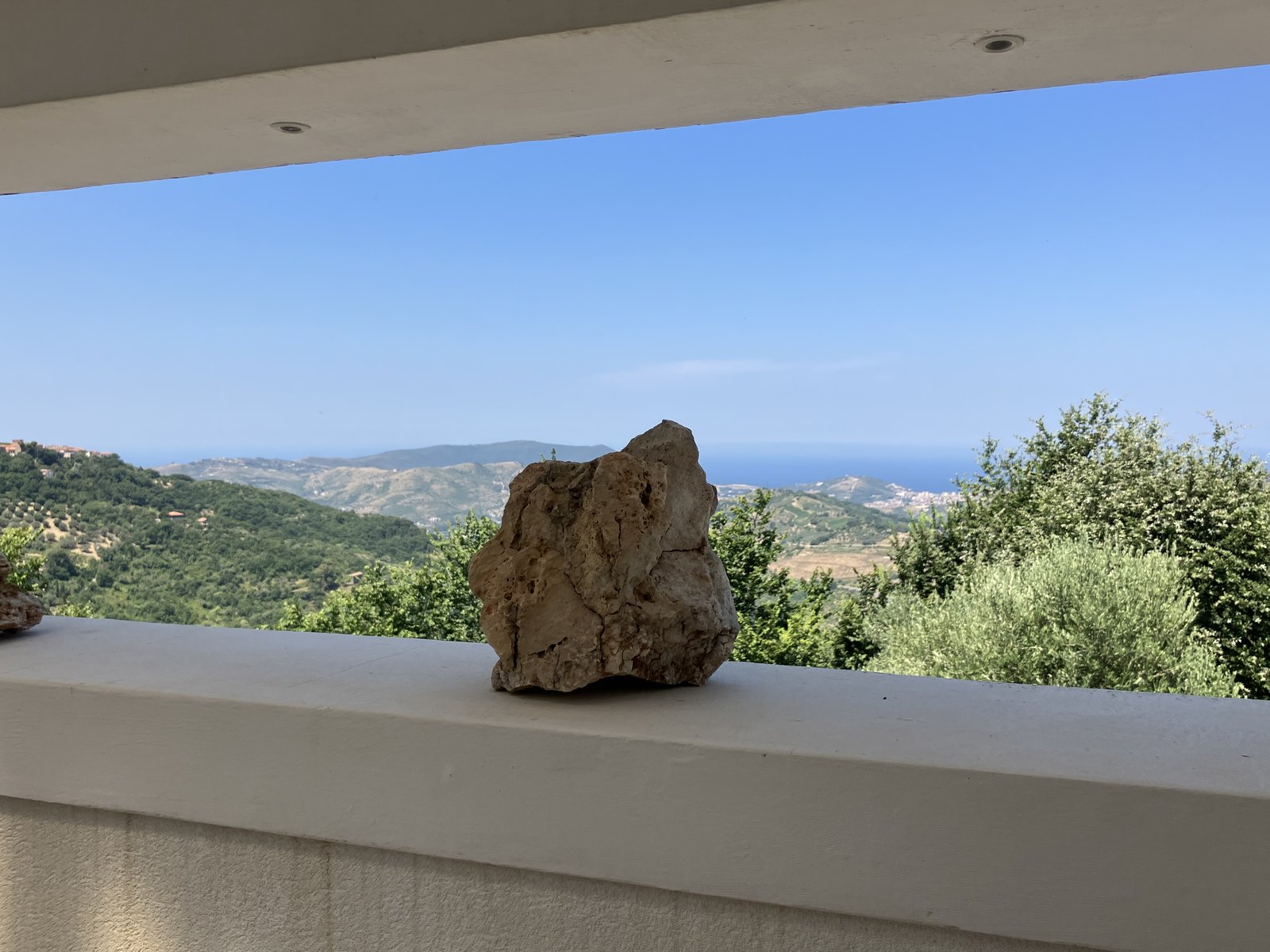
A stone resting on a white parapet at Santomiele, the Cilento hills and sea in the distance.
The view from Santomiele toward the sea. Photo: Eva Winterer
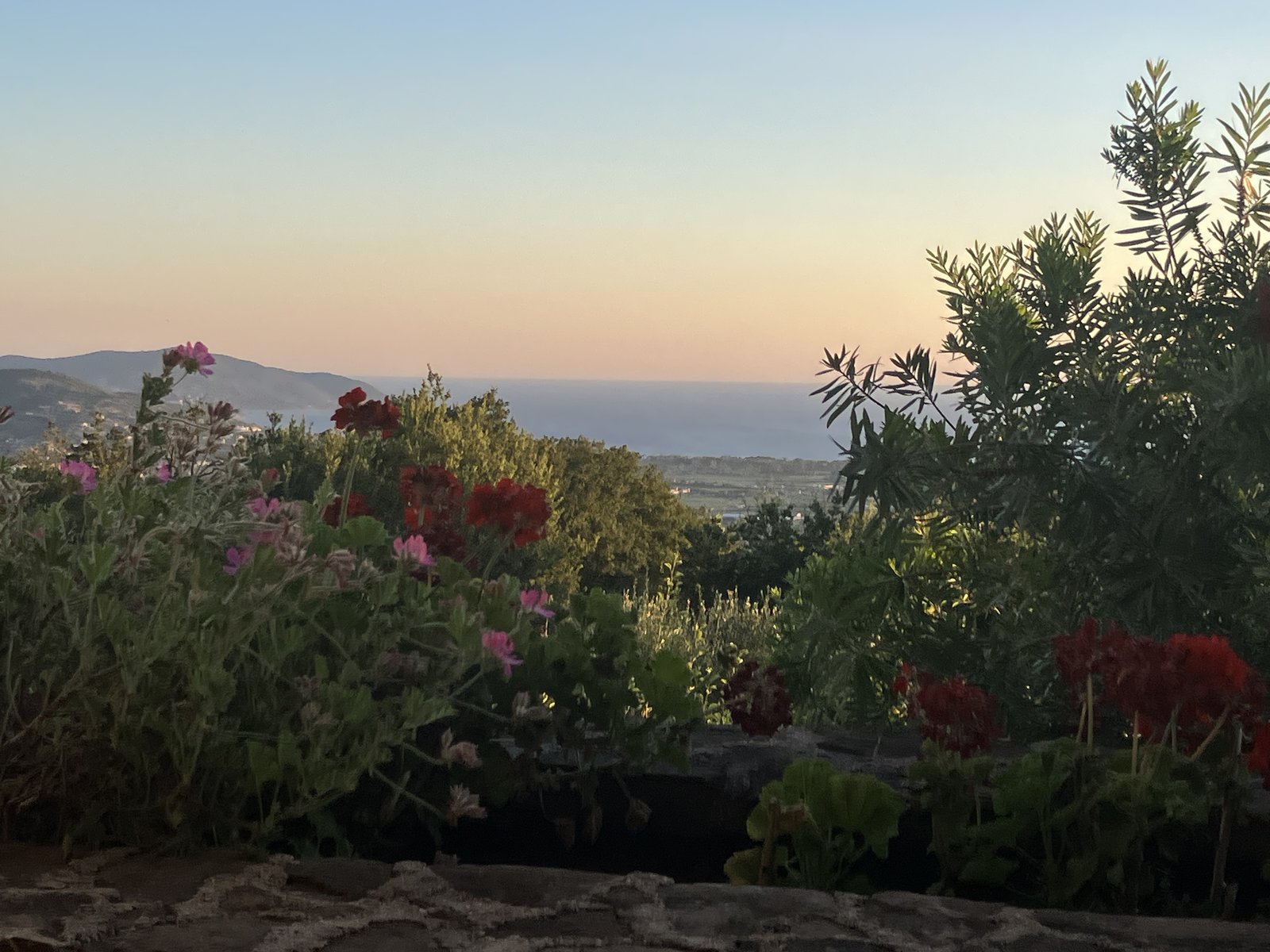
Geraniums on the terrace of Borgo La Pietraia, the Cilento coast and sea beyond in evening light.
Dusk over the plain, seen from Borgo La Pietraia. Photo: Eva Winterer
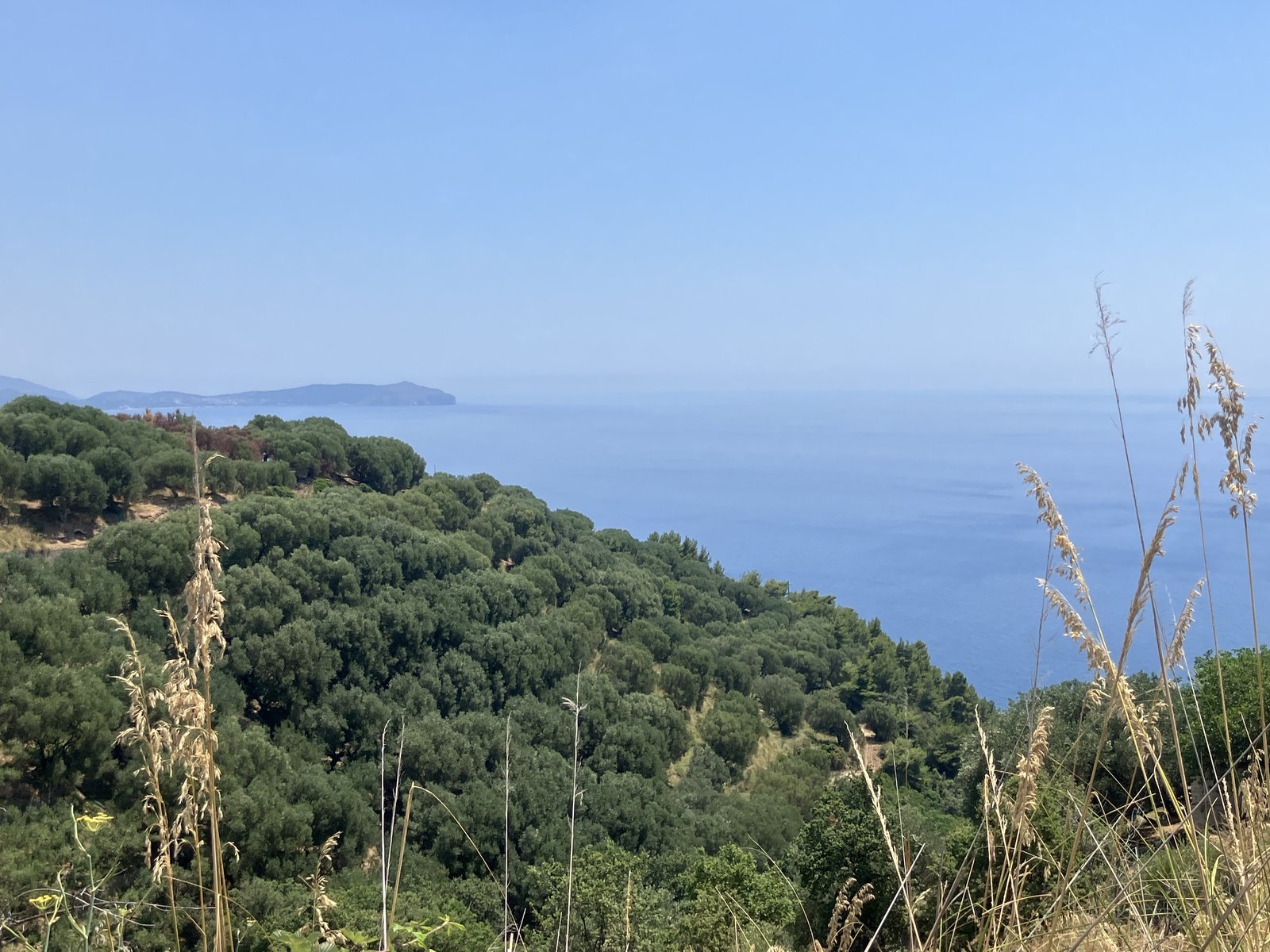
Olive groves on a wooded slope above the sea on the Cilento coast near Velia.
The Cilento coast near Velia. Photo: Eva Winterer
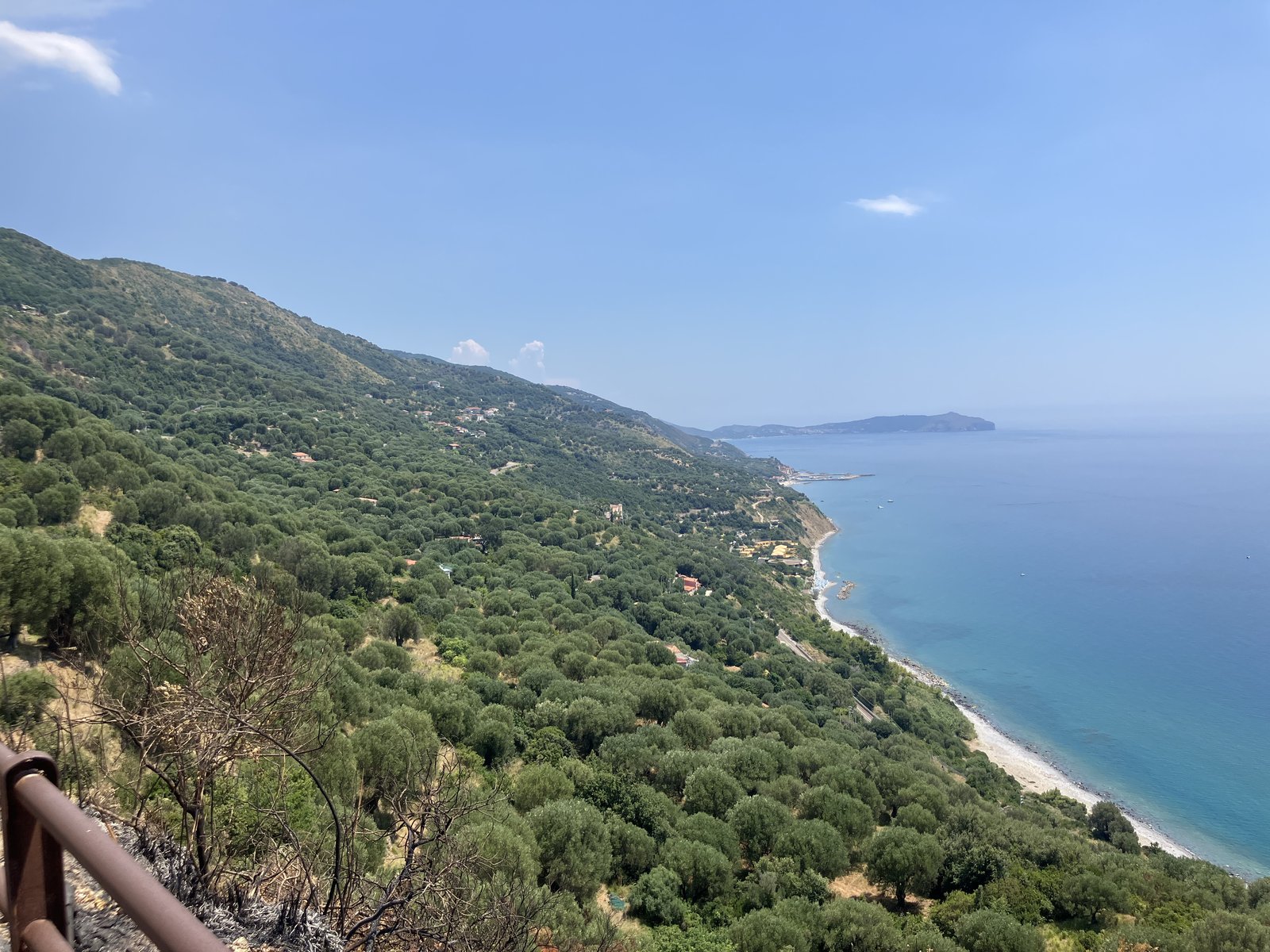
A wide view of the Cilento coast near Velia, wooded hills descending to a bay.
Coast and hills near Velia. Photo: Eva Winterer

A few facts in fast motion. Figs are barely grown in Europe any more; most come from the Middle East. Yet fig and olive trees, planted together, make excellent natural stabilisers against landslides. Santomiele works consistently organic. The drying of the fruit, harvested from late July and left without artificial acceleration, takes weeks. A by-product of that process is a sweet juice, worked into fig concentrate: a purely natural, plant-based sweetener and an aromatic alternative to refined sugar. In antiquity the same concentrate counted as a source of strength. Olympic athletes are said to have used it as a kind of natural doping.

The connection to the fig runs deeper on TSL in its own piece on Santomiele and the white figs of the Cilento, where the fruit, its roots in rock, and the economics of waiting have room to unfold.

Between Cemeteries and Elea: Parmenides and the Eleatic School

After a short cool-down in the church of Prignano, in this season a natural form of air conditioning, the road went on south toward Pisciotta. It kept a few more surprises ready. The route ran through the national park: deep-green wooded slopes, rivers still carrying water, and a pressing, sweat-soaked heat. After about an hour, a bend opened suddenly onto the cliff coast and the open sea behind it.

Finding a place to stop and photograph it, with both a view and somewhere to pull over, proved difficult. Then a shaded car park appeared. Instead of a viewpoint, I found myself in front of a cemetery that, to Austrian eyes, looked unusual: small temples, grave buildings like miniature houses, altogether an impressive ensemble.


The wall told me where I was. Ascea, known in antiquity as Elea, once a significant site of Greek antiquity and the starting point of the Eleatic school of philosophy. Parmenides and Zeno thought here, on this coast, about being and permanence. It is a fitting place for a region that measures value in cycles.

Pisciotta: Odysseus, Sirens and a Coast Road Slipping for Thirty Years

From the short stop, the coast road continued toward Pisciotta. Taken by the beauty of the cliffs, where Homer is said to have set the drama of Odysseus and the Sirens, my buoyant mood broke off as abruptly as the road did. A section had slipped away, the concrete buckled. A narrow gap between two concrete pillars stood open, and beside it the sign: no entry.

Was this to become my own personal odyssey, a wandering along the coast? Searching in a small panic for reading glasses and navigation, I heard not the voices of Sirens but the horn of a car and the voice of a woman: “Come along, you can drive through, I’ll go ahead of you.” The odyssey along several kilometres of single-track, undulating, steeply falling coast road, with sharp pitches in between, was in the end accomplished.

Arriving at my appointment at the Antica Menaica of Maria Coppola, I asked about the road and when it would be repaired. The reply was startling. It has been like that for thirty years. Every year it slips a little further. Beyond makeshift stabilising, nothing happens. A place of remoteness as an image of an enforced rallenta.

Menaica: Nets, EU Fishery Quotas and Garum

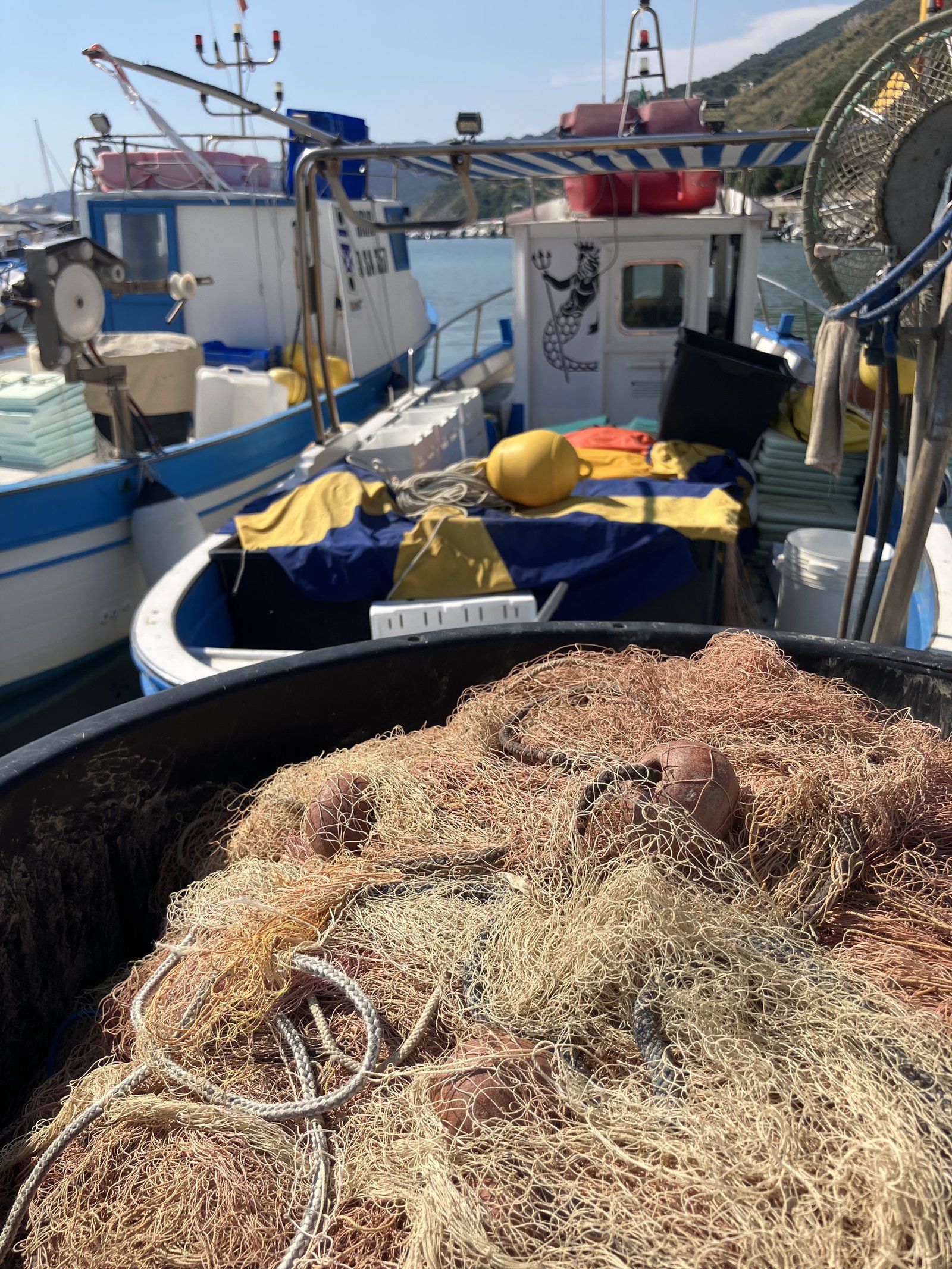
The traditional catching technique for the alici di Menaica uses special nets, selective ones, taking larger fish after the spawning season so the cycle stays intact. The nets are knotted as they were in antiquity, and the catch is layered by hand in salt troughs, pressed, and stored for several months. In the pressing, garum forms, the concentrated fish sauce the ancient Romans used as a standard seasoning, and which today finds a fresh interpretation.

The method stands, Coppola says, on the edge of disappearing, for two reasons. An EU directive treats the Menaica method as equivalent to large-scale trawling with dragnets. While industrial bag netting stays permitted, no new licences are issued to Menaica fishers. And anchovies are the favourite food of tuna, whose stocks off the Cilento coast are rising sharply because tuna fishing is capped by quota. Those quotas fall almost entirely to large international fleets. Small fisheries, faced with the high costs, are left without a chance.
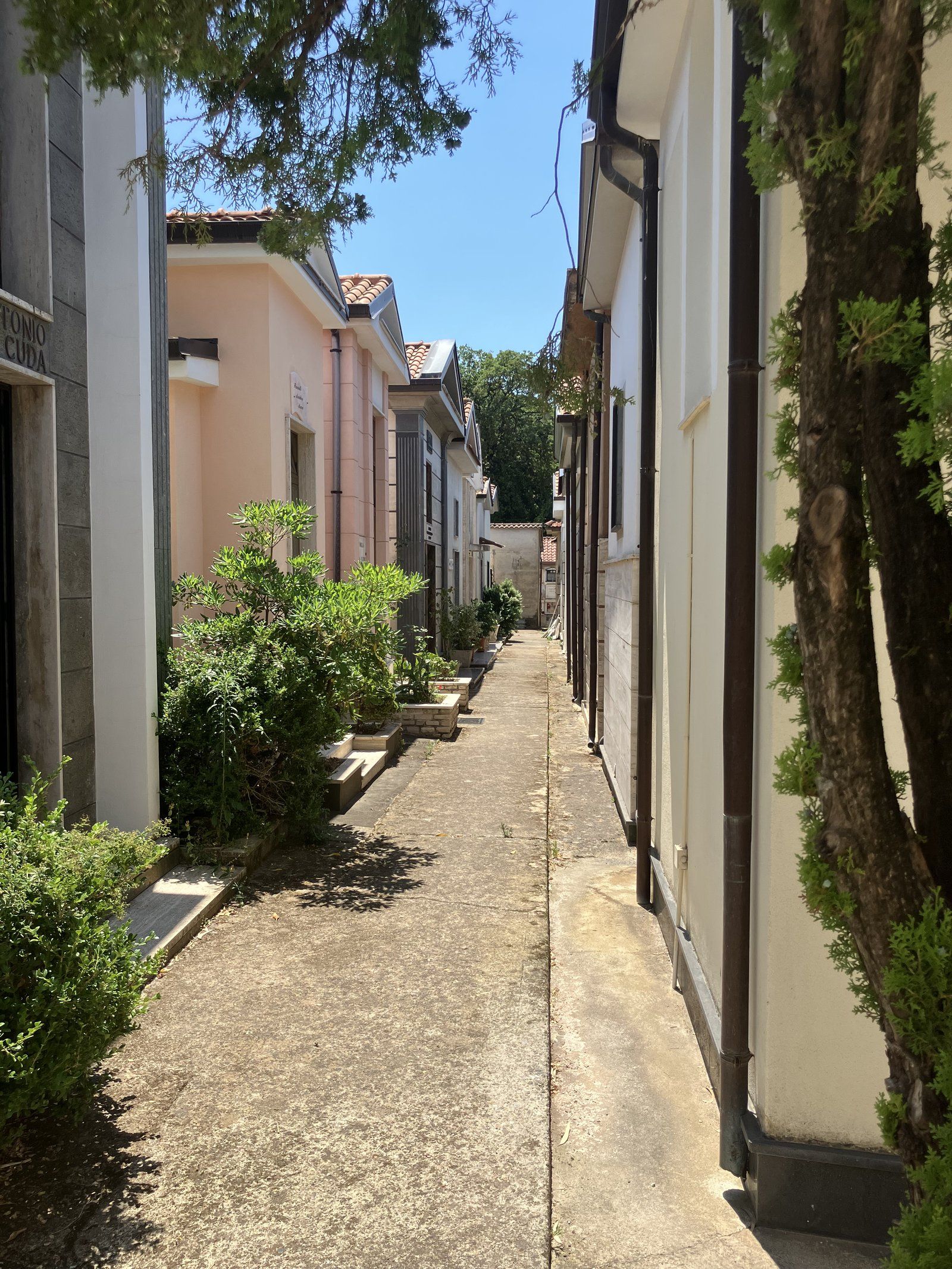
A narrow path between temple-like tomb houses at the cemetery near Ascea in the Cilento.
The cemetery near Ascea, its tombs built like small temples. Photo: Eva Winterer
Menaica fishing nets in the foreground with blue and white boats in the harbour of Pisciotta.
Menaica nets in the harbour of Pisciotta. Photo: Eva Winterer

San Salvatore 1988: Buffalo, Wine, Professionalism and Philosophy

The next day belonged to the buffalo: energy source, company financier, raw-material supplier, and the symbol of a working circular economy.

In a deeply philosophical conversation with Giuseppe Pagano, owner of San Salvatore 1988, a whole biodynamic system opened up, one recognised in 2023 with Robert Parker’s Green Emblem, an award for estates that take a leading role in sustainability, biodynamics and biodiversity. Pagano spoke about the philosophy of the company and of the region. About Kalokagathia, the togetherness of the good, in the sense of flourishing, and the beautiful, gathered into a single word that no longer quite exists.

The old Greek Kalokagathia describes, for him, what shapes the Cilento. Only in accord with nature are both possible at once. This region does not live on nostalgia. It shows how local resources are used intelligently while staying in a stable balance. The Cilento works as a slow region because it accepts the conditions of the landscape and lets them set the pace. San Salvatore’s own story, its buffalo and its biodynamic cycle, continues in the piece on San Salvatore 1988.

The conversation with Pagano was only the opening to the estate itself. Around 750 buffalo produce, through their waste, twice the energy the company’s operations require, from the winery to the caseificio, where buffalo milk becomes mozzarella, ricotta and yoghurt, through to a five-star and a four-star hotel at the Lido of Paestum. A note on taste: genuinely fresh mozzarella, made that morning, tastes salty. Only the time in brine turns it sweet. Here there is only fresh mozzarella. When it sells out, none is kept back.

Then the way into one of the vineyards. The view slides over the facing mountains, villages on their ridges, the land falling gently toward the sea, and a sun preparing its slow descent over the silhouette of the Amalfi Coast. Otherwise, silence. Marco Radano, export business manager at San Salvatore 1988, put it simply. “This is luxury. To stand here, to enjoy the quiet and the view over the vines and the land.”

The day ended with a philosophical look at the state of the world, and of life itself, in the Cantinetta of San Salvatore, together with Marco and Saverio, the oenologist. Reality returned quickly enough, in the form of a stop by the Carabinieri, who in the end asked how I liked Italy and how I found the food.
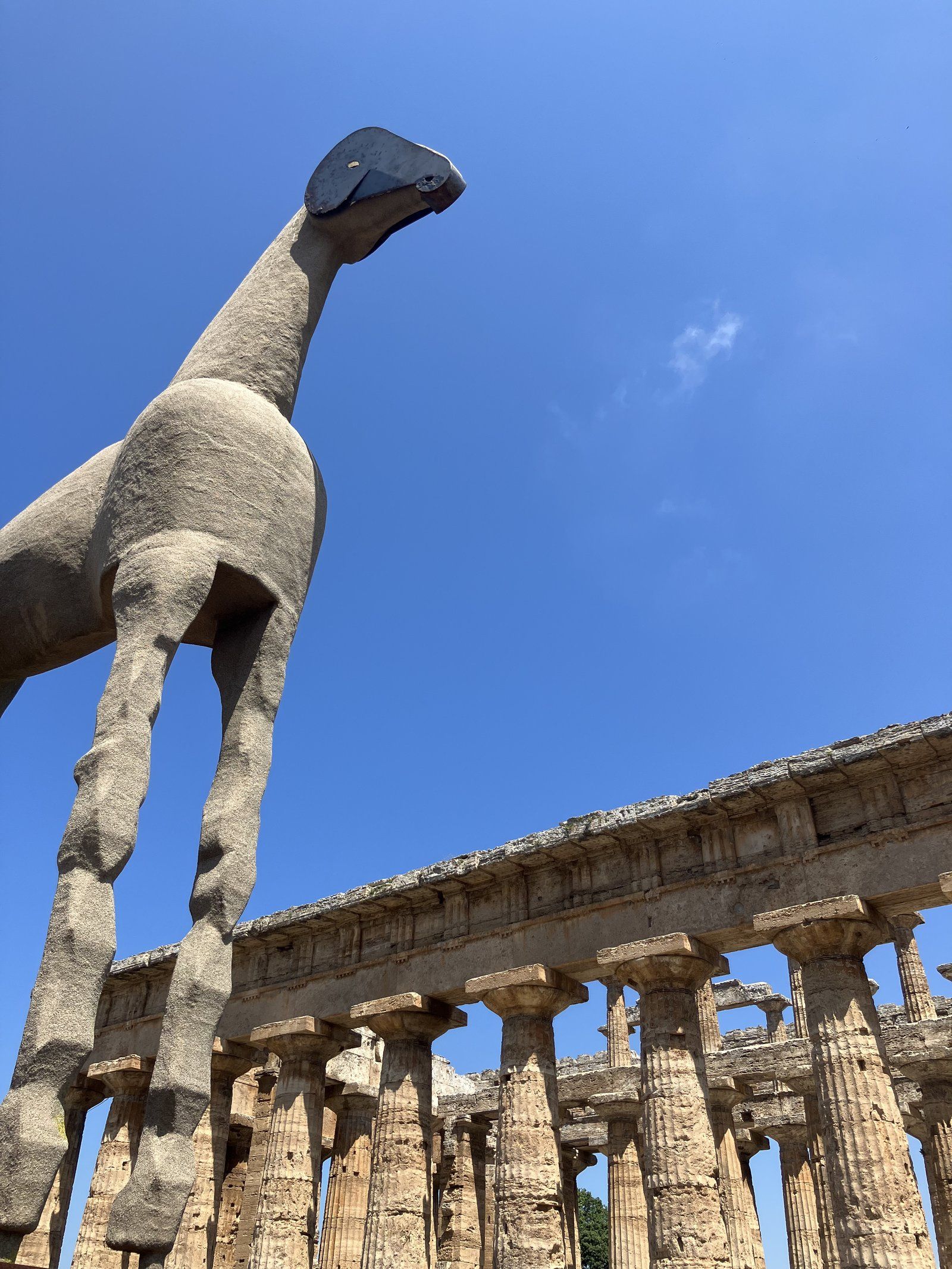
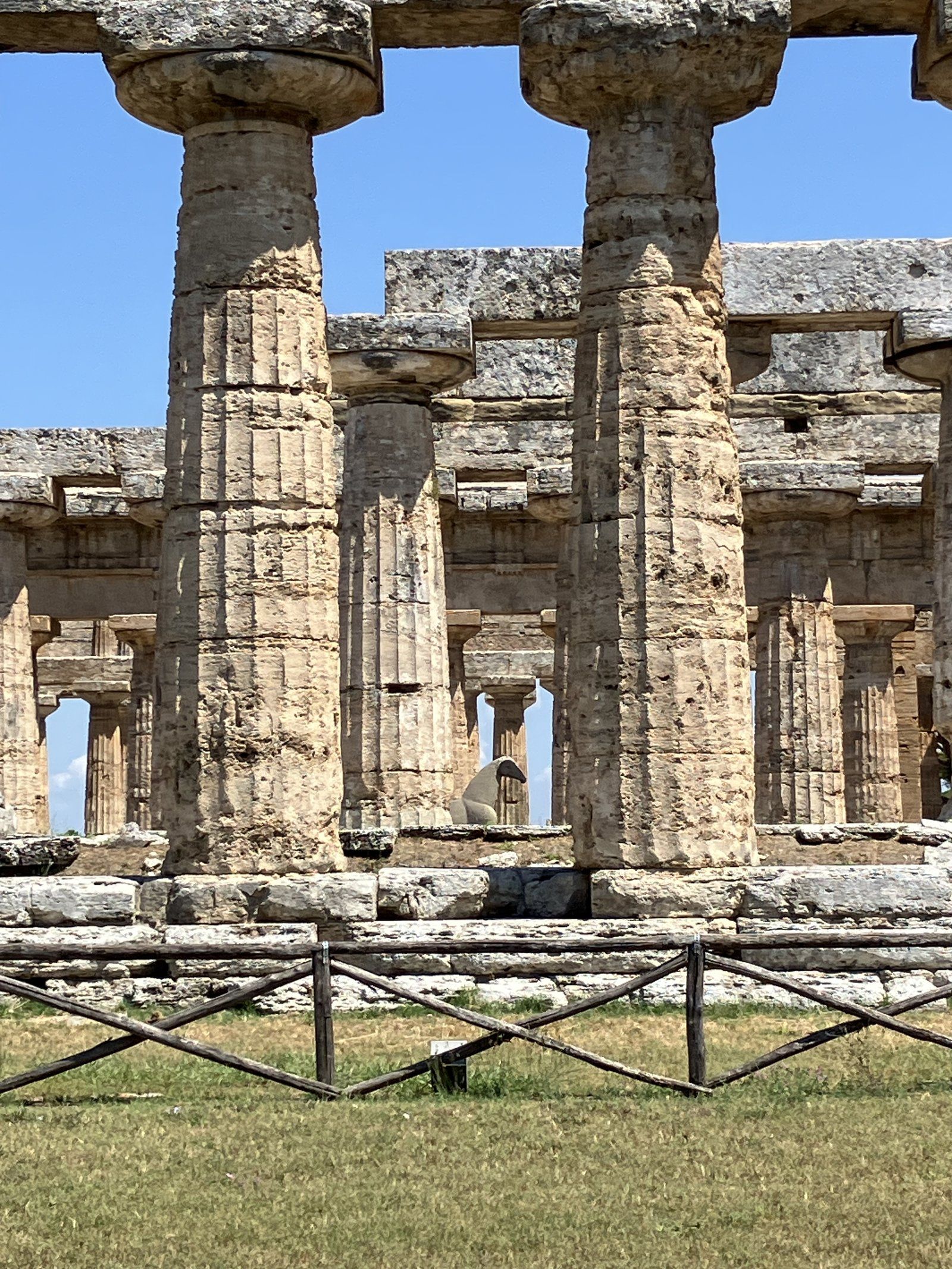
A sand sculpture of a horse before the columns of the Temple of Neptune at Paestum, the ancient Greek city of Poseidonia in the Cilento.
A horse of sand before the Temple of Neptune. Paestum wears its antiquity lightly. Photo: Eva Winterer
The Doric columns of a temple at Paestum, the ancient Greek city of Poseidonia in the Cilento.
Paestum, once Poseidonia. Doric temples among the best preserved of Magna Graecia. Photo: Eva Winterer
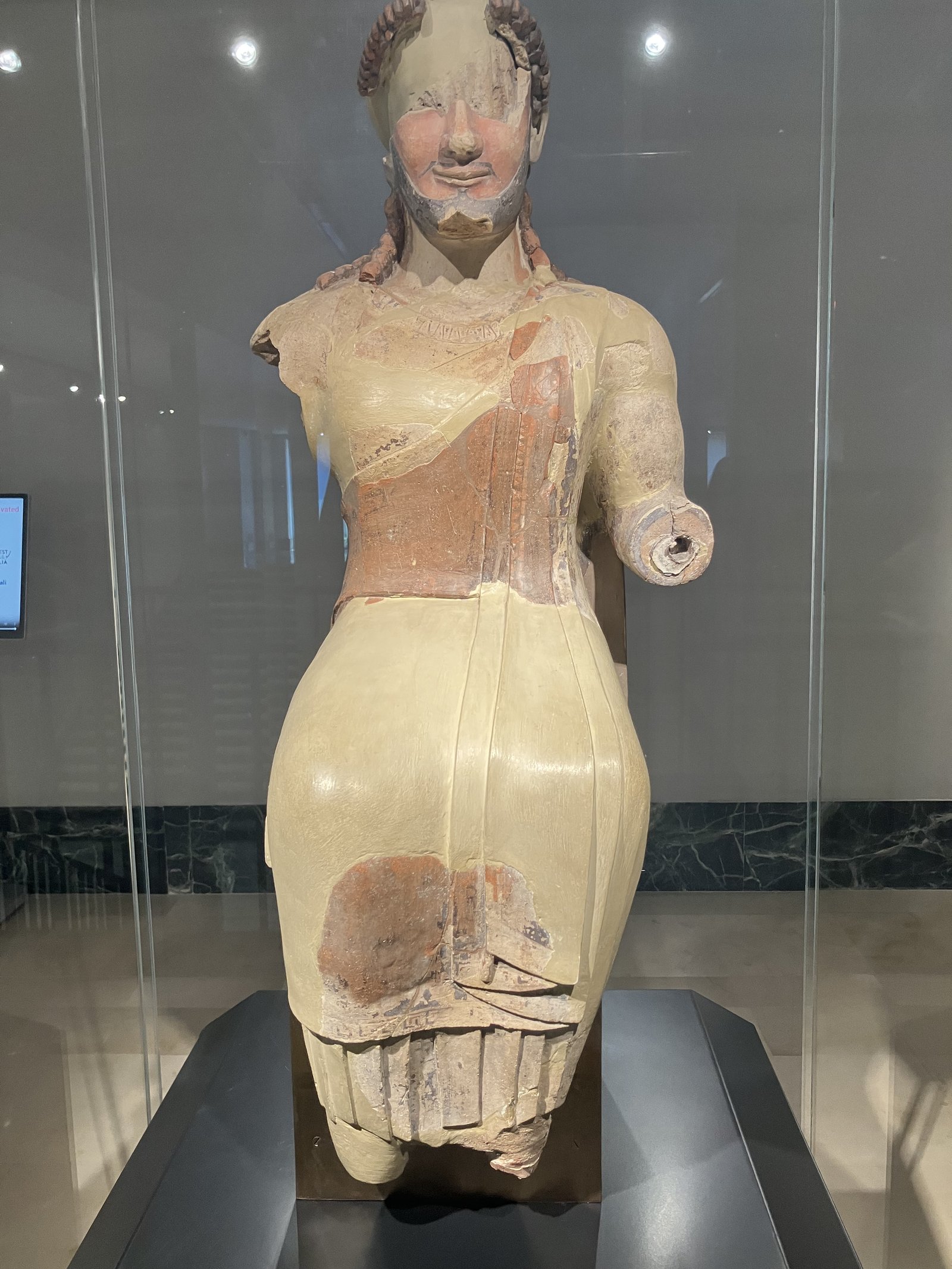
An archaic statue of Zeus in the National Archaeological Museum of Paestum, the face lifted in the archaic smile.
The Zeus of Paestum. Even he is smiling. Photo: Eva Winterer
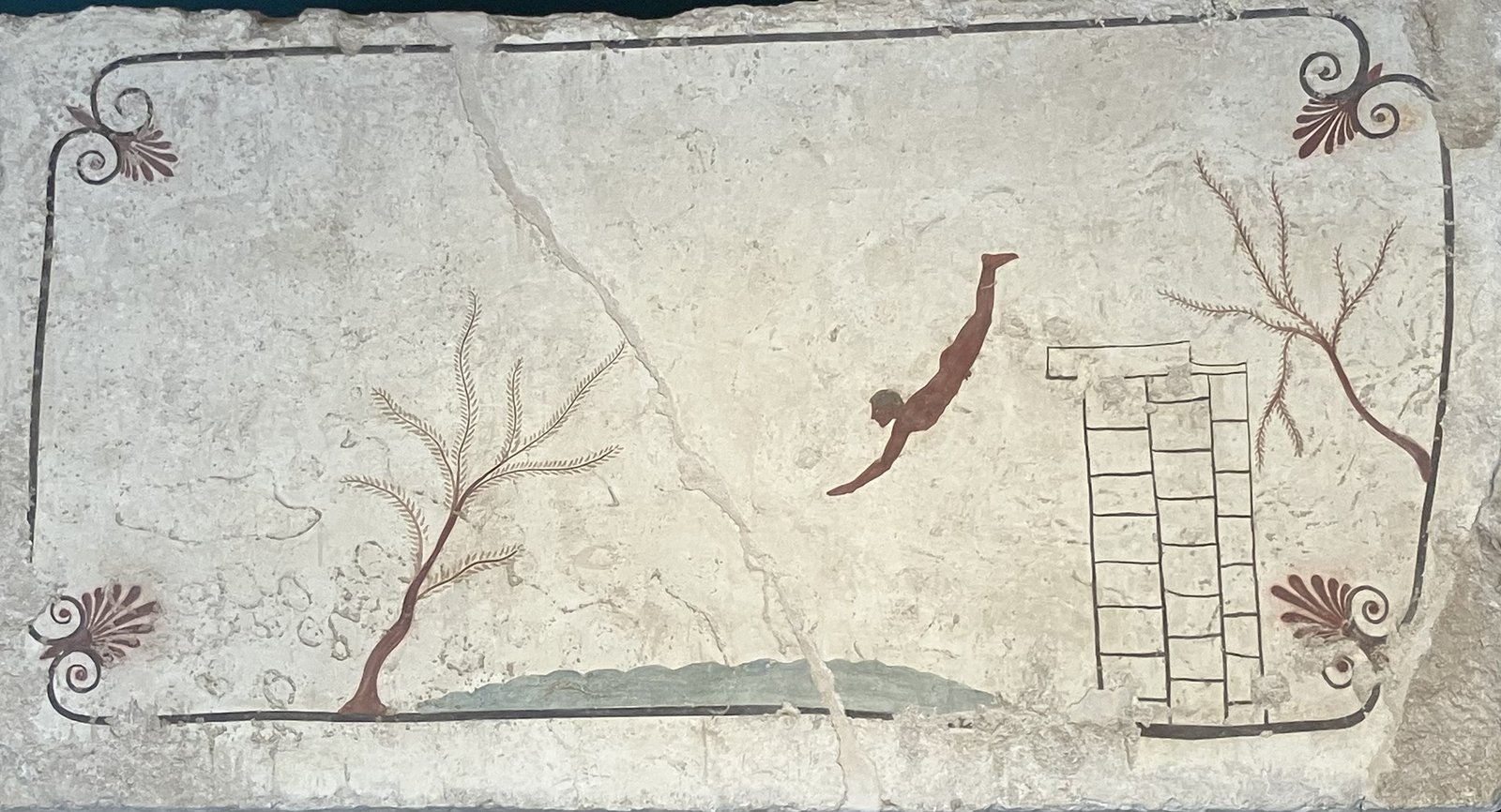
The fresco of the Tomb of the Diver at Paestum, a young man diving into water, painted around 480 BC.
The Tomb of the Diver, around 480 BC. The only surviving Greek figurative wall painting of its era. Photo: Eva Winterer

Even Zeus Smiles Here: Paestum and the Tomb of the Diver

The San Salvatore hotels sit at the Lido of Paestum, and Paestum is where the deep history of this coast becomes visible in stone. Greek settlers from Sybaris founded the city around 600 BC and named it Poseidonia, for the god of the sea. The Lucanians took it, and in 273 BC the Romans renamed it Paestum. What remains today are three Doric temples among the best preserved anywhere, the Temple of Hera from around 550 BC, the great Temple of Neptune from the middle of the following century, and the Temple of Athena on its higher ground.

Inside the National Archaeological Museum of Paestum stands a figure that gave me the measure of the place. The Zeus is an archaic statue, and archaic sculpture shows a particular expression, the corners of the mouth lifted into what art historians call the archaic smile. Standing in front of him, the thought arrived on its own. Even Zeus is happy here, because he is smiling.

The museum keeps something rarer still. The Tomb of the Diver, painted around 480 BC and found in 1968 a short way south of the city, gives us the one surviving Greek figurative wall painting of its era. A young man leaps from a platform into a stretch of water, a single clear image for the passage from one life into whatever follows. The idea reaches back along this same coast to Elea, where Parmenides had thought about being and permanence a few decades earlier. Paestum and Velia stand as the two Greek poles of the Cilento, one holding the temples, the other the philosophy, and between them the region learned early to think in terms of what lasts.


Borgo La Pietraia: A Concentrate, to Close

All of this began at Borgo La Pietraia, the house on the ridge where the region first came into view. The full story of that house, built like a home more than a hotel, waits in the piece on Borgo La Pietraia.

The Cilento shows that quality grows where respect for nature, knowledge and origin comes first. Where time is not an opponent. And where the future is thought in cycles. This is what slow hospitality looks like when a whole region lives it, the deeper current beneath the way its houses receive you, part of a larger conversation about slow hospitality and conscious travel.

Continue reading

Arianna and Raffaella Scariati stand either side of a turquoise door numbered 206, set into the dry-stone sandstone wall of Borgo La Pietraia.

Borgo La Pietraia: A Hotel Built Like a Home

Borgo La Pietraia rises in local sandstone above Paestum, where the Scariati family’s architecture and a kitchen drawn from the Cilento Blue Zone make the building feel like a home.

Borgo La Pietraia sits above the plain of Paestum in the Cilento, one of the original Blue Zones where the Mediterranean diet was first documented as a longevity practice. Built in 2007 by the Scariati family with architect Nicola Pagliara from local sandstone, the property is a slow hospitality hotel in the deepest sense: twelve rooms curved into the hillside, a kitchen rooted in the land around it, and a pace of days that the terrain itself sets.

The scent arrives before the building does. Rosemary, laurel, the dry warmth of stone that has been in the sun all afternoon. Giovanni Scariati planted more than seven thousand plants on this hillside above Paestum — cypresses, over a hundred olive trees, carob, herbs, fruit trees — and the landscape they have grown into in the years since 2007 now frames the twelve rooms of Borgo La Pietraia in a way that no architectural decision alone could have produced. The building and the terrain have grown together. That is what you feel on arrival, before a single door has opened.

The hillside sits at around 350 metres above the plain of Paestum, where three Greek temples have been standing for two and a half thousand years. On clear evenings, from the upper terrace where Ristorante Pietre serves its thirty guests, the temples are visible in the distance below, small and precise in the fading light, with the Tyrrhenian Sea behind them and Capri on the horizon. The Cilento is the original Blue Zone, the territory where researchers first documented the Mediterranean diet as a longevity practice. It was never designed. It grew from what the landscape gives and what the people living inside it learned, across centuries, to do with it.


When the Word Hotel Falls Short: Nicola Pagliara and Twelve Rooms in Sandstone

Borgo La Pietraia is not a hotel in the conventional sense, and the Scariati family has never tried to make it one. There is no classic reception, no lobby. A room designed as a living space leads into the grounds, and from there the twelve rooms — four Deluxe, seven Junior Suites, one Suite — are reached along paths bordered by the low dry-stone walls typical of this stretch of southern Italian hillside. The atmosphere is that of a borgo, a village, and the word is precise: scattered volumes in the green, the stone walls, the sense of a settlement that has found its form through use rather than through planning.

The twelve rooms all open onto private terraces facing the plain of Paestum and the sea. The Suite, twenty-nine square metres of quiet precision, is furnished with pieces from Pedrali, Emu and Designers Guild — selected with the same attention to material and proportion that the building itself carries. The architecture, by Nicola Pagliara, uses local sandstone as its primary material — the yellowish-grey arenaria of this hillside — with windows, doors and pergolas in strong colour: red, blue, green, yellow, the original colours of the Paestum temples reproduced in the architectural elements that punctuate the stone. The effect is neither nostalgic nor merely decorative. The building knows where it stands.

  • The upper terrace at Borgo La Pietraia at dusk — the plain of Paestum below, the Tyrrhenian Sea on the horizon, and the coloured architectural accents that echo the original pigments of the Greek temples. | Photo Courtesy of Borgo La Petraia

    A Hotel Built Like a Home

    Borgo La Pietraia

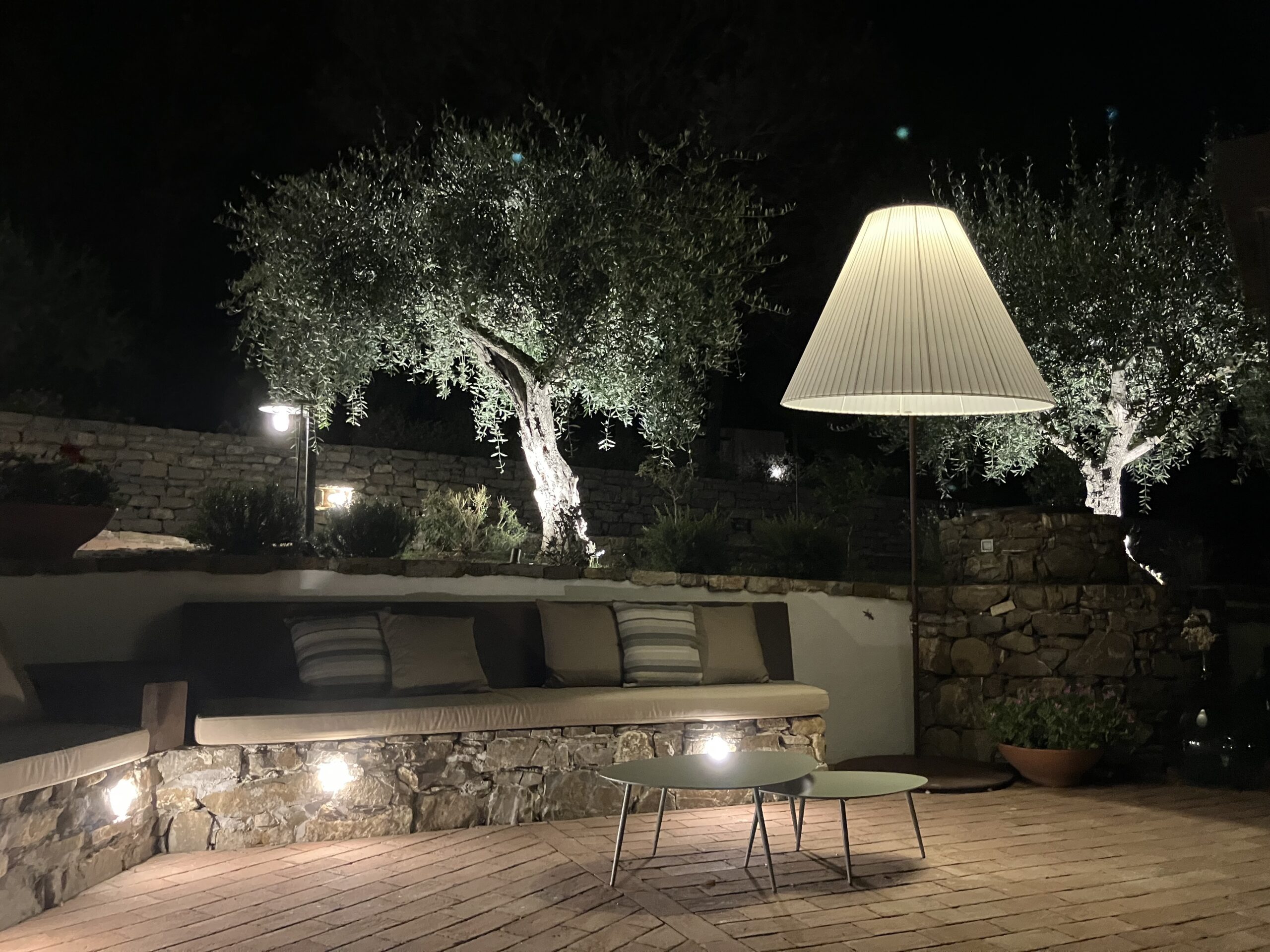
  • Borgo La Pietraia, Cilento: an evening on the terrace where the olive trees have been standing longer than the building around them. | Photo: The Silent Luxury
  • Aerial view of the Borgo La Pietraia terrace at sunset, guests dining above the plain of Paestum and the Tyrrhenian Sea, Cilento, southern Italy
  • Ristorante Pietre terrace at Borgo La Pietraia at golden hour, set tables with white linen and wine glasses, red columns in the colours of the Paestum temples, Cilento
  • Private terrace of a suite at Borgo La Pietraia, local sandstone walls, reed pergola, white garden chairs and flowering Mediterranean garden, Cilento
  • Junior Suite at Borgo La Pietraia, private terrace with green garden chair opening to light-filled room with local sandstone wall, yellow window accent and contemporary art, Cilento
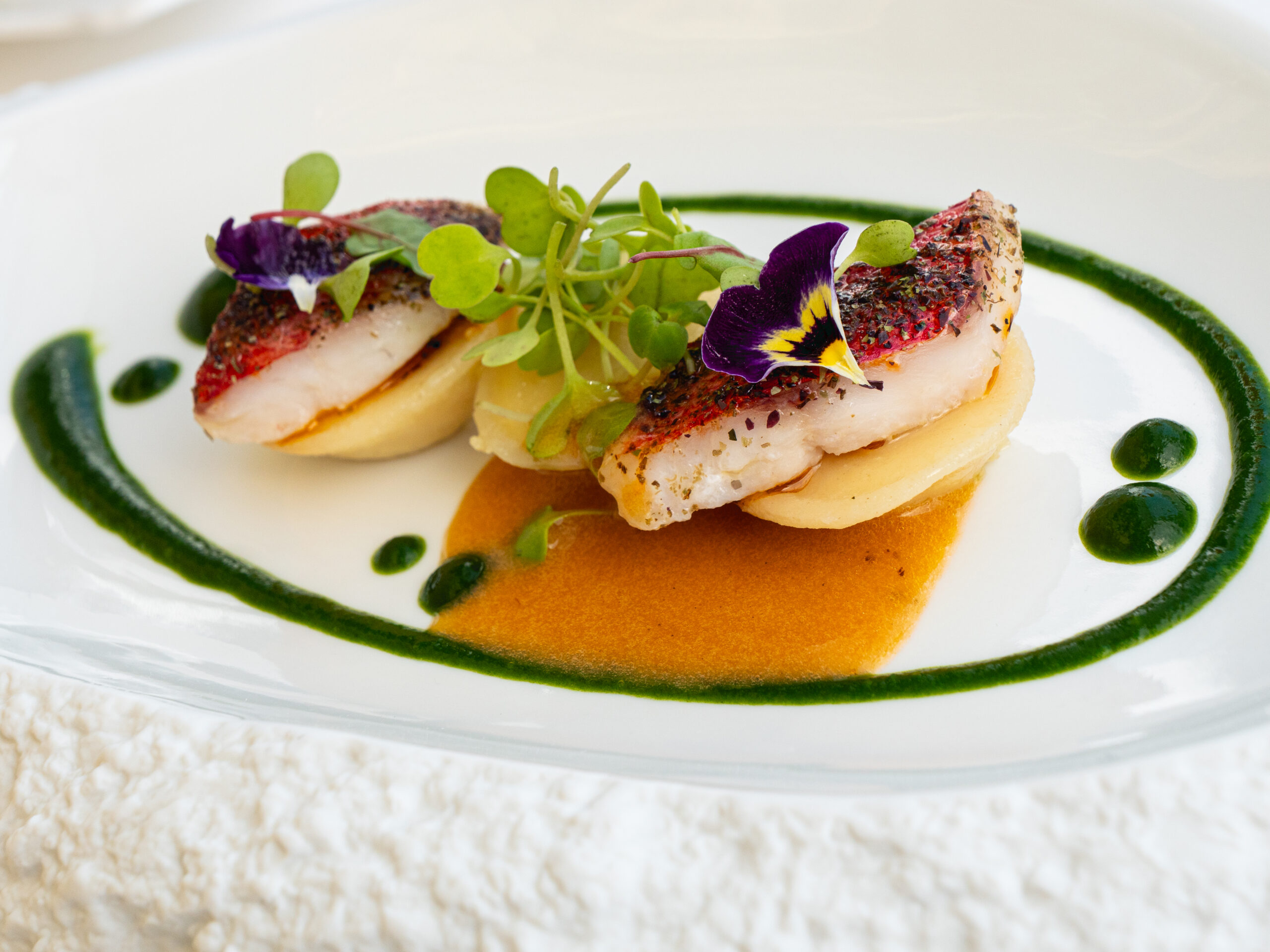
  • Dish by Chef Mario Stellato at Ristorante Pietre, Borgo La Pietraia — pan-seared fish with herb sauce, edible flowers and seasonal Cilento produce

A Conversation Between a Site and an Architect

Nicola Pagliara, professor at the University of Naples and one of the defining architects of the Cilento, died in 2017. His work, influenced by the organic architecture of Frank Lloyd Wright, Louis Sullivan and the Viennese school of Otto Wagner, understood buildings as what he called a conversation between matter and memory. When Giovanni Scariati invited him to see the hillside above Paestum, Pagliara was immediately drawn to it. The geographical situation, the panorama, the specific quality of the terrain — these were the material he wanted to work with.

His proposal was to follow the natural curvature of the road running up towards Capaccio-Paestum, a decision that required shaped iron beams and raised the construction costs considerably. Scariati agreed without hesitation, because the quality of the project mattered more than the budget. That exchange — between a builder who understood the value of the right decision and an architect who understood the intelligence of this particular place — is visible in every line of the building.

The planting that followed was Scariati’s own contribution to the project, undertaken personally, outside the architectural brief. The seven thousand plants he chose and placed over the years after construction give the property its specific sensory signature: the temperature modulation of the hillside in the hot months, the privacy between the terraces, the scent that meets you before you arrive.


Spaces · Slow Travel · Cilento

Borgo La Pietraia

Address

Strada Provinciale 13
84047 Capaccio Paestum (SA)
Cilento, Italy

Contact

+39 0828 1991999

info@borgolapietraia.com

borgolapietraia.com

Visit Website

The Kitchen as Landscape: Mario Stellato at Ristorante Pietre

Ristorante Pietre is open year-round, with thirty seats distributed between inside and the upper terrace. Chef Mario Stellato, born in 1990, trained with chef Paolo Barrale and returned to the Cilento to build his own project here. He is Arianna Scariati’s husband, and the kitchen he runs draws from what the property’s own garden produces and what the region around it offers by season. The cuisine is contemporary and deeply rooted: plant-forward, seasonally precise, built from the specific nutritional intelligence of this coastline. The Cilento Blue Zone is not a marketing claim. It is the accumulated consequence of what this land gives and what the people living inside it learned to do with it over centuries, and Stellato’s kitchen carries that knowledge into each plate.

Arianna and her sister Raffaella Scariati run the property today, continuing the work their father began. The warmth guests describe in review after review — the sense of being made to feel like family, the feeling that the hospitality is genuine rather than performed — comes from the same place as the architecture: from people who understand what this hillside is and have built something that serves it rather than competes with it.

What Remains: Giovanni Scariati and the Opposite of Ugly Building

Giovanni Scariati, speaking to the architecture journal akeda about the project, said: “Thank you, Nicola Pagliara, and thank you to everyone who believed in us. In many cases the Cilento has been damaged by ugly buildings. This project was meant to be the opposite of that.”

The opposite of that, in practice, turns out to be a place where the stone holds the afternoon warmth until late in the evening, where the olive trees planted by the owner filter the August heat into something bearable, where a terrace at sunset holds the plain of Paestum and the sea and the last light on the temples below, and where a kitchen rooted in the longevity traditions of one of the world’s original Blue Zones makes the connection between landscape and wellbeing entirely concrete. Borgo La Pietraia is a slow hospitality hotel in the sense that matters: built from the ground, held by a family, open to a landscape, the slow region of the Cilento, that has always known how to take care of the people living inside it.

Continue reading

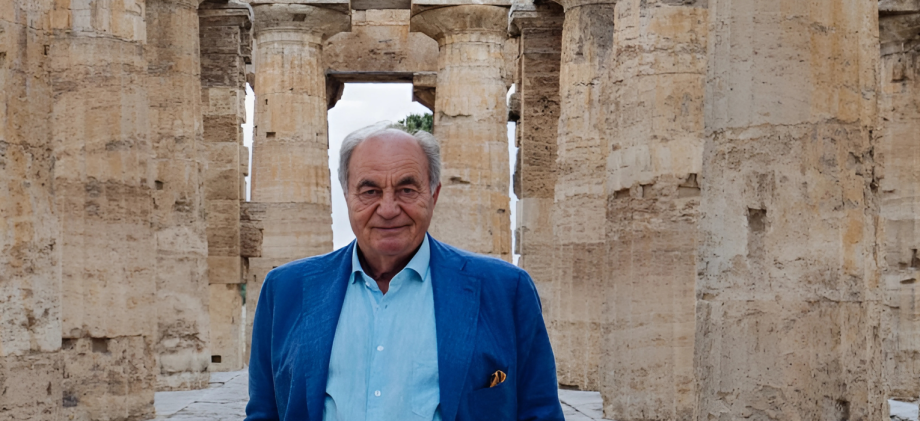
Giuseppe Pagano stands in a blue jacket between the weathered Doric columns of the Temple of Neptune at Paestum, the stone rising around him.

San Salvatore 1988: A Working Circular Economy in the Cilento

Above the plain of Paestum in the Cilento, Giuseppe Pagano runs San Salvatore 1988 as a closed loop. Around 750 buffalo turn their waste into twice the energy the winery, the caseificio and the estate’s hotels require. The viticulture is biodynamic, and in 2023 the estate received Robert Parker’s Green Emblem for sustainability.

In the heart of the Cilento, where time follows the rhythm of the sun and the soil, San Salvatore 1988 proves that true significance lies in the detail. It is a place where 750 buffaloes, ancient Greek history, and biodynamic viticulture converge. It is the living feeling of a Slow Region that doesn’t rush toward the harvest but waits for the perfect moment. Here, every wine is a testament to the belief that beauty is found in the integrity of the small things.

You must be able to hear the silence to understand Giuseppe Pagano. It’s not an empty silence that lies over the steep vineyards of his San Salvatore 1988 estate. It’s a silence filled with the hum of bees, rustling lizards, the calls of circling buzzards, the quiet rumination of 750 buffalo, and the almost imperceptible yet ever-present whisper of a 2,500-year-old history.

Here, in Cilento, south of the Amalfi Coast, time seems to follow a different rhythm. It’s a rhythm that Giuseppe Pagano, founder and owner of the San Salvatore 1988 winery, embodies. A man with alert eyes who speaks about the land where his vision became reality.

“Do you see that?” he asks as we stand on the first floor of San Salvatore 1988’s headquarters in Giungano before a large glass wall, looking toward Monte Calpazio. “Everything here is a cycle,” he begins, and his hand describes a wide arc. “There’s the biogas plant, next to it the silos. And the stables where our 750 buffalo live. They give us not only the milk for the best mozzarella but also the manure for our energy.”

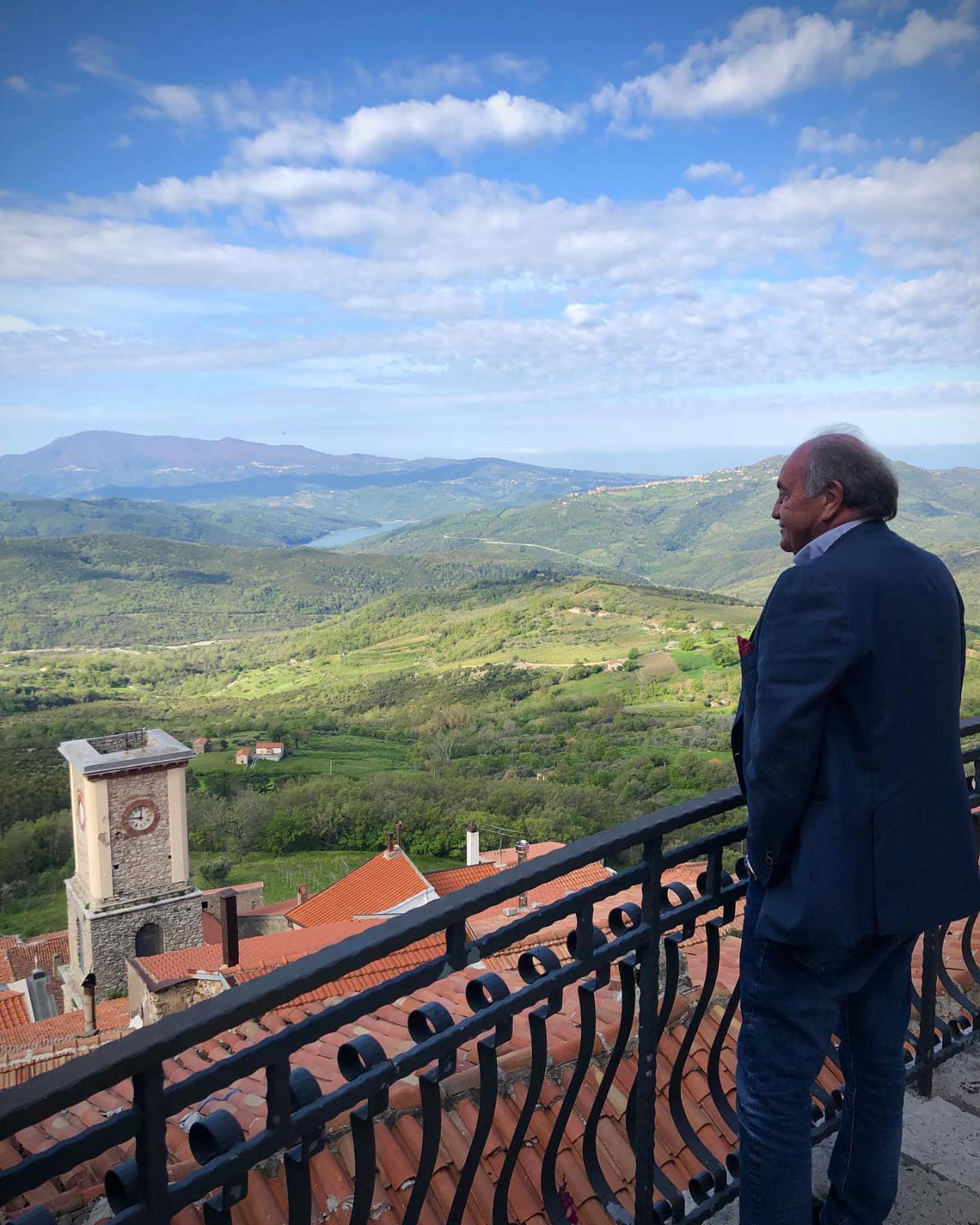
Giuseppe Pagano stands at a black iron balustrade above the terracotta roofs and stone clock tower of Giungano, the wooded hills of the Cilento falling away toward the sea.

In Short: Giuseppe Pagano surveys the land where philosophy was born from necessity.

Overlooking Cilento’s rolling hills—where San Salvatore 1988 vineyards climb from 200 to 750 meters, where 165 hectares stretch across the National Park, where ancient Greek colonies once turned winter storms into meditation—the founder of San Salvatore 1988 sees what the vines show him each evening. Terra-cotta roofs cluster around a stone bell tower below, testament to centuries of adaptation to imperivo terrain. Beyond unfolds the landscape that forced fishermen to philosophize when they couldn’t sail, that kept conquerors away through sheer impassability, that preserved Pre-Socratic wisdom in steep ascents where only measured pace allowed survival.

Here Pagano built his closed-loop system: 750 buffalo producing energy that powers not just his winery and dairy but feeds surplus back to the grid, biodynamic vineyards yielding 400,000 bottles annually, organic cycles that earned Robert Parker’s Green Emblem. Yet he comes to this viewpoint not to calculate kilowatt-hours but to listen—to what the land communicates without words, to the silence filled with buzzards and bees, to the rhythm that taught him Kalokagathia isn’t merely a word but the very architecture of how beauty and goodness become inseparable when you let terrain dictate tempo.

“The vines communicate with signs,” he says. “You just have to learn to see them.” From here, he sees everything: past, present, and the positive vision of future that drives someone who tends details without rushing yet moves quickly, who discusses morning plans with young buffalo, who spent years searching for a single word that could hold both aesthetics and ethics until Don Carlo whispered “Kalokagathia” and the Neptune Temple confirmed it at sunset.

Photo: San Salvatore 1988


Respect as Future Vision: 2.4 Million Kilowatt-Hours from 750 Buffalo

What Pagano describes here isn’t idyllic country life but a perfectly closed cycle. The biogas plant, combined with photovoltaic roofs, produces 2.4 million kilowatt-hours per year. “That’s exactly double what we consume as an entire company—winery, dairy, hotels,” he explains. “Even if we add the energy needs of our suppliers for corks, bottles, and labels, we remain in surplus.”

This demonstrates the lived philosophy of a place Pagano conceives as an “ethical system.” Respect is the word that falls again and again in conversation: “Respect is the foundation of everything. Respect for the environment that nourishes us. Respect for the animals. Respect for the people who work with us. Respect for those who enjoy our products—for their wellbeing and health.”

Yet it’s the many small details that make the difference for Pagano. He says: “Whoever does all these things must have an absolutely positive vision of the future. But to do things well, we must pay attention to details, without rushing yet quickly.” But how does this fit with slow hospitality?

How Slopes Shape Slowness and Soul: Parmenides, Zeno and the Fishermen of Elea

To understand the place, it helps to know the slow region of the Cilento around it.

“They say time passes more slowly in Cilento,” Pagano begins, leaning back slightly as if pulling ancient wisdom from the ground. “Many think we Cilentani are simply slow. But that’s only half the truth.” He describes a land that has always been impassable—imperivo. Steep ascents, dangerous descents. “Only those who adapted their pace to the terrain could survive here. Anyone who tried to take these mountains at a sprint long-term would literally have had their heart torn apart sooner or later.”

This forced deceleration created space for something else. The impassability and poverty kept conquerors away, thus preserving an ancient heritage: the Greek. “Cilento was poor,” says Pagano. “There were no riches to take here. So people preserved the traditions. It’s no coincidence that we still feel the DNA of Greek philosophy today.”

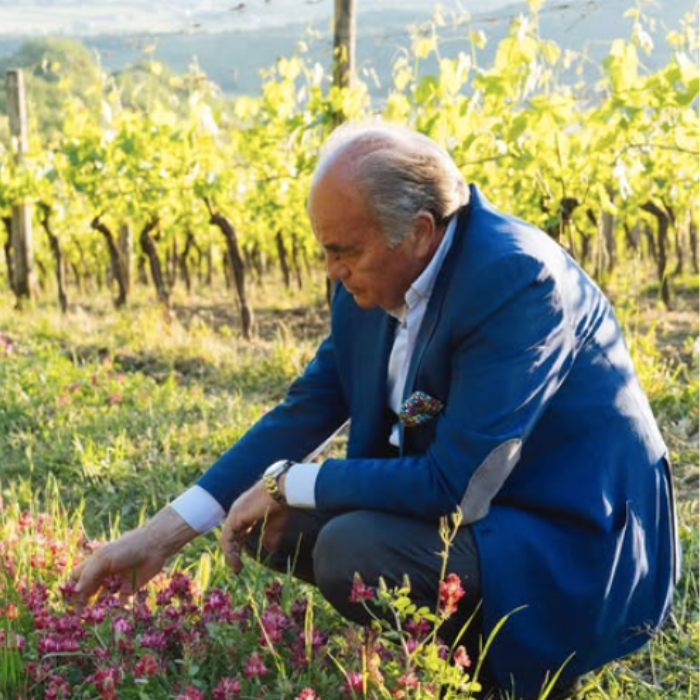
  • Giuseppe Pagano crouches among flowering pink cover crop between the vine rows of San Salvatore 1988, the vineyard in evening light behind him.
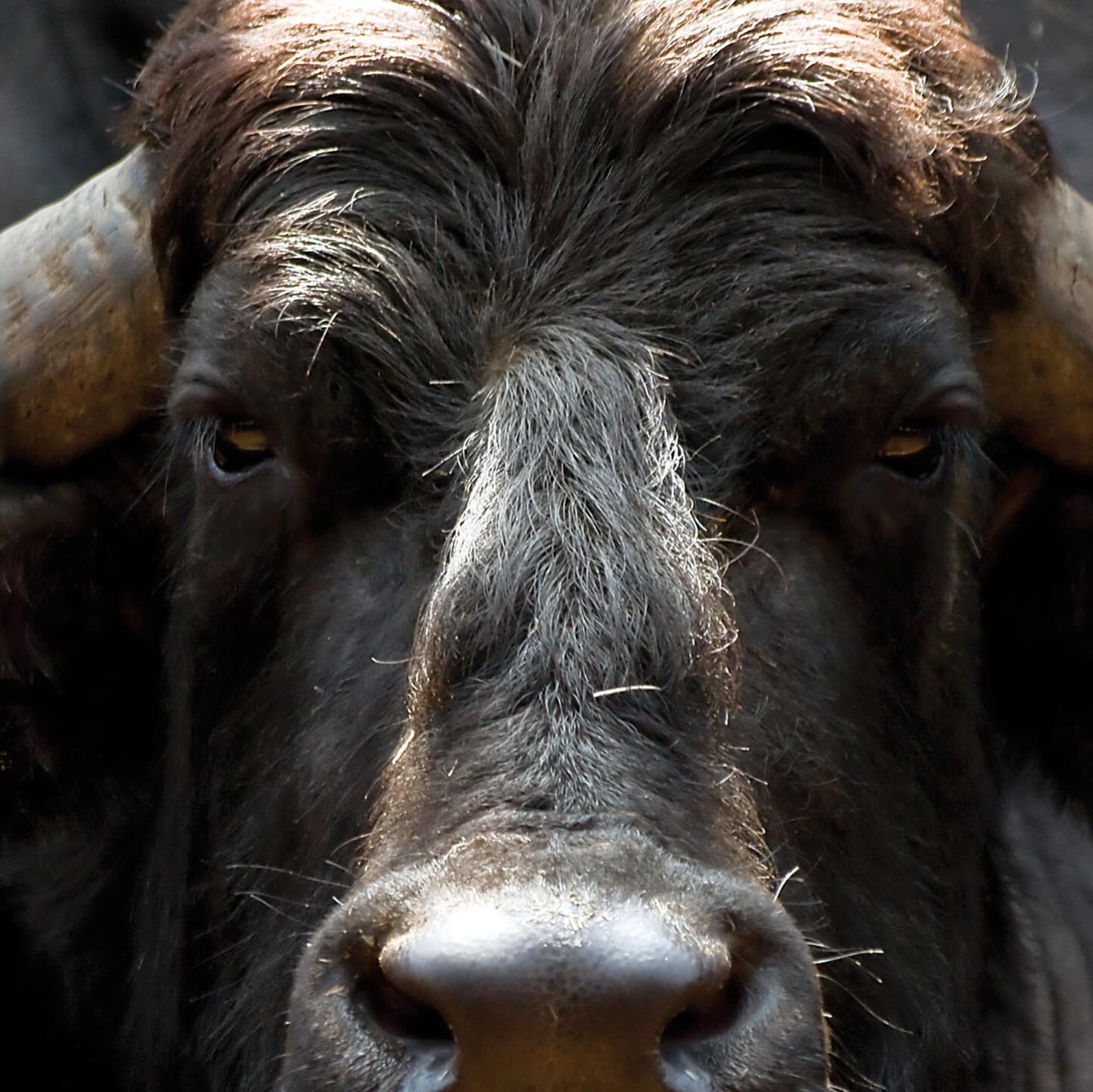
  • Close portrait of a dark water buffalo at San Salvatore 1988, horns and pale muzzle filling the frame.

Philosophy as Child of Necessity: Paestum, Elea and the Two Greek Colonies

Pagano tells the story of the two Greek colonies. There were the settlers of Paestum, farmers who cultivated fertile land at the mouth of the Sele River and built their magnificent temple complexes from local limestone—which endured all historical storms. And there were the founders of Elea, today’s Ascea. They were fishermen seeking rocky coasts and fish-rich waters.

“What did these fishermen do when winter storms raged and they couldn’t go out to sea for weeks?” Pagano asks rhetorically. “They ate their fish, rich in phosphorus, walked along the sea, and began to philosophize.” From these walks emerged the teachings of Parmenides and Zeno, the Pre-Socratics. A philosophy born as a child of necessity, leisure, and good nutrition. A DNA that, according to Pagano, still exists in Cilentani today: the ability to create something essential from the little they have. Giuseppe Pagano himself may be the best proof of his theory.


Green Emblem: Robert Parker’s 2023 Award and the Biodynamic Life Cycle

Rallenta. Cura. Memoria. Three simple words that are central principles in Giuseppe Pagano’s thinking. They stand for deceleration, for care, and for memory—not backward-looking but as awareness of time, cycles, and origin. From these three concepts unfolds the company’s self-understanding. Without time pressure, everything follows cycles: the rhythm of nature, growth, and responsibility.

This system was awarded the Green Emblem by Robert Parker in 2023. An international recognition for a small number of wineries taking a pioneering role in biodiversity, biodynamics, and ecological responsibility. But Pagano doesn’t speak about awards. He speaks about responsibility and about Kalokagathia.

The winery operates under the designation “Conduzione: Biologica.” 100% natural fertilizers are used, combined with a clear focus on organic farming. These principles apply throughout—from vineyard to livestock and dairy operations to fruit and olive cultivation.

The numbers speak for themselves:

  • 165 hectares of own land in Cilento and Vallo di Diano National Park, distributed across the municipalities of Capaccio-Paestum and Giungano
  • 42 hectares of vineyards at elevations between 200 and 750 meters
  • 4 hectares of fruit, 15 hectares of olive trees
  • 80 hectares of arable land for buffalo feed—cultivation of wheat, corn, hay, vegetables
  • 400,000 bottles of wine produced annually
  • 2,400,000 kilowatt-hours of energy, 50% fed into the public grid
  • 100% organic farming, certified

Kalokagathia: Don Carlo and the Search for a Word for Good and Beautiful

Kalokagathia runs as a central motif through the conversation: the search for one word that unites the beautiful and the good. Pagano tells how for years he searched for a term that could express this unity. Neither friends nor guests, neither dialects nor foreign languages offered him a solution. Until one day he sat in church and Don Carlo spoke of “il pastore bello e il pastore buono”—the beautiful and good shepherd.

After mass, he asked if there was a word for both in ancient Greek. Don Carlo answered: “Kalokagathia.” A concept that in ancient thought signifies the complete unity of aesthetics and ethics. Beauty that is simultaneously goodness. And goodness that cannot exist without beauty. Pagano was overwhelmed, he says. For him it was more than a linguistic discovery—it was a confirmation of his inner compass.

He carried the word with him. And it wouldn’t let him go. When he later stood before the Neptune Temple in Paestum at sunset, the concept became clear to him: “Beauty lies in proportion, in balance. That’s the outer form. But true goodness lies in duration. These temples have stood for 2,500 years. That’s substance.” Kalokagathia became the key for him—for personal action, for entrepreneurial thinking, for an approach to the world that connects duration and attitude.

A Name That Carries Stories: Salvatore, 1988 and the Two Eights

The name “San Salvatore 1988” is more than a brand. It’s a biography. Salvatore—that was his father. From him, Pagano learned love for wine. Until age 18, they worked together in viticulture, but then his father had to stop for health reasons. Giuseppe and his brothers began working in tourism. “You don’t always have to do what you like,” says Pagano. “Sometimes you have to do what’s possible—and learn to like it.”

The addition “1988” is also doubly significant: It’s the year Pagano married. And the year his son Salvatore was born. The two eights in the logo lie like the infinity symbol. A symbol for continuity, for future, and for responsibility across generations.

Buffalo Discussions and Plant Signs: How Pagano Reads the Vines

For Pagano, dealing with animals isn’t a technical task. Every morning he talks to his young buffalo. He explains what will be done, why it will be done, and how. Sometimes a young buffalo cow doesn’t agree—then they discuss. This may sound playful, but it’s an expression of an attitude: communication, respect, participation. Even with animals.

A similar approach shapes his relationship with the landscape. Often he goes to the vineyards in the evening. Fifteen minutes, alone, at sunset. Afterward he knows what needs to be done. Not because someone told him—but because the plants showed him. “The vines communicate,” he says. “Not with words, but with signs. You just have to learn to see them.”

Kalokagathia – What If…

At the conclusion of our conversation, Giuseppe Pagano’s philosophical DNA emerges again: “I often ask myself why modern languages haven’t adopted a word for Kalokagathia. If this word existed—if we had a single word that unites the beautiful and the good—we would be forced to think differently. We would learn that both are possible. Simultaneously. And I believe the world would be a bit better.”

Continue reading