Cilento: Concentrates, Cycles, Continuity
The Cilento in Italy’s Campania runs on cycles. Santomiele in Prignano Cilento dries figs for weeks without acceleration. San Salvatore 1988, awarded Robert Parker’s Green Emblem in 2023, powers its winery from 750 buffalo. In Pisciotta, Maria Coppola’s Antica Menaica works a catching method from antiquity that an EU directive treats as industrial trawling. At Elea, Parmenides thought about permanence.
Forty minutes south of the glamorous, crowded Amalfi Coast, another way of living begins. The Cilento is a slow region, and slowness here is a way of life, and the phrase means what it says. It gives up nothing of the elation of the coastal landscape, the steep cliffs, the villages that fold themselves into the rock. It gives up nothing of life itself. Silent by nature describes it well.
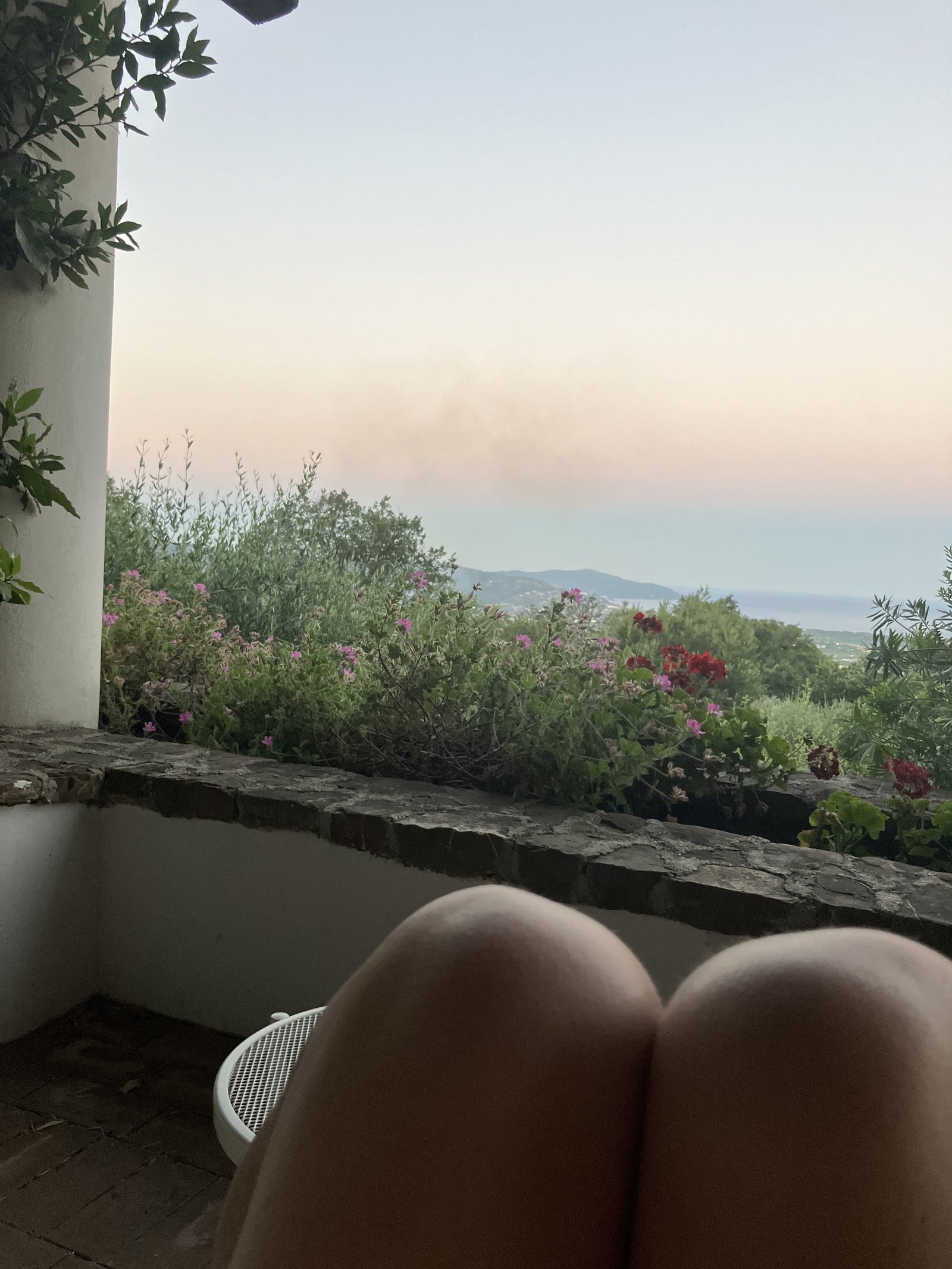
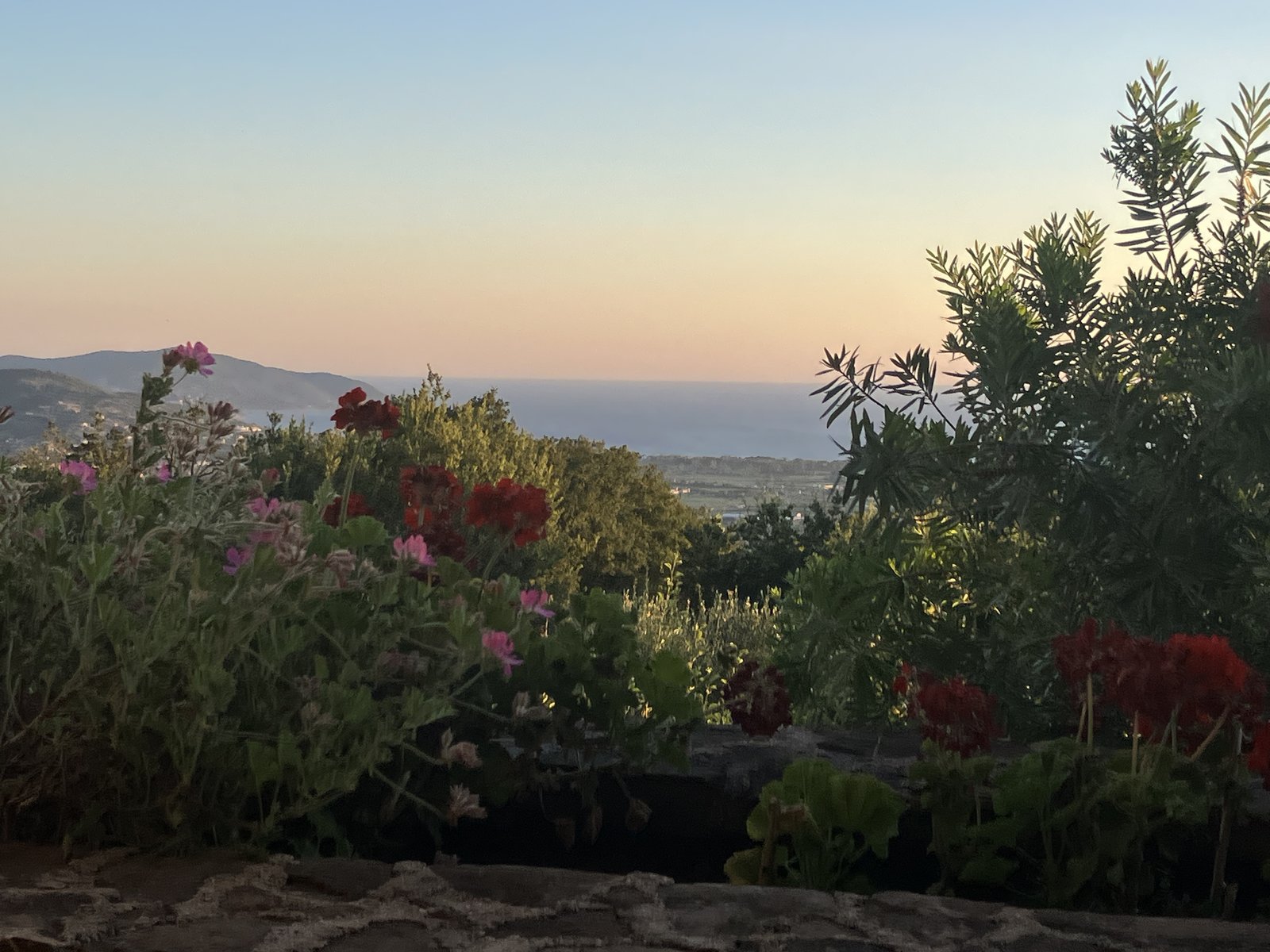
I came to the Cilento after two rest days on the terrace of Borgo La Pietraia, two molars lighter, and began the exploration from there: the nature of the place, its philosophy, and a handful of the companies that express that philosophy in what they make. The journey turned out to be surprising, funny, sweat-soaked, full of small revelations, and quietly philosophical. Everything, it kept turning out, is connected.
Four words describe the whole region, and they returned at every stop. Rallenta. Cura. Memoria. Kalokagathia. Slow down. Care. Memory. And the old Greek idea of the good and the beautiful in a single word.
Santomiele in Prignano Cilento: The White Figs and the Sweetness of Antiquity
Leaving the almost hypnotic panorama of the Borgo behind, the first real finding came within a few kilometres: mountain roads, many of them, and more of them narrow, with fiercely steep climbs. A navigation system that occasionally surrendered. Somewhere near Prignano Cilento, reversing hopelessly into a lane that kept getting tighter, I heard a voice from an older man: “Mädchen, das geht sich schon aus.” Girl, you’ll make it. Waving directions, he guided me out.
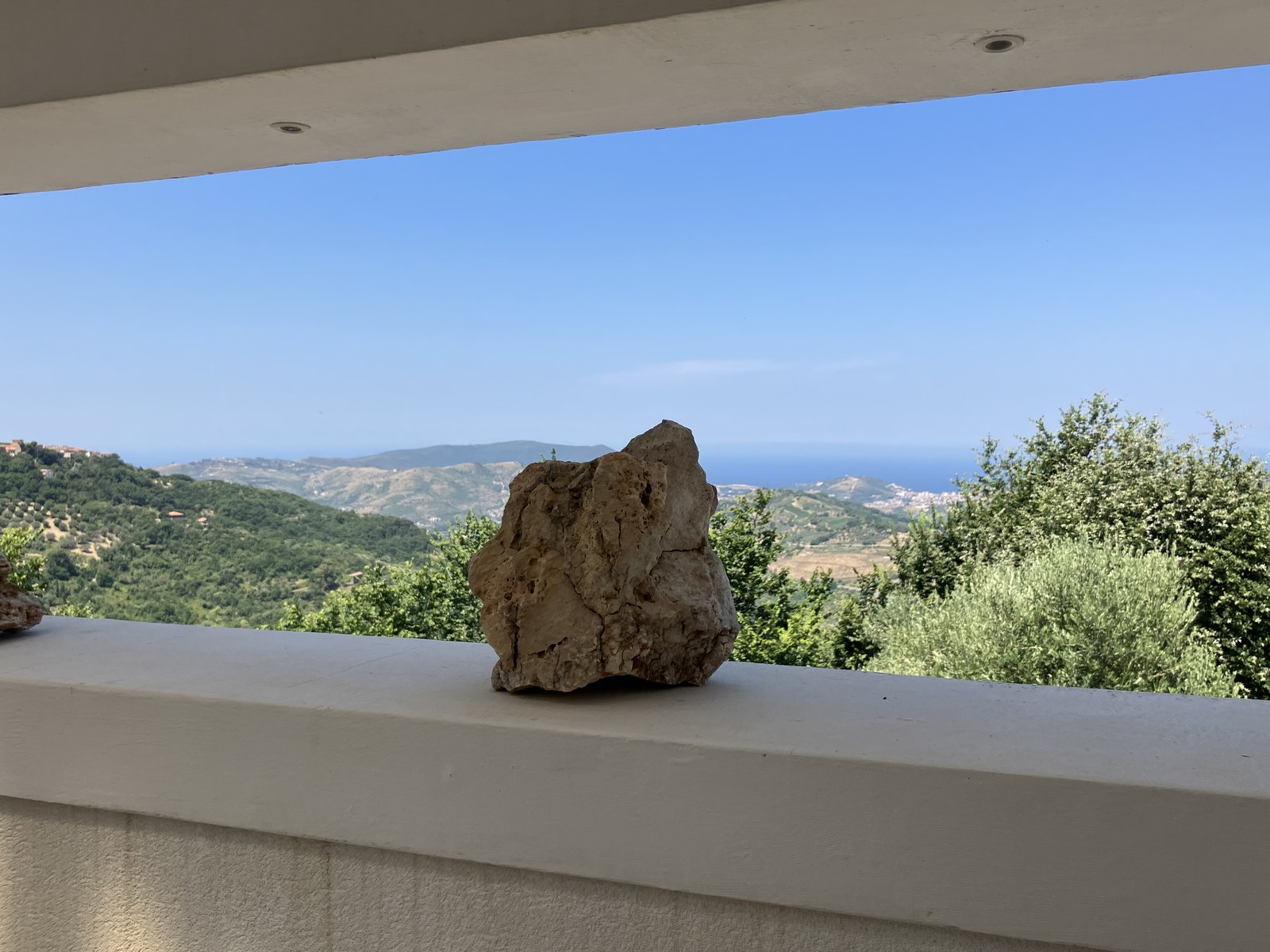
That was just before the first company visit, at Santomiele in Prignano Cilento. Two surprises arrived at once. The first was the position of the place, high on a mountain ridge with a view across the foothills to the sea. The second was Santomiele itself, a company that turns a fruit thousands of years old into a sensory experience, its design as considered and inventive as the tradition of fig cultivation it draws on.
A few facts in fast motion. Figs are barely grown in Europe any more; most come from the Middle East. Yet fig and olive trees, planted together, make excellent natural stabilisers against landslides. Santomiele works consistently organic. The drying of the fruit, harvested from late July and left without artificial acceleration, takes weeks. A by-product of that process is a sweet juice, worked into fig concentrate: a purely natural, plant-based sweetener and an aromatic alternative to refined sugar. In antiquity the same concentrate counted as a source of strength. Olympic athletes are said to have used it as a kind of natural doping.
The connection to the fig runs deeper on TSL in its own piece on Santomiele and the white figs of the Cilento, where the fruit, its roots in rock, and the economics of waiting have room to unfold.
Between Cemeteries and Elea: Parmenides and the Eleatic School
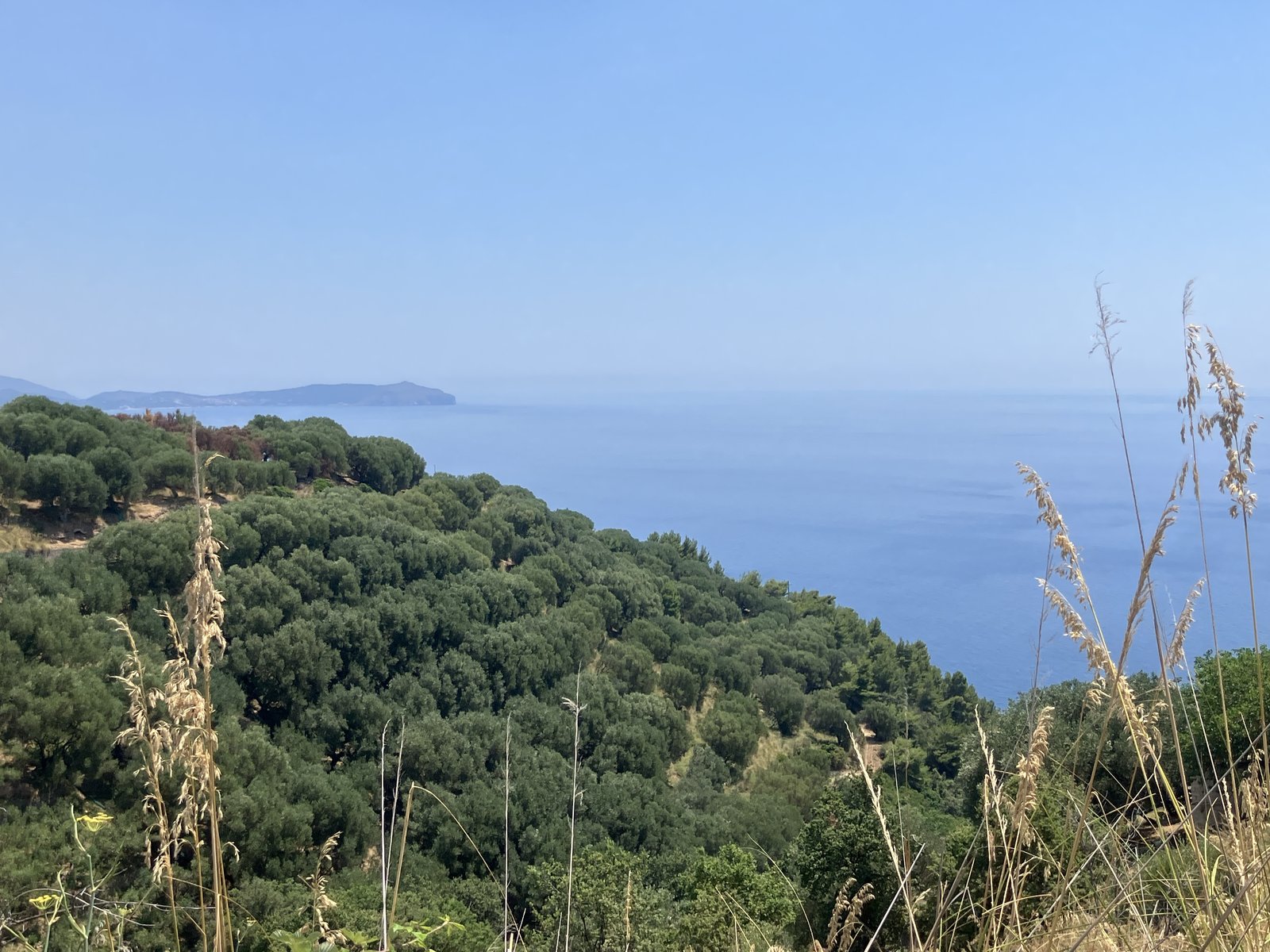
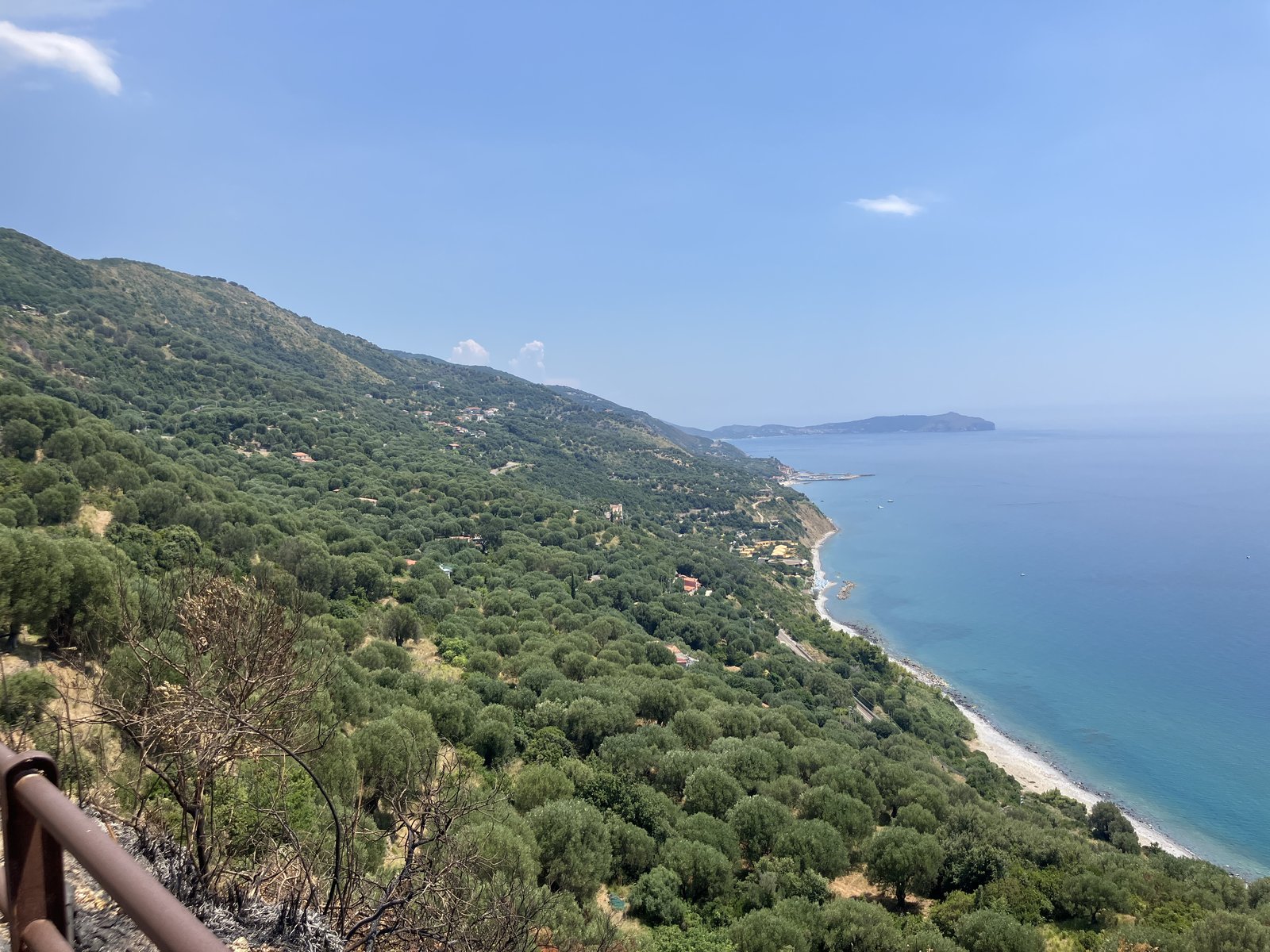
After a short cool-down in the church of Prignano, in this season a natural form of air conditioning, the road went on south toward Pisciotta. It kept a few more surprises ready. The route ran through the national park: deep-green wooded slopes, rivers still carrying water, and a pressing, sweat-soaked heat. After about an hour, a bend opened suddenly onto the cliff coast and the open sea behind it.
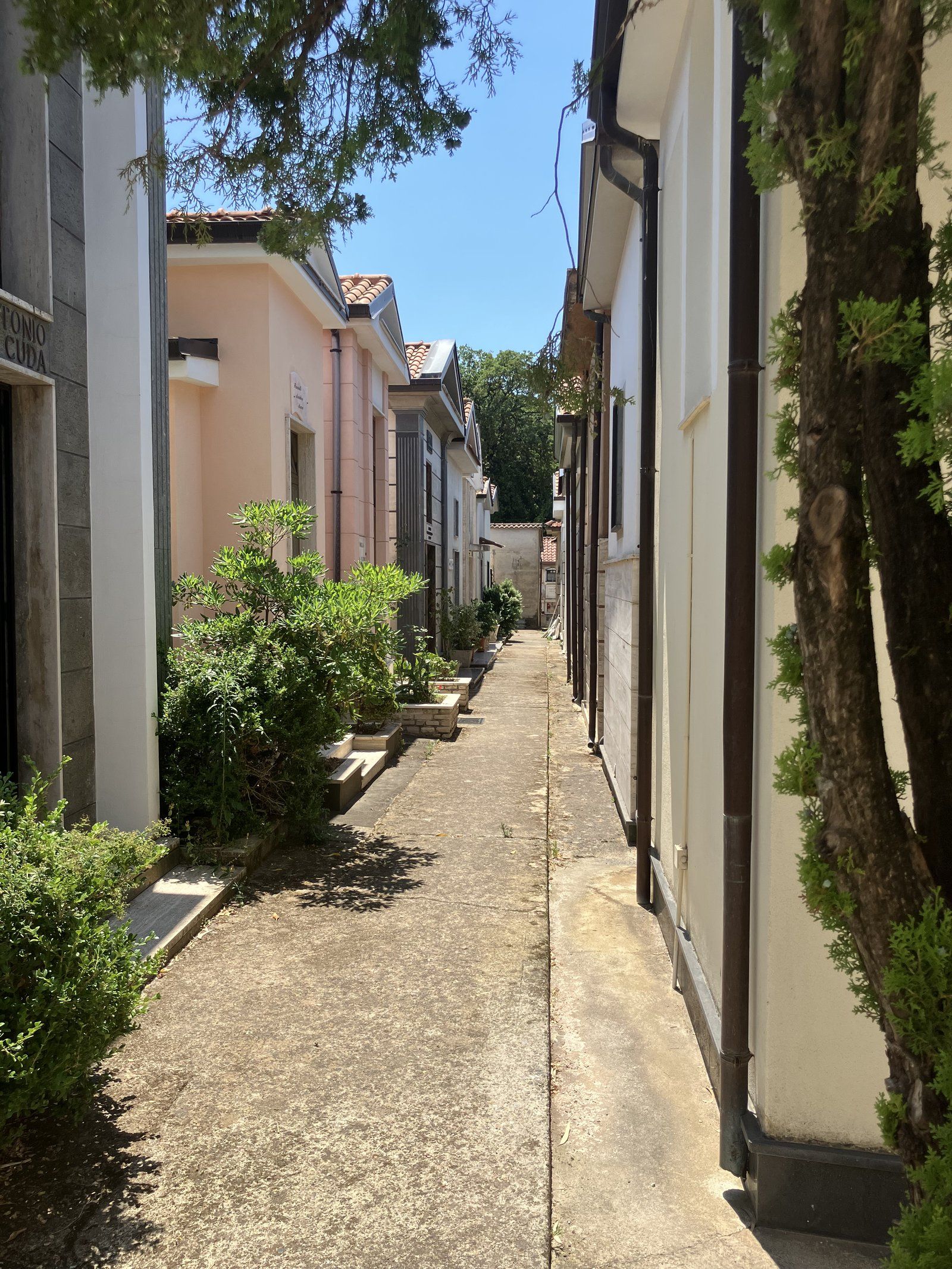
Finding a place to stop and photograph it, with both a view and somewhere to pull over, proved difficult. Then a shaded car park appeared. Instead of a viewpoint, I found myself in front of a cemetery that, to Austrian eyes, looked unusual: small temples, grave buildings like miniature houses, altogether an impressive ensemble.
The wall told me where I was. Ascea, known in antiquity as Elea, once a significant site of Greek antiquity and the starting point of the Eleatic school of philosophy. Parmenides and Zeno thought here, on this coast, about being and permanence. It is a fitting place for a region that measures value in cycles.
Pisciotta: Odysseus, Sirens and a Coast Road Slipping for Thirty Years
From the short stop, the coast road continued toward Pisciotta. Taken by the beauty of the cliffs, where Homer is said to have set the drama of Odysseus and the Sirens, my buoyant mood broke off as abruptly as the road did. A section had slipped away, the concrete buckled. A narrow gap between two concrete pillars stood open, and beside it the sign: no entry.
Was this to become my own personal odyssey, a wandering along the coast? Searching in a small panic for reading glasses and navigation, I heard not the voices of Sirens but the horn of a car and the voice of a woman: “Come along, you can drive through, I’ll go ahead of you.” The odyssey along several kilometres of single-track, undulating, steeply falling coast road, with sharp pitches in between, was in the end accomplished.
Arriving at my appointment at the Antica Menaica of Maria Coppola, I asked about the road and when it would be repaired. The reply was startling. It has been like that for thirty years. Every year it slips a little further. Beyond makeshift stabilising, nothing happens. A place of remoteness as an image of an enforced rallenta.
Menaica: Nets, EU Fishery Quotas and Garum
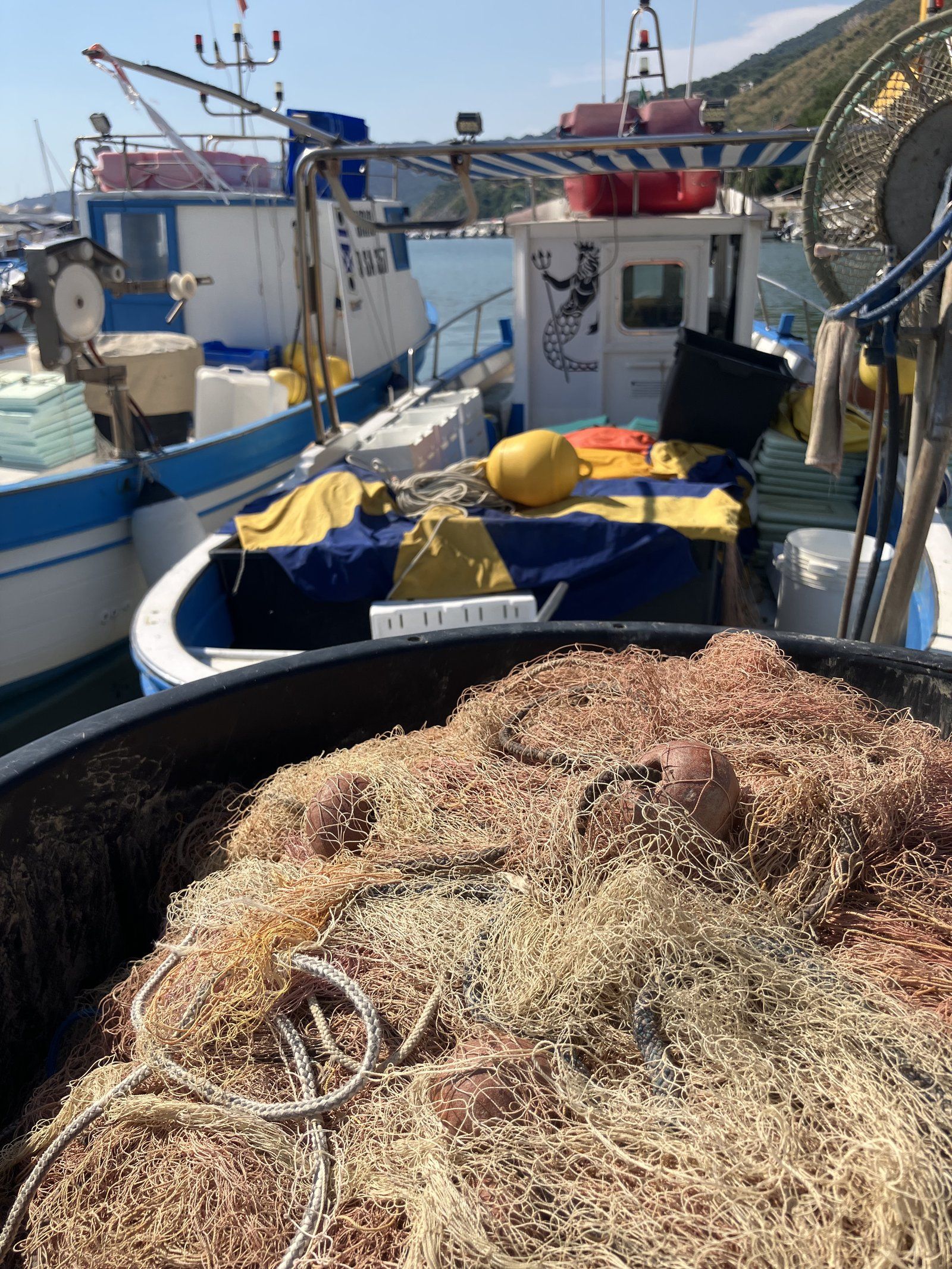
The traditional catching technique for the alici di Menaica uses special nets, selective ones, taking larger fish after the spawning season so the cycle stays intact. The nets are knotted as they were in antiquity, and the catch is layered by hand in salt troughs, pressed, and stored for several months. In the pressing, garum forms, the concentrated fish sauce the ancient Romans used as a standard seasoning, and which today finds a fresh interpretation.
The method stands, Coppola says, on the edge of disappearing, for two reasons. An EU directive treats the Menaica method as equivalent to large-scale trawling with dragnets. While industrial bag netting stays permitted, no new licences are issued to Menaica fishers. And anchovies are the favourite food of tuna, whose stocks off the Cilento coast are rising sharply because tuna fishing is capped by quota. Those quotas fall almost entirely to large international fleets. Small fisheries, faced with the high costs, are left without a chance.
San Salvatore 1988: Buffalo, Wine, Professionalism and Philosophy
The next day belonged to the buffalo: energy source, company financier, raw-material supplier, and the symbol of a working circular economy.
In a deeply philosophical conversation with Giuseppe Pagano, owner of San Salvatore 1988, a whole biodynamic system opened up, one recognised in 2023 with Robert Parker’s Green Emblem, an award for estates that take a leading role in sustainability, biodynamics and biodiversity. Pagano spoke about the philosophy of the company and of the region. About Kalokagathia, the togetherness of the good, in the sense of flourishing, and the beautiful, gathered into a single word that no longer quite exists.
The old Greek Kalokagathia describes, for him, what shapes the Cilento. Only in accord with nature are both possible at once. This region does not live on nostalgia. It shows how local resources are used intelligently while staying in a stable balance. The Cilento works as a slow region because it accepts the conditions of the landscape and lets them set the pace. San Salvatore’s own story, its buffalo and its biodynamic cycle, continues in the piece on San Salvatore 1988.
The conversation with Pagano was only the opening to the estate itself. Around 750 buffalo produce, through their waste, twice the energy the company’s operations require, from the winery to the caseificio, where buffalo milk becomes mozzarella, ricotta and yoghurt, through to a five-star and a four-star hotel at the Lido of Paestum. A note on taste: genuinely fresh mozzarella, made that morning, tastes salty. Only the time in brine turns it sweet. Here there is only fresh mozzarella. When it sells out, none is kept back.
Then the way into one of the vineyards. The view slides over the facing mountains, villages on their ridges, the land falling gently toward the sea, and a sun preparing its slow descent over the silhouette of the Amalfi Coast. Otherwise, silence. Marco Radano, export business manager at San Salvatore 1988, put it simply. “This is luxury. To stand here, to enjoy the quiet and the view over the vines and the land.”
The day ended with a philosophical look at the state of the world, and of life itself, in the Cantinetta of San Salvatore, together with Marco and Saverio, the oenologist. Reality returned quickly enough, in the form of a stop by the Carabinieri, who in the end asked how I liked Italy and how I found the food.
Even Zeus Smiles Here: Paestum and the Tomb of the Diver
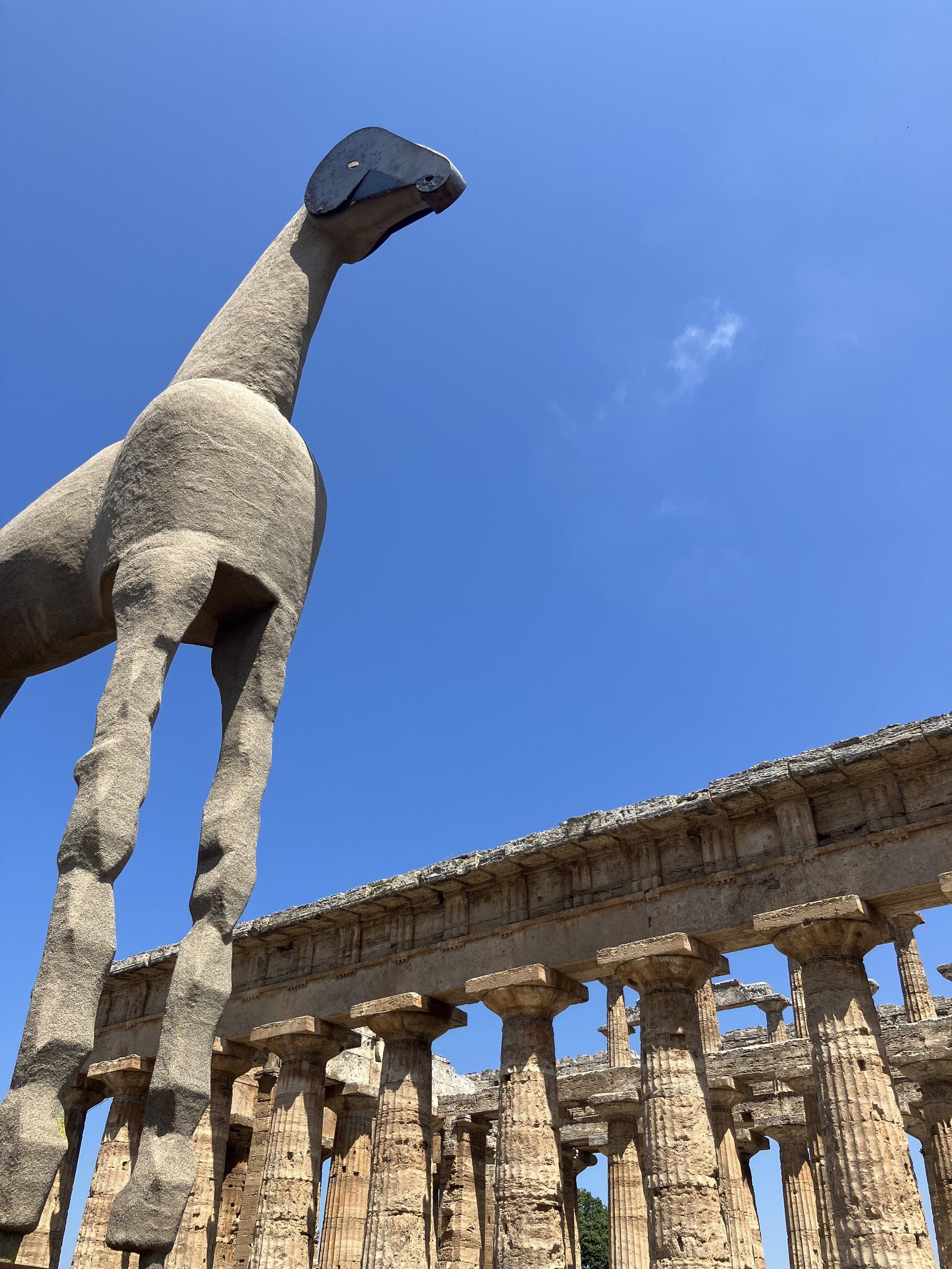
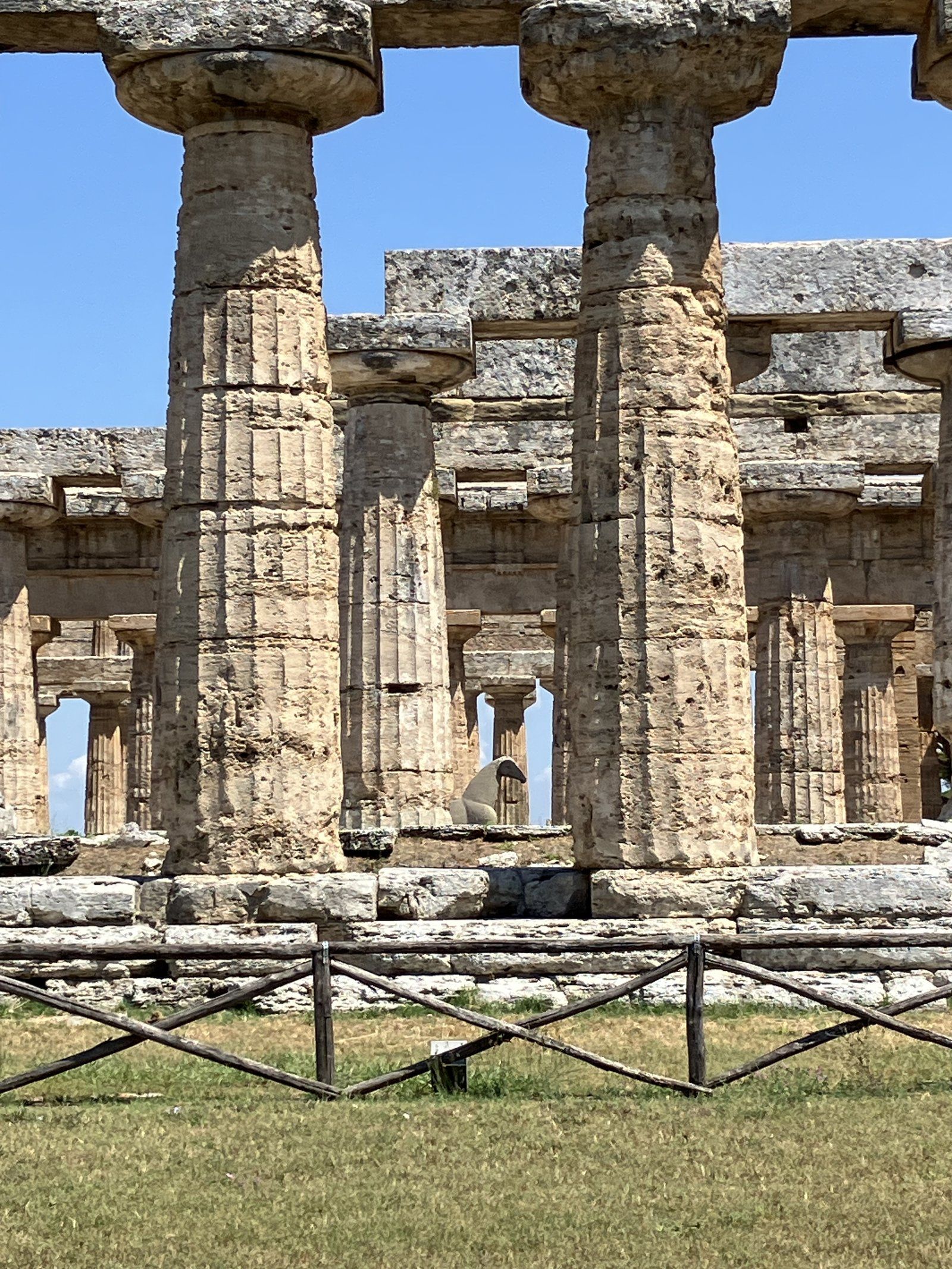
The San Salvatore hotels sit at the Lido of Paestum, and Paestum is where the deep history of this coast becomes visible in stone. Greek settlers from Sybaris founded the city around 600 BC and named it Poseidonia, for the god of the sea. The Lucanians took it, and in 273 BC the Romans renamed it Paestum. What remains today are three Doric temples among the best preserved anywhere, the Temple of Hera from around 550 BC, the great Temple of Neptune from the middle of the following century, and the Temple of Athena on its higher ground.
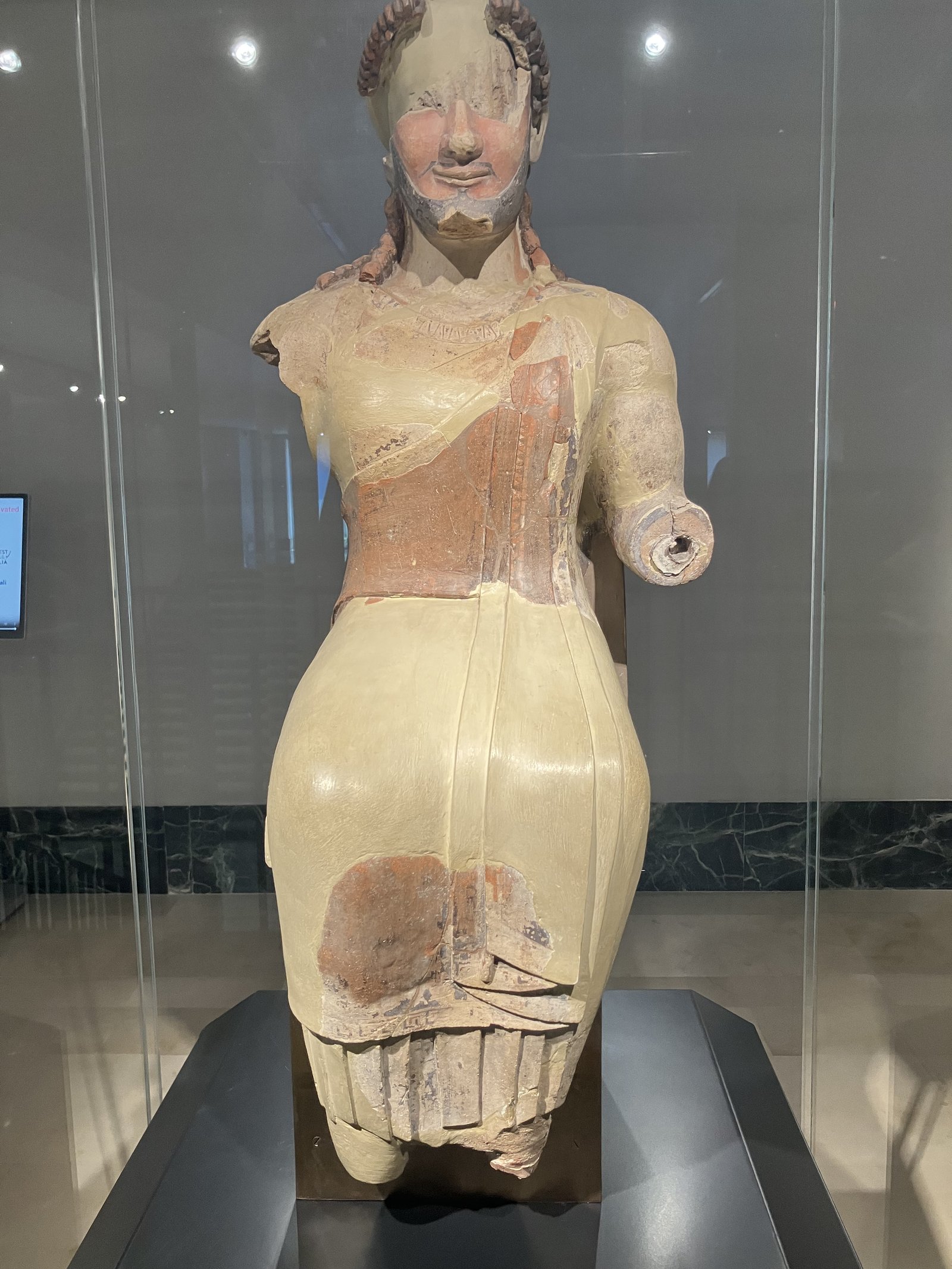
Inside the National Archaeological Museum of Paestum stands a figure that gave me the measure of the place. The Zeus is an archaic statue, and archaic sculpture shows a particular expression, the corners of the mouth lifted into what art historians call the archaic smile. Standing in front of him, the thought arrived on its own. Even Zeus is happy here, because he is smiling.
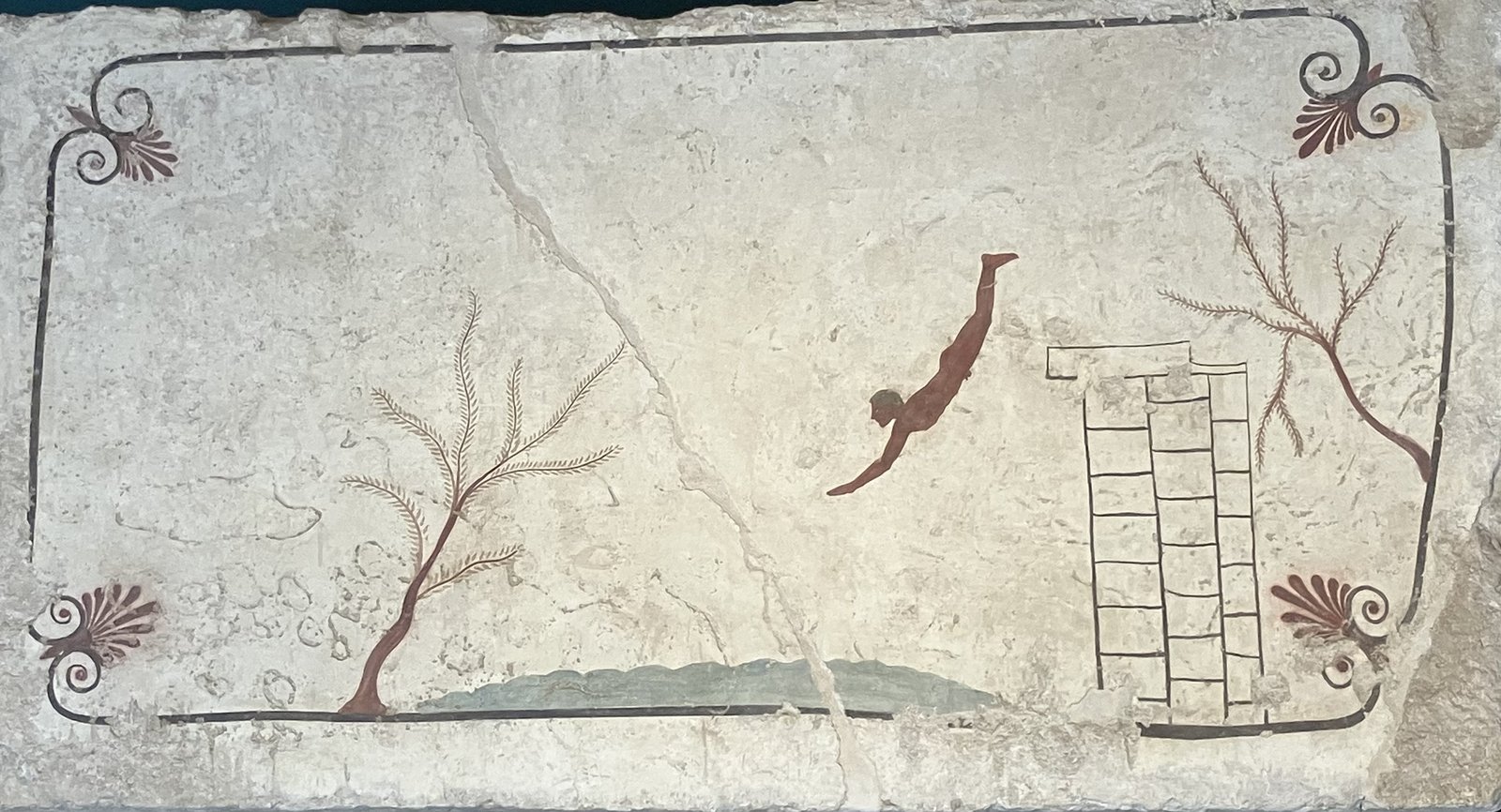
The museum keeps something rarer still. The Tomb of the Diver, painted around 480 BC and found in 1968 a short way south of the city, gives us the one surviving Greek figurative wall painting of its era. A young man leaps from a platform into a stretch of water, a single clear image for the passage from one life into whatever follows. The idea reaches back along this same coast to Elea, where Parmenides had thought about being and permanence a few decades earlier. Paestum and Velia stand as the two Greek poles of the Cilento, one holding the temples, the other the philosophy, and between them the region learned early to think in terms of what lasts.
Borgo La Pietraia: A Concentrate, to Close
All of this began at Borgo La Pietraia, the house on the ridge where the region first came into view. The full story of that house, built like a home more than a hotel, waits in the piece on Borgo La Pietraia.
The Cilento shows that quality grows where respect for nature, knowledge and origin comes first. Where time is not an opponent. And where the future is thought in cycles. This is what slow hospitality looks like when a whole region lives it, the deeper current beneath the way its houses receive you, part of a larger conversation about slow hospitality and conscious travel.
Similar Articles
The Second Row: Das LOFT and the Architecture of Hospitality in Vienna
The Store Is the New Runway: Gucci and Moncler Turn Shopping Into an Experience
Villa Nava: The Spaceship That Became a Home