50 Best Vineyards 2026: Schloss Johannisberg Wins, and the Map Moves to France
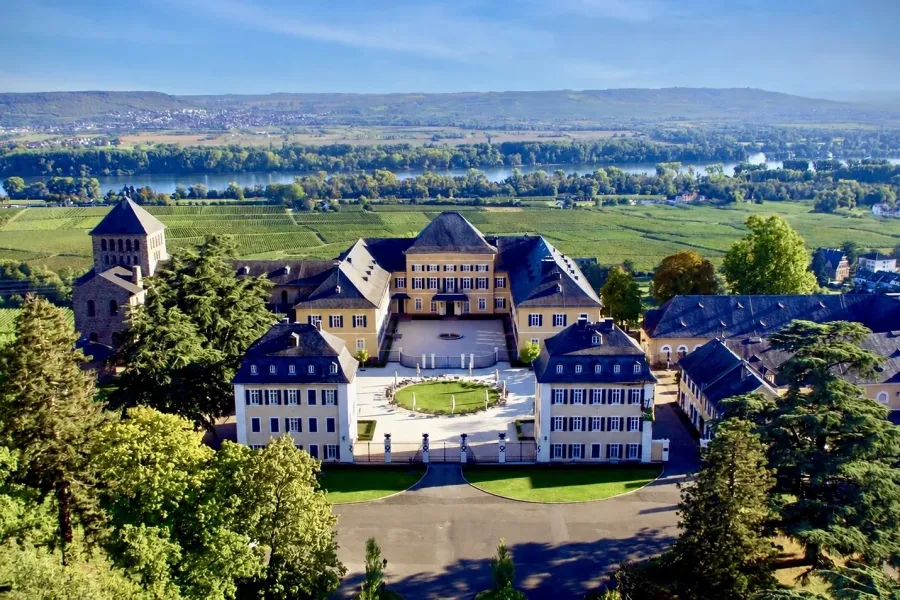
Aerial view of Schloss Johannisberg with its courtyard, basilica and vineyards sloping towards the Rhine, with the river and the hills beyond. Schloss Johannisberg above the Rhine, No. 1 in The 50 Best Vineyards 2026. Courtesy of Schloss Johannisberg, photo Christian Düringer / Rheingaugold
The 50 Best Vineyards ranks wine estates by the whole visit, from hospitality to the wine, and its 2026 list puts Schloss Johannisberg in the Rheingau at No. 1. Behind the winner, France gains nine estates in the top 100, the United States loses ground and Champagne becomes a hospitality region.
Eva Winterer
The 50 Best Vineyards named Schloss Johannisberg the world’s best vineyard on 18 November in Santiago de Chile. The prize rewards a Rheingau estate for what a visitor finds there: a palace above its vineyards, a vaulted cellar and a Riesling story told on the spot. Voters judge the whole visit. Its 2026 edition moves the weight of wine tourism towards France and the edges of Europe. The estate, owned by the Oetker family through Henkell Freixenet, rose from eighth in 2023 to fifth and then second. It is the first German estate at No. 1.
The winner is one part of a larger shift. France now holds 23 places in the top 100, up from 14 a year ago. Champagne houses rose from six to nine. The United States fell from seven estates to four in the top 50. Japan, with two estates in the top 50 last year, left the top 100 altogether. The New World’s share of the top 50 held at 54 per cent. The movement runs mostly inside the Old World, towards Bordeaux and Champagne and out to Georgia, Hungary and Santorini.
Hospitality, Atmosphere, Wine: How the 50 Best Vineyards Is Voted
The 50 Best Vineyards is voted by more than 700 wine and travel experts, who judge an estate the way a guest would. Sommeliers, wine writers, travel specialists and seasoned wine lovers from 20 regions nominate seven “vineyard experiences” apiece. Each region has its own academy chair. Voters work without a fixed scoring system. They are asked to consider “the overall quality of the visitor experience, including hospitality, atmosphere, activities and wine offering”. The wine is one of four things a voter weighs.
The rules keep the panel moving. At least a quarter of the voters in each region change every year, and ballots stay confidential. From 2026 an estate needs votes from at least two countries to be eligible, a guard against regional blocs.
Under these rules, heritage becomes something a guest can walk through. Schloss Johannisberg has grown only Riesling since 1720, when the whole estate was planted with the grape. It tells the story of a delayed harvest order in 1775 that produced the first Spätlese. Below the palace, a cellar finished in 1721 holds the Bibliotheca Subterranea, whose oldest vintage dates from 1748. The press release for 2026 lists palace grounds, vineyards, historic cellars and guided tastings with views across the Rheingau. The estate also runs a restaurant and a programme of cultural events.
Eight, Five, Two, One: Schloss Johannisberg’s Climb to No. 1
Schloss Johannisberg reached the top in steps, and the last one came when the estate above it left the field. The house was eighth in 2023, when it was also third in Europe. It was fifth in 2024 and second in 2025, behind Vik in Chile. In 2026 Vik was off the ballot. Past winners now sit in a group the organisers call the Best of the Best. The 2026 press release states that they “were therefore not eligible for voting”: Vik, Marqués de Riscal, Catena Zapata, Antinori nel Chianti Classico and Zuccardi Valle de Uco.
The rule turns the list into a rotation. Zuccardi won three times in a row, from 2019 to 2021. The bar on former winners can therefore date from 2022 at the earliest, and the exact year remains unpublished. Last year the press release still spoke of a “Hall of Fame”, a term the 2026 release drops.
The same mechanism decided the restaurant list two weeks earlier. Asador Etxebarri became No. 1 at The 50 Best Restaurants after finishing second in 2024 and 2025 behind winners who are now barred. William Reed runs both rankings. For Schloss Johannisberg the result is a single title with a fixed end. From 2027 the estate joins the Best of the Best. Bodegas Ysios in Rioja and Montes in Chile’s Colchagua Valley, now second and third, begin the next vote closest to the top.
Europe’s Edges and France: Where the Best Vineyards Are Now
The best vineyards on the 2026 list sit increasingly in France and on the margins of Europe. France leads the top 50 with nine estates, up from seven. In the top 100 it climbs from 14 to 23. Bordeaux carries much of that rise. Haut-Bailly, Mouton Rothschild, Palmer and Domaine de Chevalier join the top 100, alongside Smith Haut Lafitte, Yquem, Pape Clément and Pichon Baron in the top 50.
The United States moves the other way. Its share of the top 50 falls from seven estates to four. Joseph Phelps and Maysara drop out of the top 100, and Robert Mondavi slides from 39 to 88. Shafer Vineyards in Napa Valley enters at 34. In October The Silent Luxury reported on Napa Valley, where wine tourism has met its limit. The list now shows a thinner American presence. Japan leaves the top 100 after two placings last year, 98Wines at 20 and Château Mercian Mariko at 46. In East Asia only Silver Heights in Ningxia remains, at 94.
Europe’s edges fill part of the space. Georgia has two estates in the top 100, Château Mukhrani and Shumi. Hungary has two, with Szepsy back in the top 50 at 30 and Sauska at 74. Bulgaria has Midalidare at 81. Aya Estate in Bulgaria’s Struma Valley received the first One to Watch award without a place on the list. Santo Wines on Santorini enters at 100.
The New World holds its share. Estates from the Americas, Oceania and South Africa fill 27 places in the top 50. That is 54 per cent, exactly as in 2025. Chile keeps seven estates in the top 50 even without Vik, two of them in the top ten. South Africa doubles from two to four. Some of the steepest climbs came from below the top 50. By The Silent Luxury’s own count, Château Kefraya in Lebanon rose from 92 to 18. Clos Apalta in Chile climbed from 65 to 6 and Quinta do Crasto in the Douro from 67 to 16. The official Highest Climber award went to Champagne Taittinger, up 39 places. Whether moves from the 51–100 list count for that award remains unpublished.
Champagne as a Destination: Ruinart, Taittinger and Wine Tourism
Champagne has become the list’s strongest hospitality region. Nine Champagne houses stand in the top 100, against six a year ago, and four are in the top 50. Maison Ruinart rose from eight to four and Champagne Taittinger from 50 to 11. Champagne Philipponnat, part of the Lanson-BCC group, moved from 76 to 47. Champagne Bollinger fell from 15 to 37 and keeps its place in the top 50.
Groups and families share the ranking. Ruinart, Moët & Chandon at 52 and Veuve Clicquot at 62 belong to LVMH. Maison Pommery at 61 belongs to Vranken-Pommery Monopole. Across all regions, LVMH has five estates in the top 100 this year: Ruinart, Yquem, Cloudy Bay, Moët and Veuve Clicquot. That is one fewer than in 2025, after Joseph Phelps dropped out. The winner belongs to a family. Schloss Johannisberg is part of the Oetker group and is privately held.
Champagne’s houses are opening their doors in a lean year for their vines. In September The Silent Luxury reported that the 2026 Champagne harvest fell by 47 per cent. France as a whole brought in its smallest harvest since 1957. The two facts stand side by side. The list records how many of the region’s houses now win votes as places to visit.
Who Carries the Ranking: William Reed, Santiago and the 50 Best Vineyards
The 50 Best Vineyards is a media product of William Reed, which “organised and published” the results. In September the company gathered its lists under the single brand The 50. Rikki Tidball, managing director of awards and rankings, framed this year’s edition as a celebration of wine tourism. “We are delighted to celebrate the people, places and experiences that make wine tourism so compelling,” Tidball said, “inspiring travellers to discover the world’s most remarkable vineyard destinations for themselves.”
The ceremony moves to a new host each year. The ceremony went to Nyetimber in West Sussex in 2024 and to Margaret River in Western Australia in 2025. This year it came to Santiago de Chile, the Official Host Destination Partner, and Viña Don Melchor hosted the evening.
Sponsors attach their names to the awards. LATAM Airlines presents Best Vineyard in South America, and Lexus the Highest Climber. Grupo Liderazgo backs the new One to Watch award. SevenRooms, a booking platform, presents the new Icon Award. It went posthumously to the oenologist Michel Rolland, who died in March aged 78. A list built on visits draws its sponsors from the journey itself: an airline, a car maker and a reservation system. DoorDash, the delivery partner, completes the roster.
Hospitality as Capital: What the 50 Best Vineyards Means for Estates
For an estate whose capital is the visit, the 50 Best Vineyards sends travellers to the door. Schloss Johannisberg showed the scale in 2020. That year Stefan Doktor, then winery manager and now managing director, told Wine Business International that “normally about 150,000 visitors come to us every year”.
The rotation shapes the long game. A win comes once, and a place on the list has to be earned again every year. The list rewards history that guests can see, as at Johannisberg. It also gives a stage to Europe’s edges, from Georgia to Bulgaria’s Struma Valley.
From 2027 the vote opens without Schloss Johannisberg. The palace joins the former champions, and the next No. 1 will again be an estate that guests have travelled to see.
Send this to someone who chooses a journey by its vineyards.
Slow hospitality reshapes luxury travel around depth, place and time, as travellers choose fewer destinations and longer stays. At Vigilius Mountain Resort on the Vigiljoch, reached only by a cable car first built in 1912, Ulrich Ladurner has built a house around what arrival should feel like.
San Salvatore 1988 is a wine estate above the plain of Paestum that Giuseppe Pagano runs as a closed loop. Around 750 buffalo turn their waste into twice the energy the winery, the dairy and the estate’s hotels need, and in 2023 the estate received Robert Parker’s Green Emblem.
The overlay of El Niño and European drought in 2026 shows in the chemistry of luxury goods: the acidity of wine, the polyphenols of olive oil and the strength of flax. Austrian growers measured 9.0 grams of acid per litre by mid-August, against 13.7 grams a year earlier.