Beauty M&A in 2026: Record Deals, Smaller Bets and the Funds Holding the Door

This article is part of the dossier on the luxury beauty market, The Nature of Beauty.
On October 20, the day Kearney published its annual study of beauty deal-making, Chanel handed control of Capsum to the private equity firm Motion Equity Partners. Capsum is a French formulation specialist, the kind of company that turns a skincare idea into a product. One of the most powerful houses in beauty had placed a piece of its own toolkit in the hands of a fund.
That single transaction captures the market Kearney describes in “2026 M&A in Beauty and Personal Care: Volume over Scale and Value.” Beauty and personal care companies changed hands 384 times in 2025, more than in any year on record. But the deals are getting smaller, the large beauty groups are busy restructuring, and financial investors are taking the seats they have left empty. Marie Droll, a principal at Kearney and one of the report’s authors, explained the mechanics in conversation with The Silent Luxury.
Why Beauty M&A Is Up in Volume but Down in Value
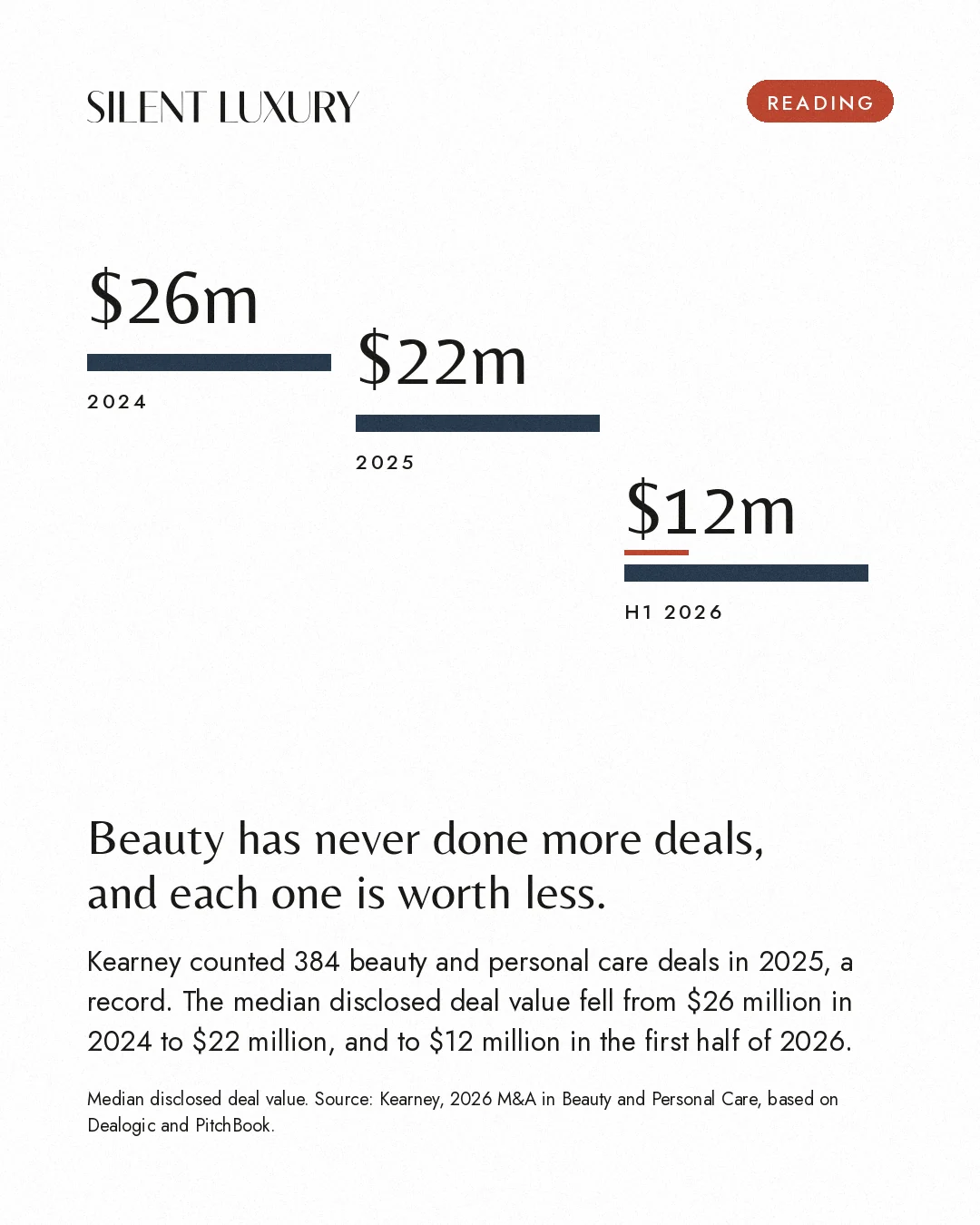
Beauty M&A volume and deal value have decoupled. The 384 deals of 2025 were 8 percent up on the 355 of 2024, the third record year in a row. Yet the median disclosed deal value fell from $26 million in 2024 to $22 million in 2025, and to $12 million in the first half of 2026.
“One of our key findings is that volume and value have decoupled,” Droll said. Of the fall in the median, she added: “That is a significant drop, even though more deals were counted, and I think it is a clear indication of where the market is right now.”
The headline average hides the drift. At $331 million, the 2025 average looks like a recovery, but one transaction carries it: Sycamore Partners’ $23 billion purchase of Walgreens Boots Alliance. Without that deal, the average falls to about $116 million, below the level of 2024. In the first half of 2026 it stood at $65 million.
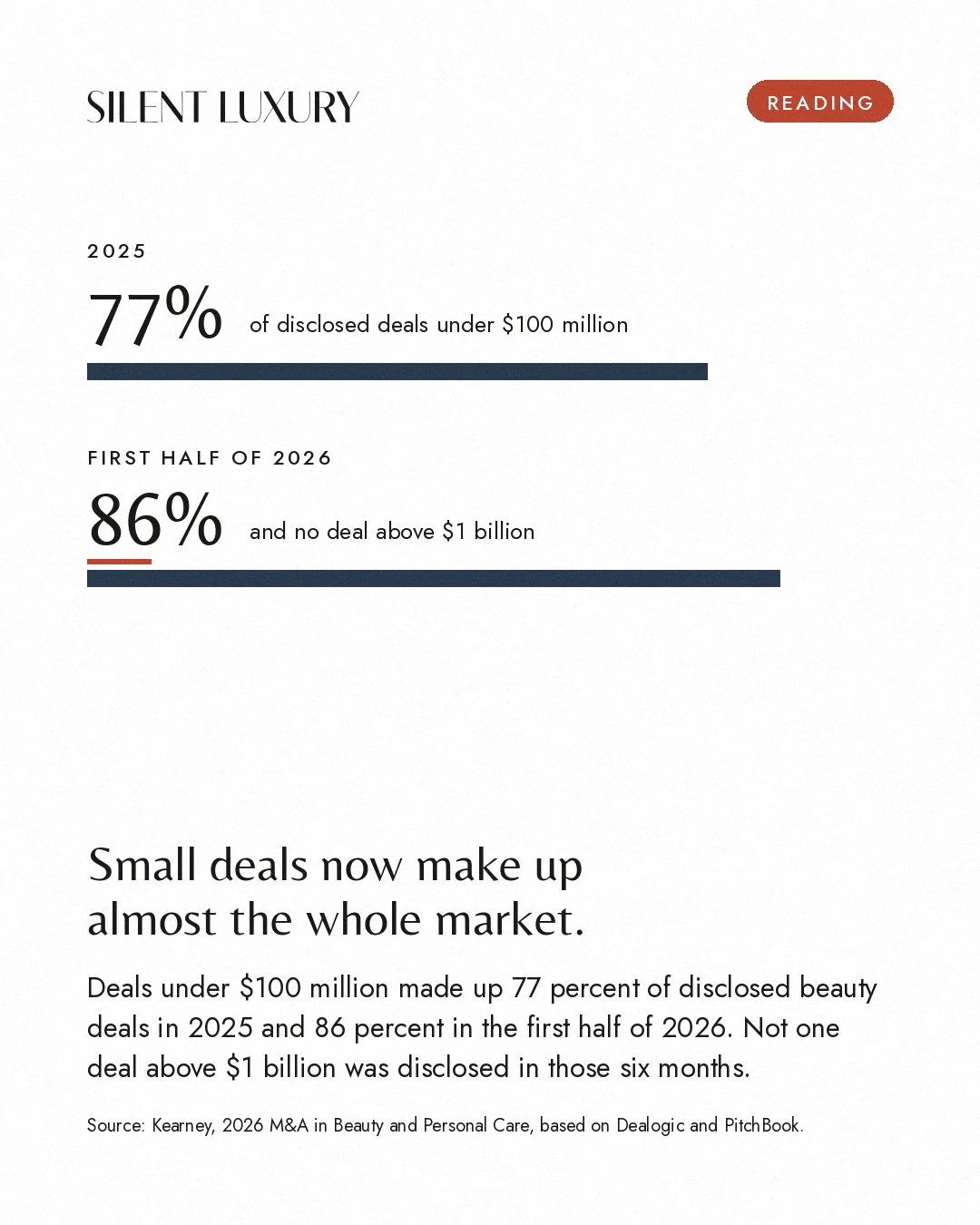
Small deals now dominate. Transactions under $100 million made up 77 percent of disclosed deals in 2025 and 86 percent in the first half of 2026. Large deals above $1 billion doubled from 3 to 6 percent in 2025, then disappeared: not one was disclosed in the first six months of 2026. Overall activity fell 11 percent compared with the first half of 2025. “Volume is at a record, but value and scale haven’t followed,” the report’s authors write.
Why the Big Beauty Groups Stopped Buying
The large beauty groups have stopped buying because they are rebuilding themselves. Kearney calls the missing megadeals “a supply-side constraint, not a timing gap.” The multinationals are restructuring their portfolios and still absorbing earlier acquisitions, which leaves little capacity for new ones.
The last large deals show what that capacity once looked like. In 2025 L’Oréal bought Kering Beauté and the British skincare brand Medik8, and e.l.f. Beauty acquired Rhode. A year on, the big groups are trying to sell rather than buy. In July 2026 Estée Lauder decided to keep Too Faced, Smashbox and Dr.Jart+ after finding no buyer: a sale that ended in a memo.
“Many of them are busy restructuring, because the economic environment has become more challenging,” Droll said. They want their recent acquisitions “fully integrated before they release the capital, and the capacity, to think about outbound M&A again.”
The mid-sized brands feel this most. Kearney describes the $100 million to $1 billion tier as “largely not yet sellable rather than simply unsold,” for three reasons. These brands have historically been the hardest to integrate profitably. Buyers now want proof of profit before they engage. And categories rotate faster than a mid-sized brand can prove itself, so a multiyear bet on one has become harder to underwrite.
Droll sees buyers looking for one of two things, and the middle offers neither. “Buyers look either for the next big thing they can bet on or for a business that is already financially sound,” she said. Social media has made the first bet harder: “A brand can be hyped one month and almost forgotten the next, and that makes every investment riskier.”
A note from The Silent Luxury
Good reading deserves to find you again.
How Private Equity Is Holding the Door
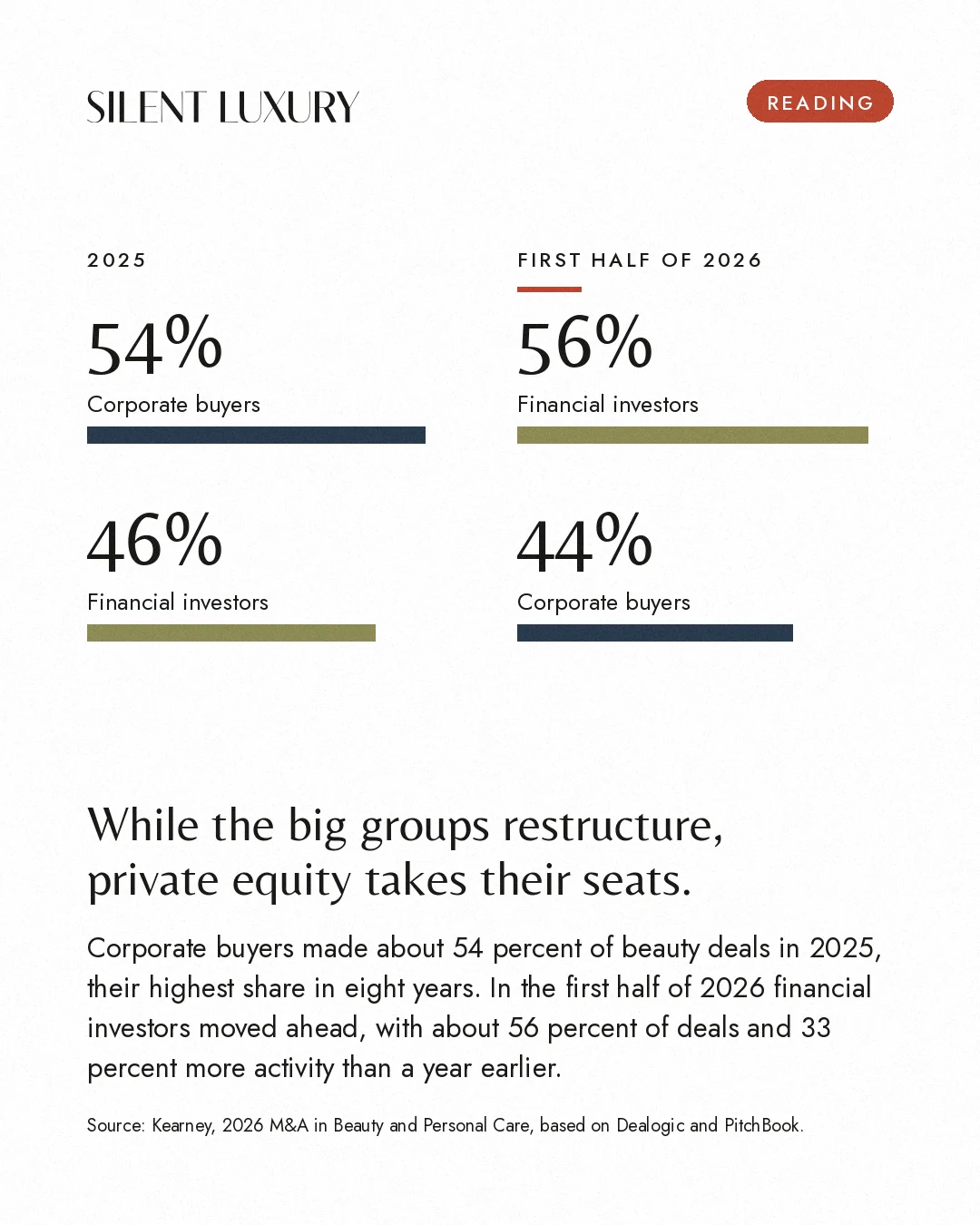
Private equity is filling the space the beauty groups have left. In 2025 corporate buyers still led: their deals rose about 36 percent, and they took about 54 percent of all transactions, their highest share in eight years. The first half of 2026 reversed that. Financial investors accounted for about 56 percent of deals, and their activity grew 33 percent even as the wider market slowed.
“While the strategics are busy restructuring and cleaning up their own portfolios, private equity and other financial investors are stepping in,” Droll said. “They take the spot the strategics leave because they lack the bandwidth to buy right now.”
Kearney sees the funds as stand-ins, not as a sign of revival. The funds are buying platforms, bolt-ons and carve-outs, such as Capsum, rather than betting on high-priced growth. “Financial buyers are stepping into the gap, but this points to selective opportunities rather than a broad recovery,” said Fabian Lux, a partner at Kearney and co-author of the report.
The funds also know where their exit lies. “Financial owners buy a company in order to build it up and sell it, ideally to a strategic player,” Droll said. They clean the business up and sell it on at a premium, once the large groups have bandwidth again. Kearney calls this recurring pattern the “beauty M&A value loop”: a six-stage cycle from a reset in demand through cost cuts, portfolio adjustments and an investment window to integration, until market volatility starts it again. By Kearney’s reading, the market of 2026 sits between stages two and three, with the funds’ window opening before the majors have finished restructuring.
“That is the recurring value loop we describe in the report,” Droll said. “It resets the playing field, and once the strategics have more bandwidth again, they come back in.” How long one turn of the loop takes is hard to pin down. “Typically we talk about three, five, seven years,” she said. “And there is always a next crisis around the corner.”
What Beauty Buyers Pay for Now
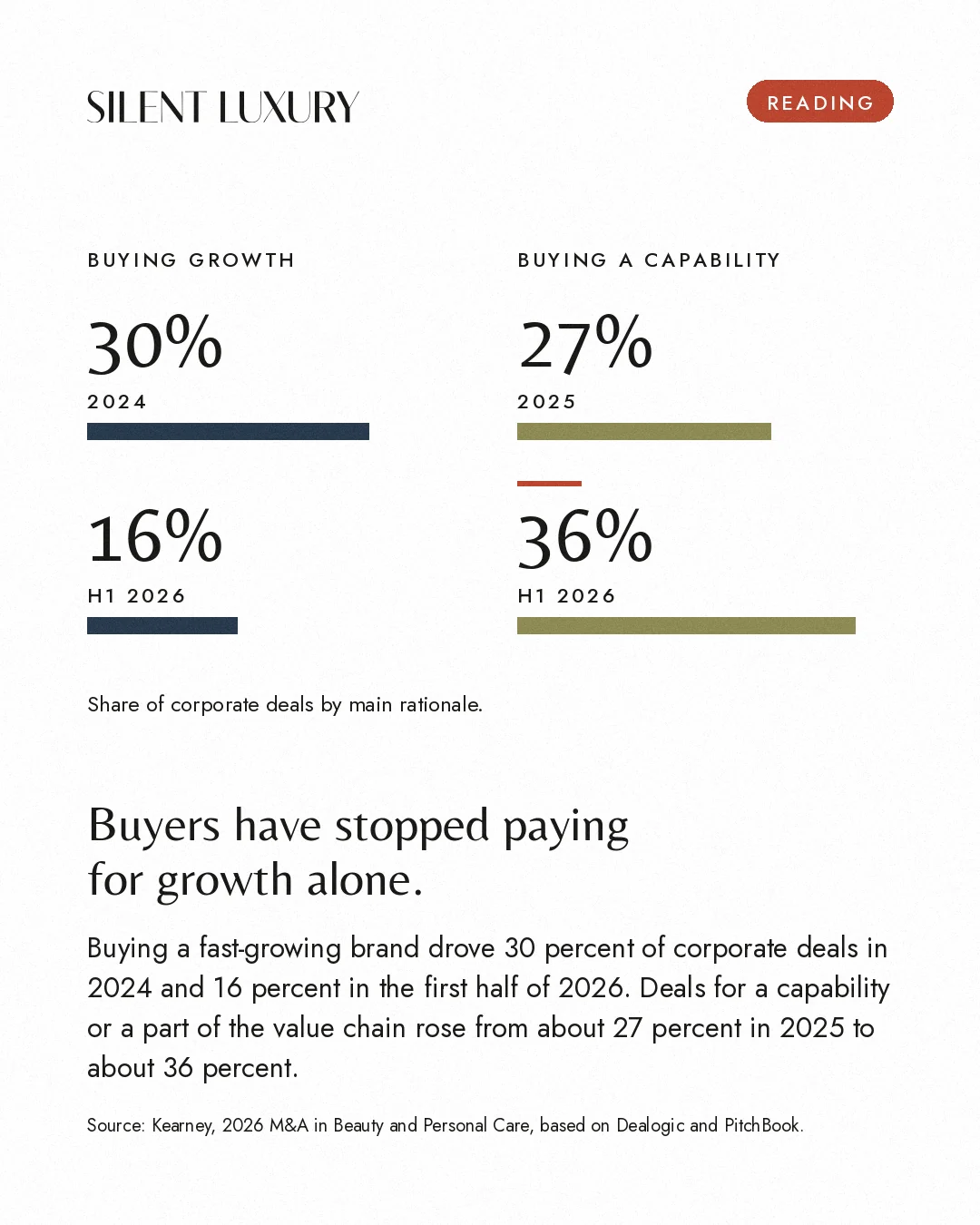
Corporate buyers have stopped paying for growth alone and now pay for capabilities. Buying a fast-growing brand to accelerate growth accounted for 30 percent of corporate deals in 2024, 23 percent in 2025 and 16 percent in the first half of 2026, the lowest share Kearney has recorded. Deals that secure a part of the value chain or a capability rose from about 27 percent of corporate transactions in 2025 to about 36 percent in the first half of 2026. Expansion into new countries fell to about 3 percent.
What a capability means in practice is often unglamorous. “Sometimes it is access to a specific manufacturer, or to particular formulations,” Droll said. Kearney lists operational fit, technology, intellectual property, sourcing and distribution, “over simply the fastest-growing logo they can find.” Puig’s agreement in September to pay €1.2 billion for the half of Isdin it did not already own fits that pattern: Puig is buying a dermocosmetics business that comes with its own science.
Proof has become the price of entry. “It is a consultant’s favorite answer, but it depends,” Droll said, before naming what counts most. The first test is profitability: “A product with a self-funding P&L is extremely important.” The second is evidence. “If a brand has strong performance signals, a clear channel or home market, or clinical evidence, that makes it highly relevant.” The third is how easily a brand fits its new owner: “Is there a very strong founder you will need to deal with, or is it a natural fit?” And it must not compete with what the buyer already holds. “The large players typically do not buy a brand that would cannibalize sales from one they already own.” When the report came out, she put it in a single sentence: “For brands seeking a buyer, growth needs to be backed by profitability and a clear fit with the buyer’s business.”
The categories follow the same logic. Kearney names clinical, science-led skincare the “must-win category in 2026,” where proven performance earns the highest premiums. Hair and body care are the next waves of consolidation as “skinification” spreads. Fragrance stays resilient in niche and luxury. Color cosmetics remain hard to underwrite because of low margins and little differentiation. And as beauty moves from expression to vitality, deal-making follows consumers into supplements with clinical backing, treatment and device platforms, and services in medical aesthetics.
“The derm brands are incredibly successful,” Droll said. “In hair care, for example, a lot of medicalization is happening as well. Being clinically proven, scientific and credible is extremely important for a target company.”
From Minority Stakes to Control
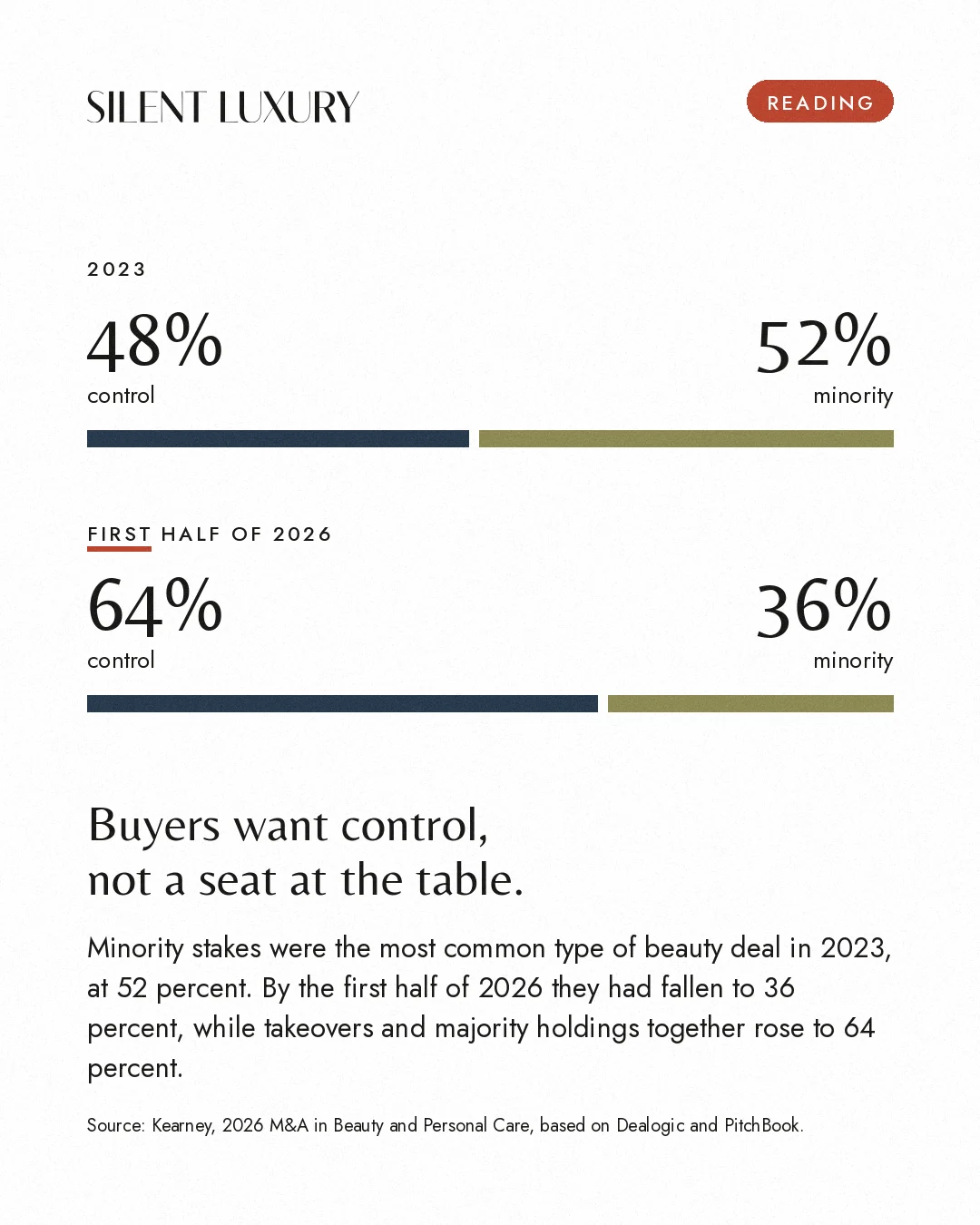
Buyers in beauty increasingly want control rather than a seat at the table. Minority stakes were the most common type of deal in 2023, at 52 percent. Their share fell to 39 percent in 2025 and 36 percent in the first half of 2026. Controlling deals, meaning outright takeovers and majority holdings, rose from about 61 percent in 2025 to 64 percent, and takeovers alone reached 56 percent in the first half of 2026.
The logic runs through the whole market: a buyer who must create value wants the authority to do so. Kearney expects a two-track pattern. Minority stakes remain the way into early-stage or founder-led brands, where alignment with the founder matters most. Control becomes the default for brands that have already shown they can scale.
Control only pays off if the integration works, and that is where Droll sees the real test. “How well can the acquirer integrate the target? Does it give the brand the right level of freedom and the right boundaries?” Building brands in-house, she noted, is something the big groups have at times struggled with. “Careful selection and then careful integration into the portfolio are key.”
Where Beauty Deals Happen: Europe, North America and Asia
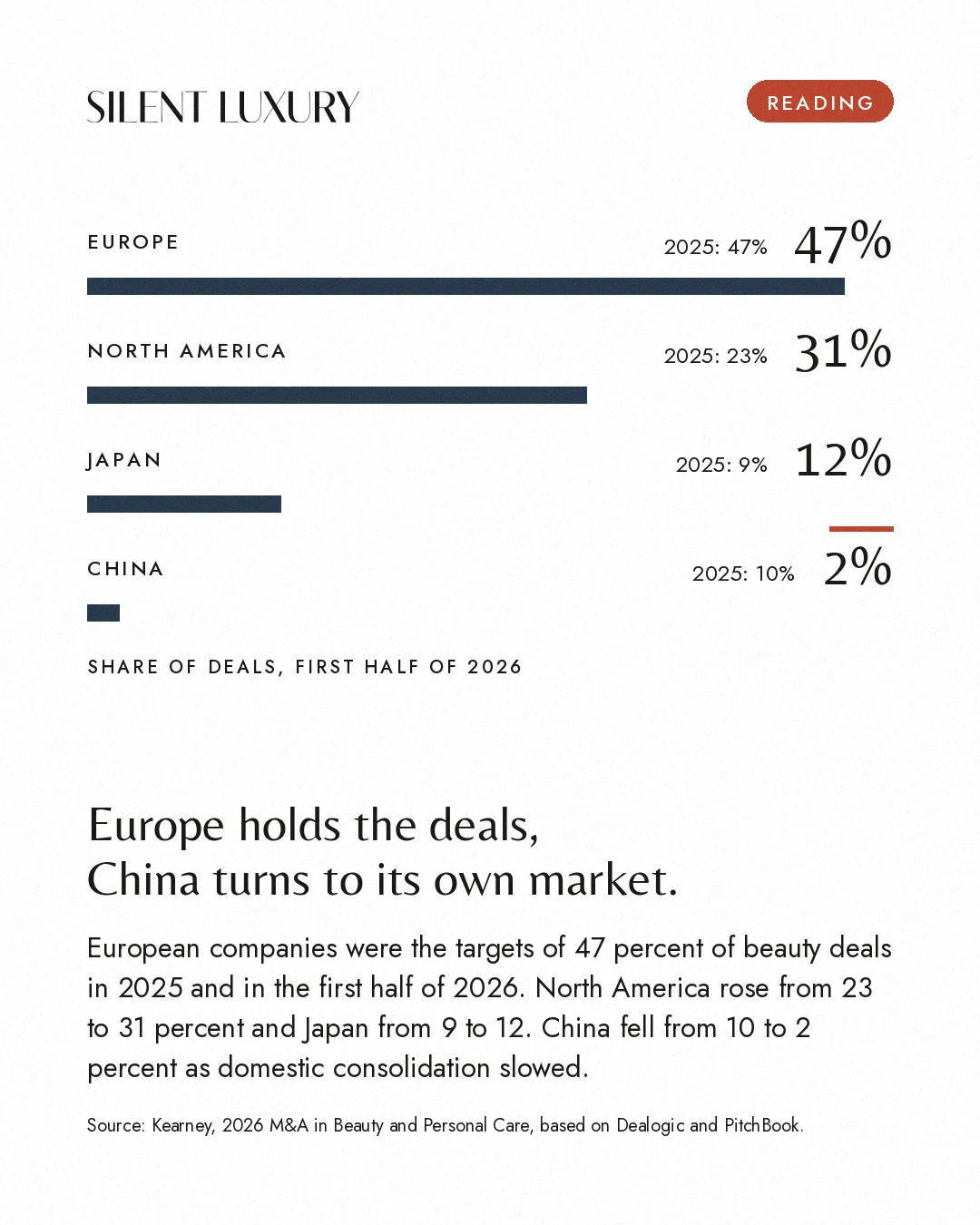
Europe is the anchor of beauty M&A. European companies were the targets of 47 percent of deals in 2025, the highest share in Kearney’s eight-year series, up from 40 percent in 2024, and Europe held 47 percent in the first half of 2026. “Interestingly, Europe continues to be very strong in beauty M&A,” Droll said. “Europe has very strong regulation. As soon as a brand’s value rests on credibility, on proven claims, that makes Europe a very relevant region.” North America fell from 26 to 23 percent between 2024 and 2025, then rebounded to 31 percent in the first half of 2026.
Asia no longer moves as one region. Japan rose from 9 percent of deals in 2025 to 12 percent in the first half of 2026. “With the whole hype around K-beauty, we expect it to move from Korea into other Asian markets, Japan in particular,” Droll said. The rest of Asia, where Kearney counts Korea, fell from 17 percent in 2024 to 8 percent. India, in Kearney’s view, is proven in the mass market and now opening up to prestige, with travel retail as its accelerator.
China’s beauty market grows on its own terms. China’s share of deals rose from 7 percent in 2024 to 10 percent in 2025, then dropped to 2 percent in the first half of 2026. Kearney attributes the fall to a pullback in domestic and inbound consolidation, not to a shift in outbound buying, which has stayed thin throughout. Only a few have bought overseas, among them Bloomage Biotech, SYoung, Ushopal, which acquired the French skincare house Payot, and Yatsen.
A deal count also misses what grows without changing hands. “When we talk about China deals, we always mean the target geography, where the acquired company sits,” Droll said. Homegrown houses such as Proya and Mao Geping have built their scale at home. Local brands, in her words, “are gaining a lot of traction, but less through large M&A than as locally grown Chinese brands.” She expects them to turn further toward their own heritage: “We also expect a shift toward a traditional Chinese medicine point of view for those brands.”
Kearney sees the same pattern beyond China. Indian hair care, Arab fragrance and skin and body care rooted in traditional Chinese medicine are following the path K-beauty took into Western prestige, where authentic provenance combined with a scaled community is the scarce asset.
What Comes Next for Beauty M&A
The next 18 months will reward buyers who build now on a small scale. Kearney expects the deal funnel to widen “unevenly, concentrated at the extremes.” Carve-outs and founder exits will add supply, but the wave of corporate divestments that many expected looks like a story for 2027 and beyond. “Our report suggests more businesses could come up for sale as restructuring progresses,” Lux said.
The capabilities that will decide ownership are already visible, Droll said: integration, clinical credibility, consumer health and technology. “Supplements with clinical backing, treatments, device platforms” will matter from an M&A perspective, and beauty tech has been “simmering” for years. “Infrared masks, cleansing tools, all the devices. That is coming more and more.”
When the large groups return, they will return as sellers first. Kearney’s advice to investors is plain: the buyers that use this window to build integration capability on smaller platforms will be ready to move, while those waiting for a megadeal will bid into a market “already priced in the wait.”
For a small house, the window is open but narrow. “There is definitely a big opportunity if you have a clear USP, a clear reason for being, a clear route to the customer, and ideally you are already profitable,” Droll said. Timing matters as much as quality. “If the acquirer is not ready to make an acquisition, you can be a fantastic small company and it will still be tricky.” Over recent months, she added, buyers have often chosen the bigger, better-known brands, “because the large strategics are looking for credibility and a proven business model, and they are less willing to take big risks.” Her headline for the coming months is short: “You have to have credibility.” It has always mattered, she said, “but it has changed. There was a time when it was simply about taking over brands.”
The report ends on a line that could stand over the whole market: “The opportunity in beauty and personal care M&A right now isn’t the deal everyone’s waiting for. It’s the one nobody else wants to close today.” How these shifts play out across luxury skincare is tracked in the luxury skincare market after Q3 2026 and in The Nature of Beauty.
For anyone who asks who owns beauty now, and who is waiting to buy.
Further Reading
-
Marie Droll of Kearney: Beauty Buyers Now Pay for Proof
Kearney principal Marie Droll on record deal counts, falling deal values, private equity and what small beauty houses need to be bought.
-
Chanel Sells Control of Capsum: The Lab Behind Luxury Skincare Changes Hands
Chanel is selling its majority stake in Capsum, the Marseille developer and maker of skincare and make-up, to the Paris private equity firm Motion Equity Partners, and keeps a minority share.
-
The Luxury Skincare Market After Q3 2026: The New Powers Gain Ground
The luxury skincare market grew where houses build their own science, while the large groups bought their way into natural skincare.
Sources
- Kearney, 2026 M&A in Beauty and Personal Care: Volume over Scale and Value (October 2026)
- Marie Droll, Kearney, in conversation with The Silent Luxury, October 26, 2026
- European Business Magazine, Europe’s share of beauty M&A deals hits eight-year high
- WWD via Yahoo Finance, Beauty M&A is up in volume but down in value
- The Silent Luxury, Beauty M&A Hits a Record as Mid-Sized Brands Struggle to Sell
Similar Articles

The Luxury Skincare Market After Q3 2026: The New Powers Gain Ground

Puig Bets on Fragrance as the Middle of the Luxury Market Gives Way

Where Luxury Begins: The Value of Natural Fibre, From the Karoo to Vittorio Veneto