Paolo Ferrari: The Next Chapter of Luxury Is Transformation
At Desert Rock, the welcome begins with smoke. Incense is lit as guests arrive, as households across the region have long done for visitors at the door, and the scent follows you into a resort set deep in the granite of the Hejaz mountains. Paolo Ferrari, whose studio designed every interior of the resort, calls it a relatively small gesture. “It signals that something is changing,” he said in an interview with The Silent Luxury. “You are entering a different environment and, hopefully, a different state of mind.”
That change of state is the whole brief as Ferrari understands it. Desert Rock, developed by Red Sea Global with architecture by Oppenheim Architecture, opened in December 2024 with 64 villas and suites set into the rock. This year it became the first resort in Saudi Arabia to receive three Michelin Keys, the guide’s highest hotel rating, and it won the Michelin Architecture and Design Award for 2026. Ferrari’s explanation of why it works is brief. “I believe that the next chapter of luxury is about transformation,” he said. “What stays with you, what you begin to see differently, and what you carry back into your life long after you have left.”
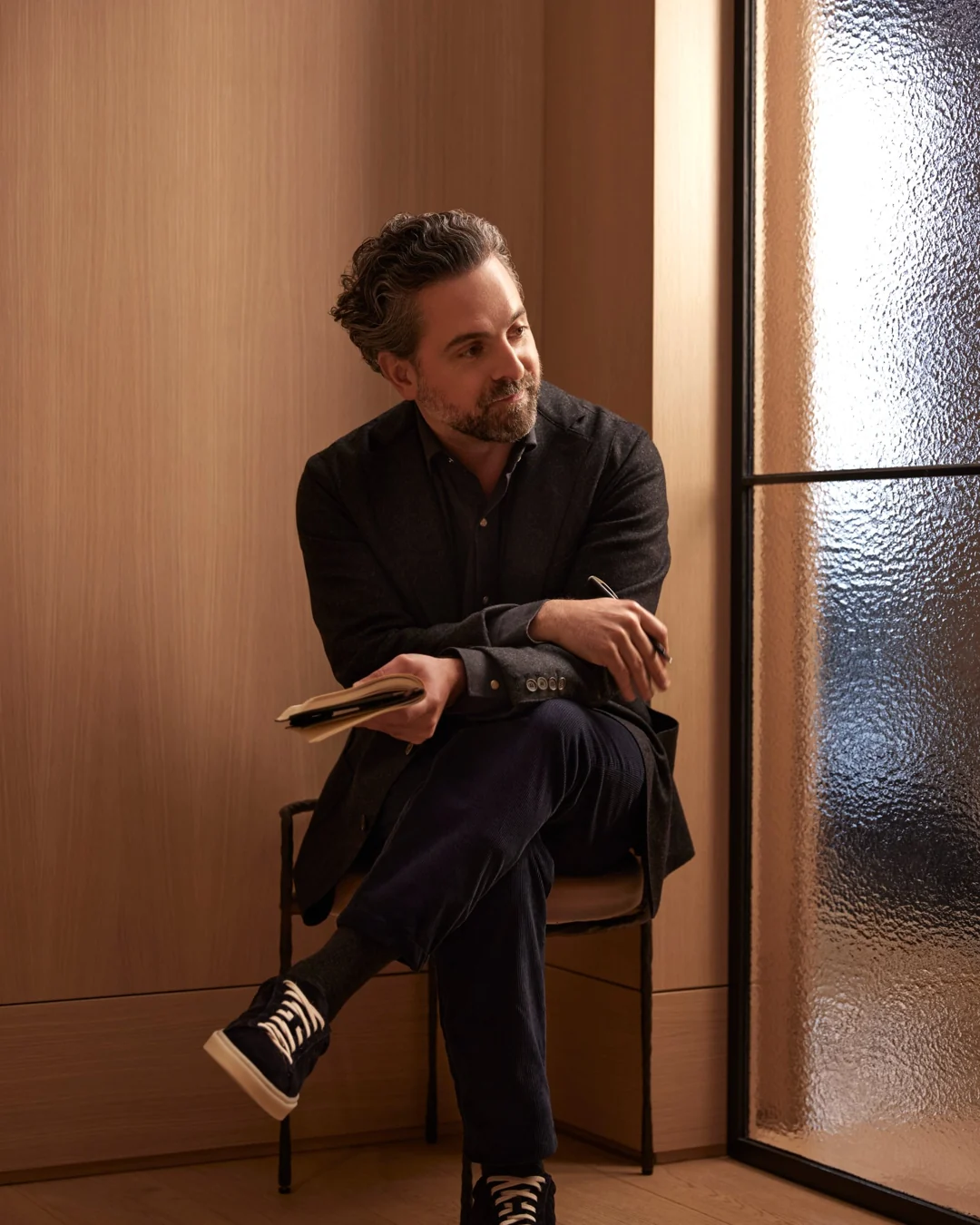 In conversationPaolo FerrariFounder of Studio Paolo Ferrari, Toronto and Milan. The full interview with The Silent Luxury.
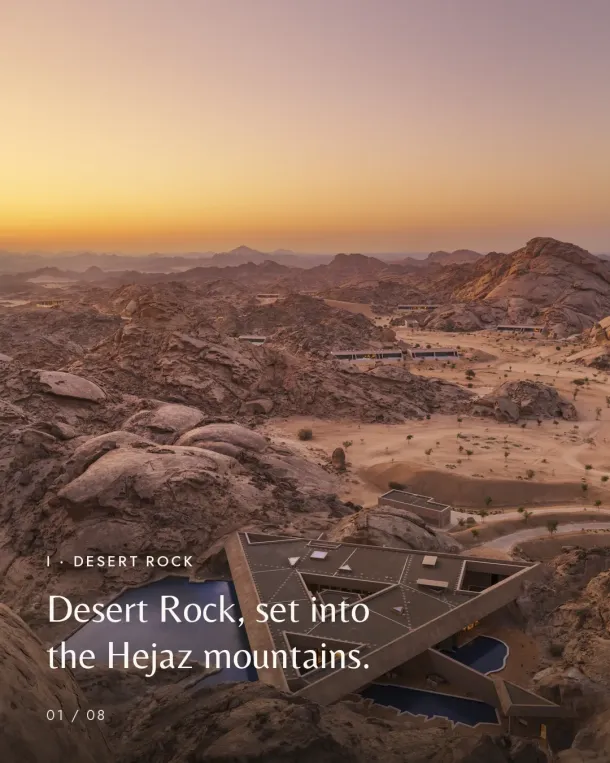
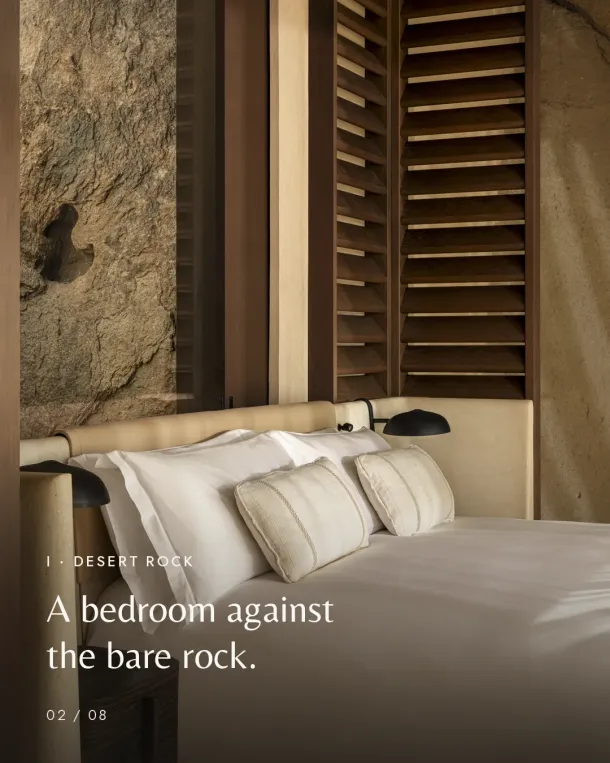
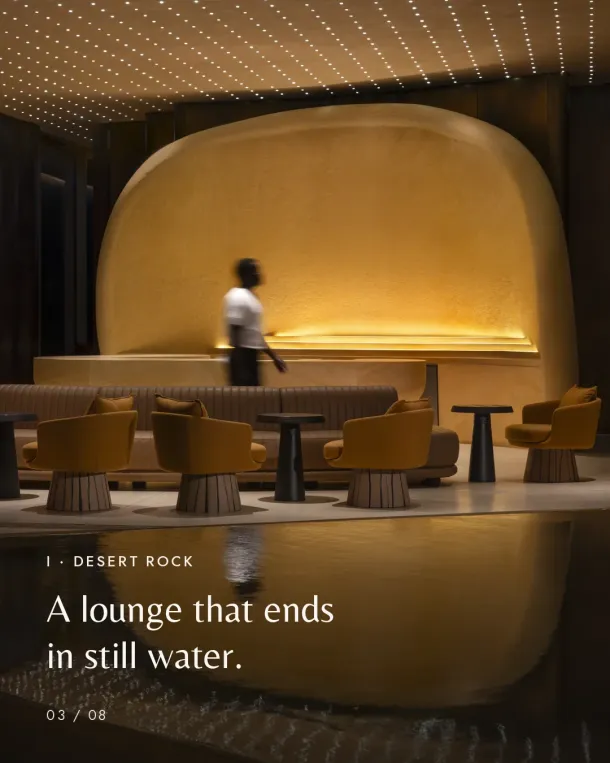
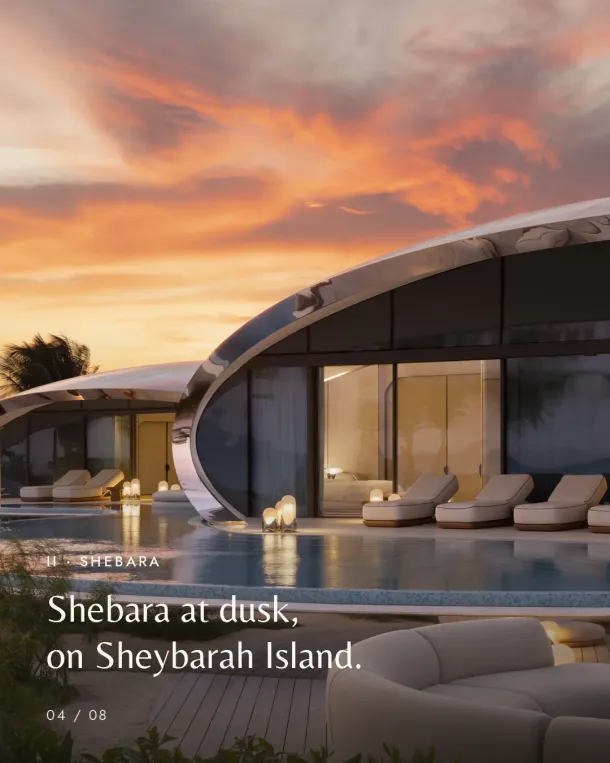
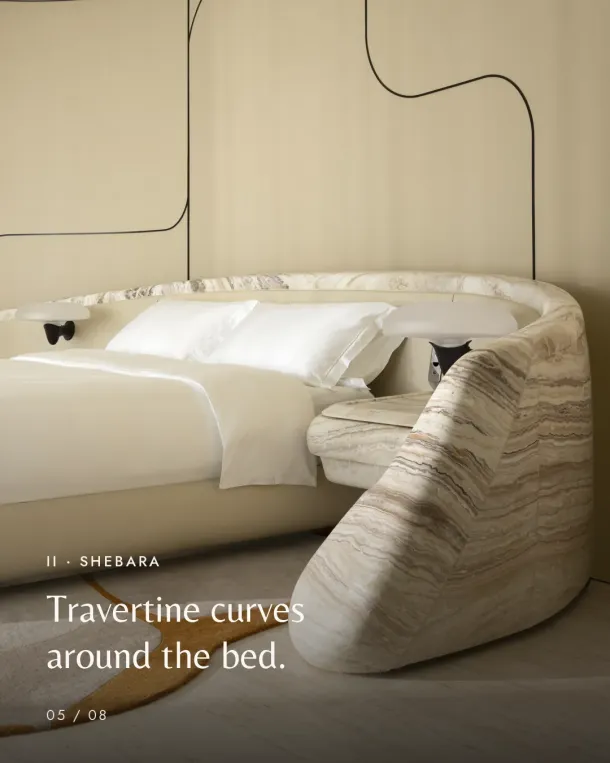
Studio Paolo Ferrari: Desert Rock, Shebara, Peridot in Hong Kong and MC72 for Poltrona Frau. Photos: Ema Peter, Virgile Simon Bertrand, Cortili Photo. Courtesy of Studio Paolo Ferrari
Quiet Monumentality: How Desert Rock Resort Lets the Mountain Speak
Ferrari has a phrase for what the resort does with all that rock. He calls it quiet monumentality, and he defines it by what it leaves out. “Impact doesn’t necessarily come from scale, decoration or visual intensity,” he said. “Sometimes the most powerful gesture is restraint.” The rooms at Desert Rock are generous and the public spaces are tall, and still the eye goes first to the boulders outside the glass. Ferrari designed them to reveal themselves slowly. A guest notices the sandblasted grain of a cupboard door on the second day, and the cupboard pull shaped like a forked branch on the third.
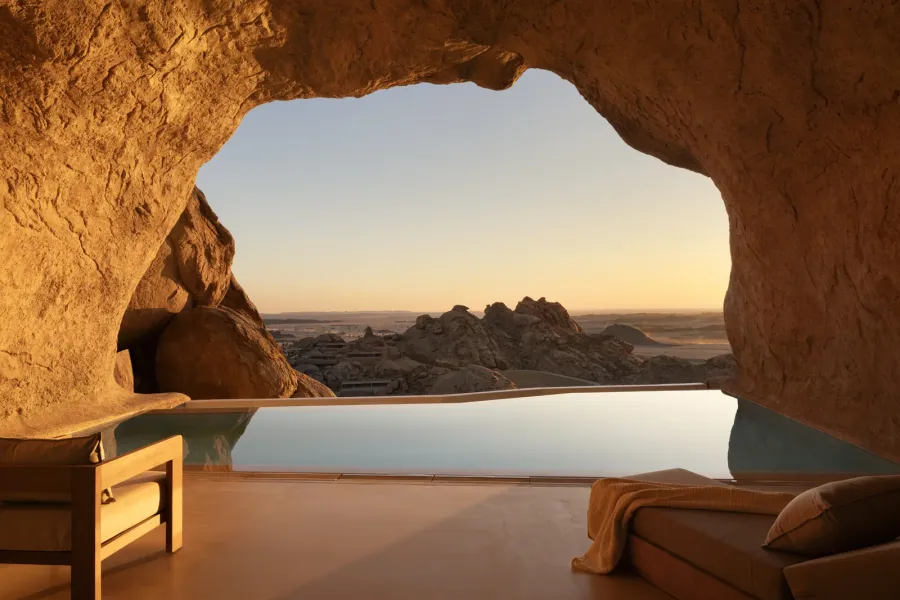
The palette is short and deliberately mineral: concrete, plaster, limestone, bronze and wood, some of it charred and some of it sandblasted. Door handles and light fittings were sand cast, a method that leaves the slight irregularity of the mould on every piece. “There is something beautiful about allowing the process of making to leave its own trace,” Ferrari said. The aim, in his words, was interiors that “felt as though they had emerged organically from the landscape”. He spoke of cocooning, of rooms that shelter a guest while keeping the earth in view, and the cave villas make the idea literal. Their plunge pools sit inside openings in the rock, so that a swimmer looks out across the valley through a frame of granite.
Ritual runs through the plan as firmly as the stone. Ferrari describes his work at Desert Rock as designing a journey, with questions he calls almost cinematic: how a guest arrives, what they meet first, where the atmosphere turns intimate and where the moment of discovery falls. A tunnel lit by low lamps runs through the rock. In the lounges, a metal hood hangs over an open fire. In a courtyard open to the sky, a single olive tree stands on a bed of river stones.
Desert Rock and Shebara: Two Red Sea Resorts, Two Worlds
Ferrari’s studio also designed the guest villas at Shebara, the Red Sea Global island resort whose mirrored stainless-steel orbs by Killa Design stand over the lagoon of Sheybarah Island. The resort has 73 villas, 38 of them over the water and 35 on the beach, and it holds two Michelin Keys. Ferrari describes the two projects as geographically close and entirely different. “Desert Rock is about the permanence and physical presence of the mountains, whereas Shebara is about the relationship between architecture, water, light and reflection,” he said.
At Shebara the studio worked from an idea it called natural futurism. Inside the polished shells, travertine walls curve around the beds, chrome furniture catches the light off the sea and a drawer opens onto compartments lined in deep red. Desert Rock asks the guest to settle into the ground. Shebara floats. Both projects, Ferrari said, demanded coordination across great distances and unfamiliar technical conditions, and both changed his practice. “The most interesting work happens when you allow a place to change you,” he said. “You arrive with your own ideas, but the project should leave you thinking differently about design than you did before.”
Paolo Ferrari on Bespoke Furniture and the Future of Luxury Design
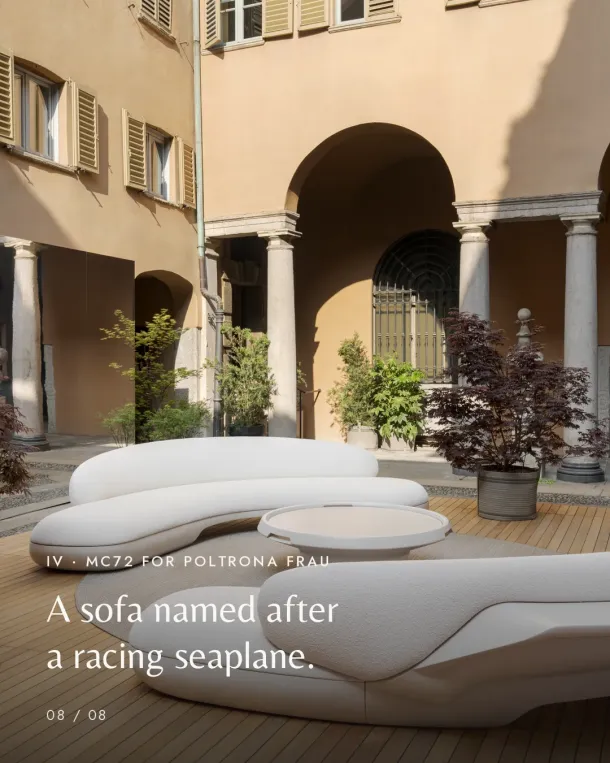
For Desert Rock alone, the studio designed approximately 200 pieces of furniture and lighting. Ferrari treats them as part of the architecture, with proportions and textures that answer to the geology, to local craft or simply to how a guest moves through a room. He sees no contest between that approach and the global collection. This year the studio presented MC72 with Poltrona Frau, a low sofa and limestone table named after the Macchi M.C.72, the Italian racing seaplane of the 1930s, and Ferrari says the studio is now developing future collections with several other brands. “Perhaps the future is not an either-or proposition,” he said. “It is about understanding when an object should have a life of its own and when it should exist exclusively in service of a larger experience.”
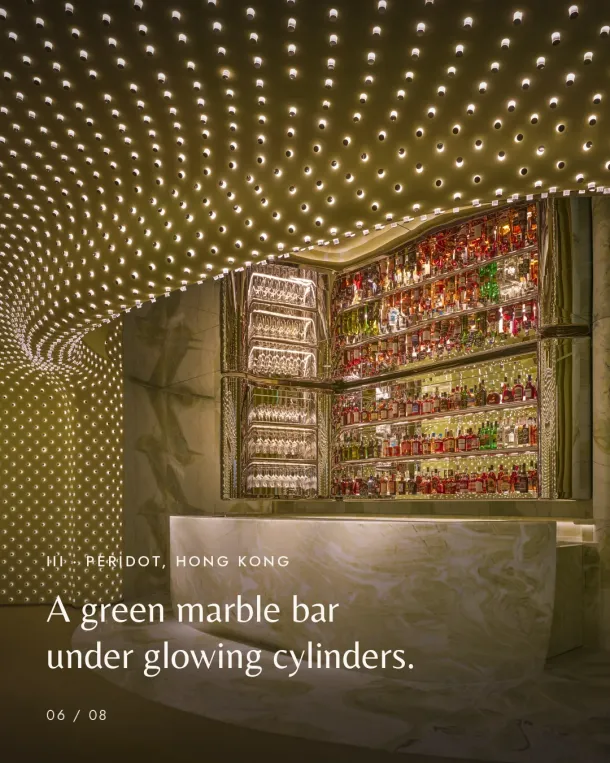
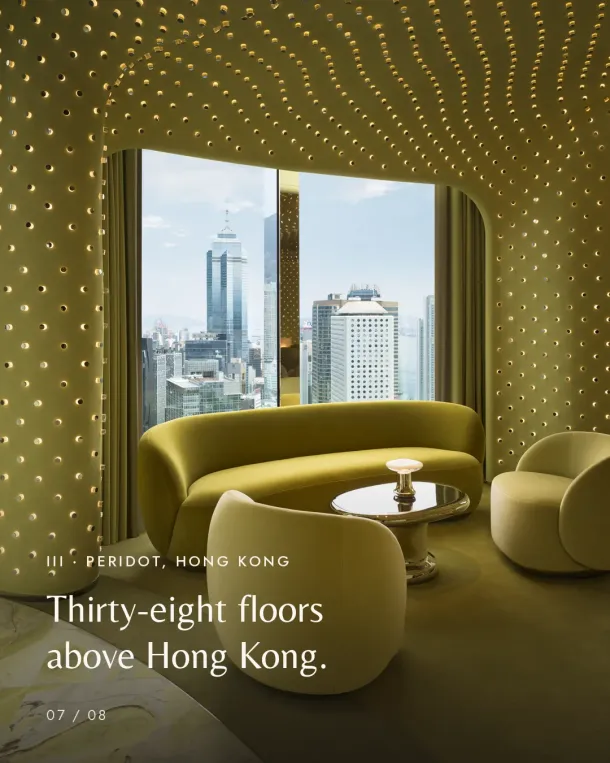
The same discipline appears far from the desert. On the 38th floor of The Henderson, the Zaha Hadid Architects tower in Hong Kong, the studio built Peridot, a bar wrapped in soft green plaster and lit by a grid of glowing acrylic cylinders, with a bar carved from green marble at its centre. Ferrari works between Toronto and Milan and calls the two cities a productive tension, openness and experiment on one side, material culture and craft on the other. Asked which places will shape the next idea of luxury, he named none. “Geography is no longer the premium,” he said. “The future belongs to places that have something meaningful to communicate, places that can make you feel something, challenge your perspective and stay with you long after you have left.”
At dusk in the cave villas at Desert Rock, the plunge pool turns the colour of the sky, and the granite frame around it goes dark first.
The full interview with Paolo Ferrari appears in Paolo Ferrari in Conversation with The Silent Luxury.
Send this ↗ to someone who measures a journey by what stays with them afterwards.
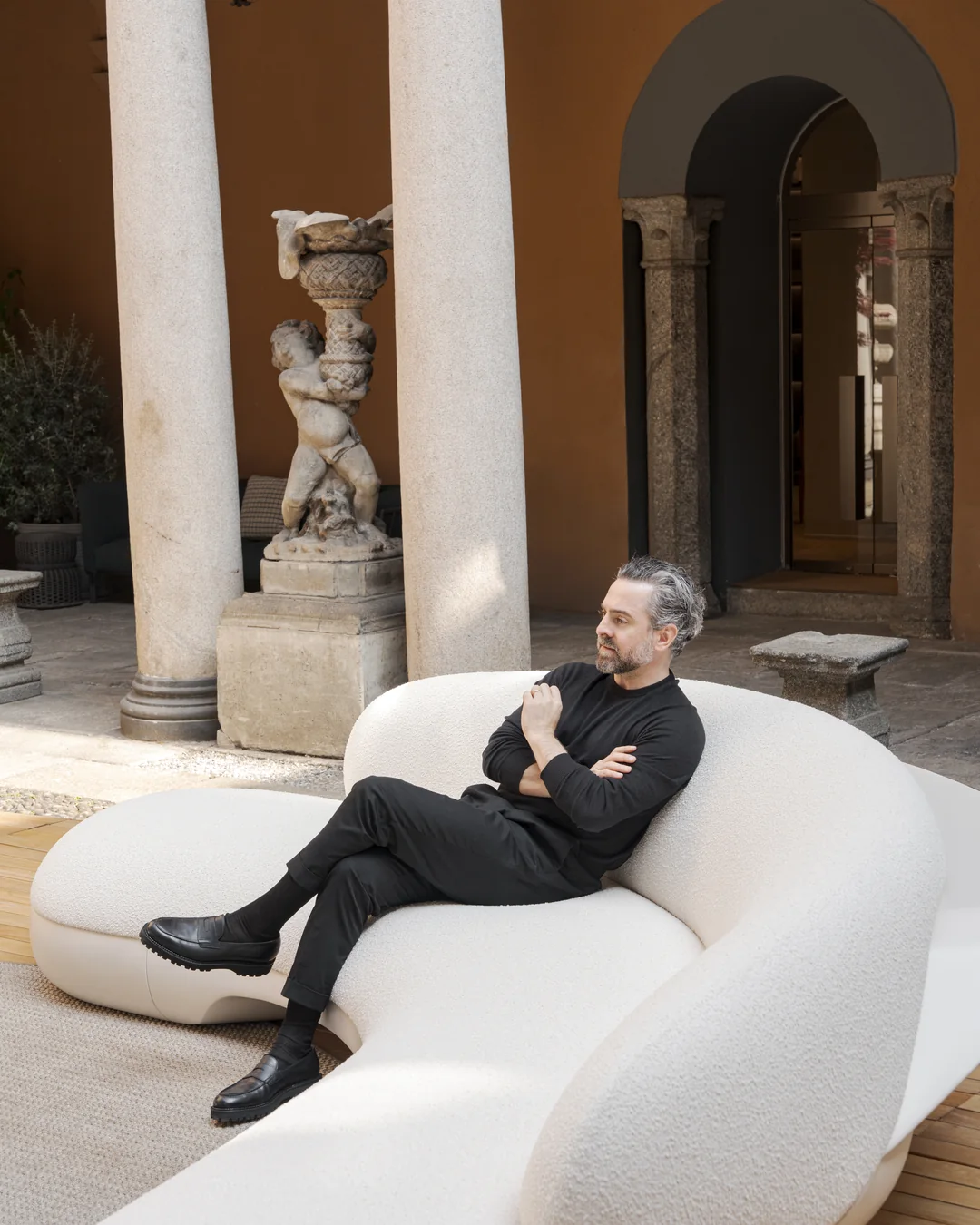 Read next · The ConversationPaolo Ferrari: “Sometimes the Most Powerful Gesture Is Restraint”The full interview on quiet monumentality, 200 pieces made for one place and the ritual of arrival.
Further Reading
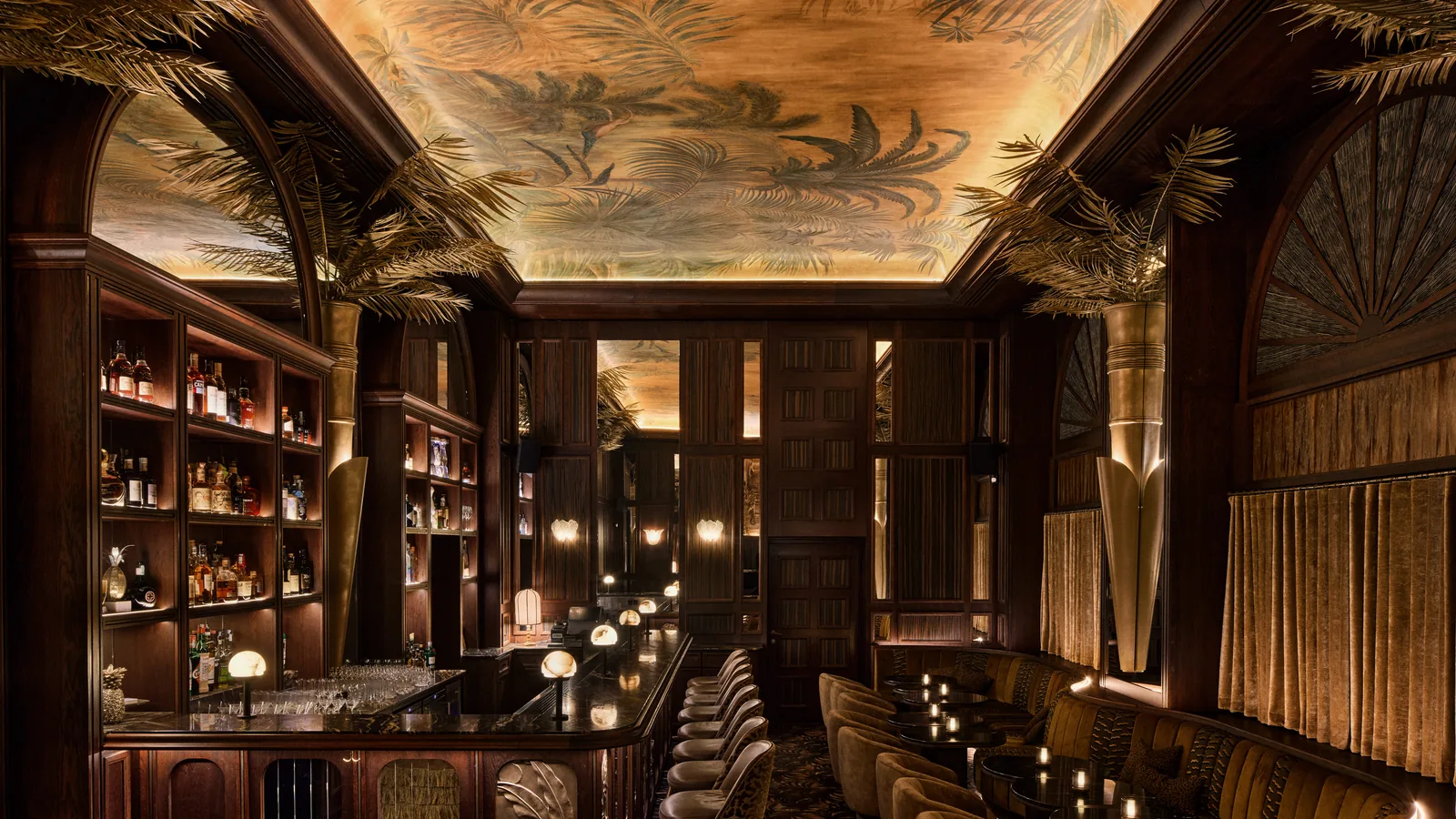
Lazy Lion: How a Budapest Shipping Palace Went Wild
A cocktail bar in Budapest’s Adria Palace by the Barcelona studio Astet, named Best Europe Restaurant/Bar at the 2026 Restaurant & Bar Design Awards.Luxury Trends 2027: From Hermès to Zegna, the Second Purchase Decides
Fewer people walk into the stores, those who do spend more, and enduring objects outsell seasonal fashion.
Sources
- Paolo Ferrari, founder of Studio Paolo Ferrari, in conversation with The Silent Luxury, hosted by Eva Winterer, November 2026
- Arab News, Desert Rock, the first Saudi resort to obtain three Michelin Keys
- Hospitality Design, Saudi Arabia’s Desert Rock Immerses Guests in the Land, 28 May 2025
- Dezeen, Shebara Resort features shiny cantilevered pods and transcendent interiors, 11 June 2025
- Studio Paolo Ferrari and Poltrona Frau, MC72 Collection, press information, April 2026
- The Silent Luxury, Carved into the Rock: Saudi Arabia’s New Desert Resorts
Similar Articles
Lazy Lion: How a Budapest Shipping Palace Went Wild
Hana no Kumo: A Cloud of Blossoms Above Hong Kong
Saikindō: The Abu Dhabi Listening Bar Built to Change Through the Day