
Hana no Kumo: A Cloud of Blossoms Above Hong Kong
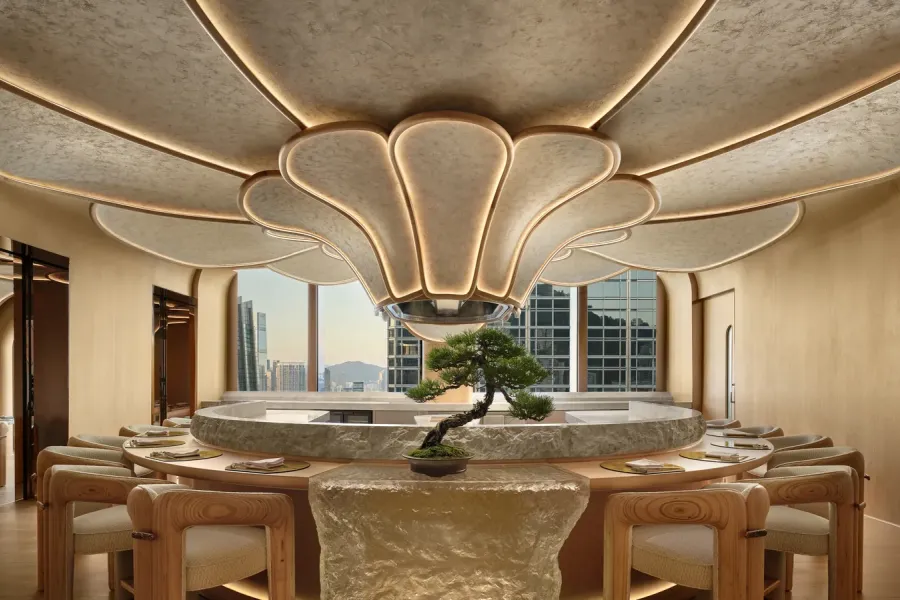
HONG KONG — Hana no Kumo, a kappo restaurant in The Henderson, was named Best Asia Restaurant at the 2026 Restaurant & Bar Design Awards. It has 24 seats on the tower’s 38th floor in Central. The tower around it, by Zaha Hadid Architects, is one of the most expressive buildings in Hong Kong. The room inside does the opposite. HBA, the hospitality design firm behind it, hung a canopy of glowing petals over a counter and took away almost everything else. What is left for guests to watch is the chef’s hands. In conversation with The Silent Luxury, the two partners who shaped it explain how the room was made. Mathew Lui is a partner at HBA Hong Kong; Gerard Lee is a partner at the lighting studio Light Directions.
The jury gave the restaurant a second title, Asia Small Space, at the ceremony on 5 October. The Prix Versailles has also named all three restaurants at The Henderson among the World’s Most Beautiful Restaurants of 2026. Besides Hana no Kumo, they are the bar Peridot by Studio Paolo Ferrari and Akira Back by AB Concept. For a single building, that is an unusual run.
In conversation
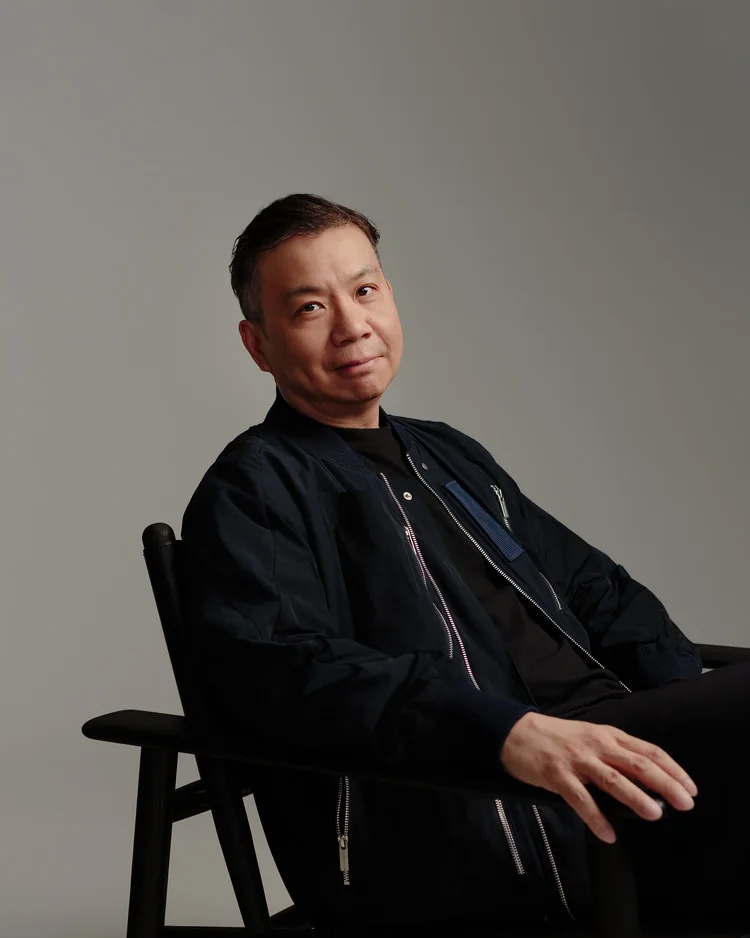
Mathew Lui
HBA Hong Kong
Partner in charge of the interiors of Hana no Kumo.
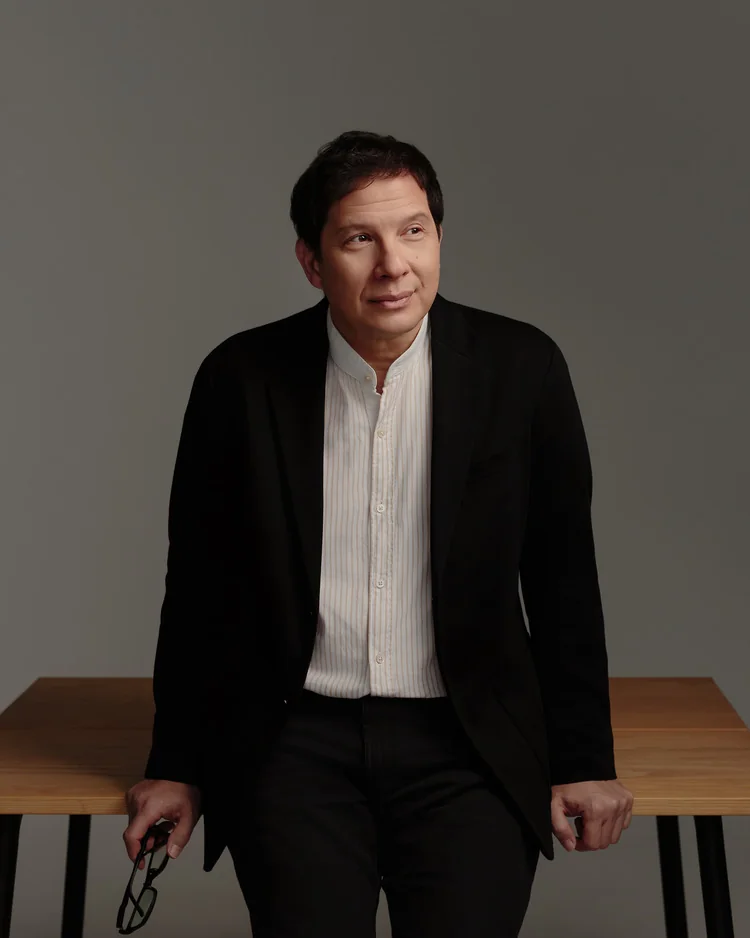
Gerard Lee
Light Directions
Partner in charge of the lighting of Hana no Kumo.
Portraits: Sayher Heffernan, courtesy of HBA
Hana no Kumo Hong Kong: A Private World Inside The Henderson
The answer to a loud building, the designers decided, was not to shout back. The Henderson, developed by Henderson Land on Murray Road, is all fluid curves and glass. “The Henderson is a building with a strong architectural identity,” Lui and Lee said. “Rather than competing with its bold presence, we chose to embrace its language and reinterpret it at a more intimate scale.”
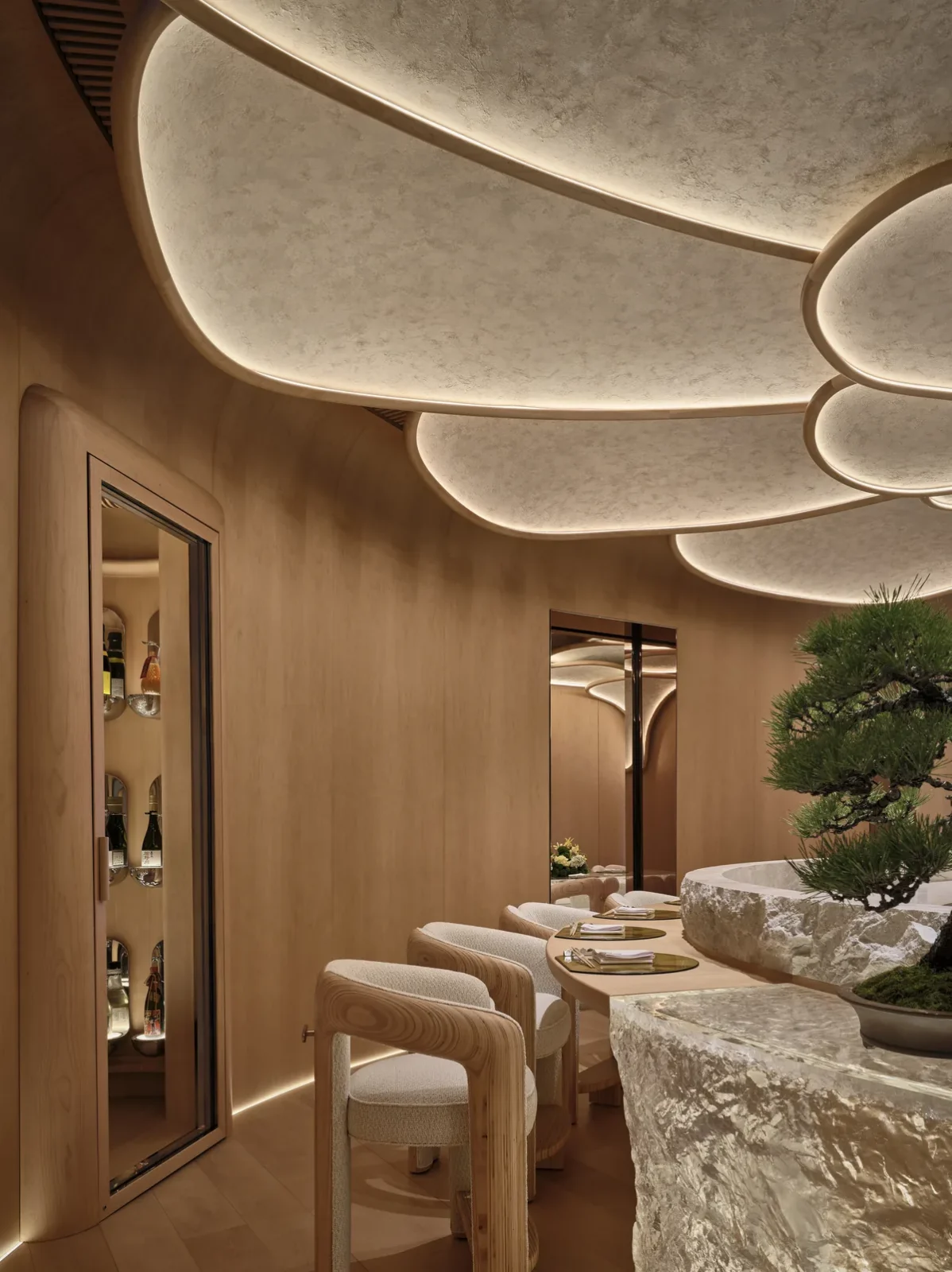
HBA took its cue from the tower’s organic form and turned to botany. The firm knew the building well: it also designed the Swan Library and the function rooms at The Henderson. For the restaurant, it planned a gradual change of scale, from the city outside to something far more personal. “We imagined guests entering a hidden sanctuary suspended above Hong Kong,” the designers said, “where the focus shifts away from the urban panorama and towards the finer details of nature, texture, and ritual.”
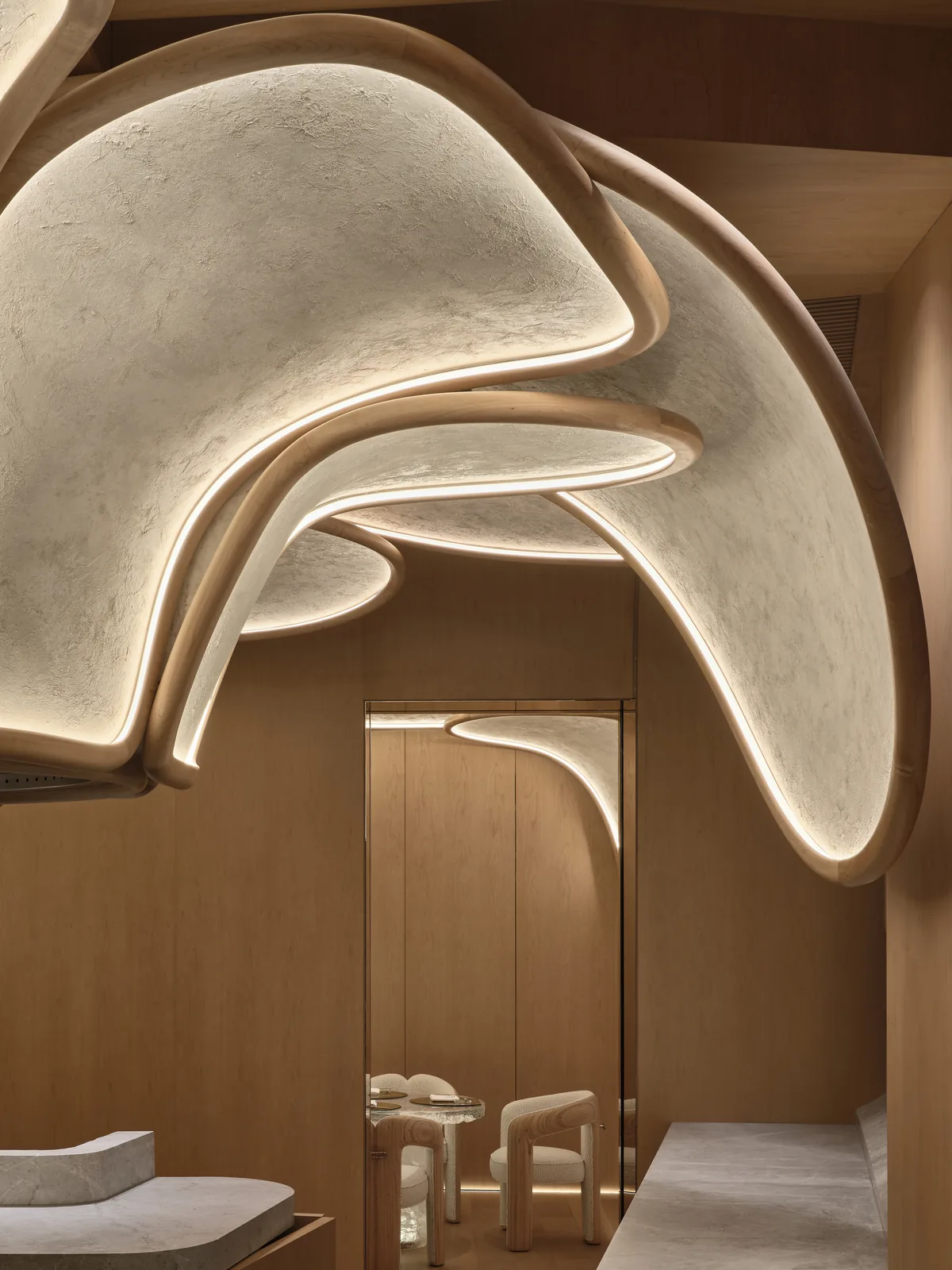
That shift begins in the hallway, where petals bend down from the ceiling and frame the way in. Floral forms recur throughout the restaurant, but none is literal. The view of Central is still there, in the windows, but it is no longer the point. “The goal was to create a dining experience that feels deeply personal,” the designers said, “despite being located within one of the city’s most iconic landmarks.”
A note from The Silent Luxury
Good reading deserves to find you again.
How a Memory of Kyoto Shaped Hana no Kumo
The canopy began as a conversation with the chef. In long brainstorming sessions, the executive chef, Ogawa Masaru, told the designers about his memories of cherry blossom season in Kyoto. Ogawa began his career there in 1996, at Kyoto Kitcho Hana-Kitcho in Gion. In 2009 he moved to Hong Kong as part of the opening team of a one-Michelin-star wagyu kaiseki restaurant.
His memory gave HBA its theme. The designers wanted to celebrate “the fleeting beauty of Kyoto’s cherry blossoms.” Their tools were “organic forms, warm wood tones, and delicate lighting accents.” The result hangs over the counter: a canopy of petals with a washi-paper texture, each one outlined in warm light. The restaurant’s name carries the same image. In Japanese poetry, hana no kumo, “a cloud of blossoms,” describes cherry trees in full bloom seen from afar. Matsuo Bashō opened one of his best-known haiku with it. A cloud of blossoms, he wrote, and a temple bell: from Ueno, or from Asakusa?
Light does the rest. Light Directions worked with the interior team from the first day. Together they tuned the room to the daylight that falls through its windows. The light shifts between shades of white and pink. “As day turns into evening, the lighting gently softens,” the designers said, “allowing the restaurant to evolve into a warmer and more intimate environment.” Lee joined Light Directions in 1990. He has since lit hotels from The Peninsula and the Mandarin Oriental in Hong Kong to the Shangri-La at the Shard in London. Here his job was to make a blossom season pass through a single evening.
The Kappo Counter at Hana no Kumo Hong Kong
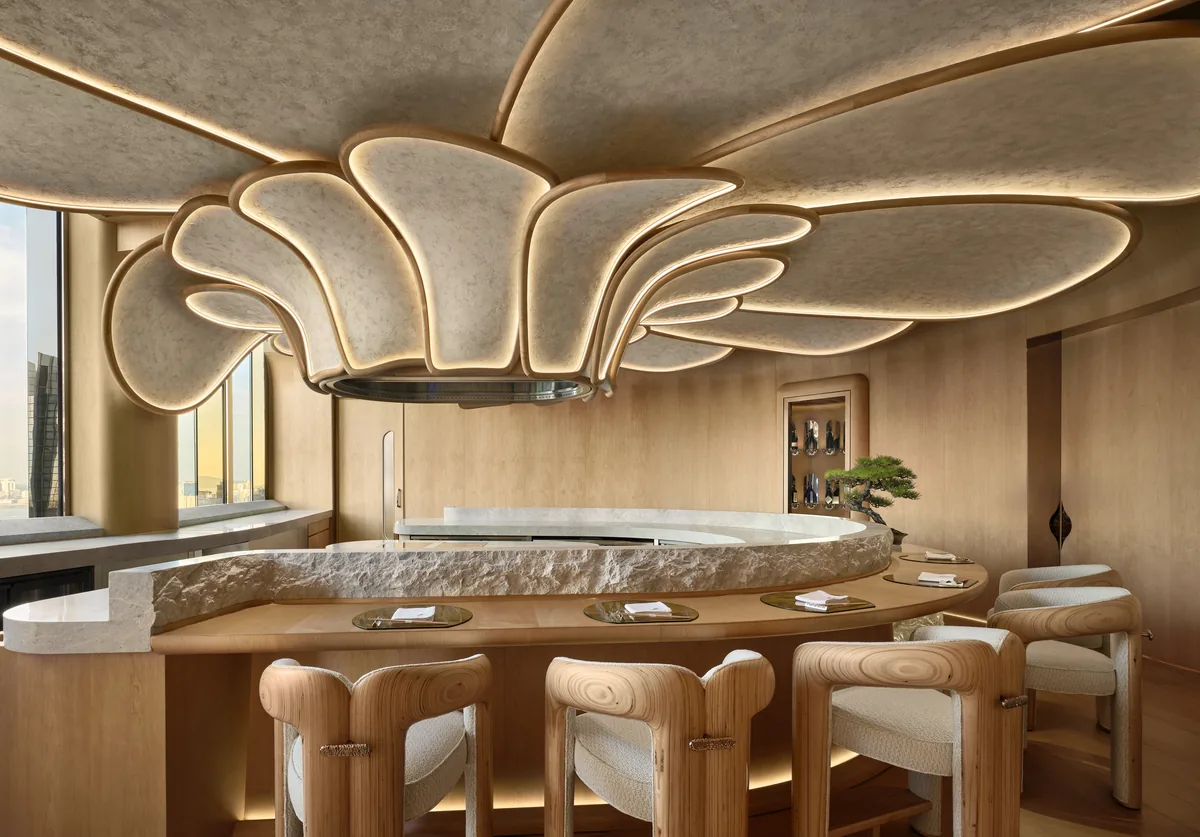
At a kappo counter, the meal is a performance seen at arm’s length. Kappo translates as “cut and cook.” It brings the chef out from behind the kitchen door and puts him in front of the guest. “Kappo dining is built on the relationship between chef and guest,” Lui and Lee said. “Every gesture, movement, and interaction becomes part of the experience, which meant the design needed to support that connection rather than overshadow it.”
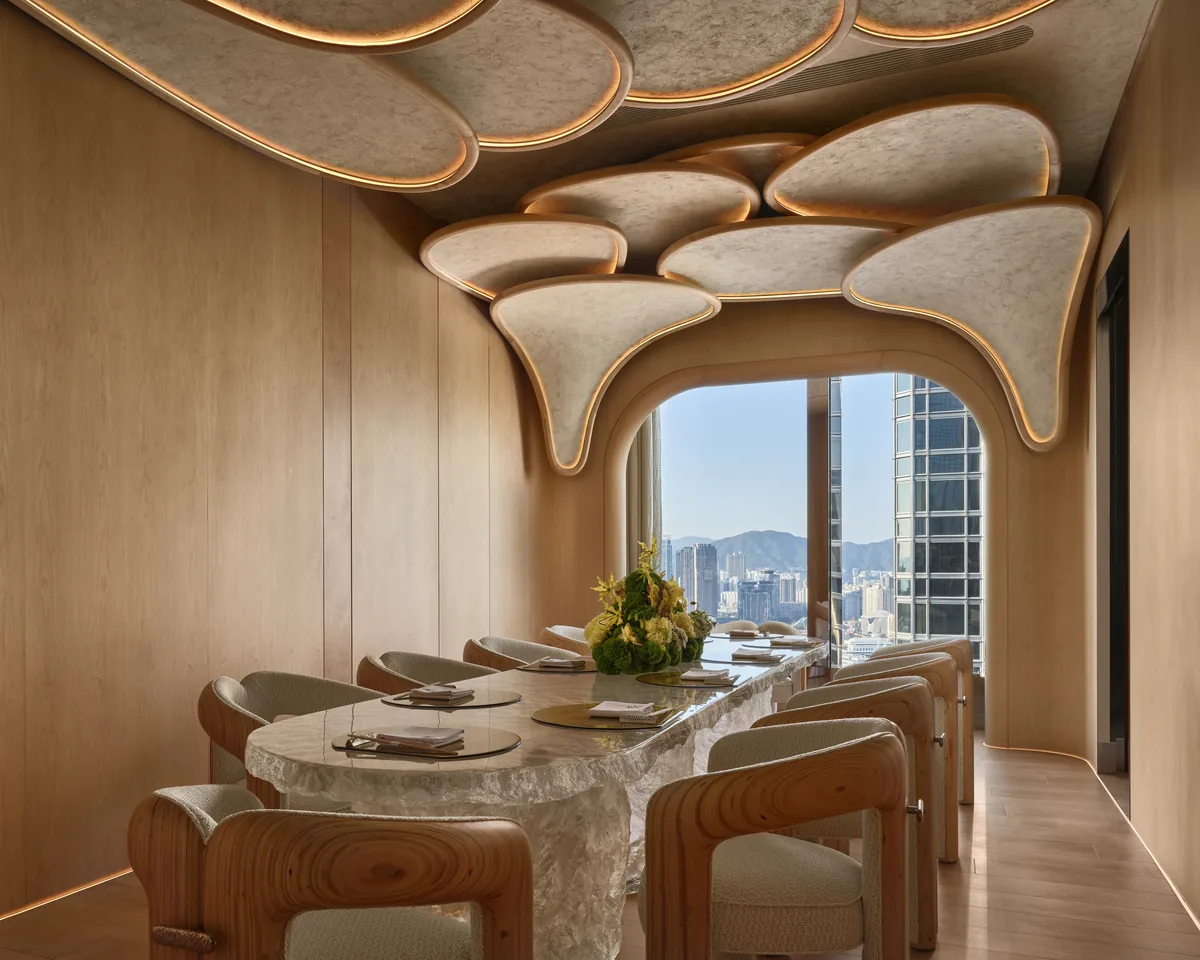
Twelve guests sit at the counter and twelve more in a private room. The designers treated the room as a stage, with Ogawa’s craft as its focal point. “The proportions of the counter, seating arrangements, sightlines, and lighting were all carefully considered to ensure guests remain fully connected to the preparation process,” they said. The island counter, finished in rough-cut glass rock, sits at the centre. Its shape follows the chef’s workflow.
The harder work was subtraction. “We deliberately avoided dramatic architectural statements, decorative excess, and overly theatrical lighting effects,” the designers said. “In many ways, the most important design decision was knowing what to leave out. The quieter the surroundings, the more powerful the culinary performance becomes.” Saikindō, the year’s best bar, made a similar choice in Abu Dhabi. There the DJ and the bartenders work side by side in the middle of the room. Two of this year’s winners hand the stage to the people who work there.
How HBA Builds a Personal Room at Global Scale
HBA is one of the largest hospitality design firms in the world. Hana no Kumo seats 24. Lui and Lee reject the idea that size brings sameness. “People often assume that larger firms operate through standardisation,” they said, “but projects like Hana no Kumo are the result of the opposite.”
The project moved in rounds. Designers, lighting specialists, the operator and Ogawa himself reviewed several mock-ups. Materials were tested again and again under different light. Lui has more than 30 years in hospitality design, with projects from Wynn Palace in Macau to the Fullerton in Sydney. Hana no Kumo asked for a different discipline. “What makes a project feel personal is not the size of the firm behind it, but the dedication invested in the process,” the designers said. HBA’s global network brings breadth, they added, “yet every successful project is ultimately shaped by a small, passionate team focused on a singular vision.”
That is also what this year’s awards rewarded. Carbone Riviera in Las Vegas, the best restaurant overall, softens its light through hand-blown Venetian glass. Hana no Kumo softens its light with the hour. In both, the luxury lies in what the guest is spared: noise, excess, the sense of being sold to. What remains is a counter, a pair of hands and a blossom season that returns every evening. Their aim, the designers said, was a restaurant “that feels both timeless and deeply human.” In it, “design quietly supports hospitality, craftsmanship, and memorable moments shared around the counter.”
Send this to someone who books a table for the chef, not the view.
Sources
- Mathew Lui, partner, HBA Hong Kong, and Gerard Lee, partner, Light Directions, written interview with The Silent Luxury, October 2026
- Restaurant & Bar Design Awards 2026
- HBA: Hana no Kumo, Hong Kong
- The Henderson: The Henderson unveils Hana no Kumo
- The Henderson: Three restaurants recognised at the Prix Versailles 2026
- Travel Extra: Restaurant & Bar Design Awards 2026 reveal global winners
Similar Articles
Lazy Lion: How a Budapest Shipping Palace Went Wild
Saikindō: The Abu Dhabi Listening Bar Built to Change Through the Day
Quality Over Quantity: Lech Zürs Answers Climate Change With Quiet Seasons
