Saudi Arabia bases its hospitality on a principle pursued in equal measure by the Royal Commission for AlUla and the project developer Red Sea Global: a place should be left richer than it was found. In AlUla, the AlUla Sustainability Charter governs what may be built; at the Al-Wajh Lagoon, marine biologists determined the locations before architects drew up their plans.
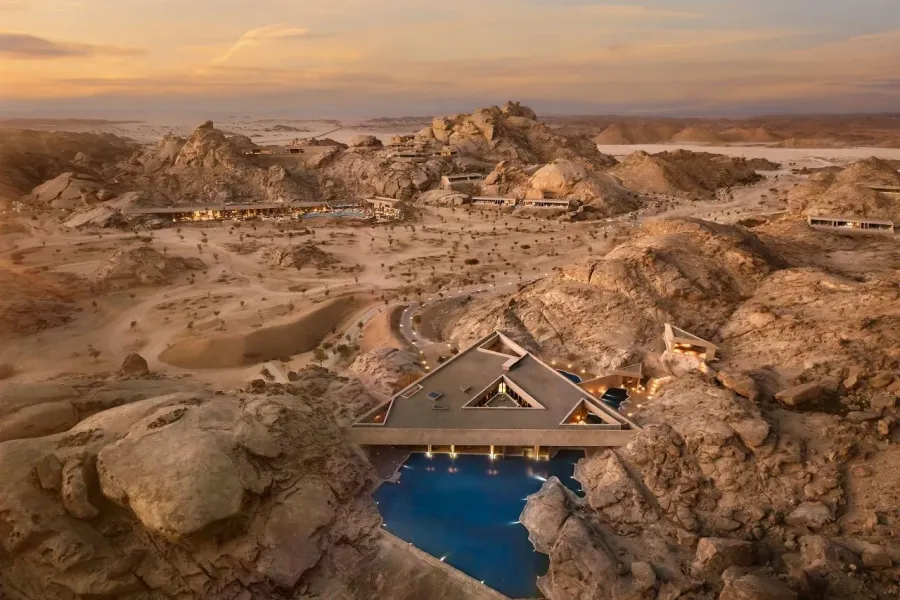
One day, a glass elevator will ascend through five hundred million years. It travels through the interior of a sandstone mountain in northern Saudi Arabia, past rust-red and ochre-colored layers, past niches set with art and engravings, and where it stops, a space carved into this very rock opens up. Outside the windows lies the valley of AlUla—vast, silent, and bathed in copper-hued sunlight. Sharaan by Jean Nouvel is the name of the building designed by the French architect, which has been under construction here since 2024—thirty-eight suites, each carved into the mountain one above the other. The Royal Commission for AlUla describes the process as an ancient Nabataean practice of creating spaces within the rock, combined with modern engineering methods. The architect calls AlUla a museum in which every wadi, every rocky outcrop, and every sandy expanse deserves the utmost care.
The Architecture of Preservation: Defining Modern Ultra Luxury
Anyone who wakes up in such a space is surrounded by the mountain—its coolness, its color, its age. AlUla is a cultural landscape in the northwest of the country, comprising twenty-two thousand five hundred square kilometers of sandstone valleys, oases, and desert, a good hundred kilometers from the Red Sea coast. For centuries, the Incense Route passed through here, and caravans traveling between southern Arabia and the Mediterranean stopped in this valley. Since 2017, the Royal Commission for AlUla has managed the region, and its chairman, Amr AlMadani, described it in the Harvard Business School alumni magazine with a sentence that captures its scope: AlUla has two hundred thousand years of history and has remained virtually untouched.
The AlUla Sustainability Charter, with its twelve guiding principles, governs what may be built here and aims for comprehensive regeneration. On its official website, the Commission describes a model that reduces the impact of travel, replenishes natural resources, and strengthens the livelihoods of local people. On the sidelines of the Future Investment Initiative in Riyadh, AlMadani told the daily newspaper Arab News what this ultimately means. He explained that there are rules and controls in place for sustainable tourism and that they want visitors who appreciate cultural engagement: “We are not after mass tourism.”
The long-term viability of the local economy, AlMadani continued, depends on preserving heritage and nature. What stands in AlUla, he said, has evolved over millennia and is an asset that generates economic value. He refers to the landscape itself as “our yellow oil”—the Kingdom’s yellow oil. The sandstone is meant to achieve what black oil has achieved over decades, with one crucial difference: An oil field eventually runs dry, while a well-maintained landscape endures. Those who treat it well tap into a renewable resource. Hence AlMadani’s concept of an open, living museum.
AMAALA: Where Well-Being Sets the Standard for Architecture
What such an approach means in the built environment has been evident for the past few months along a single stretch of coastline. On the northwestern Red Sea, where the Tabuk Mountains meet the world’s fourth-largest barrier reef, the state-owned project developer Red Sea Global is developing a destination called AMAALA, dedicated to the well-being of its guests. The properties there are operated by international hotel brands and opened one after another this summer: Four Seasons on June 15, Six Senses in mid-July, and on August 18, Rosewood, featuring 110 pool villas spread across 40 hectares, designed by Milan-based architects Antonio Citterio and Patricia Viel. This first phase of construction comprises nine properties, and Stephen Cheeseborough, who is responsible for development at Red Sea Global, told Arabian Business that all of them are scheduled to be ready by fall 2026. Each property shares the same mission: to leave the bay in which it stands in better condition than it found it.
Al-Wajh Lagoon: First the Biologists, Then the Architects
These homes are located where they are because scientists determined it should be that way. The Al-Wajh Lagoon spans 2,081 square kilometers; it is home to coral reefs, seagrass beds, and mangroves, and marine biologists from King Abdullah University—the research university on the Saudi Red Sea coast—spent 2017 and 2018 documenting it through fifteen ecological studies. A year of monthly coordination meetings followed, attended by architects and engineers. From five thoroughly analyzed scenarios emerged the map that, to this day, determines where a house may be built. The goal, published in 2020 in “Frontiers in Marine Science”, is a 30 percent increase in biodiversity in this lagoon—more than a marine protected area covering the entire area would have achieved. Anyone snorkeling here today swims over a reef that has benefited from the hotel’s construction.
The Falcon Islands: What Remained for the Animals Became the Most Valuable
Of the ninety-two islands in the lagoon, by far the largest portion still belongs to the animals. Nine of them are designated as special protection zones; loggerhead and green sea turtles nest on Waqadi; and sooty falcons circle above the mangroves, more than thirty Sooty falcons are being tracked by GPS and satellite tags so that researchers can understand their breeding and hunting routes. John Pagano, the CEO of Red Sea Global, says of the islands he left to the animals that many of them would have made magnificent resorts. He left them anyway. Anyone who arrives on one of the few islands with a house on it is rewarded with something that hardly any traveler on earth can find anymore: a place all to themselves, just like one of the first people ever to set foot there. The water all around belongs to them alone, as does the silence, and both restore what is lost in a busy life.
Shebara: The Villa That Bids Farewell at Sunset
On one of these islands, Shebara—a complex of seventy-three villas designed by the Dubai-based firm Killa Design—has been welcoming guests since late 2024. They rest above the water, spheres of mirror-polished steel, and their appearance changes with every hour of the day. At sunrise, they take on the orange of the sky; at noon, the silver of the lagoon; and at dusk, their edges blur with the water until the eye loses sight of the boundary between the reef and the house. Shaun Killa, the architect of this complex, wanted exactly that: to reflect the sky, the lagoon, and the coral beneath—different in every light and at every hour. You step inside and feel steel beneath your feet—cool, where your body expects sand. Somewhere in the room, a leather-lined bar awaits, opening only when a hand finds its hidden spot. The room remains silent, leaving the guest to set their own pace.
AlUla’s night sky: where the gaze is lost in infinity
Back inland, a second experience awaits the guest—one that sets this journey apart from any other. Above the AlUla desert, there is hardly any moisture in the air to form clouds, and little light to brighten the night. Thus, a firmament opens up above the rocks—one that remains hidden from city dwellers for the rest of their lives. You lie down on a warm rock, look up, and eventually the boundary between the one who looks and what he sees dissolves. You lose yourself in infinity. What reveals itself up there is greater than a single life and older than any memory, and it continues long after the observer is gone.
Hegra: An Art That Slept for Two Thousand Years
This sky shaped AlUla long before the first visitor arrived. A few kilometers from Sharaan lies Hegra, Saudi Arabia’s first World Heritage Site since 2008. There, in the first century, the Nabataeans carved their tombs into the same sandstone—one hundred and eleven in number, ninety-four of them adorned with facades featuring eagles, snakes, and sphinxes. They found their way through the desert by the stars, and they followed them right into their structures. In February 2023, an international group of archaeoastronomers surveyed the orientation of 113 of these burial chambers—the largest contiguous survey of its kind in the Nabataean realm—and found that they had been deliberately aligned with the rising and setting of specific stars. Two of the more than two hundred stars with Arabic names are named after this place: Alula Borealis and Alula Australis. Anyone who ever loses themselves beneath this sky can sense what moved those people to carve their chambers into the rock so that their openings face the rising of those stars under which they had traveled during their lifetimes.
One Million Guests a Year: Restraint as a Business Model
In October 2024, AlUla Manara and Gharameel Nature Reserve became the first places in Saudi Arabia and the entire Gulf to receive Dark Sky certification. A year later, Sharaan National Park and Wadi Nakhlah Nature Reserve followed. Today 6,146 square kilometres of protected night sky lie over AlUla, the third largest of its kind in the world..
AlUla plans to welcome no more than one million visitors per year by 2030, with a target of two million by 2035; along the Red Sea coast, the limit is one million. These numbers determine what a guest finds here: a sky that has witnessed two thousand years, a mountain that is still a mountain, and a reef that sustains more life than before their arrival. The Nabataeans left behind a place that has endured for two thousand years because they oriented it toward something greater than themselves. Those who come here today and then depart may take the same thing with