Who Owns Puma and Hugo Boss Now: Germany’s Brands Shift to Retailers and Brand Builders
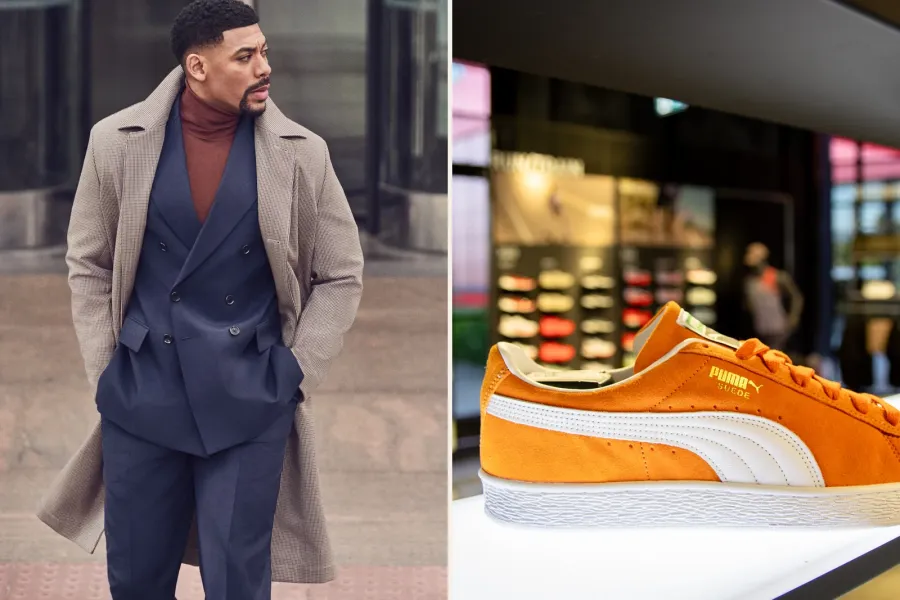
Aaron Pierre in the BOSS autumn/winter 2026 campaign and the Puma Suede in store. Courtesy of HUGO BOSS and PUMA
Puma’s largest shareholder is now Anta Sports of China, which bought the Pinault family’s stake in October 2026, and Hugo Boss is controlled by Frasers Group, the British retailer behind Sports Direct and Harvey Nichols. Five signals on where value, meaning and control in luxury are moving.
Eva Winterer
Two of Germany’s best-known brands changed hands in October 2026. On 7 October Anta Sports, the Chinese sportswear group that owns the Fila brand in China, became Puma’s largest shareholder. It bought 29.06 per cent from Artémis, the Pinault family’s holding company, for €1.51 billion. On 23 October Frasers Group raised its stake in Hugo Boss to 50.08 per cent. The British retailer owns Sports Direct, Flannels and Harvey Nichols. The answer to who owns Hugo Boss is now a retailer: the Metzingen fashion house has become a subsidiary, and its results will be consolidated in Frasers’ accounts.
Anta and Frasers: The New Owners Who Sell for a Living
Both brands change hands in a weak year. Puma is in the middle of a turnaround under Arthur Hoeld, who crossed the river from Adidas to run its neighbour in 2025. On 30 October it reported a third-quarter net loss of €54.9 million and confirmed an operating loss for the year. Hugo Boss sold €1.8 billion in the first half of 2026, 10 per cent less than a year earlier. For the full year it expects revenue to fall by 5 to 9 per cent at constant exchange rates. Anta paid €35 a share, below the more than €40 that Artémis had hoped for. Frasers had offered €38 a share for Hugo Boss in June, and the Hugo Boss boards rejected it as “financially inadequate”.
The buyers come from the same side of the business. Anta builds and repositions sports brands, from Fila in China to Arc’teryx. Frasers runs shops, from discount sports stores to Harvey Nichols in Knightsbridge. Neither company created the brand it now steers. On 5 October, in the middle of Paris Fashion Week, Frasers brought its luxury stores together in a new division. Its chief executive, Michael Murray, described the plan in one sentence. “We’re building out a luxury retail ecosystem,” he told Vogue Business.
That sentence sums up the month, and it reaches well beyond Germany. Power in luxury is moving from the people who create brands to those who control desire, distribution and markets. The brands have become tenants. Their new owners are landlords who hold the places where brands live: the rooms where desire is made, the shop floor and the growth markets. For the market, this changes who sets prices, who owns the client data and who decides what a name stands for. Five signals show how far the shift has gone.
Puma and Hugo Boss Under New Owners: What Changes Now
Puma keeps its independence on paper and gains a shareholder with a plan for China. Anta will seek seats on Puma’s supervisory board and says it has no plans for a takeover offer. Ding Shizhong, Anta’s chairman, has promised to respect “Puma’s independence and brand identity” and to share “our experience and capabilities” as a long-term shareholder. Puma makes about 7 per cent of its sales in China, and analysts at Citi expect Anta to grow that share quickly. The agreement also protects the seller. If anyone pays more for Puma shares within 15 months of the closing, Anta tops up its price under an agreed formula.
Hugo Boss is changing faster, because Frasers now has control. Frasers took its first 5 per cent in 2020, raised the stake to 19.2 per cent in 2025 and placed Murray on the supervisory board. After the rejected offer it reached 47.89 per cent in August. In October a final purchase of 198,666 shares for about €7.6 million took it past 50 per cent. Stephan Sturm handed the chair of the supervisory board to Murray in September, and Robert Palmer, Frasers’ company secretary, has joined him on the board. The chief financial officer has left, Ivica Maric became finance and operations chief on 1 October, and Hugo Boss ended its share buyback early. Daniel Grieder remains chief executive, and Frasers may buy more shares within twelve months.
The great luxury fortunes are buying the places where desire takes shape: the saleroom, the cellar, the agency, the journey. What is made in volume goes to those who sell it.
Reading
Signal 2
Luxury leaves mass sport to the sportswear groups
Luxury keeps its seat at the trackside and in the boardroom. The factories that make trainers by the million pass to groups built for scale.
Reading
Signal 3
Brand operators buy European names
A heritage name now takes its meaning from the market where it sells best. Origin stays on the label, and the decisions move to whoever runs the brand.
Reading
Signal 4
Retailers and jewellers take control of the whole chain
Shops are buying the brands they stock, and brands are buying the chain behind them. Whoever holds the counter holds the price and the client.
Reading
Signal 5
The premium middle becomes a buyer’s market
Famous names that have lost their pull are the cheapest way into luxury. Heritage has a price again, and it is set in the weak years.
Swipe through →
Signal 1: Family Fortunes Leave Product Brands
The great family fortunes behind luxury are moving their capital to the places where desire is created: art, fame, rare wine and travel. Along the way, brands made in volume are passing to owners who run shops and brand portfolios. What people will want is increasingly decided before an object reaches a shop, in a saleroom, a talent agency or on a journey.
The Pinault family shows the move most clearly. Its holding company owns Christie's, where an evening sale in New York can fix what a painting is worth for years. It owns Château Latour, the first growth from Pauillac, and Ponant, whose small ships take guests to Antarctica. In 2023 Artémis bought a majority of Creative Artists Agency at a valuation of $7 billion. The Los Angeles firm represents Tom Cruise as well as musicians and athletes. Artémis had described its Puma stake as non-strategic, and the diversification has been expensive. Artémis reported consolidated debt of €26.7 billion at the end of 2024 and says its liquidity is secure. The family still holds about 42 per cent of Kering.
More product brands will come up for sale as family holding companies reshape their portfolios, and the buyers will increasingly be retailers and brand operators. The landlords of desire keep the rooms where the price of taste is set. The goods made in volume go to whoever can sell them.
Signal 2: Luxury Leaves Mass Sport to the Sportswear Groups
As owners, the luxury groups are leaving mass sport; as a stage, they are moving closer to it. Sports brands are passing to groups built for volume. The luxury houses buy what sport offers them, a global audience and the glamour of winning, through sponsorships, board seats and collaborations. Brands that sit between sport and fashion lose the shine a luxury owner once lent them.
Kering ran the experiment for eleven years. In 2007 PPR, the retail group that later took the name Kering, bought a majority of Puma. It called the brand a perfect fit for a portfolio spanning luxury and sport lifestyle. Kering spun Puma off in 2018 to concentrate on its fashion houses. The Pinault holding kept about 29 per cent, the stake that has now gone to Anta.
LVMH prefers a lighter touch. In September 2026 Alexandre Arnault joined the board of Nike. A week later the Swiss running brand On told investors in Zurich that luxury had lost roughly 80 million customers to lower price points. On calls the buyers it wants the Movement Class, people for whom sportswear is part of who they are.
The volume business is consolidating around groups such as Anta. It owns Fila in China, Descente and Jack Wolfskin, and through Amer Sports it controls Arc'teryx, Salomon and Wilson. Luxury rents the grandstand. The factories belong to someone else.
Signal 3: Brand Operators Buy European Names
The value of a heritage brand now depends on its access to the growth markets, and whoever controls that access decides what the brand means. Origin becomes the story on the label. The operator on the ground sets price, stores and clients. European names are becoming instruments for groups in China and the United States with global ambitions.
Anta developed the method with Fila. The label was founded in Biella in 1911, among the wool mills at the foot of the Alps. In the 1970s it dressed Björn Borg at Wimbledon. In 2009 Anta bought the rights to Fila in China, where it then had about 50 shops, all of them losing money. It repositioned the brand between sport and fashion, raised its prices and opened stores on the best shopping streets of Chinese cities. By 2021 Fila sold more than 20 billion yuan a year in China, over a third of Anta's revenue. Anta later turned Arc'teryx, a Canadian climbing label, into a status brand in Shanghai and Beijing.
The same logic operates out of New York. In 2026 LVMH sold Marc Jacobs to WHP Global and G-III Apparel for $925 million. WHP owns brand names and licenses them to companies that make and sell the products. Traffic runs the other way as well. On 13 October 2026 Proya, China's largest beauty group by revenue, opened a research laboratory in Suresnes, west of Paris.
For Puma, the question in 2027 is whether Herzogenaurach keeps control of design while Anta shapes how the brand is sold in China. The name stays with the brand. Its meaning travels to whoever runs it.
Signal 4: Retailers and Jewellers Take Control of the Whole Chain
The line between the brand and the shop that sells it is disappearing, and with it the old balance of power. For most of luxury's modern history the houses chose their stockists and set the terms. Now retailers buy brands and brand owners buy the chain. Both want control of pricing, the client data and the last word on what goes on the shelf. Independent multibrand stores are caught between houses that sell for themselves and retailers that own houses.
Frasers is crossing the line from the shop's side. Mike Ashley opened his first sports shop in Maidenhead in 1982. He built it into Sports Direct, the discount chain on almost every British high street. Under Murray, chief executive since 2022, the group moved upmarket. Flannels now turns over more than £1 billion. In 2025 Frasers took a majority of The Webster, the independent boutique Laure Hériard Dubreuil opened in Miami. In August 2026 it bought Harvey Nichols. With Hugo Boss, a fashion house is now controlled by a retailer that sees every day which sizes sell out and which prices hold.
Richemont is crossing it from the other end. The owner of Cartier is in advanced talks to join the consortium bidding for De Beers, the diamond miner Anglo American is selling. A jeweller that owns part of the mine controls the stone from the ground to the shop window.
The test for Hugo Boss is whether a retailer's knowledge sharpens the brand or flattens it.
Signal 5: The Premium Middle Becomes a Buyer's Market
Consolidation has reached the premium middle of the market, where famous names have lost momentum and their share prices with it. Heritage is getting cheaper, and the buyers are those with cash and selling space. The hourglass that has been emptying the middle of luxury now shows up in ownership.
Every one of the recent purchases began with a brand under pressure. Harvey Nichols opened in Knightsbridge in 1831 as a linen shop, and this August Frasers bought it out of administration for £43.3 million. Frasers holds 8.78 per cent of Under Armour, bought while the shares traded near multi-year lows. In October it raised its Burberry stake to 7.42 per cent. In the same month Lacoste dismissed Éric Vallat, a little over a year after hiring him to take the crocodile upmarket. Thierry Guibert is back as chief executive.
Puma and Hugo Boss were both bought in weak years, and both prices show it. Anta paid a 62 per cent premium to Puma's share price before the deal was announced, and still less than the seller had wanted. Frasers gained control of Hugo Boss by buying shares in the market after its offer had been turned down. Arthur Hoeld opened Puma's quarterly results by welcoming the new owner. “October marked an important new chapter in Puma's history,” he said, “with the entry of Anta Sports as our largest shareholder.”
Heritage has a market price again, and it is set when the brand is weak. Frasers' stakes in Burberry and Mulberry show where the landlords are looking next.
Who Holds the Keys: Luxury Brand Ownership in 2027
The year ahead will show how far the new owners go. Anta expects seats on Puma's supervisory board, and its price agreement with Artémis runs into early 2028. Frasers may buy more Hugo Boss shares within twelve months. In Australia its final offer of 65 cents a share for the footwear retailer Accent Group stays open until 29 January 2027, and Accent's shareholders meet on 20 November.
For shoppers, the change is quieter. The names stay above the door. The leaping cat still marks Puma's headquarters in Herzogenaurach. In Metzingen the outlet stores bear the name Hugo Boss gave his clothing business in 1924. What changes is who decides what goes on the shelf, at what price and for how long. That decision is moving to Jinjiang, where Anta began making shoes in 1991. It is also moving to Shirebrook in Derbyshire, where Frasers runs its business from a warehouse on the site of a former colliery.
After Rudolf and Adi Dassler split in 1948, people in Herzogenaurach looked at your shoes before they spoke to you. The shoes showed which brother you worked for. The shoes still show which brand you wear. Who owns that brand is now decided by the people who know how to sell it.
Send this to someone who wants to know who owns the brands they wear.
Luxury brands lose relevance in 2026 as over-distribution and constant availability dissolve the desire the houses spent decades building. The brands losing relevance are those that made these decisions systematically during the boom years of 2021 to 2023.
The luxury trends shaping 2027 are already visible in the third-quarter results of 2026: fewer people walk into the stores, and those who do spend more. For Hermès, Kering, Zegna and their peers, the figure that now matters most is how many new clients return for a second purchase.
Kering's ReconKering is the multi-year turnaround Luca de Meo runs across Gucci, Saint Laurent and Alexander McQueen. Six chapters follow the overhaul from the McQueen case to the figures behind the model.
Sources
Anta Sports Products Ltd, completion of the acquisition of a 29.06 per cent stake in Puma SE, 7 October 2026: ir.anta.com
Puma SE, third-quarter 2026 results, 30 October 2026: about.puma.com
Hugo Boss AG, half-year report 2026, voting rights notifications and supervisory board changes, 2026: group.hugoboss.com
Frasers Group plc, regulatory announcements on Hugo Boss AG, Burberry Group, Under Armour, Harvey Nichols and Frasers Group Luxury, 2025 and 2026: frasers.group
Accent Group Ltd, ASX announcement on the Frasers offer, 20 October 2026: asx.com.au
Kering, history of the group from Pinault S.A. to PPR and Kering: kering.com
On Holding AG, Investor Day, Zurich, 22 September 2026: on.com