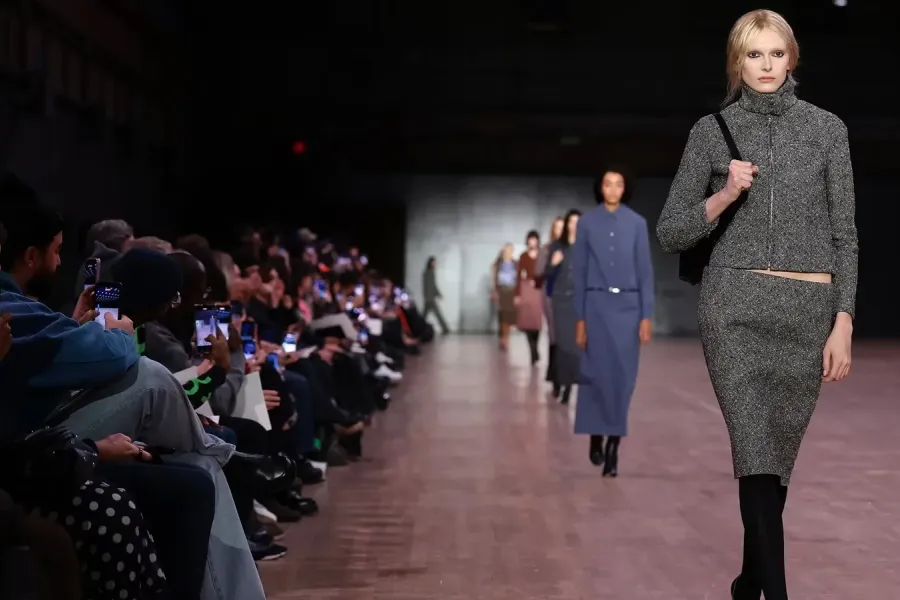
Marc Jacobs opened New York Fashion Week on 9 February 2026 in the near-empty Park Avenue Armory, returning to the low-slung plaids and greige knits of the collection that cost him his job in 1992. Courtesy of Marc Jacobs.
The Long Goodbye: What LVMH Really Sold When It Parted Ways with Marc Jacobs
The $925 million offloading of the American fashion house to WHP Global and G-III Apparel Group marks the end of a thirty-year luxury experiment and exposes the widening fracture between creative ownership and corporate licensing.
Eva Winterer
At a Glance: On 1 September 2026, LVMH completed the $925 million sale of Marc Jacobs to WHP Global and the G-III Apparel Group, ending an ownership that began in 1997. The buyers hold the trademarks in a 50/50 joint venture, while G-III bought the 100-plus shops and licensed the name for the United States, Canada, Mexico and Western Europe. Marc Jacobs stays on as creative director.
In November 1992, a twenty-nine-year-old Marc Jacobs, then heading womenswear at Perry Ellis, sent a shockwave down the runway that would alter the grammar of modern fashion. The collection was built entirely from the detritus of New York thrift stores, elevated by the alchemy of luxury. Flannel shirts that had once sold for two dollars returned as printed silks. Thermal underwear was reincarnated in heavy cashmere. Delicate floral dresses were spun from gossamer chiffon. As Kate Moss, Christy Turlington and Naomi Campbell glided down the catwalk, the critic Suzy Menkes pronounced the grunge aesthetic hideous, while Women’s Wear Daily crowned Jacobs the undisputed guru of the movement and the Council of Fashion Designers of America honoured him with its award for womenswear designer of the year.
Weeks later, Perry Ellis fired him and cancelled production on the entire line. In a final act of romantic defiance, Jacobs mailed the samples to Kurt Cobain and Courtney Love. They were never worn. Decades later, Love revealed that the couple had promptly burned the lot, since punks had no use for luxury approximations of their own subversion.
Marc Jacobs remains as creative director – tasked with steering the aesthetic identity of a label where his name and his business are now owned by entirely separate corporate entities
Marc Jacobs: Thirty Years Inside LVMH
Marc Jacobs and Robert Duffy found the label Marc Jacobs.
LVMH acquires a stake in the label. No figure was disclosed.
By
LVMH holds 80 per cent of the brand, with Jacobs and Duffy at 10 per cent each.
WHP Global and G-III acquire the trademark rights to the Marc Jacobs brand, half each. G-III owns the operating business under licence.
That founding story of rebellion and commercial volatility has loomed over the brand ever since Jacobs and his business partner Robert Duffy resurrected the label the following year. It also illuminates the structural shift that occurred on 1 September 2026, when LVMH finalised the sale of Marc Jacobs for approximately $925 million. The transaction, which ends a three-decade custodianship dating back to 1997, strips the label down to a corporate abstraction.
The two buyers have divided the spoils with clinical precision. WHP Global and G-III Apparel Group each hold a fifty percent stake in a joint venture that owns the brand’s trademarks and nothing else. G-III acquired the physical operating business, which includes more than a hundred retail locations across the United States and Europe, alongside a long-term licence to exploit the name across North America and Western Europe. According to filings with the Securities and Exchange Commission, G-III funded its roughly $500 million share through a combination of cash and a revolving credit facility, warning investors that the acquisition would dilute earnings over the first twelve months. Marc Jacobs himself remains creative director, steering the aesthetic identity of a label where his name and his business now sit with separate corporate entities.
A Fractured House: The Long Split Between Name and Trademark
To seasoned observers, this decoupling of identity and asset comes as no surprise, because the brand’s ownership had been fractured long before the ink dried on the September contract. Robert Duffy, who discovered Jacobs at his 1983 Parsons School of Design senior show and hired him on the spot for a sportswear label called Sketchbook, had always negotiated with a keen eye for protection. When Bernard Arnault brought the pair into the corporate fold in 1997, installing Jacobs as artistic director of Louis Vuitton in the same season, the arrangement was already split down the middle.
By 2013, according to Women’s Wear Daily, LVMH controlled the operating company outright while Arnault, Jacobs and Duffy each retained a third of the trademarks. The conglomerate eventually consolidated an eighty percent stake by 2015, leaving the remaining fifth with the two founders. The separation of a designer’s birth name from the vehicle that trades upon it has been a structural reality here for nearly thirty years, and this final sale pushes that logic to its conclusion.
The rise and fall of Marc by Marc Jacobs proved a stark reality: in the modern luxury machine, high-street volume can be a financial lifeline, or the end of an IPO fantasy
Marc Jacobs Is Cut in Two
LVMH sold the brand for $925m on 1 September 2026. The buyers separated the name from the business.
Marc Jacobs
founded 1984
The Trademarks
a 50/50 joint venture
WHP Global
50%
G-III
50%
the name only
The Operations
wholly owned
G-III
100%
Stores
100+
US and Europe
Long-term licence
A long-term licence runs from the joint venture to the operating business, covering the United States, Canada, Mexico and Western Europe.
For a long time, the engine driving the brand’s valuation was the democratic allure of the high street rather than the rarefied atmosphere of the Paris runways. Launched in 2001, the diffusion line Marc by Marc Jacobs targeted a younger, less affluent customer and became a juggernaut, with analysts estimating that it generated up to eighty percent of the brand’s total retail revenue. Buoyed by these numbers, LVMH’s chief financial officer Jean-Jacques Guiony tantalised Wall Street in early 2014 by hinting at an impending public listing, with total revenues hovering around the billion dollar mark.
Then the strategy pivoted. Fourteen months later, LVMH dismantled the diffusion line entirely. Jacobs told Women’s Wear Daily in March 2015 that operating two collections with conflicting messages had become counterproductive, and he described his long-held belief that fashion could coexist at all price points, from thirty-dollar flip-flops upward, with none of it treated as the poor relation of anything else. The volume left with the diffusion line, the listing evaporated, and by 2017 an anxious Arnault told an audience that Marc Jacobs worried him more than the geopolitical unpredictability of the Trump presidency. Luca Solca, then at Exane BNP Paribas, estimated that the brand was losing more than fifty million euros annually against flat sales.
The task of triage fell to Eric Marechalle, who arrived from Kenzo in 2017 and spent the following decade engineering a quiet turnaround. He rationalised the retail footprint, cutting the store count from over 250 to a lean 130, and refocused the house on accessible hits. The launch of The Marc Jacobs in 2019 yielded the ubiquitous Tote Bag, followed by the Gen-Z-focused Heaven line in 2020 under Ava Nirui. By the end of that year the business recorded its first profit since 2015. Marechalle also formalised the duality that the recent sale has now codified into law, treating the runway as an avant-garde laboratory for the designer while an insulated commercial team produced the goods that actually paid the bills.
The message from Paris is unmistakable: LVMH is retreating from the unpredictable theater of downtown New York cool, choosing instead to double down on the bulletproof, quiet luxury of Loro Piana
Two Years of Talks and the New Corporate Masters
LVMH’s patience had limits, and the search for an exit has been an open secret in the financial capitals for more than two years. Bloomberg reported in 2024 that the group had engaged advisers, a claim a spokesman denied forcefully. The Wall Street Journal reported active talks in July 2025 at around a billion dollars, and Reuters named three suitors: Authentic Brands Group, WHP Global and Bluestar Alliance.
The Authentic negotiations collapsed in late 2025 over the complex knot of Jacobs’s personal equity and future creative control, which Women’s Wear Daily reported had made the transaction too complicated to complete. The arrangement that closed in September answers the existential question of how a living designer fits into a modern licensing machine by drawing a hard financial line between the art and the trademark.
The brand now enters the stable of WHP Global, a brand-management firm founded in 2019 by Yehuda Shmidman and backed by Oaktree Capital Management, Ares Management and BlackRock. Shmidman has described his strategy to CNBC as a rescue mission for legacy brands, acquiring underused intellectual property straight off the mall shelves and scaling it through aggressive wholesaling. Marc Jacobs now sits in a portfolio generating over $8.5 billion in retail sales, alongside names as disparate as Vera Wang, rag & bone, Lands’ End and Toys”R”Us. The new owners have signalled their intent to reverse the 2015 consolidation by expanding wholesale and signing new global licences.
The Luxury Contraction: Paris Retreats to Absolute Exclusivity
For LVMH, the offloading of Marc Jacobs arrives at a moment of sobering realignment across the sector. Days after the sale closed, LVMH shares tumbled to their lowest level since 2020, a comedown from the peaks of spring 2023. The group’s fashion and leather goods division reported one percent organic growth in the second quarter, caught in a global cooldown that has spared neither Hermès nor Kering. Bain counts some sixty million consumers who have exited the luxury market over the past three years, driven away by post-pandemic price increases of up to seventy percent.
In this climate of contraction, the disposal of a volatile American fashion house signals a deeper strategic shift. Eight months before the Marc Jacobs sale, in January 2026, LVMH deployed a billion euros to increase its stake in Loro Piana from 85 to 94 percent. That transaction valued the Italian house at eleven billion euros, against an enterprise value of 2.7 billion when the group first bought in during 2013.
The Andean Strategy: Owning the Loom, the Mountain, and the Animal
While contemporary brands gamble on ephemeral consumer trends and volatile licensing deals, LVMH is quietly retreating to an older, more defensive fortress: the absolute control of the raw material.
That control begins in the thin air of the high Andes. The pinnacle of the house’s offering is vicuña, a wild, notoriously skittish camelid that thrives only above four thousand meters in Peru. A single animal yields a mere eight ounces of fleece and can be safely shorn only once every two years. At twelve to thirteen microns, the resulting fiber is finer than the most exquisite cashmere, a rarity that pushed the species to the brink of extinction, reducing its population to a mere six thousand animals by 1950.
Loro Piana’s true genius was recognizing that luxury in the 21st century would be defined by scarcity. In the 1980s, the Italian house partnered with the Peruvian government to finance fencing, breeding, and conservation initiatives, effectively rescuing the species while securing exclusive rights to manufacture commercial vicuña cloth by the 1990s. The firm doubled down on this vertical monopoly in 2008, financing Peru’s first private nature reserve for the species before snapping up shearing rights across a massive 85,000-hectare reserve in neighboring Argentina.
The house’s celebrated cashmere operations follow the exact same, uncompromising logic. Rather than navigating speculative textile markets, Loro Piana operates its own dedicated trading entity in Mongolia, purchasing fleece directly from nomadic herders before shipping it to be spun and woven at its historic mills in Quarona and Roccapietra. What LVMH acquired more of in January reaches back to a specific animal on a specific mountain and ends at a loom the group owns.
The New Luxury Landscape
The two transactions carry no stated connection to each other and fell within the same financial year. Their juxtaposition, however, is telling. In an uncertain landscape, the world’s largest luxury conglomerate is retreating from the unpredictable theatre of downtown New York cool, choosing instead to double down on vertical integration and absolute exclusivity. In this new world, true luxury no longer belongs to the designer who creates the look, but to the conglomerate that owns the entire supply chain.
Meanwhile, Marc Jacobs will continue to show his collections outside the constraints of the official fashion calendar, on dates the house chooses for itself, as he has done since 2021. He remains the creative heart of the label. The name above the door belongs to Oaktree, Ares and BlackRock.