The Hourglass Snaps Shut: What the US Luxury Market Reveals in 2026
This article is part of the dossier on the structural shift reshaping the luxury market.
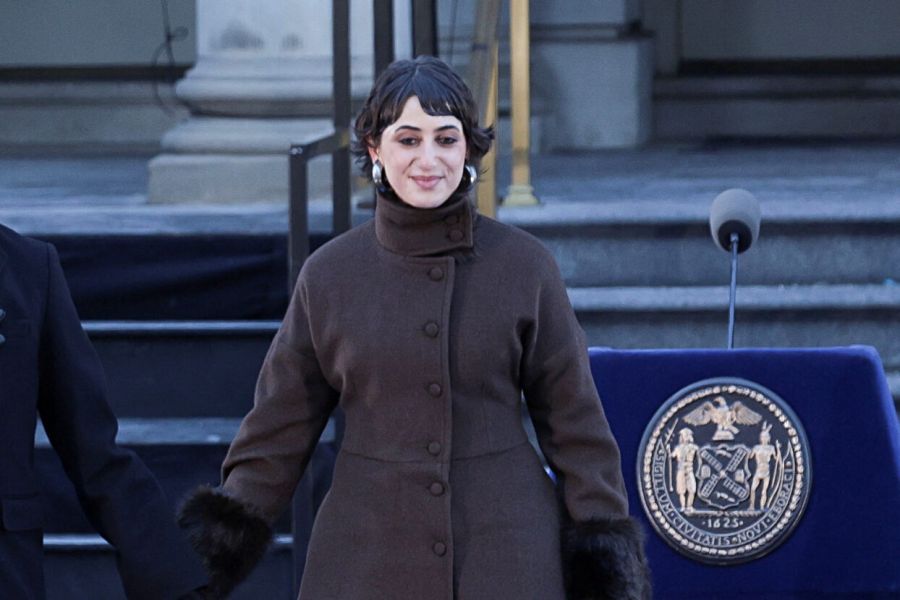
On the first day of January 2026, Rama Duwaji stood at her husband’s inauguration as the 111th mayor of New York City in a vintage Balenciaga coat sourced from the Albright Fashion Library, tailored shorts from The Frankie Shop, and boots borrowed from British independent label Miista. For the midday ceremony at City Hall, she wore a reworked piece by Palestinian-Lebanese designer Cynthia Merhej of Renaissance Renaissance, a third-generation couturier whose atelier operates between Beirut and Paris, with collections made in Lebanon using local artisans and family-owned factories. Her stylist, Gabriella Karefa-Johnson, framed the choice plainly on Substack: “On her first official day as First Lady of New York, Rama is wearing a small, independent woman designer from the Middle East.”
The image circulated widely. It was also a precise signal about the American market: on the most public stage New York offers in January, the first lady chose provenance over brand, a maker with a face over a conglomerate with a logo. That choice carried the whole meaning of the moment. It was the moment.
Three months later, the April 2026 Consumer Sentiment Index landed at 49.8 — the lowest reading in seventy-four years, down from 52.2 in April 2025 and from 74.0 in April 2024. Within two years, American households had lost nearly a third of their economic confidence on an index where 100 represents full confidence and the long-run historical average sits at 86.
The Deloitte Financial Well-Being Index confirmed the same direction: tracking how Americans feel about paying their bills, their savings, and their financial expectations for the year ahead, it fell to 101.1 in March, down from above 105 through most of 2025. Housing costs, healthcare, debt service, and stagnant wages had been growing faster than incomes for years, and the economic shock of the Iran conflict landed on top of that accumulated pressure. At the lowest sentiment reading in seventy-four years, a broad stratum of American households had stopped absorbing it quietly. With inflation expectations for the year ahead at 6.7 percent, the highest reading in four decades, there was little in the data to suggest the pressure would ease.
The Hourglass Economy: Wealth Up, Middle Out
The hourglass economy describes the structural polarisation of consumer spending into two growing segments with a contracting middle: wealth concentrating upward among high-net-worth individuals, the aspirational middle tier eroding under the compounding pressure of inflation, housing costs, and debt, and a broadening base of households the category has moved beyond reach entirely.
For two decades, the growth engine of American luxury was the aspirational middle tier: corporate managers, dual-income suburban households, high-earning-not-rich-yet professionals earning between 150,000 and 300,000 dollars a year. These buyers stretched for entry-level purchases, drove volume across the category, and kept brands growing without having to compete for the very top of the wealth pyramid. By early 2026, a compounding mix of persistent core inflation, soaring housing costs, stagnant real wages, and heavy consumer and student debt had stripped this tier of its discretionary capital. The income was still there. The fixed costs had grown to absorb it.
Bain, BCG, and Deloitte track the consequence consistently across their 2025 and 2026 reports. Between 2022 and early 2026, the global luxury customer base contracted from approximately 400 million people to around 330 million, according to Bain & Company, with the departure concentrated in exactly this aspirational stratum across every major Western market. BCG and Altagamma tracked where the spending went: approximately 35 percent of these consumers redirected their budgets toward savings, debt reduction, and the resale market.
In 2026, wealthy buyers hold 47 percent of all US personal luxury spending, according to Bain and eMarketer. In 2019, that share stood at 30 percent. The sixty to seventy million who exited the global luxury market between 2022 and 2026 did not stop spending; they redistributed downward, into the mass market, the resale economy, and categories where their budgets still had reach. At the upper end of the income spectrum, the dynamic ran in the opposite direction. North America added 7.3 percent to its population of high-net-worth individuals in 2024, reaching 8.4 million people with aggregate wealth of approximately 29.9 trillion dollars, according to Capgemini’s World Wealth Report 2025. By 2026, 47 percent of US luxury spending sits with buyers who represent a small fraction of the total consumer base.
The Q1 2026 earnings results showed precisely which brands had built for that buyer and which had not.

Continued Reading
The Hourglass Economy: What the Luxury Market Data Shows
Wealth concentrating upward, the middle hollowing out, and the structural pattern behind the Q1 2026 divergence.
Read the analysis →Seventeen Points: The Confidence Collapse of 2026
Hermès grew the Americas by 17.2 percent in Q1 2026. Brunello Cucinelli added 14 percent to constant exchange rates, with a rising proportion of special and unique pieces in each transaction. Prada’s Americas retail sales advanced 15 percent. LVMH’s Watches and Jewelry division gained 7 percent organically, with Tiffany a particular driver. Even Kering, whose flagship Gucci brand fell 8 percent in comparable terms across the group, recorded a North American gain of 8 percent.
Between 2023 and 2025, approximately 80 percent of global luxury market growth had come from price increases rather than genuine volume expansion or investment in craft, according to the BoF-McKinsey State of Fashion 2026. Some houses used that period to extract revenue from a loyal base. Others invested in the quality of the object and the depth of the client relationship. J.P. Morgan’s head of European Luxury and Sporting Goods, Chiara Battistini, described North America as “the bright spot of the season, supported by wealth creation and equity market strength.” Hermès and LVMH’s US performance diverged by 17 percentage points in the same quarter, in the same market, serving the same high-net-worth consumer. The difference runs deeper than the macroeconomy. It is structural.
Permanence as Currency: What Keeps Its Value
The Federation of the Swiss Watch Industry reported that Q1 2026 reached 6.2 billion Swiss francs in total export value, a 1.4 percent increase over the prior year, with the United States holding its position as the single largest destination market. The number of units exported fell faster than the value of what was shipped. For 2025 as a full year, export value fell 1.7 percent while unit volume dropped 4.8 percent. Fewer watches left Switzerland, and each one was worth more on average.
In May 2026, Watches of Switzerland raised its full-year earnings guidance on the basis that American consumers had spent 24 percent more on fine watches and jewellery over the previous twelve months, with US revenues reaching 1.24 billion dollars, more than half of the group’s global income. That same week, Reuters reported US consumer sentiment at a seventy-four-year low. Concentrated wealth spending more on durable, appreciating objects at the top of the market; broad consumer anxiety at its most acute since before the oil crisis. Both readings describe the United States in the same moment.
KPMG’s luxury report documented that the global pre-owned luxury market reached an estimated 48 billion euros in 2023. Within the Swiss watch industry specifically, the proportion of consumers willing to purchase a pre-owned piece doubled between 2020 and 2024. American collectors increasingly ask, before any acquisition, whether a piece will hold or grow its value over twenty years. That question points them toward categories with documented provenance, established secondary markets, and material integrity that seasonal fashion cannot credibly promise. Karefa-Johnson asked an equivalent question when she dressed Rama Duwaji: not which brand is most visible, but which maker has a name, a place, and a record.

Continued Reading
The Luxury Recalibration Blueprint 2026
The structural forces reshaping the global luxury market and what they mean for brands, buyers, and the decade ahead.
Read the Blueprint →The Other Growth Story: Where Independents Gain
While European conglomerates spent the opening months of 2026 staging Cruise presentations in Los Angeles and Aspen, a generation of American independent labels posted growth through a different mechanism entirely.
Rachel Scott’s Diotima launched in 2021. Approximately 60 percent of each collection is built on crochet techniques rooted in Jamaica, executed by women across the island who have been working with these methods across generations. Named CFDA Womenswear Designer of the Year in 2024 and subsequently appointed creative director of Proenza Schouler, Scott described the distinction between the two in a February 2026 interview with W Magazine: “Diotima is a personal, political brand. It’s rooted in the Caribbean and it’s anti-imperialist. Plus, the craft foregrounds everything. About 60 percent of the collection is made by hand. Proenza comes from the part of me that studied philosophy and French and is obsessed with film.” The Fall 2026 collection, built around a collaboration with the estate of Cuban artist Wifredo Lam, made Scott’s position explicit: the Caribbean craft traditions Diotima draws on are actively developed and transmitted, not preserved as reference.
Frances Howie’s Fforme has, over four New York Fashion Week seasons, built a following among editors and buyers without advertising spend or institutional backing. The collections are argued through construction: how a garment is cut, how it holds its shape, where the weight falls. Maria McManus works from a parallel premise. Fast Company has described her label as carrying “a fully traceable collection made from sustainable fabrics,” with all materials certified to Global Recycled Standard or GOTS. The longevity of the garment is the design brief, not a secondary consideration.
Regenerative luxury describes an approach to value that measures what an object, place, or production system actively sustains and carries forward, rather than what it minimises or reduces. Where conventional sustainability asks how much harm is avoided, regenerative luxury asks how much value is returned: to the landscape, the craft tradition, the community, and the buyer’s own sense of what endures. The labels growing in the American upper market in 2026 are operating within this logic, whether or not they use the term.
The buyer who finds these labels arrives through research. According to The RealReal’s 2025 Luxury Resale Report, Diotima recorded a 152 percent increase in searches on the platform, a buyer actively seeking out the brand, not encountering it through a recommendation feed. Karefa-Johnson made a version of the same search when she dressed Rama Duwaji: she looked for makers with a specific location, a specific skill set, and a specific politics of production. She found them outside the conglomerate system.

Continued Reading
Local Soul: The Quiet Rise of Independent Luxury
Why small independent luxury brands are gaining relevance in 2026 and what this signals for the market.
Read the analysis →The Local Soul: The Return of the Regional Maker
Local Soul is the material intelligence of a place when food systems, craft traditions, architecture, and hospitality remain connected to their specific territory of origin, producing value that is simultaneously specific, situated, and forward-facing.
Nashville, the Pacific Northwest, Montana, and the American Southwest have their own material cultures and their own relationship to provenance, developed independently of luxury retail.
Nashville’s affluent buyer is formed by proximity to producers: to regional grain, heritage meat breeds, and the specific agriculture the Smoky Mountains terrain supports. Blackberry Farm in Walland is a functioning agricultural estate with its own brewery, cheese operation, and smokehouse, holding a Relais and Châteaux designation. It draws the same upper-market buyer that Diotima reaches through cloth, someone who tracks origin as a purchasing criterion, in food as in fashion.
The Pacific Northwest has run on provenance and minimal intervention for decades, in wine, in food, in outdoor manufacture. Filson, the Seattle outfitter founded in 1897, offers a lifetime guarantee on every product and opens its manufacturing facility to public tours. The upper-market buyer who travels to watch an object being made is applying the same purchasing logic as the collector who asks for the movement history of a Swiss watch before acquiring it.
The Tariff That Changed the Arithmetic
The tariff regime extended into 2026, with China at 145 percent, Vietnam at 46 percent, Bangladesh at 37 percent, and the European Union at 20 percent. For independent labels producing across multiple international manufacturing geographies, the cost increase is existential. American independent designers have publicly described the regime as potentially catastrophic for small-scale production, where margins cannot absorb sudden cost spikes of this magnitude. Swiss watch exports face a 20 percent EU tariff, which the Federation of the Swiss Watch Industry has flagged as a meaningful headwind for a category where American demand had been growing at 24 percent annually.
For labels already producing domestically, the arithmetic has shifted. The cost differential that made American manufacturing prohibitive for a decade has narrowed sharply. In 2026, producing in the United States is increasingly a competitive calculation, not only a values one. Handwork 2026, a national craft initiative organised by more than two hundred American craft institutions to mark the country’s 250th anniversary, is consolidating a conversation that had previously been fragmented across regional communities. Its centrepiece exhibition at the Renwick Gallery in Washington DC in November, and a Monacelli Press publication, signal institutional investment in American making that aligns, for the first time in decades, with an economic incentive to produce domestically.
30, 47, Seven Years: The Numbers Behind the Split.
In 2019, wealthy buyers held 30 percent of US personal luxury spending. In 2026, they hold 47 percent.
The University of Michigan’s April 2026 sentiment reading of 49.8 and Watches of Switzerland’s 24 percent American revenue growth sit in the same quarter, in the same country. Rama Duwaji stood on the steps of City Hall in a coat with a documented history, boots with a named maker, and a dress from a specific atelier with a specific address. The buyer who applies the same criteria through a different budget, tracking provenance, choosing the named maker, asking who built the thing and where, is the buyer the American luxury market now organises itself around.
The seventeen points between 30 and 47 percent show how long that process has been underway.
A note from The Silent Luxury
Good reading deserves to find you again.
Add as a Preferred Source in GoogleFurther reading:
- THE DEFIANT VALUE: Inside the Bifurcation of the US Luxury Market
- The Return on Repair: How a 500-Million-Euro Figure Is Reshaping the Economics of the Fashion Industry
- Luca de Meo Named True Luxury: The Conversation Has Just Begun.
- The Magic is Spent: Q1 2026 and the Structural Shift Reshaping the Luxury Market
Sources: Bain & Company / Altagamma; BCG / Altagamma; Deloitte Global Powers of Luxury 2026; KPMG Luxury Report; Capgemini World Wealth Report 2025; Federation of the Swiss Watch Industry Q1 2026; Watches of Switzerland FY2026 guidance; University of Michigan Consumer Sentiment Index April 2026; Deloitte Financial Well-Being Index March 2026; BoF-McKinsey State of Fashion 2026; Q1 2026 earnings: Hermès, LVMH, Kering, Prada Group, Brunello Cucinelli; J.P. Morgan European Luxury Research; Reuters, April–May 2026; McKinsey Consumer Pulse 2026; Accenture “Luxe Eternal: The Customer Edit”; eMarketer US Luxury Spending 2026; New World Wealth USA Wealth Report 2025; The RealReal Luxury Resale Report 2025; W Magazine, February 2026; Fast Company, February 2024.
Similar Articles
The Future of Luxury After Q3 2026: The Members’ Club Era

AI Billionaires Before the Midterms: The New Patrons of Luxury Pay in Shares