Rolls-Royce Ghost Savile Row: Ieuan Hatherall on Designing From the Inside Out
Rolls-Royce presented the Ghost Savile Row at the Goodwood Festival of Speed in July 2026, a one-of-one Ghost Extended in Midnight Sapphire over English White. Bespoke designer Ieuan Hatherall built the commission around an embroidery hidden under the rear armrest, 250,000 stitches in seven colours. He tells The Silent Luxury why the first decision of a design is the one an owner finds last.
“If people turn to look at you in the street, you are not well dressed.” The man who said it shaped menswear into the form it still holds. In Regency London, Beau Brummell was the ultimate authority on matters of dress, a confidant of the Prince Regent whose judgment could make or break a reputation. He spent hours getting dressed, and the result was a calculated simplicity: a dark blue coat, a white shirt, a neckerchief of impeccable precision. In a society that read rank through gold, colour and lace, this amounted to a provocation. To him, standing out was proof of failure. His statue on Jermyn Street carries the line that holds the whole doctrine: “To be truly elegant one should not be noticed.”
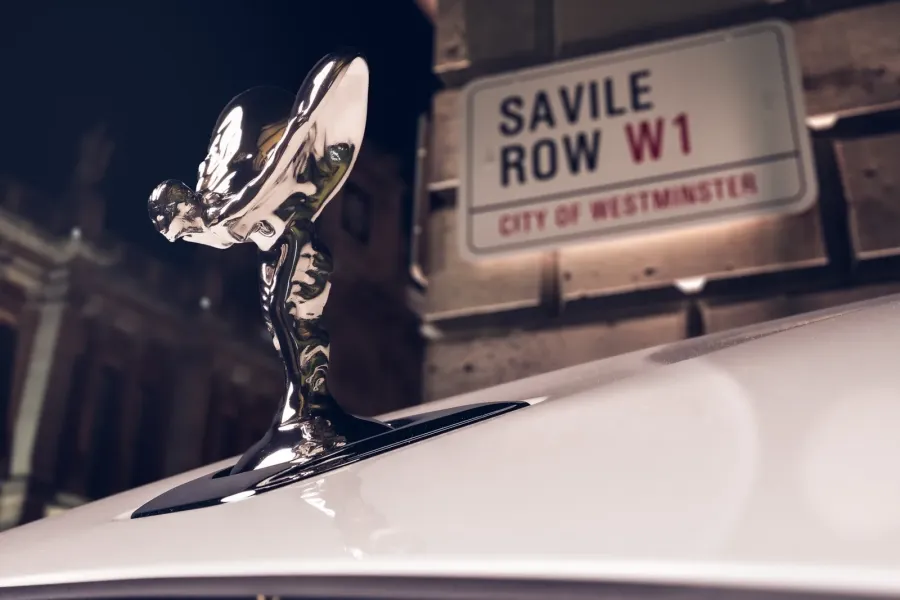
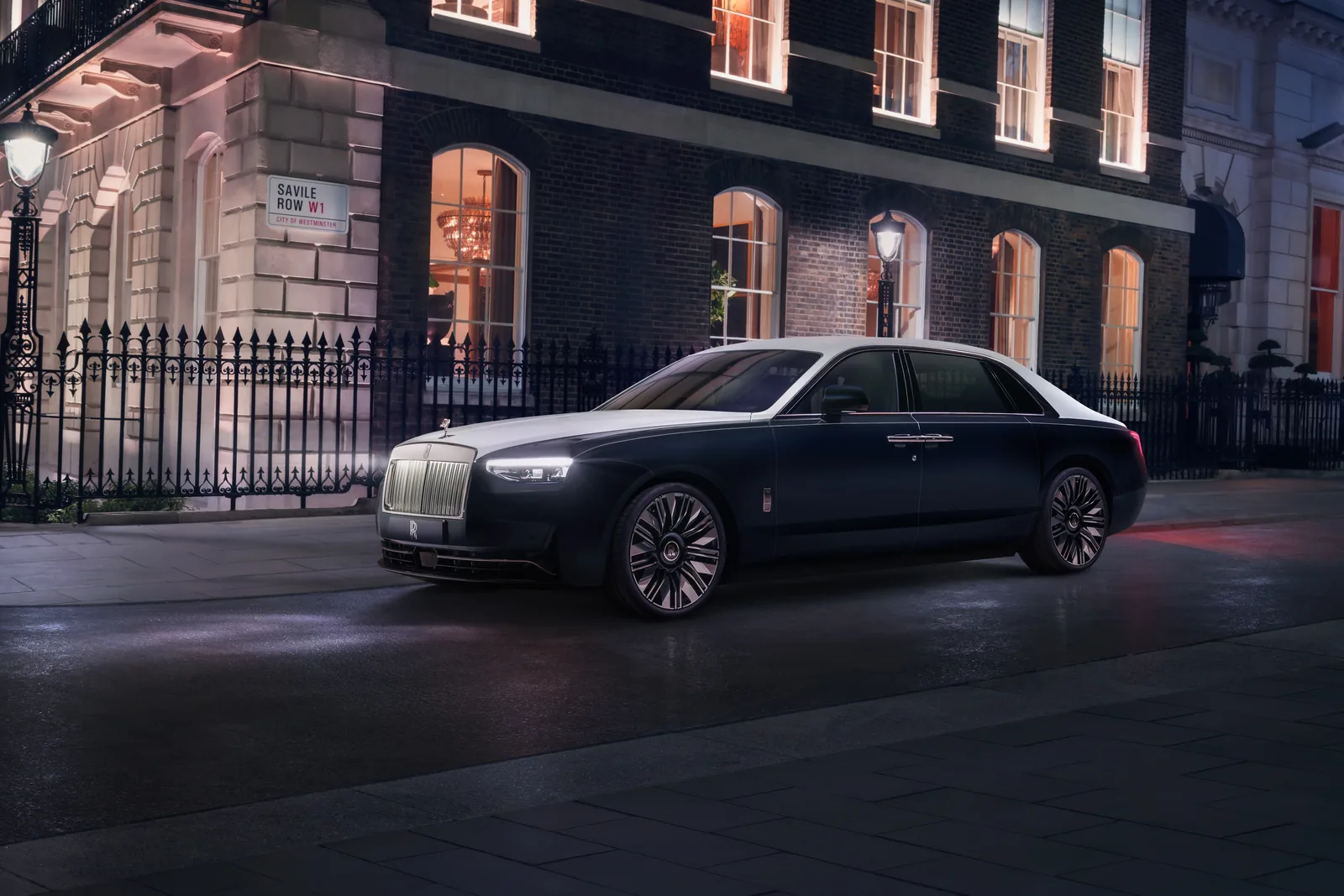
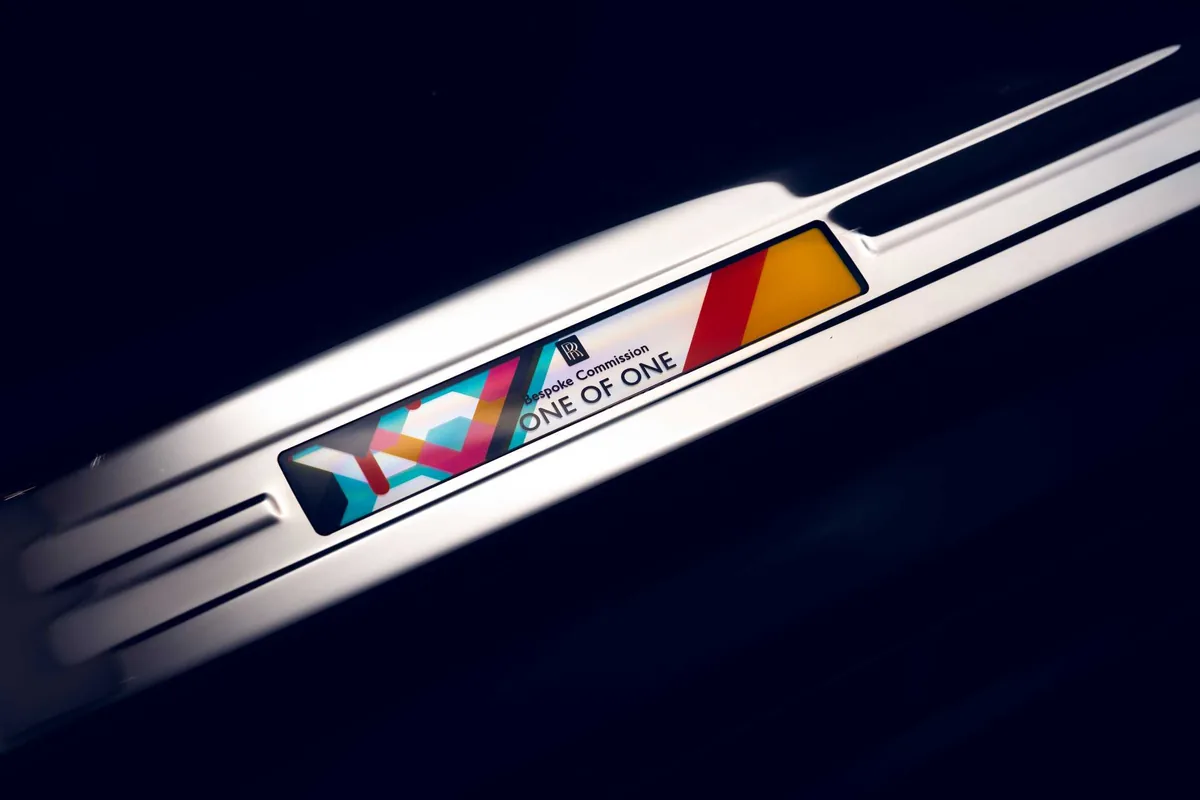
Nearly two hundred years later, Rolls-Royce Motor Cars takes up that lesson and gives it a body. The Ghost Savile Row is a one-of-one that the marque will never repeat, and it pays homage to the London street that holds the world’s finest men’s tailoring. From the outside it wears Brummell’s colours, a deep Midnight Sapphire with a roof in English White, the look of a navy suit over a white shirt. Reading it that way covers the exterior. Everything that decided the design sits inside, in details that open up to anyone who knows where to look.
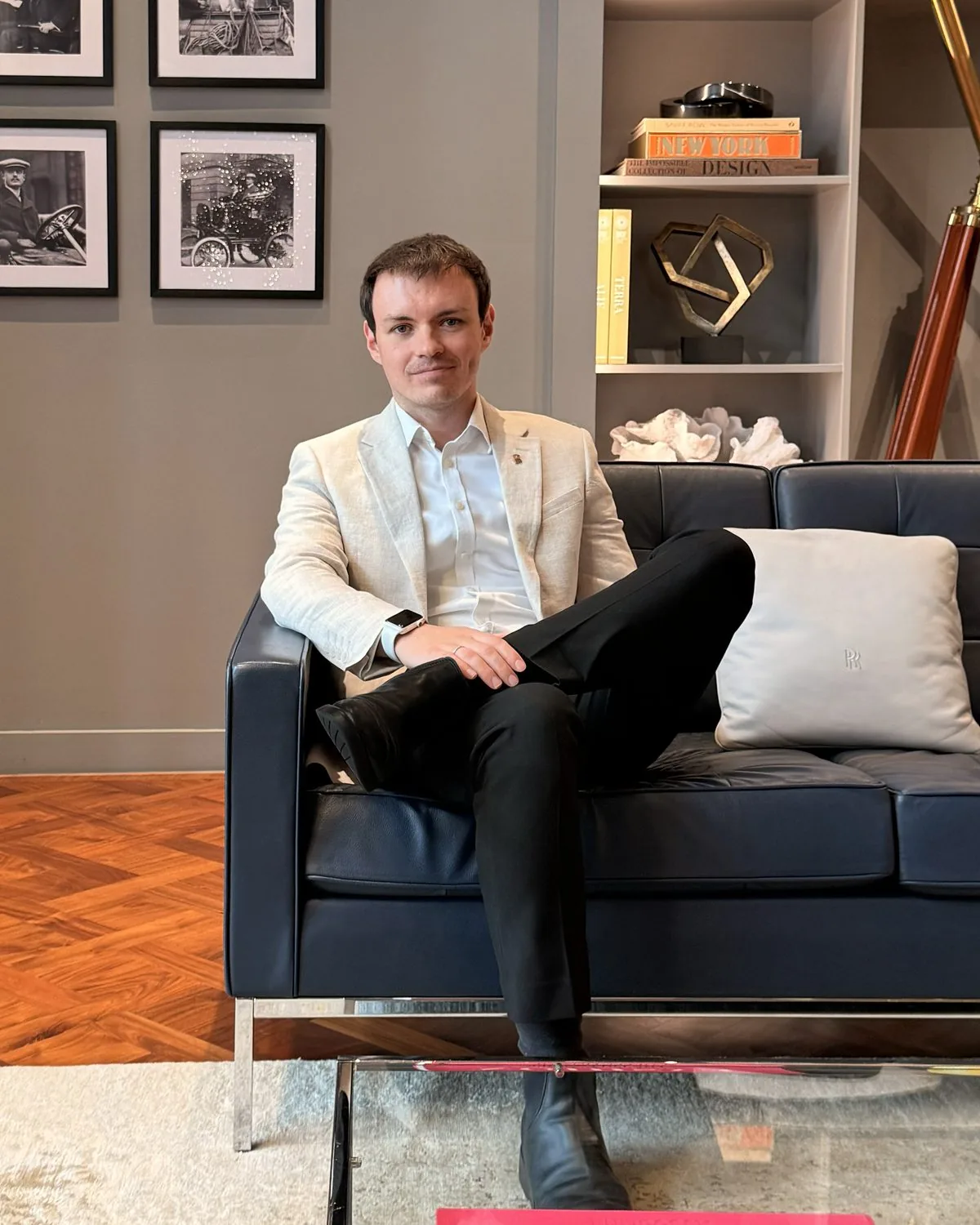
“Savile Row is something quintessentially British for the British, and the idea of a bespoke car travels into countless cultural languages.”
Ieuan Hatherall, Bespoke Designer at Rolls-Royce Motor Cars
On bespoke beyond Savile Row. Through the regional private offices, the designers of Rolls-Royce work in their own markets. A client in India might take a suit ordered from a Savile Row tailor as the starting point for the colours of his car, and a model was created in China to celebrate the Year of the Dragon.
Bespoke Began as a Length of Cloth on Savile Row
The connection between the car and the tailor’s street begins with language. “Bespoke,” the term that now stands for made-to-order worldwide, comes from the ateliers of Savile Row. It traces back to a bolt of cloth that a customer reserved for himself before the scissors touched it. The cloth was spoken for, and out of that phrase grew a word that today describes whole industries. Rolls-Royce has its own geography in the same quarter, having opened its first London showroom on Conduit Street in 1905, a few minutes’ walk from the Row.
Ieuan Hatherall, who designed the car, sees more than a linguistic coincidence in this. A commission at Rolls-Royce begins the way it begins with a tailor, he says: a person arrives with an idea, a cut, a piece of fabric in mind, and the actual work is, first of all, listening. What sets it apart from a fashion house is the depth of knowledge it draws on. The Bespoke team knows the people they work for, they know where they live, what flowers stand in their home, what is served at their table. The design grows out of that knowledge long before the first line is drawn.
The client sets the creative starting point, and for Hatherall that is precisely the condition of his freedom. He cites Frank Lloyd Wright, who held that anyone arriving on a construction site without an idea will struggle to find a good one later, and that a building’s design must be born directly from its context, which means the client and the environment together. The framework a client sets is the ground on which the creative process finds its footing.
A Rolls-Royce Is Built for Fifty Years, and Simplicity Is the Method
A Rolls-Royce is made to last for decades, for half a century and longer, in an age that has grown used to the fleeting and the disposable. Hatherall is wary of the word “timelessness” when it hardens into a label. It works poorly as a style applied to a car, he says, and well as an attitude that runs through the entire company, from development to the workbench at Goodwood.
His key term here sounds modest for an object of this calibre: simplicity. What he means is the clarity with which the purpose of a design becomes apparent at a glance, which sits some distance from aesthetic minimalism. As an example he cites the Phantom Centenary, a one-off with a woven tapestry on the rear seats, a car of great technical complexity, curated such that the tapestry takes centre stage. The same rule applied to the Ghost Savile Row. Every detail that made the cut had to carry a story worth telling.
With this car, restraint reaches into the colour. The body is finished in Midnight Sapphire, a deep navy, with a roof in English White, and in place of the traditional hand-painted coachline the Bespoke Collective set a slender Silver Featureline into the white upper section, the way a cufflink or a fine watch sits against a white shirt. In flat light the surface appears austere and almost unremarkable. When the sun meets the paint at the right angle, it begins to sparkle. Nothing about this car gives itself away at once, and that is its deepest kinship with a well-tailored suit.
The Ghost Savile Row Was Designed Outward From Its Hidden Lining
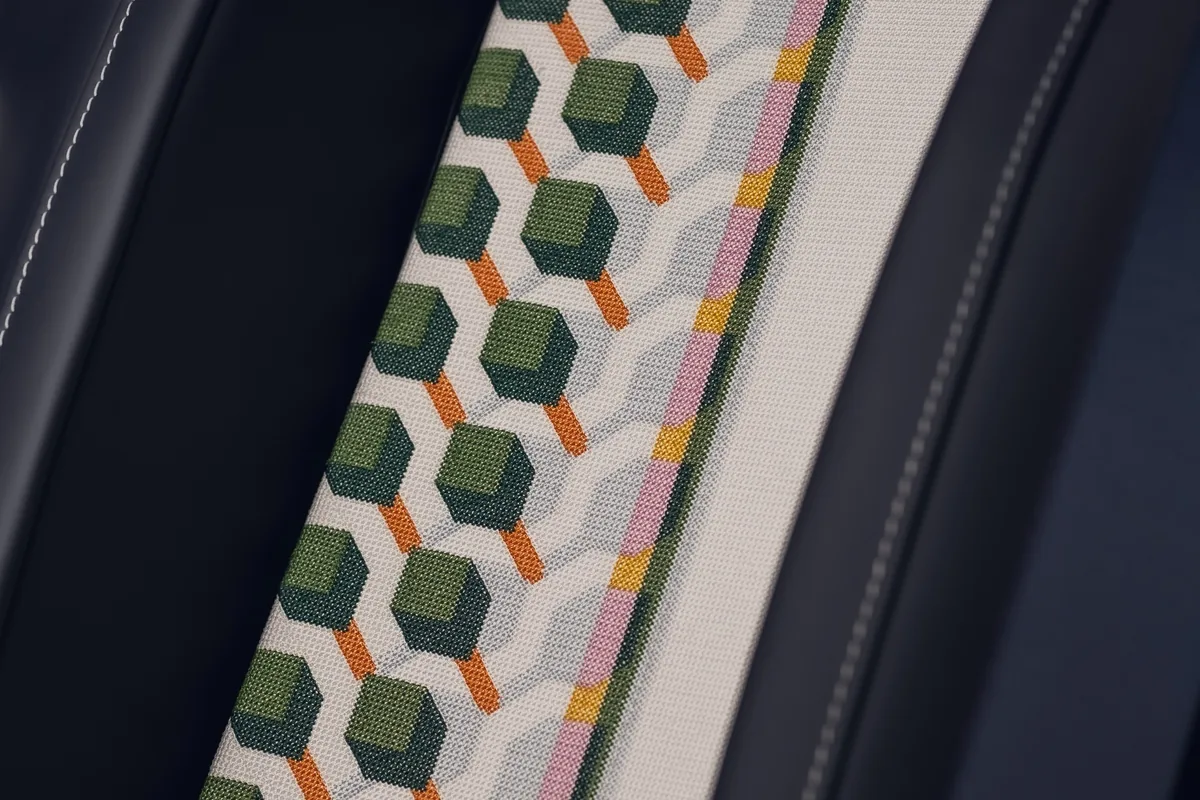
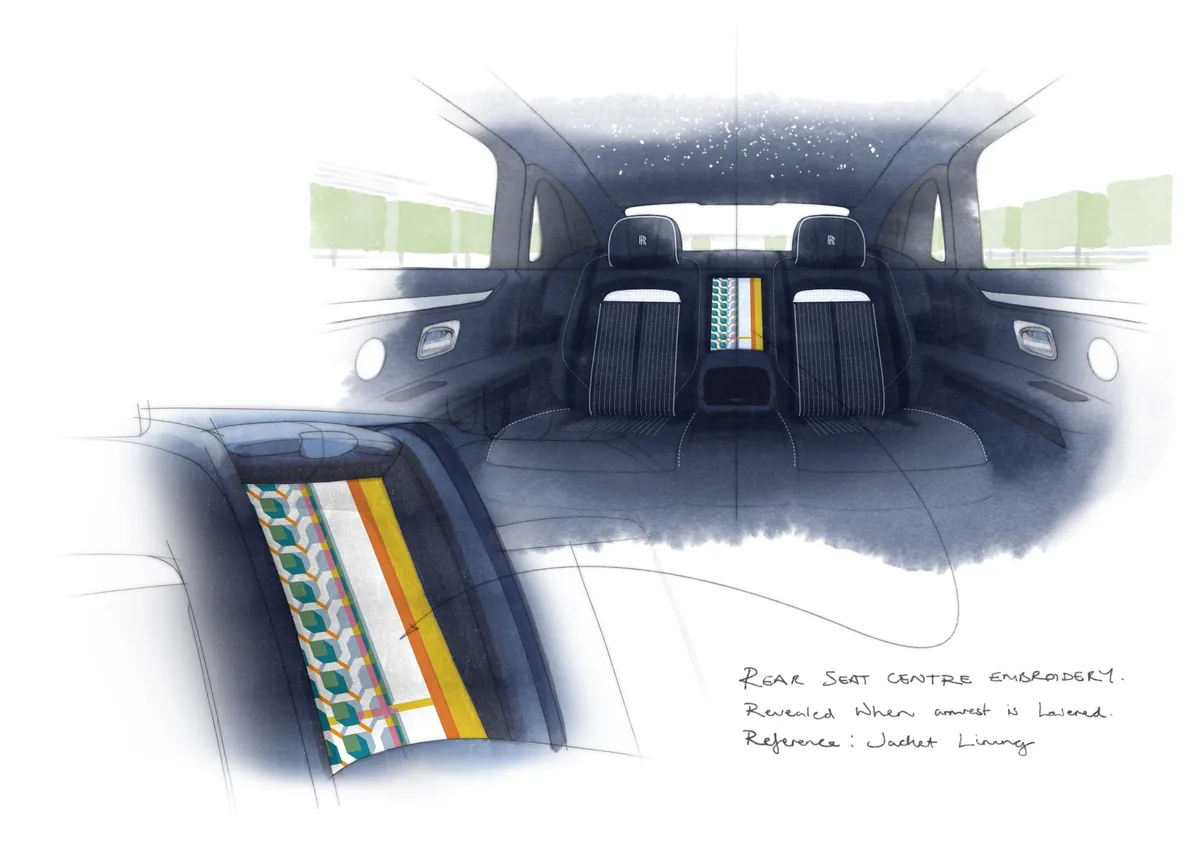
The most surprising revelation of the conversation concerns the order in which the car was designed. Its boldest feature appears when the centre armrest in the rear is folded down. Then the lining shows itself, a luminous, deliberately contrasting accent that stays out of sight in everyday use. Hatherall designed the entire car starting from this hidden detail. He wanted a burst of colour inside, a revelation held back from view, and the navy of the whole car emerged afterwards as the finish that served that core element best. The starting point of the design is exactly what the observer discovers last.
The principle comes from tailoring. A Savile Row suit reads as formal from the outside and nearly merges with the room, and only when the wearer comes home and takes off his jacket does the lining appear, a burst of colour known to him alone. The rear seat centre filler panel of the car carries the most demanding single-frame embroidery Rolls-Royce has ever produced: seven colours, 250,000 stitches, 1,830 metres of thread, nine hours of work. It shows the orthogonally trimmed trees that line the courtyard of the Goodwood manufacturing facility and the shadows they cast, strictly pruned, almost architectural, and the first thing every visitor notices. The motif is Goodwood itself, and it carries a playful British wit that Hatherall put there deliberately. A very formal interior in navy and white, and then, when the seatback comes down, this burst of colour as a counterpoint. It is, says Hatherall, the most British part of the entire car, a sign that one should take neither the car nor oneself too seriously.
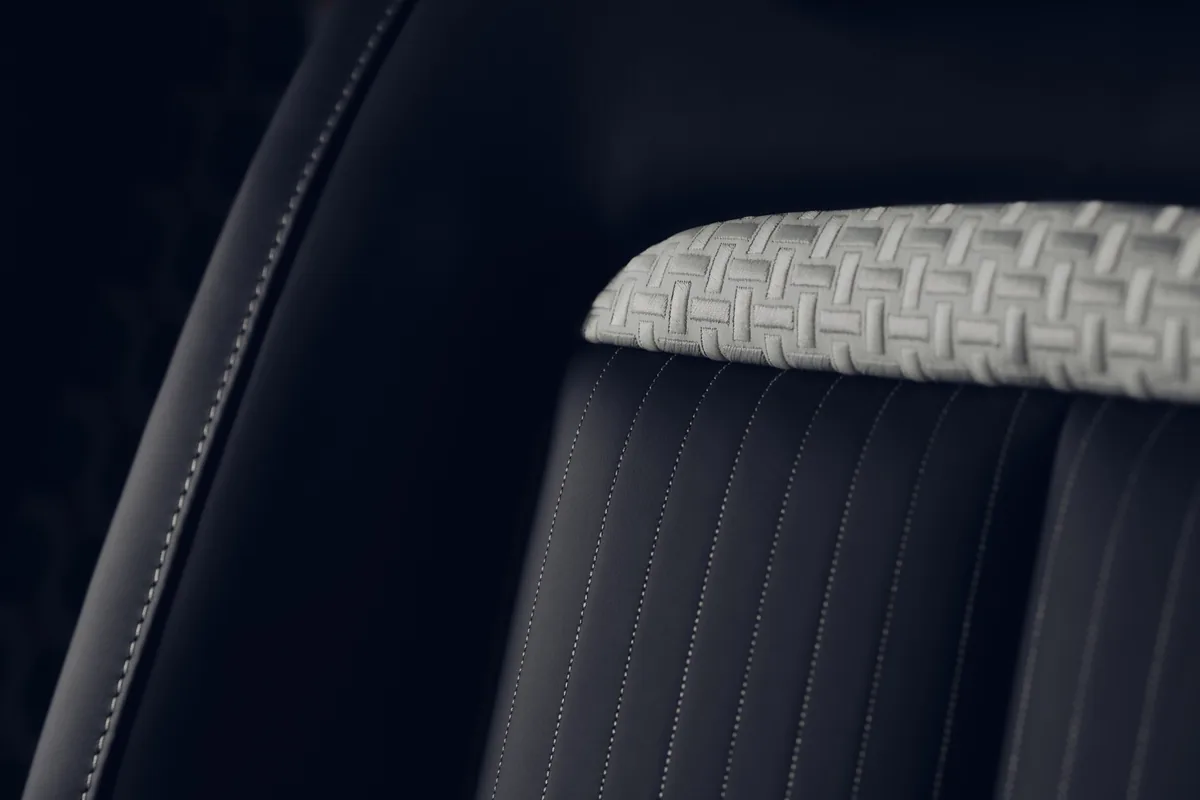
That a painter’s signature is embedded in this detail shapes the whole work. The weave on the seat inserts comes from a shirt in Hatherall’s own wardrobe. He noticed that the fabric formed a simple basket weave, enlarged the pattern and laid it into the seat, positioned like a pocket square, more than 16,600 stitches to each insert. An ordinary shirt became the defining motif of an object that exists once in the world.
“Timelessness is an attitude that runs through the entire company, from development to the workbench at Goodwood, rather than a style one applies to a car.”
Ieuan Hatherall, Bespoke Designer at Rolls-Royce Motor Cars
The Details Only the Owner of a Rolls-Royce Knows
The attention to detail reaches into features that hardly anyone would ever name as distinctive, and precisely these reveal the most about the clientele such a car is built for. There are three control knobs in the cockpit. The two lower ones, for heating and ventilation, sit between navy leather panels and are covered in that same blue. The upper one, for the audio system, sits next to white-stained ash and is therefore covered in white leather. “You don’t point it out,” says Hatherall, “but on some level, you sense that it’s been thought through.” When the car was shown at the Festival of Speed, his parents and his partner noticed the detail only after he pointed it out, and were suitably delighted when it was observed. The indicator stalk is wrapped in leather and matched to the interior, so that even the most casual touch carries the mark of careful attention.
At Rolls-Royce such hidden touches have a name, Easter eggs, and here the most intimate aspect of this work comes to light. Some clients request details that nobody else knows about, not their children, not their partner, a mark in the car that belongs to the owner alone. You reach for a control, expecting the familiar, and one colour answers another, or an embroidery becomes visible. The luxury lies in the knowledge itself, and the car shares that knowledge with one person.
Leather and Cloth Once Sat in the Opposite Order
A historical fact known to few sheds a sharper light on the embroidery in the rear. In the early days of the automobile, materials were arranged in exactly the reverse of today’s order. The chauffeur sat up front on leather because it withstood the weather he was exposed to, while the owners sat in the back on the finest textiles, silk and heavy cloth. Leather was the material of labour, fabric the mark of the master. Industrial production in the twentieth century turned that order around and lifted leather to a universal status symbol.
Hatherall knows this history and works it into his design. A Rolls-Royce should always read as a Rolls-Royce first, he says, and leather stays inseparable from the marque. The question, he notes, is what fabric can achieve in addition. The embroidery on the rear panel uses a stitch developed specifically for this commission, inspired by the interlocking threads of woven cloth, which gives leather the look and the liveliness of fabric. It is about the change of material and about using each material where it belongs. With the most precious textile in this car placed in the rear, in the seat where the owner reigns, a very old order returns, one in which cloth, and not leather, was the finer material.
“A tree can only grow healthily upward if its roots are fresh and deep in the earth, and where the roots are rotten, nothing grows.”
Ieuan Hatherall, Bespoke Designer at Rolls-Royce Motor Cars
Bespoke Translates Into Other Cultures Beyond Savile Row
Every company with a long history faces the question of how to hold on to its origins while inventing something new. Hatherall answers with an image from nature. A tree grows healthily upward only while its roots sit fresh and deep in the earth, and where the roots rot, nothing grows. With the Spirit of Ecstasy and the Pantheon grille, Rolls-Royce holds a foundation that has carried the marque since the very first car, and even where these features stay out of immediate view, the character of the car remains that of a Rolls-Royce.
This foundation gives him the freedom to look ahead. He lives in the future, says Hatherall, and he holds the past in high regard, with a great deal of research going into it, though everything passes through a modern lens. As long as the roots are there, the design can be more colourful, more expressive, more playful. For him the Ghost Savile Row was a balancing act between two kinds of client, those who love bold colour and those who seek understated elegance.
And here the insight emerges that reaches far beyond this one car. For Hatherall, Savile Row is one example among many. Through the regional private offices, the designers of the marque work in their own markets and translate the idea of bespoke into their own cultures. A client in India might take a suit ordered from a Savile Row tailor as the starting point for the colours of his car, just as a model was created in China to celebrate the Year of the Dragon. The street in London is something quintessentially British for the British, says Hatherall, and the idea of a bespoke car travels into countless cultural languages. The Ghost Savile Row is one of them, the one he made.
What stays after the conversation is a particular idea of luxury. It lies in what escapes the first glance, in the certainty that every detail has been chosen with care, down to the leather on an indicator stalk that only the driver will ever notice. The invisible thread runs between a person’s character and the hand that works for them. You have to lower the armrest to see it.
About
Ieuan Hatherall
Bespoke Designer, Rolls-Royce Motor Cars
A native of Wales, Ieuan Hatherall creates one-of-a-kind commissions for Rolls-Royce Motor Cars, whose manufacturing facility stands at Goodwood in England. He studied Automotive Design at Coventry University and continues to work as a painter, and his work has been displayed at venues such as the Mall Galleries in London. His 2019 Rose Phantom, commissioned by a Swedish entrepreneur, carries over a million stitches in its interior and recreates the Phantom Rose, a rose bred specifically for Rolls-Royce that grows only in the courtyard at Goodwood.
Further Reading
-
Why Rare Objects Now Outvalue the New
Genuine scarcity is a function of time and singularity: an edition of one, a named maker, a finite material, a history that happened once. Manufactured scarcity can be reversed at will by the house that decided it, and the saleroom pays for the other kind.
-
Tenuta Vannulo Borsa: A Woven Icon of Italian Craft
The Cesta is hand-woven in precise strips of buffalo leather at Tenuta Vannulo in Campania, under the creative direction of Mario Scairato. Antonella Palmieri traces the form back to the farm, where the hide counts as part of what the animal gives.
-
Luxury Brand Pyramid 2026: The Hierarchy Had a Good Run
The pyramid running from accessible to inaccessible luxury was never only a price chart, it was a theory of access and social distance. An architecture built on relationship, meaning and depth is taking its place.
Similar Articles

Armani Without Giorgio: The House Opens a New Chapter
Savile Row: One Block of Mayfair, Two Centuries of Bespoke Tailoring

The Caliber of the Deep: Blancpain and the Ocean Photographer of the Year 2026