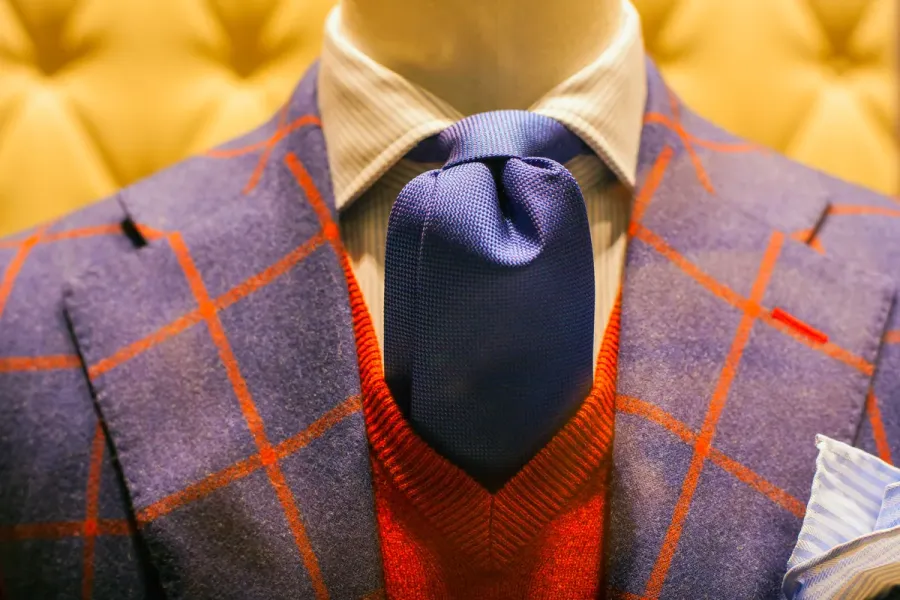
Savile Row runs for one block through Mayfair, parallel to Regent Street, between Conduit Street at the top and Vigo Street at the bottom, and it has been the address of English bespoke tailoring since the middle of the nineteenth century. The houses that work there cut for one customer at a time, from a paper pattern drawn for one body, and the word for that practice is bespoke, which the rest of the world has since borrowed for furniture, software and holidays. The name is said SAV-il ROH, with the stress at the front and row rhyming with go.
Lady Dorothy Savile Gave the Street Her Name, and the Tailors Arrived a Century Later
Richard Boyle, the third Earl of Burlington, laid it out from 1731 on the land behind his house on Piccadilly and named it after his wife, Lady Dorothy Savile. For the first two generations the residents were army officers, physicians and politicians who wanted the short walk to St James’s, and there was not a tailor among them.
The tailors were somewhere else entirely. They worked east of Regent Street in Soho, in rooms that were cramped and poorly lit and a long way from anyone who could afford what they made, and from around 1803 the more ambitious among them began taking premises on the quiet blocks of the Burlington Estate, because the gentlemen they dressed preferred to be measured somewhere other than a market street.
Henry Poole understood what that proximity was worth. In 1846 he moved the entrance of his father’s firm onto the Row at No. 32 and rebuilt the front room as something closer to a private club than a workshop, with mirrors, heavy carpet and a chandelier, so that the men who came to be fitted found themselves in a room that flattered them before anyone had touched a tape measure. His competitors followed within a generation. The workrooms went downstairs into the basements, where the light came in at pavement level and the rent was lower, and most of them are still there.
Henry Poole Cut the Tails Off a Coat in 1865 and America Named It After a Club
Henry Poole & Co has traded since 1806, longer than anyone else on the street, and in 1865 the firm was asked to solve a small domestic problem. The Prince of Wales, later Edward VII, wanted something he could sit down in at Sandringham without the tails of an evening coat getting in the way. Poole cut the tails off and made a short jacket in dark cloth instead. An American guest named James Potter saw it, ordered one for himself, and wore it at his club in Tuxedo Park, north of New York, where the other members asked their tailors for the same thing. The garment has carried the name of that club in America ever since.
Huntsman Builds the Chest Out, Anderson & Sheppard Leaves the Shoulder Soft
Each house cuts to a line you can recognise across a room, and choosing a tailor on Savile Row means choosing between them. Gieves & Hawkes holds No. 1, the corner address, and its military inheritance shows in a shoulder that sits square and high. Huntsman came to tailoring from the hunting field in 1849, and the single-button coat it still cuts has a waist set high and a chest built out with canvas, so that a man wearing one stands differently than he did an hour earlier.
Anderson & Sheppard went the other way. Under the cutter Frederick Scholte the house left the shoulder soft and almost unpadded and put a deliberate surplus of cloth across the chest, which falls in slight folds called the drape and lets a man raise his arm without the whole coat lifting with it. The house works off the Row itself, one block west, which is where several of the older firms now sit while keeping the Savile Row name.
Customers tend to find the house that suits their build and then stay with it, sometimes for a lifetime and sometimes across three generations of one family, because the paper pattern cut for one body is kept in the archive and used again.
A Savile Row Suit Takes Fifty to a Hundred Hours of Hand Work
The Savile Row Bespoke Association, which the houses formed in 2004 when rising rents began to look like an existential problem, sets the standard its members work to: a pattern drawn individually for every customer, a minimum number of fittings, and between fifty and a hundred hours of hand work in a single two-piece suit. The trade is still entered through apprenticeship rather than through a school, and a cutter and a coat maker train separately, because the skills do not transfer between them.
The first fitting is called the baste, and it is the one that surprises people. The coat arrives held together with white tacking thread, without pockets, lining or buttonholes, looking less like a garment than like the idea of one, and the cutter opens the seams on the customer’s own body, marks the corrections in chalk and sends it back downstairs. Two more fittings follow before anyone sees a finished coat.
A second suit from the same house costs less than the first, because the pattern already exists, and the seam allowances are cut generously enough that a coat can be let out or taken in as the man wearing it changes shape across twenty years.
Bespoke Cloth Waited in the Merchant’s Room With the Customer’s Name Against It
The word itself comes off a shop floor. To bespeak meant to speak for something, to claim it in advance, and its past tense was bespoke, so a length of cloth a customer had chosen and paid for stood in the merchant’s room with his name against it, bespoken, while everything else on the shelf stayed available to anyone who walked in.
What the word describes is the order of events. The cloth belongs to the customer before the making begins, and that is the difference between bespoke and the two other ways a suit gets made: ready-to-wear is cut to a standard size from a block pattern and altered afterwards, made-to-measure takes an existing block in the customer’s nearest size and adjusts it within limits narrower than most buyers assume, and bespoke begins with nothing but a set of measurements and a sheet of paper.
The difference continues inside the coat, where nobody sees it. A factory suit glues its interlining to the outer cloth, and after enough dry cleaning the glue can lift and the chest bubbles. A Savile Row coat carries a floating canvas of horsehair and linen, attached to the cloth with thousands of loose stitches put in by hand, so the chest stays flexible and slowly takes the shape of the man inside it.
The Beatles Played Their Last Concert on the Roof of 3 Savile Row
For four years the Row had a tenant with no interest in cloth. Apple Corps, the company the Beatles founded, took No. 3, and on 30 January 1969 the band carried their equipment onto the roof and played for forty-two minutes over a street of tailoring workrooms, which turned out to be the last time the four of them performed together in public. The police arrived after complaints about the noise.
Two weeks later, on 14 February, Tommy Nutter opened his own shop a few doors down with backing from Apple’s Peter Brown. He kept every bit of the hand work the street was built on and threw out its restraint, cutting wide lapels and loud checks for Mick Jagger and Elton John, making Bianca Jagger’s wedding suit, and tailoring three of the four suits on the cover of Abbey Road.
Beau Brummell Took the Colour and the Gold Off a Coat and Left the Cut
George Bryan Brummell dressed in London in the decade after 1798, and what he did was subtract. He took the embroidery off a coat, and the colour, and the gold, and left the cut, and the effect was a man who had clearly spent hours getting dressed and looked as though he had not thought about it at all.
That doctrine held for two centuries and produced a trade whose best work is the part nobody sees. The canvas floats inside the chest, the lapel is padded by hand so that it rolls instead of creasing, and the customer chooses a lining that will be visible to him alone. A suit made this way carries nothing on the outside to say who made it, and only someone who knows where to look can read it. The same principle runs through cloth, through houses, through cars. On this street it has an address.
Further Reading
-
Couture Régénérative rests on three pillars: couture-level mastery, regenerative practice in production, and circular value that treats designer, material and wearer as a relationship rather than a supply chain. Time is the proof of quality in this system, which is why patina, repair and transmission count as evidence and not as wear.
-
The 2026 trophy of the European Textile & Craft Award holds a tobacco-toned wool from Lanificio Bottoli in Vittorio Veneto, dyed with coffee grounds collected from local hospitality businesses. Coastland in northern Germany weaves mulesing-free Merino on analogue looms from the 1970s that still run on punch cards, and JESA produces six unique pieces twice a year in the last hand-weaving studio in Irpinia.
-
The global fashion industry produces 100 billion garments a year, and 87 percent of them end up in landfill. Post-materialist buyers move the other way, purchasing 18 pieces a year instead of 67, spending 178 euros a piece instead of 27, and keeping what they buy for 7.8 years instead of 3.2.