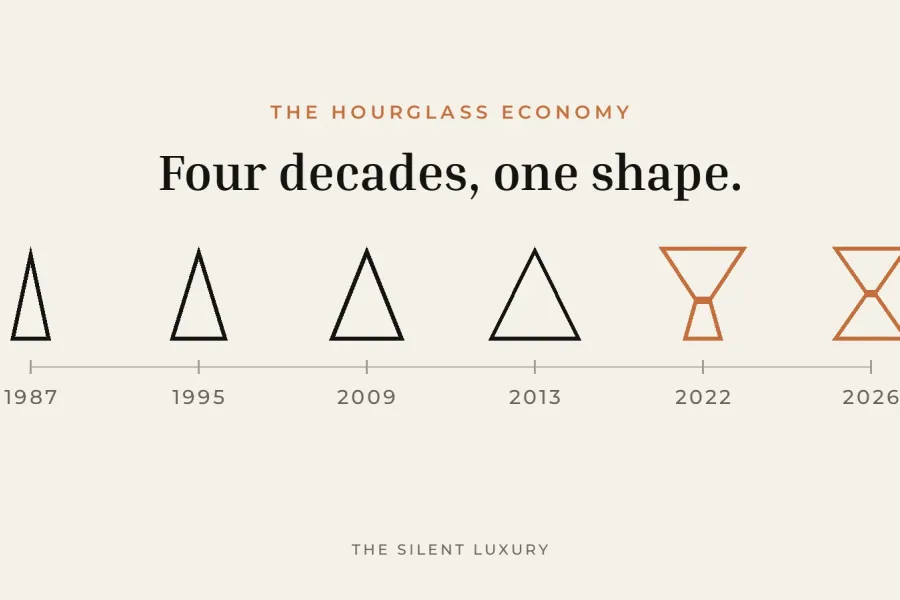
The global luxury customer base grew from roughly 90 million people in 1995 to 400 million in 2022 and contracted to about 330 million by 2026, according to Bain & Company. The Silent Luxury traces this forty-year arc from the LVMH merger of 1987 to the hourglass-shaped market of 2026, in which wealthy buyers hold 47 percent of US luxury spending.
The Merger That Gave the Pyramid an Owner
In June 1987, Moët Hennessy and Louis Vuitton merged into a single company and gave the luxury industry its first modern group. The new house united ten maisons, employed twelve thousand people and recorded three billion euros in revenue, figures the group itself still cites as its founding measure. Two years later Bernard Arnault took control and began building by acquisition, and the families who had led their houses for generations became shareholders and chairmen. For the first time in its history, the pyramid of luxury belonged to someone.
Japan, the Gulf and the First Count of 90 Million
What the new owners understood early was that the pyramid could be made to grow. Through the 1990s the industry carried its goods far beyond Europe, into Japan above all, which became the largest single market luxury had known, and into the Gulf. When Bain & Company later reconstructed the period, its analysts counted roughly 90 million luxury consumers worldwide in 1995, and the number matters because it marked the first time anyone had counted. A market that had defined itself through rarity now carried a measured base, and the base became the growth plan.
China Grows 16 Percent Through the 2009 Recession
The 2000s delivered the growth. China discovered luxury with a speed that surprised even the houses profiting from it, and the discovery held firm through the sharpest test the decade could offer. In 2009, the year the global economy contracted, China’s luxury sales rose 16 percent, a figure McKinsey recorded in its 2011 market study alongside the projection that the country would carry a fifth of global demand by mid-decade. While the West counted its losses, the pyramid kept widening from the East.
Ten Million New Consumers a Year: The Road to 400 Million
By the following decade that widening had become the industry’s operating system. At the end of 2013 the customer base stood at 330 million people, more than triple the figure of 1995, and Bain’s analysts observed a net ten million new consumers entering the market every year, a rate they projected would carry the base to 400 million. Distribution multiplied to receive them, through travel retail and e-commerce, through outlet villages, fragrance counters, beauty lines and accessories walls, and by 2018 Chinese consumers alone accounted for 33 percent of global luxury spending. The projection landed almost exactly on schedule. In 2022 the base reached 400 million people, the widest pyramid the industry had ever carried.
When 80 Percent of Growth Came From Price
The shape began to give way the following year. Between 2023 and 2025, around 80 percent of the market’s growth came from price increases, according to the BoF-McKinsey State of Fashion, and a market that had grown for four decades by admitting people switched, within a few seasons, to growing by charging them more. The arithmetic of that switch shows in a single Bain figure: the top 2 percent of customers now carry roughly 40 percent of luxury sales. Growth settled at the two ends of the market, and the pressure gathered exactly where the model had been built, on the middle class.
The Middle Class Moves in Four Directions
The households that carried aspirational luxury, earning between 150,000 and 300,000 dollars a year, kept their incomes while housing, healthcare, education and debt service grew to absorb them. Priced out of its aspirations, the middle class moved in four directions at once. Part of it moved upward, into rare objects, high jewellery and craft, where value survives the purchase. Part of it moved sideways, into travel, experience and beauty. Part of it moved downward, into resale, accessible formats and selective buying. And part of it chose to wait, to save and to postpone. BCG and Altagamma measured the largest of these flows and found that about 35 percent of the departing budgets went to savings, debt reduction and resale.
2026: Seventeen Points in Seven Years
By 2026 the result carried a countable size. Around 330 million consumers remain in the market, which means an estimated 60 to 70 million people have left it or been priced out of it within four years. In the United States, wealthy buyers hold 47 percent of personal luxury spending, up from 30 percent in 2019, seventeen points in seven years. The first quarter of 2026 shows what the new shape rewards: Hermès grew the Americas by 17.2 percent, Prada by 15 percent, Brunello Cucinelli by 14 percent, while Gucci lost 14 percent in the same market, in the same quarter, with the same consumers available to it. The difference is structural.
330 Million in 2013, 330 Million in 2026
Set the two ends of the Bain series beside each other and the four decades compress into one sentence. There were 330 million luxury consumers at the end of 2013, and there are around 330 million in 2026. The market gave back thirteen years of growth in four, and changed shape doing it. The pyramid that Paris assembled in 1987 now stands pinched at its waist: few people and concentrated value above, many people and a new value logic below, and between them a narrow passage of glass. Sand that passes through it gathers at the bottom, and sand that stays above keeps its place. The forty-year anatomy explains the shape. The question it opens will occupy this series for some time: when the middle empties, where does value live?
Further Reading
What is the hourglass economy in the luxury market?
The concept page behind this series. The hourglass model, its two growing ends and the narrowing middle, laid out with the 2026 market data.
The Hourglass Snaps Shut: an anatomy of US luxury in 2026
The American case in detail: wealthy buyers at 47 percent of personal luxury spending, consumer sentiment at 49.8, and the quarter in which the divergence became visible.
The Magic Is Spent: the structural shift reshaping luxury
Gucci loses fourteen percent in the quarter Brunello Cucinelli gains fourteen, in the same market with the same consumers. The decoupling of price and value, told through the results.
Luxury Recalibration Blueprint 2026
The playbook for the new shape: how houses adjust portfolio, pricing and clienteling when the middle of the market steps back.
Sources:
LVMH, Our History ·
Bain & Company, Lens on the Worldwide Luxury Consumer, 2014 ·
McKinsey & Company, Tapping China’s Luxury-Goods Market, 2011 ·
Bain & Company, What’s Powering China’s Market for Luxury Goods, 2019 ·
Bain-Altagamma Luxury Goods Worldwide Market Study, 2023 ·
BoF-McKinsey, The State of Fashion 2026 ·
BCG / Altagamma · Bain & Company / eMarketer, 2026 · Q1 2026 Company Earnings