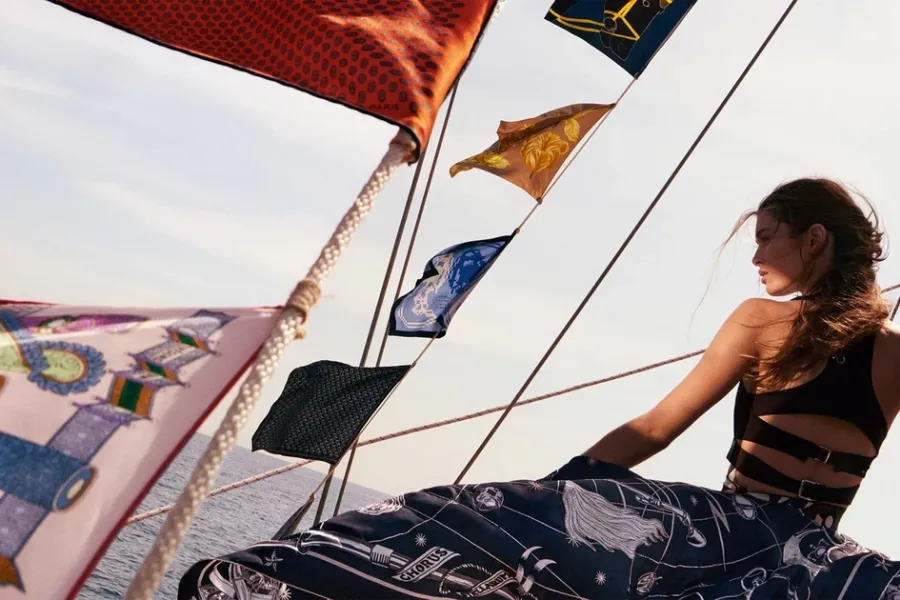
Silk carrés as signal flags in the Hermès spring-summer 2026 campaign, from the image material published with the 2026 first-half results, presented in Paris on 29 July 2026. | In courtesy of Hermès International
·

EXCLUSIVE INTERVIEW

Hermès H1 2026: Quality Sets the Quantity
Axel Dumas, executive chairman of Hermès and the sixth generation of the founding family to lead the house, told the analysts he would sell more leather if he produced more, and named the criteria of recruitment, training and savoir-faire that set the ceiling, in a half-year where the quality of the hides became the condition on which the plan to 2030 depends.

Hermès reported first-half revenue of 8.16 billion euros on 29 July 2026, up 6 per cent at constant exchange rates, with a recurring operating margin of 41.0 per cent. At the results presentation in Paris, executive chairman Axel Dumas told analysts the house would sell more leather goods if it produced more, and named the ceiling as the number of trained artisans and the availability of hides at the quality Hermès accepts.


On the morning of Wednesday 29 July 2026, before he came to the figures, Axel Dumas was asked about the fires burning around Fontainebleau and in the Gironde, where Hermès runs a leather manufacture at Montereau and a second site.

“Our manufactures were far enough from the fires, so there is nothing on our production tools,” Dumas told the analysts. “But inevitably the people were very affected. I know that some at Fontainebleau went to help evacuate horses. Other employees of ours in the Gironde were not affected personally but have family who were, who had to evacuate. Since we are first a society of artisans, and therefore of women and men, there is a fairly strong stress in the region, for their families and for themselves. And we are of course with them wholeheartedly.”

He added his thanks to the volunteer firefighters on the Hermès payroll, covered by a convention the company signed years ago, who had been called hard to the fire.

Hermès employed 27,107 people at the end of June, 61 per cent of them in France, and added more than 600 in the half. The house presented its first-half accounts to the analysts that same morning.

Hermès grew 6 per cent to 8.16 billion euros in the first half of 2026: The figures inside the boundary

Hermès reported first-half revenue of 8.16 billion euros, up 6 per cent at constant exchange rates and 2 per cent at current ones. A currency effect of 360 million euros removed four and a half points of growth, arising mainly from the depreciation of the yen, the dollar and the Korean won against the euro. The second quarter reached 4.1 billion euros and grew 7 per cent, an acceleration on the first. Éric du Halgouët, executive vice-president of finance, reported a gross margin of 71.1 per cent, four tenths of a point above the previous year, and attributed the improvement to stock management and to sell-through rates on the recent collections he described as exceptional. Recurring operating income came to 3.35 billion euros at a margin of 41.0 per cent, against 41.4 per cent a year earlier. Net profit attributable to the group reached 2.24 billion euros, level with the previous year. Free cash flow grew 18 per cent, and net cash stood at 12.9 billion euros.


Axel Dumas says Hermès would sell more leather if it produced more: The question that returns every quarter

An analyst asked Dumas about the volume growth of leather goods and whether more production would mean more sales. He answered without qualification.

“If I produced more leather, would I sell more leather? Yes,” Dumas said. “Certainly, because the desirability is there.”

Then he named what stops him. “We stay within our criteria of recruitment, of training and of savoir-faire.” Later in the same session he put the same thought the other way round, and with evident satisfaction: he is very happy, he said, that Hermès has a demand far superior to what it can produce. Producing beyond that point would dissolve the exclusivity on which the objects rest. The waiting list a client accepts in a Hermès store is the visible edge of an arithmetic performed at the workbench.

Hermès leather volume grows about 6 per cent a year through added working hours: Growth measured in working hours

Dumas disputed, in front of the room, the way the analysts build their leather models. The long-term growth rate for the division is 6 per cent, he said, and adding a price increase to that figure produces a number that describes nothing.

“Most of our volume growth is actually a growth of working hours,” he said, because the house grows through the people who make the objects by hand. A crocodile bag and a smaller model consume different hours at the bench, so a bag counted as a unit tells you little about what Hermès has actually made. The variable that governs the largest division of the group is the number of trained hands and the hours those hands spend.


More than 700 Hermès buyers from 40 countries set their own volumes at the podium in Pantin: The house without a central assortment

The system that turns those hours into a collection was the subject Dumas returned to at length.

“At Hermès it is quite organic,” he said. “We have something rather marvellous called the podium, where there is a great freedom of creation. I remind you, there is no marketing department. We present all our novelties to all the buyers during the podium, and they decide themselves on their purchase, what they like, what they do not like, and on the volume. So we have something quite organic compared with others who are rather centralised, at their head offices or with merchandising departments, as they are called. With us it is really done at the level of the store, where each store director. We receive more than 700 people from 40 countries at Pantin to show them the things. Our way of managing stock is quite organic, and it is an addition of small shops at the centre of the world.”

Twice a year, then, every new object across the sixteen métiers passes in front of the people who will sell it, and the quantity of each is settled there.

A group that sets volume centrally can raise it centrally. At Hermès the volume of each collection is settled by the people who will sell it.

Hermès reduced its network from around 300 shops to close to 200 while revenue grew: Fewer addresses, larger stores

The store network follows the same reasoning. When Dumas became chief executive Hermès operated around 300 shops, and it now operates close to 200, and group revenue grew across that reduction.

“They are bigger stores, and that allows us to show all the métiers,” he said, crediting the strategy to Florian Craen, the executive vice-president for sales and distribution, who was sitting beside him. Presenting the full range inside a larger space became the driver of growth in the divisions beyond leather. The first half added addresses one at a time: two openings in Beijing and Nagoya, and in London the sixth maison in the world, six connected historic buildings at 166 New Bond Street holding 2,000 square metres across 55 rooms. Growth from here, Dumas said, will come from volume inside each store through a fuller presentation of every métier, while the contribution of new floorspace stays in the range it occupies now.


Hermès bases its production plan to 2030 on productivity, savoir-faire and the supply of leather: The three conditions

Hermès is building production capacity to 2030, and Dumas set out three conditions on which the plan depends, in the order of weight he gives them.

The first is the productivity of the French sites. The second, which he said matters most to him, is the preservation of the savoir-faire, delivered by artisans trained from the beginning and certified with the French CAP diploma. “It is very important that I don’t compromise,” Dumas said, “and I won’t produce if it is not at the level of quality.” The third condition he described as the one that is not exactly visible in any figure, the ability to find leather at the level the house requires.

The capacity is arriving on that schedule. The twenty-fifth leather manufacture opened at Loupes in the Gironde in April. Three more are confirmed, at Charleville-Mézières for 2027, Colombelles for 2028 and Les Andelys for 2030, and Hermès is looking at new French regions for production beyond that horizon. Each manufacture brings roughly 300 people into a region and trains them over the years it takes to reach the level Dumas will accept.

That training produces a second effect he values in an unsettled world. Because the artisans are formed for the métier and not for a single model, “we have the flexibility to adapt our workforce to the demand,” he said. A workshop can move its hands from one model to another as the orders shift, which is a form of resilience that no inventory system supplies.

Axel Dumas says the industrialisation of farming yields fewer good hides: Why Hermès buys its own tanneries

Of the three conditions, the third is the one that occupies him. “This is the thing that worries me,” Dumas said, “that with the industrialisation of farming we find less and less good skin. So we invest more and more in our tanneries in order to get better quality of the skin. The most important thing for me is to keep the quality of Hermès, and to keep the quality of everything. We produce as much as we can in terms of quality.”

Hermès tanneries supply the leather divisions that generated 3.76 billion euros in the half, 46 per cent of group revenue.


Leather goods and saddlery grew 10 per cent and hold 46 per cent of Hermès revenue: Where the desire concentrates

Across the divisions the half-year shows where the appetite sits.

HERMÈS H1 2026
Revenue by métier, first half 2026
Hermès International revenue by métier for the first half of 2026, in millions of euros, with growth at constant exchange rates. Total revenue 8,163 million euros, up 6 per cent.
Métier Revenue, €m Growth
Leather goods and saddlery 3,761 +10%
Ready-to-wear and accessories 2,198 +2%
Other Hermès métiers 1,065 +5%
Silk and textiles 469 +10%
Watches 269 0%
Perfume and beauty 233 (4)%
Other products 168 +3%
Total 8,163 +6%

Growth at constant exchange rates. Leather goods and saddlery account for 46 per cent of group revenue.
Source: Hermès International, 2026 first-half results, presented in Paris on 29 July 2026.

Leather goods and saddlery grew 10 per cent and account for 46 per cent of group revenue. Silk and textiles matched that rate on a smaller base. Two lines gave ground, watches flat across the half with a good second quarter, and perfume and beauty down 4 per cent. Dumas took the second onto himself. Beauty performs well, he said, and perfume sells well inside the Hermès stores while the trade outside them is more complicated. “We should have done better.” He declined to hand the result to the wider climate, because a house answers for its own creativity and its own choices before it answers for the weather.

He added a caution about how the room reads any of these lines. He is obsessed, he said, with absolute values ahead of percentages, because a comparison base can make a weak half look strong and a strong half look ordinary.


The Americas grew 15 per cent and Japan 11 per cent while the Middle East fell 4 per cent: Hermès revenue by region

HERMÈS H1 2026
Revenue by region, first half 2026
Hermès International revenue by geographical region for the first half of 2026, in millions of euros, with growth at constant exchange rates. Total revenue 8,163 million euros, up 6 per cent.
Region Revenue, €m Growth
Asia-Pacific excluding Japan 3,533 +2%
Americas 1,585 +15%
Europe excluding France 1,165 +9%
Japan 798 +11%
France 753 +2%
Other (Middle East) 330 (4)%
Total 8,163 +6%

Growth at constant exchange rates. A currency effect of 360 million euros reduced reported growth by four and a half points.
Source: Hermès International, 2026 first-half results, presented in Paris on 29 July 2026.

The Americas grew 15 per cent in continuation of an exceptional first quarter. Japan grew 11 per cent on dynamic traffic and the loyalty of its local clientele. Europe outside France grew 9 per cent across the whole region, and France 2 per cent, lifted in the second quarter by local clients and a recovery in tourist flows. Asia outside Japan grew 2 per cent, with Korea performing strongly and Greater China still in retreat. The zone that gathers the Middle East fell 4 per cent in a geopolitical context Dumas called unstable, with a gradual recovery through the second quarter. For the remainder of the year, he sees no change of trend in the United States, Japan or Korea, and he offered no prediction on the Middle East, where he said no one can make one.


Axel Dumas says he relies on game theory ahead of control in an unpredictable market: The manager and the gap he preserves

An analyst put the philosophical question directly: how much visibility does he really have on the volume growth of leather goods, in a house that has diversified far beyond the Birkin and the Kelly.

Dumas answered that a manager in an environment that shifts this much, with an earthquake in Japan the day before the presentation, relies on game theory ahead of control. “Who could have predicted Covid? Who Fukushima? Who the war in the Middle East?” The fundamentals, he said, are sound.

Hermès employed 27,107 people at the end of June, having added more than 600 in the half, of whom more than 300 work in France, where 61 per cent of the workforce sits. Capital expenditure of 344 million euros went to stores and distribution, to production and the métiers, and to real estate. The ninth high jewellery collection, Into the Horsescape, was unveiled in Paris at the beginning of July and sold immediately. All of it fits inside the year Hermès named L’Appel du large, the call of the open sea.

The distance between what Hermès could sell and what it agrees to make is the one figure the house protects, and no line in the accounts reports it. It is counted in hands trained over years, and in hides that are becoming harder to find, and both are counted one at a time.


Further Reading

Kering H1 2026: Gucci Racing and the New Currency of Desire Luca de Meo names what a decade of price rises cost, and where Kering looks for growth once price stops supplying it. https://the-silent-luxury.com/kering-h1-2026-new-currency-of-desire/

LVMH H1 2026: Growing Where Wealth Is Created Cécile Cabanis describes her strategy for the year as an act of recruitment, and the clientele figures name who answered. https://the-silent-luxury.com/lvmh-pyramid-recruitment-wealth-2026/

Kering and the Renaulution: the method Luca de Meo brings to luxury The platform logic of the car industry applied to fashion houses, and the point where a method built for machines meets hands. https://the-silent-luxury.com/kering-renaulution-reconkering-strategy/

Natural Fibres: Cloth and Origin Four voices from the IWTO, Remei and two textile makers on fibre, biodegradability and what traceability means in production. https://the-silent-luxury.com/natural-fibres-luxury-cloth-and-origin/

Couture Régénérative The framework for a luxury production that returns more to its material sources than it removes. https://the-silent-luxury.com/couture-regenerative/

The Italian Fashion Industry and the Hourglass Economy Where the middle of the market went, and what its disappearance means for the houses that depend on it. https://the-silent-luxury.com/italian-fashion-industry-renaissance-hourglass/


Sources

  1. Hermès International, 2026 first-half results presentation, Paris, 29 July 2026. finance.hermes.com
  2. Hermès International, 2026 first-half results slide deck, 29 July 2026.
  3. Axel Dumas and Éric du Halgouët, remarks and analyst question and answer session, 2026 first-half results presentation, 29 July 2026.
  4. Hermès International, 2025 annual results and universal registration document. finance.hermes.com


\n\n

\n

\n HERMÈS H1 2026\n Revenue by métier, first half 2026\n

\n\n

\n

\n

\n

\n

\n

\n

\n

\n

\n

\n

\n

\n

\n

\n

\n

\n

\n

\n

\n

\n

\n

\n Hermès International revenue by métier for the first half of 2026, in millions of euros, with growth at constant exchange rates. Total revenue 8,163 million euros, up 6 per cent.\n
Métier Revenue, €m Growth
Leather goods and saddlery 3,761 +10%
Ready-to-wear and accessories 2,198 +2%
Other Hermès métiers 1,065 +5%
Silk and textiles 469 +10%
Watches 269 0%
Perfume and beauty 233 (4)%
Other products 168 +3%
Total 8,163 +6%

\n\n

\n Growth at constant exchange rates. Leather goods and saddlery account for 46 per cent of group revenue.\n Source: Hermès International, 2026 first-half results, presented in Paris on 29 July 2026.\n

\n

\n\n\n\n

“}},{“type”:”text”,”props”:{“column_breakpoint”:”m”,”content”:”

Leather goods and saddlery grew 10 per cent and account for 46 per cent of group revenue. Silk and textiles matched that rate on a smaller base. Two lines gave ground, watches flat across the half with a good second quarter, and perfume and beauty down 4 per cent. Dumas took the second onto himself. Beauty performs well, he said, and perfume sells well inside the Hermès stores while the trade outside them is more complicated. \”We should have done better.\” He declined to hand the result to the wider climate, because a house answers for its own creativity and its own choices before it answers for the weather.

\n

He added a caution about how the room reads any of these lines. He is obsessed, he said, with absolute values ahead of percentages, because a comparison base can make a weak half look strong and a strong half look ordinary.

“,”margin_bottom”:”default”,”margin_top”:”default”}},{“name”:”Divider Style Small”,”type”:”divider”,”props”:{“divider_align”:”center”,”divider_element”:”hr”,”divider_style”:”small”}},{“type”:”text”,”props”:{“column_breakpoint”:”m”,”content”:”

The Americas grew 15 per cent and Japan 11 per cent while the Middle East fell 4 per cent: Hermès revenue by region

“,”margin_bottom”:”default”,”margin_top”:”default”}},{“type”:”html”,”props”:{“content”:”\n\n

\n

\n HERMÈS H1 2026\n Revenue by region, first half 2026\n

\n\n

\n

\n

\n

\n

\n

\n

\n

\n

\n

\n

\n

\n

\n

\n

\n

\n

\n

\n

\n

\n

\n Hermès International revenue by geographical region for the first half of 2026, in millions of euros, with growth at constant exchange rates. Total revenue 8,163 million euros, up 6 per cent.\n
Region Revenue, €m Growth
Asia-Pacific excluding Japan 3,533 +2%
Americas 1,585 +15%
Europe excluding France 1,165 +9%
Japan 798 +11%
France 753 +2%
Other (Middle East) 330 (4)%
Total 8,163 +6%

\n\n

\n Growth at constant exchange rates. A currency effect of 360 million euros reduced reported growth by four and a half points.\n Source: Hermès International, 2026 first-half results, presented in Paris on 29 July 2026.\n

\n

\n\n\n\n

“}},{“type”:”text”,”props”:{“column_breakpoint”:”m”,”content”:”

The Americas grew 15 per cent in continuation of an exceptional first quarter. Japan grew 11 per cent on dynamic traffic and the loyalty of its local clientele. Europe outside France grew 9 per cent across the whole region, and France 2 per cent, lifted in the second quarter by local clients and a recovery in tourist flows. Asia outside Japan grew 2 per cent, with Korea performing strongly and Greater China still in retreat. The zone that gathers the Middle East fell 4 per cent in a geopolitical context Dumas called unstable, with a gradual recovery through the second quarter. For the remainder of the year, he sees no change of trend in the United States, Japan or Korea, and he offered no prediction on the Middle East, where he said no one can make one.

“,”margin_bottom”:”default”,”margin_top”:”default”}},{“name”:”Divider Style Small”,”type”:”divider”,”props”:{“divider_align”:”center”,”divider_element”:”hr”,”divider_style”:”small”}},{“type”:”text”,”props”:{“column_breakpoint”:”m”,”content”:”

Axel Dumas says he relies on game theory ahead of control in an unpredictable market: The manager and the gap he preserves

\n

An analyst put the philosophical question directly: how much visibility does he really have on the volume growth of leather goods, in a house that has diversified far beyond the Birkin and the Kelly.

\n

Dumas answered that a manager in an environment that shifts this much, with an earthquake in Japan the day before the presentation, relies on game theory ahead of control. \”Who could have predicted Covid? Who Fukushima? Who the war in the Middle East?\” The fundamentals, he said, are sound.

\n

Hermès employed 27,107 people at the end of June, having added more than 600 in the half, of whom more than 300 work in France, where 61 per cent of the workforce sits. Capital expenditure of 344 million euros went to stores and distribution, to production and the métiers, and to real estate. The ninth high jewellery collection, Into the Horsescape, was unveiled in Paris at the beginning of July and sold immediately. All of it fits inside the year Hermès named L’Appel du large, the call of the open sea.

\n

The distance between what Hermès could sell and what it agrees to make is the one figure the house protects, and no line in the accounts reports it. It is counted in hands trained over years, and in hides that are becoming harder to find, and both are counted one at a time.

“,”margin_bottom”:”default”,”margin_top”:”default”}},{“name”:”Divider Style Small”,”type”:”divider”,”props”:{“divider_align”:”center”,”divider_element”:”hr”,”divider_style”:”small”}},{“type”:”text”,”props”:{“column_breakpoint”:”m”,”content”:”

Further Reading

\n

Kering H1 2026: Gucci Racing and the New Currency of Desire Luca de Meo names what a decade of price rises cost, and where Kering looks for growth once price stops supplying it. https://the-silent-luxury.com/kering-h1-2026-new-currency-of-desire/

\n

LVMH H1 2026: Growing Where Wealth Is Created Cécile Cabanis describes her strategy for the year as an act of recruitment, and the clientele figures name who answered. https://the-silent-luxury.com/lvmh-pyramid-recruitment-wealth-2026/

\n

Kering and the Renaulution: the method Luca de Meo brings to luxury The platform logic of the car industry applied to fashion houses, and the point where a method built for machines meets hands. https://the-silent-luxury.com/kering-renaulution-reconkering-strategy/

\n

Natural Fibres: Cloth and Origin Four voices from the IWTO, Remei and two textile makers on fibre, biodegradability and what traceability means in production. https://the-silent-luxury.com/natural-fibres-luxury-cloth-and-origin/

\n

Couture Régénérative The framework for a luxury production that returns more to its material sources than it removes. https://the-silent-luxury.com/couture-regenerative/

\n

The Italian Fashion Industry and the Hourglass Economy Where the middle of the market went, and what its disappearance means for the houses that depend on it. https://the-silent-luxury.com/italian-fashion-industry-renaissance-hourglass/

“,”margin_bottom”:”default”,”margin_top”:”default”}},{“name”:”Divider Style Small”,”type”:”divider”,”props”:{“divider_align”:”center”,”divider_element”:”hr”,”divider_style”:”small”}},{“type”:”text”,”props”:{“column_breakpoint”:”m”,”content”:”

Sources

\n

    \n

  1. Hermès International, 2026 first-half results presentation, Paris, 29 July 2026. finance.hermes.com
  2. \n

  3. Hermès International, 2026 first-half results slide deck, 29 July 2026.
  4. \n

  5. Axel Dumas and Éric du Halgouët, remarks and analyst question and answer session, 2026 first-half results presentation, 29 July 2026.
  6. \n

  7. Hermès International, 2025 annual results and universal registration document. finance.hermes.com
  8. \n

“,”margin_bottom”:”default”,”margin_top”:”default”}}]}]}],”name”:”Content”},{“type”:”pagination”,”props”:{“margin_bottom”:”medium”,”margin_top”:”medium”,”pagination_space_between”:true,”pagination_type”:”previous/next”,”text_align”:”center”}}]},{“type”:”column”,”props”:{“image_position”:”center-center”,”position_sticky_breakpoint”:”m”,”prevent_collapse”:true,”width_medium”:”1-4″},”children”:[{“type”:”module_position”,”props”:{“breakpoint”:”m”,”content”:”sidebar”,”layout”:”stack”}}]}]}],”name”:”Post”}],”version”:”5.0.38″} –>