Master of Days: Konstantin Chaykin’s Fairy Tale of the Week

By the sea, in the opening lines of Alexander Pushkin’s poem Ruslan and Lyudmila, there stands a green oak with a golden chain wound around it. On the chain a learned cat walks round and round, day and night. When it walks to the right, it sings. When it walks to the left, it tells a tale. Generations of Russian schoolchildren have learned the lines by heart, and in Pushkin’s verse the stories come only while the cat is moving.
Konstantin Chaykin built a clock around that chain. His Lucomorye clock, begun in the autumn of 2016, shows the hour with a chain wound around a shaft. Chaykin had noticed that such a chain could form the outlines of Roman numerals, and he later patented the arrangement. The case itself is Pushkin’s oak, its trunk set with opals and its crown made of carved jade leaves. Around it stand the learned cat, a mermaid and the hut on chicken legs.
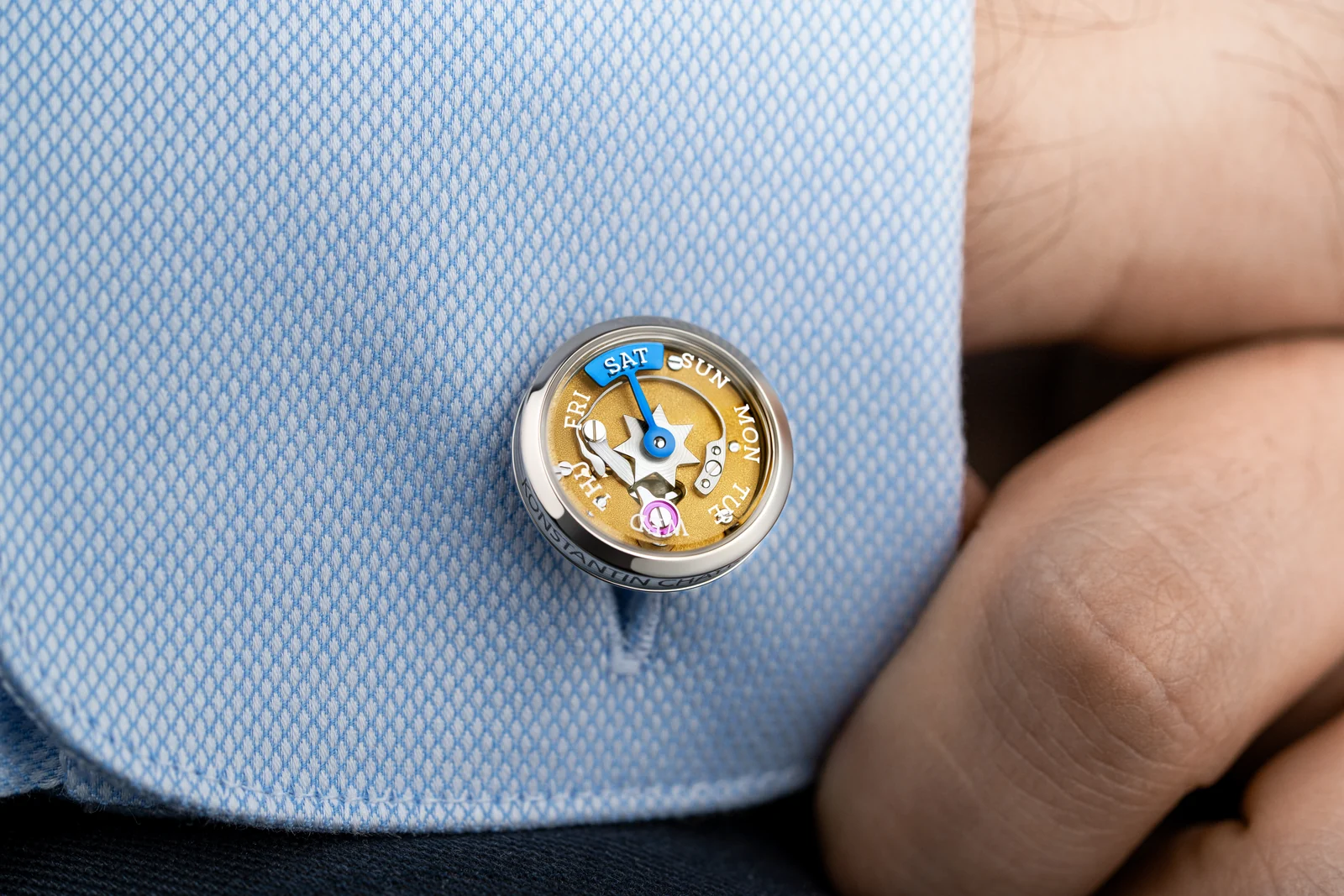
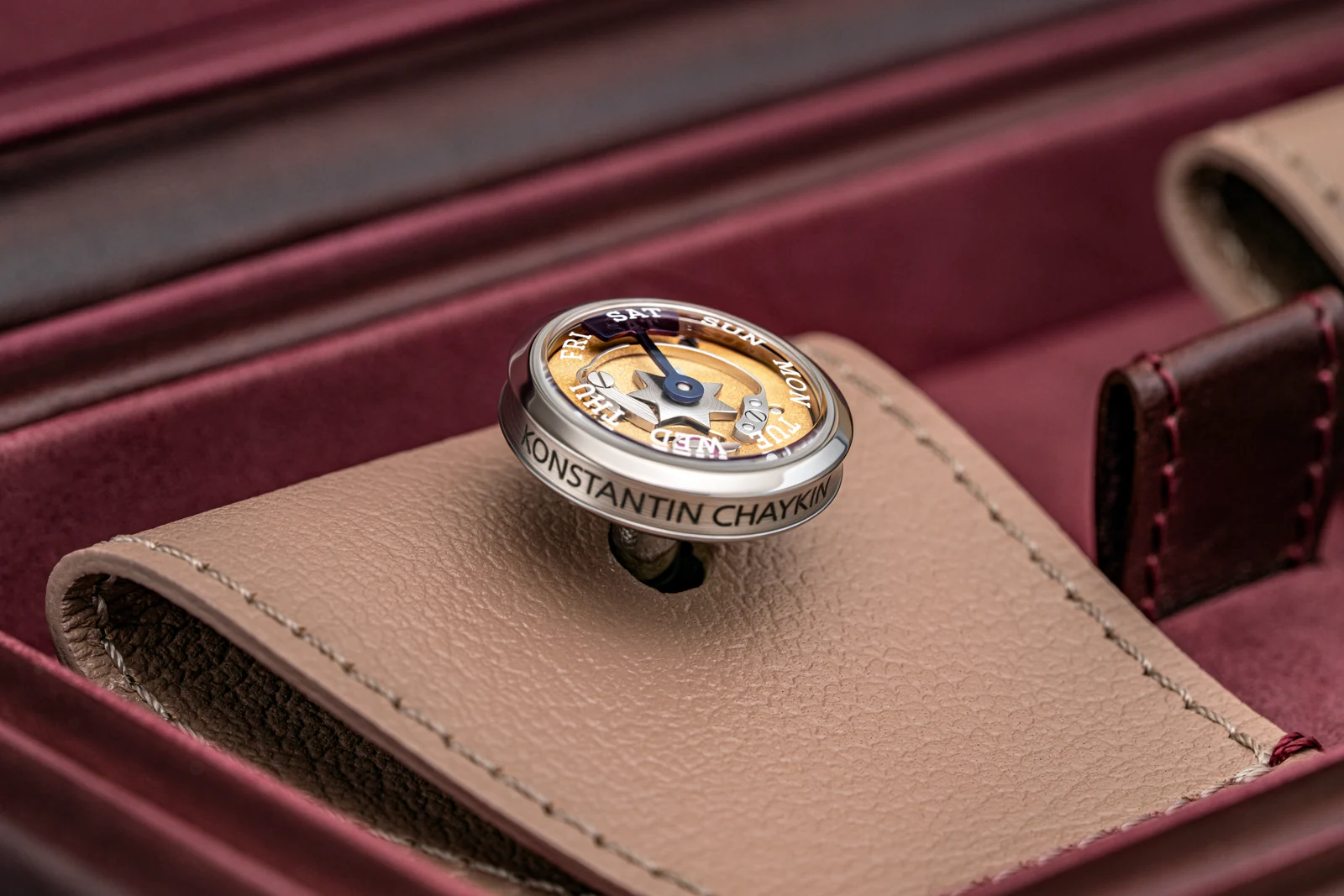
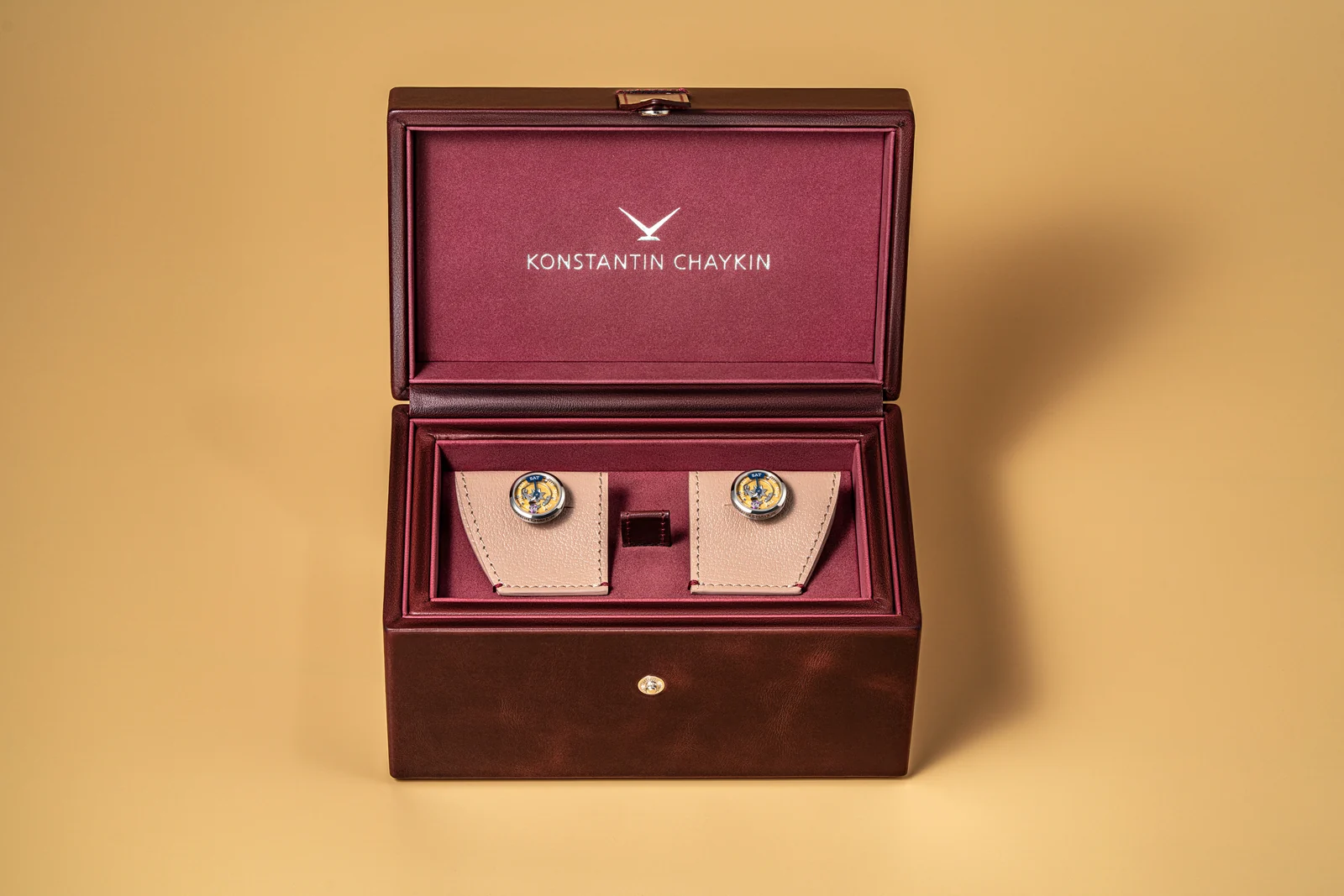
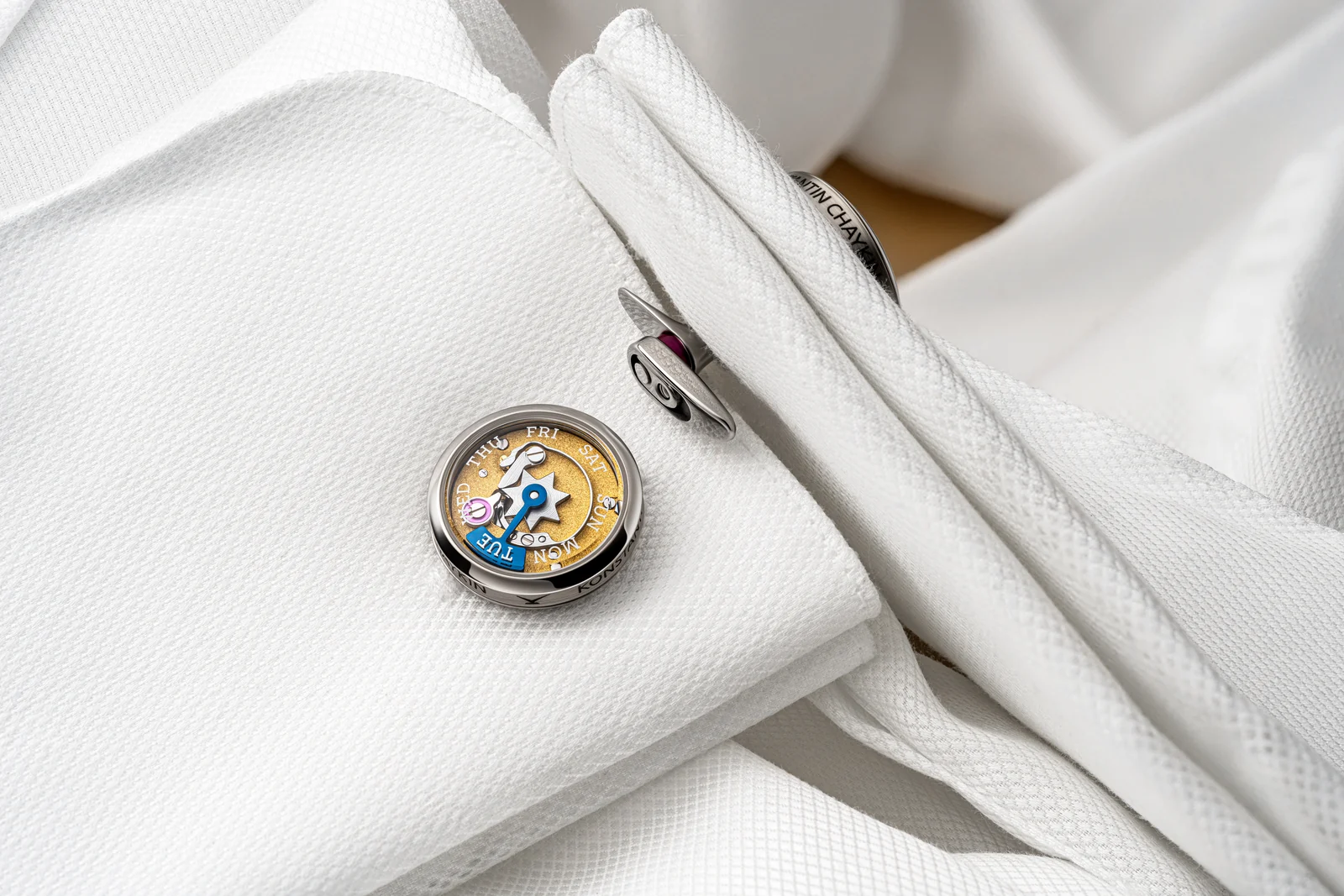
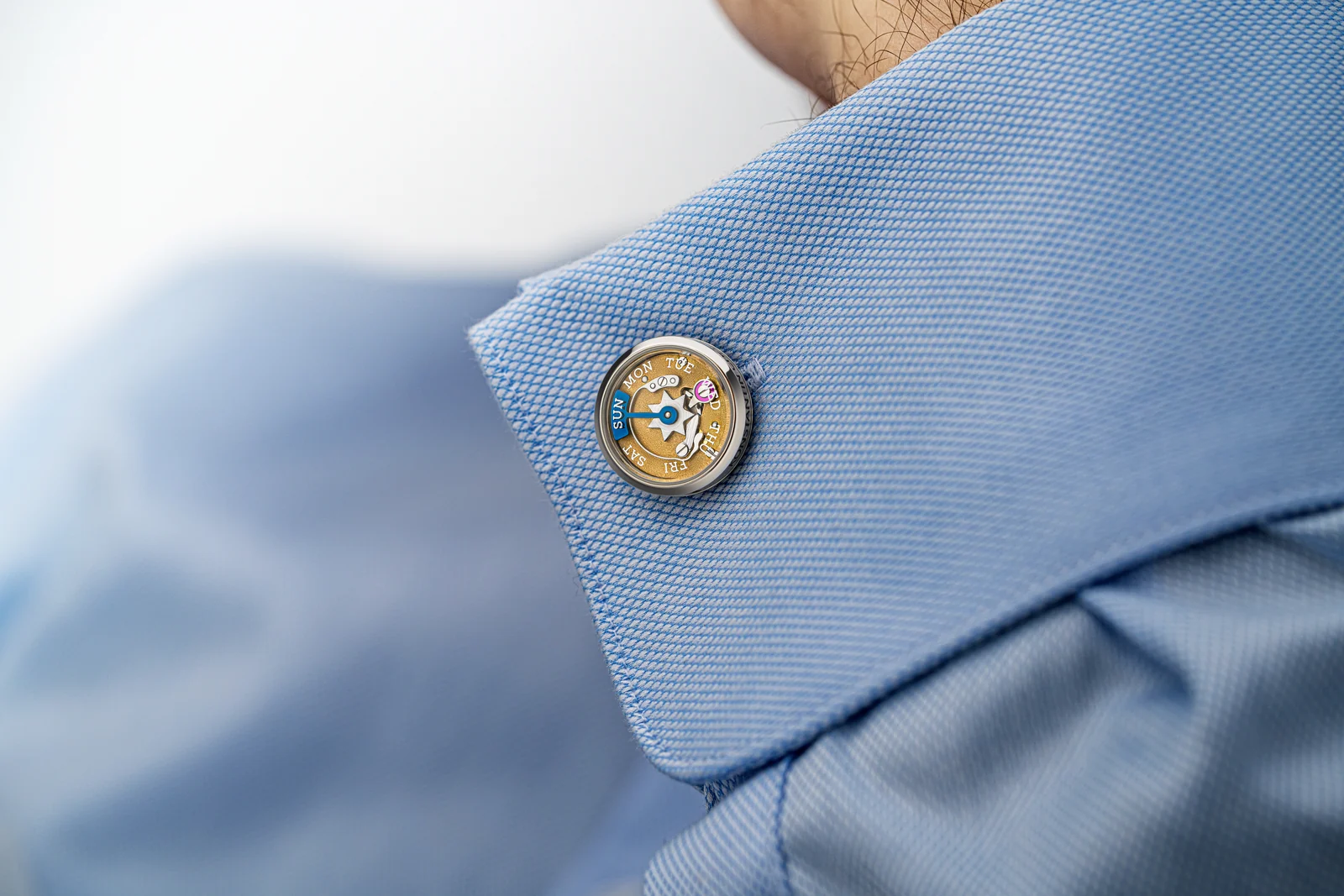
On 2 October 2026, Chaykin presented a far smaller piece. It works on the principle of the cat on the chain: it moves on when someone moves it. Master of Days is a pair of titanium cufflinks with a mechanical calendar that shows the day of the week, and the day changes when the wearer fastens the cuff. Chaykin gave his first interview about the cufflinks in conversation with The Silent Luxury.

In a Certain Kingdom: Who Decides When the Day Begins
For most of history, the beginning of a day has been fixed by decree. Russian fairy tales open in a certain kingdom, where the tsar’s word settles what is true, and the calendar has a long history of such decrees. On the night of Thursday, 4 October 1582, people in Rome, Madrid and Lisbon went to sleep and woke on Friday, 15 October. Pope Gregory XIII had removed ten days by papal bull, to bring the date of Easter back into line with the spring equinox. The dates jumped. The days of the week ran on undisturbed.
Later kingdoms issued their own decrees. British towns once kept their own local time, with Plymouth about sixteen and a half minutes behind Greenwich. In 1847 the Railway Clearing House recommended that every station keep Greenwich Mean Time. Today a phone changes its date at midnight on a signal from a distant server while its owner sleeps.
Easter, Hijra and the Sabbath: Chaykin’s Calendar Clocks
Chaykin has given much of his career to these older authorities. His computus clocks calculate the date of Easter, the very problem that moved Gregory XIII, and switch to the coming year’s feast once a year, at New Year. The first of them, made in 2005, was only his third timepiece. His Lunar Hijra clock follows the Islamic calendar, whose twelve lunar months drift through the seasons. His Shabbat clock is built so that its owner never has to wind it on the Sabbath.
Master of Days hands the shortest of these cycles, the seven-day week, to a single person, and Chaykin chose it on purpose. The days of the week follow “an endless, continuously repeating cycle”, Chaykin told The Silent Luxury. “That is precisely why I chose the day-of-the-week indication as the first calendar complication to explore. I found it symbolic that, in this case, the person becomes part of the mechanism itself, keeping it running through their everyday actions.”
A note from The Silent Luxury
Good reading deserves to find you again.
The Steel Flea: How the Master of Days Calendar Works
Master of Days works like the day-of-the-week calendar in a watch, with the wearer’s hand in place of the movement. It also belongs to a Russian tradition of mechanics at the edge of visibility. That tradition has its own great tale, written by Nikolai Leskov in 1881, which critics at first took for the retelling of an old legend. An English workshop presents the tsar with a steel flea so small that the key to wind it can be seen only under a microscope, and the flea dances. A cross-eyed, left-handed gunsmith from Tula and his fellow craftsmen answer by fitting the flea with horseshoes. Each craftsman signs the part he made. Lefty alone leaves no signature, because he forged the nails, and they are too small to sign. The shod flea, so the story goes, dances no more.
Chaykin’s cufflinks keep their mechanism running. In a watch, the day of the week is one of the simpler complications. A wheel driven by the movement turns once every twenty-four hours and bears a small finger. Shortly before midnight, the finger meets a tooth of a seven-pointed star wheel and pushes it round. As the tooth passes its highest point, a sprung lever called a jumper drops into the next gap. It snaps the star into place, one-seventh of a turn further on. Finer watches build up energy in a spring during the last minutes before midnight and release it at once, so that the day jumps instead of creeping. The energy always comes from the mainspring, and the timing from the movement.
Calibre A.01-1: A Calendar Driven by the Cuff
Master of Days keeps the star wheel and does away with what drives it. Each cufflink contains calibre A.01-1, which measures 13.9 millimetres across and 2.1 millimetres high. Its display mechanism has 27 parts and two jewels, arranged around a seven-pointed star wheel that moves a blue pointer. The 24-hour wheel and the mainspring are gone. Chaykin’s manufacture describes a kinematic chain that extends beyond the case, with the wearer taking the place of the movement.
Chaykin describes the cycle from morning to evening. “When someone gets dressed in the morning, inserts the cufflink through the buttonholes of their shirt cuff and rotates its movable element into the closed position, the calendar advances by one day,” he said. “In the evening, when they remove the cufflink and return it to the open position, the calendar indication remains unchanged. Meanwhile, the switching mechanism resets to its initial position, ready for the next cycle the following morning.” The result is a calendar with no sense of midnight. It counts fastenings, and left in a drawer, it keeps the day on which it was last worn.
Chaykin says the calendar itself posed few difficulties. The harder work lay in the forces involved. The cuff closes smoothly and opens only with additional force, a resistance his engineers calculated so that the cufflink cannot open by accident. “We paid particular attention to reliability testing,” Chaykin said. “Every cufflink undergoes 1,500 opening and closing cycles on a specially designed test rig. In terms of daily use, this corresponds to just under five years.”

Lefty’s Nails: How Master of Days Is Finished by Hand
Each cufflink has 40 parts, so a pair has 80, which the manufacture compares with a complete watch movement. The case is titanium, 18 millimetres across, a metal prized in watchmaking for its lightness and known among machinists for resisting the cutting tool. The edges of the parts are bevelled by hand and polished to a mirror, the technique called anglage, and the mainplate is sandblasted. The inside of each case is decorated with circular graining before assembly and sealed away when the case is closed. Like Lefty’s nails, it is finished work that its owner will never see. In haute horlogerie, even the hidden parts of a mechanism are finished, and Chaykin keeps to that custom. “For our brand, this approach is a fundamental principle and an integral part of everything we do,” he said. “We simply cannot imagine doing things any other way.”
The Trial in Geneva: ThinKing Mystery Wins the GPHG 2026 Audacity Prize
Konstantin Chaykin’s ThinKing Mystery won the Audacity Prize at the 26th Grand Prix d’Horlogerie de Genève on 7 November 2026. It is his second Audacity Prize, after a watch called Clown won in 2018. Every tale has its trial at court, and this court has now delivered its verdict. Chaykin knows it well, having sat on its jury in 2025. The ThinKing Mystery was one of 84 nominated timepieces and competed in the Mechanical Exception category, which Blancpain won with its Grande Double Sonnerie.
The watch measures 1.65 millimetres from front to back. In a conventional watch, the balance and its supporting parts are stacked. Chaykin laid them out in a single plane to reach that thickness.
The watch gives up height and the cufflinks give up their power source, but Chaykin points to what lies behind the thin case. “Everything appears remarkably simple on the outside, but behind that apparent simplicity lies an extremely complex technical execution,” he said. Into the thinnest of cases he added a mystery display, its hour and minute indicators floating on two transparent sapphire discs. In the cufflinks, what Chaykin added is the wearer.

Beyond the Wrist: Konstantin Chaykin’s Move into Accessories
Master of Days now sits in a section of its own in Konstantin Chaykin’s collection, listed as accessories, and the step follows an older pattern of his trade. For most of its history, watchmaking had little to do with the wrist. Clocks, pocket watches and mechanical objects occupied the trade for centuries, and the wristwatch became common only in the early twentieth century. Chaykin’s work moves easily between these forms. Alongside the table clocks, his wristwatches include Kolobok, named after the folk tale of a round loaf that rolls away from everyone it meets. He also paints a series he calls Horological Archetypes. In the cufflinks, the mechanism a watch keeps behind its dial has become the dial.
More objects of this kind will follow. “I can say with absolute certainty that Master of Days will not just potentially mark the beginning of an entire series — it definitely will,” Chaykin said. Other everyday gestures could set the next mechanisms in motion. “We already have a number of fully developed concepts and ideas that we plan to bring to life,” he added.
A Tale Is a Lie: Why Master of Days Counts Only the Week
Master of Days counts only the seven-day week, the calendar cycle that has survived every reform. It came through the Gregorian reform intact and outlasted the ten-day week of the French Republic, introduced in 1793 and abolished at the end of 1805. Pushkin ended The Tale of the Golden Cockerel, written in 1834, with a couplet Russian readers still quote. The tale is a lie, he wrote, but there is a hint in it, a lesson for good fellows. Like the learned cat on its golden chain, Chaykin’s cufflinks tell their story only when someone sets them in motion. Each morning, when a cuff is fastened, the day begins.

Send this to someone who still fastens their cuffs every morning.
Further Reading
-
A New Watch for 2027: The 12th Art Makes Its Case for Watchmaking as an Art
The 12th Art is an international initiative that wants watchmaking, jewellery, fine jewellery and goldsmithing recognised together as an art in their own right, alongside painting, music and film. Conceived by Antoine Gamboni, it takes its first physical form in a watch planned for 2027 and built in Switzerland.
-
How a Bespoke Suit Is Made: Hackett’s Head of Tailoring on Cloth, Canvas and Time
A bespoke suit is cut from a paper pattern drafted for one man and sewn largely by hand, while a made-to-measure suit adapts an existing pattern to his measurements. At Hackett’s No. 14 Savile Row, a bespoke suit takes at least a hundred hours of hand work, as Graham Simpkins, Hackett’s Head of Tailoring, explains.
-
Luxury Watch Market 2027: The Brands Make Fewer Watches and Take Over Resale
The luxury watch industry goes into 2027 making fewer, more expensive watches and handling more of its own resale. Collectors’ money, meanwhile, is moving to independent watchmakers and to auction, where watches have become the largest category at Phillips.
Sources
- Grand Prix d’Horlogerie de Genève, Prize list of the 26th GPHG (7 November 2026)
- Grand Prix d’Horlogerie de Genève, ThinKing Mystery
- Konstantin Chaykin, ThinKing Mystery Earns Konstantin Chaykin His Second GPHG Award (8 November 2026)
- Konstantin Chaykin, Master of Days: A Calendar on the Cuff (2 October 2026)
- Konstantin Chaykin, Master of Days, media information
- Konstantin Chaykin, Lucomorye clock
- Konstantin Chaykin, Shabbat clock
- Royal Museums Greenwich, Greenwich Mean Time and the confusing case of the traveller’s watch
- The Silent Luxury, Konstantin Chaykin: “The Person Becomes Part of the Mechanism”
Similar Articles

Habsburg Kleidermanufaktur: A Great Name That Never Raises Its Voice
The Red Column and the Year of Family: INTIMAA Opens in Abu Dhabi

The Material Era: How Portugal Makes the Shoes Europe Will Buy Next.