Konstantin Chaykin: “The Person Becomes Part of the Mechanism”
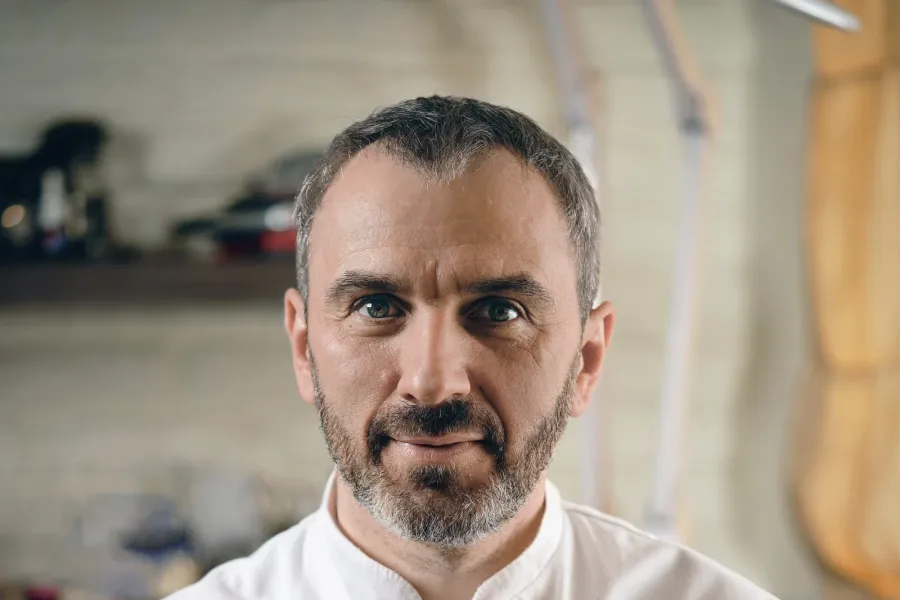
Konstantin Chaykin’s ThinKing Mystery, a watch 1.65 millimetres thick, won the GPHG Audacity Prize in Geneva on 7 November 2026. It was the second time the prize had gone to him. Now, in conversation with The Silent Luxury, he gives his first interview about Master of Days. The calendar in these titanium cufflinks moves on by one day each time the cuff is fastened.
At the 26th Grand Prix d’Horlogerie de Genève, a jury chaired by Wei Koh chose among 84 nominated watches. Rexhep Rexhepi took the Aiguille d’Or, the evening’s top award, for his Chronograph Flyback. The ThinKing Mystery had been nominated in the Mechanical Exception category, which went to Blancpain’s Grande Double Sonnerie. Chaykin first won the Audacity Prize in 2018, with a watch called Clown. In 2025 he sat on the GPHG jury himself.
His answers return to one idea, which he puts in eight words: “the person becomes part of the mechanism itself”. They reached The Silent Luxury after the ceremony in Geneva.
A Calendar in the Wearer’s Hands: Master of Days by Konstantin Chaykin
Master of Days puts the day of the week in the hands of the person who wears it. Chaykin’s earlier clocks follow calendars kept by institutions. His computus clocks calculate the date of Easter, and his Lunar Hijra clock follows the Islamic calendar.
The Silent Luxury: Your clocks follow calendars kept by churches and whole communities. In Master of Days, the wearer decides when the day moves on. Why did you want to give that role to a person, and what changes for you when a calendar depends on a human gesture?
Konstantin Chaykin: Calendars have always been a subject very close to my heart. Back in 2005, I created my third timepiece, which featured an indication of the date of Orthodox Easter. It incorporated not only the Orthodox ecclesiastical calendar but also a perpetual calendar. Since then, I have returned to this subject many times, exploring and studying various calendar systems in great depth.
Of course, the idea of giving a person control over a calendar is not entirely new. What intrigued me was this particular way of bringing it to life. Every day, we perform certain familiar actions, such as putting on and taking off accessories. I wanted to find a solution that would connect this daily ritual with a calendar indication.
For my first exploration of this idea, I chose cufflinks, one of the classic accessories in a gentleman’s wardrobe. I felt that combining them with a calendar mechanism was a particularly fitting solution, effectively allowing the wearer to take on the role normally performed by a watch movement.
There is also a certain philosophical dimension to this concept. The days of the week, for example, follow an endless, continuously repeating cycle. That is precisely why I chose the day-of-the-week indication as the first calendar complication to explore. I found it symbolic that, in this case, the person becomes part of the mechanism itself, keeping it running through their everyday actions.

A note from The Silent Luxury
Good reading deserves to find you again.
Fastening the Cuff: Chaykin’s 1,500 Test Cycles and a Water-Resistant Case
Each Master of Days cufflink goes through 1,500 opening and closing cycles on a test rig, the equivalent of just under five years of daily wear. Its compact case is water-resistant. Inside sits calibre A.01-1, 13.9 millimetres across and 2.1 millimetres high, driven by the wearer’s hand alone.
The Silent Luxury: How is the motion of fastening transmitted to the star wheel, and how is the star held in place between steps? What did you have to solve to make a calendar work without a movement behind it?
Konstantin Chaykin: The calendar mechanism itself is fairly traditional in its construction.
An anti-reflective sapphire crystal reveals the calendar mechanism. At its center, a seven-pointed star advances the vivid blue pointer to the next day of the week. What makes it unusual is that the calendar advances through the reciprocating motion of one of the cufflink’s components.
When someone gets dressed in the morning, inserts the cufflink through the buttonholes of their shirt cuff and rotates its movable element into the closed position, the calendar advances by one day. In the evening, when they remove the cufflink and return it to the open position, the calendar indication remains unchanged. Meanwhile, the switching mechanism resets to its initial position, ready for the next cycle the following morning.
As for the technical challenges, the calendar mechanism itself was not particularly difficult for us. The more interesting task was to develop a construction that could meet several requirements simultaneously.
First, we had to ensure water resistance. Very few cufflinks of such compact dimensions feature a water-resistant construction. Second, we wanted to create an interesting design solution. For example, we incorporated watchmaking jewels into the construction, and they are clearly visible in two places. And, of course, the third major priority was reliability and the quality of execution.
The Silent Luxury: What did that mean for the engineering?
Konstantin Chaykin: I would like to emphasize that we approached the development of these cufflinks with the same engineering philosophy we apply to watchmaking. This meant not only using components traditionally found in watch movements, but also carrying out detailed engineering calculations, including determining the forces required to operate the mechanism.
For example, when fastening the cufflink, the movable element should transition into the closed position relatively smoothly. However, moving it in the opposite direction, from closed to open, requires additional force. This is intentional, as it prevents the cufflink from opening accidentally.
We conducted dedicated research to determine the optimal amount of force. On the one hand, the cufflink had to be comfortable and easy to use; on the other, it needed to remain securely fastened. Finding the right balance required extensive calculations and testing, which ultimately allowed us to arrive at the optimal construction.
We paid particular attention to reliability testing. Every cufflink undergoes 1,500 opening and closing cycles on a specially designed test rig. In terms of daily use, this corresponds to just under five years.
Once the testing is complete, we check that every element of the mechanism operates correctly. Only when we are satisfied that everything functions reliably do we proceed to final assembly. This is how each finished piece comes into being.
Fastening the cuff: as the toggle closes, the calendar moves on by one day. Courtesy of Konstantin Chaykin
The Hidden Finish: Konstantin Chaykin’s Haute Horlogerie in a Cufflink
Master of Days is finished to the standard of a watch movement, including the parts no one sees. Each cufflink has 40 parts in a titanium case 18 millimetres across. The inside of each case is decorated with circular graining before it is sealed.
The Silent Luxury: Which part of Master of Days was the hardest to make, and why did you decorate surfaces that no wearer will ever see?
Konstantin Chaykin: As I mentioned earlier, one of the greatest challenges was carrying out the necessary research, accurately calculating the forces involved in opening and closing the cufflinks, and developing the optimal testing procedure. We needed to find a solution that would ensure both ease of use and structural reliability.
As for the finishing, we follow the traditions of haute horlogerie. In fine watchmaking, it is customary to meticulously finish and decorate even the hidden components of a mechanism — those concealed inside that the owner may never actually see.
For our brand, this approach is a fundamental principle and an integral part of everything we do. We simply cannot imagine doing things any other way. Every component must be properly finished and decorated, whether it is visible or hidden within the mechanism.

Apparent Simplicity: The ThinKing Mystery and the Audacity Prize
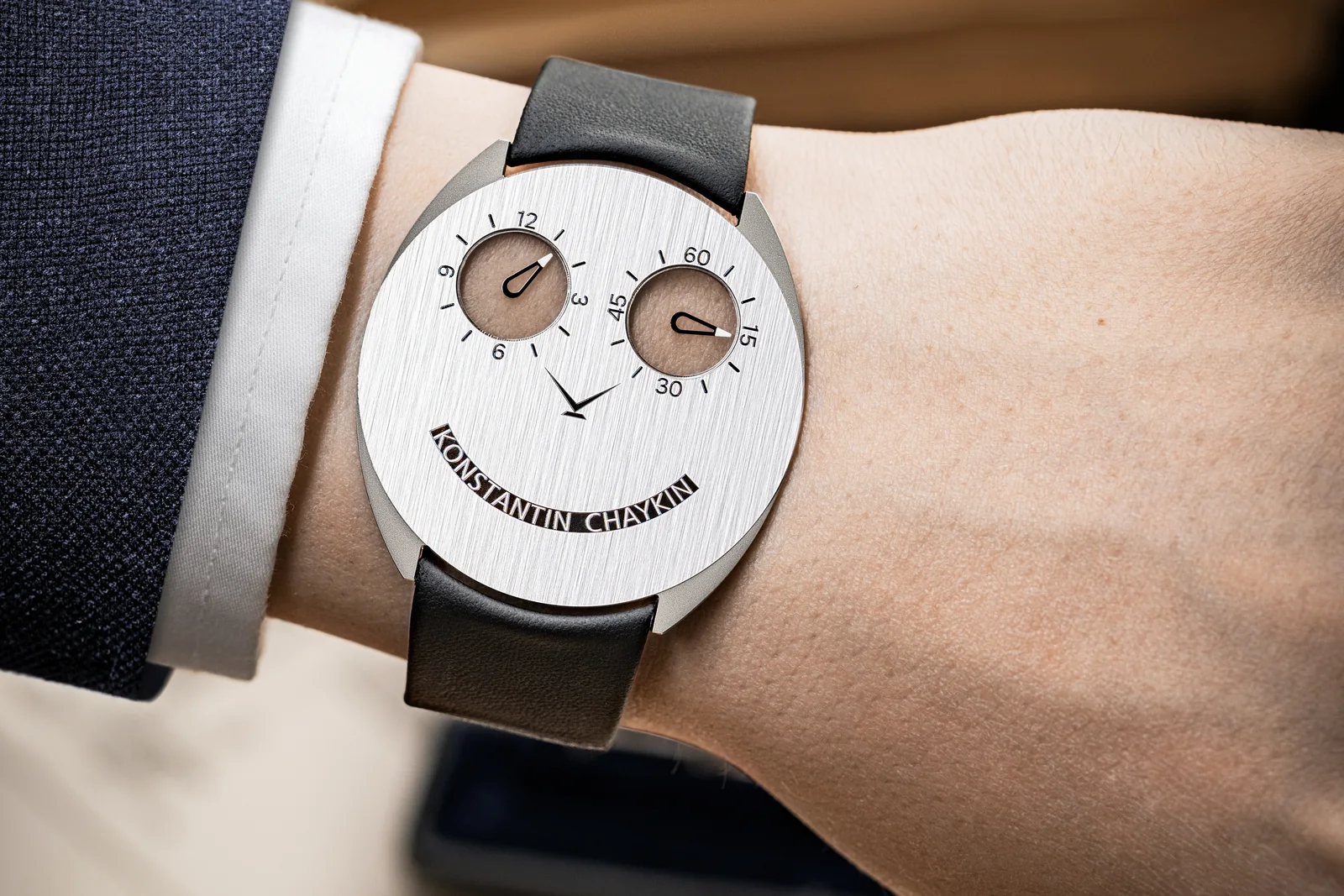
The ThinKing Mystery, which won the Audacity Prize in Geneva on 7 November 2026, is 1.65 millimetres thick. In a conventional watch the balance and its supporting parts are stacked. Chaykin laid them out in a single plane to reach that thickness. The GPHG’s own description says that “the master added rather than removed”. Chaykin fitted a mystery display into that construction, and its hour and minute indicators float on two transparent sapphire discs.
The Silent Luxury: The ThinKing Mystery and Master of Days both take something away, height in one case and the power source in the other. Is reduction a deliberate method in your work?
Konstantin Chaykin: I wouldn’t say that ThinKing Mystery is an example of simplification. Quite the opposite, in fact. Everything appears remarkably simple on the outside, but behind that apparent simplicity lies an extremely complex technical execution.
With Master of Days, the situation is somewhat different. Many people who take an interest in these cufflinks assume that there is a complete watch movement inside. In reality, however, we transfer the movement’s function to the wearer. This is an interesting inventive approach that allows us to look at a familiar challenge from an entirely different perspective.
So, for me, it is not so much about simplification as it is about finding new and unconventional solutions. The goal is not simply to remove something from a construction, but to introduce an element of novelty, to come up with an interesting idea.
In the case of Master of Days, the wearer becomes an active participant in the operation of the mechanism. Rather than simply using an object, they interact with it directly, controlling the calendar through their own actions. And I believe this is precisely where the deeper philosophical meaning of the concept lies.
What Comes Next: Konstantin Chaykin’s Accessories
Konstantin Chaykin lists Master of Days in a section of its own in his collection, under accessories.
The Silent Luxury: Is Master of Days the beginning of a wider family of objects? Which other everyday gestures could set a mechanism in motion?
Konstantin Chaykin: I can say with absolute certainty that Master of Days will not just potentially mark the beginning of an entire series — it definitely will.
As for using other familiar everyday gestures to set mechanisms in motion, this is indeed a very interesting direction to explore. We already have a number of fully developed concepts and ideas that we plan to bring to life.
So, while we are completing work on this series, we are already developing new accessories for our brand. Stay tuned — there is much more to come.
The story behind the cufflinks reaches from Pushkin’s learned cat to Leskov’s steel flea. It is told in Master of Days: Konstantin Chaykin’s Fairy Tale of the Week.
Send this to someone who believes a good object needs the person who uses it.
Further Reading
-
F.P. Journe and Chanel Buy Ebel for $66.5 Million: A New Way to Own a Watch Brand
On 8 October 2026, Movado Group agreed to sell 95 per cent of Ebel for $66.5 million to a group led by Montres Journe, the Geneva company of the watchmaker François-Paul Journe, with Chanel as investor. Pierre Jacques, the former chief executive of De Bethune, will run the brand.
-
F.P. Journe Souscription Résonance Sets $13.9 Million Auction Record at Phillips New York
The F.P. Journe Chronomètre à Résonance, Souscription No. 007, sold at Phillips New York for $13.9 million, a record for the independent watchmaker. It belongs to the early Souscription watches with which twenty collectors financed Journe’s manufacture around the turn of the millennium.
-
Authenticity Is the New Luxury: Proof, Belonging and Provenance Now Outrank Prestige
Authenticity has become the new luxury as buyers move their trust from prestige and paid content towards proof and people they know. Studies by Branding in Asia, Team One, Boston Consulting Group with Fondazione Altagamma and CreatorIQ show quality ranking far above prestige, by 47 per cent to 18 per cent.
Sources
- Grand Prix d’Horlogerie de Genève, Prize list of the 26th GPHG (7 November 2026)
- Grand Prix d’Horlogerie de Genève, ThinKing Mystery
- Konstantin Chaykin, ThinKing Mystery Earns Konstantin Chaykin His Second GPHG Award (8 November 2026)
- Konstantin Chaykin, Master of Days, media information
- The Silent Luxury, Master of Days: Konstantin Chaykin’s Fairy Tale of the Week
Similar Articles

Marie Droll of Kearney: Beauty Buyers Now Pay for Proof

Yves Bugmann: In China, Swiss Watches Have Moved Further Upmarket

Inside Habsburg Kleidermanufaktur: Markus Meindl and Michael Rumerstorfer on the Name, the Johann Karl and Clothes Made for Generations