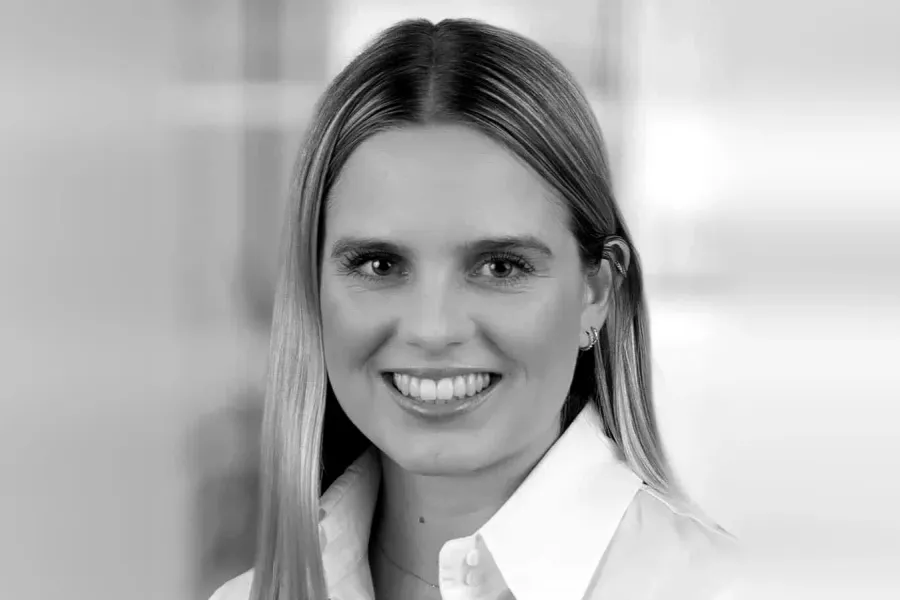
Black-and-white portrait of Marie Droll, principal at Kearney in Zurich, smiling, in a white shirt.
Beauty is doing more deals than ever, and each one is worth less. In conversation with The Silent Luxury, Kearney principal Marie Droll, who co-leads the firm’s beauty M&A report, explains why the big groups have gone quiet, what buyers want from a brand today and what small houses need to be bought.
Eva Winterer
Beauty’s deal-making has split from its deal values. In 2025 the number of transactions in beauty and personal care reached a record, yet the median deal value fell. Large acquisitions have almost stopped, and private equity is filling the gap the big groups have left.
Marie Droll is a principal in Kearney’s consumer goods and retail practice in Zurich, where she specializes in beauty. With Kearney partner Fabian Lux she has led the firm’s annual beauty M&A report through three editions, most recently “2026 M&A in Beauty and Personal Care: Volume over Scale and Value.” She spoke in conversation with The Silent Luxury about what the numbers show, where they stop, and which capabilities will decide who owns beauty in the next decade. The full analysis of the report is in Beauty M&A in 2026: Record Deals, Smaller Bets and the Funds Holding the Door.
More Deals, Smaller Checks
Beauty saw a record number of deals in 2025, yet the median deal value fell. What does that tell us about the market?
One of our key findings is that volume and value have decoupled. The number of deals reached a record high in 2025. This edition only covers the first half of 2026, but we expect the trend to continue. At the same time we see many more small deals, and that pulls down both the average and the median deal value. In 2024 the median was $26 million. In 2025 it fell to $22 million. That is a significant drop, even though more deals were counted, and I think it is a clear indication of where the market is right now.
There were no large deals at all in the first half of 2026. Why are the big groups holding back?
The large deals are usually done by the multinational, multi-category players, the names we all think of. Many of them are busy restructuring, because the economic environment has become more challenging. They want to make sure their recent acquisitions are fully integrated before they release the capital, and the capacity, to think about outbound M&A again. In the first half of 2026 there were none, as we categorize them.
Activity in the mid-sized deals is declining too. Buyers look either for the next big thing they can bet on or for a business that is already financially sound, and in the middle of the market it is hard to be profitable and still easy to integrate. Small deals offer more room to find the next big thing. But social media has made the cycles much faster. A brand can be hyped one month and almost forgotten the next, and that makes every investment riskier.
By the numbers: 384 beauty and personal care deals in 2025, up from 355 in 2024. The median disclosed deal value fell from $26 million in 2024 to $22 million in 2025 and $12 million in the first half of 2026. Deals under $100 million made up 77 percent of disclosed deals in 2025 and 86 percent in the first half of 2026, when no large deal was disclosed.
Funds and Groups as Owners
How does a fund shape a beauty company differently from a strategic owner, and how long does the cycle between them run?
This is not specific to our report, it is the general logic of the market. Financial owners buy a company in order to build it up and sell it, ideally to a strategic player. Strategic owners build a brand to fit into their own system. So they think in very different cycles: the strategics longer term, the financial investors shorter.
What we saw, and this brings us back to where we started, is that while the strategics are busy restructuring and cleaning up their own portfolios, private equity and other financial investors are stepping in. They take the spot the strategics leave because they lack the bandwidth to buy right now, and in our data they are gaining ground. Then the funds clean up the company in order to sell it at an attractive premium, to another financial investor or, ideally, to a strategic. That is the recurring value loop we describe in the report. It resets the playing field, and once the strategics have more bandwidth again, they come back in.
It is hard to put an exact number on how long that takes. It depends on the economy, on inflation, on financing conditions. Typically we talk about three, five, seven years. And there is always a next crisis around the corner. No one could have foreseen the situation in the Middle East, and that shakes things up significantly.
By the numbers: Corporate buyers accounted for about 54 percent of deals in 2025, their highest share in eight years, and about 44 percent in the first half of 2026. Financial-buyer activity rose 33 percent in the first half of 2026 compared with a year earlier.
What makes a beauty company attractive to an acquirer today?
It is a consultant’s favorite answer, but it depends. There are several things that make a brand an interesting target. The first is profitability. Especially in the middle of the market it is very hard to be successful and still be easy to integrate, so a product with a self-funding P&L is extremely important.
The second is proof points. That goes in the direction of credibility and science. If a brand has strong performance signals, a clear channel or home market, or clinical evidence, that makes it highly relevant, especially in an age of scientific credentials in skincare and hair care.
The third is how easily the brand can be integrated into the acquiring company. What does the operating model look like? Is there a very strong founder you will need to deal with, or is it a natural fit? And finally the brand has to fit into the portfolio. The large players typically do not buy a brand that would cannibalize sales from one they already own.
Value-chain and capability deals have grown strongly. What exactly are buyers trying to secure?
In the report we look at the motives behind beauty and personal care M&A, and value-chain and capability deals rose significantly. Those motives accelerate the decision to buy. Sometimes it is about closing a gap in the value chain or adding a segment. Sometimes it is access to a specific manufacturer, or to particular formulations.
Skincare is becoming more medical, and hair care is following. How far does this shift reach?
Skincare is still a huge differentiating factor in a lot of deal-making, especially the medicalization of skincare. The derm brands are incredibly successful. We also see this medical perspective moving into other categories. In hair care, for example, a lot of medicalization is happening as well. Being clinically proven, scientific and credible is extremely important for a target company.
By the numbers: Growth acceleration as the reason for a corporate deal fell from 30 percent in 2024 to 23 percent in 2025 and 16 percent in the first half of 2026, the lowest share on record. Value-chain and capability deals rose from about 27 percent of corporate transactions in 2025 to about 36 percent.
Where the Deals Happen
China’s beauty market has turned toward its own brands. Companies such as Proya and Mao Geping grow largely without outside buyers. Kearney counts transactions in which a Chinese company is acquired, so this organic growth does not appear in its deal data.
Europe remains the strongest region for beauty M&A. Why?
Interestingly, Europe continues to be very strong in beauty M&A. One reason is probably that Europe has very strong regulation. As soon as a brand’s value rests on credibility, on proven claims, that makes Europe a very relevant region. North America also stays relevant. We saw a small drop between 2024 and 2025 there, and the overall economic environment plays a role. In the first half of 2026 North America seems to be recovering, but that needs to be watched closely over the second half.
Chinese brands are growing at home, yet deals with Chinese targets have fallen sharply. What do the deal numbers show, and what do they leave out?
When we talk about China deals, we always mean the target geography, where the acquired company sits, not where the buyer comes from. China stayed relatively stable from 2024 to 2025 and even gained a little. In the first half of 2026 it dropped significantly. Outbound activity from Chinese buyers has also stayed thin. The first half of a year is not always representative, so we need to be cautious.
It is probably a combination of things. The overall economic situation has not been ideal in recent years, including for the beauty market. And there is a strong focus on local brands, which are gaining a lot of traction, but less through large M&A than as locally grown Chinese brands. We also expect a shift toward a traditional Chinese medicine point of view for those brands and for the market. That will be very interesting to follow.
Japan is gaining ground. Is the K-beauty effect moving across Asia?
Japan stayed relatively flat from 2024 to 2025 and has already gained in the first half of 2026. With the whole hype around K-beauty, we expect it to move from Korea into other Asian markets, Japan in particular, credentializing this Asian-heritage beauty component. K-beauty is huge globally. We do not look at Korea individually in our data set; it falls under the rest of Asia, which dropped a little from 2024 to 2025 after a big year in 2024. It is probably stabilizing now, but we expect it to become more prominent again.
By the numbers: Share of deals by target geography, 2025 to the first half of 2026: Europe 47 to 47 percent, North America 23 to 31 percent, Japan 9 to 12 percent, China 10 to 2 percent.
The Capabilities That Will Decide Ownership
Which capabilities will decide who owns beauty ten years from now?
Honestly, it is difficult to say which segments will win, because there are so many hype areas. It is more useful to ask which capabilities an acquirer needs. Whether that holds for the next two or three years or the next ten is always tricky, but for the next 18 months or so, I would name several.
The first is integration. How well can the acquirer integrate the target? Does it give the brand the right level of freedom and the right boundaries? Internal incubation is something the big strategics have historically struggled with at times, not always, but there have been cases. Careful selection and then careful integration into the portfolio are key.
The second is science: the credentials and proven outcomes of the target, its clinical credibility. That is key to making a brand an interesting target.
Third, we are convinced that consumer-health adjacencies will matter a great deal from an M&A perspective: supplements with clinical backing, treatments, device platforms. Fourth, data and technology. Beauty tech has been simmering for a few years, and we expect it to gain traction. Infrared masks, cleansing tools, all the devices. That is coming more and more.
And finally the value chain itself: sourcing capabilities and how resilient the supply chain is. Which segment you play in, which consumers you can reach, which geographies you have access to. In short, what differentiates you from the rest of the market.
There is a clear tendency toward scientific, clinically proven, credible products. But it depends on the deal rationale. An acquirer who is missing a basic treatment line may look for a mass product. The broad, basic products will always remain, because they bring volume, and the big strategics typically build complementary portfolios across mass, prestige and luxury.
By the numbers: Controlling stakes, takeovers and majority holdings together, made up about 61 percent of deals in 2025 and 64 percent in the first half of 2026. Minority stakes fell from 52 percent in 2023 to 36 percent.
What Small Houses Need Now
What does a small, new brand, for example in natural beauty, need to attract investors or a buyer?
There is definitely a big opportunity if you have a clear USP, a clear reason for being, a clear route to the customer, and ideally you are already profitable. But there is also the other side. If the acquirer is not ready to make an acquisition, you can be a fantastic small company and it will still be tricky. Both sides need to come together at the right moment.
We continue to see big stories in the press almost every week, so the opportunity is there. Over the last months, though, the brands being acquired have often been the bigger, better-known ones. The large strategics are looking for credibility and a proven business model, and they are less willing to take big risks. If I had to give it a headline: you have to have credibility. That has always been true, but it has changed. There was a time when it was simply about taking over brands. Today even the financial investors act more strategically.
For anyone who wonders who will own beauty next, and what it takes to be bought.
Chanel is selling its majority stake in Capsum, the Marseille developer and maker of skincare and make-up, to the Paris private equity firm Motion Equity Partners, and keeps a minority share.