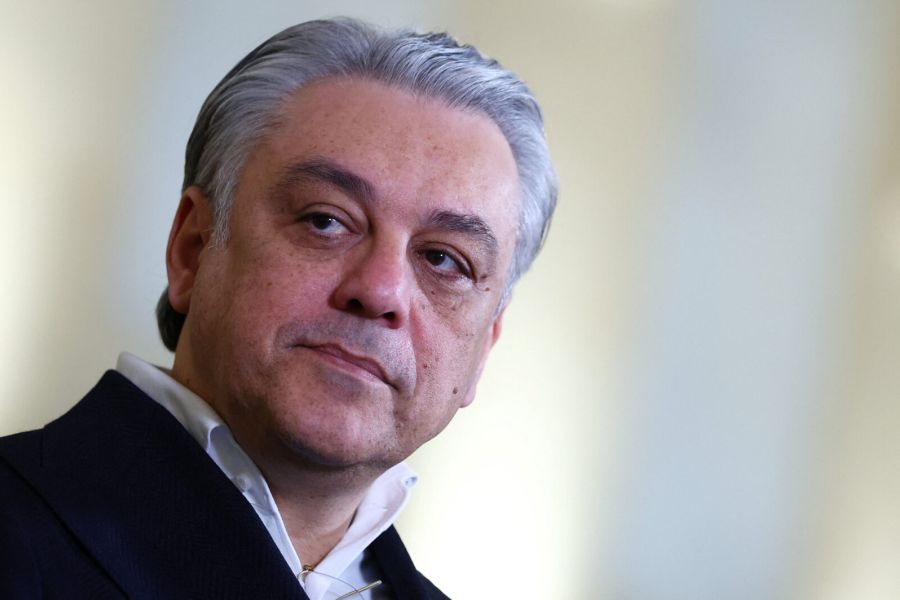
Luca de Meo at Kering’s Capital Markets Day in Florence, April 2026 — where he placed True Luxury at the centre of the ReconKering strategy and opened the most important conversation in luxury right now. | Photo: APA-Images / REUTERS / Gonzalo Fuentes
Luca de Meo Named True Luxury: The Conversation Has Just Begun.
Luca de Meo placed true luxury at the centre of Kering’s ReconKering strategy, and the term he chose opens a question about value that the industry has yet to answer.
Eva Winterer
This is the figure at the heart of our ReconKering Dossier, the conversation on what true luxury now means at Kering.
The ReconKering strategy names the concept and opens the conversation, what de Meo means precisely by True Luxury is the most interesting open point in the strategy, and the question the luxury market now needs to answer together. The silent luxury movement has been building one answer since its emergence: value built through time, provenance, responsibility and the quality of the relationship between maker and buyer.
A Term That Opens a Conversation
When Luca de Meo stood before investors in Florence on April 16, 2026 and placed True Luxury at the centre of the ReconKering strategy, the phrase landed in the financial and luxury press as a headline. It also landed as an invitation — one that the presentation, across three strategic phases, multiple financial targets and brand-specific roadmaps, began but did not complete.
De Meo is not a man who avoids precision. “In a nutshell,” he told investors, “a model that worked for a decade is no longer effective.” Later, he made a distinction that was perhaps the sharpest observation of the entire three-and-a-half-hour address: “Everyone in our industry talks about luxury. For me, beyond the word desirability, the word that truly matters is excellence. Luxury is a perception; excellence is a discipline. Luxury can be claimed. Excellence must be earned every day, in every detail, across the entire value chain.”
The distinction between luxury as perception and excellence as discipline is precisely the territory that the silent luxury movement has been charting for years. De Meo has named the terrain. The conversation about what True Luxury actually demands — in production decisions, in distribution architecture, in the relationship between a house and its buyers — is the one that follows from this naming. ReconKering identifies four pillars: creativity, savoir-faire, cultural relevance and product excellence. Each is a direction rather than a definition. Each opens a question rather than closing one. That is, in its own way, the most honest thing a strategy document can do.
The Silent LuxuryKering · Q1 2026 Revenue
Kering Q1 2026 — Brand Performance
Organic revenue growth by brand · January to March 2026 · Source: Kering Earnings Release April 14, 2026
The Q1 2026 results provide the context from which the True Luxury conversation emerges. Kering’s group revenue stabilised at €3.57 billion — down 6.2 percent in reported terms but flat organically, marking the first sequential stabilisation after several quarters of decline. The divergence within the portfolio tells the more precise story. Gucci, which still accounts for approximately 60 percent of the group’s operating profit, recorded a decline of 14.3 percent in reported terms and 8 percent organically. Kering Jewelry, led by Boucheron — the fastest-growing brand in the group this quarter — grew 22 percent organically.
The arithmetic is precise: the categories that embody the structural conditions closest to true luxury — intrinsic material value, craftsmanship, controlled production — are growing. The categories that drifted furthest from those conditions during the boom years are contracting. As Armelle Poulou, Kering’s CFO, noted: “While the recovery will be gradual, the fundamentals are being rebuilt in the right order.”
De Meo responded with a commitment: “Gucci remains our top priority. A comprehensive turnaround is underway, with decisive actions across client, distribution and, above all, the offer.” The word “offer” carries weight here. It signals a return to the object itself — its quality, its relevance, its reason to exist — as the primary instrument of recovery. This is where the True Luxury conversation becomes most concrete.
JPMorgan analysts described the ReconKering plan as “back-end loaded” — the heavy lifting of a structural reset taking time to manifest in the bottom line. The observation applies with equal force to the cultural reset that True Luxury demands. Rebuilding the conditions under which desire can accumulate is, by definition, a slow project. De Meo understands this: “Gucci’s recovery will be real, because it will be structured.”
The Structural Tension Worth Examining
De Meo came to Kering from automotive — from Renault, where he applied the tools of industrial restructuring with precision. The vocabulary of ReconKering carries that background. “Leaders tend to protect what they’ve already built,” he said in Florence. “Challengers, on the other hand, focus on what has yet to be invented. They question habits, act faster and remain uncompromising on execution.”
The challenger mindset is a coherent framework for a turnaround, and it may well deliver the financial reset that Kering needs. The structural question worth examining openly is whether the vocabulary of acceleration — faster, more agile, more innovative — is compatible with the conditions under which true luxury value accumulates. The luxury object that carries genuine value takes longer to make than the market expects. The relationship between a house and its buyers develops across years rather than quarters. The mystery that generates desire grows from silence and consistency.
This is the conversation that ReconKering has opened — and that the luxury market now needs to pursue with depth. De Meo himself drew the line that makes the conversation necessary: luxury is a perception. Excellence is a discipline. The gap between the two is precisely where True Luxury lives.
The Silent LuxuryReconKering · Strategy Roadmap
ReconKering: Three Phases to 2030
The strategic roadmap Luca de Meo presented at Kering’s Capital Markets Day, Florence, April 16, 2026
2026
Phase 01 · Reset
Structural Reset
Financial discipline restored across all Maisons
Gucci product architecture reset
Distribution rationalised — outlets reduced by one third
The silent luxury movement emerged as a structural reading of the luxury market well before de Meo placed the term in public discourse. Silent luxury is a mindset — a form of engagement with value that asks different questions than the aspiration-based model that defined luxury growth for three decades.
Where the industrial luxury model asked how many people can be brought into contact with a brand, silent luxury asks about the quality of the relationship between an object and the person who carries it. Where the industrial model measured success through volume and visibility, silent luxury measures it through the depth of what remains when the season has passed.
As Eva Winterer, Publisher of The Silent Luxury, has articulated it: luxury is a relationship. A form of engagement with things, places and people. Georg Simmel recognised as early as 1900 that luxury manifests in relationships rather than in objects. What he described then applies with greater precision today: luxury arises through the way we relate to things, through the care we invest in them and through the time we allow them to accumulate meaning.
This relational understanding is what the Remapping of Luxury has been charting since the founding of The Silent Luxury. De Meo’s own formulation — “luxury is a perception; excellence is a discipline” — arrives at the edge of this understanding. Silent luxury is the step beyond it: the discipline of building the conditions under which the perception becomes real.
Five Conditions That True Luxury Demands
True luxury, understood as a set of structural conditions, requires five things — each of which the ReconKering strategy points toward without yet fully defining.
Time is the first condition. True luxury is built in time and for time. The repair economy is growing at 17.9 percent annually because a significant segment of buyers understands that the object returning to the craftsman for the fourth time carries more value than the one replaced after two years. Time is the primary material from which lasting value is made.
Provenance is the second condition. True luxury knows where it comes from. The material has a traceable origin. The maker has a name and a place. The knowledge embedded in the object belongs to a specific geography, a specific tradition, a specific sequence of decisions. This is the structural foundation of what The Silent Luxury describes as Local Soul — the rootedness of value in a place, a knowledge and a human skill.
The relationship is the third condition. Luxury was understood for decades as a purchasing act: buy, wear, replace, buy. The buyers shaping the market in 2026 understand themselves as custodians of objects that will be passed on. Patina is proof that the original decision was right. This is the Relationship Economy that The Silent Luxury has been mapping since its founding.
Silence is the fourth condition. True luxury allows the process of creation to happen behind closed doors. The finished object arrives without announcement or justification. The brand that stages its creative decisions in public, that negotiates its identity with the market in real time, dissolves the very mystery that makes desire possible. As Eva Winterer has observed: visible desperation is the opposite of spell.
Responsibility is the fifth condition — understood as an operational reality rather than a communications position. Couture Régénérative is the framework The Silent Luxury developed to address this: the integration of material origin, production transparency and lasting relevance into a single design and business conviction. True luxury generates objects that outlast the season in which they were made.
The Conversation the Market Needs to Have
De Meo has done something significant by placing True Luxury at the centre of Kering’s strategic direction. He has named the terrain on which the next phase of the luxury market will be contested — and invited the market to think with him about what it demands. What de Meo means precisely by True Luxury is the most interesting open point in the ReconKering strategy, and the question that deserves a deeper answer than a strategy document can provide.
The hourglass economy is the structural expression of a market correcting toward genuine value. The upper end rewards the five conditions described above. The brands building their operational architecture around those conditions — in production, distribution and the quality of the relationship they cultivate with their buyers — are the brands the market is moving toward.
De Meo said it himself in Florence: luxury can be claimed. Excellence must be earned. True luxury is the discipline of earning it — every day, in every detail, across the entire value chain. The conversation about what that discipline demands from a house the size of Kering, with a portfolio as complex as Kering’s, is one that The Silent Luxury would very much like to continue — directly, and with the depth it deserves.
For a deeper reading of what this shift demands from brands communicating in the premium segment, the Luxury Recalibration Blueprint 2026 maps the structural and communicative implications in full. For the complete structural diagnosis of where the luxury market stands in Q1 2026, the analysis of the tectonic shift reshaping the market provides the full framework.