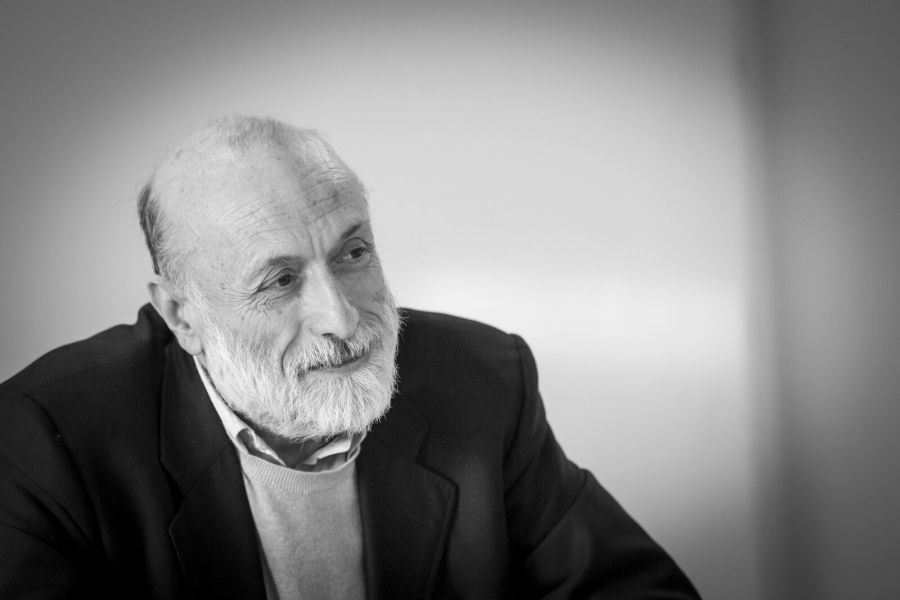
Carlo Petrini and the Political Right to Slowness
Chi semina utopie, raccoglie realtà.
Those who sow utopia will harvest reality.
Carlo Petrini, 1949–2026
Carlo Petrini, the Italian journalist, gastronome and founder of the international Slow Food movement, died at his home in Bra on the evening of 21 May 2026, aged seventy-six. The news arrived as the silencing of a voice that had spent a lifetime teaching the world to slow down. In the Piedmontese town where he was born in 1949, an idea had gone out into the world that changed how humanity thinks about food. Slow Food parted from its founder with a sentence he had carried like a manifesto: Chi semina utopia, raccoglie realtà. Those who sow utopia will harvest reality.
A Revolutionary at the Roots
To call Carlo Petrini a radical is to use the word in its original sense. The Italian radicale leads, through the Latin radix, to the root. With Slow Food, he went to the roots of our existence — to the act of eating, and to the nature of the relationship it creates between a person and the world. He had understood that a society neglecting its roots will, without fail, wither. And at precisely this moment, when the background noise of our present is driven by algorithmic acceleration, artificial intelligence and the compulsion to permanent digital disruption, Petrini leaves behind the most radical sign of the age: the cultural and political right to slowness.
The Topography of the Mind: Piedmont as Teacher
To understand his thinking at its foundation, one should not look to universities or the conference rooms of cities. A first glance at the geography of his homeland is sufficient. Piedmont, in north-western Italy, enclosed by the protective curtain of the Alps, is a region of transition. Shaped by dense autumn fogs, the gentle vineyard-covered hills of the Langhe and the Roero, and the white truffle, it carries over its landscape a deep, almost melancholy seriousness.
Within this landscape lies Bra: a composed small city of red brick and Piedmontese baroque, far from the tourist routes. Carlo Petrini was born there on 22 June 1949, and there his circle closed on 21 May 2026. In this landscape, where the distance between field and table has historically never been severed, the conviction that would carry his life’s work took hold: that quality grows from deep belonging to one’s own ecosystem, and that eating is the most intimate point of contact between a person, a culture and the earth.

The Three-Part Chord: Between Holy Water, the Red Flag and Family
Petrini grew up in a family that functioned like a lens concentrating the political Italian soul of the first half of the twentieth century — the tension between the Catholic Church and the left-wing social vision, held together within a single household. His grandmother Caterina was a woman of deep faith. His grandfather, also Carlo Petrini, was a railway worker and co-founder of the local communist party cell in 1921.
A family anecdote that Petrini loved to tell, and that Pope Francis reportedly laughed heartily upon hearing, stands as an emblem for a disposition that will be familiar from Don Camillo and Pepone — and that was equally to define his own life. After the war, the village priest asked his grandmother how she intended to vote. Like her late husband, she replied: communist. The priest explained that under those circumstances he could not grant her absolution. E allora se la tenga, she answered. Then keep it, father.
The story describes an unshakeable independence, a trust in one’s own judgement and the readiness to measure authority against the realities of life. Petrini was made of this.
The Rebellion with the Fork
Where many of his fellow travellers of the 1968 generation protested with cobblestones, Petrini protested with culture, pleasure and forks. As he did in the spring of 1986, when McDonald’s opened a branch beside the Spanish Steps in Rome. In that opening he saw an existential assault on the soul of society, the final capitulation of humanism to the efficiency imperatives of an accelerating modernity. His response was as subversive as it was elegant: he and the Amici del Barolo distributed bowls of fresh penne to passers-by. An act of culinary sovereignty, from which a movement of worldwide reach would emerge in December 1989 at the Opéra Comique in Paris: Slow Food.
“We are enslaved by speed and have all succumbed to the same insidious virus: Fast Life, which disrupts our habits, pervades the privacy of our homes and forces us to eat Fast Food,” he wrote in the Slow Food Manifesto of 1989. “To be worthy of it, Fast Life needs a solid defence: the table of Slow Food.”

Pleasure as Political Act: Carlo Petrini’s Philosophy of Food
Slow Food originates in a distinctly Italian cultural philosophy. One understands it in kitchens, vineyards and market squares, not in institutions: in the Diritto al piacere, the right to pleasure, and in the conviction that eating is the most intimate point of contact between a person, a culture and the earth. Italian thinkers have never understood food as mere fuel. It is culture. When Petrini on that spring day in 1986 passed bowls of penne around the Piazza di Spagna, he was making a statement against the loss of convivialità — that distinctly Italian form of sociability in which the shared time at table matters more than the act of eating itself.
Behind that gesture stood an understanding of food as territorio — a word for which English has no equivalent. The territorio is the indivisible unity of geology, microclimate, craft, local varieties and the historical soul of the people who work it. It is the principle the French human geographer Jean Brunhes set down in La Géographie humaine (1910) and that Petrini made one of his most cited sentences: Mangiare è incorporare un territorio — to eat is to take a landscape into oneself. When a wine tastes of the specific slope on which the vine grew, and a cheese of the Alpine meadow grasses of May, that is not poetry but precision. Quality has coordinates, and to dissolve them is to erase knowledge. “Taste, like identity,” he said repeatedly, “has value only when there are differences.”
What he accomplished was the democratisation of hedonism: pleasure was to be removed from its elite enclosure and made into a political act of understatement, a human right. “Slow Food unites the pleasure of food with responsibility, sustainability and harmony with nature,” he said in later interviews. Whoever eats slowly, whoever knows which farmer produced the cheese, performs a quiet but radical resistance to the uprootedness of the modern world. Behind this lay what he called a metabolic deceleration: we are destroying our future by subordinating the rhythms of nature to the rhythms of the market. The right to pause was the core of Slow Food.
This conviction had developed in tension with his own political home. As a journalist rooted in the Italian left of the late 1960s, and the founder of Radio Bra Waves, one of Italy’s first independent radio stations, he encountered a contradiction he could never leave behind: the ascetic, pleasure-hostile stance of the left of that period, which wished to liberate society while simultaneously denying it the poetry of enjoyment. He saw in this a dialectical failure: if the working class labours only for the factory and leaves good food to the bourgeoisie, the revolution is incomplete.
It was fundamentally at odds with his nature to treat taste as a distinction of the privileged. Pleasure in eating was for him a basic human right. The person who eats and thinks this way he called the sobrio epicureo, the measured epicurean: someone whose pleasure knows endurance, proportion and responsibility, who chooses a product that convinces in taste, whose production respects the living foundations of its place and whose price guarantees those who make it a life of dignity. Petrini placed pleasure at the centre of a social vision, and from that vision Slow Food was born: the joy in a good food is access to knowledge, to relationship, to responsibility. How can a product preserve its place while opening a future for the people who cultivate it? That became the question of his life.
“Pleasure is a human right, since it is physiological in nature,” he wrote in Terra Madre (2009). “But if this pleasure is based on the destruction of nature or on the exploitation of human beings, it is not civilised. It is vulgar.”
Petrini understood quality of life through the daily act of eating: as knowledge, pleasure, responsibility and relationship. It is a perspective that continues within the wider question of Well Living.

Buono, Pulito, Giusto — The Three Pillars of Slow Food
From this understanding of territorio, Petrini derived the three-part formula that became the philosophical foundation of the entire Slow Food movement:
- Buono (Good): Food must be sensorially outstanding, fresh, alive in taste, carrying the unadulterated character of its place. Quality grows from time and belonging, from the condensation of a territorio into a single product.
- Pulito (Clean): Production must respect the resources of the earth — biodiversity, animal welfare, natural rhythms; the process must move in accord with the cycles of nature, without artificial acceleration.
- Giusto (Fair): The producers — farmers, shepherds, fishermen — must receive a wage that guarantees them a life of cultural and economic dignity. A pleasure built on exploitation loses all its beauty.
“The paradoxical failure of our contemporary food system,” he wrote in Buono, pulito e giusto (2005), “is that people ought to eat food. But today it seems as if the economic system wants to eat people. We do not eat computers. We eat tomatoes and bread.”
The Farmer as Intellectual
Among the most profound of Petrini’s legacies is his reversal of established intellectual hierarchies. A mountain farmer in the Piedmontese highlands, who without a thermometer — purely through the feel of his hands and the reading of the weather — produces a raw-milk cheese of epic complexity, was for him a complete intellectual. He called these people the custodians of sapere implicito, of implicit knowledge. Where the modern university frequently produces highly specialised experts who have lost the view of the whole, the traditional producer preserves a systemic memory encompassing biology, meteorology, history and embodied production knowledge. True cultivation, he said at his address to Terra Madre in Turin in 2006, is measured by the depth of connection to one’s own work: “A system that values a financial speculator more highly than the farmer who feeds the soil is morally and economically bankrupt. We must rediscover the intellect of the hands.”
At the Università per Stranieri di Perugia in 2022, he put it still more sharply: “If a gastronome is not an environmentalist, he is a fool — because he will never know what he is putting on the plate of his guests.” And the reverse: “An environmentalist who is not a gastronome is a sad person.”
This knowledge finds its fullest expression in convivialità: eating forms a social language from who one is, where one comes from, what one wishes to preserve, how one lives together. Through the economy of proximity, a product loses its anonymity. One buys the knowledge, the care and the devotion of a particular person. The consumer becomes a co-produttore, whose daily choices actively shape the conditions of production and the preservation of landscapes. “Food history is as important as a baroque church,” he wrote. “A cheese is as worthy of preserving as a sixteenth-century building.”
In this relationship between producer, place and person lies an early grammar of what The Silent Luxury describes as the Relationship Economy.
What Slow Food Is Today
Slow Food is today one of the largest civil society movements in the world dedicated to food. The organisation is active in more than 160 countries, with 2,000 active groups directly engaging more than 100,000 people worldwide. The Ark of Taste catalogues more than 5,300 threatened food traditions from over 130 countries — from the quail corn of the Hopi in Arizona to the Castelmagno cheese of the Piedmontese highlands. The Presìdi, Petrini’s most concrete instrument, today protect over 650 artisan products worldwide with active economic support and market access.
Terra Madre, the global farmers’ gathering that Petrini convened in Turin in 2004, has grown into a permanent global network connecting thousands of food communities. The Università di Scienze Gastronomiche in Pollenzo, the first university in the world to offer an interdisciplinary degree in gastronomy, has formed a community of more than 4,000 students and alumni since its founding. The Gardens in Africa project, launched in 2011, has created more than 2,900 gardens in 35 African countries.
The Enduring Legacy
Carlo Petrini planted a seed. It lives on in the Presìdi, which preserve artisan knowledge across the world; in the biodiversity on the palate; and in every moment in which people claim the right to resist the tyranny of speed. He showed that one changes the world by remaining at the table, by listening, by sharpening the eye for what matters and by returning to the roots their original force.
Continued Reading: From Slow Food to the Architecture of Value
Similar Articles
Lacoste’s CEO Change and the Promise of the Crocodile
The Silver Heel Tab and the Swoosh: Alexandre Arnault Joins Nike’s Board
Anton Rupert Moves Up at Richemont as the Rupert Succession Takes Shape