Switzerland’s China Trade Deal: Bern and the Watch Industry Bet on the Top End

When Helene Budliger Artieda, the director of Switzerland’s State Secretariat for Economic Affairs, and China’s commerce minister, Wang Wentao, signed the revised China–Switzerland free trade agreement in Beijing on 30 October, they committed both countries to a timetable that reaches well into the next decade. China’s tariffs on Swiss watches will fall to zero over as many as ten years, in a market that has been buying fewer of those watches every month. The signature came in the middle of the slump. In conversation with The Silent Luxury, the State Secretariat (SECO) and the Federation of the Swiss Watch Industry (FH) explain why they are prepared to wait. Both look beyond the downturn in Chinese demand, and both are betting on the buyer at the top of the market. That is where, according to the FH’s president, Yves Bugmann, Swiss exports to China have more than tripled in volume.
Watchmakers have a word for what the treaty buys: power reserve. A mechanical watch keeps running after it leaves the wrist, on the energy stored in its mainspring. The agreement works the same way. Its tariff cuts unwind in stages over a decade, whatever China’s buyers decide next season. The question is whether the reserve lasts until they return.
Two tests lie ahead for the tariff path for Swiss watches: the Swiss parliament and the FH’s October export figures. Bugmann and SECO set out their reasoning in full in Yves Bugmann: In China, Swiss Watches Have Moved Further Upmarket and SECO on the China Free Trade Agreement: A Strategic Priority Beyond the Economic Cycle.
Ten Years Against a Slump: Swiss Watch Exports to China
The treaty arrives in the fifth year of a long decline. Five years ago China was among the best markets Swiss watchmakers had: the FH counted SFr2.97bn of watches shipped to the mainland in 2021. By 2025 the figure had fallen to SFr1.80bn, and China had slipped from second place among the industry’s markets to third. This year it has slipped again, to sixth. In September, as the rest of the industry returned to growth, shipments to China fell another 14.2 per cent.
Bugmann traces the decline to the property market. “The crisis in the property sector has destabilised the financial markets and the Chinese economy, undermining consumer confidence and significantly curbing discretionary spending,” he says. In his account the downturn is nearly three years old and “appears to be largely cyclical and could therefore be reversed.” On timing he stays cautious: “the current lack of visibility makes it impossible to make a more precise forecast.”
“The mere announcement of the modernisation of the free trade agreement opens up favourable prospects,” Bugmann says. “It sends a positive signal to Swiss manufacturers and Chinese consumers.” That uncertainty is what gives the agreement its value. An industry whose view ends a few months ahead now holds a schedule that runs for ten years.
-
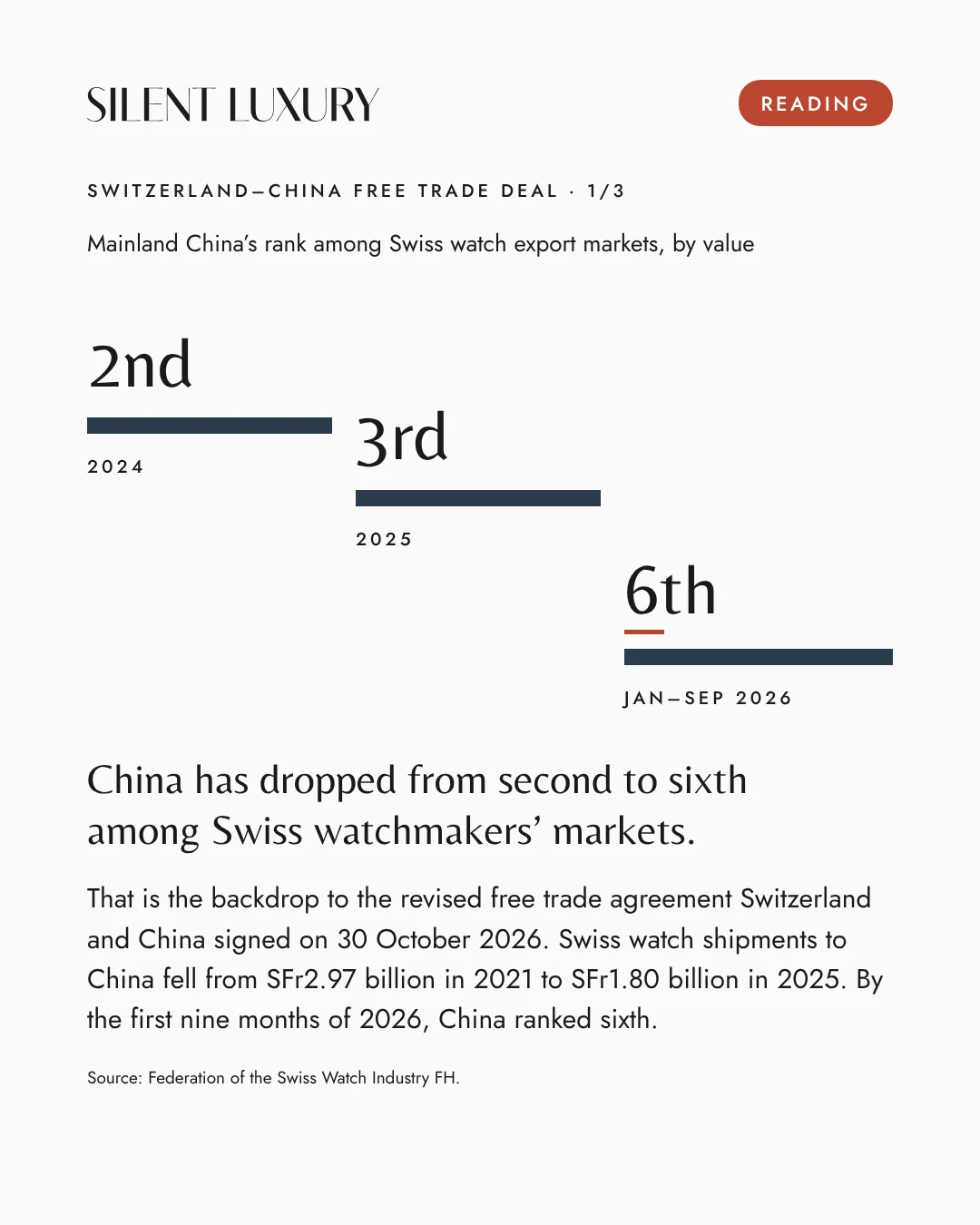
China has fallen from second to sixth among the markets for Swiss watches. Graphic: The Silent Luxury. Source: Federation of the Swiss Watch Industry FH -
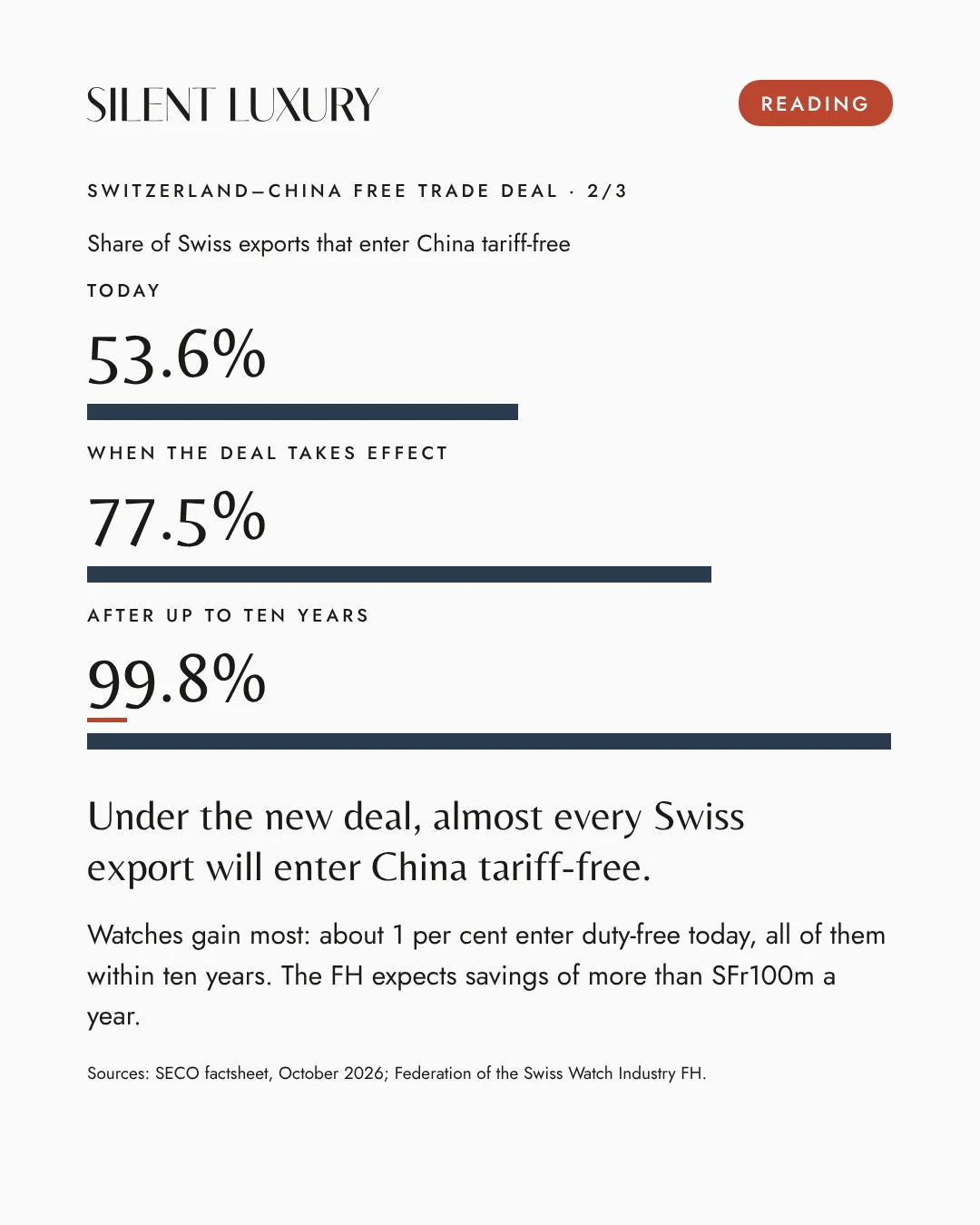
The tariff-free share of Swiss exports to China rises in two steps to 99.8 per cent. Graphic: The Silent Luxury. Source: SECO -
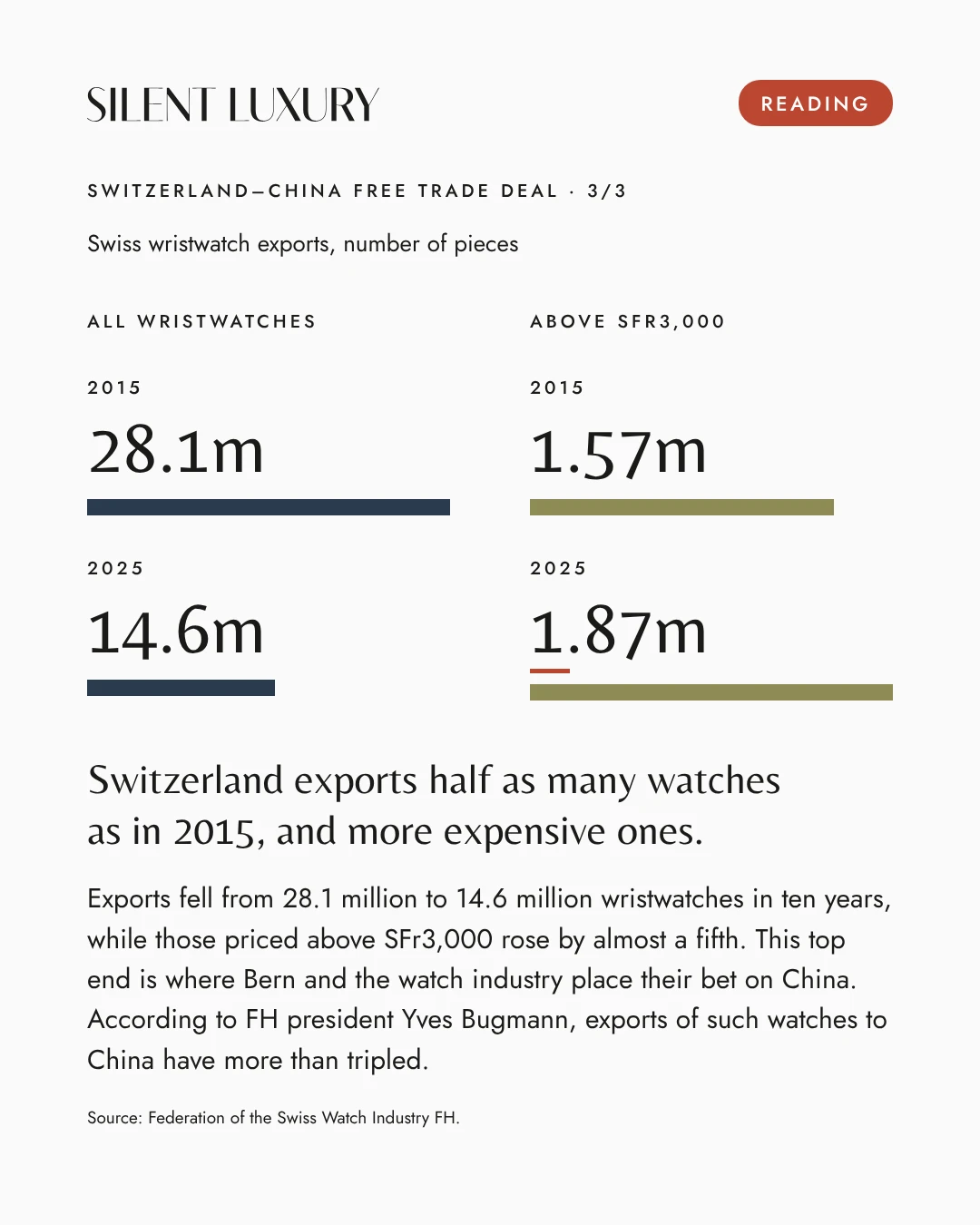
Fewer Swiss watches, and more of them above SFr3,000. Graphic: The Silent Luxury. Source: Federation of the Swiss Watch Industry FH
A note from The Silent Luxury
Good reading deserves to find you again.
What the Deal Contains: The Switzerland–China Free Trade Agreement
For a Swiss watch, the agreement changes what happens at the border. Today about 1 per cent of Swiss watch exports enter China without a tariff. Under the treaty all of them will, once cuts phased over five or ten years have run their course. Across all Swiss exports, the tariff-free share rises from 53.6 per cent today to 99.8 per cent, according to SECO, and the federal government puts the annual saving at about SFr244m. For watchmakers, Bugmann puts the gain in plain figures: “In practice, the phasing out of customs duties on Swiss watches will result in savings of over 100 million Swiss francs a year.” In his view this is “the most significant impact of the agreement on the Swiss watch industry.”
The mechanism is simple. A tariff is a charge levied at the border, and someone pays it: the brand absorbs it in its margin, or the customer pays it in the shop price. As the charge falls step by step, each house gains room to choose, whether to lower its prices in China, keep them and earn more on every watch, or invest the difference in its boutiques and service there. The agreement leaves that choice to the brands.
One cost stays where it is. SECO’s factsheet states that “the Chinese luxury tax is not covered by the FTA.” That tax is collected inside China on expensive watches, at the point of sale, so it stays in the shelf price after the tariff is gone. The price of a Swiss watch in Shanghai will therefore fall by less than the tariff alone suggests. The power reserve drives only part of the movement.
Beyond Tariffs: Services, Investment and Swiss Made
Beyond the tariff schedule, the protocol reaches into services and investment. According to MOFCOM, China’s Ministry of Commerce, it updates eight chapters of the 2013 treaty and adds two new ones, on digital trade and on trade and sustainable development. Swiss companies may fully own subsidiaries in several sectors, and investors receive national treatment. SECO describes the new chapter as “the most ambitious sustainability provisions China has ever accepted in a trade agreement” and adds: “For the first time, China has agreed to a comprehensive and legally binding Trade and Sustainable Development chapter covering both labour rights and environmental protection.”
For the watch industry, a second protection sits alongside the treaty. The FH has signed a memorandum of understanding with the Chinese authorities which, Bugmann says, “aims, in particular, to strengthen the protection of intellectual property and geographical indications, including the ‘Swiss Made’ designation for watches.” The name on the dial is protected together with the price at the border.
Beijing’s Side of the Agreement
Seen from Beijing, the agreement is a partnership in which the watch has a place of its own. MOFCOM names watches (钟表) in the chapter on economic and technical cooperation, next to agriculture, traditional Chinese medicine and supply chains. The watch therefore appears in the treaty twice, as a tariff line and as a field of cooperation. The protocol was signed by the commerce minister, Wang Wentao, and the director of SECO, Helene Budliger Artieda, with Xi Jinping and the Swiss president, Guy Parmelin, as witnesses.
China’s own gains lie in agriculture, where Switzerland opens its market further than to any other third country, in MOFCOM’s description. According to SECO, the optimised agreement covers 97.3 per cent of Chinese agricultural exports, 80.1 per cent of which are duty-free. The timing carries weight in Beijing as well: 2026 marks ten years of an “innovative strategic partnership” with Switzerland, and the original agreement of 2013 was China’s first with a country in continental Europe.
Bern’s Calculation: SECO on the Switzerland–China Free Trade Agreement
In Bern, the reasoning is that of a small economy that plans its markets over decades. SECO describes Switzerland as “a highly open economy with a small domestic market” whose aim is “a broad network of reliable and predictable market access opportunities around the world.” China, its third-largest trading partner after the European Union and the United States, belongs at the centre of that network. “Even in a period of slower growth, it remains one of the world’s largest consumer markets and an essential destination for many Swiss exporters,” SECO told The Silent Luxury.
On watches, Bern speaks the language of patience. “Regarding watches specifically, the tariff phase-out should be viewed as a long-term investment in competitiveness,” SECO says. “While demand in China is currently weaker, lower tariffs will improve the competitiveness of Swiss watches. In that sense, the agreement can help support and potentially revive demand over time.” The words are chosen with care. Bern promises access and a better price position, and leaves the date of the recovery open.
The treaty also lands in a year when tariffs have reshaped trade with the United States, where Swiss goods have faced a combined tariff of up to 12.5 per cent since late July. SECO treats the two relationships as parallel. “Strengthening economic relations with one partner does not come at the expense of the other,” it says. “Switzerland remains committed to deepening its partnership with the United States, while further developing its economic relations with China and diversifying its international trade relations through an extensive network of free trade agreements.”
Upmarket in China: Yves Bugmann on the Swiss Watch Industry
The industry’s confidence in China rests on a change in what Switzerland sells. In 2015 Swiss watchmakers exported 28.1m wristwatches; in 2025 they exported 14.6m. “Each price segment follows its own trajectory,” Bugmann says. “The number of units has indeed halved over the past 10 years, mainly amongst watches with an export price of less than 500 francs. At the same time, watches priced at over 3,000 francs (export price) have seen their volumes increase by 20 per cent.” The arithmetic behind that sentence explains the whole strategy: when fewer watches are sold but each one is worth more, export value can hold up while the number of pieces falls, and the industry’s fortunes come to rest on a smaller circle of buyers who spend more.
China, in his account, has travelled further along that path than the industry as a whole. “Watch exports to China have followed the same trends, albeit to a greater extent,” Bugmann told The Silent Luxury. “Volumes for watches priced above 3,000 francs have more than tripled there, for example.” The figure is the federation’s own, stated without a time frame, and its public statistics publish market and price band separately, so it stands on Bugmann’s word. On the industry’s intent he is plain. Swiss brands, he says, “are continuing to operate there,” and “China remains, and will continue to be, an important market for the Swiss watch industry.”
The bet has a weak point. The top of the market, on which the whole industry now leans, is growing slowly: in the first nine months of 2026, exports of watches above SFr3,000 rose 0.8 per cent in volume. The same move towards fewer, dearer watches shapes the luxury watch market heading into 2027. In India, where a separate trade agreement is bringing import duties on Swiss watches down towards zero, watchmakers are planning along a second tariff path.
The 2030s: Fewer Watches, Longer Lives
The agreement runs into the 2030s, and the trade it will govern is already changing shape. In a survey of Swiss watch suppliers that Deloitte published on 30 September, 79 per cent of those surveyed saw falling volumes as a major structural risk or as pressure to move into higher-value work. Rising prices, Deloitte noted, have masked that risk in the export figures.
The watch itself is living longer, and the brands are building for it: Audemars Piguet now authenticates and resells its own watches through a platform it opened in October. If the Chinese buyer at the top of the market returns, it will be to a different kind of ownership: fewer pieces, each bought to last and, more and more often, sold on.
What Comes Next: Parliament and the Switzerland–China Free Trade Agreement
Before any tariff falls, the agreement must clear both countries. In Switzerland the decision rests with parliament, and its vote can be put to the electorate through an optional referendum. The date of the debate is still open. The Greens have attached conditions: Christine Badertscher, a Green member of the National Council, said on 30 October that her party would call a referendum should the agreement fail to protect human rights, and the party wants a binding enforcement mechanism. Swissmem, the tech industry association, considers a popular vote likely.
The nearer test comes on 19 November, when the FH publishes its October export figures and shows whether shipments to China have stopped falling.
A mainspring stores its energy when it is wound and releases it once the watch is set running. This one was wound in Beijing on 30 October, and it begins to unwind on the day the agreement enters into force. Bern and the watch industry are betting that China’s buyers at the top of the market will be back before it runs down.
Send this to someone who follows where Swiss watches will sell over the next ten years.
 Continue · The conversation
Yves Bugmann: In China, Swiss Watches Have Moved Further Upmarket
The president of the FH on a slump he regards as cyclical and a market he expects to stay important.
 Continue · The conversation
SECO on the China Free Trade Agreement: A Strategic Priority Beyond the Economic Cycle
Bern on what a ten-year tariff path secures and how China fits beside the United States.
Further Reading
-
Swiss Watch Exports in Q3 2026: Mexico, the US and a Recovery Built from Below
Swiss watch exports rose 11.7 per cent in September 2026 and turned the year positive, with shipments 2.7 per cent higher after nine months. Mexico, a US recovery from last year’s tariff collapse and the least expensive Swiss watches carried the quarter.
-
LVMH Q3 2026: The Core Slips in China, the Edges Carry the House
LVMH grew 1 per cent organically in the third quarter of 2026, to €18.5bn, as Fashion & Leather Goods fell 5 per cent on weaker Chinese demand. Sephora, jewellery and champagne carried the quarter.
-
The Strategy of Control: Swiss Watchmaking’s Resilience in Crisis
Swiss watchmaking is meeting the crisis through control rather than expansion. Vertical integration, retail ownership and geographic spread carry the margins.
Sources
- Swiss Federal Council, Die Schweiz und China stärken ihre Zusammenarbeit im Handel und in der Wissenschaft, 30 October 2026
- SECO, Freihandelsabkommen Schweiz–China, accessed 12 November 2026
- SECO, Factsheet: Optimisation of the Switzerland–China FTA (mirror on sinoptic.ch), 20 August 2026
- SECO, Swiss-US trade relations, accessed 12 November 2026
- MOFCOM via Xinhua, 商务部国际司负责人解读中国—瑞士自由贸易协定升级议定书, 30 October 2026
- Guangming Daily, 释放双边贸易投资更大合作潜力 中国与瑞士签署自贸协定升级议定书, 1 November 2026
- Federation of the Swiss Watch Industry FH, Swiss watch exports, September 2026, 20 October 2026
- Federation of the Swiss Watch Industry FH, Swiss watch exports by market, January to September 2026, October 2026
- Federation of the Swiss Watch Industry FH, Swiss watch exports by market, historical series, October 2026
- Federation of the Swiss Watch Industry FH, Swiss watch exports by price segment, historical series, October 2026
- Federation of the Swiss Watch Industry FH, Statistics and release dates, accessed 12 November 2026
- cash.ch / SDA, In Zukunft fast keine Zölle mehr für Schweizer Exporte nach China, 20 August 2026
- cash.ch, Parmelin unterzeichnet angepasstes Freihandelsabkommen mit China, 26 October 2026
- SRF, Parmelin in Peking: Schweiz und China erneuern Freihandelsabkommen, 30 October 2026
- SRF, Optimierter Freihandel: China geht es vor allem um Geopolitik – oder um ein Feigenblatt?, 20 August 2026
- Keystone-SDA via bluewin, Switzerland and China renew their agreements, 30 October 2026
- Global Times, China, Switzerland complete FTA upgrade negotiations, 21 August 2026
- Swissmem, Freihandelsabkommen mit China: wichtiger Durchbruch für die Schweizer Tech-Industrie, 30 October 2026
- Greens Switzerland, Media release, 30 October 2026
- Deloitte, Swiss Watch Industry Insights 2026: Spotlight on the supplier universe, 30 September 2026
- Yves Bugmann, president of the FH, and SECO, in conversation with The Silent Luxury, November 2026
Similar Articles
SECO on the China Free Trade Agreement: A Strategic Priority Beyond the Economic Cycle

Botswana Doubles Down on De Beers at the Bottom of the Diamond Market

Chinese Skincare Brands: The Plant at Home, the Lab in Paris