Venetian Glass and Light: “Tradition Is Our Most Sophisticated Technology”

Marco Borile founded Sogni di Cristallo in 2012 in Mirano, on the Venetian mainland, and has built it into a manufacture of hand-blown and cast glass for designers such as Martin Brudnizki, Ken Fulk and Laura Gonzalez. For Carbone Riviera at the Bellagio in Las Vegas, his company developed every chandelier, sconce and table lamp, and the jury of the 2026 Restaurant & Bar Design Awards named the room the best restaurant in the world.
The Silent Luxury tells the story of that light in Controlled Imperfection: Sogni di Cristallo and the Hand-Blown Light of Carbone Riviera. The interview has been translated from Italian and lightly edited.

Light Beside a Work of Art: Sogni di Cristallo at Carbone Riviera
At Carbone Riviera, your lights stand beside the Picasso ceramics that have returned to the room. How do you design a light that has to live next to a work of art without competing with it?
The first principle is understanding that light, in a space of this level, does not necessarily have to be the protagonist. It has to be part of the composition. Carbone Riviera is a particularly interesting case because it was born in a place that carries a very strong memory: for more than twenty-five years this was Picasso, and today some of his ceramics continue to live in these rooms. Martin Brudnizki’s design does not try to erase that history. It reinterprets it through a new language, inspired also by Picasso’s relationship with Vallauris and with ceramics.
In a context like this, true luxury is measure. Light that is too assertive risks turning into an object that demands attention. Well-designed light builds the atmosphere and lets the architecture, the art and the people take the centre of the stage.
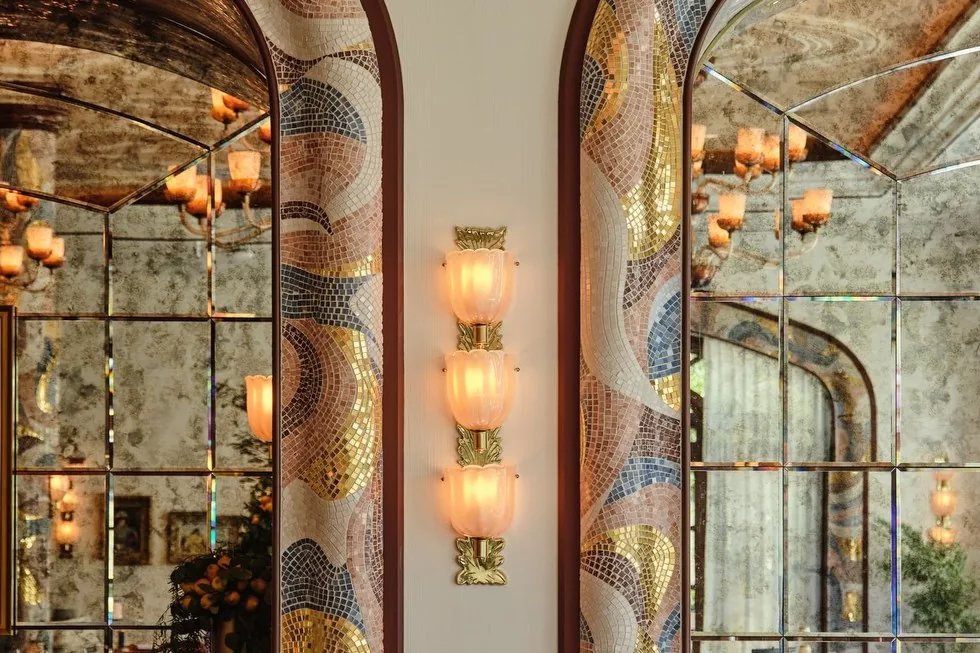
That is why, for Carbone Riviera, we worked on a series of completely custom elements: chandeliers, wall lights and table lamps, as well as the brass elements and the architectural components. We did not simply adapt an existing product to a room. We developed every element according to the proportions, the distances, the materials and the overall light of the space.
This is where Venetian glass becomes particularly interesting. Blown glass does not give back a flat or uniform light. It has depth, a vibration, a capacity to filter and refract light that changes with the form and the thickness. It is a living material. And it is precisely this controlled imperfection that allows the light to be present without becoming intrusive.
A note from The Silent Luxury
Good reading deserves to find you again.
Between Drawing and Know-How: How a Venetian Glass Manufacture Works with Designers
The design comes from Martin Brudnizki’s studio. How much of the final piece comes from the drawing and how much from the knowledge of the manufacture, and was there a moment when the manufacture said no to a drawing?
I believe the right relationship is not one between drawing and manufacture, as if they were two separate worlds. The result comes precisely from their interaction.
When we work with designers like Martin Brudnizki Design Studio, the project arrives with a very precise vision. We are not talking only about a form, but about proportion, rhythm, the relationship with the architecture, materials, colour, atmosphere. Our task is to understand that vision and bring it into the material.
The great international designers are looking for more than a producer. They are looking for a partner who sets no limits on their creative process and guarantees the greatest freedom of expression, and who offers a concrete solution when the drawing on paper has to meet the physics of the material.
The manufacture does sometimes say no, but it is rarely a definitive no. More often it is a ‘not this way’. That is where our know-how comes in. We can change a proportion, a section, an assembly system or the way the glass is supported, and keep the designer’s intention intact.
Where does the value origin from?
The value lies not only in the ability to execute a drawing. It lies in the ability to translate design into glass without losing either the original idea or the identity of the manufacture.
That is why, over the years, we have been chosen by international studios such as Martin Brudnizki, Ken Fulk, Lázaro Rosa-Violán, Charles & Co and Laura Gonzalez, and why we have worked on projects regarded as among the most exclusive in international luxury: Annabel’s in Mayfair, all the houses of the Soho House group, several Belmond projects including the renovation of Hotel Splendido in Portofino and the expansion of the celebrated Orient Express trains, the restyling of Hotel Ancora in Cortina, the new Restoration Hardware showroom in Milan, the restyling of The Ritz in London, and several projects with the American hospitality group MGM in the renovation of its hotels and casinos.

Glass and Time: Hand-Blown Glass for International Hospitality
In an age of fast production, what does it mean for a glass manufacture to work for international hospitality, and what will you never change?
Working for international hospitality today means accepting a contradiction. The client wants the uniqueness of craftsmanship, but at the same time demands the precision, traceability and reliability of an industrial structure. It is a challenge we chose to face without industrialising what must not be industrialised.
An international project can include dozens or hundreds of elements, each with precise dimensions, finishes and technical requirements: delivery times, quality control, packaging, logistics, certifications and sometimes installation on site. That is why, over the years, we have built an organisation around the manufacture that can work with the world of international contract projects.
Then, where is the starting point?
The starting point always remains the furnace. The difference is that today the knowledge of the master glassmaker has to work within a much wider system of designers, architects, lighting designers, project managers and contractors. It is this integration that allows us to apply a technique born in Venice to projects all over the world.
What we will never change is the relationship with the material and with the hand of the artisan, because tradition is our most sophisticated technology. Hand-blown glass is not a limit to contemporary design. It is a design tool that allows us to create forms, variations, surfaces and details that standardised production could not give back in the same way.
For me, the future of Sogni di Cristallo lies exactly here: in using innovation to give tradition an international scale, without having to choose between the two.

Send this to someone who works with designers, makers or light.

Sources
- Marco Borile, interview with The Silent Luxury, October 2026 (translated from Italian)
- Restaurant & Bar Design Awards 2026
- Bellagio Las Vegas: Carbone Riviera
- Sogni di Cristallo
Similar Articles
Lacoste’s CEO Change and the Promise of the Crocodile
The Silver Heel Tab and the Swoosh: Alexandre Arnault Joins Nike’s Board
Anton Rupert Moves Up at Richemont as the Rupert Succession Takes Shape