Italian Shoe Industry: Vigevano Is Exporting Shoes Again
Vigevano’s shoemakers are selling more abroad again while the Italian shoe industry contracts around them. In 1931 the Lombard town hosted the first edition of the fair that became MICAM. Its footwear district exported 26.6 per cent more in the first half of 2026, Intesa Sanpaolo reports. Italian shoe exports as a whole fell 2.4 per cent in value from January to May. The rebound follows two difficult years, and the town’s machine builders had a much harder six months. Giovanna Ceolini, who presides over MICAM today, also leads the industry’s bid for UNESCO recognition of Italian shoemaking. That bid will have to show where the skills are still practised, and Vigevano is one of the places to look.
A Craft Put Forward: The Italian Shoe Industry’s UNESCO Bid
The Italian shoe industry’s UNESCO bid puts forward a skill and the people who carry it. A promoting committee chaired by Ceolini, who also heads the manufacturers’ association Assocalzaturifici, was formed in Rome on 11 June 2026. It aims to place Italian shoemaking on UNESCO’s list of the Intangible Cultural Heritage of Humanity. Seven regions back it, Lombardy among them. At MICAM 102 in Milan in September, Giovanni Bozzetti of Fondazione Fiera Milano took the chair of a supporters’ committee. What the bid puts forward, he said, is “the people, skills and techniques”.
The dossier is still being written. The three candidacies that Italy’s national UNESCO commission opened in March 2026 were for the nativity scene, the appassimento of Valpolicella and an Alpine food tradition. Early in November Ceolini called the application “an important journey” and the dossier something “to leave behind for young people”. One of its next tasks, MICAM announced in September, is a safeguarding plan for passing the skills on. Such a plan needs towns where the work still goes on every day.
A note from The Silent Luxury
Good reading deserves to find you again.
Exports Up 26.6 Per Cent: Vigevano’s Shoe District Rebounds
Vigevano’s footwear district exported 26.6 per cent more in the first half of 2026. The figure comes from Intesa Sanpaolo’s monitor of Lombardy’s industrial districts, released at the end of September. The region around it barely moved. Lombardy’s districts together exported €22.4bn, 0.5 per cent less than a year earlier. The region’s fashion industry gained 2.2 per cent, while the silk makers of Como lost 7.3 per cent. Vigevano’s machine builders, which Intesa counts as a district of their own, went the other way. Their exports fell 20.3 per cent.
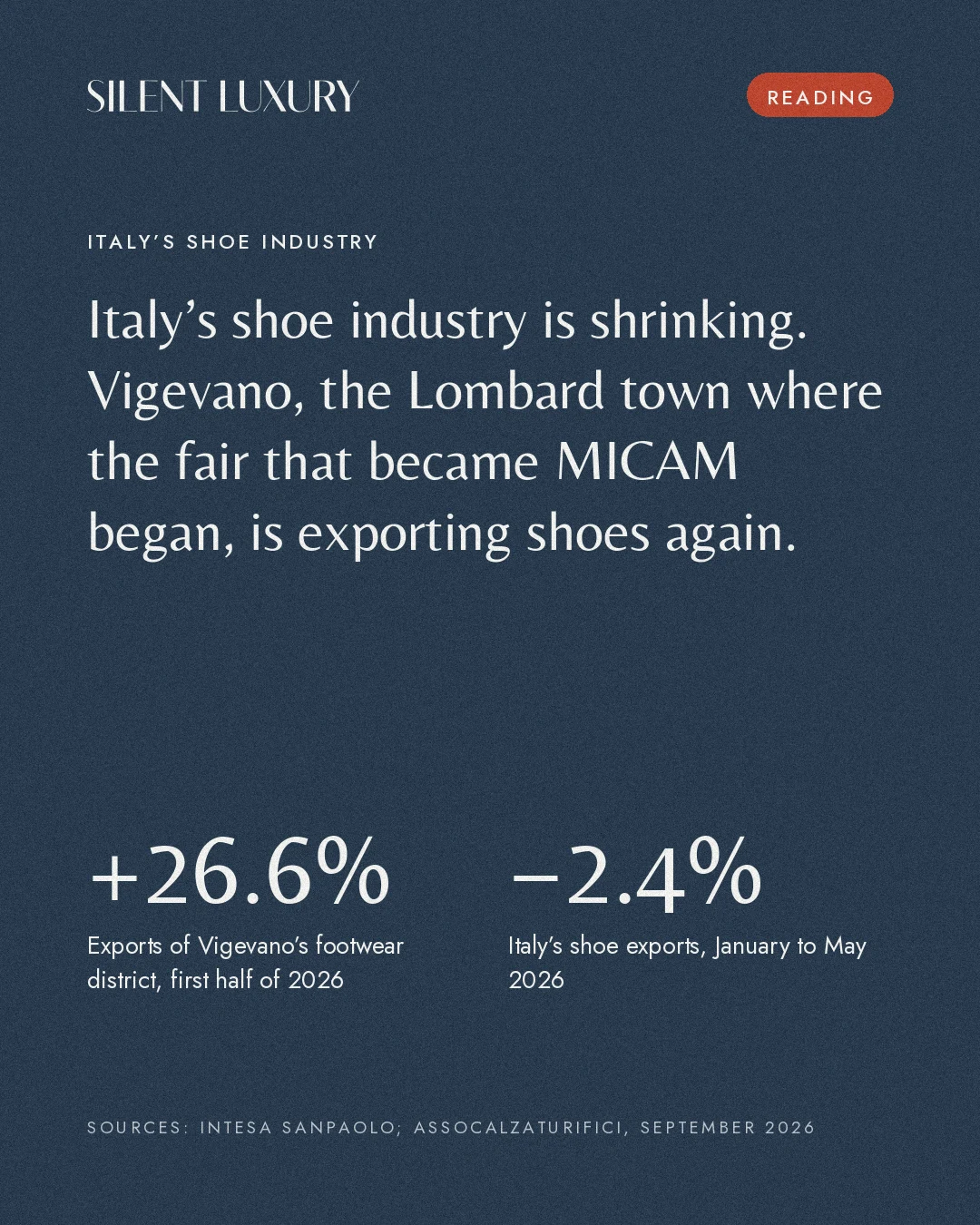
Vigevano, the Lombard town where the fair that became MICAM began, is exporting shoes again. Graphic: The Silent Luxury. Sources: Intesa Sanpaolo; Assocalzaturifici 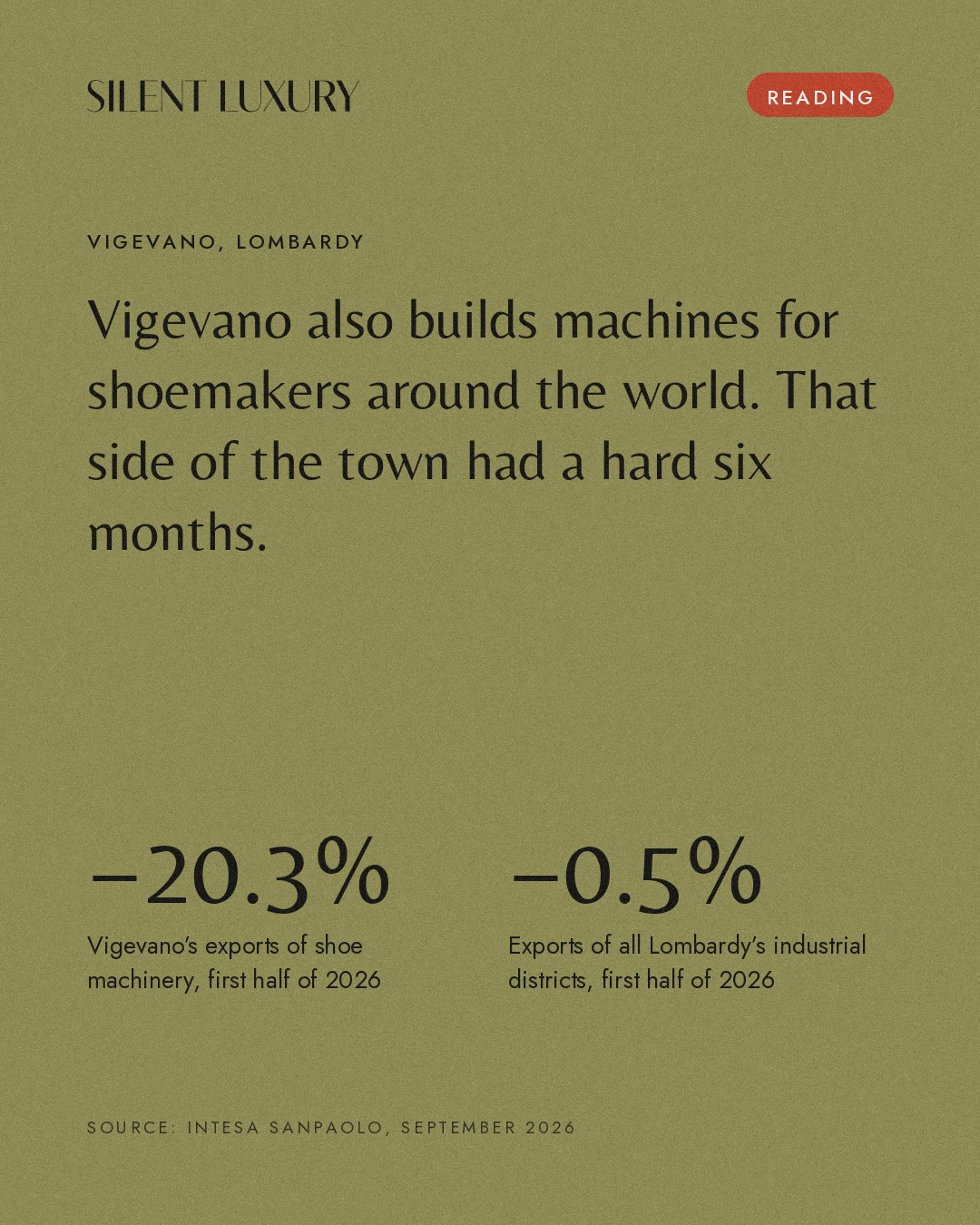
Vigevano also builds machines for shoemakers around the world, and that side of the town had a hard six months. Graphic: The Silent Luxury. Source: Intesa Sanpaolo 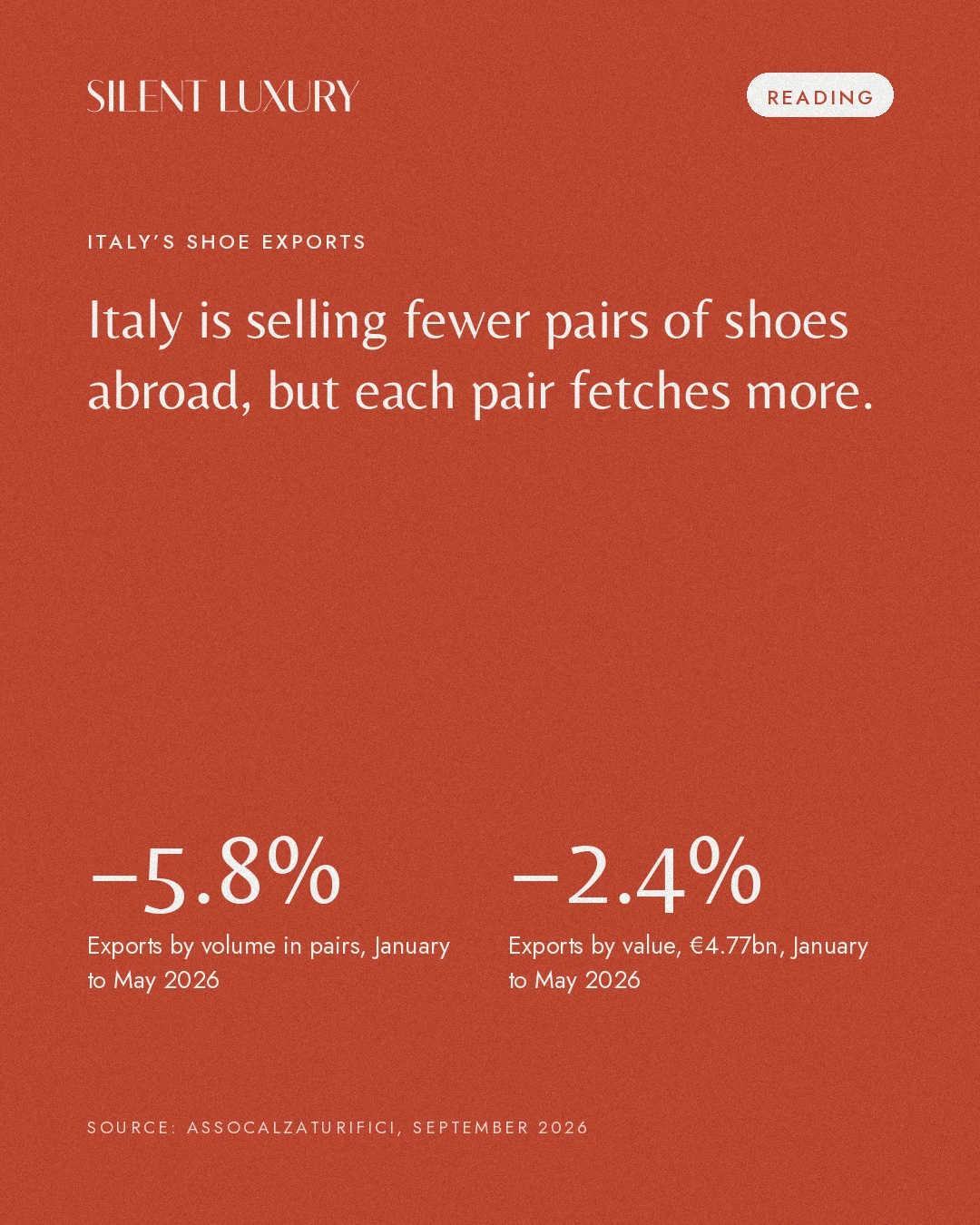
Italy is selling fewer pairs of shoes abroad, but each pair fetches more. Graphic: The Silent Luxury. Source: Assocalzaturifici 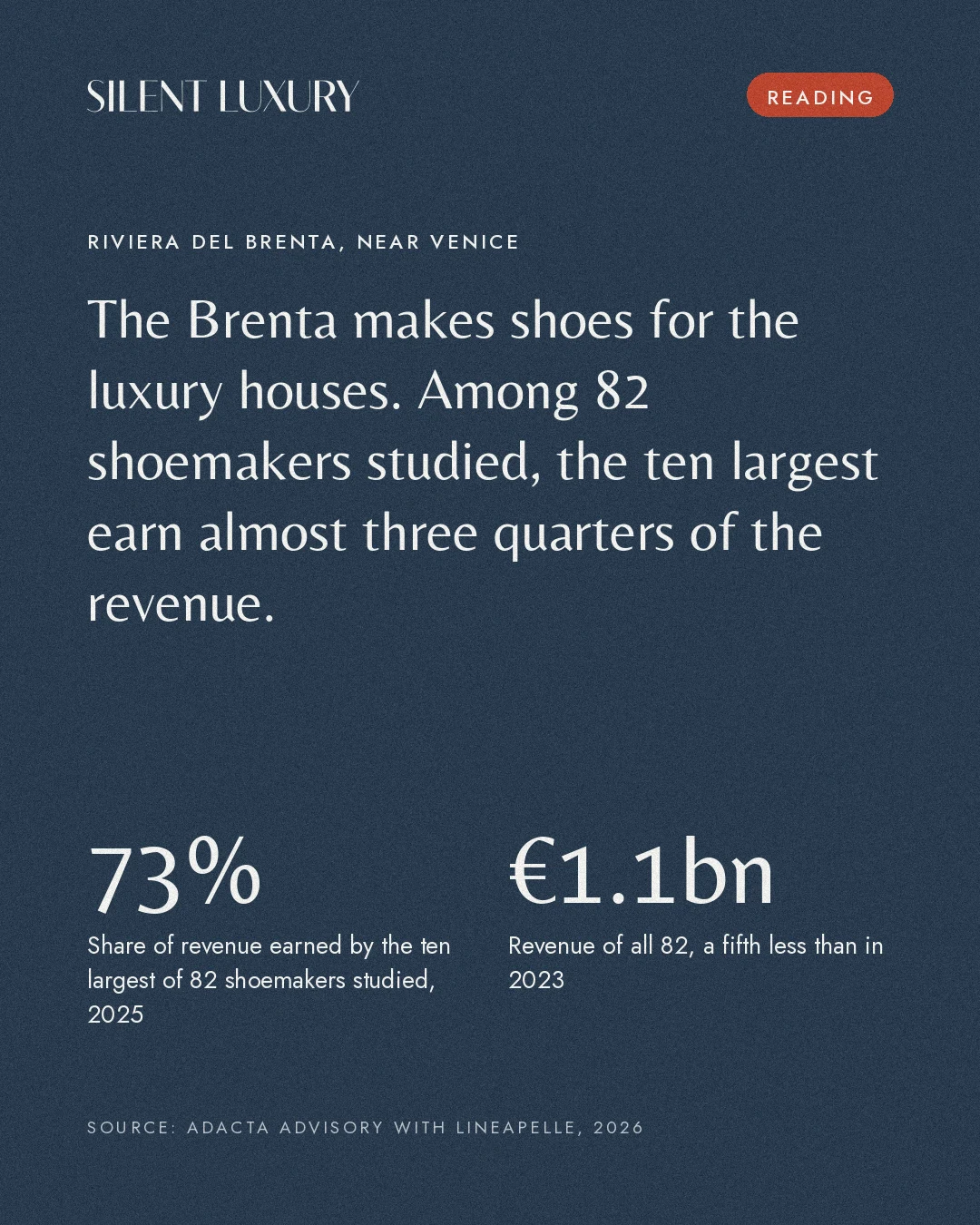
On the Brenta, the ten largest of 82 shoemakers studied earn almost three quarters of the revenue. Graphic: The Silent Luxury. Source: Adacta Advisory with Lineapelle
The rebound follows two difficult years. Assolombarda, the employers’ association, had found the wider district, shoes and shoe machinery together, growing by 28.5 per cent between 2019 and 2022, with shoemaking alone up 29.7 per cent. The years since have been harder. Turnover fell 13.8 per cent in 2023, and by 2024 the district’s production value of €722m stood 1.4 per cent below its 2019 level.
Everything in One Town: Vigevano’s Shoes, Machines and Makers
Vigevano still holds the whole chain of shoemaking in one place, from the chemistry of the sole to the cutting machine. Assolombarda credits the district with the widest variety of skills and production stages in the entire shoe supply chain. Over the decades its weight has shifted from making shoes to building the machines that make them. Assomac, the national association of those machine builders, has its headquarters in the town. “If not the capital of footwear, Vigevano could well aspire to be the capital of its supply chain,” Maria Vittoria Brustia, then Assomac’s president, said in 2024.
The town has traded this way for a long time. When MICAM marked its hundredth edition, Il Giornale called Vigevano “the cradle of Italian footwear”. In 1961 the journalist Giorgio Bocca counted 900 shoe factories in Vigevano’s telephone directory, their names changing constantly between the new and the bankrupt. Their owners spoke no foreign language, he wrote, and faced the babel of world markets without fear. “If they close the Congo on me, I couldn’t care less,” one told him. “I’ll break into Burma.”
Today that far-off market is the Gulf. Vigevano’s footwear district sends a larger share of its exports to the Gulf and the Middle East than almost any other Italian district. In 2025 that share reached 18.4 per cent, second only to the goldsmiths of Arezzo. Sales to the region rose 62.9 per cent to €8m, Intesa Sanpaolo found.
Manolo Blahnik and the Contract Makers
Much of the work goes to the top of the market. Massimiliano Sandri, who came from private equity, bought the women’s shoemaker Mosaicon in 2013. “I immediately closed the brand to produce for the big brands,” he said. The company now develops more than 200 new models a year for luxury labels. In nearby Gravellona Lomellina, FAE Project makes soles, moulds and finished trainers with around 300 employees. Its own account of its rise begins with a loss: “In 2009 we only had a small workshop and we lost our main customer, but that was the turning point.”
Manolo Blahnik went a step further and bought its maker. In July 2019 the brand acquired Calzaturificio Re Marcello, founded in 1938, which had made its shoes since 1990 and employed 77 artisans. Kristina Blahnik called it “our first atelier and manufacturing facility”. Bruno Re explained the sale plainly. “I made the decision to sell by looking at my identity card,” he said. “I am 73 years old and my children are doing something else.” The quality of the production, he added, “was the winning card, even with Blahnik”.
The Names Vigevano Lost
The district has also lost names it once carried. Moreschi, founded in 1946 and by then trading as Moreschi Milano, ended production in Vigevano in 2024 and dismissed 59 people. Il Giorno called it the last shoemaker in the town producing under its own brand. It went bankrupt that July, and in 2025 its brand and machines sold at auction for €1.73m to Glam, a Milan company. Calzoleria Artigiana, which made sandals mainly for the Arab market, dismissed 24 people in 2025. Between 2022 and 2023 ten companies in the supply chain went into liquidation, six of them shoemakers, Assolombarda counted. The shoes made in Vigevano today mostly carry other houses’ names.
The Wider Picture: The Italian Shoe Industry in 2026
The Italian shoe industry as a whole is still contracting. Turnover fell 9.4 per cent in 2024 to €13.21bn and slipped to €12.84bn in 2025, Assocalzaturifici reports. In the first half of 2026 it fell another 2.3 per cent. Over those six months the industry lost 151 companies and 3,065 jobs, leaving 3,045 active companies and 65,279 employees.
Exports fell faster in pairs than in value. From January to May they dropped 2.4 per cent in value and 5.8 per cent in volume, so each pair earned more. Sales to the Middle East fell by 34 per cent, after a first quarter in which Spain and Italy led a wider fall in Europe’s shoe exports. Vigevano’s own sales to the Gulf and the Middle East dipped 3.9 per cent in the first half. Italian households bought about 2 per cent more shoes in the first half, the first rise after three years of decline. The industry’s trade surplus for the five months rose 9.6 per cent to €2.16bn, which Ceolini said shows “the capacity of Made in Italy to keep creating value even in a particularly difficult phase”.
Working for the Houses: The Riviera del Brenta Shoe District
The Riviera del Brenta in the Veneto works mainly for the luxury houses, and that dependence weighs on it. The 82 companies in a study by Adacta Advisory with the leather fair Lineapelle turned over €1.099bn in 2025, 20.2 per cent less than in 2023. The ten largest earned 73 per cent of it. The houses have bought deep into the district. Dior has made shoes in its own factory in Fossò since 2015, and Chanel took over Ballin in Fiesso d’Artico in 2020. Companies with a brand of their own held up better than pure contract makers, Adacta found. Vigevano makes shoes for famous names too. Its makers of machines and components give it a second leg to stand on, even in a year when the machine builders’ exports fell by a fifth.
What Comes Next: The Future of the Italian Shoe Industry
The future of the Italian shoe industry depends on who learns the work next. In Vigevano the companies themselves name the limit of their growth. In 2024 the heads of FAE Project and Mosaicon said they could hardly find local staff, young people least of all. The machine builders face a second test, because China, Assomac reports, has consolidated a dominant position in shoe machinery.
Lombardy has begun to build around the district. In October 2025 the region formally recognised the footwear supply chain, with 43 companies and a programme for innovation, training and investment. In March 2026 Assolombarda’s Vigevano office held a workshop on artificial intelligence for shoemaking. The association behind the UNESCO bid works here as well. Since 2019 Assocalzaturifici’s research and testing centre, CIMAC, has occupied a 2,200-square-metre building in Vigevano, and Assolombarda calls it the only specialised testing centre of its kind in Italy.
The UNESCO dossier will need proof that the skills are handed on, and Vigevano keeps a long record of them. In the Castello Sforzesco, the shoe museum shows a pianella that belonged to Beatrice d’Este, dated 1495. When the museum reopened in 2016, a Fab Lab opened beside it, where students work with artisans and companies. From 27 November to 28 February the castle shows a retrospective of Vanessa Noel, the New York designer who has had her stilettos made in Vigevano for almost forty years. The town is naming her the American ambassador of the Vigevano stiletto. Ninety-five years after the fair’s first edition, the town where MICAM began is selling more of its shoes abroad again.
Send this ↗ to someone who wants to know where Italy’s shoes are still made.
Continue Reading
Luís Onofre: Portugal’s Family Shoemakers Are Betting on Skill Over Scale
The president of APICCAPS on why Portugal stopped competing on volume, and what its family firms build instead.
The Material Era: How Portugal Makes the Shoes Europe Will Buy Next
Portugal’s family shoemakers chose development, short runs and new materials over volume.
Pignatelli and Pantofola d’Oro: Morocco Link Leads to Shoes
An Italian formalwear house and a football boot maker founded in 1886 make shoes together.
Sources: Intesa Sanpaolo, Lombardy’s industrial districts, first half of 2026, 28 September 2026; Intesa Sanpaolo, Monitor dei distretti, September 2026; Intesa Sanpaolo, Monitor dei distretti, March 2026; Assolombarda, Your Next Pavia, update of the strategic plan, 2026; Assolombarda, Alessandro Spada visits FAE Project and Mosaicon Shoes, April 2024; Assolombarda, AI for the Vigevano footwear supply chain, 25 March 2026; Il Sole 24 Ore, Vigevano district: luxury contractors grow, April 2024; Giorgio Bocca, Il provinciale, excerpt, University of Bologna; La Conceria, Blahnik buys Re Marcello, Bruno Re explains, July 2019; FashionUnited, Manolo Blahnik acquires Re Marcello, July 2019; Il Giorno, Moreschi ends production in Vigevano, 2024; BeBeez, Moreschi brand sold at auction to Glam, May 2025; Il Giorno, Calzoleria Artigiana, 2025; Teleborsa, Assocalzaturifici first-half 2026 figures, 14 September 2026; ItaliaOggi, Italian shoe exports fall 2.4 per cent, 14 September 2026; Teleborsa, committee for the UNESCO bid, 12 June 2026; Affaritaliani, MICAM Milano 2026 and the UNESCO bid; World Footwear, Giovanna Ceolini interview, November 2026; Assomac, annual assembly booklet 2026; La Conceria, CIMAC inaugurates its new headquarters; La Conceria, Riviera del Brenta report by Adacta Advisory, November 2026; Vigevano24, Vanessa Noel Dream Shoes at the Castello Sforzesco, 17 November 2026.
Similar Articles

De Beers: The Diamonds Come Home to Botswana and Angola
SECO on the China Free Trade Agreement: A Strategic Priority Beyond the Economic Cycle

Switzerland’s China Trade Deal: Bern and the Watch Industry Bet on the Top End