De Beers: The Diamonds Come Home to Botswana and Angola
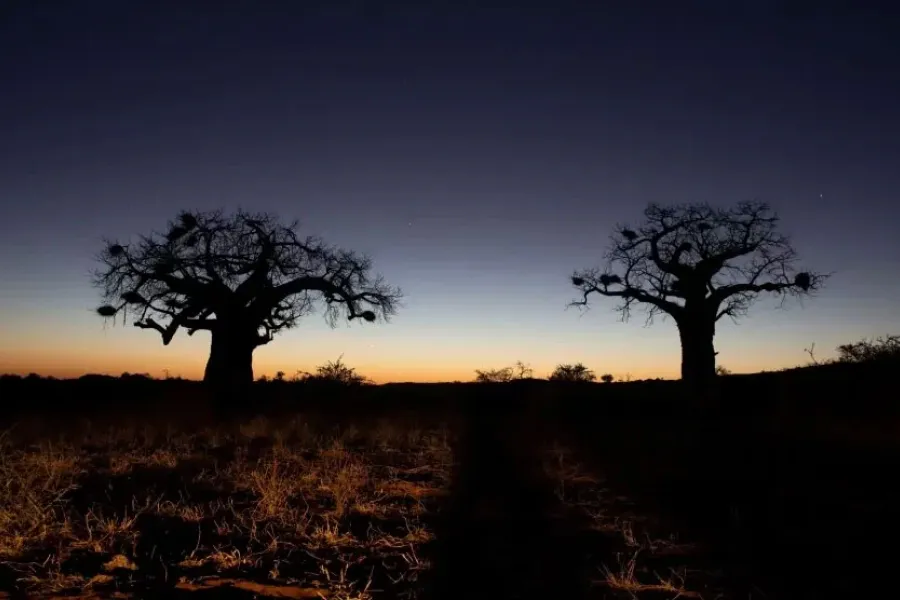
Two baobab trees at dusk. Anglo American plans to sell De Beers to states that want the diamond value chain at home. Courtesy of De Beers Group
Anglo American plans to sell its 85 percent of De Beers for about one billion dollars to a consortium that would include Botswana, Angola and Namibia, Antwerp traders and capital from Oman. If the deal is signed, the producing states would seek to keep more of the diamond value chain at home, from sorting and sales to cutting and polishing.
Eva Winterer
Anglo American wants to sell De Beers, and among the likely owners are African states that want more of the diamond value chain at home. Botswana plans to double its stake to 30 percent. Angola wants 10 percent, and Namibia reportedly the same. The buyer would be the Global Diamond Consortium, led by Gareth Penny, De Beers’ chief executive from 2006 to 2010. Antwerp traders and capital from Oman would join it. Richemont, the owner of Cartier, is also in talks. According to Bloomberg, Anglo’s 85 percent would go for about one billion dollars. Nothing has been signed.
The stake would give the producing states a say over the stages that add most to a diamond’s price once it leaves the ground. Botswana already sorts and sells much of its output in Gaborone through DTC Botswana, its joint venture with De Beers. Only about a tenth of its stones are polished at home. In August Diarough, an Antwerp trader in talks to join the consortium, opened the sixth cutting and polishing unit at Angola’s diamond hub in Saurimo. If the deal is signed, ownership would follow the stones home, and in Angola the cutting has already begun.
From Monopoly to Consortium: How De Beers Came Up for Sale
Anglo’s plan to sell De Beers comes at the end of a long retreat from control. Cecil Rhodes formed De Beers Consolidated Mines in 1888. For most of the twentieth century the company and its selling arm, the Central Selling Organisation, decided how many diamonds reached the market. They also set the price. De Beers’ 1947 slogan, “A Diamond Is Forever”, took care of demand.
The retreat began in 2000. Under a strategy called Supplier of Choice, De Beers gave up its role as guardian of world prices. Over the following years it sold the stockpile it had used to hold them up. In 2012 Anglo American paid 5.1 billion dollars for the Oppenheimer family’s 40 percent and raised its holding to 85 percent. Botswana kept the remaining 15.
Twelve years later Anglo decided to leave. In 2024 Anglo fended off an approach from BHP worth almost 50 billion dollars. To concentrate on copper and iron ore, it put De Beers up for sale. Meanwhile the diamond market fell. Three write-downs in three years left De Beers on Anglo’s books at 2.3 billion dollars in February 2026. In May 2025 De Beers said it would close Lightbox, its own lab-grown jewellery brand, after the price of laboratory stones collapsed.
The buyers took shape in the same years. Angola bid for all of Anglo’s 85 percent in October 2025, spoke of 20 to 30 percent in February and has now settled on 10 percent. In July a Botswana government official said Anglo had chosen Penny’s consortium as preferred bidder. On 9 November President Duma Boko announced that his country would take 30 percent, raising its bet on diamonds at the bottom of the market. The documents are still unsigned.
Sorting and Selling: The Diamond Value Chain Behind De Beers
De Beers drew its power from the middle of the chain. There, rough stones are sorted into thousands of categories and sold to a closed circle of buyers, the sightholders, at prices De Beers set. By DTC Botswana’s own reckoning, sorting and sales are worth more to the diamond value chain than mining.
Botswana already sits on both sides of that sale. Since February 2025 its Okavango Diamond Company has received 30 percent of Debswana’s rough, rising to 40 percent by the end of the ten-year agreement. A clause that had kept it from competing with De Beers for contract buyers has lapsed. In September 2025 Okavango offered a million carats in an emergency tender and sold none. Two months later it began contract sales. In 2025 it sold about three million carats of an allocation of more than four million.
With 30 percent of De Beers, Botswana would own a share of the company it competes with for the same customers. According to Reuters, the traders in talks to join the consortium include Diarough and Pluczenik, both of them De Beers customers. De Beers had already cut its sightholders from about 70 to about 45. For the new De Beers, the price of a diamond would become a negotiation among its own shareholders. They would decide who sells to whom, and in which country the margin stays.
Cutting at Home: Saurimo, Gaborone and the Diamond Value Chain
Angola has already begun to cut its own stones; Botswana is still pushing to. Angola has built a diamond hub in Saurimo, the capital of Lunda Sul, to bring cutting closer to the mines. In August Diarough opened the hub’s sixth cutting and polishing unit, with 130 jobs, 100 of them local. It plans to reach a capacity of 4,000 carats within two years. According to the state trader Sodiam, Angola’s local factories bought 62,500 carats of rough worth about 104 million dollars in 2025. Polished exports more than doubled in volume.
Botswana starts further back. Only about a tenth of its production is polished in the country. Boko has called for every diamond from Botswana’s mines to be manufactured at home. In June Serty Leburu, managing director of DTC Botswana, urged the country to localise cutting, polishing and valuation along with mining.
The pull grows stronger because the old cutting centre is changing what it cuts. Most of the world’s diamonds are polished in India, around Surat. In the year to March 2026, India exported more lab-grown carats than natural ones for the first time, 18.84 million against 16 million. By value the order is reversed. Over the year natural stones averaged about 760 dollars a carat, lab-grown about 60. By value, lab-grown made up less than 9 percent of exports. The workshops that once made natural diamonds affordable now give more of their time to stones grown in reactors. The producing countries see room to bring the cutting of natural stones home.
What the New Owners Would Buy: Value, Risk and the Stone at the Top
The planned homecoming falls in a shrinking diamond market, and the new owners would buy its risk along with the company. The world mined 98.8 million carats in 2025, 8.4 percent fewer than a year earlier, according to the Kimberley Process. De Beers’ average realised price fell to 84 dollars a carat in the third quarter, 45 percent below a year earlier. Botswana ended 2025 with 12 million carats in stock, almost twice the level its rules allow.
The fall is uneven. Large stones have held their prices while small ones have slipped. In October Rapaport’s index for three-carat diamonds rose 0.9 percent, while the index for 0.30 carats fell 5.5 percent. The small stones are the ones laboratory diamonds replace. This month France and Botswana answered with the Paris Declaration on Natural Diamonds, which reserves the word “diamond” for natural stones.
For the producing states, the bet is that value created at home will be worth more than value earned at the mine. It holds only if the stone at the top keeps its price, because that stone pays for the factories in Saurimo and the jobs in Gaborone. Richemont’s interest points the same way. A group whose maisons sell rare stones is looking for a seat at the source. If the deal is signed, its first year will show whether the diamonds come home. The new De Beers would then decide where it sorts its stones and how many it leaves to be cut where they were found.
Send this to someone who has wondered where the value of a diamond is made.