The New Generation: Why Javier Goyeneche Demands Business with an Honest Soul
The era of empty promises is over. Javier Goyeneche is convinced that the world no longer needs companies that play by the rules of fifty years ago. In an age where profit was often placed above the protection of our livelihoods, he calls for a new generation of leaders who embrace responsibility as an honest foundation. It is about the living feeling that economic success and the preservation of our planet are not contradictions, but a shared path. A conversation about radical transparency, the courage to change, and a vision for a future where every company must answer one question: What do we truly leave behind?
THE SILENT LUXURY met with Javier Goyeneche, President and Founder of the sustainable lifestyle brand ECOALF, to discuss the current state and future of the fashion industry and to answer the question: Why buy a recycled product when you can buy a new one?
Silent Luxury (SL): How do you define quality?
Javier Goyeneche: I love and appreciate a product that combines sustainability and design. For me, the value has to do with the footprint a product has in the world.
SL: Your garments are made from recycled materials – essentially, your raw material is waste. Do you ever worry about running out of it?
Goyeneche: This is an interesting point, because when we started, sustainability wasn’t cool. Especially in Spain it was considered hippie, it was a synonym of bad design and quality. The first time I had a meeting with the head buyer of El Corte Inglés she asked me why anybody would buy a recycled product when they can buy a new one. This has changed. I think very few people nowadays consider a re- or upcycled product to be of bad quality. But when it comes to waste itself not much has changed. Now they are saying that 16 tons of waste get into the ocean every minute. No, we will not run out of raw material.
SL: Is the fashion industry the right place to start making change?
Goyeneche: Indeed, fashion is one of the most polluting industries in the world in terms of water use, emissions and waste. But of course, fashion can be sexy, fashion is emotional, it is about beauty and aesthetics, about looking good, but in a sustainable way.
SL: Why aren’t all fashion companies following your lead? Could ECOALF become the iPhone of fashion?
Goyeneche: ECOALF can show that it is possible to have all these fabrics made from recycled materials, that it is possible not use up so much water, that it is possible not to do promotions. However, at the end of the day, we don’t have the volume to change things in a big way. The big change has to come from the major players who have the volume and the resources.
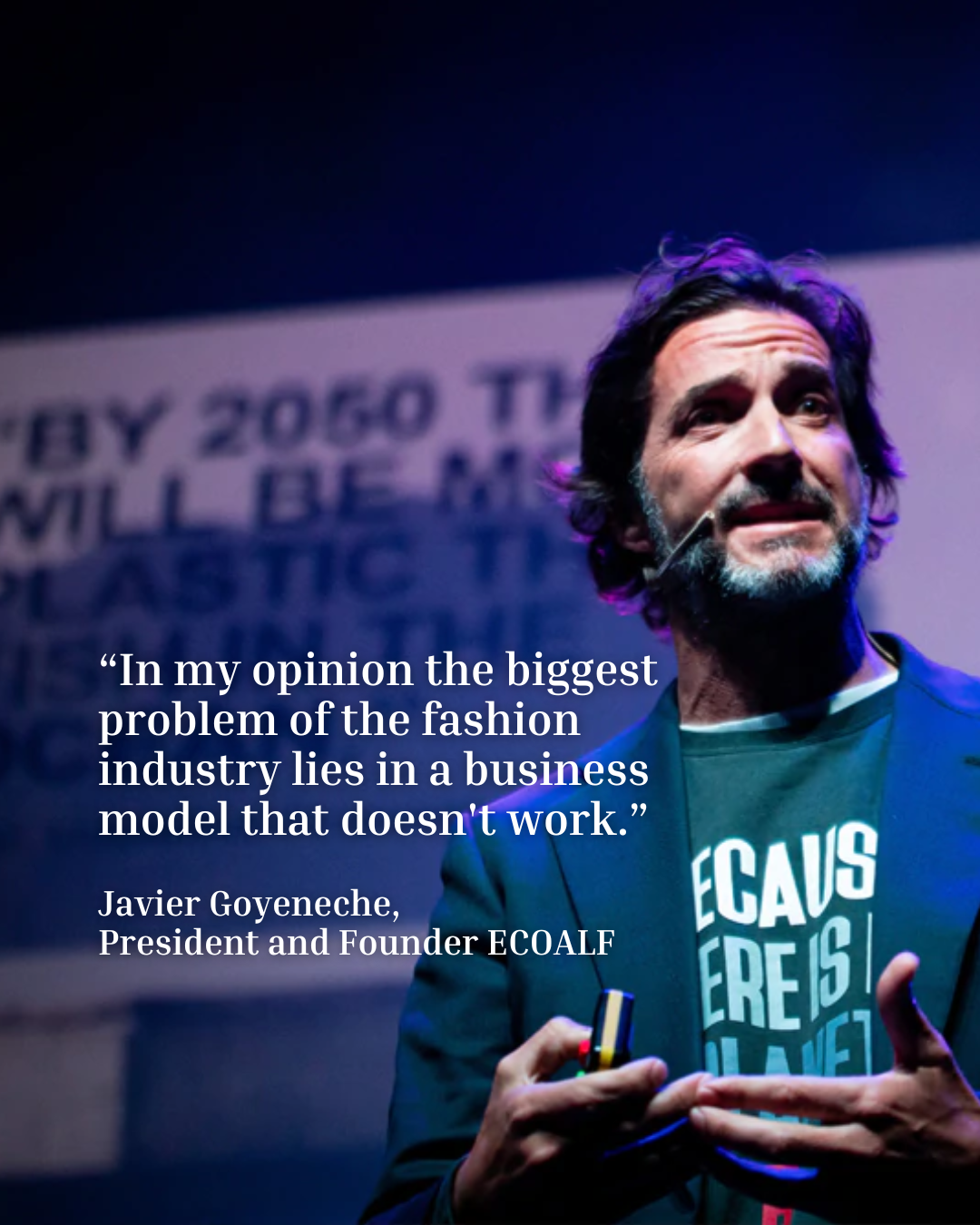
In my opinion the biggest problem of the fashion industry lies in a business model that doesn’t work: this is coming, this is going, things are bought and thrown away, again and again. However, it is complicated to change that, as many large brands continue to make a lot of money with this business model. And their CEOs are under a lot of pressure from investors, who feel that sustainable is more complicated and more expensive.
SL: Despite these challenges, do you believe change is possible?
Goyeneche: I believe it is, maybe not from one day to the next, but if you have a clear vision you can go forward. We haven’t invented anything, the technology to convert plastic bottles into polymer does not belong to us, it is open. But we do know which type of polymer makes which type of yarn, and we know the good producers around the world, and where to find the materials we need.
SL:Your claim is “There is no planet B®” Where did that come from?
Goyeneche: You know how it started? It was an accident. We went to Berlin to show our first collection in 2013, and when we arrived, the space allocated for presenting the clothes was the worst. It looked like a bathroom, and it had a column in the centre. We needed to do something, quick. On the plane to Berlin I had been reading about the concept of Plan B. So we wrote “There is no planet B®” outside, and people walking by stopped and took photos of it. The next day we registered it.
A Dialogue on Change: The Vision Behind the Mission
We are at a crossroads where the blueprints of the past no longer suffice. Javier Goyeneche’s conviction goes beyond fashion; it is a call for a fundamental shift in how we define the soul of a company. This exploration delves into his vision of a new generation of leaders—those who move beyond the logic of the last fifty years to embrace an honest, systemic responsibility. It is an invitation to understand how a brand can become a living force for good, driven by the unwavering belief that when there is no Planet B, our success must be measured by the world we preserve.
He recognizes that the structures built fifty years ago relied on the illusion of infinite resources. Today, that veil has lifted. Goyeneche argues that an honest company can no longer focus solely on growth; it must prioritize a depth of substance that respects the planet’s limits. It is about a return to permanence over profit.
It is a generation where responsibility is woven into the very fabric of the brand. For Javier, this means radical transparency and the courage to choose integrity over speed. These companies do not merely sell; they exist as a soulful response to the challenges of our time, ensuring that every action is an honest reflection of their values.
It serves as a quiet, constant reminder of our shared reality. In this new era of business, every decision—from the first thread to the final product—is filtered through this truth. It is the realization that a company’s longevity is inseparable from the health of our earth, creating a legacy that belongs to the next generation.
Similar Articles
Spazio Gio Ponti: Milan Finally Gives Its Architect a Home
Michaela Karl on Schiaparelli: Smart Women Pay for Their Own Clothes
Lulu Shabell on Why African Heritage Belongs to Africa