The Value Left the Ground: Forever Was the Easy Part
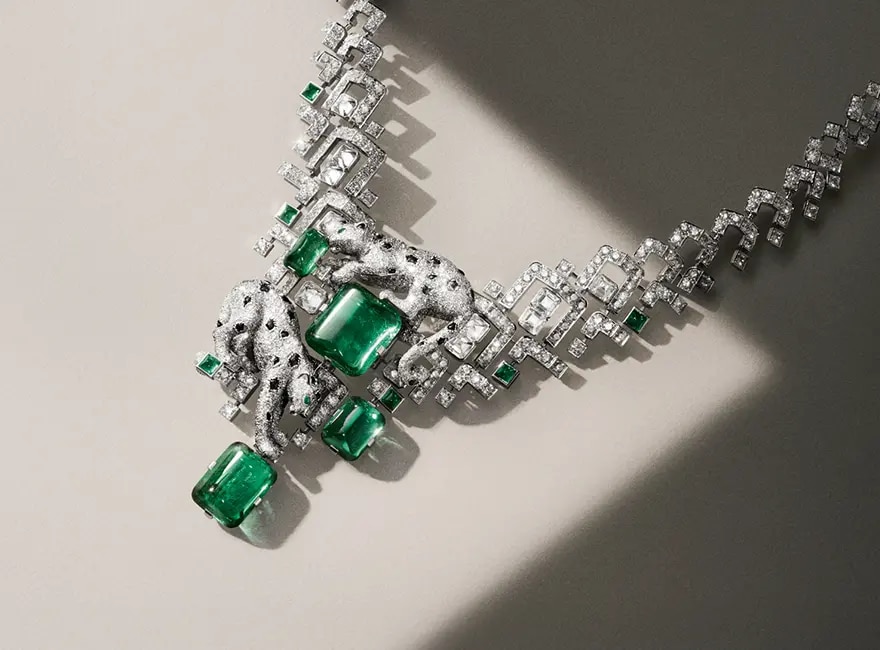
Cartier En Équilibre Summae ring in white gold with cabochon emeralds, troïdia-cut diamonds and onyx on a pale green ground. | Photo: courtesy of Cartier
Cartier, Van Cleef & Arpels, Buccellati and Vhernier grew 24 percent in the quarter to 30 June 2026, while Anglo American wrote De Beers down from 9.2 to 2.3 billion US dollars in three years and paused its largest mine. The money now sits with the houses that cut and set the stone, and it has left the ground it came from.
Eva Winterer
Richemont’s four jewellery maisons, Cartier, Van Cleef & Arpels, Buccellati and Vhernier, grew 24 percent at constant exchange rates in the quarter to 30 June 2026, to 4.7 billion euros. In the same period De Beers, majority-owned by Anglo American, posted an underlying EBITDA loss of 511 million US dollars and paused its Venetia mine for two years. The rough stone lost value while the setting held it.
Update · 21 October 2026
Three months after this analysis, Richemont is in advanced talks to join the Global Diamond Consortium, the preferred bidder for De Beers, alongside Botswana, Namibia and Angola. Follow the De Beers sale ↗
In the first reporting season of 2026, two companies sold the same mineral and closed their books on opposite results. De Beers, the largest name in diamonds, posted an underlying EBITDA loss of 511 million US dollars for 2025, against 25 million the year before. Richemont’s jewellery arm, which holds Cartier, Van Cleef & Arpels, Buccellati and Vhernier, grew 24 percent at constant exchange rates in the quarter to 30 June 2026, to 4.7 billion euros, its seventh straight quarter of double-digit growth. One diamond, two ledgers, weeks apart.
The Balance Sheet: The Margin Leaves the Stone
De Beers held its revenue almost flat, at 3.49 billion dollars, a rise of six percent. The money kept coming in. The margin left the stone. The company sold rough worth three billion dollars in 2025, a consolidated volume of 20.9 million carats, up 17 percent, and earned less for it: the average realised price fell seven percent to 142 dollars a carat, and once the year’s stock rebalancing deals are counted, the rough price index dropped 25 percent. De Beers had bought stones onto its own balance sheet at a higher index and sold them into a lower one, a trading loss of 424 million dollars in a single line. The slide has carried into 2026. In the first quarter, the consolidated average realised price fell a further 19 percent to 101 dollars a carat, on a sales mix weighted toward lower-value goods, according to the company’s April production report.
Where the stone comes out of the ground decides how far it has fallen. Anglo American’s own figures put the average price of South African rough at 66 dollars a carat in 2025, against 110 dollars for Botswana and 353 dollars for Namibia. The same carbon runs through all three lines. The distance between 66 and 353 is the distance between a deposit of small, ordinary stones and a deposit of large, clean ones, and the market has pulled the two apart.
Anglo American: Three Years of Writing It Off
That gap sits at the centre of what Anglo American decided to do with the business. The parent company has written De Beers down three years running, by 1.6 billion dollars in 2023, 2.9 billion in 2024 and 2.3 billion in 2025, cutting the carrying value from 9.2 billion dollars to 2.3 billion. A business that loses three quarters of its book value in three years while its revenue holds steady is priced as a commodity, on what it fetches per unit rather than on the name above the door.
Duncan Wanblad, chief executive of Anglo American, put the diamond business in the language of capital preservation. “We are progressing the sale process for De Beers and continue to assess further cost and capital preservation measures to minimise the impact from challenging diamond markets,” he said alongside the group’s first-quarter results in 2026. Anglo has designated the diamond unit non-core and is rebuilding its portfolio around copper, premium iron ore and crop nutrients. The company has agreed to merge with Canada’s Teck Resources to add copper at scale, a transaction expected to close between September 2026 and March 2027.
South Africa, where the fall lands hardest, runs a single mine. Venetia, in Limpopo province near the Zimbabwe border, turns out the smaller, lower-value goods that sit exactly where prices have dropped furthest. It produced 2.23 million carats in 2025 and accounted for 10.3 percent of De Beers’ total group production, on a 2.3 billion dollar underground project that began in July 2023 after three decades of open-pit mining ended in December 2022. On 13 July 2026, De Beers paused it for two years. Al Cook, the company’s chief executive, put the decision in the register of efficiency. “The changes we are making to our business are focused on underpinning our efficiency now and into the future, favourably positioning De Beers in its leadership role,” he said in the statement. Around 4,400 employees and contractors stand behind that sentence.
Venetia: The Mine as Leverage
The pause arrived while Anglo American was running a formal sale process for De Beers, and the timing did work no efficiency drive alone would explain. A buyer inheriting a mine that burns cash each month carries the largest near-term risk in the business, and freezing Venetia’s operating losses and capital calls lifts that risk before the handover. De Beers offered the market a cleaner asset in the same weeks it was asking for bids.
The mine it chose to halt had been ramping up. Venetia’s output rose 53 percent to 740,000 carats in the first quarter of 2026, on higher volumes of underground ore. Holding back a producing mine that carries a tenth of group volume restricts natural rough into a market the company already calls oversupplied, and it does so in the week De Beers also cut official rough prices and condensed its client base from 70 sightholders to roughly 45. Cook told the trade last month that a sale was closer than at any earlier point, with Anglo describing advanced discussions with a select group of strategic parties. The government of Botswana, which already holds 15 percent of De Beers, and the state of Angola have both been named among the interested parties, each with a national stake in the stones beneath its own ground.
The Stone That Splits the Market
Two mines in the same year tell the split at the level of the rock. Venetia turns out mass, the small and ordinary carats that any deposit yields and that fell to 66 dollars in South Africa. The exceptional stone follows a different law. In April 2019 the Canadian miner Lucara recovered the Sewelô from its Karowe mine in Botswana, at 1,758 carats the second-largest rough diamond ever found after the 1905 Cullinan, and in 2020 Louis Vuitton bought a stake in it and set about cutting a collection from it. Bernard Arnault reached for the rarest object in the ground because the stone that occurs once in a century stands outside any deposit’s routine output. Graff had paid 53 million dollars for Karowe’s 1,109-carat Lesedi La Rona in 2017 on the same reasoning. The ordinary carat falls to the price of a commodity while the once-in-a-century stone climbs into a category of its own.
The mass a mine like Venetia produces can be undercut. The great stone holds, and so does the thing a house builds around the stone. De Beers wrote the rules for that second part before anyone else, and then built its business on the first.
De Beers: The Myth Came on Commission
De Beers made the diamond a symbol of marriage before it earned much on the stone itself. Cecil Rhodes founded De Beers Consolidated Mines on 12 March 1888, on the Kimberley fields, and named it after Diederik and Johannes de Beer, two Boer farmers who had sold the land where the first stones surfaced and never held a share. For sixty years the company ran as a supply machine: buy the rivals, hoard the stones, meter the output through the sight system. The line that fixed the diamond as the token of marriage arrived in 1947, and it arrived from outside. Frances Gerety, a copywriter at N.W. Ayer in Philadelphia, wrote “A Diamond is Forever” late one night for an account the agency had held since 1938, and the line first ran in 1948. Ayer had already done the cultural work, placing stories in the press and on screen that made the diamond ring the expected form of a proposal. De Beers bought that idea and industrialised it.
Cartier and Van Cleef & Arpels wrote their own. Louis Cartier designed the Trinity ring in 1924, three interlaced bands of rose, yellow and white gold, and his friend the poet Jean Cocteau wore it on his little finger and made it seen; the ring reached its hundredth anniversary in 2024 in continuous production. Van Cleef & Arpels created the first Alhambra sautoir in 1968, twenty four-leaf-clover motifs in yellow gold edged with gold beads, the motif drawn from the four-leaf clovers Jacques Arpels picked in his own garden, and the house has carried it since through a craft of setting and proportion passed across generations of the workshop. Neither story was bought from an agency.
That authorship decides the price. De Beers sold the mineral, the part any deposit can yield and a rival can undercut. Cartier and Van Cleef & Arpels sold the setting, the part that took a century of one house to build, and Richemont raised prices into a market that kept paying for it, the four jewellery maisons up 24 percent at constant exchange rates in the quarter to 30 June 2026. The company that dug the stones out of the ground is the one now for sale. The maisons that set them booked records.
Gerety’s line held. It held for the setting, and the company that rented it is the part now on the market. The diamond proved forever, the line proved forever, and the corporation that paid an agency to write it is the part that did not last.