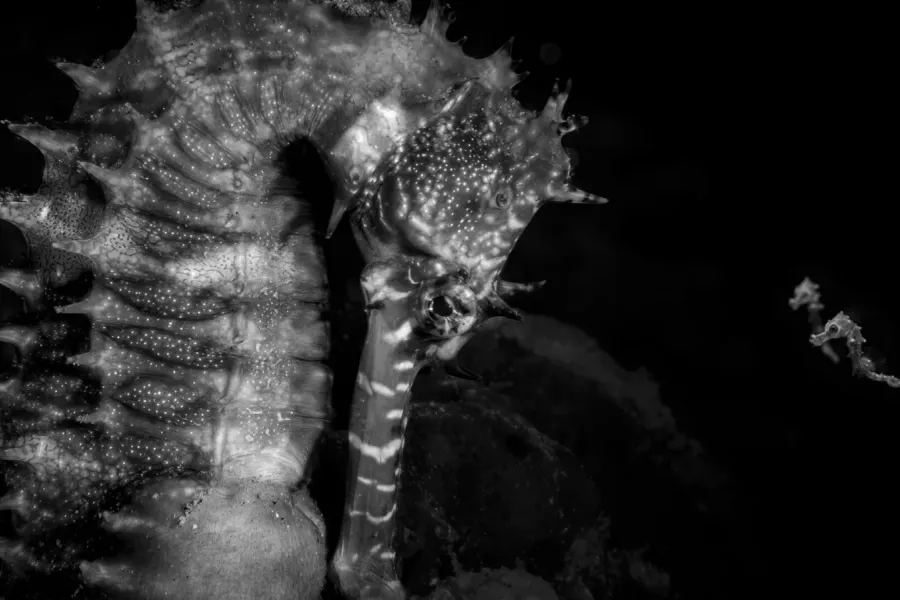
When the results were announced in London on Wednesday, 9 September 2026, it was a single black-and-white photograph that profoundly moved the jury of the Ocean Photographer of the Year to claim the grand prize.Captured in the shallow waters off Moorea, French Polynesia, photographer Julien Anton framed a rare and intimate scene: an adult seahorse holding itself upright in the current, while two newborns turn back toward it in protective proximity. In seahorses, it is the male who carries and births the young, a detail that gives the frame its quiet charge.
The jury, led by Oceanographic Magazine and the Swiss haute horlogerie house Blancpain, selected the piece from more than 15,000 global entries. When The Atlantic published the winning gallery on 9 September 2026, competition founder Will Harrison recalled a rare moment of collective reverence: confronted with this father and his young, the entire panel fell silent. It is an image that leaves an unspoken, existential question hanging in the frame: what exactly remains for those who come after us.
Generations over quarters: The legacy of Villeret
The answer to Blancpain’s presence at this specific photography prize lies far beyond the conventional boundaries of corporate sponsorship. In haute horlogerie, a caliber is the internal architecture of a timepiece, the hand-assembled arrangement of gears, springs and balances that dictates the rhythm of time. For the manufacture founded in Villeret in 1735, the oldest registered watchmaking house in the world, that caliber is never a fleeting, seasonal commodity. For nearly three centuries, the brand has steadfastly rejected the quartz movement, choosing instead to craft every single caliber entirely by hand.
A house built on such principles does not measure its success in quarterly earnings, but in generations. The knowledge of its master watchmakers is passed down like a sacred relay. Its highly complex perpetual calendars and moon-phase complications track celestial cycles that stretch far beyond the span of a single human life. This uncompromising dedication to slowness connects the brand with its partners far outside the watchmaking world, be it the visionary kitchens of Pierre Gagnaire or the heritage estates of Relais & Châteaux. When such an institution turns its gaze to the sea, it does not seek a transient marketing opportunity. It seeks the only planetary system that possesses the same epochal constancy as its own craft.
Marc Hayek: A personal obsession
This maritime dedication is anchored deeply within the company’s leadership. Marc Hayek, President and CEO of Blancpain since 2003, has been an avid diver since his early childhood. Shaped by his grandfather’s profound love for the sea, he spent his childhood summers along the Mediterranean coast, counting down the days until he turned twelve and could finally learn to dive.
“It all started with a dive watch and a fascination with its aesthetics,” Hayek recalls. “But it quickly evolved into something far greater.” When the CEO speaks of the world’s oceans today, his words mirror the philosophy of his watchmakers: “The ocean is the cradle of life and the key to our survival. Its health is vital to ensure a future for our children.”
You are currently viewing a placeholder content from YouTube. To access the actual content, click the button below. Please note that doing so will share data with third-party providers.
More Information
Nineteen expeditions beyond the headlines
What grew from this personal conviction is the Blancpain Ocean Commitment, an initiative that has consolidated the house’s marine work under one banner since 2014. The balance sheet is highly measurable, reflecting an investigative, fact-based approach to philanthropy:
- 19 scientific expeditions have been co-funded by the manufacture to date.
- 11 marine protected areas (MPAs) have been established worldwide using the data gathered.
- 4 million square kilometers of protected ocean territory have been successfully created.
The most prominent witness to this commitment is the renowned marine biologist and underwater photographer Laurent Ballesta, whose Gombessa expeditions have been entirely supported by Blancpain since 2012. In 2013, Ballesta descended to a depth of 120 meters off the coast of South Africa, capturing the world’s first-ever photographs of the coelacanth, a prehistoric fish long believed to have gone extinct 70 million years ago.
In 2019, to study the deep floor of the Mediterranean, Ballesta and three fellow researchers spent 28 days living inside a canary-yellow steel capsule measuring just one square meter, subjected to 13 times atmospheric pressure. He returned to the surface with severe frostbite on his fingers, but with groundbreaking ecological data. Ballesta has consistently emphasized that Blancpain selects its projects based on scientific credibility, routinely rejecting shallow publicity stunts.
The art of noble reticence
This deliberate restraint is precisely what defines the photography prize. The seahorse of Moorea won because its creation required the same caliber of patience the house builds into its movements: countless hours waiting in difficult conditions, with no guarantee of finding a single animal. The image encapsulates, in miniature, exactly what Blancpain has spent over seventy years attending to since the introduction of its legendary Fifty Fathoms dive watch: the quiet act of one generation handing life over to the next, embedded in an ancient ecosystem.
Crucially, the watchmaker’s name never forces itself into the foreground. It remains resting quietly at the edge of the prize, within the jury credits, or attached to the Female Fifty Fathoms Award, won in 2026 by British photographer Jenny Stock. A house that has outlasted centuries since 1735 understands how to bow to the timelessness of the ocean. Blancpain does not use the sea as a billboard; instead, the manufacture pays the people who go into the dark water to bring its truth back to the light.
Further Reading
-
Silent Luxury describes an architecture of endurance, trust and relationship, held together by Wertschätzung and the Relationship Economy. Value develops duration through relevance, care and the capacity to remain meaningful over time.
-
A value system in which worth accumulates through use, restoration, cultural transmission and continued relevance across generations. Global fibre production reached 132 million tonnes in 2024, with polyester at 59 percent.
-
Swiss watchmaking answers structural crisis by holding its own production rather than outsourcing it. The atelier becomes the strategic centre, and vertical integration turns from a cost question into a question of survival.
-
Value in luxury 2026 is no longer determined by price. The post-materialist buyer measures worth by provenance, craftsmanship and the documented conditions of production.