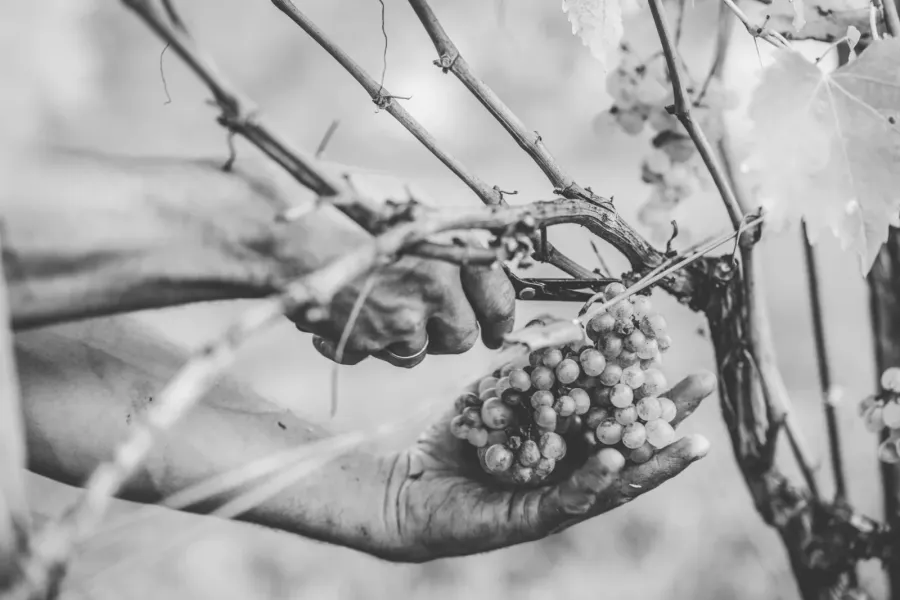
The small, thick-skinned berries of 2026, less juice and deeper concentration after a summer of drought across Europe’s vineyards. | Photo: magnific.com
The Great Small Vintage of 2026: A Season of Concentration
Drought and heat pressed Europe’s 2026 vintage into its lowest yields in decades and, in the same stroke, its densest fruit. From Champagne to the Rhine the grapes came in small and thick-skinned, while England ripened its finest crop on record. A field report by Eva Winterer on the year the map of fine wine began to move.
Eva Winterer
At Maison Telmont in Damery, the pickers went into the rows on 12 August, marking the earliest start the historic Champagne house has ever entered in its records, to harvest fruit that held more sugar and less juice than any grower had planned for. That single morning holds the whole of 2026 in a bunch. France brought in 33.9 million hectolitres of wine this year, its lowest collective yield since 1957, while a thousand kilometres to the north, England picked the ripest, most phenomenally balanced fruit its growers have ever measured. The brutal summer heat that lightened the southern crop deepened what stayed on the vine. Europe finds itself holding a small vintage of rare concentration: the raw material of a serious, deeply structured wine rather than a plentiful one. As Austria comes in at its densest in fifteen years and Italy holds back its national estimate for the first time in history, the ground beneath fine wine is shifting quietly toward the cool north.
Low Yields, Generational Depth: The 2026 French Harvest Destroys Volume to Create Structure
France produced a mere 33.9 million hectolitres in 2026, the agriculture ministry confirmed on 7 September, falling close to two million below last year and near seven million under the recent five-year average. According to Agreste, the ministry’s statistical service, the historic shortfall is driven by a permanent contraction of vineyard area combined with yields worked mercilessly by severe drought and successive heatwaves. If these figures hold to the close of the vendange, the 2026 French vintage will stand as the lowest national yield since 1957, delivering berries of unprecedented thickness and aromatic density.
The season had opened well, with good spring moisture in the soil and clean, disease-free canopies, before an unrelenting heat dome settled over the continent and the vines began drawing water back out of their own berries. Champagne felt the squeeze most acutely, coming in near half its five-year average at 1.3 million hectolitres, with average grape weights falling to a twenty-year low after spring frosts gave way to a scorching summer.
Burgundy and Beaujolais saw volumes fall by a third, with Burgundian Pinot Noir down by more than half on some prized slopes. The Jura eased back 36 percent, while the Cognac vineyards of the Charentes shrank by a quarter. A handful of southern appellations ran counter to the trend, Bordeaux rising ten percent and the Languedoc five, saved by late-August rain and grape varieties bred to hold their nerve in extreme heat. Yet what the great regions surrendered in volume, they gained in extractable depth; the small berries pressed a dense, structured, and phenomenally concentrated must into the vats.
Trimming the Rows: Europe’s Deliberate Retreat From the Red Wine Glut
Weather accounts for only half the story of this small crop; the other half is a deliberate structural correction. Under a crisis scheme managed by FranceAgriMer, some 27,500 hectares of French vineyard are being permanently grubbed up in 2026, drawing back the national vineyard area by 2.5 percent in a single year through a €130 million fund paying €4,000 per hectare. Most of the decommissioning applications came from the south-west, the Gironde, the Aude, and the Hérault, and targeted bulk red grapes, a category whose market has softened significantly as younger drinkers pivot away from everyday Bordeaux rouge. Jean-Marie Fabre, president of the Vignerons Indépendants de France, cast the program as an essential correction for regions carrying volumes the modern market can no longer absorb.
The same measured retreat is underway across European borders. In Germany, Rhineland-Palatinate has established a premium of €5,000 for every hectare permanently cleared using EU funds, with Bavaria readying a scheme of its own for next year. Concurrently, the Austrian wine board is in talks with the agriculture ministry to send seven to ten million litres of surplus red wine into industrial alcohol distillation. Three historic producing nations are easing the same red-wine glut in the same season, using a brutal summer to accelerate a necessary market correction.
European Wine Harvest 2026 · change vs the 2021–2025 average
Region
2026 harvest
Change
Source
France (total)
33.9M hl
−17%
Agreste
— Champagne
1.3M hl
−47%
Comité Champagne
— Jura
—
−36%
Agreste
— Burgundy / Beaujolais
—
−33%
Agreste
— Charentes (Cognac)
—
−25%
Agreste
— Bordeaux
—
+10%
Agreste
— Languedoc
—
+5%
Agreste
Austria (total)
1.7M hl
−28%
Weinbauverband
— Weinviertel
—
up to −40%
Weinbauverband
Spain (total)
31.5M hl
from 33.1M
Cooperativas
— Castilla-La Mancha
19M hl
≈ stable
OIVCLM
Italy
no forecast
withheld
Assoenologi / UIV
The Taint That Stayed Away: How Véraison Saved Bordeaux from Smoke
The summer carried fire alongside the heat, threatening the organoleptic profile of the entire vintage. Wildfires ran through more than 42,000 hectares around Bordeaux and displaced some 224,000 people out of the Gironde, while in Spain, mechanical harvesters were suspended in Ávila and Toledo to keep smoke-marked fruit out of the crush. Growers frantically watched for guaiacol, the volatile compound that wildfire smoke leaves in grape skins.
Paul Krug, managing an estate in Pommard, described the insidious nature of the taint, noting that the vine locks smoke compounds to sugars so the fruit tastes perfectly clean until fermentation opens them again as an unshakeable ashtray finish.
The panic drove several estates to harvest early. Ultimately, salvation came from the drought itself: heat-stressed vines had stalled in early véraison, the critical stage at which the skin becomes highly receptive to smoke absorption. By September, laboratory analysis had largely cleared the 2026 vintage of smoke taint, leaving Bordeaux with low volumes but clean fruit, having paid the season’s price in lost wine tourism instead.
Small, Dark, and Serious: Austria Records Its Densest Vintage in Fifteen Years
Austria offers the 2026 vintage in its purest, most highly concentrated form. On 10 September, the Austrian Wine Board set the 2026 crop at around 1.7 million hectolitres, down from close to 2.6 million the year before and 28 percent under the five-year average, marking the smallest national yield since 2010. The east carried the steepest reduction, with growers in the Weinviertel looking at volumes as much as 40 percent down.
Johannes Schmuckenschlager, the board’s president, defined the vintage’s structural backbone in Vienna using precise fine-wine metrics: “Diminutive berries yield a restricted quantity of juice, yet they deliver an extraordinary concentration of phenolics and essential dry extract. Consequently, we anticipate remarkably aromatic, high-definition wines of immense expressive power.”
The lighter white crop reaches the market smoothly, as baseline reserves from a generous 2025 vintage remain resting in Austrian cellars at 2.65 million hectolitres (with white stock accounting for 1.42 million hectolitres), which holds market prices stable. Red wine remains the real structural conflict. The domestic cellars are currently packed with 1.23 million hectolitres of red wine reserves, nearly 2.5 times the actual volume harvested this entire season (508,000 hectolitres). It is this massive red wine overhang that is driving the board’s negotiations to release 7 to 10 million litres into crisis distillation, viewing the year as an accelerated shift toward white wine, which already claims two-thirds of the country’s vineyard space.
Austrian Wine Harvest · 2010–2026
Sixteen Years of Yield
Total production in million hectolitres
2010 · 1.6920182026 · 1.70 · forecast
At 1.7 million hectolitres, 2026 matches the low of 2010 — a small crop of concentrated berries and exceptional aromatic depth.
Source: Statistik Austria · 2026 figure: Weinbauverband forecast
Straw on the Rhine: Riesling at the Tipping Point of the River
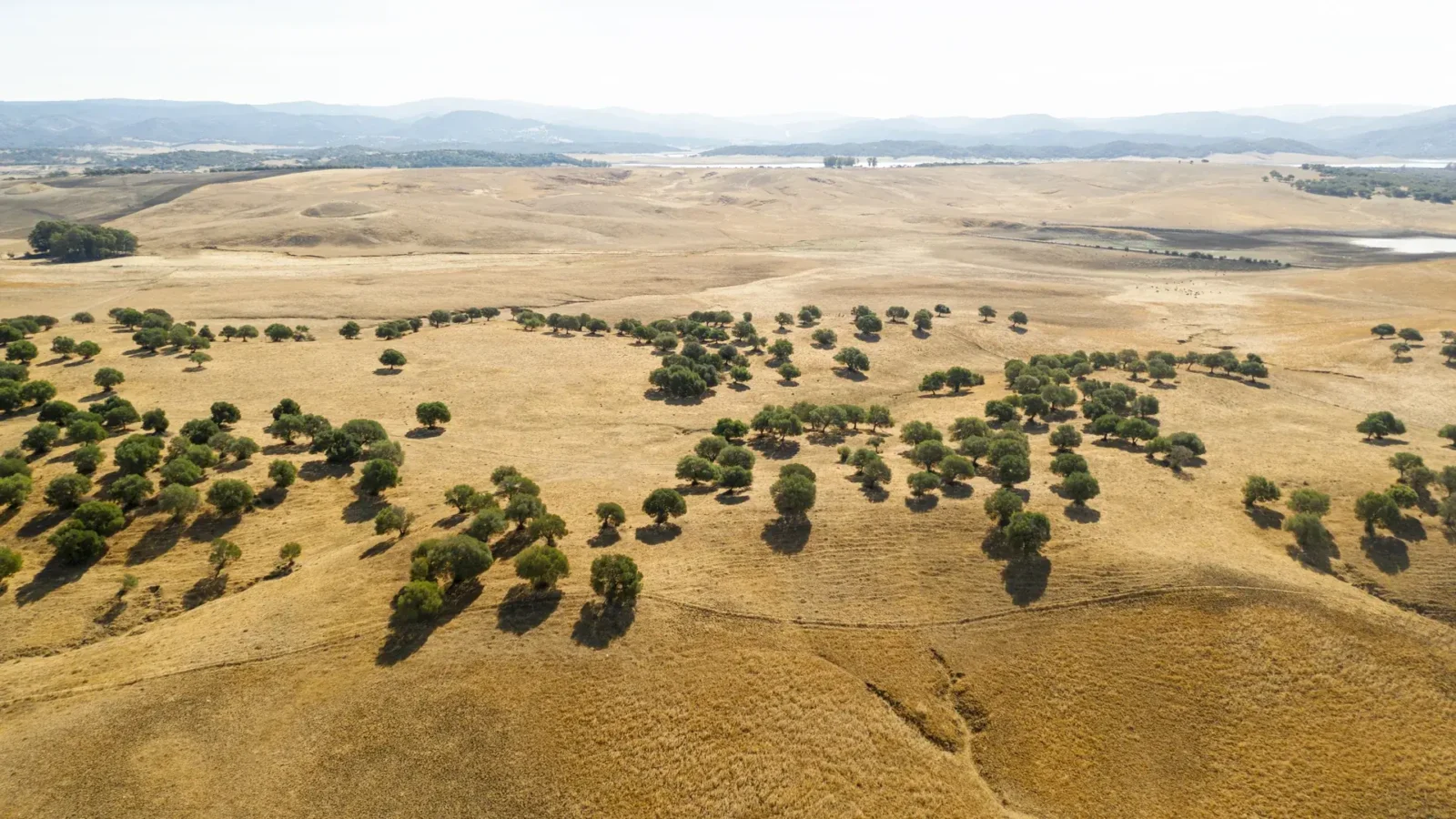
Germany told its version of 2026 along its main logistical artery. Growers began the harvest in the second week of August, weeks ahead of the customary October window, while the Rhine fell to record lows, stopping commercial barges across the country.
Florian Weingart, a Riesling grower on the Mittelrhein who laid straw between his rows to retain soil moisture, noted that without emergency irrigation, this area would basically be lost for the harvest, indicating that the vineyard had reached a true climatic tipping point. The German Wine Institute recorded the exact signature found further south: tiny berries with minimal juice yielding musts of unusual concentration, searing acidity, and intense phenolic lift.
The Weight of Silence: Italy Halts Forecasts to Protect an Over-Stocked Market
Italy met the volatile summer with tactical restraint. For the first time in its history, Assoenologi, Ismea, and the Unione Italiana Vini set aside their customary pre-harvest forecast, judging the weather too unsettled for an honest figure and holding the count until the vendange closes in mid-November. When the bodies that usually call a year short or generous choose silence, the pause itself carries immense economic weight.
The true pressure sits in the warehouse rather than the vineyard: 42.6 million hectolitres of wine currently rest in Italian cellars, keeping stocks up 7.5 percent while 2025 exports dropped 3.7 percent as sales to the United States, Italy’s leading market, slipped 9.2 percent in value. Puglia has already trimmed permitted yields on its principal red IGP wines. The drought lightened the bunches, and the full cellars settled the rest.
Two Spanish Harvests: Recovery in Rioja and the Desolation of Priorat
Spain came through the year in two completely different registers. The national estimate settled near 31.5 million hectolitres, below the 33.1 million of the year before, with the wide plateau of Castilla-La Mancha holding steady at 19 million hectolitres and bringing in its earliest fruit in memory.
Rioja found its feet again after two punishing years, its vines fully recovered, while the terraced, slate vineyards of the Priorat and Tarragona surrendered more than a third of their potential crop to the relentless drought. Across the country, growers reported lighter volumes but notably clean, high-quality fruit; the severe dryness that shrank the berry size also held vineyard disease entirely at bay.
Moving North: How England Outgrew Its Marginal Climate
The heat that lightened the south is actively building the north, shifting the geographic boundaries of fine wine. England brought in its second-largest crop on record in 2025, yielding between 15 and 16 million bottles of the ripest fruit its growers have ever measured, supported by a national vineyard area that has grown roughly 510 percent since 2005 across more than eleven hundred registered sites.
The 2026 season ran toward the earliest picking dates in the country’s history. Continental houses have recognized this macroeconomic shift: Taittinger and Pommery have established English estates, followed across the Channel by Jackson Family Wines and a prominent Burgundy domaine. A climate once dismissed as too marginal to ripen fruit now yields sparkling wines that consistently best Champagne in blind flights.
The Physiology of Scarcity: Why Small Berries Yield Age-Worthy Musts
The smaller crop can be the finer one, and the reason sits inside the anatomy of the berry. A vine under water stress sets small, thick-skinned grapes, which sharply lifts the skin-to-pulp ratio. The skin holds the tannins, the colour-bearing anthocyanins, and the greater share of the aromatic compounds, while the pulp holds water and sugar. A smaller berry yields a more concentrated must and a wine with deeper phenolic structure. Across the drought years, the trade has settled into one vocabulary for it, speaking of healthy fruit, small berries, and dense, structured, ageworthy wines.
The reward turns on timing. Heat lifts sugar, and with it potential alcohol, faster than phenolic ripeness arrives, meaning a vine can reach technological ripeness while its tannins and aromas stay green. Schmuckenschlager pointed to this very balance when he stressed the early picking date, the narrow window in which sugar and acidity still meet. A concentrated vintage rewards the grower who reads that window and exacts a heavy price from the one who lets it pass.
Scarcity Without a Premium: The Deflation of the En Primeur Myth
A small vintage no longer lifts release prices on its own, and the disastrous 2025 Bordeaux campaign proved it. The châteaux relied on the pricing model they had trusted for forty years, the lowest yields since 1991 set against high quality, and the Union des Grands Crus made the case for the small crop. Then they released above the previous year’s prices and the global trade stood back.
Marc Ditcham, fine wine buyer at Corney & Barrow, noted that the châteaux had ignored the pleas from negociants, UK merchants, and the final consumer, pricing young wines above older vintages that sat cheaper on the secondary market. Buyers held off, and Liv-ex read the campaign’s failure as a matter of credibility rather than market uncertainty.
A second signal rose from within Bordeaux itself. Describing how few of his wines still sell on release, one Médoc proprietor told Wine-Searcher the market was “going back to the 1980s, when 50 or 60 brands were allocated and sought-after”. The broad middle now moves strictly on price, and the old premium holds only for the scarcest names.
Into that market the 2026 wines arrive with the two qualities, low yield and high concentration, that once carried a price on their own. A generation ago the arithmetic would secure a firmer release. Today it secures an allocation and a question: whether the great houses can turn this vintage into value or watch its depth settle into supply and stop short of the price it once commanded.