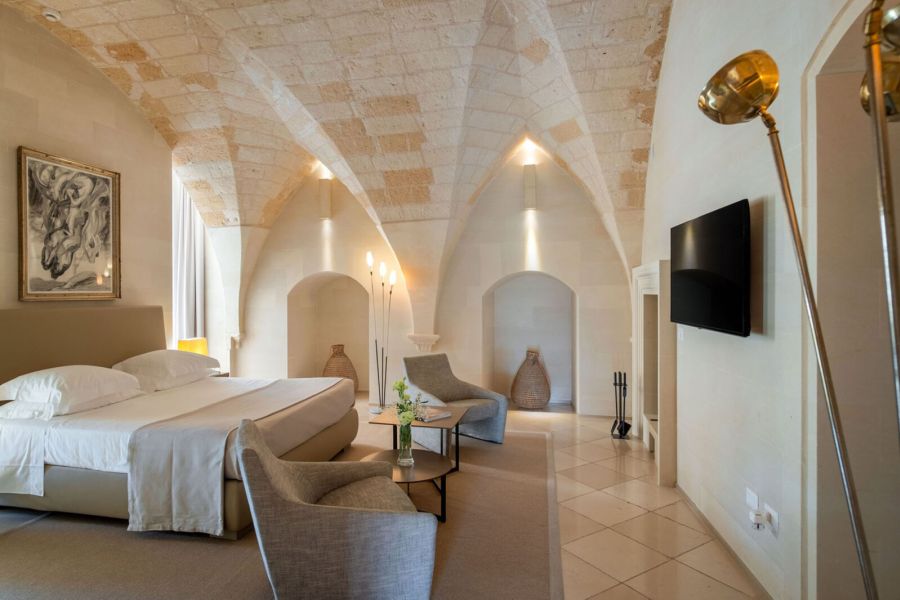
Where to stay in Lecce inside the city walls: La Fiermontina Family Collection is a hotel in the historic centre of Lecce, Puglia, operating as an albergo diffuso across three restored buildings within steps of each other. La Fiermontina Luxury Home is a 17th-century Masseria with 19 rooms, a pool, a garden and the Zéphyr Restaurant, opened in 2015 after a ten-year restoration. La Fiermontina Palazzo Bozzi Corso is an aristocratic palazzo built in 1775, with ten suites, opened in 2018. The Fiermonte Museum is a private museum of nine rooms and a secret garden, with four overnight suites. All three are operated by Fouad Giacomo and Antonia Yasmina Filali, grandchildren of the Apulian painter Antonia Fiermonte. Interiors across the collection are by Laboratoire Design, Rabat. Guests of any house hold access to all three, including the museum after closing hours.
La Fiermontina Family Collection in Lecce brings together three historic properties in the old city: La Fiermontina Luxury Home, La Fiermontina Palazzo Bozzi Corso and the Fiermonte Museum. Together, they form an albergo diffuso shaped by the Fiermonte Filali family biography, Apulian architecture, art, restoration and the design work of Laboratoire Design in Rabat.
La Fiermontina Lecce at a glance
La Fiermontina in Lecce is an albergo diffuso, a specifically Italian hospitality model in which different historic buildings form one connected experience. In Lecce, this model unfolds through three houses. La Fiermontina Luxury Home is a 17th century masseria with 19 rooms. La Fiermontina Palazzo Bozzi Corso is an aristocratic palazzo from 1775 with 10 suites. The Fiermonte Museum is a private museum with four overnight suites.
The collection is operated by siblings Fouad Giacomo and Antonia Yasmina Filali. Guests can access all three properties, the shared pool, the restaurant and the museum, including private night access. The result is a stay that moves through Lecce rather than remaining inside one hotel building.
La Fiermontina Luxury Home
Fiermonte Heritage: A Love Story in Stone, Art and Soul
A 17th-century Masseria with 19 rooms inside the old city walls. Ten years of restoration, and what the house gave back.
Read the full story →
A Masseria in Lecce
Three generations of the family had left Apulia before anyone came back. Fouad Giacomo Filali arrived in Lecce in 2003 looking for traces of his family’s Apulian roots.
He found a Masseria inside the old city walls and intended it as a private retreat. Restoration began. The further the work went into the building, the more the building gave back: rooms that did not appear on the official plans, dimensions larger than any record showed.
The floors of the Masseria were laid using terrazzo mixtures no one had used for decades. Someone had to find them first, in old records, in the memory of craftsmen, in what lay beneath everything the intervening years had put on top. That act of retrieval, patient, specific and without shortcuts, is the clearest way to understand how La Fiermontina was built.
The Masseria had been waiting with the particular patience of old stone that knows it outlasts everything placed over it.
By 2013 the structure was secured. Two years later, La Fiermontina Luxury Home opened with 19 rooms across three building wings. The decision to welcome guests had not felt like a business choice. It had felt like an obligation to what the building had quietly insisted on becoming.
The Ground It Stands On
Six million years ago the Salento lay under water. The sediment that sank to that seabed became the stone the city is made of. Pietra Leccese is a Miocene calcarenite, formed from the skeletons of marine organisms, fragments of coral and shells too small to see, bound in calcite. It leaves the quarry soft enough to cut with a blade. Once the air reaches it, it hardens over the following months and holds. Every Baroque façade in Lecce still standing owes its survival to that second property, and so do the star-vaulted ceilings inside the Masseria.
The quarries around Lecce, Cursi and Melpignano run as deep as fifty metres, and the depth decides everything. The upper banks give the soft stone that takes ornament. The lower banks give the hard stone for floors and thresholds. The old cavamonti knew the varieties by sight and named them, cucuzzara, tosta, dolce, saponara, and chose according to what each block would be asked to do. The same distinction runs through the three houses: Pietra Leccese overhead, Marmo di Trani underfoot, Chianche from the old terrace relaid as garden paving.
Sailors arriving from the Aegean saw this peninsula before any other part of Italy, and they named it in their own language. Messapia, the land between the two waters, the Adriatic to the east and the Ionian to the west, built the same way Mesopotamia was built. The syllable ap carries water and survives in Iapygia and in Apuli, from which Apulia comes. Strabo records it plainly: the Hellenes call it Messapia. What the inhabitants called themselves has never been established. They wrote from the sixth century before Christ in an alphabet borrowed from the Greeks, and their language remains undeciphered. The oldest name this place carries was given to it by people who came off the sea.
The town was Sybar before Rome took it and made it Lupiae. Under Augustus an amphitheatre went up at the edge of the settlement, cut directly into the rock so that the stone removed became the stone that built it, with room for twelve to fourteen thousand people. From the eleventh century the town helped itself to the decoration, and capitals from Lecce turned up in the crypt of the cathedral at Otranto. Then houses rose over it, and a church, and a square, and for six centuries the city walked across it without knowing. In 1904, during excavation for the Banca d’Italia, Cosimo De Giorgi recognised what the diggers had exposed. A third has been opened since. The rest lies under Piazza Sant’Oronzo, where it stays.
The saint the square is named for arrived by the same logic as everyone else. A disciple of Paul called Giusto was shipwrecked off San Cataldo, and a young patrician named Publio, hunting nearby with his nephew Fortunato, pulled him out of the water. The rescued man converted his rescuers. Publio took the name Oronzo at his baptism, travelled to Corinth, and returned as the first bishop of Lecce. All three were beheaded under Nero on the road out of town, and a woman named Petronilla carried the bodies to her house in the country. In 1656 plague emptied Naples and left Lecce standing, and the city credited Oronzo, who until then had not been its patron at all. The column he stands on came from Brindisi, from the end of the Appian Way.
This is the ground the three houses stand on: a city that kept every layer instead of clearing it, built from a stone that yields first and sets afterwards, named by strangers, and long in the habit of taking people in.
La Fiermontina Palazzo Bozzi Corso
Of Hollywood Glamour and Imagine Dreams
Built in 1775 for a man who wrote his intentions into the wall. Today it holds Enzo Fiermonte’s boxing gloves and John Lennon’s drawings.
Read the full story →
The Filali Line
La Fiermontina begins with a family story that moves between Puglia, France and Morocco. Its name carries the memory of Antonia Fiermonte, the Italian artist whose life connected painting, music, sculpture, family legacy and artistic presence. Through the Fiermonte Filali family, this biography has become spatial. It appears in a restored Masseria, an aristocratic palazzo, a museum, collected artworks, garden sequences and the relationship between hospitality and memory.
Fouad Giacomo and his sister Antonia Yasmina Filali grew up between continents. Their mother was Anne Fiermonte Filali, daughter of the Apulian painter and violinist Antonia Fiermonte, who had left Puglia in the 1930s for Rome and then Paris. Their father was a Moroccan diplomat. The family moved between North Africa, Asia, Europe and the Americas, a childhood in which rootedness was a choice rather than a given.
This biography is not incidental to the project. It is the project. The ability to read a place without the shortcuts of familiarity, to notice what is particular about a material or a room rather than what it shares with others, is what a life between cultures trains. It shows in every spatial decision across all three properties: in what was kept, what was moved and what was left to speak without assistance.
In Lecce, the story structures the collection. Each house carries a different part of the family archive. Each address opens another perspective on how biography can become architecture and how hospitality can carry cultural memory through rooms, gardens, artworks and private interiors.
Three Houses, One Logic
The La Fiermontina Family Collection encompasses three distinct properties within steps of each other in Lecce’s historic centre. La Fiermontina Luxury Home carries the project’s origin in its 17th-century Masseria walls. La Fiermontina Palazzo Bozzi Corso, an aristocratic palazzo built in 1775, hosts ten suites named for members of the family saga — among them Anne Fiermonte-Filali, whose friendship with Yoko Ono led her to organise the Neapolitan mosaic masters behind the IMAGINE memorial in Central Park’s Strawberry Fields. Original drawings by John Lennon, given personally by Yoko Ono to Anne, hang in one of the Palazzo’s suites.
The Fiermonte Museum holds the emotional core: nine rooms dedicated to Antonia Fiermonte and the two sculptors who loved her, René Letourneur and Jacques Zwobada, with four suites that allow guests to sleep inside the narrative. At night, when the museum closes to the public, suite guests walk its rooms alone with flashlights. These three buildings form an albergo diffuso: a hotel distributed across the city, connected by a single logic.
A Collection Rather Than a Hotel
The strength of La Fiermontina lies in the way its houses remain distinct while belonging to one narrative. Luxury Home gives the collection its first domestic and garden oriented expression through the structure of a restored Masseria. Palazzo Bozzi Corso brings scale, heritage and the atmosphere of a private residence. The Fiermonte Museum adds the dimension of art, archive and after hours access.
La Fiermontina is best understood as a collection rather than a single hotel. The guest experience is built through movement. A room becomes part of a larger geography. A breakfast, a garden path, a museum visit, a palazzo interior or an evening return through Lecce all belong to the same hospitality language.
For travellers, this creates a different rhythm. La Fiermontina asks to be entered through several layers: the Masseria, the palazzo, the museum, the garden, the restaurant, the city and the family story that holds them together.
La Fiermontina Museo
Where the Past Takes a Room
Nine rooms, a secret garden and four suites. After closing, guests walk the museum alone with flashlights.
Read the full story →
Art, Architecture and Family Biography
Art at La Fiermontina belongs to the family line and to the architecture of the houses. The Fiermonte Museum gives this most direct form, but the same logic appears across the collection. Sculptures, drawings, interiors and restored spaces create a living archive in which the family story remains present through material, proportion and spatial memory.
The collection gains its depth from the way family biography, restoration and hospitality occupy the same space. At the Fiermonte Museum, this becomes part of the guest experience. The museum extends the stay. Rooms, artworks and private access allow the biographies of Antonia Fiermonte, René Letourneur and Jacques Zwobada to become part of the spatial experience.
Morocco as Design Intelligence
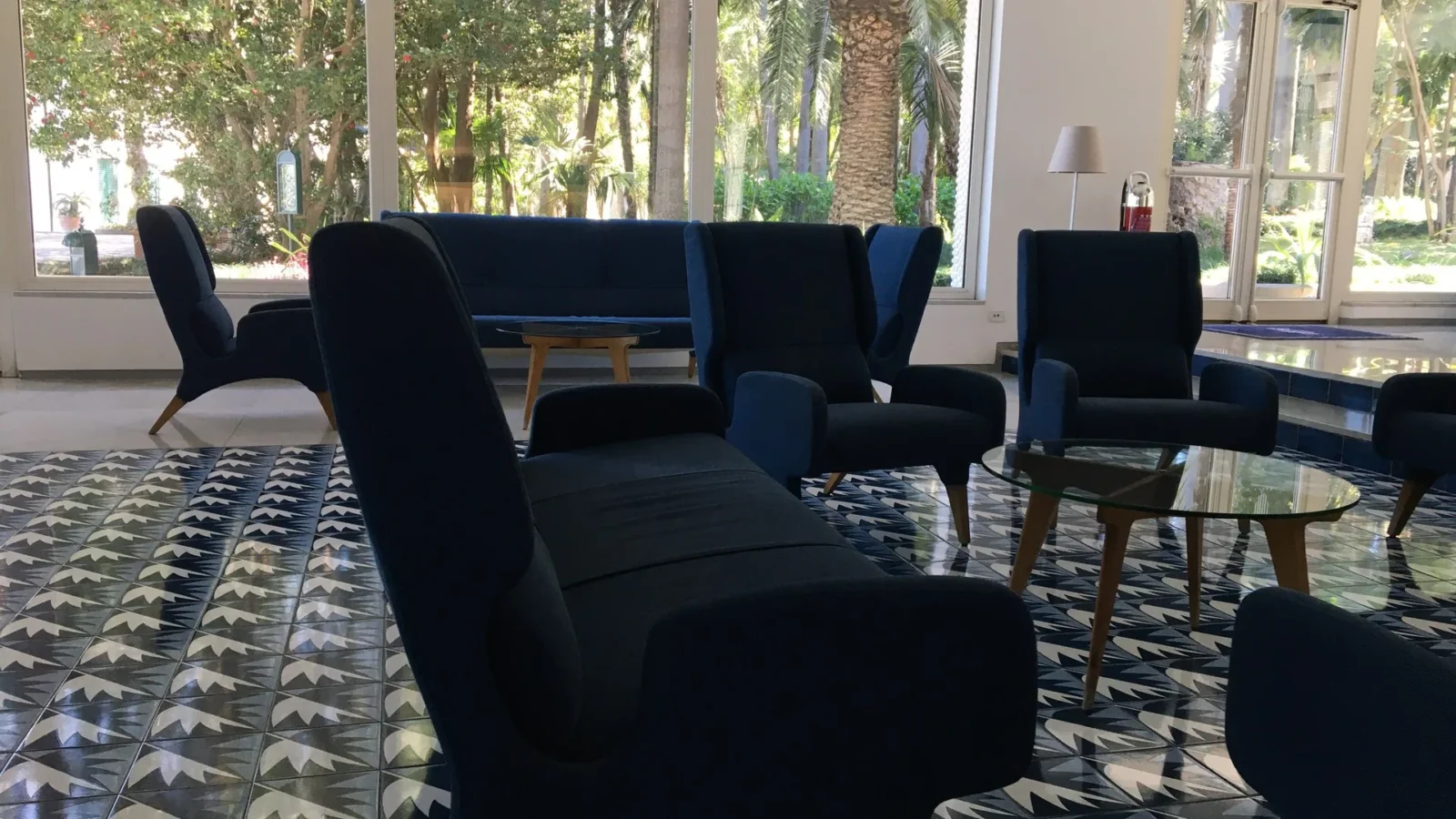
The interior design across all three properties is the work of Laboratoire Design, a studio based in Rabat. Jacques-Philippe and Christophe have overseen every detail since the original Masseria restoration — a continuity of attention that is itself part of the project’s character. Their approach does not impose. It listens. Forgotten terrazzo mixtures were researched and revived. Original Chianche stones from the old terrace were repurposed as garden paving. Old stair stones became garden benches.
The pieces they placed against that restored material are period design rather than reproduction: Sottsass, Gio Ponti, Mackintosh, Le Corbusier, Tobia Scarpa, set under original fittings and restored vaults. Nothing in the three houses pretends to be older than it is.
The Filali family and Laboratoire Design share a reference point: both come from cultures where materials are understood to carry information, where the role of the designer is to clarify what is already there. This alignment between biography and method is what makes La Fiermontina coherent across three very different buildings and two centuries of construction history.
A Stay That Moves Through Lecce
La Fiermontina creates a form of travel that unfolds through movement rather than itinerary. A guest arrives at one address and gradually enters a wider geography of houses, gardens, artworks, courtyards, interiors and streets. The stay does not remain fixed inside one hotel building. It opens through Lecce.
This is where the collection becomes relevant for contemporary Slow Travel. The experience asks for time, attention and return. It gives the city a role in the stay and allows the guest to understand place through architecture, art, family history, restaurant life and the rhythm of daily movement.
The three houses create continuity without uniformity. The Masseria, the palazzo and the museum each hold their own atmosphere. Together, they form a way of staying in which Lecce is not background. It becomes part of the hospitality structure. For four generations this was a family that left. What they opened is what happens when one of them comes back.