La Fiermontina Palazzo Bozzi Corso: Of Hollywood Glamour and Imagine Dreams
Sometimes it’s the side strands of a family history that offer surprising insights. Stories that meander off the mainstream and wait to be discovered in an old palazzo. In the heart of Lecce, with its golden facades, stands such a place: La Fiermontina Palazzo Bozzi Corso.
You remember? The stunning love story of Antonia Fiermonte, who shattered the conventions of her time. Two men who adored her, 1,001 love letters, and a bold leap over a Parisian garden wall. Her life was a novel, but the Fiermonte saga is far from over. While Antonia’s story laid the foundation, the elegant salons and suites of the palazzo reveal two more, previously little-known chapters that expand the family legacy with Hollywood glamour and the peace hymns of a pop icon.
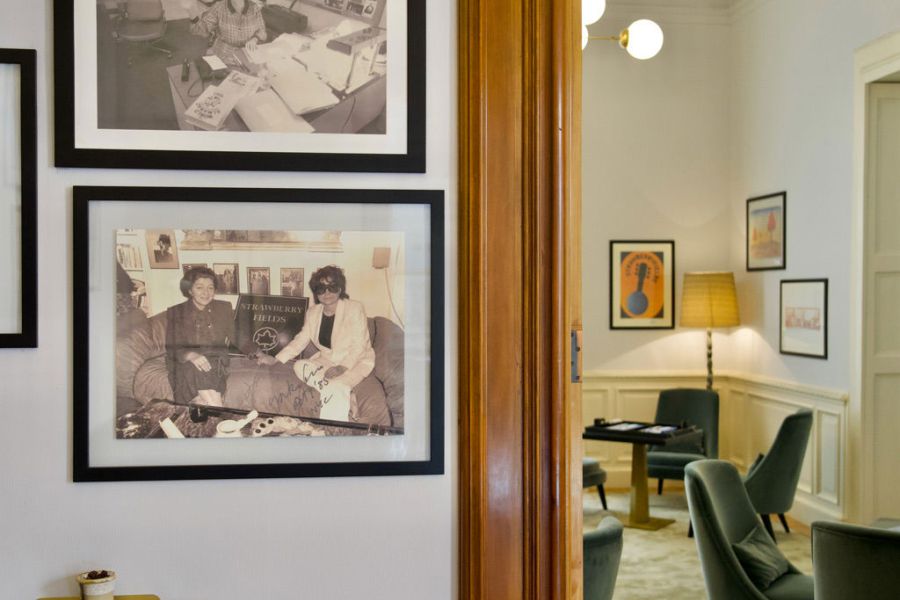
Built in 1775 and part of the La Fiermontina Family Collection, Palazzo Bozzi Corso is an aristocratic city palazzo in the historic centre of Lecce, Puglia, with ten suites named for members of the Fiermonte family biography. The palazzo is dedicated to two previously little-known chapters of the family story: Enzo Fiermonte, Apulian boxer and Hollywood actor who appeared in over 100 films after meeting Lady Astor; and Anne Fiermonte-Filali, whose friendship with Yoko Ono led her to organise the Neapolitan mosaic masters behind the IMAGINE memorial in Central Park’s Strawberry Fields. Original drawings by John Lennon, a personal gift from Yoko Ono to Anne, are displayed in one of the suites. Interior design by Laboratoire Design, Rabat.
Golden Stone: The Soul of the Florence of the South
The Palazzo Bozzi Corso itself is the first scene of the new episode. Built in 1775, it radiates restraint. Certainly, it’s due to Pietra Leccese—that soft, warm stone that is the soul of Lecce and exceptionally easy to work. It speaks of nobility that turned its splendor inward.
This stone gives the city its extraordinary, warm atmosphere and is often called the “marble of the South.” Even in Lecce, it distinguished rank within the aristocracy. Those who could afford marble were definitely higher in financial standing. As an affordable alternative, Pietra Leccese enabled Baroque masters to carve their boldest visions into filigree garlands, mythical creatures, and playful ornaments. The soft structure of the stone can literally be cut like butter.
On Palazzo Bozzi Corso itself, form was reined in, splendor directed inward. It was the residence of two aristocratic families, the Bozzi and the Corso—a place for business and discreet luxury.
A Palace as Life’s Stage
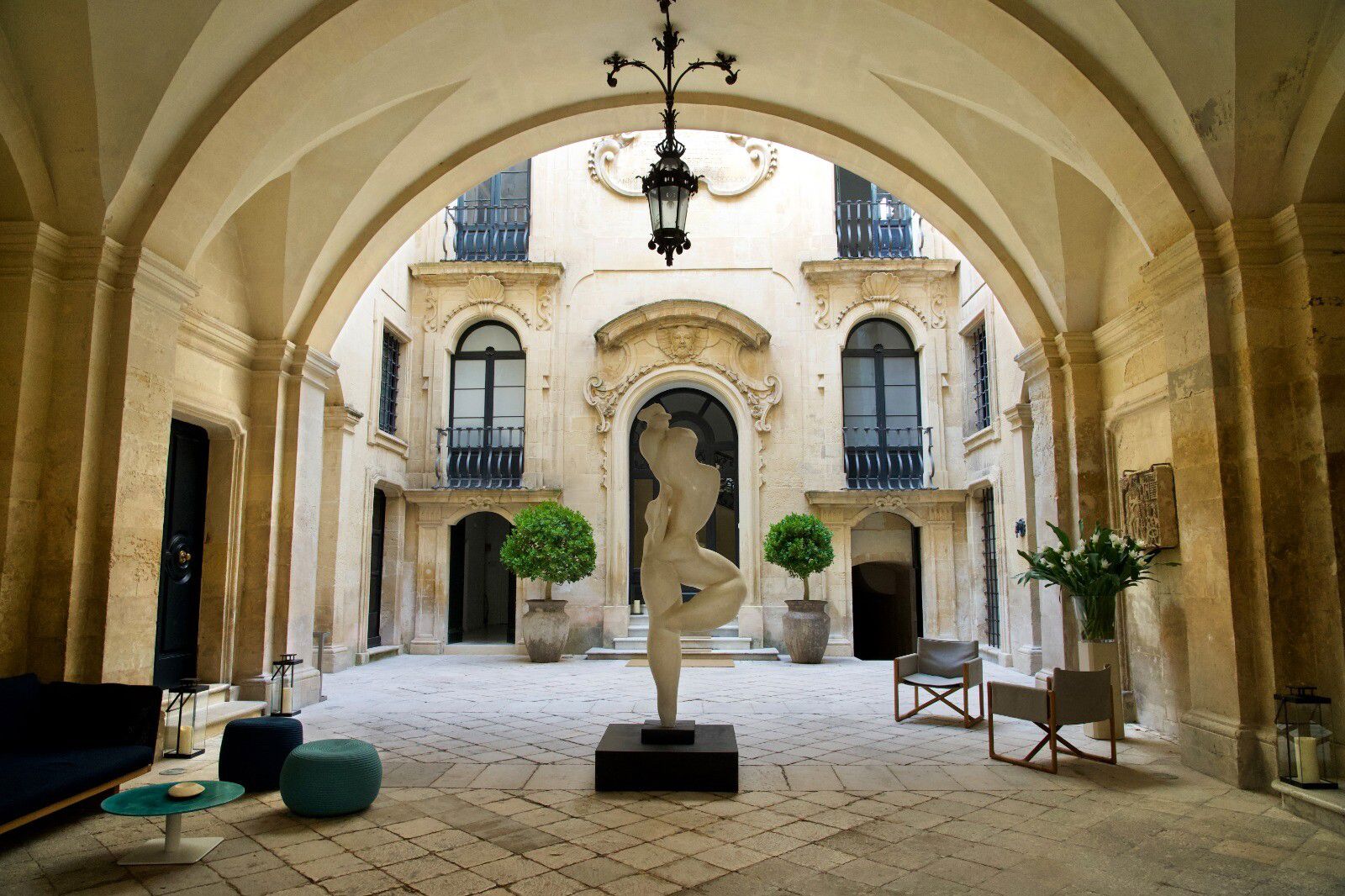
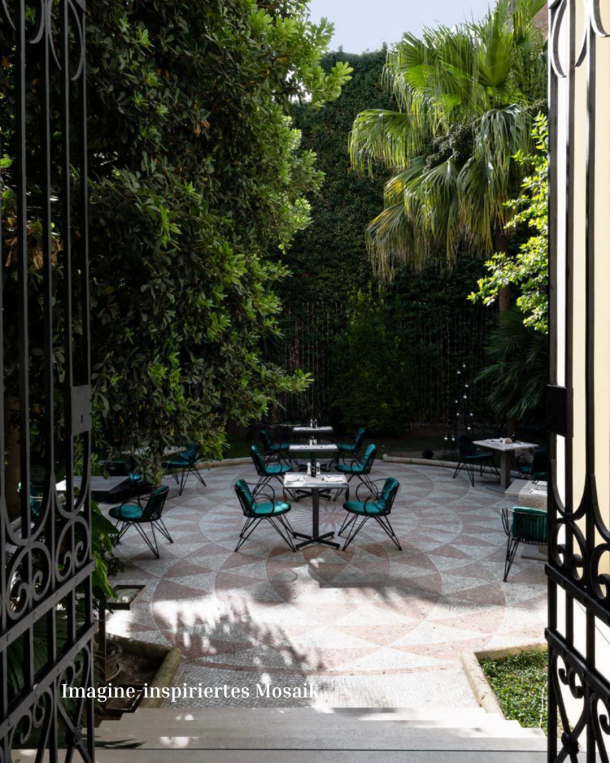
When the Fiermonte family took over the palazzo in 2018, they were originally looking for a new home in Lecce. Today it’s a temporary home. A home that, when you enter the palazzo from the narrow alley through its large heavy gate, welcomes guests in an architecturally and chromatically enchanting inner courtyard. The heavy gate closes and silence prevails. The second scene begins. In this almost intimate moment, you believe you hear a whisper from the walls, telling stories of those to whom the hotel’s rooms are dedicated today.
Where Baroque Restraint Meets Modern Serenity
Through the heavy gate from Lecce’s narrow streets, silence descends in Palazzo Bozzi Corso’s inner courtyard—an architectural sanctuary built in 1775 where Pietra Leccese, the golden “marble of the South,” glows with honeyed warmth. Vaulted arches frame a symmetrical façade where aristocratic families once turned splendor inward: carved stone garlands whisper of Baroque masters who could sculpt this butter-soft limestone into filigree ornament, yet here chose elegant restraint. A contemporary sculpture commands center stage—fluid femininity frozen in cream-toned stone, flanked by manicured topiaries in terracotta urns that echo centuries-old formality. Director’s chairs and modern seating in emerald and navy suggest this isn’t a museum but a living palazzo, where design icons by Sottsass, Gio Ponti, and Le Corbusier inhabit rooms dedicated to the Fiermonte family saga. This courtyard becomes threshold between worlds: from the bustling streets of Lecce’s historic center to an intimate theater where each suite tells stories—Enzo Fiermonte’s Hollywood glamour, Anna Fiermonte-Filali’s friendship with Yoko Ono, the “Imagine” mosaic legacy. Here, the gate closes behind you and history becomes habitable. The wrought-iron lantern overhead, the weathered stone bearing witness to 250 years, the careful placement of contemporary art—all whisper that La Fiermontina Palazzo Bozzi Corso is more than accommodation. It’s an invitation to step into narrative, to breakfast beneath John Lennon’s drawings, to inhabit rooms where aristocratic reserve meets international cosmopolitanism, where Apulia’s golden stone frames dreams of peace that began in Central Park.
Part of the La Fiermontina Family Collection
Three houses in Lecce. One family story.
The complete guide
La Fiermontina Lecce: Three Houses, One Family Story →Luxury Home
A 17th-Century Masseria in Lecce →Fiermonte Museum
When the Past Takes a Room →© La Fiermontina · The Silent Luxury
Enzo Fiermonte: From Boxing Ring to Silver Screen
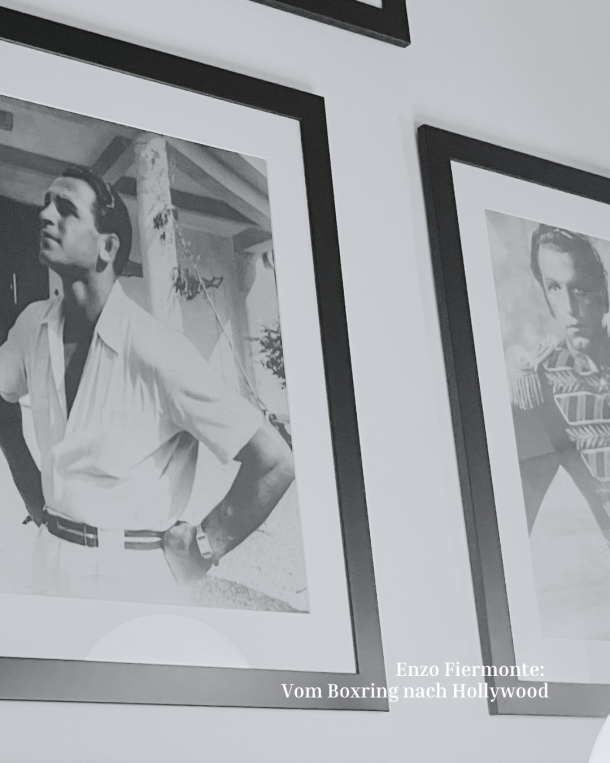
One story on the piano nobile, the main floor, tells of Enzo Fiermonte, whose life sounds like a real Hollywood script. As Antonia’s brother, he laid the foundation for an exciting career with his good looks and success in boxing.
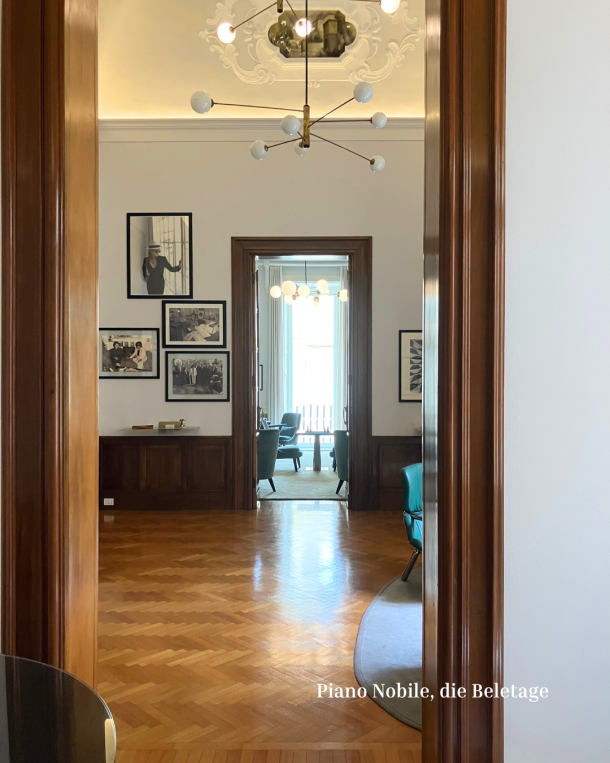
In the USA, he met Lady Astor—shimmering personality of high society and survivor of the Titanic disaster. It was an amour fou. She convinced him to hang up his boxing gloves, which can still be seen today in the bar dedicated to him. Lady Astor introduced him to the world of cinema, and he appeared in over 100 films in Italian and Hollywood productions. The bar itself is a homage to this wild ride through the 20th century, decorated with black-and-white photographs, film posters, and newspaper clippings.
Anne & Yoko: A Mosaic for Peace
Just a few meters away, you enter another world. Here, in the suites narratively dedicated to individual family members, European art history merges with American pop culture. One of the most impressive suites is that of Anna Fiermonte-Filali, Antonia’s daughter. Anne was a cosmopolitan, married to a Moroccan diplomat, her life a mosaic of travels between China, Spain, and the USA. In New York, she befriended Yoko Ono.
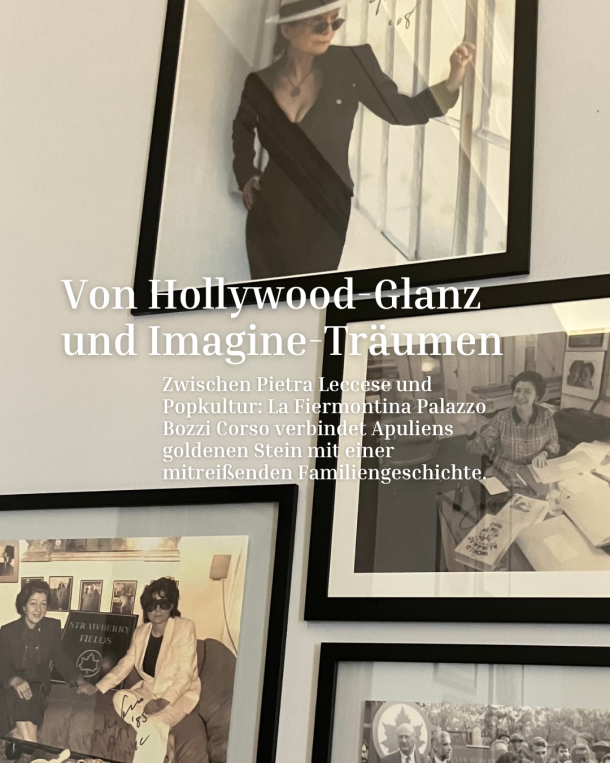
Anne supported Yoko in realizing the memorial in Strawberry Fields in Central Park. She was the one who organized the mosaic masters from Naples for the composition of the famous “IMAGINE” mosaic and involved other artists from her broad international network to create a monument that today is a symbol of peace and pilgrimage site for millions of people.
“Imagine” in the Palazzo
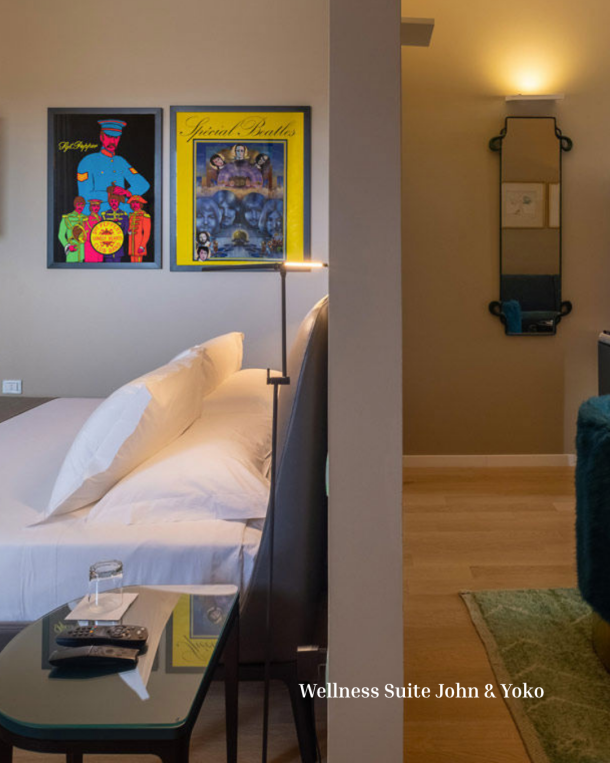
In Palazzo Bozzi Corso, this connection becomes tangible. In one suite hang original drawings by John Lennon, a personal gift from Yoko Ono to her friend Anna. In this southern Italian place, the warmth of Pietra Leccese meets the clear lines of Lennon’s pen strokes, Baroque elegance meets the universal message of “Imagine.” Thus the suite becomes a space that bridges Lecce’s history and the global dream of peace.
A Fabric of History and Design
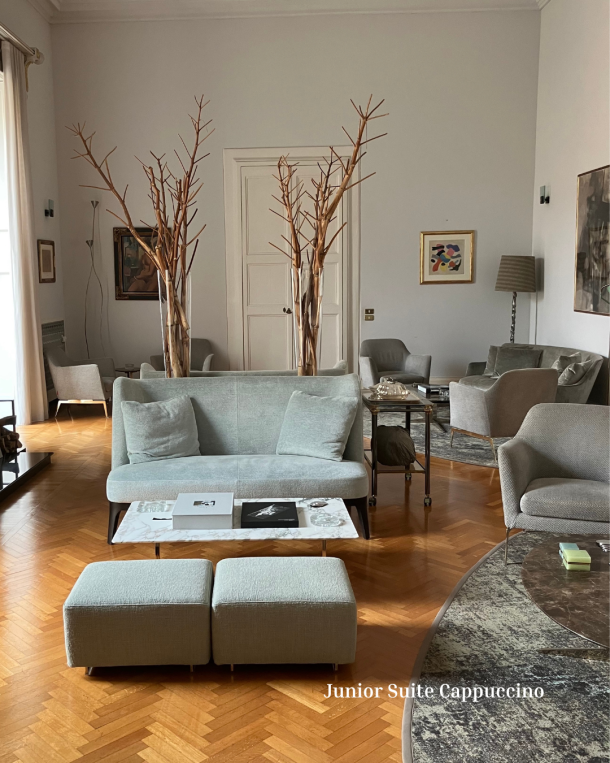
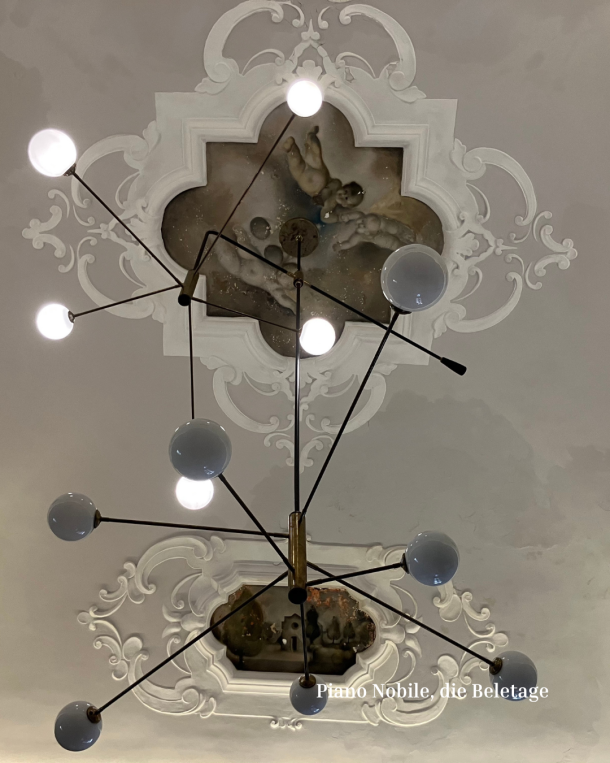
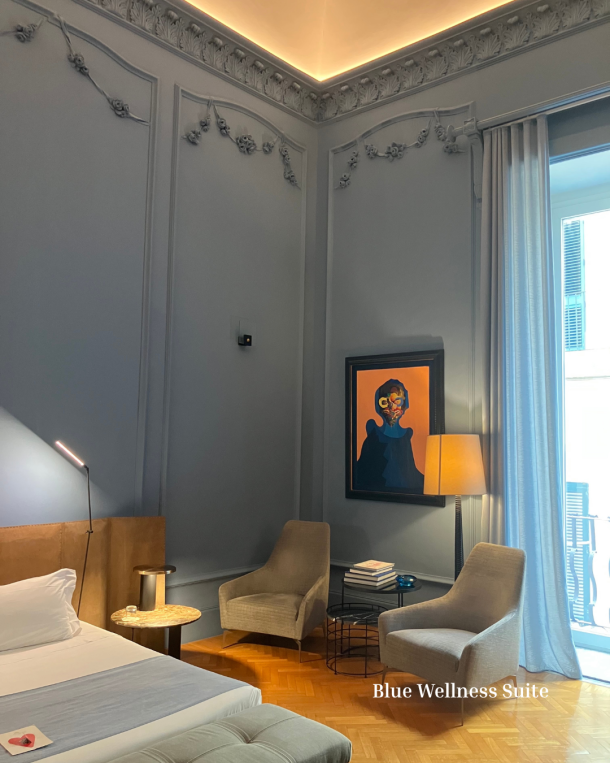
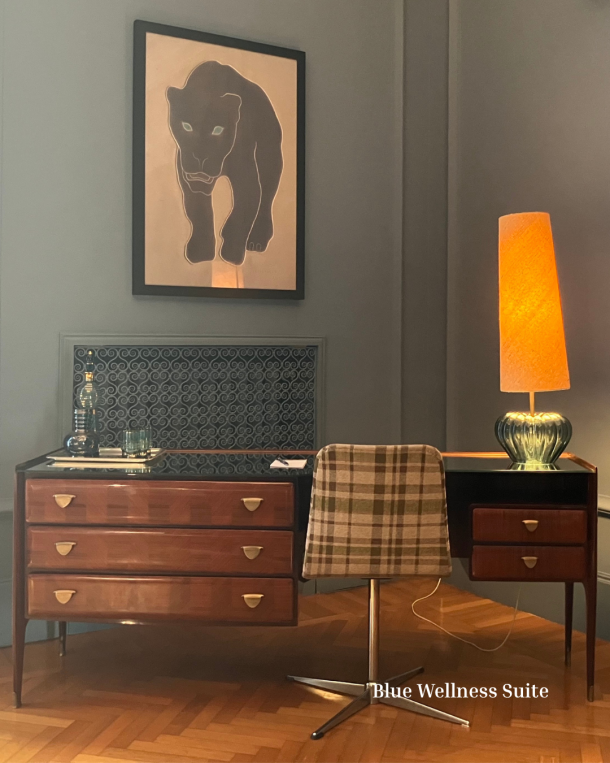
Thus everything in La Fiermontina Palazzo Bozzi Corso comes together into a greater whole. Each of the ten suites, whether dedicated to glamorous Lady Astor or the sculptors Letourneur and Zwoboda, is a thread in a rich fabric that continues to be woven. High ceilings and doors with original fittings define the rooms. The furnishings and interior architecture are classic to design according to the period’s thematic style, with important pieces by Sottsass, Gio Ponti, Mackintosh, and Le Corbusier.
A Living Legacy
A narrative fabric of stone, art, and soul that invites every guest to become part of it for a time. Palazzo Bozzi Corso brings this urban history together with family biography. Its architecture expresses an era, its furnishings reflect personal paths and international connections. Those who stay here move through rooms that are both accommodation and ongoing narrative: from boxing ring to Hollywood, from the Titanic’s deck to a breakfast table in Lecce, under which a mosaic recalls “Imagine,” and the rooftop with views over Lecce and dreamlike sunsets.
A note from The Silent Luxury
Good reading deserves to find you again.
Similar Articles
Villa Nava: The Spaceship That Became a Home
The Yellow Oil: How Saudi Arabia Turns Its Landscape into Wealth
Casa all’Italiana: Gio Ponti’s Houses, Where the Soul Finds Peace