Interview with Tanja Störchli: “The Clover Leaf Was Missing from the World of Bags”
Tanja Storchli welcomes us in her atelier in Kastanienbaum on Lake Lucerne. On the table lie leather samples, a few stones, a half-finished bag. She speaks of an autumn spent in Tuscany, of an artisan who introduced her to the traditional Tuscan art of edge finishing, and of a bird she has dedicated an entire bag model to. Anyone who meets Tanja Storchli for the first time quickly understands what CICONIIDAE stands for: haute maroquinerie handbags made to be carried for decades and passed from one generation to the next.
The Silent Luxury (TSL): Tanja, your brand is called CICONIIDAE and your new model is the Boyciana – both names come from the world of storks. For those not yet familiar with CICONIIDAE: what is behind this name?
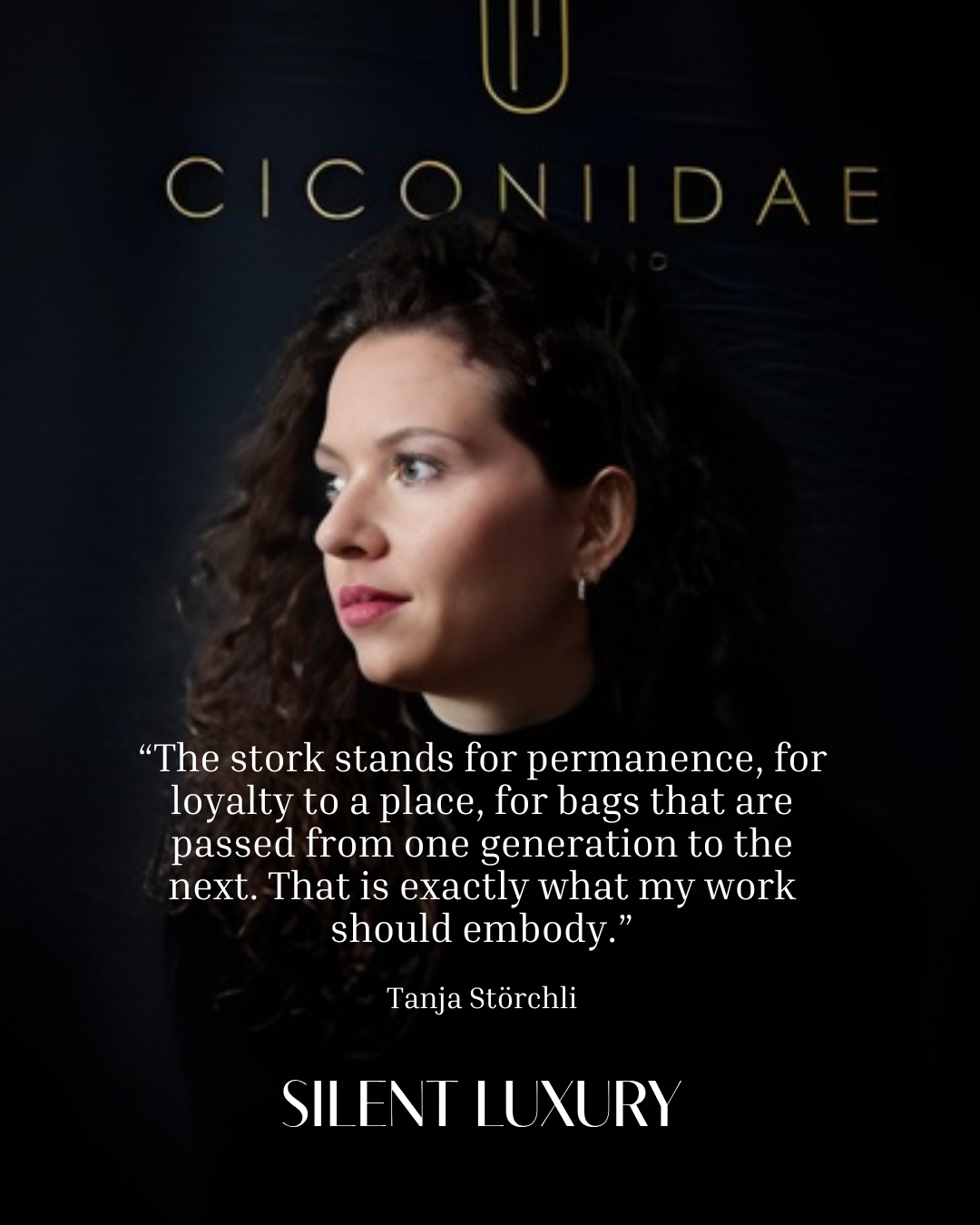
Tanja Störchli: The name was a very personal decision from the beginning. Storchli is my family name, and at some point I began to play with it: what does it actually mean, scientifically, ornithologically? And then suddenly there was CICONIIDAE, the stork family, and it felt right immediately. The stork stands for permanence, for loyalty to a place, for bags that are passed from one generation to the next. That is exactly what my work should embody. The Boyciana takes this further: it is named after the Oriental Stork, the Konotori, which has stood for dignity and longevity in Japan and Korea for centuries. A bird with a character all its own: the black bill, the pale eyes and the vivid red ring of bare skin that frames them. That distinctiveness is what I wanted to bring into the bag.
TSL: The Boyciana has a clover-leaf form. How does an idea like that come about?
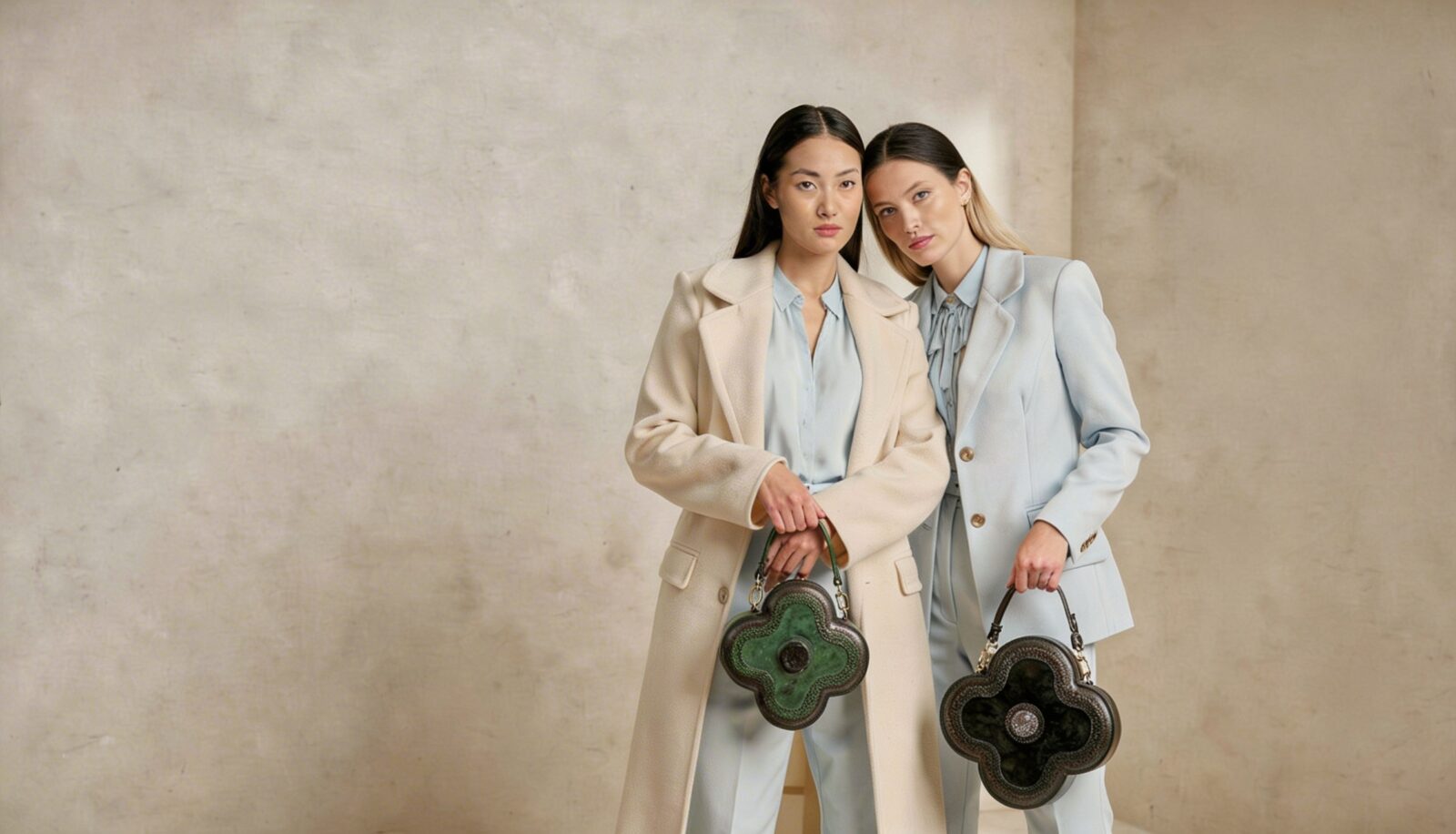
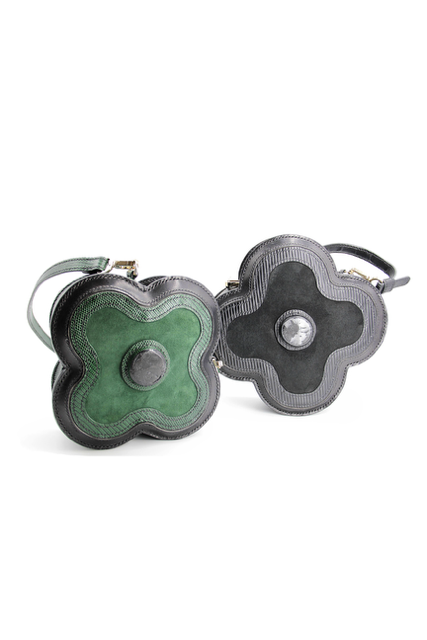
Störchli: I have always loved playing with geometric forms – that has always been the case. At some point I started connecting that with what nature offers in terms of geometry: things bound up with luck, with emotion, with meaning. Then I asked myself what exists in nature that is geometric and at the same time carries a story. The clover leaf has both, for me. It is clear in its form and has been connected with luck across so many cultures for centuries. Since the Boyciana came into being, I keep encountering this form everywhere – in architecture, in churches and cathedrals. It is fascinating to see how a geometry rooted in nature reappears in such different contexts. And when I realised that this form did not yet exist in the world of bags, that was the moment to take it seriously. I feel the clover leaf was missing there.
TSL: A year of development. What occupied you most during that process?
Störchli: The proportions. That may sound unremarkable, but it really is the heart of the entire process. Where does the opening sit, how does the bag behave in movement, how does it stand when you set it down? Should it be more sculptural or softer? You draw, visualise in three dimensions, wear it, adjust, wear it again. And then you carry out a wear test and realise something still is not quite right, and you start again. It is a genuinely long process – a year, with everything that entails. But that is precisely where you discover whether a piece truly works. Whether it comes alive on the body and is equally beautiful simply standing on a shelf.
TSL: You spent time in Tuscany in autumn 2025 to deepen your knowledge of manual edge finishing. What do you take away from visits like that?
Störchli: For me, Tuscany was both a development and an inspiration. It fundamentally changed how I look at the material. I spent days there trying to understand a single technique. The edge is built up layer by layer, through shaping, pressure and drying times that can stretch over several days. There are different approaches: a Japanese edge finish, for example, which uses no edge paint at all and is created purely through friction and pressure. These traditional techniques require time, precision and a deep understanding of the material. They are rarely found in industrialised production today, which is exactly why it matters to me to engage with them and carry them forward in my own work.
TSL: The wearer shapes the Boyciana entirely herself. How do you experience these encounters in your atelier?
Störchli: They are truly the most beautiful moments. When someone comes in and we go through everything together – which leather inside, which outside, which thread, which stone – you can feel how personal it becomes. Someone holds a leather in their hands and says: yes, that is it. Or they look at a stone and feel a connection immediately. You notice how much someone reflects on herself while she is choosing. And in the end she holds something in her hands that is truly hers and will never be made again, because the combination is unique.
“These traditional techniques require time, precision and a deep understanding of the material. They are rarely found in industrialised production today, which is exactly why it matters to me to engage with them and carry them forward in my own work.”
Tanja Störchli
TSL: How do you select the gemstones you offer?
Störchli: First by provenance and certification – that is non-negotiable for me. All the stones come from certified mines; I source them through Switzerland and they originate from Asia, Africa and Brazil. But then the selection is very intuitive. I take each stone in my hand, turn it, hold it to the light. There are stones that trigger something immediately: a presence, a clarity, a warmth. And each stone carries its own meaning. Rose quartz stands for love, tenderness and self-acceptance – legend has it that it is a gift to humanity, to radiate harmony. Red tiger’s eye stands for inner strength and willpower and is worn as a talisman in many cultures. Malachite, the green stone with its wave-like rings, stands for transformation and self-realisation and was used as a protective stone in ancient Egypt. I offer more than twenty different stones. And it is usually precisely the stone that truly fits when you feel that pull towards it.
TSL: Do the stones also have a connection to star signs?
Störchli: Yes, very much so – it is a beautiful way in. Each stone has its own qualities and many can be connected to particular star signs. Carnelian, for example, for Virgo. It is often a wonderful starting point for clients who are not yet sure which stone they want to choose. It opens a conversation, and from that conversation the right stone almost finds itself.
TSL: You once said the Boyciana is like a painting, even when it is simply standing and not being worn.
Störchli: I am very drawn to objects that are beautiful even when they are not in use. When the Boyciana stands on a shelf, it still draws the eye: the clover leaf, the stone at the centre, the composition of materials. When I was designing it I thought very carefully about how it stands, how it looks when it is simply there. Almost like a sculpture. I personally always see it, even when I am not wearing it, and that is a feeling I find very beautiful.


The Geometry of Connection: Co-Creating the Boyciana
True exclusivity is born from participation. The Boyciana by CICONIIDAE is not merely an accessory, but a collaborative masterpiece that only reaches completion through its wearer. While the architectural clover-leaf silhouette offers a striking presence, its soul lies in the “Craft of Patience”—a 50-day manual process in Tanja’s atelier at Kastanienbaum, Switzerland, the edges are built up layer by layer and every saddle stitch is set by hand with absolute precision.
This journey invites you to become a co-creator: from selecting the central gemstone—the symbolic “nest”—to choosing from a curated palette of Italian deadstock leathers and fine thread colors. By harmonizing traditional artisanal mastery with your personal intuition, each Boyciana becomes a singular, unrepeatable icon of craftsmanship designed to last a lifetime.
TSL: Why do you work exclusively by hand?
Störchli: Because the result is different. You can feel whether a stitch was set by hand or by a machine. That is not romanticism – it is reality. And it is also about respect: for the material, for the animal and for the traditional techniques that have been passed down across generations. I want my bags to carry that care. That is why I travel to Tuscany, why I choose deadstock over uniform materials, and why every closure is made in Switzerland. All of that together produces a piece you can feel.
TSL: What do you hope for when someone holds the Boyciana for the very first time?
Störchli: That she pauses for a moment. That she takes in the scent of the leather. That she touches the stone, feels the leather and the edge, and understands what has come into being there. And I hope she feels: this was made only for me. This will accompany me.
The Boyciana: The full story
The Boyciana Trilogy: Tanja Störchli on clover-leaf geometry, the craft of patience and the stone that almost chooses itself. And everything you need to know before you compose yours.
The Moment of Landing
A rare stork from East Asia, a Tuscan workshop and the new CICONIIDAE model that invites its wearer to co-create it from the very first touch.
Co-Creation of Boyciana
Timelessly crafted. Individually composed: The Boyciana is a clover-leaf handbag from the world of haute maroquinerie, geometric and nature-inspired, launched in mid-February 2026.
The Origin of Dignity
Insights into the Symbolism, Heritage, and Creative Vision of Tanja Storchli: Deeply rooted in the iconography of East Asia and the heritage of the Storchli family, the Boyciana represents more than design—it represents a philosophy of longevity. The following section clarifies the cultural significance of the Oriental Stork (Ciconia boyciana), the meaning of the central gemstone “nest,” and the artisanal values that define the CICONIIDAE narrative.
The name is derived from Ciconia boyciana, the Oriental Stork, which has been a symbol of dignity and longevity in Japan and Korea for centuries. CICONIIDAE, the brand name, is the scientific designation for the stork family and simultaneously pays homage to the founder’s surname, Störchli.
While closely related, the Oriental Stork possesses distinct features: a black bill, pale eyes, and a vivid red ring of bare skin framing them—contrasting with the red bill and dark eyes of the European White Stork. This clarity of silhouette inspired the geometric design of the bag.
The gemstone represents a “nest”—a point of focus, rest, and presence within the geometric clover-leaf shape. It is a signature element of Tanja Störchli’s design, creating an intuitive connection between the artisanal object and the personal story of its wearer.
Every Boyciana is handcrafted in the artisanal workshop of Tanja Störchli, in Kastanienbaum, Switzerland. The decision for this location was based on the region’s centuries-old tradition in leathercraft and the shared commitment to the “Craft of Patience” and traceable provenance.
Similar Articles
Lacoste’s CEO Change and the Promise of the Crocodile
The Silver Heel Tab and the Swoosh: Alexandre Arnault Joins Nike’s Board

Anton Rupert Moves Up at Richemont as the Rupert Succession Takes Shape