Botswana Doubles Down on De Beers at the Bottom of the Diamond Market
Botswana will double its stake in De Beers to 30 percent, President Duma Boko told parliament on 9 November, Reuters reported. Boko said the country would become the company’s “single largest shareholder”, according to Bloomberg. Most of De Beers’ diamonds come from its mines, and Botswana is raising its bet on natural stones at the bottom of the market. With the larger stake, Botswana takes on the part of the trade it has long left to others: the cost and the risk of making the world want a diamond.
The increase is part of the bid by the Global Diamond Consortium for Anglo American’s 85 percent of De Beers. The group is led by Gareth Penny, chief executive of De Beers from 2006 to 2010, and counts Namibia and Angola among its members. In the same speech, Boko said the consortium had been selected as the preferred bidder. Anglo American said it was encouraged by the progress and is working on binding agreements. The final documents are still unsigned. The price, the timetable and the stakes for Namibia and Angola have yet to be disclosed. Richemont, the owner of Cartier, and the American jeweller Signet were reported in October to be in talks to join, a step that would bring jewellers back to the mine. Both companies have kept silent on the reports.
Botswana is buying at the bottom on three levels at once. The company costs a fraction of its 2012 price. Botswana’s own economy shrank last year, and the mining slump is a major reason. And a mine sits on the lowest rung of the chain that turns a rough stone into a ring.
The Price at the Bottom: De Beers Ownership at a Discount
Botswana’s bigger stake in De Beers comes at a fraction of the company’s 2012 price, and that discount is the strongest argument for buying now. Fourteen years ago, Anglo American paid 5.2 billion dollars for 40 percent of De Beers. The deal valued the whole business at about 13 billion. After three write-downs in three years, Anglo carries it at 2.3 billion. The consortium is negotiating a price of about one billion dollars for the 85 percent, Bloomberg reported in July. Of that, 750 million would be due on completion and 250 million later, with earn-outs on top. Around 500 million more would go into the company as fresh capital.
Each earlier step bought Botswana a larger share of the income from its own ground. The company that became Debswana, the state’s mining partnership with De Beers, was founded on 23 June 1969, with the government holding 15 percent. Sir Seretse Khama opened Orapa in July 1971, and Sir Ketumile Masire opened Jwaneng in 1982. Botswana took 5 percent of De Beers itself in 1987 and 15 percent in 2001. “Diamonds have become the backbone of our economies,” the former minister Gaositwe Chiepe is quoted as saying in Mmegi’s history of Debswana’s first 45 years.
The doubling announced this month buys a larger share of the company that sells those diamonds. De Beers held its prices steady at a small sight in October, the third sale in a row without a change. One sightholder told Rapaport that “the last reliable source [of rough] is about to be sold, [so] you may want to know what’s happening.” In July, the diamond analyst Paul Zimnisky called buying De Beers a “high risk/reward purchase.” For Botswana, the reward shows in the price. The risk sits in the national accounts.
A note from The Silent Luxury
Good reading deserves to find you again.
Buying Into a Downturn: Botswana Diamonds and the Budget
Botswana is doubling its exposure to diamonds after two years in which the stones pulled its economy into contraction. Mining value added fell 47 percent in the fourth quarter of 2025 from a year earlier. The economy shrank 5.4 percent in that quarter and 0.7 percent across the year, after a fall of 2.8 percent in 2024. Diamonds bring in about a third of government revenue and around three-quarters of foreign-exchange earnings. The slump went straight into the budget. Mineral revenue for 2025/26 was revised to 12.06 billion pula, against 15.75 billion budgeted. The February budget speech forecast 12.21 billion for 2026/27.
The strain shows across the public accounts. The deficit reached 7.25 percent of GDP in 2024/25. In September 2025, the International Monetary Fund put public debt at more than 30 percent of GDP. On 13 March 2026, S&P cut Botswana’s rating from BBB to BBB-, with a negative outlook. In the weeks before Boko’s speech, weaker diamond sales and foot-and-mouth disease in the cattle herd squeezed the budget further. Spending has moved the other way: the old-age pension has risen from 800 to 1,400 pula. In May, Boko called for “bold institutional reform” and a “radical simplification of processes.”
For and Against: Boko, the IMF and Botswana’s Bet
The case for the purchase rests on timing and control. A state that buys at a low price gains if diamonds recover. Boko has framed the deal as a question of sovereignty from the start. “It’s a matter of economic sovereignty for Botswana,” he said in October 2025. Bogolo Joy Kenewendo, the minister of minerals and energy, said in June that Debswana accounts for 90 percent of the country’s diamond sales. She promised: “We are going to continue to be disciplined.”
The case against rests on concentration. A budget that already rises and falls with one stone ties itself more tightly to it, and a long slump in prices would now cost twice as much. The IMF made that case in December 2025, when it advised Botswana against a larger stake in De Beers, citing strained public finances and the country’s heavy dependence on diamonds, according to Mmegi. Boko answered days later at a kgotla meeting in Kanye: “The IMF are not Batswana, they are not voters.” In the same remarks he said that “diamonds are not selling due to the process being used.” He wants De Beers to move its headquarters to Botswana. Both cases hold up on the numbers. The route to 30 percent shows how Botswana weighed them.
Sovereignty at the Table: Who Owns De Beers After Botswana’s Bid
After the bid, Botswana would own 30 percent of De Beers, with the rest shared among Namibia, Angola and private investors in proportions not yet disclosed. It reached that figure by negotiating down from a claim to majority control. In October 2025, Boko spoke of majority ownership. A month later he told parliament that “concrete steps are underway towards the acquisition of Anglo American’s shares in De Beers.” In October 2026, Bloomberg reported talks on a stake of around 25 percent. In that model, private investors would hold 51 percent and the three producer states 49. On 9 November the figure became 30. If the three states stay at 49 percent, Namibia and Angola would share about 19 percent between them, against roughly 24 percent in the October version. Whether the private majority still stands remains open.
Botswana’s partners argued for restraint from the start. In February, Paulo Tanganha, Angola’s national director of mineral resources, said his country wanted 20 to 30 percent. He explained the ceiling: “Taking the majority stake within luxury commodities is very dangerous because it depends on the market.” He added a saying: “Together we are stronger.” In October 2025, Angola’s minister Diamantino Azevedo had said that “De Beers’ future depends on remaining a private-sector-led, global company.” Namibia’s cabinet backed a push for 10 to 15 percent in 2025. An official told Mmegi: “We are interested, but there remain concerns about our financial capacity to afford a stake.”
Statute and Seizure: Mali, Burkina Faso, Niger and Congo
Further north, governments have pursued the same goal by statute and by seizure. Mali’s 2023 mining code allows the state and local investors up to 35 percent. Barrick’s Loulo-Gounkoto gold complex stood closed until a settlement of 430 million dollars in November 2025. Burkina Faso’s 2024 code raised the state’s free stake from 10 to 15 percent. The government also nationalised the Boungou and Wahgnion gold mines. Niger nationalised Somaïr, the uranium mine run by France’s Orano, and in August 2025 the Samira Hill gold mine. In the Democratic Republic of Congo, the state miner Gécamines holds 20 percent of Tenke Fungurume. It has used its offtake right to sell 100,000 tonnes of copper to American buyers.
These are African answers to one question: who keeps the value of what lies underground. The Sahel answers it by law and by seizure, Kinshasa through the sale of the metal. Gaborone answers it with a share register, negotiated with a London-listed miner, two neighbours and private money. Botswana’s route takes patience and shares control. It also leaves the country holding a company, with everything a company has to do to earn its keep.
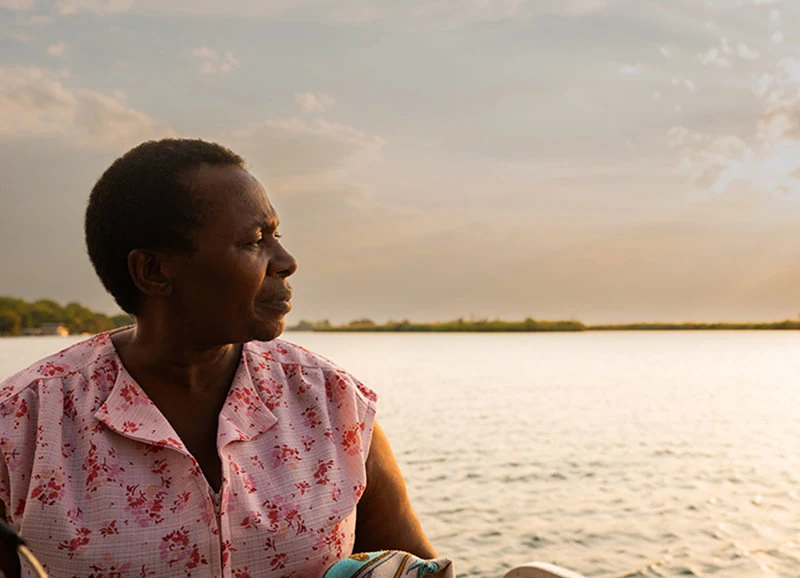
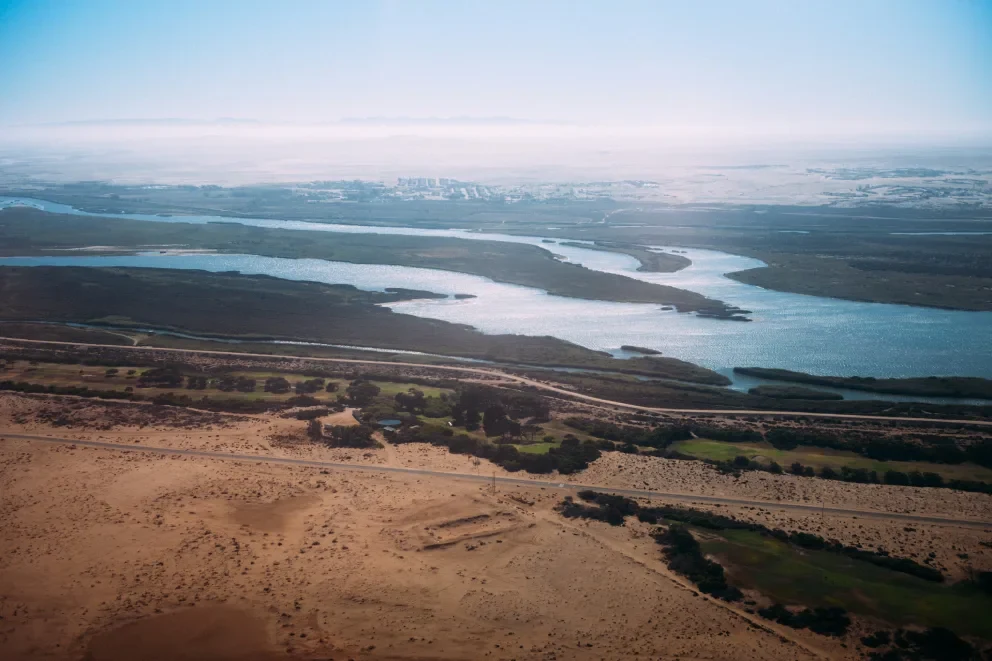
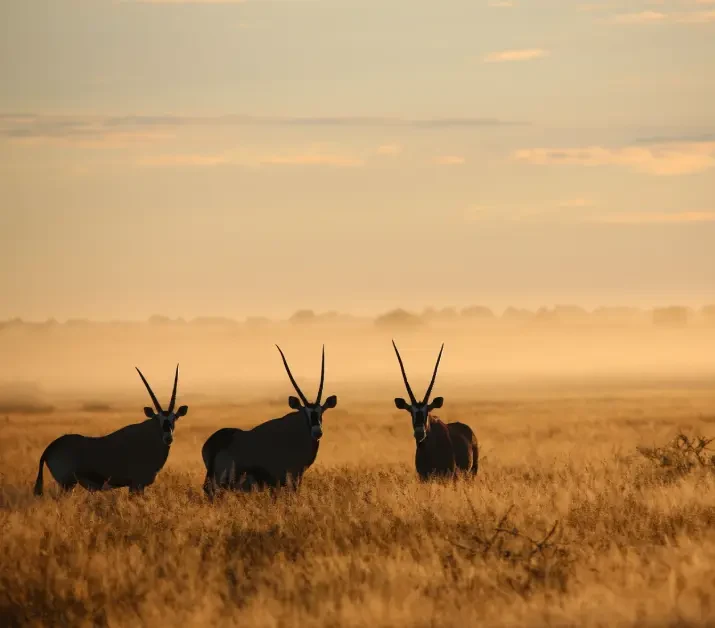
Evening by the water. · A river through the desert, Namibia. · Oryx at dawn. Courtesy of De Beers Group.
The Bottom of the Chain: De Beers Ownership and the Cost of Desire
As a larger owner of De Beers, Botswana moves closer to the part of the trade where most of a diamond’s value is made, and to the cost of creating demand for it. Figures presented by DTC Botswana in June put exploration and mining at about 14 billion dollars. Sorting and sales come to 18 billion, and cutting and polishing add a further 34 billion. The jewellery market at the end of the chain reaches about 75 billion. The mine is the smallest link. “Botswana has not fully taken advantage of these opportunities, but immense potential lies ahead,” said Serty Leburu, the managing director of DTC Botswana.
Botswana has begun to move along that chain. Under the sales agreement signed in February 2025, the state’s Okavango Diamond Company already sells 30 percent of Debswana’s output, a share that rises to 50 percent if the deal is extended. Every carat Okavango sells itself is a carat whose price Botswana sets and whose risk Botswana carries. When the deal was announced, Kenewendo said she hoped the agreements would “bring some level of stability and rebuild market confidence in the diamond industry.” A 30 percent stake in De Beers extends that exposure to the company that markets the rest.
Paying for Desire: The Diamond Collective and Lab-Grown Stones
The producer countries have also started to pay for desire themselves. In Luanda in June 2025, Botswana, Angola, Namibia, the Democratic Republic of Congo, South Africa and others agreed to put 1 percent of their diamond revenue into joint marketing under the Natural Diamond Council. On 22 September 2026, the council relaunched as The Diamond Collective under Amber Pepper. Its Diamond Desire Index tracks the United States, India and China, the markets where the map of jewellery is being redrawn. At an industry conference in February, Penny said that reviving demand for natural diamonds could take 200 to 300 million dollars in marketing.
The rival they face has fallen in price and grown in reach. Wholesale prices for lab-grown diamonds have dropped 96 percent since 2018, according to the analyst Edahn Golan. Among American couples who married in 2025, lab-grown stones made up 61 percent of engagement-ring centre stones. Natural rough has fallen too: De Beers’ average realised price dropped 32 percent to 105 dollars a carat in the first half of 2026, and it fell further in the third quarter. Joshua Freedman of Rapaport said: “The diamond industry has a solid future, but at a smaller scale.”
That smaller industry will be run in larger part by the countries that hold the ground, and they answer to voters. In Namibia, the government and De Beers each own half of Namdeb Holdings. Kennedy Hamutenya, Namibia’s former diamond commissioner and the founding chief executive of Namib Desert Diamonds, said in February: “Diamonds fund schools, hospitals, roads and social programmes. Synthetic diamonds do not.” With 30 percent of De Beers, Botswana moves closer to the decision behind that sentence: the moment a couple chooses a stone from the ground. The country is buying at the bottom, and what it buys is a share of that choice.
Send this to someone who wonders who will own the diamond trade next.
Continue Reading
-
Who Owns Puma and Hugo Boss Now: Germany’s Brands Shift to Retailers and Brand Builders
Puma’s largest shareholder is now Anta Sports of China, which bought 29.06 percent from Artémis, the Pinault family’s holding company, for €1.51 billion in October 2026. In the same month Frasers Group raised its stake in Hugo Boss to 50.08 percent.
-
A Mirror Set, a Blue-Green Diamond, a Journe: Four Records and One Rule
Across four salerooms in the first half of 2026, collectors paid record sums for Claude Lalanne mirrors, the Ocean Dream diamond, an F.P. Journe watch and a Hockney. The four results share one rule: the market paid for what each object could prove, its provenance or the scarcity written into it.
-
The Counter Becomes a Vault: What Japan’s Jewellery Record Actually Measures
Sales of gems, precious metals and artwork at Japan’s department stores rose 19 percent to 330 billion yen in the first half of 2026, the highest figure since records began in 2008. With the yen near 164 to the dollar, Japanese households have begun converting savings into gold and stones.
Sources:
Reuters via CNBC Africa, Botswana will increase stake in De Beers to 30%, president says, 9 November 2026;
Bloomberg, Botswana Agrees to Raise De Beers Stake, Easing Anglo’s Exit, 9 November 2026;
Finimize, Botswana is set to become De Beers’ biggest shareholder, 9 November 2026;
Rapaport, De Beers holds prices steady at small October sight, 2 November 2026;
Inc., the former De Beers chief betting on a natural diamond comeback, 30 July 2026;
Rapaport, De Beers trims losses amid price stabilisation, 30 July 2026;
Bloomberg via Swissinfo, Richemont and Signet in talks to join bidder for De Beers, 15 October 2026;
The Botswana Gazette, Botswana eyes 25% as luxury giants jostle for De Beers ownership, October 2026;
Mmegi, Still sparkling, forty-five years on, 14 November 2014;
Reuters via BusinessDay, Mining slump a major reason for Botswana’s shrinking economy, 31 March 2026;
allAfrica, Botswana’s economy, rating and reform agenda, 26 May 2026;
Government of Botswana, 2026 Budget Speech, 9 February 2026;
International Monetary Fund, 2025 Article IV mission to Botswana, 26 September 2025;
allAfrica, SONA 2026: Boko walking a tightrope, 3 November 2026;
Mmegi, Boko and Angola on De Beers ownership, 2 October 2025;
Mmegi, Boko rebuffs IMF on De Beers’ pursuit, 17 December 2025;
MarketScreener, Botswana weighs larger stake in De Beers as Angola also signals interest, November 2025;
Mining Weekly, Botswana seeing soft recovery in diamond demand, minister says, 23 June 2026;
Reuters via Mining Weekly, Angola seeks 20 to 30% stake in De Beers, 9 February 2026;
Mmegi, Namibia’s cabinet and the Luanda marketing agreement, 18 November 2025;
SWP, Resource nationalism in the Sahel, 21 April 2026;
Mining Indaba, State mining companies and mineral sovereignty, 9 September 2026;
allAfrica, DTC Botswana on the diamond value chain, 30 June 2026;
Government of Botswana and De Beers Group, Diamond partnership for the next generation, 27 February 2025;
PR Newswire via Newsis, Natural Diamond Council relaunches as The Diamond Collective, 23 September 2026;
JCK, Lab-grown wholesale prices, 10 August 2026;
The Namibian, Namibia faces fiscal pressure as synthetic diamonds devalue natural market, February 2026;
Namdeb Holdings, Information Booklet, July 2026.
Similar Articles

Chinese Skincare Brands: The Plant at Home, the Lab in Paris

Who Owns Puma and Hugo Boss Now: Germany’s Brands Shift to Retailers and Brand Builders
Puig Bets on Fragrance as the Middle of the Luxury Market Gives Way