In the first half of 2026, four objects set records across four salerooms: fifteen Claude Lalanne mirrors from the Yves Saint Laurent collection sold for 33.5 million dollars at Sotheby’s, the Ocean Dream diamond for 17.3 million at Christie’s, an F.P. Journe watch for 13.9 million at Phillips, and a David Hockney for 2.42 million pounds. The four results share one rule: the market paid for what each object could prove, its provenance or the scarcity written into it.
In the first half of 2026, a set of fifteen mirrors that had not changed since 1985 sold for 33.5 million dollars, having fetched 1.8 million euros in 2009. A blue-green diamond took 17.3 million, more than double its 2014 price. A watch by an independent maker almost nobody knew sold for 13.9 million. The objects held steady. What the market paid for was the case each one could prove: provenance, or scarcity written into the thing itself.
Between 1974 and 1985, the sculptor Claude Lalanne made fifteen mirrors for the music room of Yves Saint Laurent and Pierre Bergé, each framed in gilt bronze with leaves she cast from her own garden. When Christie’s sold the Saint Laurent and Bergé collection in 2009, Terry de Gunzburg, who had run the beauty division at Yves Saint Laurent and created the Touche Éclat concealer, bought the ensemble for 1.8 million euros. On 22 April 2026, Sotheby’s offered the same fifteen mirrors again. They sold for 33.5 million dollars, a record for the artist and the most valuable design sale Sotheby’s has held, after ten minutes of bidding among five collectors. The mirrors had not changed. The sum the market would pay for the line of names behind them had.
That gap, between an object that stays the same and a price that multiplies, is the story of the first half of 2026. Global auction sales at Christie’s, Sotheby’s and Phillips rose 70 per cent year on year to 6.8 billion dollars including fees, the best opening half since 2022, according to the analysts ArtTactic. The figure looks at first like a simple return of confidence. The salerooms themselves tell a narrower story, one about what kind of object now commands the top price, and it reaches across categories that rarely get considered together.
Alexandre Ghotbi has spent his career inside that shift. A deputy chairman at Phillips and head of watches for Europe and the Middle East, he puts the rising prices down to a change in what a collector understands an object to be. Collectors have grasped that a watch is far more than something worn to tell the time, he says, that it sits on the level of a work of art, and that understanding has driven both the desire and the prices.
The scale of that understanding is easy to plot in his own field. Auctions for collectible watches began only in the late 1980s, and roughly forty years passed before a wristwatch first sold for around ten million dollars, a 1940s Patek Philippe, in 2016. Paul Newman’s Rolex Daytona followed a year later at about seventeen million. In the first six months of 2026, Phillips alone sold five watches above ten million. Two years ago, Ghotbi says, a million was an event; today a million is a lot of money that impresses nobody, and watches now play in the same league as art.
The object stays the same, the price does not
What drives those sums, for Ghotbi, is never the object alone. Nobody buys a 1950s car for its engine, he says, but for its history, its rarity and its meaning, and a watch answers to the same rule. At the highest level no one bids on the movement.
The mirrors carry the plainest version of that rule, because they let the market price the same object twice. Christie’s realised 1.8 million euros for them in 2009. Sotheby’s realised 33.5 million dollars for them in 2026, more than double the high estimate of 15 million. Between the two sales the bronze did not move. What had been rewritten was the market’s willingness to pay for a single unbroken line of ownership, from Saint Laurent and Bergé to the de Gunzburgs, a provenance a buyer can name and verify.
Two kinds of rarity in the jewellery room
Provenance is one source of that value. Scarcity written into the object itself is the other, and the jewellery week in Geneva showed the second in its purest form. On 13 May, Christie’s offered the Ocean Dream, a 5.5-carat triangular-cut stone that the Gemological Institute of America records as the largest fancy vivid blue-green diamond it has ever graded. Blue-green saturation of that grade forms only under natural radiation near the earth’s surface, which places a stone of this size beyond the reach of any owner’s history to manufacture. It sold for 17.3 million dollars after twenty minutes of bidding among three collectors, a record for its type, and close to 3.5 million dollars a carat.
The same stone carried the two forces at once. Christie’s had sold the Ocean Dream once before, in 2014, for 8.6 million dollars, after it had appeared in the Smithsonian’s Splendour of Diamonds exhibition in 2003. Its 2026 price more than doubled that figure. Scarcity set the floor, and a traceable history lifted it from there.
The name on the dial matters less
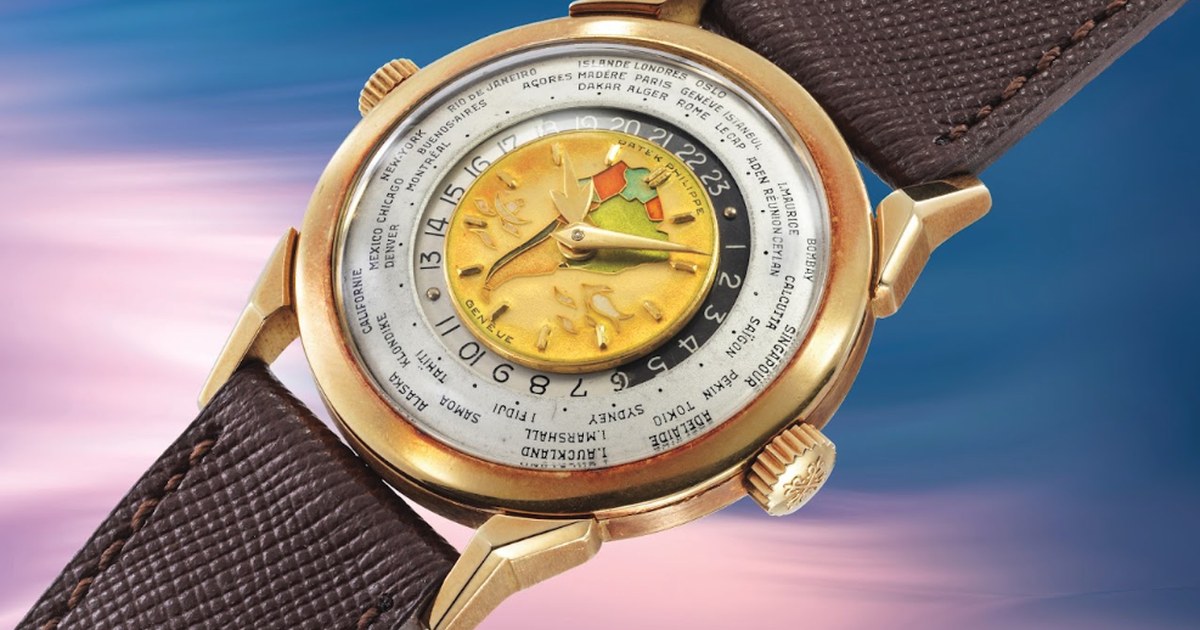
The clearest proof of Ghotbi’s point came from his own saleroom. On 13 June, Phillips New York sold the F.P. Journe Souscription Résonance No. 007 for 13.9 million dollars, the top lot of the season across every auction company in the world, and the highest price ever paid for a watch by an independent maker. Journe built the piece early, when almost nobody outside a small circle knew his name. Traditionally the big collectors bought the established brands, Ghotbi says, Rolex and Patek Philippe above all; with the new generation it has come to matter far less than the watch itself, and a piece from a small independent nobody has heard of no longer means a weak sale.
The generation driving that change, Ghotbi says, has pulled the older collectors along with it, and it bids from a widening set of regions, the Middle East and Asia strongly present alongside Europe and America. The salerooms’ own numbers point the same way. Alongside art, still the largest category at both Christie’s and Sotheby’s, luxury has become the second stream and the main route to younger buyers. Christie’s luxury sales rose 15 per cent to 539 million dollars in the half, carried in large part by watches.
What the summer confirmed
The death of David Hockney in June tested how firm the pattern had become. Hockney, whose Californian swimming pools count among the most reproduced images of the twentieth century, had held the record for the most expensive work by a living artist since 2018. A death often lifts an artist’s prices, because no new work can follow. When Phillips offered The Only One with Waves two weeks after he died, the lift did not come. The painting took 2.42 million pounds, the value the work already held. The room paid for what Hockney had made, and declined to pay a premium for the fact of his death.
For the second half, Ghotbi expects no wild swings, only more of the same discipline. The market showed incredible strength in the first six months, he says, and short of a serious shock to the world economy he sees it staying on this track, with collectors still chasing the exceptional piece, whether an old Rolex or a modern watch from a maker of thirty a year that almost nobody has heard of and that still sells for five million euros.
The four objects that defined the half share nothing in material. A set of mirrors, a diamond, a watch, a painting. What they share is that each one could prove its case. The mirrors proved a line of ownership, the diamond proved a scarcity fixed in the earth, the Journe proved that a maker of thirty pieces a year could outbid a maison that makes thousands, and the Hockney proved that the market would pay for the work and not the event. The name stamped on the object decided less than it once did. The case the object could carry decided more.