Hackett on Savile Row: Graham Simpkins and the Suit That Outlives Its Owner
In the early 1980s some of the best-cut suits in London changed hands on Portobello Road, at a stall run by two young men who had noticed something the high street preferred to overlook. Jeremy Hackett and his partner, Ashley Lloyd-Jennings, bought old English suits and sold them on, and their keenest customers came from the City: young men on their first salaries who had worked out that a good second-hand suit would serve them better than a new one from Marks & Spencer.
Hackett knew what he was handling. He had worked on Savile Row in the 1960s, and the coats on his rails carried the cut of an older London in their shoulders and their seams. When the pair opened a shop on the King’s Road in Chelsea in 1983, it sold second-hand clothes, and it sold them so quickly that the supply of good old suits ran dry. So they began to make their own, in a second shop next door, with what Hackett later described as no business plan, no marketing plan and no money.
That beginning matters more than its charm suggests. A company founded on clothes that had already outlived one owner has spent four decades making clothes meant to outlive the next, and its most patient answer to that ambition now sits across London in Mayfair, behind a window at No. 14 Savile Row, where Graham Simpkins runs the cutting table.
Hackett Began on Portobello Road and Now Belongs to a Group in Madrid
Hackett London is a British menswear house founded in 1983 by Jeremy Hackett and Ashley Lloyd-Jennings, and its owners have changed rather more often than its shoulders. Richemont held the company until 2005, when it passed to the Spanish investment firm Torreal. Today it belongs to AWWG, the Madrid group that used to be called Pepe Jeans, and runs more than 160 stores around the world. There is a pleasing symmetry in the address of its present owners, since Madrid was where Hackett opened its first shop outside Britain, in 1989.
So what makes a house British when its owners sit in Spain? Dan Slater, Hackett’s Chief Retail Officer, who ran one of its flagships himself in 2001 and now decides where the house opens next, gives an answer made entirely of manners. “Britishness at Hackett is defined by design ethos, silhouette, attitude, and visual humour rather than geographic manufacturing origin,” he told The Silent Luxury. The shoulder carries the passport, in other words, and the wit carries the accent. For the proof, the house keeps an address on Savile Row.
A note from The Silent Luxury
Good reading deserves to find you again.
At No. 14 Savile Row, Hackett Kept the Queen’s Bathroom and Put Its Tailors in the Window
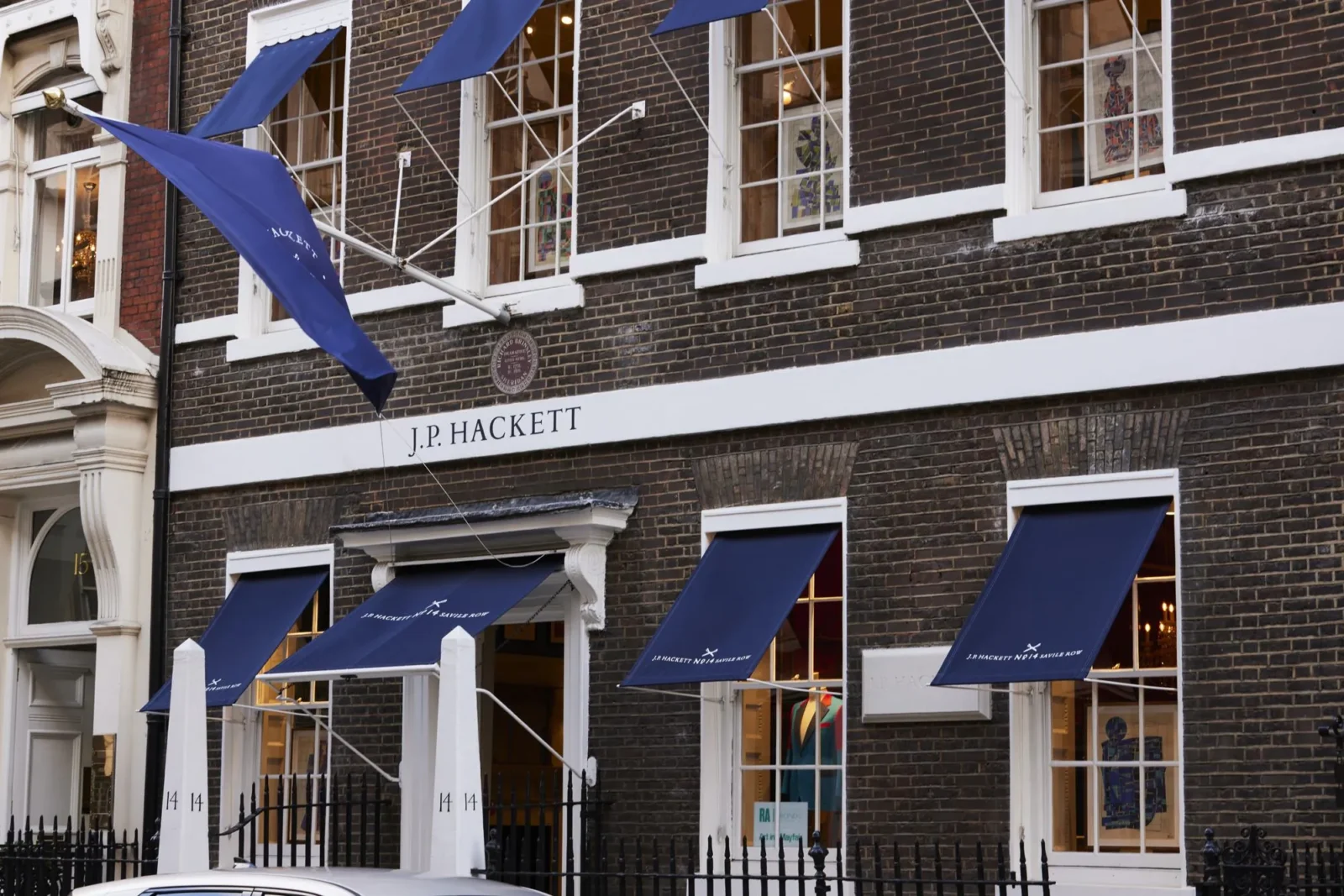
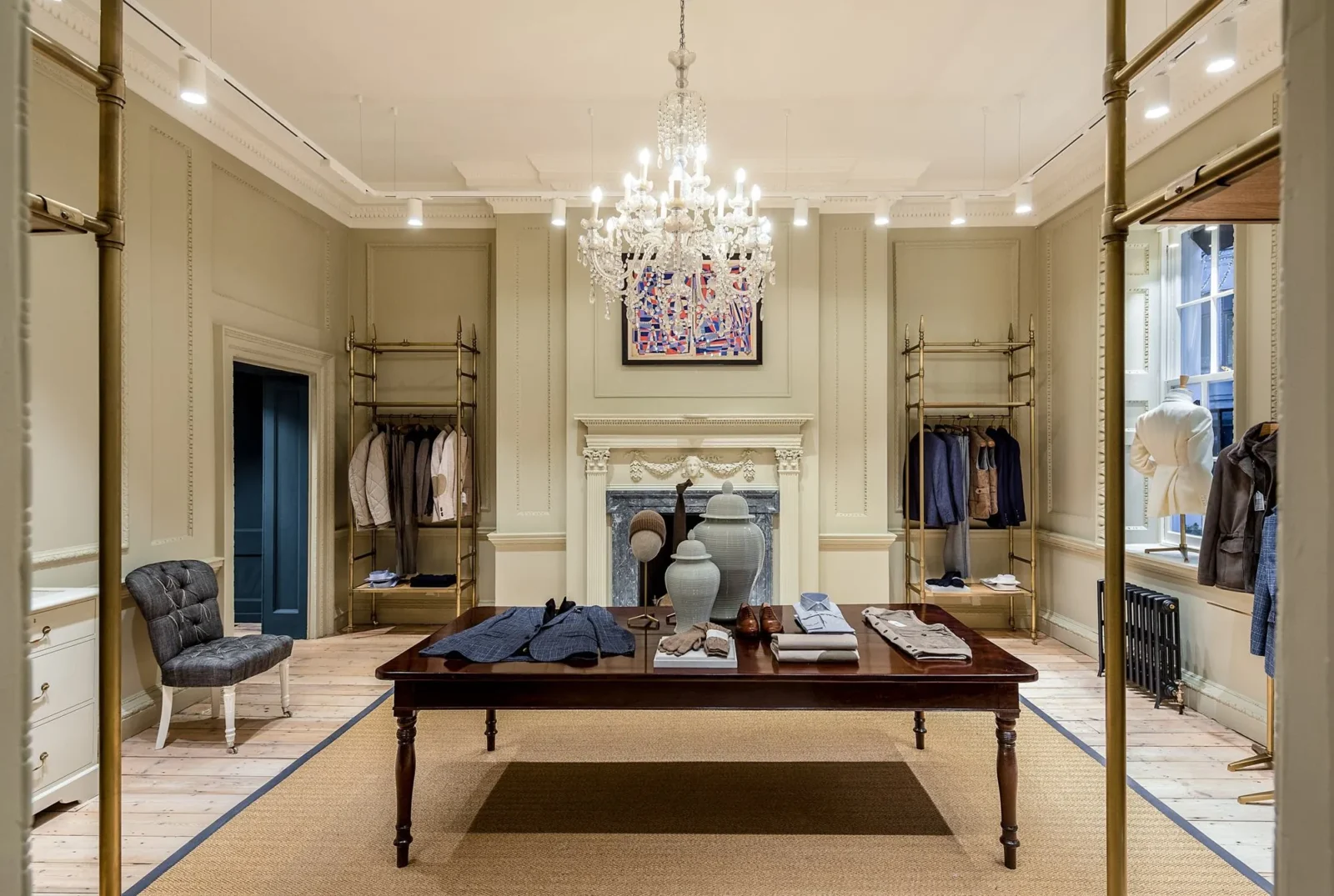
No. 14 Savile Row was the house of the couturier Hardy Amies from 1946 until March 2019, and it still contains the bathroom he installed in the 1950s for Queen Elizabeth II. Hackett took the building in June 2019 and opened it that November, with interiors by Jeremy Hackett and the designer Ben Pentreath. A cocktail bar arrived, and a club room for members. The bathroom stayed exactly where it was, which tells you a good deal about the house’s sense of what to keep.
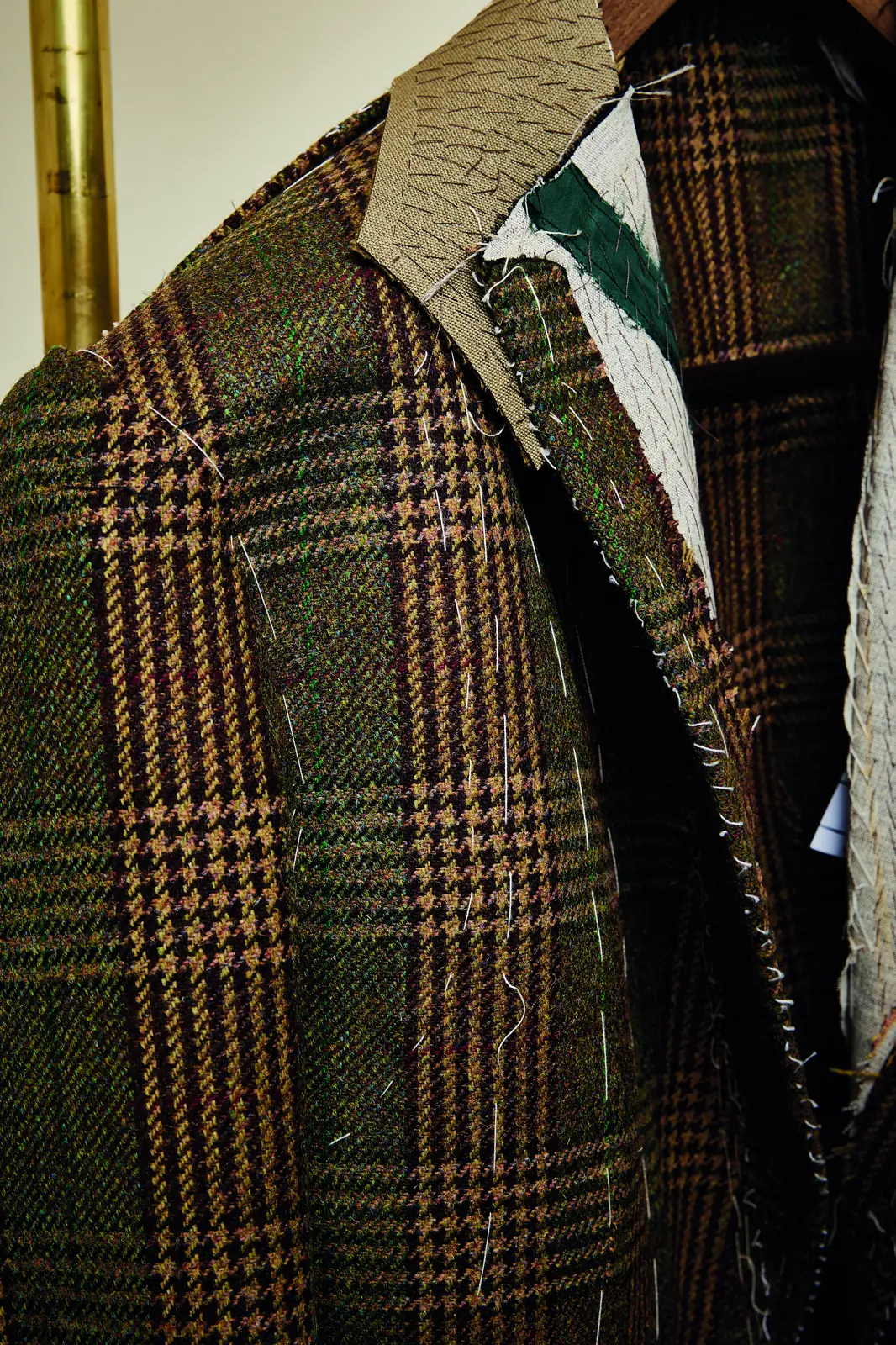
Before the first coat was cut, Jeremy Hackett sat down with Graham Simpkins, now the house’s Head of Tailoring, and gave him a brief that fitted on a single line. “We were to create a bespoke team of exceptional quality, where the focus was all about the quality of the cut, make and finish of each and every garment made,” Simpkins recalls. Finding those people took, in his words, “an awful lot of interviews.” The team he assembled works in full view. Anyone walking down the street can stop at the window and watch suits being sewn by hand, and inside, the cutter stands on the shop floor among men who came in for a shirt.
Slater has watched what that does to them. A customer who wandered in for something casual “witnesses the precision, time, and skill involved in suitmaking,” he says, and leaves with a different idea of everything else on the rails. The street outside has been making the same argument for two centuries, on a single block of Mayfair that bespoke tailoring has called home since the early nineteenth century.
Graham Simpkins Recuts a Client’s Pattern for Life and Keeps the Changes to Himself
A bespoke pattern at Hackett is drafted once and then quietly revised for the rest of a client’s life, until it becomes a kind of biography of the man it belongs to. “The original draft of the pattern for one of our customers’ commissions is just the beginning of the journey,” Simpkins says. As a client changes shape, the cutters adjust his measurements and recut the paper. It costs the workshop hours and the client a longer wait, and the conversation about it is kept admirably short.
Simpkins puts the principle in a sentence that could hang over the door of every workshop on the Row: “The tape measure will never lie, but the tailor will never talk.” Beneath it lies a smaller kindness. When a regular client orders a new suit, the cutters build in a little extra room, “especially around Christmas time, just in case.” A man may wear that suit for twenty years and owe his comfort each December to a decision taken quietly on his behalf. At No. 14, discretion is cut into the cloth along with everything else.
Suit Cloth Has Fallen From 14 to 9 Ounces, and the Canvas Inside Has Changed With It
Simpkins learned his trade as a trainee at Austin Reed, the outfitter that closed all its stores in 2016 after 116 years, and in his first years a typical suiting cloth weighed around 14 ounces. Thirty-five years later he puts the average at about 9. Ask him why, and the first answer is disarmingly ordinary: air conditioning has become an everyday thing. The modern man spends his days in offices, aircraft and hotel rooms held at the same mild temperature all year, and his cloth has followed him indoors. Wool itself has grown scarcer in the world’s wardrobe along the way, slipping to 0.7 per cent of the world’s fibre in 2025 while polyester went on climbing.
Lighter suiting cloth has consequences for the part of a jacket its owner rarely thinks about. Inside a good coat sits a canvas of horsehair and linen that floats between the cloth and the lining and slowly takes the shape of its wearer’s chest. Simpkins calls the chest piece “so important to the feel, the way it fits, and more importantly the way it moulds to your body along the journey with you owning it.” A heavy canvas would drag a 9-ounce cloth out of true, so every commission at No. 14 is given a canvas weighed against its cloth, and the cutters ask how a suit will be worn before they decide what goes inside it. In bespoke, the question of how a man lives is a technical one.
Hackett’s tailoring shares this principle with an altogether different British craft. At Rolls-Royce, Ieuan Hatherall designed the Ghost Savile Row outward from an embroidered lining hidden beneath the rear armrest, beginning with the detail its owner would discover last. A Savile Row coat is built on the same principle, from its hidden layer outward, and how a bespoke suit is made, layer by layer, deserves a story of its own.
Since 2008 Anyone in Britain May Call a Suit Bespoke, So Hackett Keeps Three Kinds of Tailoring Apart
On 18 June 2008 Britain’s Advertising Standards Authority considered an advertisement by Sartoriani London that called a machine-cut, machine-sewn suit bespoke, and found no breach of its codes. With that, a word that had meant a pattern drafted for one man became available to anyone with a sewing machine. Simpkins describes himself as “exceptionally conscious” of the fact. “We do not hide behind smoke and mirrors,” he says, and Hackett keeps its tailoring in three clearly labelled tiers.
Personal Tailoring, offered in 28 of Hackett’s key locations around the world, produces a machine-made, half-canvassed garment with a choice of details inside and out. Made-to-Measure, offered in a selection of stores, delivers a suit with a full canvas. Bespoke is made entirely by hand at No. 14, by appointment or at trunk shows abroad, and Simpkins’ team gives each suit a minimum of a hundred hours. Demand currently holds the workshop at a twelve-week lead time, and he has a theory about why. A few years ago, he says, “we were all living in tracksuits and jumpers,” and men are now restocking their wardrobes with something like relief, velvet included.
Some things at No. 14, Simpkins insists, stay exactly where they are. On white tie, a man follows the invitation to the letter, because “one would never wish to insult the host.” And he keeps close one line from Jeremy Hackett himself: “Formal dress is not fancy dress.”
Dan Slater Learned That a Hackett Shop Works Best on a Smaller Scale
Dan Slater has spent a quarter of a century with Hackett, and his most candid answer concerns square metres. In the years of fast expansion, he says, the house “misjudged store footprint by overestimating how much square footage was needed to project brand authority.” The large, multi-floor shops of that era diluted the intimate, club-like atmosphere on which the brand depends. Hackett has since withdrawn from secondary markets, concentrated its money on prime European flagships and moved into tighter, more carefully composed rooms. “It was painful to exit established locations,” he says. “I would make the exact same choice today.”
Hackett’s yardstick for a shop changed with the rooms. Slater now counts client lifetime value and repeat visits ahead of the sale on the day, on the reasoning that a fitting or a haircut builds a relationship that pays out later in bespoke orders or online. Before he signs off on a new city, he walks the surrounding streets at different hours to see whether Hackett’s customer fits the rhythm of the place. It is the method of a man who once ran a shop floor himself, and in Dan Slater’s full conversation he follows the idea from No. 14 to the smaller shops beyond it.
Graham Simpkins Hopes a Hackett Jacket Will One Day Return to a Second-Hand Rail
Simpkins has trained a great many tailors over his career and admits that he is still learning. Two makers can do exactly the same job, he says, and the padding on the chest or the collar will sit a little differently, because every pair of hands carries its own habits. Those habits pass from older makers to younger ones over four to six years of apprenticeship, at whatever pace a maker’s skill and drive allow. His own counsel to them is brief: “It takes twice as long if you get it wrong.”
Asked which single bespoke suit a man should own, he answers without a moment’s hesitation: a very deep navy, two buttons, single-breasted, nothing shiny, with the slightest texture in the cloth. Worn with a roll neck, it goes to dinner. With a shirt and tie, it goes to the meeting. He has a name for the man who owns it: “the one suit wardrobe man.”
Then he looks forty years ahead, to a Hackett jacket hanging in a second-hand shop, found the way Jeremy Hackett once found his stock, with a name sewn inside and the year it was made. “It would bring everything full circle,” Simpkins says. The moment is easy enough to picture. A young man takes the jacket from the rail, slips it on and feels the canvas settle against his chest the way it once settled against someone else’s, and in that small surrender the suit begins its second life.
Send this to someone who owns one good suit.
Further Reading
-
Savile Row: One Block of Mayfair, Two Centuries of Bespoke Tailoring
Savile Row is the Mayfair street laid out from 1731 by the third Earl of Burlington and named after his wife, Lady Dorothy Savile. Henry Poole, Huntsman and Anderson & Sheppard built English bespoke tailoring there, where a two-piece suit still takes fifty to a hundred hours of hand work.
-
Rolls-Royce Ghost Savile Row: Ieuan Hatherall on Designing From the Inside Out
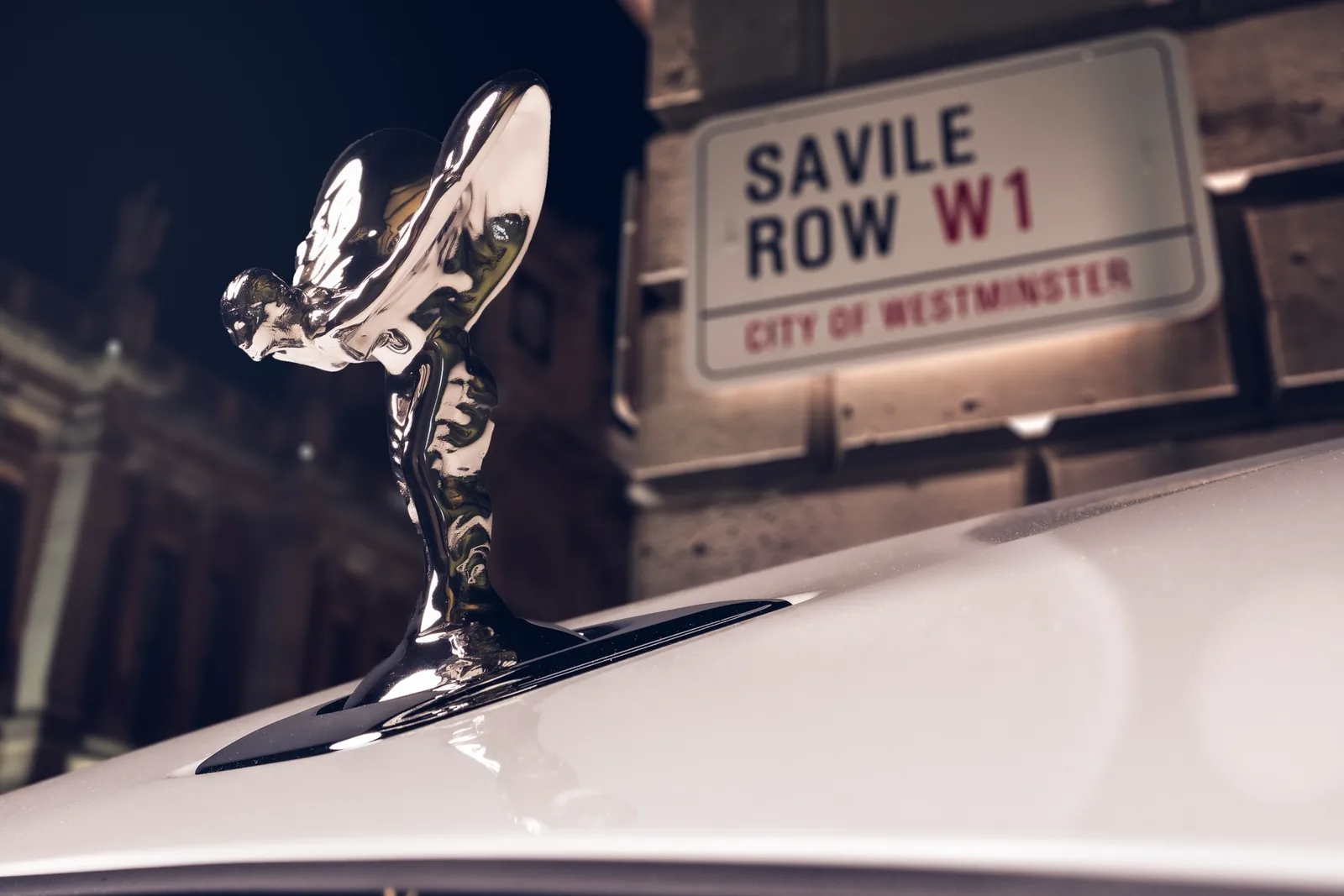
The Rolls-Royce Ghost Savile Row is a one-of-one Ghost Extended that Bespoke Designer Ieuan Hatherall designed outward from an embroidery hidden under the rear armrest. The lining carries 250,000 stitches in seven colours.
-
McQueen Is Home Now: London Tailoring Shapes the House’s Next Chapter
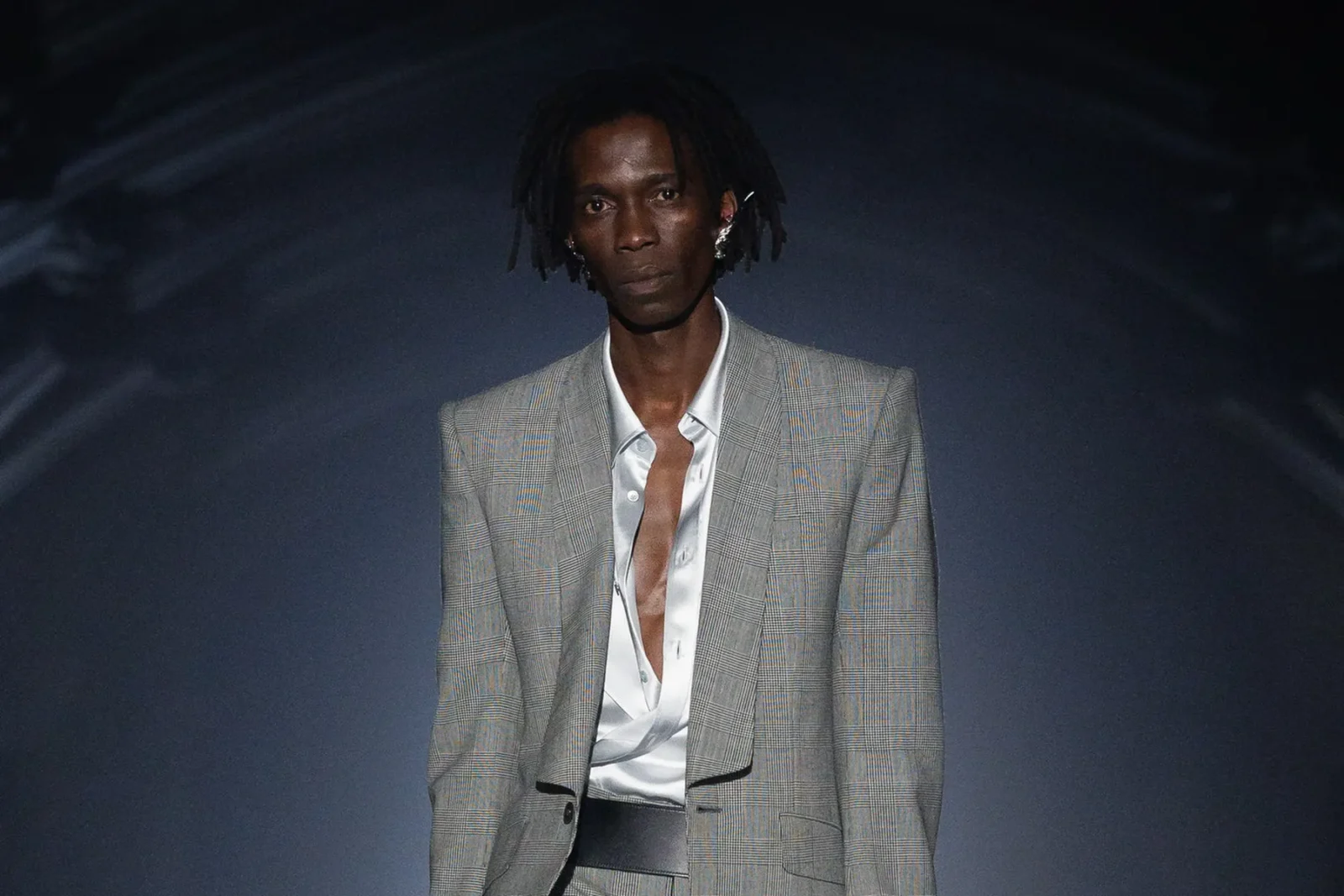
Alexander McQueen returned to London Fashion Week on 20 September 2026 for the first time since 2001, with Seán McGirr’s Spring/Summer 2027 show and three bespoke men’s looks made by Huntsman.
-
Global Fibre Production Hits a Record 139 Million Tonnes, and the Growth Is Fossil
Global fibre production reached 139 million tonnes in 2025, according to Textile Exchange. Polyester rose to 82.5 million tonnes, while wool held at about one million tonnes and slipped to 0.7 per cent of the world’s fibre.
Sources
- Graham Simpkins and Dan Slater, interviews with The Silent Luxury, October 2026
- Hackett London: Our Story
- Luxury London: Jeremy Hackett interview
- Wikipedia: Hackett London
- Modaes: Pepe Jeans becomes AWWG
- FashionNetwork: Hackett opens Savile Row townhouse with bespoke focus (2019)
- Permanent Style: The ASA ruling on the word bespoke (2008)
- Wikipedia: Bespoke tailoring
- The CFO: Austin Reed collapses after 116 years (2016)
Similar Articles
McQueen Is Home Now: London Tailoring Shapes the House’s Next Chapter
Rolls-Royce Ghost Savile Row: Ieuan Hatherall on Designing From the Inside Out

Armani Without Giorgio: The House Opens a New Chapter