
Ibrahim Mahama at the Fondation Cartier: A Ghanaian Factory Rebuilt in Paris
The Ghanaian artist Ibrahim Mahama has rebuilt a bottle factory from his country’s first years of independence inside the Fondation Cartier in Paris. His exhibition The Harvest Season opened on 22 October in the foundation’s new home on Place du Palais-Royal, a 19th-century building converted by Jean Nouvel, and runs until 28 February 2027. At its centre is Things Fall Apart, made from the Aboso Glass Factory in southern Ghana, which opened in 1966, the year President Kwame Nkrumah was overthrown.
The plant had been abandoned. Mahama bought the site in 2024 with funds from the Fondation Cartier, dismantled it and rebuilt sections in Paris and in his studio in Tamale, in northern Ghana. The work took two years to realise.
In brief
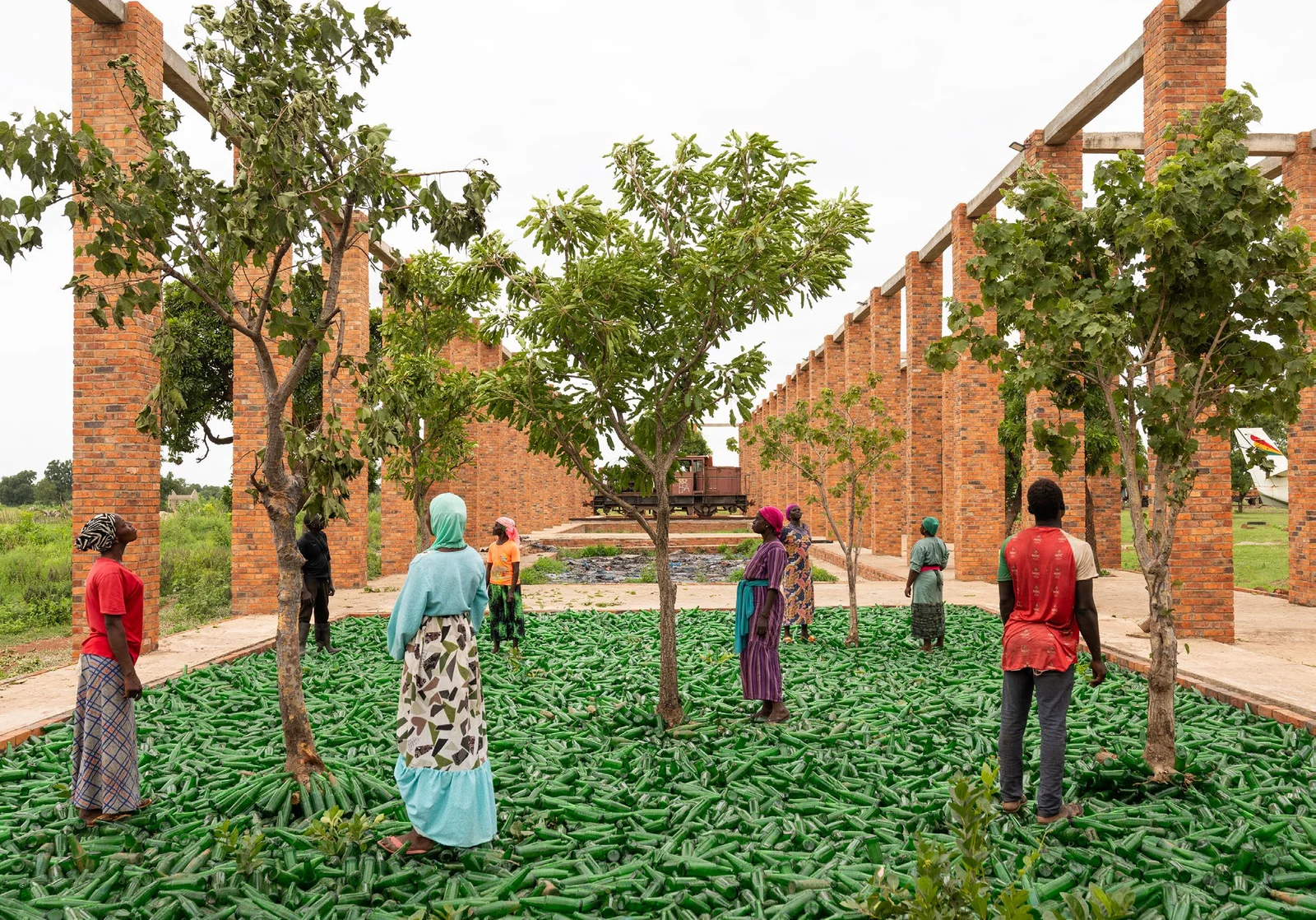
The installation. Things Fall Apart includes the factory’s original sign and metal structure, flanked by 1,000 stacked wooden crates and more than 25,000 green glass bottles. Around it hang collages that pair archival orders from the factory with charcoal drawings of African labourers building colonial railways. Mahama’s burlap works, made from the jute sacks that carried Ghanaian cocoa to Europe, hang between the building’s 19th-century arches.
The artists. Mahama, born in Tamale in 1987, shares the museum with nine artists and collectives; Aby Gaye-Duparc curated his part of the exhibition and Jeanne Barral the associate artists. They include his former teacher Dorothy Akpene Amenuke; James Barnor, 97, Ghana’s first photojournalist; the painter Gideon Appah; and CATPC, the Congolese Plantation Workers Art League, whose members use the proceeds from their art to buy back land seized in 1911 by Lever Brothers, which later merged into Unilever. For Parliament of Ghosts, a chamber of empty seats, Mahama used wooden stools from the Asante Empire, which Britain annexed in 1902.
The question. “What does it mean to be able to harvest the potentials that were in the past?” Mahama asks of the exhibition. He has put the income from his work into three art centres in Tamale, among them Red Clay, where old trains from Ghana’s manganese and bauxite lines stand on the grounds.
Why it matters
Debates about African heritage in European museums usually concern objects travelling south, back to the places they were taken from. Mahama has moved an object in the other direction. In 2024 he bought a factory from Ghana’s first decade of independence, took it apart and moved its materials to Red Clay, his art centre in Tamale, and part of it is now on show in Paris.
The Aboso Glass Factory was one of the last industrial projects launched under Kwame Nkrumah, who led Ghana to independence in 1957 and wanted the country to produce goods it had imported under colonial rule. It opened in 1966, the year Nkrumah was overthrown, and was later abandoned after several attempts to restructure and privatise it. In Things Fall Apart, its sign, its steel frame and its green bottles stand beside drawings of the labourers who built the colonial railways.
The exhibition keeps returning to ownership. CATPC uses the proceeds from its sculptures to buy back plantation land, and Mahama has put the income from his own work into three art centres in Tamale. TSL’s Cultural Intelligence Dossier follows the same question of ownership and income across African design.
The setting gives the question weight. The Fondation Cartier opened its building on Place du Palais-Royal, opposite the Louvre, in October 2025, and The Harvest Season is the second major exhibition there. Until 28 February 2027, one of the most prominent cultural addresses in Europe is showing part of Ghana’s industrial history, in the form of a factory the artist himself bought.
Send this to someone who will be in Paris before the end of February.
 Continue · The reading
The Cultural Intelligence Dossier: How Africa Sets the Measure of Luxury Value
Cultural intelligence is the new measure of African luxury value: heritage, sovereignty and who owns African design.
Sources
- Wallpaper*, Ibrahim Mahama, ‘The Harvest Season’, Fondation Cartier, review, 24 October 2026
- Finestre sull’Arte, An abandoned factory in Ghana is transformed into a work of art at the Fondation Cartier in Paris, 22 October 2026
- AMA, Ibrahim Mahama brings a ‘harvest time’ of African independence to Paris, 9 October 2026
- Fondation Cartier pour l’art contemporain, Ibrahim Mahama, Le Temps des récoltes