On 1 June 2026, the Prix Versailles presented its 2026 selection of the World’s Most Beautiful Restaurants at UNESCO in Paris. Sixteen restaurants from thirteen countries were nominated, from Nobu One Za’abeel above Dubai and Le Fou in Vienna to Escā Playa on Egypt’s Mediterranean coast, Finlandia Bistro in Helsinki and Amura in Cape Town. In December 2026, three of them will receive the final World Titles in the categories Prix Versailles, Interior and Exterior.
The selection reads like a map of contemporary hospitality. Some restaurants take the height of the city as their material. Others draw the coast, vineyard or mountain slope into the room. A third group enters existing architecture and carries its memory forward. Together they ask how a place becomes a room, how a table can hold the world around it, and how dining becomes an architectural experience.
This is where the Prix Versailles 2026 restaurants become relevant beyond design. They show a shift in hospitality from spectacle towards spatial intelligence. The room is no longer a decorated frame around the meal. It becomes part of the meal’s meaning: through light, material, proportion, view, acoustic atmosphere, service choreography and the relation between building and surroundings.
What the Prix Versailles 2026 Honours
These three answers come together in the selection that the Prix Versailles presented on 1 June 2026 at UNESCO in Paris, opening its twelfth edition, across sixteen addresses. Three of them will carry an additional World Title at the end of the year, in the categories Prix Versailles, Interior and Exterior. Until then, the sixteen stand side by side and show how differently a laid table can speak of the place where it stands.
UNESCO has hosted the Prix Versailles every year since 2015. The jury measures a work by its architecture, by the materials it is built from, by its light, by the choreography between staff and guest, and by its effect on its ecological, social and cultural surroundings. Intelligent sustainability is the name the organisation gives this ambition, a way of building that serves shared life because it comes from its place and adds something to it. The architect Matteo Thun pursues the same conviction in his Hospitecture, where architecture becomes medicine. Secretary General Jérôme Gouadain described this year’s selection as a reflection of the world’s culinary heritage. “Architecture serves this diversity and is at the same time inspired by it,” he said. The nominated restaurants, he noted, present an interior in harmony with their surroundings and their menu, in rooms where the art of hospitality meets the art of the unforgettable moment.
The 16 Prix Versailles Restaurants 2026
The 2026 selection brings together sixteen restaurants across thirteen countries. They are not presented as a ranking, but as a world selection from which three final titles will be chosen in December.
- Nobu One Za’abeel, Dubai, United Arab Emirates
- Le Fou, Vienna, Austria
- Monti, Gstaad, Switzerland
- Akira Back, Hong Kong, China
- Hana no Kumo, Hong Kong, China
- Monsieur Dior by Anne Sophie Pic, Beijing, China
- Peridot, Hong Kong, China
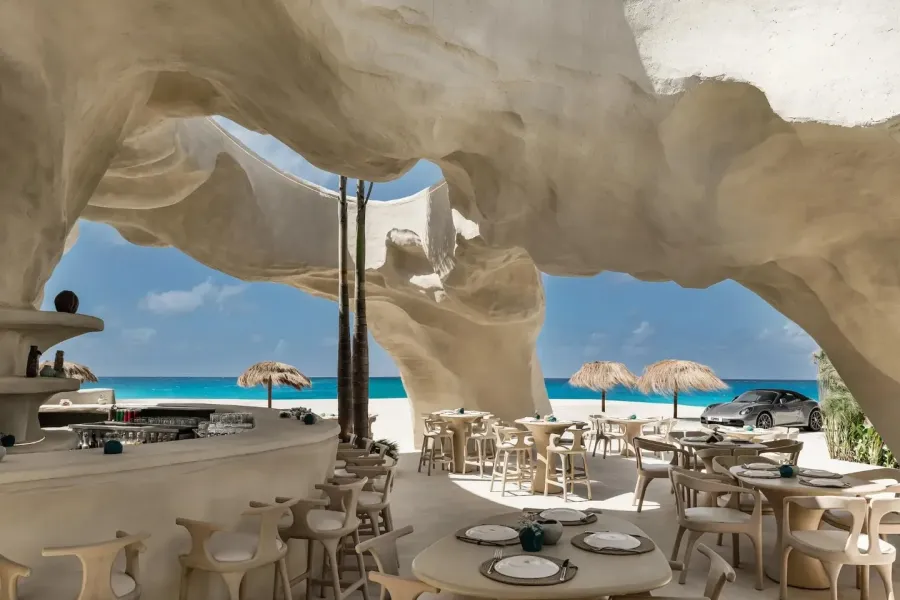
- Escā Playa, Ras El Hekma, Egypt
- Finlandia Bistro, Helsinki, Finland
- Carbone, London, United Kingdom
- Rosso, Hinganigada, India
- Marlow, Monaco
- Lucia, Los Angeles, United States
- Monsieur Dior by Dominique Crenn, Beverly Hills, United States
- Mottai, Coral Gables, United States
- Amura by Ángel León, Cape Town, South Africa
Seen together, the list shows three dominant movements: restaurants in the height of the city, restaurants grown out of landscape, and restaurants that work with architectural memory.
In the Height of the City
Five of the sixteen nominated restaurants take the height of the city as their material, from a glass bridge over Dubai to a single Hong Kong tower that holds three of them, and each turns the skyline into part of the room. A hundred metres above the ground, on the glass Sky Concourse between the two towers of the One Za’abeel complex in Dubai, Nobu One Za’abeel stands at the head of the list. The Rockwell Group assembled the room from high ceilings and crossing geometries and laid in a lighting system that runs from the bar to the private dining room. By day the view reaches across the whole skyline; by night, DJs and the cocktail list take over. On the plates is the cooking Nobu Matsuhisa has stood for over decades, Japanese tradition in conversation with the flavours of South America.
In Hong Kong this approach reaches its densest form. Three of the four addresses the city brings to the list share the same skyscraper, The Henderson by Zaha Hadid Architects in Central. At the very top sits Peridot, which Studio Paolo Ferrari fitted with more than twenty thousand handcrafted lights and a green grand piano. A floor below, Akira Back, for which AB Concept set soft lines and slender wooden posts beneath a sculptural ceiling. Higher up, Hana no Kumo, a kappou restaurant with twenty-four seats, designed by Hirsch Bedner Associates for chef Ogawa Masaru. Three restaurants in one tower, each with a voice of its own. How far a Hong Kong kitchen can take local material shows in Roganic Hong Kong and its interior of typhoon wood and oyster shells.
Out of the Landscape
Five of the nominated restaurants draw their materials, colours and climate from the landscape that surrounds them, a coast, a vineyard, a mountain slope, so that the walls read as a continuation of the place outside. On Egypt’s Mediterranean coast, the Cairo architect Mohamed Badie shaped Escā Playa as though wind, sun and tides had guided his hand. Mineral coatings and coral structures let the restaurant grow out of the sand, and the coast runs on across the walls until inside and outside are barely to be told apart.
In Cape Town, where the Indian and Atlantic oceans meet, Tristan du Plessis developed Amura out of the biodiversity of that very coast. Chef Ángel León, long known in Spain as the chef of the sea, leads through a menu that carries the flavours of Cape Town into a Mediterranean reading. North of Pune lies Rosso at Hotel Irada, on a working vineyard of 270,000 square metres, set within sixteen square kilometres of protected forest. Green marble and turned wooden columns bring India and the Mediterranean together in the same room.
Into a Building With a Past
Six of the nominated restaurants take over a building with its own history, a concert hall by Aalto, a former embassy, a couture maison, and let the new dining room answer the architecture it inherits. In Helsinki, Finlandia Bistro sits inside the Finlandia Hall, which Alvar Aalto built on the Töölönlahti bay in 1971 and in which the delegations signed the Helsinki Accords in 1975. During the 2021 refurbishment, the Finnish studio Fyra preserved the original furniture and added pieces made for the space. Aalto’s chairs still carry the hall, and over them a new layer settles with care.
In Vienna, the inherited building becomes a theatrical room. Le Fou, located inside The Leo Grand, works with the density of a historic city building and turns it into a sequence of social spaces. Interior architect Theresa Obermoser designed for Alexander Schrack a series of rooms that flow into one another, in silk, mohair velvet, natural stone and patinated metal. The main room in rust and terracotta forms the centre. A golden salon and a leopard print private area lead the atmosphere towards the theatrical. Here, the past is not treated as decoration. It becomes a spatial condition: layered, social, sensual and closely tied to Vienna’s culture of rooms, salons and staged hospitality.
In London’s Mayfair, Carbone opened its first European address in the rooms of the former US Embassy. Ken Fulk works with echoes of the American supper clubs of the fifties; a broad staircase with a hand-painted mural leads down to the bar, the lounge and the main dining room, and above the velvet banquettes hang works by René Ricard, Lola Montes and Ai Weiwei. In Monaco, Hugo Toro shaped Marlow on the main square of Mareterra, the new district built on land reclaimed from the sea. Toro brings together the wood-panelled intimacy of an English club and the open light of the Mediterranean, and he drew every element for the space himself, from the interior architecture to the lighting, the furniture and the door handles.
The House of Dior enters with two restaurants, both bringing the maison’s couture tradition to the table. Monsieur Dior by Anne-Sophie Pic sits in Beijing’s Sanlitun, behind the sculptural façade by Christian de Portzamparc, in a room with three commissioned works by the Chinese artist Hong Hao. Monsieur Dior by Dominique Crenn sits in Beverly Hills, in a room by Peter Marino, beneath a ceiling of carved rose petals and before a painting by Nicole Wittenberg titled Gardens of Courances.
In Los Angeles, Sam Jordan and chef Cleophus Hethington opened Lucia, the city’s first Afro-Caribbean restaurant, furnished by Preen, Inc. with tropical textiles, bold patterns and sculptures in shell and palm form. In Coral Gables, Florida, chef Brian Nasajon and Saladino Design Studios arranged Mottai around an open sushi bar beneath a sculptural canopy, in the echo of a Japanese sense of space where every line and surface stays pared back.
Three Approaches, One Measure
Sixteen restaurants, thirteen countries, three answers to the same question. The landscape gives its materials and its climate, the city its height and its skyline, the existing building its history. Each of the nominated restaurants makes its own statement out of its surroundings, and together they carry forward the idea UNESCO calls intelligent sustainability, spaces that improve shared life because they come from their place and work with it. Which three will carry the final World Titles at the end of the year, the jury decides in December 2026.