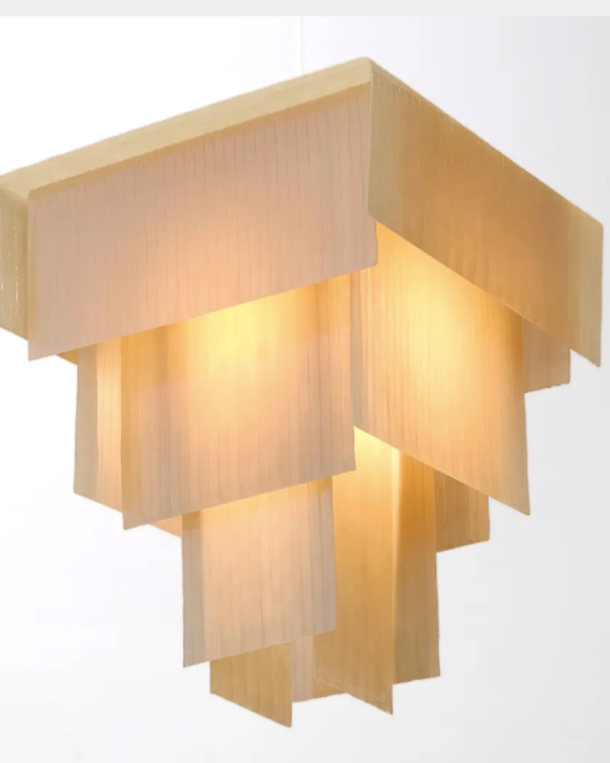
Nippon, Ark Collection. Russo Betak, Denmark. First Prize, SaloneSatellite Award 2026.
·

The SaloneSatellite Award 2026: Five Projects and the Future of Design

New Craftsmanship, New World. The 15th edition named five studios whose material knowledge points beyond this edition.

Ella Carlucci

The 15th edition of the SaloneSatellite Award was presented on 24 April 2026 in Pavilion 7 at Fiera Milano Rho, under the theme “New Craftsmanship: A New World.” The award, the only international prize dedicated exclusively to designers under 35 at the world’s most important furniture and design fair, was founded in 2011 by Marva Griffin Wilshire, creator of SaloneSatellite, who has built the platform across 28 years into the most significant launchpad for emerging design talent in the world. The 2026 jury was chaired by Paola Antonelli, Senior Curator of Architecture and Design at MoMA New York. Five projects were selected from 700 participants representing 39 countries.

Paola Antonelli has described the award’s method across fifteen years in a single formulation: insight above market, research above industrial scale. A form of collective imagination that reveals what will be structural rather than ephemeral. The five projects selected in 2026 read as a precise index of where that thinking is going. In every winning project, the operating method was the same: sustained knowledge of a specific material, applied at the boundary between the hand and the machine.


THE AWARD: Five Projects, One Direction

The Award reads SaloneSatellite 2026 through the working methods and material intelligence of five studios. Under Paola Antonelli’s jury direction, each project brought a different material position to the prize: seashells and digital fabrication, computational ceramics, mechanical listening, ancestral weaving and fiberglass mesh. Together they form a precise index of where craft knowledge is going when it encounters the tools of the present.

Photography: Salone del Mobile.Milano 2026
3DP Ceramic Tiles. IOUS Studio, Rotterdam. Second Prize, SaloneSatellite Award 2026.

IOUS STUDIO

Second Prize

Base: Rotterdam, Netherlands

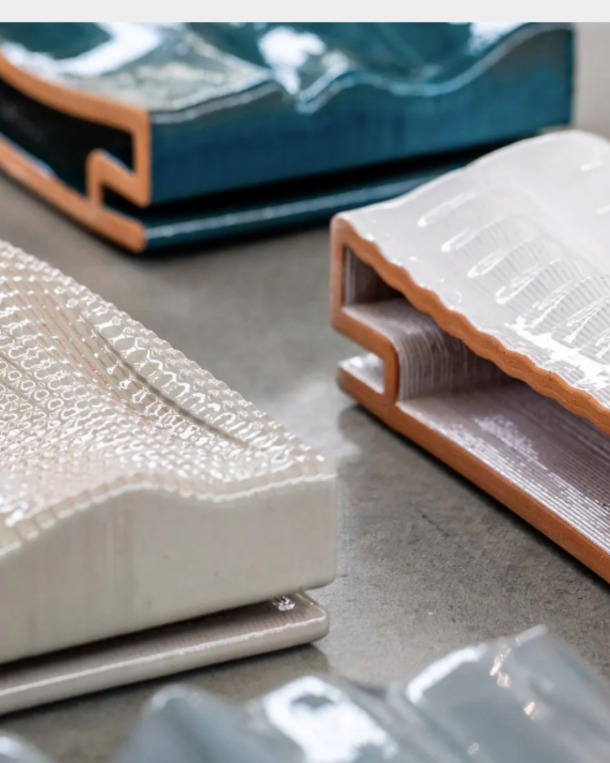
Material Position: Computational design applied to ceramic extrusion, producing facade tiles in which no two pieces are identical.

Award Reading: IOUS Studio took second prize at the SaloneSatellite Award 2026 for 3DP Ceramic Tiles. The studio was founded in Rotterdam by Sol Sanchez Cimarelli and Agustin Ros, both Argentinian-born architects who graduated from Universidad Torcuato Di Tella in Buenos Aires before working across offices in Dubai, Rome, Berlin and Rotterdam. Their 3DP Ceramic Tiles system uses robotic clay extrusion to produce exterior facade tiles whose surface texture is determined by an algorithm responsive to structural requirements: the form that emerges is both functionally optimal and visually specific to its position in the facade. The tiles shown at SaloneSatellite 2026 demonstrate the system across three material registers — a dense white interlocking surface, a teal glaze with layered relief, a pale grey with fine horizontal striations — each produced from the same computational logic applied to different clay bodies. The terracotta edge left exposed on each tile is not a detail. It is a declaration: the clay knows what it is.

Why it matters: What IOUS Studio proposes is a facade architecture in which no two tiles are identical and every tile is the direct output of its material conditions. The studio is currently establishing the first large-scale ceramic and 3D printing lab in Latin America in Buenos Aires, bringing this production logic to a new geography. In the SaloneSatellite reading, 3DP Ceramic Tiles holds both registers simultaneously: the precision of the algorithm and the irreducible variability of the clay. That combination is where the most interesting architecture of the coming decade is forming.

Soft Touch. Jüngerkühn, Germany. Third Prize, SaloneSatellite Award 2026.

JÜNGERKÜHN

Third Prize

Base: Germany

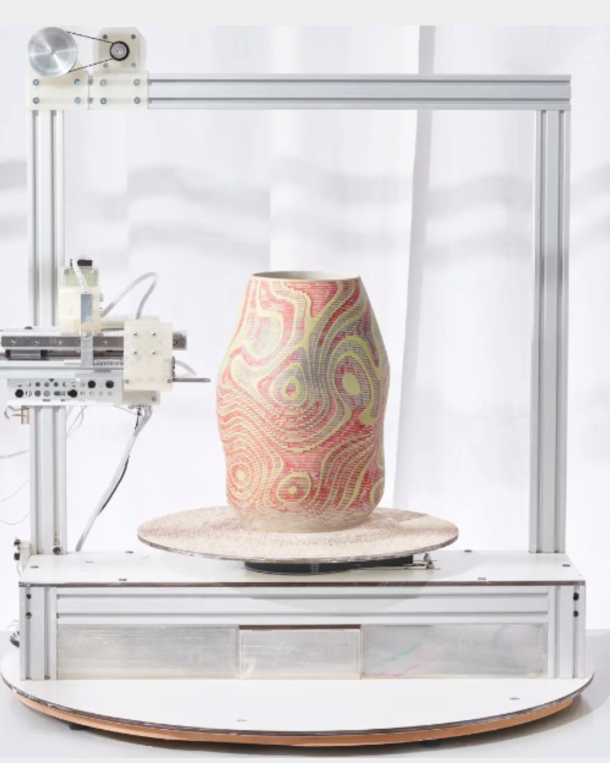
Material Position: A mechanical device that reads object surfaces and carves their topography back into ceramic.

Award Reading: Jüngerkühn took third prize at the SaloneSatellite Award 2026 for Soft Touch. The project is a device: a twin-axis mechanical arm mounted over a rotating turntable, fitted with a sensor that reads the surface of any object placed beneath it. The arm records the topography of the surface in real time and translates that recording into a cutting path applied to a second object on the same turntable. For the SaloneSatellite presentation, the studio placed hand-formed porcelain vases beneath the arm. The machine read their surfaces and carved the pattern it found back into the clay, each vase receiving a unique incised relief determined entirely by its own form. The result is a series of vessels in which pink, cream and terracotta glazes move in concentric topographic lines, every piece different, none of them possible without the machine listening to what the hand had made first.

Why it matters: Soft Touch does not automate ceramics. It uses automation to listen to what a ceramic already is. Where most machine-assisted design imposes a form determined before the material is touched, Jüngerkühn’s device responds to the form the material has already taken. Every vase in the series is unique because every hand-formed vessel it read was unique. In the SaloneSatellite reading, this is a precise model for how computation and craft can operate in relation rather than in hierarchy.

Números. Aiko Design, Santiago de Chile. Special Mention, SaloneSatellite Award 2026.

AIKO DESIGN

Special Mention

Base: Santiago, Chile

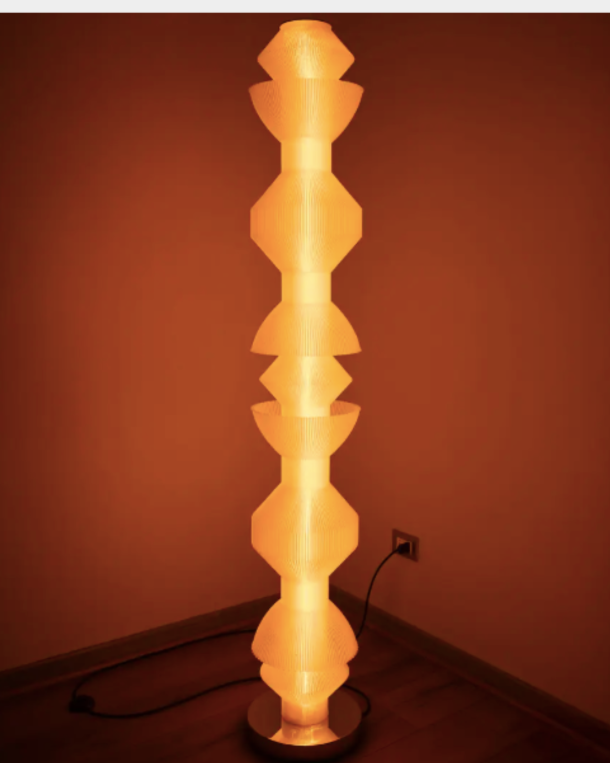
Material Position: Ancestral horsehair weaving from Rari combined with 3D-printed structural components.

Award Reading: Nicolás Romero of Aiko Design received a Special Mention at the SaloneSatellite Award 2026 for Números. The studio draws from the crin tradition of Rari, a village of around 600 people in the Maule region of Chile, in the foothills of the Andes, where horsehair weaving has been practiced for over 200 years and passed from mother to daughter across generations. The technique involves weaving horsehair strand by strand over a frame of ixtle, a plant fibre imported from Mexico, building three-dimensional forms without tools: only hands, scissors and a needle. Números is a floor lamp: a tall totem of stacked geometric wicker and crin modules, each one a different weave pattern from the Rari tradition, the whole column lit from within so that light passes through the interstices of the woven structure and turns the lamp into a luminous catalogue of the hand techniques it carries. The structural components connecting the modules are 3D printed, allowing the handmade forms to be assembled without adhesive.

Why it matters: The jury recognised Números for the way its symbolic figure holds both industrial production and meticulous craft as simultaneous conditions rather than alternatives. The lamp stands as a record of what the hands in Rari know and what computation makes possible when it works in their service rather than in their place. In the SaloneSatellite reading, Aiko Design represents the Local Soul logic at its most precise: a production philosophy rooted in a specific geography, a specific material and a specific community of makers, brought into the global conversation without losing the specificity that gives it value. Aiko Design received a month-long design residency at the Róng Design Library in Hangzhou, China.

Foggy. Yixian Wang, China. Special Mention, SaloneSatellite Award 2026.

YIXIAN WANG

Special Mention

Base: China

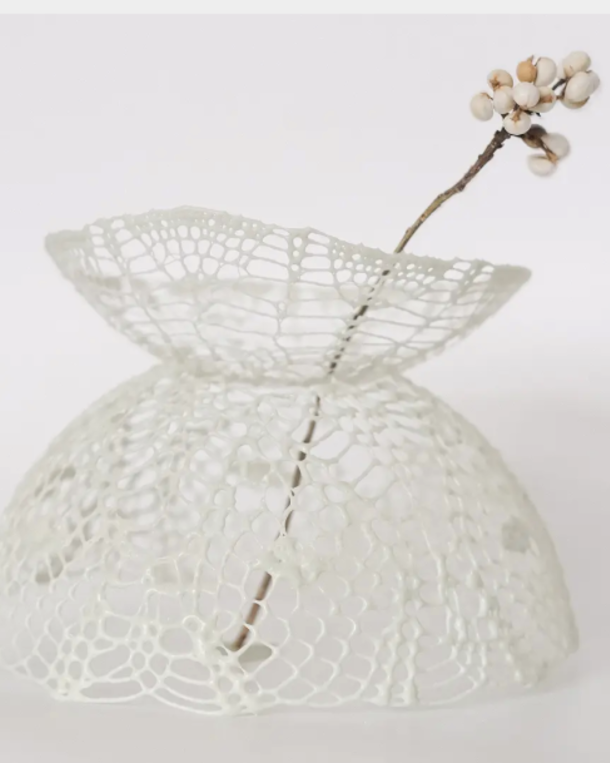
Material Position: Fiberglass arranged in a lace-like mesh structure, fired without resin to preserve translucency and fragility.

Award Reading: Yixian Wang received a Special Mention at the SaloneSatellite Award 2026 for Foggy. The project investigates fiberglass at the boundary between industrial process and organic form. Wang arranges fiberglass strands into a lace-like mesh structure and fires the vessel without resin, so that the material retains its translucency and fragility rather than hardening into a composite. The result is a dome-shaped vessel that holds its form while remaining visually permeable: light passes through the mesh, the surface reads as fog or as the finest gauze, and the dried botanical placed inside becomes visible through the structure as though the vessel were made of air. The process treats fiberglass as a material with its own grain and behaviour, not as a substrate for other properties.

Why it matters: The jury recognised Foggy for reinterpreting the visual properties of a material the medium had not previously expressed this way. Fiberglass is an industrial material designed for opacity and structural performance. Wang’s process finds in it a delicacy that its industrial context had never required it to produce. This is the argument that runs through all five winning projects: the knowledge of what a material can do when it is not asked to be something else. Yixian Wang received a month-long design residency at the Róng Design Library in Hangzhou, China.

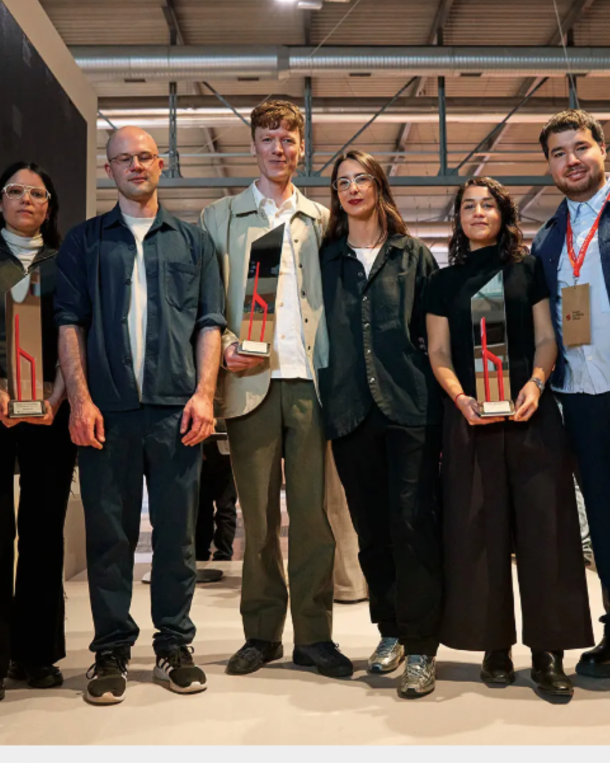
SaloneSatellite Award 2026. The winners, 15th edition, Salone del Mobile.Milano, April 2026.

Award Winners

Winners of the SaloneSatellite Award 2026, 15th edition, Pavilion 7, Salone del Mobile.Milano, April 2026. From left: Nicolás Romero / Aiko Design (Chile, Special Mention), Agustin Ros / IOUS Studio (Netherlands, 2nd Prize), Russo Betak (Denmark, 1st Prize), Jüngerkühn (Germany, 3rd Prize), Yixian Wang (China, Special Mention). Order to be verified against official Salone del Mobile.Milano press materials. 
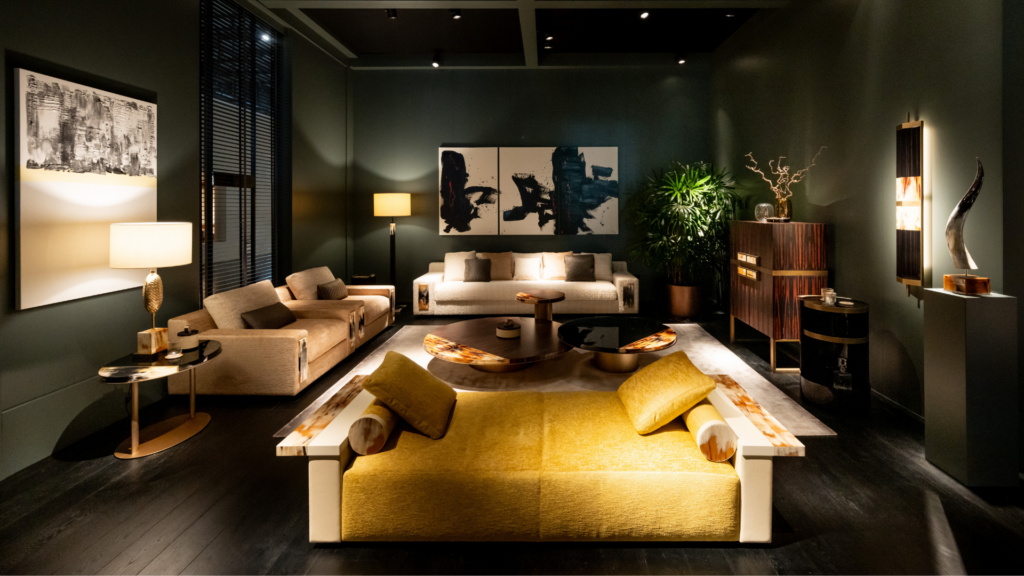
    ARCAHORN stand at Salone del Mobile Milano 2026 — dark interior with golden yellow sofa and brass lamps

    Continued Reading

    New Latitudes. What Milan Design Week 2026 Said About the Future of Design.

    Many new centres are emerging simultaneously. The 64th Salone del Mobile, read through the lens of Local Soul.

    Read the full editorial →

    Questions on the SaloneSatellite Award 2026

    Five studios, five projects and the material intelligence shaping the future of design. The following questions address what the 15th edition of the SaloneSatellite Award revealed.

    Who won the SaloneSatellite Award 2026?

    The SaloneSatellite Award 2026 was presented at the 15th edition of the award, part of the 64th Salone del Mobile.Milano, with a jury chaired by Paola Antonelli, Senior Curator of Architecture and Design at MoMA New York. First prize went to Russo Betak of Denmark for Nippon, a pendant lamp 3D printed from seashells and hand-sculpted. Second prize went to IOUS Studio of the Netherlands, founded by Sol Sanchez Cimarelli and Agustin Ros, for 3DP Ceramic Tiles, a computationally designed ceramic facade system. Third prize went to Jüngerkühn of Germany for Soft Touch, a mechanical device that reads and responds to ceramic surfaces. Special Mentions went to Nicolás Romero of Aiko Design of Chile for Números, combining ancestral horsehair weaving with 3D printing, and to Yixian Wang of China for Foggy, a fiberglass vessel fired without resin. Both Special Mention recipients received a month-long residency at the Róng Design Library in Hangzhou, China.

    What is the SaloneSatellite Award?

    The SaloneSatellite Award is an international prize dedicated exclusively to designers under 35, presented annually as part of the Salone del Mobile.Milano. It was founded in 2011 by Marva Griffin Wilshire, creator of SaloneSatellite, the platform she established in 1998 to give emerging design talent access to the world’s most important furniture and design fair. The award’s jury, chaired since its founding by Paola Antonelli of MoMA New York, selects projects based on research depth and material intelligence rather than market readiness.

    What was the theme of SaloneSatellite 2026?

    The theme of SaloneSatellite 2026 was “New Craftsmanship: A New World,” positioning craft knowledge as a technical competence for the coming design cycle rather than a heritage gesture. The five winning projects each demonstrated a specific form of material knowledge applied at the boundary between the hand and computational tools: seashells as 3D printing substrate, clay under robotic extrusion, ceramic surfaces read by a mechanical sensor, ancestral horsehair weaving combined with 3D-printed components, and fiberglass arranged as a lace-like mesh without resin.

    What is Nippon by Russo Betak?

    Nippon is a pendant lamp from the Ark collection by Danish designer Russo Betak, winner of first prize at the SaloneSatellite Award 2026. The lamp is 3D printed using seashells ground into a printable composite, then hand-sculpted layer by layer to reveal the grain of the material. The result is a tiered pendant in warm cream tones whose stacked horizontal panels hold and diffuse light. The jury recognised its material experimentation and its translation into a refined and luminous form.

    What is 3DP Ceramic Tiles by IOUS Studio?

    3DP Ceramic Tiles is a ceramic exterior facade system by IOUS Studio, a Rotterdam-based studio founded by Argentinian architects Sol Sanchez Cimarelli and Agustin Ros. The system uses robotic clay extrusion to produce facade tiles whose surface texture is determined by an algorithm responsive to structural requirements. No two tiles are identical. Each tile is the direct output of its material conditions, with the terracotta edge left exposed as a declaration of the clay’s origin. The project won second prize at the SaloneSatellite Award 2026.

    What is Soft Touch by Jüngerkühn?

    Soft Touch is a mechanical device by German studio Jüngerkühn, winner of third prize at the SaloneSatellite Award 2026. A twin-axis arm mounted over a rotating turntable reads the surface topography of hand-formed porcelain vases and carves that topography back into a second vessel, producing a unique incised relief on every piece. The device uses automation to respond to what the hand has already made rather than to impose a predetermined form.

    What is Números by Aiko Design?

    Números is a floor lamp by Nicolás Romero of Chilean studio Aiko Design, recognised with a Special Mention at the SaloneSatellite Award 2026. The lamp combines the crin tradition of Rari — a 200-year-old horsehair weaving practice from a village of 600 people in the Maule region of Chile — with 3D-printed structural components in PLA with chrome metal details. Stacked geometric wicker and crin modules, each a different weave pattern, are lit from within so that light passes through the interstices of the woven structure. The lamp is a luminous catalogue of the hand techniques it carries.

    What is Foggy by Yixian Wang?

    Foggy is a vessel by Chinese designer Yixian Wang, recognised with a Special Mention at the SaloneSatellite Award 2026. Fiberglass strands are arranged in a lace-like mesh structure and fired without resin, so that the material retains its translucency rather than hardening into a composite. Light passes through the mesh and the surface reads as fog or as the finest gauze. The jury recognised Foggy for reinterpreting the visual properties of a material the medium had not previously expressed this way.