ESG Meaning: 36 Terms That Explain the Climate Retreat in Plain English

One line in RTX’s proxy statement of March 2026 was enough to take climate out of its annual bonus: “We eliminated the non-financial component of our AIP design.” Two entries below explain that sentence: the short-term incentive, which RTX calls its annual incentive plan, and the proxy statement in which the company filed it. Much of the ESG backlash is written in that kind of language, in filings, alliance statements and EU law.
ESG stands for environmental, social and governance, the three sets of measures by which investors judge how a company treats the planet, its people and its own oversight. The terms fall into four groups: executive pay, the investors and alliances that once demanded climate targets, the EU rules on reporting and on products, and the standards a climate target rests on. Each comes with a dated case from 2025 or 2026 and the documents behind it. Together they cover the years from Larry Fink’s letter of January 2020 to the pay filings of 2026.
ESG Terms for Executive Pay: Proxy Statements and the ESG Modifier
Executive pay is where the retreat from sustainability becomes measurable, because the proxy statement sets out the metrics a bonus rests on and how much each one weighs.
Afep-Medef Code
The Afep-Medef code is the corporate governance code that the French business associations Afep and Medef set for listed companies, applied on a comply-or-explain basis. Since December 2022 it has asked that executive pay include at least one criterion tied to the company’s climate objectives, and the 2025 report of France’s High Committee for Corporate Governance confirms that version as the one in force. On 19 March 2026 Accor’s board tied 10 percent of the long-term incentive of its chairman and chief executive, Sébastien Bazin, to greenhouse gas cuts.
Source: Afep-Medef Corporate Governance Code, December 2022, section 26.1.1 (ECGI); HCGE, Rapport 2025; Accor, Board decisions (19 March 2026)
DEF 14A
DEF 14A is the code under which the definitive version of a proxy statement is filed in EDGAR, the database of the US Securities and Exchange Commission, and the form turns a year of pay decisions into a legal record. In the DEF 14A that Verizon filed on 6 April 2026, the compensation committee reports that it replaced the responsible business metrics of the 2024 plan, carbon intensity among them, with qualitative strategic and culture goals of the same weighting.
Source: SEC, Investor.gov: Proxy statements; Verizon, DEF 14A 2026
Earnings Per Share (EPS)
Earnings per share is the profit attributable to a company’s ordinary shareholders divided by the weighted average number of ordinary shares outstanding over the period, as set out in the accounting standard IAS 33. In 2026 it moved into the space that climate metrics left in bonuses. In a study of 80 companies in the S&P 100, with filings up to 28 April 2026, Proxy Pro found that a net four companies added EPS, while sustainability was the most-removed category, dropped by a net ten.
Source: IFRS Foundation, IAS 33 Earnings per Share; Proxy Pro, ESG pay metrics
ESG Modifier
An ESG modifier is an adjustment that raises or lowers an incentive payout according to how far a company met its environmental, social or governance goals. The Energy Transition Modifier at Valero could move share vesting by up to 25 percent either way on the awards of 2021 to 2024, and the refiner then let it expire. At Apple a modifier of up to 10 percent was tied to the company’s values and community initiatives, and the proxy statement of 8 January 2026 no longer mentions it.
Source: Valero, DEF 14A 2026; Apple, DEF 14A 2025; Apple, DEF 14A 2026
Free Cash Flow
Free cash flow is the cash a company generates after capital spending, usually calculated as operating cash flow minus capital expenditure. No uniform definition exists, so the US Securities and Exchange Commission requires companies that report it to explain the calculation. At RTX free cash flow now accounts for half of the annual bonus, and the proxy statement of 9 March 2026 records that the Corporate Responsibility Scorecard, which had tracked greenhouse gases and water use, is gone.
Source: SEC, Non-GAAP Financial Measures, C&DI 102.07; RTX, DEF 14A 2026
Long-Term Incentive (LTI)
A long-term incentive is pay granted in shares or performance shares whose final value depends on targets measured over several years, usually three. In its Form 20-F of 12 March 2026, Shell cuts the weighting of its energy transition condition from 25 to 20 percent. Luca de Meo, Kering’s chief executive, has no climate criterion in his 2026 annual bonus, while his 2026 performance shares keep climate at 10 percent, and at IHG the 2026 to 2028 cycle keeps 10 percent on carbon and people.
Source: SEC, Regulation S-K, Item 402; Shell, Form 20-F 2025; Kering, 2025 Universal Registration Document; IHG, Directors’ Remuneration Report 2025
What Is a Proxy Statement?
A proxy statement is the document a US-listed company files with the Securities and Exchange Commission and sends to shareholders before its annual meeting, so that they can vote on directors, executive pay and proposals. It rests on Section 14(a) of the Securities Exchange Act of 1934, and in it the compensation committee sets out each metric and its weight. In the proxy statement Oracle filed on 25 September 2026, GPU bookings account for 10 percent of one senior executive’s bonus. Ralph Lauren’s filing shows sustainability giving way to AI.
Source: SEC, Investor.gov: Proxy statements; Oracle, DEF 14A 2026
Say on Pay
Say on Pay is the non-binding shareholder vote on the pay of a company’s top executives. US companies have held it at least once every three years since 25 January 2011, when the US Securities and Exchange Commission (SEC) adopted its rules under Section 951 of the Dodd-Frank Act. Shareholders also vote at least once every six years on how often it is held. SEC guidance of 11 February 2025 adds a risk: holders of more than 5 percent who tie their votes for directors to changes in pay can lose their passive filing status.
Source: SEC, Press Release 2011-25 (25 January 2011); SEC, C&DI 103.12 (11 February 2025)
Short-Term Incentive (STI)
A short-term incentive is a performance bonus tied to the targets of a single financial year and usually paid in cash. Most American ESG pay metrics sit here. For fiscal years ending May 2024 to May 2025, WTW found only 9 percent of them in S&P 500 long-term plans. A second WTW study, published on 8 May 2026 and covering 400 S&P 1500 companies, finds ESG in 55 percent of their short-term plans, four points fewer than two cycles earlier. In the short-term plan at Verizon a carbon intensity measure ran from 2014 to 2024 and was replaced in 2025.
Source: SEC, Regulation S-K, Item 402; WTW, United States (22 January 2026); WTW, Executive pay trends in 2026 (8 May 2026); Verizon, DEF 14A 2026
Total Shareholder Return (TSR)
Total shareholder return is the full return on a share over a period, combining the change in its price with reinvested dividends. US companies must report it beside executive pay in a Pay versus Performance table, under a rule the US Securities and Exchange Commission adopted on 25 August 2022. At Valero it took the place of a climate condition. In February 2025 the refiner decided that performance shares would vest solely on relative TSR, and its Energy Transition Modifier expired.
Source: SEC, Press Release 2022-149 (25 August 2022); Valero, DEF 14A 2025
A note from The Silent Luxury
Good reading deserves to find you again.
Investors and Alliances: The Big Three, GFANZ, NZBA and Schedule 13G
The demand for climate targets in pay came from investors and lenders, and these terms trace how they organised around net zero from 2020 and stepped back from 2025.
Big Three
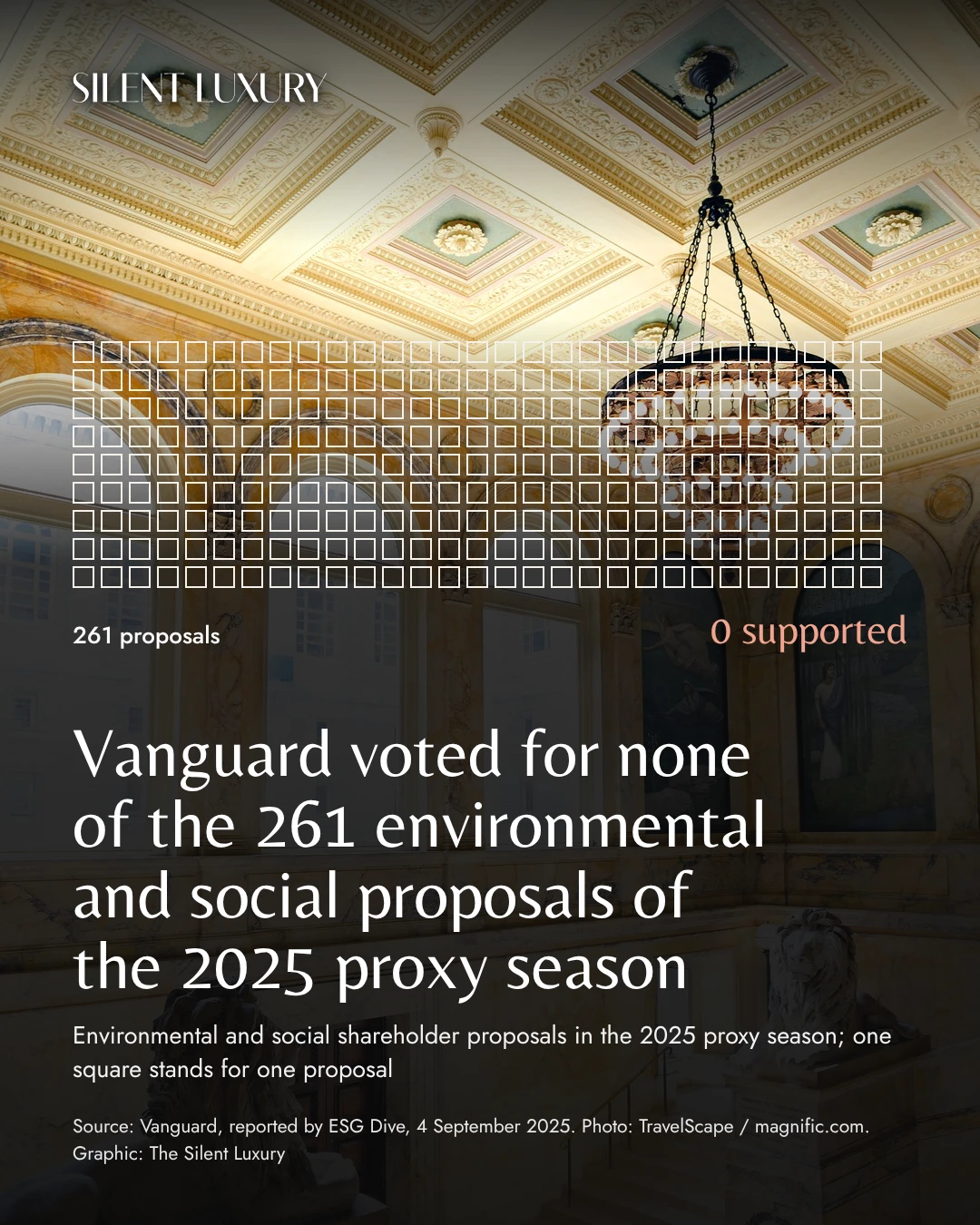
The Big Three is the shorthand for BlackRock, Vanguard and State Street, the three largest index fund managers, which together were the largest shareholder in 88 percent of S&P 500 companies, according to a study published in 2017. Their votes weigh on every climate proposal that reaches a ballot. Vanguard supported none of the 261 environmental and social proposals of the 2025 season, and BlackRock backed 4 percent in the year to June 2024.
Source: Fichtner, Heemskerk and Garcia-Bernardo, Business and Politics (2017); ESG Dive on Vanguard (4 September 2025); ESG Dive on BlackRock (22 August 2024)
Climate Action 100+
Climate Action 100+ is an investor initiative whose signatories direct their engagement at 170 of the world’s largest corporate greenhouse gas emitters. In February 2024 JPMorgan Asset Management, State Street Global Advisors and PIMCO withdrew, and BlackRock moved its participation to BlackRock International. When Texas and ten other states sued BlackRock, State Street and Vanguard over coal in November 2024, the complaint named Climate Action 100+ and the Net Zero Asset Managers initiative as the channels through which, it said, the three signalled a shared intent to cut thermal coal output. In February 2026 Vanguard settled its part of the case.
Source: Climate Action 100+ (26 February 2024); Texas Attorney General (November 2024); E.D. Tex., Stipulated Order of Dismissal as to Vanguard, Dkt. 147 (26 February 2026); Alabama Attorney General (2 March 2026)
Glasgow Financial Alliance for Net Zero (GFANZ)
The Glasgow Financial Alliance for Net Zero was launched in April 2021, with Mark Carney as chair, as the umbrella for the finance industry’s net zero alliances. At COP26 in Glasgow it brought together nearly 500 firms representing around $130 trillion. Since January 2025 it has worked as an independent group of financial leaders focused on mobilising capital, above all in emerging and developing economies. That change was announced on 2 January 2025, a week before BlackRock left the Net Zero Asset Managers initiative.
Source: UNFCCC (21 April 2021); UN News, COP26 Finance Day; GFANZ secretariat (2 January 2025)
Net Zero Asset Managers initiative (NZAM)
The Net Zero Asset Managers initiative (NZAM) is a voluntary alliance of asset managers, founded in December 2020. Before BlackRock left on 9 January 2025, it counted more than 325 signatories managing over $57 trillion, and four days later it suspended its tracking of members’ progress. Since its relaunch on 25 February 2026, members commit to support investing aligned with the global goal of net zero, subject to fiduciary duty and client mandates, and the 2050 date is gone.
Source: NZAM, Commitment; NZAM, relaunch (25 February 2026); Reuters via Insurance Journal (14 January 2025)
Net-Zero Banking Alliance (NZBA)
The Net-Zero Banking Alliance was a group of banks convened under the UN Environment Programme in April 2021 to align their lending and investment portfolios with net zero by 2050 at the latest. It grew from 43 to 144 banks by October 2024. At the turn of 2025 the six largest US banks left. On 3 October 2025 the remaining members voted to cease operations, keeping the alliance’s guidance as a framework.
Source: UNEP FI (21 April 2021); UNEP FI, NZBA update (August 2025); Banking Dive on the NZBA
Schedule 13G
Schedule 13G is the short-form filing that the US Securities and Exchange Commission (SEC) accepts from investors who hold more than 5 percent of a class of shares without seeking to influence control of the company. SEC guidance of 11 February 2025 narrowed that status. Pressing for specific environmental, social, political or pay changes now puts it at risk, and an investor that ties its support for directors to such demands can lose it and then has to file the longer Schedule 13D. For the largest index funds, a climate demand has become a filing question.
Source: SEC, Investor.gov: Schedules 13D and 13G; SEC, C&DI 103.12 (11 February 2025)
Stewardship
Stewardship is the way investors oversee the capital they manage for clients and beneficiaries, chiefly through voting and engagement with companies, with long-term sustainable value as the aim. The Financial Reporting Council published the 2026 UK Stewardship Code on 3 June 2025. The code defines stewardship as “the responsible allocation, management and oversight of capital”. For the 2026 proxy season, BlackRock and Vanguard each split their stewardship into two units, each with voting guidelines of its own.
Source: FRC, The UK Stewardship Code 2026; Cooley on BlackRock and Vanguard voting guidelines (22 January 2026)
EU Rules: The ECGT Directive, the ESRS and the EU Deforestation Regulation
Europe cuts back what companies must report and tightens what products must prove, and these thirteen terms cover both, as the CSRD Omnibus explainer sets out in full.
Corporate Sustainability Due Diligence Directive (CSDDD)
The Corporate Sustainability Due Diligence Directive, Directive (EU) 2024/1760, requires large companies to identify and address adverse impacts on human rights and the environment in their own operations, their subsidiaries and their chains of business partners. Omnibus I narrows it to companies with more than 5,000 employees and €1.5 billion in worldwide turnover, applies it from 26 July 2029 and deletes Article 22, the duty to adopt a climate transition plan.
Source: EUR-Lex, Directive (EU) 2024/1760; EUR-Lex, Directive (EU) 2026/470
Corporate Sustainability Reporting Directive (CSRD)
The Corporate Sustainability Reporting Directive, Directive (EU) 2022/2464, requires companies to report on sustainability in their management report under common standards and to have that reporting assured. Omnibus I limits it to companies with more than 1,000 employees and over €450 million in net turnover, which the Principles for Responsible Investment (PRI) estimate exempts around 90 percent of companies from the original scope. Large companies above both thresholds that had yet to report begin with the 2027 financial year.
Source: EUR-Lex, Directive (EU) 2022/2464; EUR-Lex, Directive (EU) 2026/470; PRI on the final Omnibus agreement (16 December 2025)
Digital Product Passport
A Digital Product Passport is a set of product-specific data required under the Ecodesign for Sustainable Products Regulation, with its content fixed for each product group in a delegated act. The passport makes that data available with the item itself, and for textiles the European Commission plans to adopt the act in the fourth quarter of 2027. In Portugal, the passport is expected to favour the makers who can document a shoe from the cork tree onwards.
Source: EUR-Lex, Regulation (EU) 2024/1781; European Commission, Digital Product Passport for textiles
What Is the ECGT Directive?
The ECGT Directive, Directive (EU) 2024/825 on Empowering Consumers for the Green Transition, bans generic environmental claims that a trader cannot back with recognised excellent environmental performance, sustainability labels based on neither a certification scheme nor a public authority, and claims that a product is climate neutral because of carbon offsetting. It has applied since 27 September 2026. A brand that calls a product climate neutral on the strength of offsets now breaches consumer law across the EU. Its sister proposal, the Green Claims Directive, is on the withdrawal list of the Commission’s 2027 work programme.
Source: EUR-Lex, Directive (EU) 2024/825; European Commission, COM(2026) 710, Annex III
Ecodesign for Sustainable Products Regulation (ESPR)
The Ecodesign for Sustainable Products Regulation, Regulation (EU) 2024/1781, sets the framework for ecodesign requirements on almost all products in the EU and introduces the Digital Product Passport. Since 19 July 2026 it has prohibited large companies from destroying unsold clothing and footwear, and medium-sized companies follow on 19 July 2030.
Source: EUR-Lex, Regulation (EU) 2024/1781
EU Deforestation Regulation (EUDR)
The EU Deforestation Regulation, Regulation (EU) 2023/1115, lets cattle, cocoa, coffee, palm oil, rubber, soy and wood, and their products, be sold in or exported from the EU only if they are deforestation-free, produced under the laws of the country of production and covered by a due diligence statement. Deforestation-free means produced on land not deforested after 31 December 2020. The obligations apply from 30 December 2026. Since 18 September 2026 the EUDR leather exclusion has kept cattle hides, skins and leather outside its scope, although the Commission’s own estimates put leather at up to 17 percent of the deforestation risk in EU imports, a figure the leather industry disputes.
Source: EUR-Lex, Regulation (EU) 2023/1115, Articles 2 and 3; EUR-Lex, Delegated Regulation (EU) 2026/2102; European Commission, EUDR and leather (13 July 2026); Mongabay (September 2026)
EU Taxonomy
The EU taxonomy is the classification of environmentally sustainable economic activities that rests on Regulation (EU) 2020/852, a framework to facilitate sustainable investment, and on the technical screening criteria of its delegated acts. Companies report what share of their turnover, capital expenditure and operating expenditure comes from activities the taxonomy covers. Since 1 January 2026, Delegated Regulation (EU) 2026/73 has let non-financial companies skip assessing minor activities that together account for less than 10 percent of turnover, capital expenditure or operating expenditure, and for 2025 companies could still report under the old rules.
Source: EUR-Lex, Regulation (EU) 2020/852; EUR-Lex, Delegated Regulation (EU) 2026/73
European Sustainability Reporting Standards (ESRS)
The European Sustainability Reporting Standards are the common standards that companies use to report on sustainability under the CSRD, adopted by the European Commission as delegated acts. On 3 July 2026 the Commission adopted a revised set as Delegated Regulation (EU) 2026/1563, by its own count with more than 60 percent fewer mandatory datapoints and more than 70 percent fewer in total. The revised standards apply from the 2027 financial year, and for 2026 companies may choose the old or the new version.
Source: EUR-Lex, Delegated Regulation (EU) 2026/1563; European Commission, revised ESRS (3 July 2026)
Extended Producer Responsibility (EPR)
Extended producer responsibility is a rule under which producers bear the cost, and where required the organisation, of handling their products once they become waste. For textiles and footwear, Directive (EU) 2025/1892 entered into force on 16 October 2025, and member states must set up such schemes by 17 April 2028, covering producers that first make goods available in a member state under their own name or trademark. The rule settles who pays for fashion’s waste: the producer whose name is on the label.
Source: EUR-Lex, Directive (EU) 2018/851, recital 14; EUR-Lex, Directive (EU) 2025/1892
Green Claims Directive
The Green Claims Directive is a proposal of 2023, COM(2023) 166, under which companies would have had to substantiate explicit environmental claims and have them checked before use. The Commission announced its intention to withdraw it on 20 June 2025, and its 2027 work programme, adopted on 4 November 2026, lists the withdrawal of a file that had been pending for more than three years. Green advertising now answers to the ECGT Directive, which has applied since 27 September 2026.
Source: EUR-Lex, COM(2023) 166; Latham & Watkins (20 June 2025); European Commission, COM(2026) 710, Annex III
Omnibus I
Omnibus I, Directive (EU) 2026/470 of 24 February 2026, is the EU law that amends the CSRD and the CSDDD together, confines both to the largest companies and lets suppliers with up to 1,000 employees decline data requests beyond a voluntary standard. It was published in the Official Journal on 26 February 2026 and entered into force on 18 March 2026, and member states have until 19 March 2027 to transpose its reporting rules. Inside this narrower frame, French and Italian fashion bodies set 46 shared ESG requirements for luxury suppliers.
Source: EUR-Lex, Directive (EU) 2026/470
Value Chain Cap
The value chain cap is the rule in Omnibus I that lets companies with up to 1,000 employees on average decline requests for sustainability data beyond what the voluntary standard for smaller companies specifies. A reporting company may demand nothing more through a contract, and the supplier’s self-declaration is enough. The cap covers only the datapoints in Annex II of Delegated Regulation (EU) 2026/1560 and applies from the 2027 financial year, and for their first three reporting years companies may explain gaps in value chain data. The CSRD Omnibus value chain cap shows what suppliers may refuse in practice.
Source: EUR-Lex, Directive (EU) 2026/470; EUR-Lex, Delegated Regulation (EU) 2026/1560
VSME
The VSME, the voluntary sustainability reporting standard for small and medium-sized undertakings, is the EU’s standard for companies outside the CSRD’s reporting duty, first issued by the European Commission as Recommendation (EU) 2025/1710 on 30 July 2025. Omnibus I required a delegated act, and Delegated Regulation (EU) 2026/1560 of 3 July 2026, published on 21 September, now sets the standard out in a basic module of eleven disclosures and a comprehensive module of nine. Its datapoints also set the ceiling for what reporting companies may ask of suppliers with up to 1,000 employees.
Source: EUR-Lex, Directive (EU) 2026/470; EUR-Lex, Delegated Regulation (EU) 2026/1560; EUR-Lex, Commission Recommendation (EU) 2025/1710
ESG Terms for Climate: Net Zero Targets, Scope 3 and the SBTi
Climate targets rest on a shared vocabulary of scopes, standards and certifications, and these terms define what a company promises when it sets one.
Leather Working Group (LWG)
The Leather Working Group is a global non-profit, multi-stakeholder initiative founded in 2005, with more than 2,000 members in over 60 countries, that assesses businesses across the leather supply chain against four certification standards. Since 18 September 2026 cattle hides and leather have been excluded from the EUDR, and until the EU reviews the exclusion in 2030, voluntary standards and traceability systems such as these are left to show deforestation risks in leather.
Source: Leather Working Group, About us; EUR-Lex, Delegated Regulation (EU) 2026/2102; Mongabay (September 2026)
What Is a Net Zero Target?
A net zero target is a company’s commitment to cut its Scope 1, 2 and 3 emissions to zero or a small residual by a set year and to neutralise that residual permanently. The Science Based Targets initiative requires long-term targets to cover at least 90 percent of Scope 3 emissions, and the 2026 Net Zero Stocktake, published in November, finds a net zero target at 64 percent of 1,957 large listed companies. In its 2026 proxy statement Delta Air Lines now calls net zero for its airline operations by 2050 an aspiration, and the net zero target tracker follows which companies keep, soften or drop theirs.
Source: SBTi, Corporate Net-Zero Standard, version 1.3.2; Trellis on the Net Zero Stocktake (5 November 2026); Net Zero Compare; Delta Air Lines, DEF 14A 2026
Science Based Targets initiative (SBTi)
The Science Based Targets initiative is a non-profit organisation based in England, founded by CDP, the UN Global Compact, the We Mean Business Coalition, WRI and WWF, that develops standards for science-based climate targets and validates company targets through its subsidiary SBTi Services. Version 1.3.2 of its Corporate Net-Zero Standard took effect on 20 November 2026, and version 2.0, which applies to new submissions from 1 February 2028, becomes the next test for every target that companies keep, soften or drop.
Source: SBTi, About us; SBTi, Corporate Net-Zero Standard, version 1.3.2
Scope 1, 2 and 3 Emissions
Scope 1, 2 and 3 divide a company’s greenhouse gas emissions under the GHG Protocol: Scope 1 covers its own or controlled sources, Scope 2 the energy it buys, and Scope 3 all other emissions in its value chain from sources it neither owns nor controls. The 2004 standard treats Scope 3 reporting as optional, while the Science Based Targets initiative (SBTi) requires long-term net zero targets to cover at least 90 percent of it. In its 2026 remuneration report Eni ties 20 percent of the short-term bonus to net upstream Scope 1 and 2 emissions.
Source: GHG Protocol, Corporate Standard, Revised Edition, chapter 4; SBTi, Corporate Net-Zero Standard, version 1.3.2; Eni, Remuneration Report 2026
Sustainable Aviation Fuel (SAF)
Sustainable aviation fuel is liquid jet fuel from sustainable sources that blends with conventional kerosene without changes to aircraft, and the EU sets a rising minimum share for it under the ReFuelEU Aviation regulation. Delta Air Lines has removed references to its 10 percent SAF goal for 2030 from its website, although in April 2026 a spokesperson said the airline remains committed to it. In its long-term plan Eni gives 15 percent to biojet production capacity.
Source: EUR-Lex, Regulation (EU) 2023/2405 (ReFuelEU Aviation), recitals 9 and 16; ESG Dive on Delta Air Lines (April 2026); Eni, Remuneration Report 2026
Textile Exchange
Textile Exchange is a global non-profit organisation that promotes preferred fibres and materials across the textile industry and publishes standards such as the Responsible Wool Standard, the Global Recycled Standard and the Organic Content Standard. Its data also track record global fibre production. Since 27 September 2026 the ECGT Directive has required sustainability labels in the EU to rest on a certification scheme or to be set by a public authority.
Source: Textile Exchange, About us; EUR-Lex, Directive (EU) 2024/825
Send this to someone who will run into these terms in the next round of filings.
Continue Reading
-
Patrizia Pepe and the Circular Economy Act: Fashion Workshops Face the Checks First
Brussels has moved the Circular Economy Act to 2 December and lightened what its largest companies must report. In Florence, a court has placed the maker of Patrizia Pepe under administration, and Europe’s fashion rules now reach the workshop first.
-
The Return on Repair: What Circular Fashion Pays Back to LVMH, Gucci and Patagonia
Circular fashion describes the market around repair, resale, take-back, refill, authentication and product care. In 2026 repair alone is worth 500 million euros in luxury, and LVMH, Gucci and Patagonia built the infrastructure earliest.
-
Regenerative Luxury: What the Fibre Data Shows
Regenerative luxury describes a value system measured by the landscapes, skills and cultural memory it renews. It asks whether a product, place or experience contributes to the conditions that make quality possible.
Sources
US regulators and standards: SEC, Investor.gov: Proxy statements; SEC, Investor.gov: Schedules 13D and 13G; SEC, Press Release 2011-25 (25 January 2011); SEC, Press Release 2022-149 (25 August 2022); SEC, Non-GAAP Financial Measures, C&DI 102.07; SEC, C&DI 103.12 (11 February 2025); SEC, Regulation S-K, Item 402; IFRS Foundation, IAS 33 Earnings per Share.
Company filings and reports: Verizon, DEF 14A 2026; Valero, DEF 14A 2026; Valero, DEF 14A 2025; Apple, DEF 14A 2026; Apple, DEF 14A 2025; RTX, DEF 14A 2026; Oracle, DEF 14A 2026; Delta Air Lines, DEF 14A 2026; Shell, Form 20-F 2025; Kering, 2025 Universal Registration Document; IHG, Directors’ Remuneration Report 2025; Eni, Remuneration Report 2026; Accor, Board decisions (19 March 2026).
French governance code: Afep-Medef Corporate Governance Code, December 2022, section 26.1.1 (ECGI); HCGE, Rapport 2025.
EU law and the European Commission: EUR-Lex, Directive (EU) 2022/2464; EUR-Lex, Directive (EU) 2024/1760; EUR-Lex, Directive (EU) 2026/470; EUR-Lex, Delegated Regulation (EU) 2026/1563; European Commission, revised ESRS (3 July 2026); EUR-Lex, Delegated Regulation (EU) 2026/1560; EUR-Lex, Regulation (EU) 2020/852; EUR-Lex, Delegated Regulation (EU) 2026/73; EUR-Lex, Directive (EU) 2024/825; EUR-Lex, COM(2023) 166; European Commission, COM(2026) 710, Annex III; EUR-Lex, Regulation (EU) 2024/1781; European Commission, Digital Product Passport for textiles; EUR-Lex, Directive (EU) 2018/851, recital 14; EUR-Lex, Directive (EU) 2025/1892; EUR-Lex, Regulation (EU) 2023/1115, Articles 2 and 3; EUR-Lex, Delegated Regulation (EU) 2026/2102; European Commission, EUDR and leather (13 July 2026); EUR-Lex, Regulation (EU) 2023/2405 (ReFuelEU Aviation), recitals 9 and 16.
Alliances, initiatives and stewardship: NZAM, Commitment; NZAM, relaunch (25 February 2026); Climate Action 100+ (26 February 2024); UNEP FI (21 April 2021); UNEP FI, NZBA update (August 2025); UNFCCC (21 April 2021); UN News, COP26 Finance Day; GFANZ secretariat (2 January 2025); FRC, The UK Stewardship Code 2026.
Climate standards and organisations: SBTi, Corporate Net-Zero Standard, version 1.3.2; SBTi, About us; GHG Protocol, Corporate Standard, Revised Edition, chapter 4; Textile Exchange, About us; Leather Working Group, About us.
Studies, analyses, law firms and press: Fichtner, Heemskerk and Garcia-Bernardo, Business and Politics (2017); WTW, United States (22 January 2026); WTW, Executive pay trends in 2026 (8 May 2026); Proxy Pro, ESG pay metrics; Trellis on the Net Zero Stocktake (5 November 2026); Net Zero Compare; PRI on the final Omnibus agreement (16 December 2025); Texas Attorney General (November 2024); E.D. Tex., Stipulated Order of Dismissal as to Vanguard, Dkt. 147 (26 February 2026); Alabama Attorney General (2 March 2026); Reuters via Insurance Journal (14 January 2025); ESG Dive on Vanguard (4 September 2025); ESG Dive on BlackRock (22 August 2024); Banking Dive on the NZBA; ESG Dive on Delta Air Lines (April 2026); Cooley on BlackRock and Vanguard voting guidelines (22 January 2026); Latham & Watkins (20 June 2025); Mongabay (September 2026).
© The Silent Luxury
© The Silent Luxury. You are welcome to quote from this page and to share it, with credit to The Silent Luxury and a link to this page. We are glad to see it travel. Republishing the full text needs our permission, and images remain with their credited owners. Questions are always welcome: eva.winterer@silent-communications.com
Similar Articles

Executive Compensation in 2026: Earnings and AI Replace Climate in the CEO Bonus

Net Zero Asset Managers: BlackRock and Vanguard Quit, and the Alliance Dropped 2050

The ESG Backlash: Big Companies Are Dropping Carbon Targets From CEO Pay