The ESG Backlash: Big Companies Are Dropping Carbon Targets From CEO Pay

On 14 January 2020, the chief executives of the companies BlackRock invests in received the annual letter from Larry Fink, who runs the world’s largest asset manager, and the letter’s best-known line was a short one: climate risk is investment risk. By 2023, almost a third of the S&P 500 had tied part of what their executives were paid to carbon emissions. That was the promise of those years. A climate goal set for 2050 would count in a bonus paid out every year.
Five years later the largest American banks were leaving the Net-Zero Banking Alliance, the group in which banks had committed their lending and investment to net zero by 2050. On 9 January 2025, eleven days before Donald Trump returned to the White House, BlackRock left the fund managers’ equivalent, the Net Zero Asset Managers initiative, in which signatories had committed their portfolios to net zero. The 2020 letter is still on BlackRock’s website. The bonuses have moved on.
The count came in November 2026. Just 17.7 percent of S&P 500 companies still tie executive pay to carbon emissions, down from 30 percent in 2023, according to data from the Conference Board and ESGAUGE that Bloomberg published on 18 November. In the proxy statements, the weight that leaves the bonus goes to earnings, cash flow and new measures for artificial intelligence.
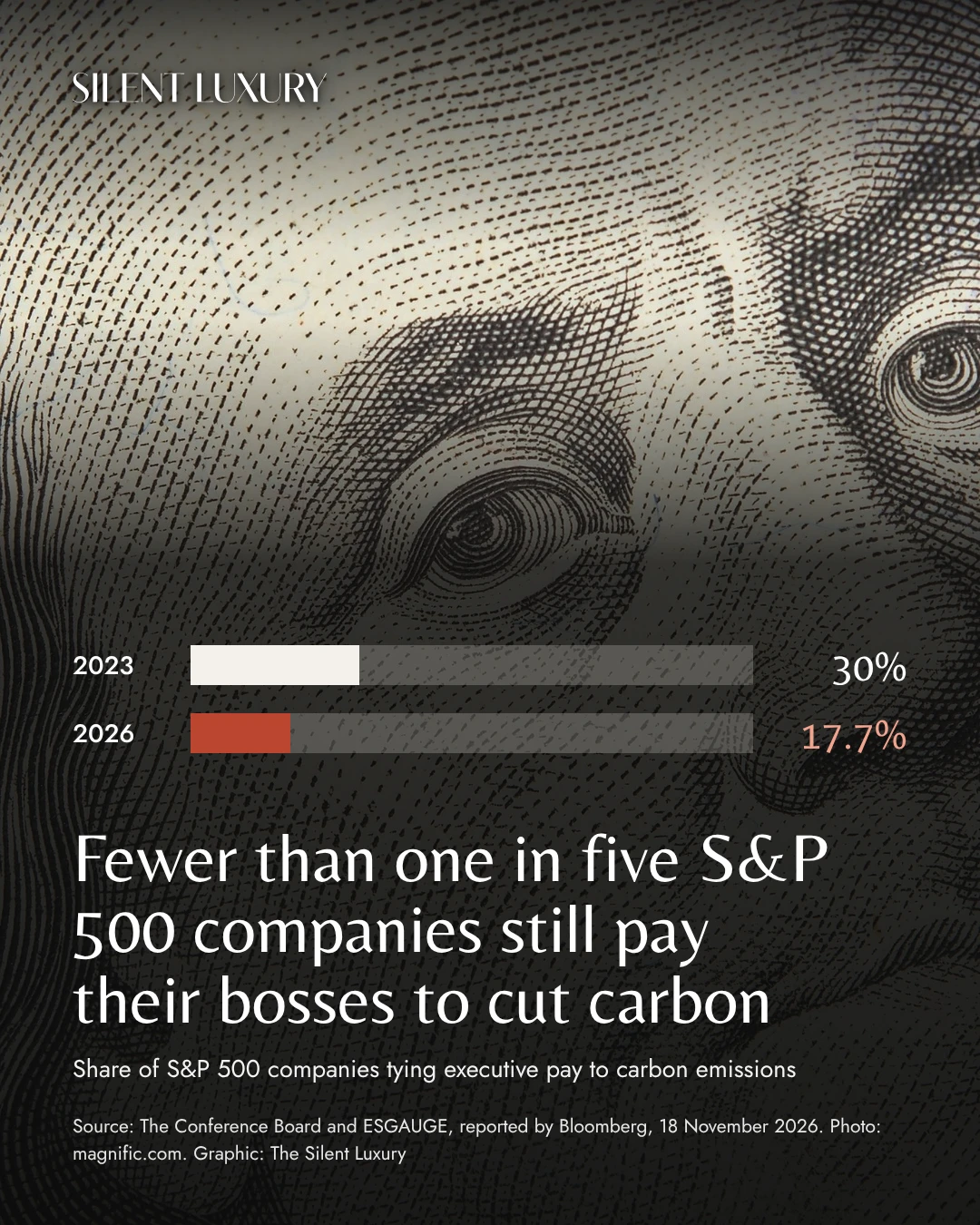
The movement has a name by now, the ESG backlash. The investors, banks and American regulators that pushed companies towards climate targets and climate disclosure after 2020 now push the other way, and in the boardroom the reversal works quietly, line by line, through the pay plan. Sustainability is losing its value there. What remains of it in American executive pay follows a logic best called net present virtue: climate stays where it pays for itself within the horizon of the bonus.
The nearest thing to a written rule came from a hotel company. In February 2026, Marriott wrote that it evaluates sustainability initiatives the same way as other corporate initiatives, with larger investments going through an analysis that may include net present value and internal rate of return. Energy efficiency still counts in the executive incentive plan at IHG, and water efficiency at Accor, while the refiner Valero let its energy transition modifier expire and listed uncertain returns among its reasons.
Six Years of Climate Pay: From Fink’s Letter to the ESG Backlash
Fund managers and banks put their own side of the promise in writing within sixteen months of Fink’s letter. On 11 December 2020, thirty fund managers with about $9 trillion under management launched the Net Zero Asset Managers initiative, and in April 2021, 43 of the world’s largest banks formed the Net-Zero Banking Alliance, both with net zero by 2050 as their horizon. In the same years boards wrote carbon measures into executive pay, and in 2023 the share of S&P 500 companies with such a measure reached 30 percent, the high point in the Conference Board’s data. The first departure had come a year before that peak, when Vanguard left the asset managers’ initiative on 7 December 2022 so that it could “provide the clarity our investors desire”.
2025 and 2026: The Banks, BlackRock, Washington and Brussels
The wider retreat came over a single holiday season. Between late December 2024 and early January 2025, six large American banks left the banking alliance; BlackRock left the asset managers on 9 January, and four days later the initiative suspended its tracking of what its members had committed to.
Washington moved within days. Donald Trump signed the order “Unleashing American Energy” on 20 January, his first day back in office, and within weeks the Securities and Exchange Commission had issued guidance under which an investor that presses companies for specific environmental or social policies risks its passive status. In March the Commission voted to stop defending its own climate disclosure rules. The banking alliance lasted until 3 October 2025, when its members voted to close it.
In 2026 the retreat reached the statute book and the pay plan. The asset managers’ initiative came back on 25 February with more than 250 managers and a goal that no longer names a year. Europe went two ways at once: its Omnibus I Directive took effect on 18 March and narrowed the duty to report, and on 27 September its rules against unproven green claims began to apply. By Bloomberg’s count in November, forty fewer companies in the S&P 500 tied pay to carbon than a year before. Days later, on 22 November, the COP31 climate talks in Antalya ended without a cover decision, after the European Union, Panama and small island states rejected a final draft that named neither coal, oil nor gas.
A note from The Silent Luxury
Good reading deserves to find you again.
Courts, Ballots and Bonuses: The ESG Backlash in the United States
In the United States the pressure now runs through the courts and the shareholder ballot before it reaches the bonus. In November 2024, Texas and ten other states sued BlackRock, State Street and Vanguard over an alleged conspiracy to constrict the coal market. In February 2026 Vanguard settled for $29.5 million, denying any wrongdoing and agreeing to refrain from using its holdings to steer the strategies of the companies it owns.
At annual meetings the sustainability vote shrank as well. Environmental and social proposals fell by almost 40 percent in the 2025 proxy year, according to Morningstar researchers, and average support dropped to 13 percent, against a peak of 33 percent in 2021.
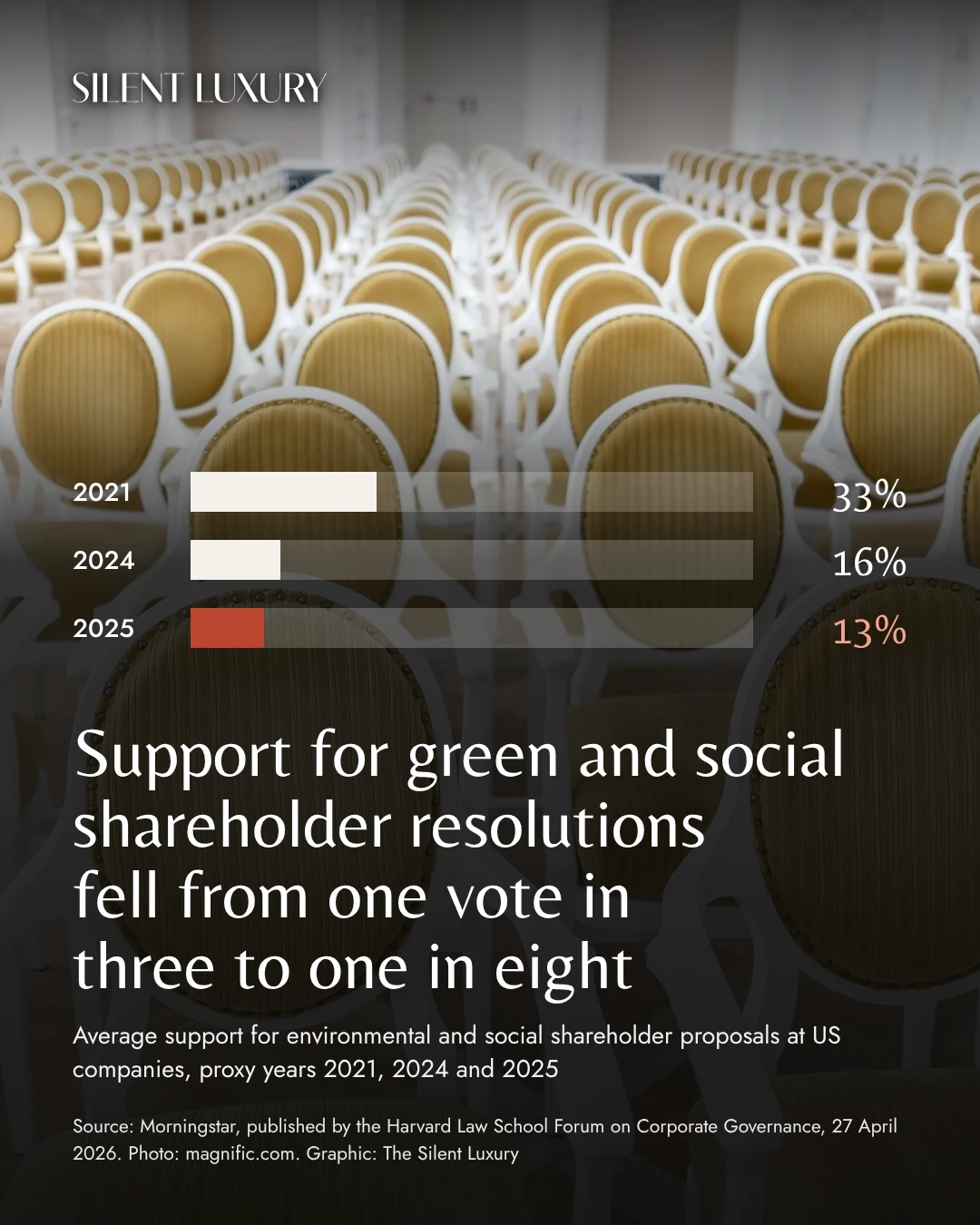
The pay plans followed. When Proxy Pro went through 80 companies in the S&P 100, sustainability was the category most often removed from incentive pay, while earnings per share and measures for artificial intelligence each gained a net four companies. At Verizon a carbon metric left the annual bonus after eleven years. At Delta Air Lines the wording changed: net zero by 2050, once a goal, is now an “aspiration”.
Europe’s ESG Backlash: Shorter Reports, Stricter Product Rules
In Europe the retreat shows up in the sustainability report, while executive pay has held. The Omnibus I Directive limits reporting under the CSRD to companies with more than 1,000 employees and €450 million in turnover, which the PRI estimates removes around 90 percent of the companies in the existing scope.
At least one ESG metric sits in the incentive plans of 94 percent of Europe’s 300 largest companies, by WTW’s count, with carbon reduction the most common at 70 percent. In France the Afep-Medef code has asked since December 2022 for at least one climate criterion in executive pay. The 2026 annual bonus at Kering, the first under its new chief executive, Luca de Meo, drops climate, which stays in the long-term plan.
For the product, 2026 brought stricter rules. Since 19 July 2026, large companies in the EU may no longer destroy unsold clothing and footwear. Since 27 September, every company that sells to consumers in the EU has been barred from generic green claims without proof and from calling a product climate-neutral on the strength of offsets. Producer responsibility schemes for textiles must follow by April 2028, even as the stricter Green Claims Directive is listed for withdrawal. Leather took the opposite direction: a delegated act of July 2026 removed it from the deforestation regulation.
Company by Company: What Is Left of ESG in the US
In the United States, ESG has come through the backlash in a smaller form. At least one ESG metric still sits in the incentive plans of 76 percent of S&P 500 companies, WTW finds, in fiscal years ending between May 2024 and May 2025. The 2026 Net Zero Stocktake counts net zero targets at 51 percent of large listed American companies, against 64 percent worldwide.
The net zero target tracker follows 33 companies through their own filings. American companies remove sustainability metrics whatever they measure, from emissions at Starbucks to packaging and water at Coca-Cola and a values modifier at Apple. British companies trim: Shell lowered the energy transition weight in its long-term plan from 25 to 20 percent, HSBC’s environmental weight fell from 25 to 15 percent over three cycles, and Rolls-Royce kept its net zero target while removing the emissions measure from its long-term plan. In continental Europe, Eni, Holcim, Heidelberg Materials, Safran, Hermès, UBS and Accor kept their weights.
The Dossier: Pay, Capital, Rules, Record and Terms
Five pieces follow the ESG backlash into the places where it is decided.
ESG Executive Pay in 2026: Sustainability Is Losing Its Value in the Boardroom
Between 2025 and 2026 Verizon, RTX and Microsoft rewrote their bonuses and Valero let its climate modifier expire, and at Oracle a senior executive is now paid partly on GPU orders.
Net Zero Asset Managers
Two of the managers that cast the largest blocks of votes on executive pay left the alliance, Vanguard in 2022 and BlackRock in 2025, and it relaunched in 2026 without them and with an undated goal.
CSRD Omnibus
The CSRD now covers only companies with more than 1,000 employees and €450 million in turnover, while the bans on destroying unsold clothing and on unproven green claims already apply.
Net Zero Target Tracker
Thirty-three companies in eight industries, from bp and HSBC to Kering and Marriott, appear with their climate targets and the change in their executive pay, each taken from the company’s own documents.
ESG Glossary
Thirty-six terms, from the proxy statement and the Afep-Medef code to Scope 3 emissions, come with a dated example and their primary source.
Net present virtue keeps the efficiency that pays back quickly, and it leaves the slower, costlier part of the transformation to whoever is still willing to wait for it. The pledge that once named 2050 now names no year.
Send this to someone who sits on a pay committee.
Continue Reading
-
Ralph Lauren Drops Sustainability From Executive Pay and Rewards AI Instead
Ralph Lauren has replaced the sustainability goals in its executive bonus plan with targets for artificial intelligence, according to its proxy statement for fiscal 2026. The citizenship and sustainability metrics in its short-term incentive plan gave way to an AI scorecard aimed at “AI literacy and enablement”.
-
Luxury Supply Chain ESG: Franco-Italian Framework Sets 46 Shared Requirements
Luxury supply chain ESG now has a shared reference point. The French and Italian fashion chambers have agreed one set of requirements for their suppliers, while each house remains responsible for its own due diligence and the EU’s due diligence directive applies from July 2029.
-
The Luxury Economy at a Turning Point: What 2026 Revealed
The luxury industry ended 2026 at about the same size, with its growth gathered among clients who already buy and in goods that hold their value. In the third quarter, LVMH grew by 1 percent on an organic basis, Hermès by 4 percent and Kering slipped by 1 percent.
Sources
Climate talks: UNFCCC, Simon Stiell at the COP31 closing plenary (22 November 2026); Daily Sabah on the end of COP31 (22 November 2026); NPR on COP31 (22 November 2026).
Investors and alliances: BlackRock, Larry Fink’s 2020 Letter to CEOs; NPR (14 January 2020); Net Zero Asset Managers, news; Net Zero Asset Managers, relaunch (25 February 2026); ESG Today (14 January 2025); ESG Dive on the NZAM relaunch; Reuters via Al Jazeera on Vanguard (7 December 2022); Reuters via Insurance Journal (14 January 2025); UNEP FI, launch of the Net-Zero Banking Alliance (21 April 2021); Banking Dive on the NZBA; Reuters via Insurance Journal (3 October 2025).
US government, regulators and courts: The White House, Unleashing American Energy (20 January 2025); SEC, C&DI 103.12 (11 February 2025); SEC, Staff Legal Bulletin No. 14M (12 February 2025); SEC Press Release 2025-58 (27 March 2025); Cooley on SEC staff guidance (14 February 2025); Texas Attorney General (November 2024); Alabama Attorney General on the Vanguard settlement (2 March 2026); Stipulated Order of Dismissal, Vanguard (26 February 2026).
EU law: Directive (EU) 2026/470 (Omnibus I); Linklaters on Omnibus I; PRI on the final Omnibus agreement (16 December 2025); ESG Today on the Green Claims withdrawal (4 November 2026); Directive (EU) 2024/825 (ECGT); Regulation (EU) 2024/1781 (ESPR); Directive (EU) 2025/1892 (Waste Framework, textiles); European Commission, EUDR and leather (13 July 2026); Afep-Medef Corporate Governance Code, December 2022, section 26.1.1 (ECGI).
Company documents: Marriott, Supplemental Statement on Sustainability Initiatives (12 February 2026); Valero, DEF 14A 2026; Verizon, DEF 14A 2026; RTX, DEF 14A 2026; Salesforce, DEF 14A 2025; Ralph Lauren, DEF 14A 2026; Delta Air Lines, DEF 14A 2026; IHG, Directors’ Remuneration Report 2025; Accor, Board decisions (19 March 2026); Kering, 2025 Universal Registration Document; Shell, Form 20-F 2025; HSBC, Form 20-F 2025; bp, Annual Report and Form 20-F 2025; Rolls-Royce, 2025 Annual Report. All further company filings are listed in the net zero target tracker.
Studies and analyses: Bloomberg via Accounting Today, Conference Board and ESGAUGE data (18 November 2026); WTW, Europe (22 January 2026); WTW, United States (22 January 2026); WTW, Executive pay trends in 2026 (8 May 2026); Proxy Pro, ESG pay metrics; Harvard Law School Forum on Corporate Governance (27 April 2026); Trellis on the Net Zero Stocktake 2026; Net Zero Compare; HEC Paris Knowledge on Efing, Ehmann, Kampkötter and Moritz, “All Hat and No Cattle? ESG Incentives in Executive Compensation”, working paper.
© The Silent Luxury
© The Silent Luxury. You are welcome to quote from this article and to share it, with credit to The Silent Luxury and a link to this page. We are glad to see it travel. Republishing the full text needs our permission, and images remain with their credited owners. Questions are always welcome: eva.winterer@silent-communications.com
Similar Articles

Net Zero Asset Managers: BlackRock and Vanguard Quit, and the Alliance Dropped 2050

ESG Meaning: 36 Terms That Explain the Climate Retreat in Plain English

Executive Compensation in 2026: Earnings and AI Replace Climate in the CEO Bonus