Tag: Couture Régénérative

Couture Régénérative names the position where luxury fashion reorganises itself beyond Quiet Luxury: regenerative materials, lasting craftsmanship, and cultural intelligence as a measurable form of value. The term gathers a practice that has existed in individual ateliers for years without a shared name to hold it together.

The architecture rests on three pillars. Materials and Earth’s Renewal addresses the level of the fibre, where regenerative agriculture, fibre-to-fibre innovation, bio-circular materials, and indigenous fibres replace the linear extract-and-discard model. Craftsmanship and Enduring Value treats time as a structural input that produces value, with visible repair and multi-generational durability as design principles. Systems and Cultural Intelligence covers what happens around and after the garment: the verification systems, the regulatory architecture, and the cultural reading that gives all of this meaning.

Three paradigm shifts follow from these pillars. From object to relationship, where the unit of value moves from the garment to the connections it carries. From perfection to patina, where wear becomes accumulated meaning rather than the loss of value. From individual to responsibility, where luxury consumption is read as participation in a longer chain rather than as solitary self-expression.

Within the Silent Luxury architecture, Couture Régénérative is the fashion expression of the same logic that Slow Hospitality articulates for travel and Well Living articulates for daily practice. The shared principle across all three is the treatment of cultural intelligence as a measurable form of value.

The Silent Luxury documents this position through pillar articles, atelier portraits, and industry analysis.

The Pyjama That Starts in the Field

Marion Röttges, Co-CEO of Remei AG, on Start of Life thinking, organic cotton, biodynamic farming and the textile traceability that begins with farmers in India and Tanzania.

The work Marion Röttges, Co-CEO Remei AG from Swittzerland, describes begins in the cotton fields of central India and Tanzania, where around four thousand smallholder farmers grow organic cotton within a purchase-guarantee system that Remei has been building for thirty years. In conversation with The Silent Luxury, Röttges reframes textile traceability as something that begins before the finished garment exists: with the raw material, the farmers, the soil and the relationships that make a transparent supply chain possible.

“Transparency is the beginning of everything. Not the end goal.” The German word for traceability, Rückverfolgbarkeit, gives her pause. “Traceability only functions when you have built it from the very beginning, from the raw material onwards. Then it becomes the result, rather than the great goal.”

Her phrase for this is Start of Life. In India, Remei’s subsidiary is developing biodynamic cotton timed to the lunar calendar. The farming practices involved are ones the farmers have long followed; Remei is formalising them through biodynamic certification.

In Tanzania, the same network is moving towards landscape-level regeneration. The QR code on the finished shirt links the wearer back to farmers in the field. This visibility matters to Röttges because it changes how producers see their own position in the supply chain. “I always experience this pride,” she told The Silent Luxury. “The producers and farmers find it truly wonderful to be part of a transparent supply chain, to be seen.”

The next project she has in mind is biodynamic Indian cotton made into pyjamas for slow hotels and mountain retreats. “Places like South Tyrol,” she said.

Continued Reading

From Fibre to Skin: Inside Remei’s Start of Life Cotton

In India, cotton follows the moon. In Tanzania, regeneration changes the fields. In Switzerland, Remei turns fibre origin into textile traceability.

Read the full feature →

In Conversation: Marion Röttges on Cotton, Origin and the Start of Life

In this conversation with The Silent Luxury, Marion Röttges of Remei AG explains why textile traceability begins with the raw material, the farmers and the relationships that make organic cotton possible. Her answers connect Start of Life thinking, biodynamic cotton farming in India and Tanzania, the LUMA shirt and the future of textiles for slow hospitality.

The Silent Luxury (TSL) How do you reframe traceability?

Marion Röttges: “Transparency is the beginning of everything. Not the end goal. Traceability only functions when you have built it from the very beginning, from the raw material onwards. Then it becomes the result, rather than the great goal.”

TSL: What is Start of Life thinking?

Röttges: “I personally believe we have to also lead the discussion of Start of Life. Where does the textile come from, where does the raw material come from? Who are the people growing it?”

TSL: How small is organic cotton in the global picture?

Röttges: “Organic cotton is one to three percent of the global cotton fibre volume. We have been working in a mini-mini-niche for thirty years. We are now entering regenerative organic cotton in Tanzania as well as in India, and practice biodynamic farming in India.”

TSL: What does biodynamic cotton farming look like in practice?

Röttges: “The farmers follow organic farming practices, plan according to the lunar calendar and use biodynamic preparations as inputs for their fields. It is the cultural link. It is how they have always worked.”

A biodynamic certification formalises a practice that predates industrial agriculture by several centuries.

TSL: What does the next phase of this biodynamic cotton look like?

Röttges: “I would like to make pyjamas from this. We could address hotels with it, or retreats. Places like South Tyrol.”

Continued Reading

What Touches the Skin: Notes on Cloth and Origin

Natural fibres in luxury fashion shape origin, traceability and trust. A report on wool, cotton, milk fibre and the future of cloth.

Read the full article →

TSL: What does traceability mean for the people on the ground?

Röttges: “I always experience this pride. The producers and farmers find it truly wonderful to be part of a transparent supply chain, to be seen.”

TSL: How does Tanzania fit into the Remei network?

Röttges: “Eighty percent of our cotton comes from Tanzania. In Tanzania there is a real awakening, a real boost. The farmers are developing.”

The landscape-level regeneration looks beyond the individual farm, taking in water, soil, biodiversity and the way the farming community lives in the broader landscape.

TSL: What does the conversion from conventional to organic require?

Röttges: “Converting a field from conventional to organic takes three years. Remei commits to buying the cotton for five years. That commitment makes the conversion possible.”

TSL: What does the LUMA T-shirt demonstrate?

Röttges: “I was really impressed by how you called it the LUMA Principle. That’s exactly what it’s all about. It’s not just the product. It’s really the principle.”

The LUMA T-shirt by Lotta Ludwigson, developed in collaboration with Remei’s Start of Life cotton, carries the full logic of the conversation: origin, farmer visibility and textile traceability made visible in one garment.

Continued Reading

Lotta Ludwigson: The LUMA Principle

Bio-circular, yarn-dyed, fully traceable: with the LUMA T-Shirt, Charlotte Piller extends the principle of her collection to the most everyday garment — in cooperation with Remei.

Read the full article →

This interview was conducted by The Silent Luxury as part of its editorial research on Remei AG, Start of Life cotton, textile traceability and regenerative luxury systems. It serves as a supporting source for the main Cloth and Skin feature on Remei and the LUMA Principle.

Continue reading

Regenerative Luxury: What Value Renews

Regenerative Luxury and the Architecture of Continuity: in Fashion, Design, Hospitality and Human Wellbeing

What is Regenerative Luxury?
Regenerative Luxury describes a value system in which luxury is measured by its ability to renew the systems it depends on: materials, landscapes, skills, communities, cultural memory, and human wellbeing. Defined by The Silent Luxury as the active dimension of the ecosystem, it ensures that every product, place, or experience contributes directly to the conditions that make true quality and Well Living possible.

Built upon the foundational philosophy of Silent Luxury, this framework moves radically beyond traditional sustainability and quiet aesthetics. By focusing on continuity, provenance, and systemic renewal, it transforms the modern high-end value architecture into a deeply conscious, unhurried, and restorative way of life.

Regenerative Luxury asks whether a product, place or experience contributes to the conditions that make quality possible. The term is defined by The Silent Luxury as the active dimension of its value architecture: the level at which value produces continuity.

The global personal luxury goods market reached around €364 billion in 2024. The number is vast. The systems that make luxury possible do not expand at the same pace. The soils that produce natural fibres, the craft traditions passed between generations, the landscapes that anchor destination hospitality and the human skills that hold quality over time require active investment in their continuity. Regenerative Luxury names the value system that takes this investment as its measure.

The Production Paradox

Textile Exchange reported that global fibre production reached 132 million tonnes in 2024. Polyester, a fossil-derived fibre, accounted for 59 percent of that volume. The proportion of natural fibres — wool, cotton, silk, linen — continues to decline as a share of global production. The FAO reports that 1.7 billion people now live in areas where human-made land degradation has reduced agricultural yields, directly affecting the soils from which cotton, wool and plant-based fibres originate. Capgemini’s 2025 analysis connects this directly to luxury’s supply chain, identifying regenerative agriculture as a strategic opportunity the luxury industry cannot continue to defer.

The luxury industry has spent decades asking what quality looks like. The question of where quality comes from — and whether the conditions of its production can be sustained, restored and passed forward — has received considerably less structural attention. Regenerative Luxury begins with that question.

Inside the 2026 Value Shift

This perspective builds on ongoing structural analyses of the global high-end market, firsthand evaluations of closed-loop systems—such as Remei’s bio-cotton—and continuous dialogue with the designers and visionaries who are reshaping our entire lifestyle architecture.


Understanding Regenerative Luxury

The word sustainability has, over two decades of use, accumulated primarily as a measurement term. It tracks emissions reduced, water saved, materials diverted from landfill. These metrics describe a system producing less harm. Regenerative Luxury operates on a different axis: it asks whether the systems that produced quality are stronger or weaker for having done so. The measure is continuity.

Sustainability has become, over two decades of application, primarily a vocabulary of reduction: tracking emissions, measuring waste, quantifying what is saved. Regenerative Luxury works from a different premise. It is a value term that asks whether the systems producing quality are stronger or weaker for having done so, whether the soils, the skills, the landscapes and the cultural knowledge that make luxury possible remain intact. The shift from reduction to continuity is the new architecture of value.

This makes Regenerative Luxury less a sustainability category than a value architecture.

This distinction reorganises what luxury is accountable for. A cashmere sweater grown from fibres with traceable provenance, processed with minimal chemical intervention and designed to last twenty years carries more regenerative value than an identically priced garment with no documented supply chain. A hotel embedded in its landscape, supporting local agricultural systems and employing craft traditions rooted in its region, carries more regenerative value than an equivalent property that imports its aesthetic from elsewhere. A ceramic bowl made by a maker with thirty years of material knowledge, designed to be restored rather than replaced, carries more regenerative value than an object produced for rapid obsolescence.

In each case, the question is the same: do the systems that produced this quality remain intact?


From Mitigation to Systemic Renewal: Sustainable vs. Regenerative Luxury

To truly understand the evolution of high-end value, we must contrast traditional eco-efficiency with the active, regenerative value system of modern luxury:

Dimension Sustainable Luxury (Traditional) Regenerative Luxury (The Active Dimension)
Core Objective Damage mitigation; aiming to do “less harm” and conserve existing resources. Active restoration; measuring luxury by its ability to renew the natural and cultural systems it depends on.
System Role Linear adjustments and static, carbon-neutral alternatives. A comprehensive value system driving continuity, deep provenance, and systemic renewal.
Value Connection Linked to external compliance, guilt-free consumption, and eco-labels. The active dimension anchored directly in the foundational philosophy of Silent Luxury.
Life Outcome Minor environmental adjustments in premium high-end consumption. True Well Living through enriched landscapes, communities, skills, and human wellbeing.

The Three Pillars of Regenerative Luxury

Regenerative Luxury applies across fashion and textiles, spaces and design, hospitality and travel, craft and human wellbeing. Three pillars describe the primary fields in which this value logic operates and the properties and practices that demonstrate it in full.

First Pillar: The Architecture of Material

How origin, fibre and land determine whether quality can continue

Every luxury object begins in the ground. Wool begins in a pasture. Cotton begins in a field. Silk begins in the mulberry leaf. Stone, ceramic, timber — all originate in ecosystems that can be cultivated intelligently or extracted without regard for their future capacity. The distinction between those two approaches is where the Regenerative Luxury reading of material begins.

Textile Exchange’s Materials Market Report 2025 documents the scale of the challenge. At 132 million tonnes of annual fibre production, with synthetic fibres accounting for the majority, the global textile system is structurally dependent on fossil extraction. Natural fibres — wool, silk, cotton, linen, bast fibres — are not simply a heritage preference within this context. They are a living material intelligence. They carry the ecological information of their origin. They can be grown in ways that build rather than deplete the soils they come from.

Capgemini’s 2025 analysis on regenerative agriculture and the luxury industry makes the commercial argument directly. Luxury companies sourcing raw materials from regenerative agricultural systems — farms that build soil health, support biodiversity and reduce synthetic input dependency — build supply chain resilience, ecological credibility and the kind of provenance that sophisticated consumers increasingly require. The paper treats regenerative sourcing as operational intelligence, not ethical positioning.

Couture Régénérative: The Fashion and Textile Intelligence Layer

Within Regenerative Luxury, the fashion and textile domain carries its own specific intelligence. Couture Régénérative is the term The Silent Luxury uses for this domain. It reads garments, fibres, craft, repair, authorship and provenance as part of a living value system.

The choice of fibre is an agricultural decision. The choice of weave structure is a craft decision. The choice of dye is a chemical and ecological decision. The decision to design for restoration rather than replacement is an economic and cultural decision. Together, these decisions determine whether a garment contributes to or extracts from the systems that made it.

The Swiss organic cotton company Remei — whose Bioré programme traces organic cotton from Indian and Tanzanian smallholder farms to finished product — demonstrates what this material intelligence looks like at agricultural scale. Traceability in the Remei model is a structural commitment to the farms, the communities and the soils that the supply chain depends on. The value of a certified organic garment made with Bioré cotton is measurable at the field level, not only at the point of sale.

Material Intelligence as Cross-Domain Practice

Material Intelligence, as The Silent Luxury uses the term, extends beyond fashion. It applies to interior design, architecture, hospitality and craft. It describes the capacity to read material beyond its surface: to understand its origin, its processing history, its likely performance over time, its capacity to be repaired or restored, and the cultural knowledge embedded in its production.

A marble floor sourced from a quarry with documented extraction practices and installed by craftspeople with traditional stone-laying knowledge carries a different material intelligence from an identical-looking floor produced by automated cutting with no documented supply chain. The distinction is invisible at first glance. It becomes legible in twenty, forty years — in how the material ages, in whether it can be maintained, in whether the knowledge to maintain it still exists.


Second Pillar: The Architecture of Place

How hospitality, landscape and spatial intelligence determine whether places renew or exhaust

Regenerative Luxury reads places as systems. A hotel is embedded in a landscape, connected to agricultural supply chains, employing local skills, drawing on a regional building tradition, and contributing to or extracting from the ecosystem that makes the location desirable in the first place.

Slow Hospitality, as The Silent Luxury defines it, is the temporal expression of regenerative value in place-based experiences. Extended stays, deep local connection, architectural intelligence rooted in landscape and material — these are the conditions under which a property functions as a regenerative system. The distinction shows in operational choices: where the kitchen sources its produce, which building traditions the property draws on, whether the staff are drawn from and trained within local communities over years rather than seasons.

Properties That Build the Architecture

Vigilius Mountain Resort in South Tyrol sits at 1500 metres, accessible only by cable car. Its design by Matteo Thun uses local larch wood and integrates with the terrain rather than imposing on it. The operational model supports local agricultural producers. At this altitude, with this level of access restriction, the property functions as a bounded ecosystem. What it imports, what it produces, what it employs — these are all legible in a way that open-access properties can more easily obscure.

Borgo La Pietraia, in the Cilento region of southern Italy, demonstrates the regenerative potential of deep geographic specificity. The Cilento is a UNESCO Biosphere Reserve. Its landscapes, agricultural traditions and culinary culture have been protected precisely by their distance from the circuits of mass travel. A hospitality model embedded here reads the landscape as inheritance. The value to the guest is inseparable from the value to the place: an ecosystem visited with care remains more intact than one marketed without it.

Forestis in South Tyrol occupies a former tuberculosis sanatorium, rebuilt with primary materials of local stone, glass and timber. The regenerative value is in the continuity of purpose: a building type that served human restoration for a century now serves it again in a different register. The landscape relationship of the original structure, the material vocabulary of the region, the therapeutic intention that shaped the site across different centuries of use — these are the sources of the value, not additions to it.

Healing Geographies as Regenerative Landscape

The Global Wellness Institute identifies green and blue wellness — healing experiences organised around forests, water, coastlines and mountain ecosystems — as one of the primary growth areas in wellness tourism for 2025. This is the landscape dimension of Regenerative Luxury: places understood as therapeutic systems, where the ecological health of the environment and the wellbeing of the visitor are the same conversation rather than competing priorities.

Thermal geography is among the oldest forms of this intelligence. Alpine mineral springs, Icelandic geothermal water, the hot springs of Japan’s volcanic landscape — these are places where the geology itself carries medicinal properties. SHA Wellness Clinic in Spain draws on its Mediterranean landscape as part of the nutritional and therapeutic architecture of its programmes. Vana in the Himalayan foothills integrates the botanical and climatic intelligence of its location into every element of its offering. Lanserhof, across its properties in Austria and Germany, builds chronobiological treatment around the specific light conditions, altitude and seasonal rhythms of each location.

GWI’s 2025 Global Wellness Economy Monitor values the global wellness economy at $6.8 trillion, with a projection to $9.8 trillion by 2029. The fastest-growing segments are those where the relationship between place, body and ecological quality is most direct. People seek places that restore them, and those places are most reliably restorative when they are themselves intact.

The Distinction That Matters

Market research has begun attaching regenerative to travel as a growth category. The Silent Luxury’s reading of place is more specific: it asks whether the relationship between a property and its landscape is genuinely regenerative — whether the ecology, the agricultural systems, the craft traditions and the community economy of the location are stronger for the property’s presence. That is a more demanding question than whether a hotel holds a sustainability certification. It is also the question that separates a regenerative hospitality model from a vocabulary.


Third Pillar: The Architecture of Time

How craft, repair and the continuity of use determine whether value compounds or is consumed

The third pillar of Regenerative Luxury is the one most legible in objects and spaces over time. It is the question of whether things are designed to last, to be restored, to improve with age, and to carry their knowledge forward into the hands of the next person who uses them.

The Ellen MacArthur Foundation identifies circular design — the practice of creating products that can be disassembled, repaired, repurposed and returned to their material origins — as one of the primary levers for reducing the material throughput of the fashion and design industry without reducing value. The Fashion ReModel names resale, rental, repair and remaking as the core mechanisms for keeping products in use longer. Each of these mechanisms rests on continuity as its economic logic.

LVMH reported 500 million euros in revenue linked to repairs, refills and take back activity — a figure that, when published, functioned as an industry signal. ThredUp’s latest resale reporting, based on GlobalData research, projects the global secondhand clothing market at $289 billion in 2026 and expects it to reach $393 billion over the following five years. The EU’s Right to Repair Directive entered into force on 30 July 2024 and must be transposed and applied by Member States from 31 July 2026, requiring manufacturers to make spare parts and repair documentation available across an expanding range of product categories. These are structural changes in the economic architecture of quality goods.

For Regenerative Luxury, the Repair Economy is the practical expression of the value logic: quality accumulates through use rather than being depleted by it. A Hermès bag that deepens in character through years of wear. A Vitsœ shelving system designed to be reconfigured across decades. A Shaker chair built with joinery precise enough to be disassembled and reassembled by a competent craftsperson two hundred years after it was made. These objects carry a different relationship to time, and that relationship is itself a form of value.

Material Intelligence in Use

The Regenerative Luxury reading of craft and repair is not simply about product longevity. It is about the knowledge that makes longevity possible. A garment can only be restored if the restoration knowledge exists. A building can only be maintained if the craft traditions that built it are still living. A ceramic can only be mended — in the Japanese tradition of Kintsugi, repaired with gold to make the damage visible rather than concealed — if the cultural understanding of repair as enhancement persists.

This is Material Intelligence at its most specific: the knowledge embedded in making, and the knowledge required to continue what making has begun. The Bosnian wood studio Zanat and the Italian studio Forma Fantasma — both of which have made material origin and craft knowledge structurally central to their practice — exemplify the maker intelligence that Regenerative Luxury reads as generative.

Time as the Value Axis

In conventional luxury, value is most often established at the moment of acquisition. Regenerative Luxury shifts this axis: worth accumulates through use, restoration, cultural transmission and continued relevance across generations. This is observable in the market data for secondhand watches, maintained historic properties and restored textiles. Objects and places designed for continuity hold value differently — and hold a different kind of cultural significance: they carry the evidence of use, the traces of the hands that have maintained them, and the accumulated intelligence of everyone who has worked with them across time.


Where Regenerative Luxury Is Being Built

Regenerative Luxury is already practised, in specific places and specific domains, by makers, properties and institutions whose work The Silent Luxury has been documenting since its founding. The following identifies the nodes where the value architecture described here is structurally present — in operation, not in aspiration.

In fashion and textiles, Couture Régénérative covers makers whose relationship to fibre, origin and craft is structural. This includes Remei, whose Bioré programme traces cotton from field to finished textile. It includes designers whose material decisions begin with the agricultural layer and work forward through processing, construction and designed longevity. It includes repair specialists, natural dyers and weavers maintaining textile traditions whose ecological knowledge is encoded in the structure of the cloth itself.

In hospitality and place, Vigilius Mountain Resort, Borgo La Pietraia and Forestis exemplify properties where the architectural, agricultural and ecological commitments are part of the operating model rather than the communication strategy. SHA Wellness, Vana India and Lanserhof demonstrate what clinical and ecological depth look like when they are genuinely integrated.

In design and craft, Zanat in Bosnia and Forma Fantasma in Italy and the Netherlands demonstrate practices where the question of what happens to the material next is built into the design from the beginning.

The Economic Signal

The data surrounding Regenerative Luxury is not the data of a niche preference. It describes a structural shift in how quality and value are being understood by sophisticated consumers, institutional buyers and the companies that supply them.

The Global Wellness Institute values the global wellness economy at $6.8 trillion in 2024 and projects $9.8 trillion by 2029. Wellness tourism grew 36 percent from 2020 to 2022, markedly faster than overall tourism recovery. Wellness trips represent 7.8 percent of all tourism trips but 18.7 percent of total tourism expenditure — a spending premium of 2.4 times the average. Consumers who seek transformation invest differently from consumers who seek transaction.

The secondhand and restoration markets for fashion and objects are growing at rates that significantly outpace primary market growth. ThredUp projects the global secondhand clothing market at $289 billion in 2026, reaching $393 billion over the following five years. The EU’s Right to Repair Directive, the Ellen MacArthur Foundation’s analysis of circular business models and the revenue now reported by major luxury houses from repairs, refills and take back activity all indicate that the economics of continuity are becoming commercially central.

Capgemini’s 2025 analysis identifies supply chain resilience, biodiversity and brand relevance as the primary strategic benefits available to luxury companies that engage seriously with regenerative sourcing. Companies that build genuine relationships with the systems they depend on are better positioned for supply volatility, regulatory change and shifting consumer expectations than companies whose supply chains are purely extractive.

While this regenerative framework defines the active dimension of modern value, it is entirely anchored in a broader paradigm shift. To explore the foundational philosophy behind this framework, read our guide on What is Silent Luxury. To see how these critical dimensions map across economic systems, explore The Matrix of High-End Value, or discover the macro perspective in The Remapping of Luxury.

Frequently Asked Questions (FAQ)

What is Regenerative Luxury?

Regenerative Luxury describes a value system in which luxury is measured by its ability to renew the systems it depends on—such as materials, landscapes, skills, communities, cultural memory, and human wellbeing. It represents the active dimension of the high-end value architecture defined by The Silent Luxury.

How does Regenerative Luxury differ from Sustainable Luxury?

Sustainable luxury aims for damage mitigation or neutral footprints. In contrast, the regenerative luxury value system actively contributes to the conditions that make quality possible by restoring and enriching cultural heritage, natural purity, and generational depth.

What is the relationship between Regenerative Luxury and Well Living?

Well Living is the ultimate outcome of this framework. When a product, place, or experience embraces the active dimension of regenerative luxury, it directly nourishes natural ecosystems and human wellbeing, translating into a deeply authentic, high-quality way of life.

Copyright & Intellectual Property Notice: The conceptual framework of the 2026 High-End Value Matrix, its individual terminology, and all accompanying visual diagrams/graphics are the exclusive intellectual property of TSL / Silent Communications GmbH. Any reproduction, distribution, modification, or commercial use of this framework or its graphic components requires the prior, explicit written consent of Silent Communications GmbH. Unauthorized duplication or redistribution is strictly prohibited and subject to legal action.

Continue reading

The Return on Repair: How a 500-Million-Euro Figure Is Reshaping the Economics of the Fashion Industry

LVMH has reported 500 million euros in repair and take-back revenue for 2025. The secondhand market is projected to reach 317 billion dollars by 2028. The global repair market grows at nearly three times the rate of new production. An analysis by The Silent Luxury of what these figures mean together and what the documented experience of Japan, China, India, Latin America, Africa, Europe and the United States reveals about the structural direction of the industry.

Kevin Germanier opened the Global Fashion Summit in Copenhagen on 6 May with a collection built from unsold stock held across seven LVMH brands. Germanier is a Swiss designer who founded his label in 2018 and has since built an international reputation working exclusively with deadstock fabrics and production surplus, developing Haute Couture silhouettes that have shown alongside the established Paris houses at international presentations. What he showed in Copenhagen was technically precise, formally rigorous, assembled from material sitting in LVMH warehouses. It was the first time the group had made its surplus inventory available to an external designer for public presentation at this scale.

“Presenting this show at the Global Fashion Summit is a way of demonstrating that circularity can be at the heart of the creative process. Working with existing pieces allows us to reveal the richness of materials and craftsmanship, while reimagining the way we create,” Kévin Germanier, Artistic Director and Founder of Maison GERMANIER. 

Surplus inventory is among the most commercially sensitive information a luxury group holds. The volumes, the styles and the fabric allocations carry detailed evidence of what the market accepted and what it did not, which is why the practice has always been to absorb, redistribute or, in the years before EU legislation banned it, destroy what remained. That LVMH chose in 2026 to open seven brands’ worth of that inventory to an outside designer, and to do so on the opening stage of one of the industry’s most visible annual gatherings, is a disclosure of intent as much as material.

The repair economy in fashion describes the business systems that extend the commercial life of garments through repair, take-back, resale, refill, remanufacturing and textile recycling. In 2026, it is moving from sustainability language into balance sheets, supply chains and customer retention strategies.

The following day, LVMH published the figure that contextualises the gesture. Under Life 360, the group’s internal sustainability and circularity programme that measures product longevity, repair and take-back services across all its brands including Louis Vuitton, Dior, Celine, Fendi, Givenchy and Bulgari, LVMH reported 500 million euros in revenue from repair, refill and take-back services for 2025, covering ten million products restored, refilled or returned. The group presented this for the first time as a revenue line rather than as a sustainability indicator. A sustainability indicator is addressed to external audiences as evidence of responsibility. A revenue line is addressed to internal audiences as evidence of a business working.


What the numbers show

The 500 million euro figure arrives within a precise market context. The global base of luxury consumers has shrunk from a peak of approximately 400 million in 2022 to 330 to 340 million in 2026, a net loss of between 60 and 70 million buyers, according to Bain and Altagamma, the Italian luxury industry association and global management consultancy whose joint annual luxury study is the most widely referenced in the sector. Bain traces approximately 80 percent of the luxury market’s growth between 2019 and 2023 to price increases rather than volume gains. Prices rose without a commensurate deepening of product quality or the depth of the customer relationship. The buyers who left understood the difference.

LVMH’s own results reflect this pressure directly. The group recorded a two percent organic revenue decline across the first half of 2025 and one percent organic growth in Q1 2026, while its share price fell 28 percent in the first quarter alone, the largest single-quarter decline in company history, exceeding the drops recorded during the 2008 financial crisis and the pandemic quarter of 2020. Kering, the French luxury group whose brands include Gucci, Saint Laurent and Balenciaga, recorded flat organic growth at group level in Q1 2026, with Gucci down eight percent organically in the same period. The primary market, measured by new product sales, is under sustained structural pressure across the sector.

In the same period, the market for extended product life has been expanding with consistency. The global market for clothing and footwear repair reached 5.8 billion dollars in 2025 and is projected to grow at 5.5 percent annually to 9.4 billion dollars by 2034. The global secondhand apparel market is anticipated to reach 53.7 billion dollars in 2026, with an 11.1 percent compound annual growth rate projected through 2036, according to Future Market Insights. The BoF-McKinsey State of Fashion 2026 documents that secondhand sales will grow two to three times faster than first-hand sales between 2025 and 2027, reaching a projected 317 billion dollars by 2028. Branded resale grew 300 percent between 2021 and 2025. Repair, resale and rental models combined are estimated to represent a 700-billion-dollar market by 2030. The global textile recycling market was valued at 6.42 billion dollars in 2025 and is projected to reach 9.23 billion dollars by 2034.

The Silent Luxury · Market Analysis · May 2026 Growth Rates: Primary Market vs. Extended Product Life Annual growth rates · Market size 2025/2026 · Selected segments
Primary Luxury Market Bain–Altagamma · 2025/2026
+1–3%
No aggregate market value
Global Textile Recycling Fortune Business Insights · 2025–2034
+4.3%
USD 6.42 billion · 2025
Clothing & Footwear Repair Dataintelo · March 2026
+5.5%
USD 5.8 billion · 2025
Secondhand Apparel Future Market Insights · 2025–2036
+11.1%
USD 53.7 billion · 2026
Sources: Bain–Altagamma Luxury Study 2026 · Dataintelo Clothing & Footwear Repair Market Report, March 2026 · Future Market Insights Secondhand Apparel Market 2026 · Fortune Business Insights Textile Recycling Market 2025–2034 © Silent Communications GmbH · the-silent-luxury.com

The brands that built the infrastructure earliest

Patagonia, the California-based outdoor clothing company founded in 1973, launched its Worn Wear repair and resale platform in 2013, thirteen years before repair became a regulatory topic in the European Union. The company repairs approximately 17,000 products annually and generates as much as 100 dollars per used jacket sold through its own resale channel. Harvard Business Review research found that an average Patagonia product lasts as long as three comparable items from other brands. In partnership with the United Repair Collective, a collaboration between Patagonia, the Amsterdam-based social enterprise Makers Unite, and the Amsterdam Economic Board, the company operates dedicated repair centres in Amsterdam and London providing business-to-business repair services for brands including Decathlon, Lululemon and Rapha.

Eileen Fisher, the New York-based womenswear label founded in 1984, has operated its Renew remanufacturing programme for two decades, taking back used garments, repairing and reselling them, and publishing annual transparency data on repairs completed. Nudie Jeans, the Swedish denim label founded in 2001, offers free in-store repairs at all its retail locations globally. Tersus Solutions, the Colorado-based logistics company whose clients include Patagonia, The North Face, Arc’teryx, Dr. Martens and Lululemon, reported banner years across those brands in 2025. “With each holiday cycle, we’re seeing the resale category grow,” said Terry Boyle, CEO of Trove, “and each year the promotions have more of the polish and scale of broader retail campaigns.”

Of the 42 major fashion brands tracked by Stand.earth in 2025, 40 now offer some form of resale or repair programme, up from nine brands in 2020. The University of Exeter’s Mapping the Repair Landscape in Fashion report, published in March 2026 as the conclusion of the UK Research and Innovation-funded Future Fibres Network Plus programme, found that repair remains commercially underdeveloped across the industry because brands have not yet resolved the practical and strategic barriers to operating it at scale.

The regulatory architecture

The European Union’s Right to Repair Directive, which came into force in 2024, establishes the legal right of consumers to have products repaired by independent repairers and requires manufacturers to provide access to spare parts and technical information for a defined period after purchase. Across the EU countries within the directive’s initial scope, smartphone repair rates have already risen by 20 percent. France has introduced its Repair Bonus, a direct government reimbursement covering a portion of consumer repair costs. Sweden has reduced VAT on repair services across clothing and textiles. The EU Digital Product Passport, which becomes mandatory for textiles in 2027, will require brands to document the material composition, provenance and repairability of every garment at the point of sale.

The Global Fashion Agenda, the Copenhagen-based non-profit organisation that convenes the Global Fashion Summit and serves as one of the primary international policy coordination bodies for the fashion industry, launched the 2030 Circularity Blueprint at the summit in partnership with ReHubs, the European network whose mandate is to develop the industrial infrastructure for textile-to-textile recycling at scale. The Blueprint sets out a roadmap for transitioning the EU textile ecosystem so that fibres recovered from used garments re-enter the production cycle as new fibre. Less than one percent of fibres are currently recycled fibre-to-fibre globally, according to BCG data documented by The Silent Luxury, against a projected annual textile resource loss of 150 billion dollars.


The Silent Luxury · Regional Data · May 2026 Global Textile Recycling Markets by Region Market size in USD billion · 2026 · Fortune Business Insights
ChinaLargest single market
2.24USD bn
Asia Pacific45% global share
2.90USD bn
Europe20% global share
1.34USD bn
North America18% global share
1.20USD bn
Latin America12% global share
0.79USD bn
Middle East & Africa5% global share
0.33USD bn
Source: Fortune Business Insights · Global Textile Recycling Market 2025–2034 © Silent Communications GmbH · the-silent-luxury.com

Europe: From policy to practice

Within Europe, the transition from policy commitment to operational practice is moving at different speeds. The United Kingdom’s resale market is projected to grow at a 9.3 percent compound annual growth rate through 2036, driven by the country’s established charity shop culture, the growth of digital platforms including Depop and Vinted, and the government’s Green Industrial Revolution framework. Germany and the Netherlands have developed the densest networks of brand-operated repair services and government-backed repair cafés. Europe’s textile recycling market generated 1.28 billion dollars in 2025 and is projected to reach 1.34 billion dollars in 2026.

Marine Serre, the French designer who won the LVMH Prize in 2017 and founded her label the following year, has built one of the most rigorous practices in European fashion around upcycled materials and archived textiles. She stepped back from seasonal runway presentations for two consecutive collections to concentrate on what she describes as the slow craft of making clothes. Her FW26 collection, titled “The Grace of Time,” and its Louvre capsule, three pieces assembled from archived Louvre shop T-shirts and souvenir medals cut apart and rebuilt, make the underlying argument at the level of craft: the object that carries evidence of prior life and careful reconstruction accumulates meaning that a new object arrives without.

United States: Scale without mandate

The United States is the world’s largest and most mature resale market, representing roughly 40 percent of global secondhand apparel revenue. Online resale in the US is forecast to grow 16 percent annually, reaching 34 billion dollars by 2027. In 2025, 66 percent of US adults reported shopping secondhand regularly, with 28 percent of Gen Z consumers doing so on a weekly basis. The US textile recycling market is projected to reach 1.02 billion dollars in 2026. The Government Accountability Office has called for coordinated federal action on textile waste, and industry coalitions including American Circular Textiles are pressing for the removal of double taxation on secondhand goods. The BoF-McKinsey State of Fashion 2026 found that fewer than one-third of US fashion industry executives called resale a priority for 2026.

Latin America: Community-rooted infrastructure

Latin America’s textile recycling market reached 770 million dollars in 2025 and is projected to grow to 790 million dollars in 2026, according to Fortune Business Insights, representing just under 12 percent of total global textile recycling revenue. Brazil accounts for the largest share of the regional market, with its textile recycling sector valued at 97.5 million dollars in 2025 and projected to reach 166.8 million dollars by 2034. Across the region, community-based textile recycling programmes represent one of the most documented growth areas, with local cooperatives gathering, sorting and repurposing used textiles in ways that combine environmental function with social impact for underserved communities.

The structural picture across Latin America is complex. Brazil, Argentina, Paraguay and Peru each restrict or prohibit commercial imports of secondhand clothing, policy decisions that reflect a choice to protect domestic textile production. Chile and other Southern Cone nations are integrating textiles into Extended Producer Responsibility frameworks. A 2026 study published in Springer Nature’s Circular Economy and Sustainability journal, examining Brazilian consumer trends from 2012 to 2022, found that fast fashion-oriented behaviour is forecast to dominate the Brazilian market by 2033 without effective structural interventions, and calls for policy measures that make the circular option economically accessible rather than aspirational.

Maison GERMANIER x LVMH, Global Fashion Summit Copenhagen, 6 May 2026. Credit: LVMH.

Maison GERMANIER x LVMH, Global Fashion Summit Copenhagen, 6 May 2026. Credit: LVMH.


China: Industrial policy as the mechanism

China’s approach to the repair and circularity economy is driven at the level of industrial planning. The State Council’s 14th Five-Year Plan, covering 2021 to 2025, set a target of achieving a textile waste recycling rate of 25 percent and producing two million tonnes of recycled fibre annually, according to research published in Frontiers in Environmental Science. The 15th Five-Year Plan, covering 2025 to 2030, continues this trajectory with emphasis on green transformation and carbon neutrality goals. China’s textile recycling market is valued at 2.24 billion dollars in 2026, the largest single national market in Asia Pacific. China’s luxury resale market was projected to grow from approximately eight billion dollars in 2020 to 32 billion dollars by 2025, according to iResearch data cited by The Interline, driven by a generational shift among Gen Z and Millennial consumers who account for more than 80 percent of secondhand luxury customers in the country.

Japan: A grammar that predates the legislation

A 2024 study published in ScienceDirect, examining circular economy potential in Japan’s textile and fashion industries and produced for the EU-Japan Centre for Industrial Cooperation, describes the concept of Mottainai as the cultural foundation beneath Japan’s approach to textile longevity. Mottainai, a term conveying deep regret at any form of waste, has produced a functioning infrastructure for textile circulation in Japan that operates without regulatory mandate: networks of secondhand retail, community exchange events, mending practices embedded in household routines, and the intergenerational transfer of clothing as a standard cultural expectation. The same study describes the kimono as a design object that embodies this logic structurally: cut in straight lines so that when untied it returns to a single piece of fabric, designed from its origin to be disassembled, reused and repurposed across generations. Japan’s secondhand luxury market is projected to grow at a 7.6 percent compound annual growth rate through 2036. The country’s textile recycling market generated 323.8 million dollars in revenue in 2025 and is projected to reach 462.7 million dollars by 2033.

India: Circularity as industrial baseline

In India, the repair and reuse economy has never required a policy framework because it has always been the baseline condition of production. A March 2026 report published in Global Textile Times on the country’s textile recycling sector found that approximately 55 percent of post-consumer textile waste is diverted from landfill through informal collection, sorting and redistribution systems supporting between four and four and a half million livelihoods, the majority held by women from marginalised communities. Nearly 100 percent of spinning sector waste is directly reused within production processes. The Indian textile recycling market is projected to reach 3.5 billion dollars by 2030. India’s G20 Presidency and Mission LiFE, the Lifestyle for the Environment programme adopted by the United Nations Environment Programme as a global framework, reinforce long-term goals that align with the repair economy’s direction.


West and East Africa: Protection as strategy

In West and East Africa, the political response has taken the form of trade policy. Kenya and Tanzania have introduced import taxes on secondhand clothing shipped from Western markets, protective measures for domestic textile manufacturing. A 2024 study published in ScienceDirect on the dynamics of global secondhand clothing trade found that while sub-Saharan African countries benefit from the affordability and employment that secondhand clothing trade creates, the dependency relationship also constrains domestic production investment. In Ghana, kente production, the hand-woven textile tradition with roots in the Asante and Ewe peoples dating to the 17th century, is experiencing documented revival as an international market positioning strategy. Bubu Ogisi, the founder of the Lagos-based label I Am Isigo and one of the most internationally recognised practitioners of a design approach in which repairability is a structural requirement from the earliest design stage, has built a following across Europe and North America among buyers who treat the durability and material honesty of a garment as primary purchasing criteria.

The Silent Luxury · Industry Data · May 2026 Brand Repair & Resale Programme Adoption Major fashion brands offering repair or resale · 42 brands tracked · Stand.earth 2025
2020
9of 42 · 21%
2023
28of 42 · 67%
2025
40of 42 · 95%
Existing 2020 Added by 2023 Added by 2025 No programme
Sources: Stand.earth Fashion Scorecard 2025 · BoF-McKinsey State of Fashion 2026 © Silent Communications GmbH · the-silent-luxury.com

What 500 million euros changes

LVMH’s Life 360 figure is the first time a luxury group of its scale has placed a revenue number on the object that stays. The group’s total revenues run well into the tens of billions, and 500 million euros is a fraction of that. What the figure changes is the terms of the conversation. Repair has been discussed in the fashion industry for the better part of a decade as a loyalty instrument, a regulatory compliance strategy, a sustainability signal, a customer service add-on. The 500 million euro figure positions it as a measurable business line with documented growth, in a market where the primary channel is under sustained pressure.

The BoF-McKinsey State of Fashion 2026 found that fewer than one-third of industry executives called resale a priority for 2026, and that only 7 percent planned to support circular business models in any meaningful way. These figures sit alongside a secondhand market projected to reach 317 billion dollars by 2028. The gap between where executive attention is directed and where consumer spending is moving is the space in which the repair economy will continue to grow.

On 6 May in Copenhagen, Germanier assembled ten million products worth of that growth into Haute Couture silhouettes and placed them on a stage where the industry’s decision-makers were required to look at them. The nails held.

What readers ask about the repair economy in fashion

The repair economy in fashion is one of the most consequential structural shifts in the global luxury and apparel industry in 2026. Based on primary market data from Bain and Altagamma, the BoF-McKinsey State of Fashion 2026, Fortune Business Insights, Dataintelo, Stand.earth and regional research from Japan, India, Latin America and West Africa, The Silent Luxury documents the economic, regulatory and cultural forces reshaping how garments are produced, maintained and valued — and what LVMH’s 500-million-euro Life 360 revenue figure signals for the industry’s next decade.

  • What is the repair economy in fashion, and why is it growing in 2026?

    The repair economy in fashion encompasses repair services, take-back programmes, resale platforms and textile recycling systems that extend the life of garments beyond their original sale. It is growing in 2026 because two structural forces are converging: the primary luxury market is contracting, having lost between 60 and 70 million active buyers since 2022 according to Bain and Altagamma, while regulatory frameworks including the EU Right to Repair Directive and the forthcoming EU Digital Product Passport are making product longevity a legal requirement for the first time.

  • How much revenue does LVMH generate from repair and take-back services?

    LVMH reported 500 million euros in revenue from repair, refill and take-back services for 2025, covering ten million products restored, refilled or returned across its brands. This was disclosed under the group’s Life 360 circularity programme and presented for the first time as a revenue line rather than a sustainability metric, at the Global Fashion Summit in Copenhagen in May 2026.

  • What is the Global Fashion Agenda’s 2030 Circularity Blueprint?

    The 2030 Circularity Blueprint is a policy roadmap launched by the Global Fashion Agenda in partnership with ReHubs at the Global Fashion Summit in Copenhagen in May 2026. It targets a full transition of the EU textile ecosystem toward fibre-to-fibre recycling by 2030. Currently less than one percent of textile fibres are recycled fibre-to-fibre globally, against an annual textile resource loss of 150 billion dollars according to BCG.

  • How does Japan’s approach to textile repair differ from Western regulatory models?

    Japan’s textile circularity infrastructure is rooted in the cultural concept of Mottainai — a deep aversion to waste — rather than in regulatory mandates. A 2024 ScienceDirect study produced for the EU-Japan Centre for Industrial Cooperation found that this cultural foundation has produced networks of secondhand retail, mending practices and intergenerational clothing transfer that predate and structurally outpace Western circular economy programmes. Japan’s textile recycling market generated 323.8 million dollars in 2025.

  • What share of India’s textile waste is recovered through informal systems?

    Approximately 55 percent of India’s post-consumer textile waste is diverted from landfill through informal collection, sorting and redistribution systems, according to a March 2026 report in Global Textile Times. These systems support between four and four and a half million livelihoods, the majority held by women from marginalised communities. Nearly 100 percent of spinning sector waste is directly reused within production processes. India’s textile recycling market is projected to reach 3.5 billion dollars by 2030.

  • How many fashion brands now offer repair or resale programmes?

    Of the 42 major fashion brands tracked by Stand.earth in its 2025 Fashion Scorecard, 40 now offer some form of resale or repair programme, up from nine brands in 2020. The University of Exeter’s Mapping the Repair Landscape in Fashion report, published in March 2026, found that despite widespread adoption, repair remains commercially underdeveloped because brands have not yet resolved the practical and strategic barriers to operating it at scale.

  • What is the projected size of the global secondhand apparel market?

    The global secondhand apparel market is projected to reach 53.7 billion dollars in 2026 according to Future Market Insights, and 317 billion dollars by 2028 according to the BoF-McKinsey State of Fashion 2026. Branded resale grew 300 percent between 2021 and 2025. Repair, resale and rental models combined are estimated to represent a 700-billion-dollar market by 2030.

  • What protective measures have African countries introduced regarding secondhand clothing imports?

    Kenya and Tanzania have introduced import taxes on secondhand clothing shipped from Western markets, as protective measures for domestic textile manufacturing. A 2024 ScienceDirect study on global secondhand clothing trade dynamics found that while the secondhand clothing trade creates affordability and employment across sub-Saharan Africa, it also constrains domestic production investment. Ghana and Ethiopia are responding by positioning traditional textiles — kente and shemma — as internationally competitive products based on cultural provenance and craft quality.


Note: The charts, data visualisations and infographics contained in this article are the copyright of Silent Communications GmbH, Vienna. Any use — including partial reproduction — requires prior written permission and must include the full attribution © The Silent Luxury (the-silent-luxury.com) with an active link to the original publication. Licensing enquiries: info@the-silent-luxury.com.


Sources:
LVMH Life 360 Programme, quantified May 2026 · Global Fashion Summit Copenhagen, 5–7 May 2026 · GFA 2030 Circularity Blueprint / ReHubs · Marine Serre / WWD FW26 · BoF-McKinsey State of Fashion 2026 · Bain–Altagamma Luxury Study 2026 · Dataintelo Clothing & Footwear Repair Market Report, March 2026 · University of Exeter: Mapping the Repair Landscape in Fashion, March 2026 · Stand.earth Fashion Scorecard 2025 · Fortune Business Insights: Global Textile Recycling Market 2025–2034 · Future Market Insights: Secondhand Apparel Market 2026 · Bleckmann: US Resale Market, January 2026 · IMARC Group: Brazil Textile Recycling Market 2026–2034 · Springer Nature: Circular Economy Challenges in Fashion — Brazilian Consumer Trends, March 2026 · ScienceDirect: Circular economy potential in Japan’s textile industries, December 2024 · Frontiers in Environmental Science: China textile and fashion industry, March 2026 · The Interline: China sustainability efforts · Global Textile Times: India Textile Recycling Market, March 2026 · Grand View Research: Japan Textile Recycling Market 2025–2033 · AICI: Fashion Circular Economy Around the World, 2025 · ScienceDirect: Global secondhand clothing trade dynamics, November 2024 · BCG Textile Resource Loss Data · Harvard Business Review: Patagonia product longevity · Tersus Solutions / Peter Whitcomb · Trove / Terry Boyle

Continue reading

Nairobi Fashion Week 2026: Decarbonize and the Material Future of African Fashion

The eighth season of Nairobi Fashion Week placed Decarbonize at the centre of African fashion. Across twelve studios, textile waste, organic cotton, social enterprise and heritage craft became the working conditions of a regenerative design economy.

Nairobi Fashion Week Season 8 was held from 28 to 31 January 2026 at Sarit Expo Centre in Westlands under the editorial title Decarbonize. Founder and Creative Director Brian Kihindas, who opened Nairobi Fashion Week in 2013 inside the Hilton Nairobi, used the eighth season to name the continental position that established Kenyan and East African studios already operate. Angela Wambui carried the season as MC across four nights of runway, two days of editorial conversation under the Thread Talks programme, and a curated launch at Matteo’s Restaurant in Karen.

In Nairobi, Decarbonize read less as a seasonal theme than as a description of an operating system. The strongest studios did not present sustainability as a surface language. They showed how textile waste, organic cotton, handwork, small batch production and social enterprise structures already shape the way fashion is made, trained, sourced and finished across parts of the East African design economy.

The eighth season produced three structural signals for the future of African fashion.

The first signal: regenerative practice in Nairobi was visible as the working condition of established social enterprises and supply-chain organisations, with the editorial title naming what already operates across Kenyan and East African studios. The second signal: upcycled material crossed from salvage narrative into primary material for couture-level finishing, with Rialto’s upcycled denim and Maisha by Nisria’s ASILI collection treating waste streams as the legitimate basis of architectural construction. The third signal: the runway gathered designers from Kenya, Nigeria, Sri Lanka, France, Mali, Germany and the United States in a convergence that registered as continental gravity at scale, with Nairobi positioned as the destination.

Kihindas put the editorial argument to the press in two registers. To TTYBrand Africa ahead of the season, he framed the title in measured language: “Decarbonize challenges designers and audiences to think about how fashion impacts the planet. We want to promote creativity that respects communities, resources, and the future.” Speaking to Africanews on the runway, he sharpened the case in the African register: “When you come down here to Africa, we are very sustainable. We use sustainable fabrics in developing our collections and pieces, but the message that comes out of here, out of home, out of the home of the unit, is for us to decarbonise.” A second sentence to Africanews placed the title inside global accounting: “Fashion is the second emitter of global carbon emissions. We have to think about it critically.”

Angela Wambui  Muiruri, known as KQ - the Kenyan Queen - carrying the eighth edition of Nairobi Fashion Week as Master of Ceremonies, Sarit Expo Centre, January 2026.

KQ — the Kenyan Queen

Angela Wambui Muiruri, known as KQ — the Kenyan Queen — carried the eighth edition of Nairobi Fashion Week as Master of Ceremonies. Born in Seattle to Kenyan parents and raised between two cultures, she returned to Nairobi and became a Capital FM radio anchor, MC and humanitarian. She co-founded Heels4Pads Foundation in 2019, a social initiative that has grown from a social media campaign into a movement delivering menstrual health education and dignity kits to girls across Kenyan counties. At Sarit Expo Centre, Wambui anchored Brian Kihindas’s Decarbonize argument across four nights of runway, walking the audience through the rhythm of twelve collections.


Decarbonize as Working Condition

The studios on the Westlands runway operate as continuing social-enterprise and supply-chain organisations, and their daily method produces the regenerative position the title named. Maisha by Nisria, founded by Nur M’Nasria and based in Gilgil, runs as a social enterprise that trains and employs young women from vulnerable communities in the Rift Valley, sourcing discarded textiles from flea markets, wholesalers and recycling factories and finishing them into one-of-a-kind clothing. The studio has been recognised by The Guardian, Vogue Business and Al Jazeera. Tausi Conde, the studio’s Head of Design, summarised the working method to The Guardian in a single sentence: “You can use anything and everything to make something interesting.” The sentence describes how the studio operates from Monday morning through Friday afternoon. The runway version made the operation legible.

Lucy Rao runs the same kind of organisation at industrial scale. She founded Rialto Fashions in 1988, sits as Co-Director of the Kenya Fashion Council and runs the Pamba Mali Organic Cotton Collective, which produces certified organic cotton for Kenyan and East African manufacturers. Her runway position was settled before the lights came up. Speaking to Africanews on the floor, she placed her work inside the wider continental argument: “Fashion is one of the biggest polluters of the planet. What better way to pass the message than using a platform like Nairobi Fashion Week.” A cotton supply collective and a couture house under one principal: that is the structure Decarbonize made visible. The title named what was already operating across three decades of Rao’s working life.


THE LOOKBOOK: Twelve Studios, One Editorial Title

The Lookbook reads Nairobi Fashion Week Season 8 through the working methods of twelve studios. Under Brian Kihindas’s editorial title Decarbonize, each label brought a different material position to the runway: upcycled cotton, organic supply, denim reconstruction, Bogolan textile, linen, leather, beadwork, hand embroidery, streetwear, small batch tailoring and social enterprise practice.

Together, the collections described a fashion system in which material is no longer treated as surface. It becomes evidence of origin, labour, community, reuse and technical discipline.

Photography by Jenkins Kuyoh.


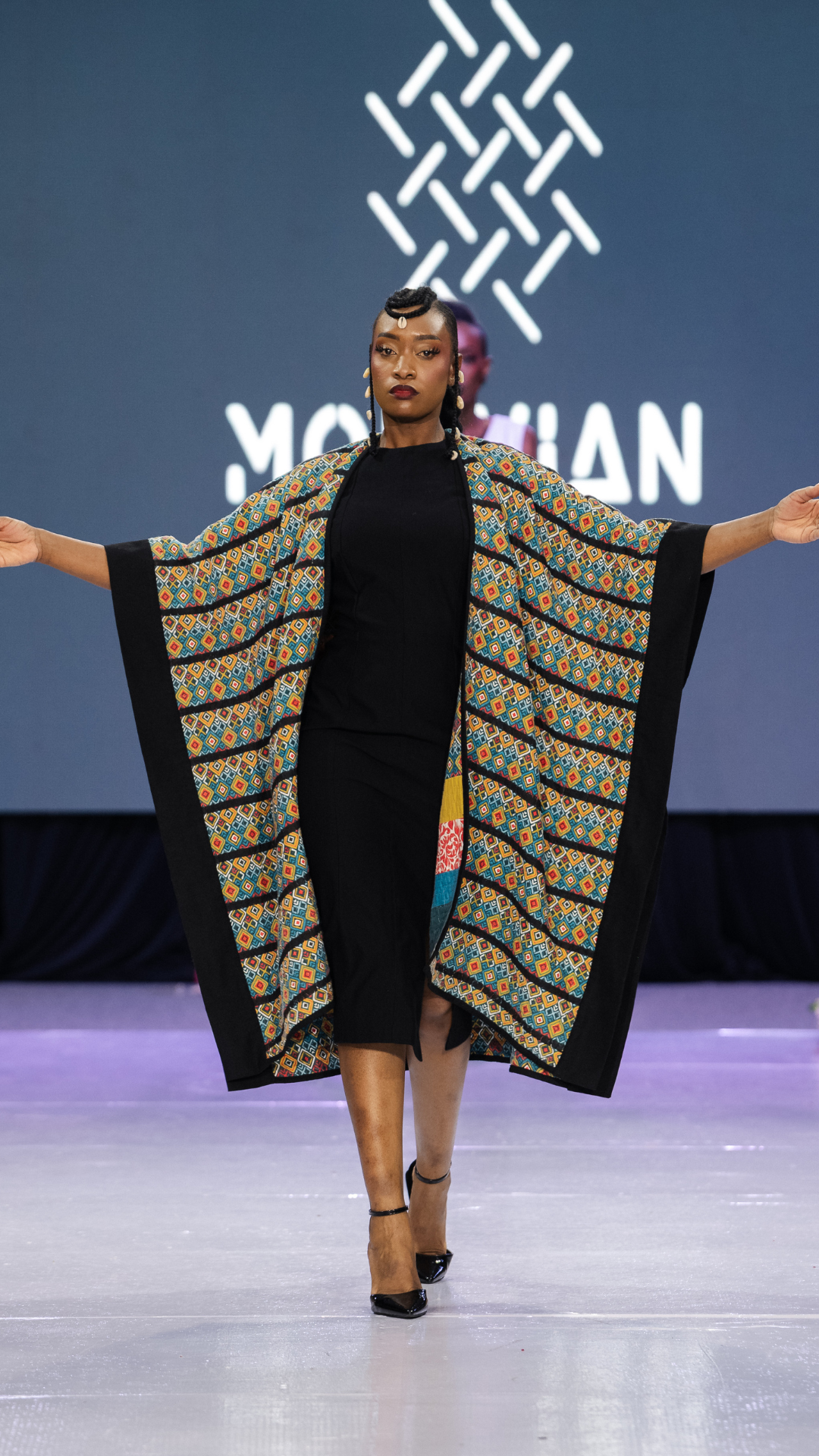
  • Molivian opens its Season 8 walk with a patchwork cape carrying West African geometric textile inside black tailored construction.

    MOLIVIAN

    Base: Nairobi, Kenya
    Material Position: Textile waste, patchwork construction, experimental tailoring
    Season 8 Reading: Molivian placed textile waste at the beginning of the design process. The Season 8 collection worked with patchwork, proportion and texture, translating salvage material into evening pieces and sharper tailored forms.

    Why it matters: The studio shows how waste streams can become primary material when construction, editing and finish are treated with discipline. In the Decarbonize reading, Molivian belongs to the new generation of studios that build design authority from the material already present in the local system.

    VIsit

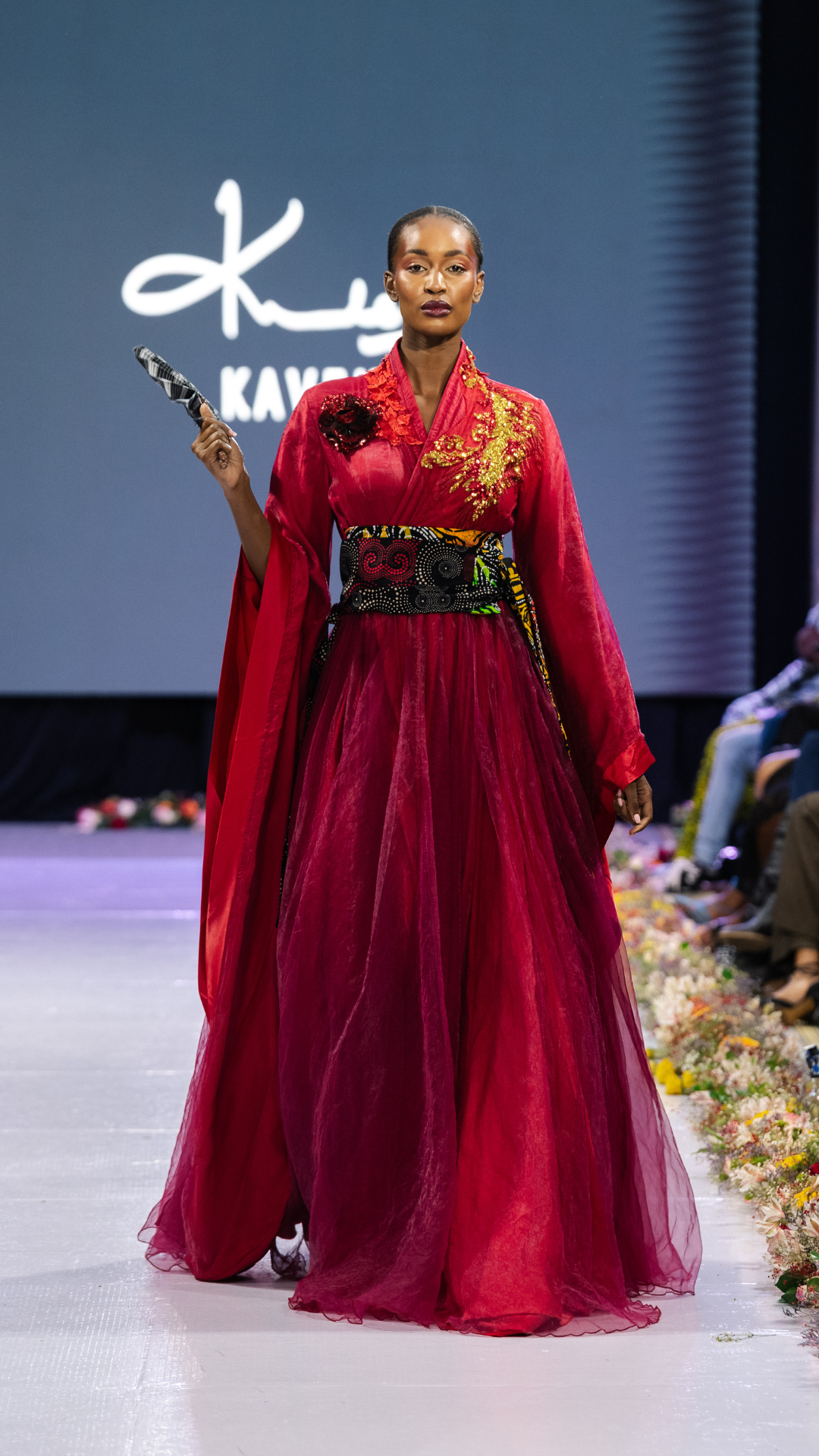
  • John Kaveke at Season 8: twenty-seven years of Kenyan menswear extending into ceremonial gown, with Maasai heritage and Japanese tailoring resolved at the seam.

    JOHN KAVEKE

    Base: Nairobi, Kenya
    Material Position: Menswear, tailoring, cultural reference, international runway experience
    Season 8 Reading: John Kaveke brought a menswear language shaped by long practice and international exposure. His Season 8 collection staged a dialogue between Japanese tailoring precision and East African cultural reference, with Samburu and Maasai codes entering the runway through cut, proportion and surface detail.
    Why it matters: Kaveke’s contribution anchors Decarbonize in an established design career. The collection showed how heritage reference can move through tailoring without becoming decorative. It positioned Nairobi menswear within a broader global conversation on structure, identity and craft.

    Visit

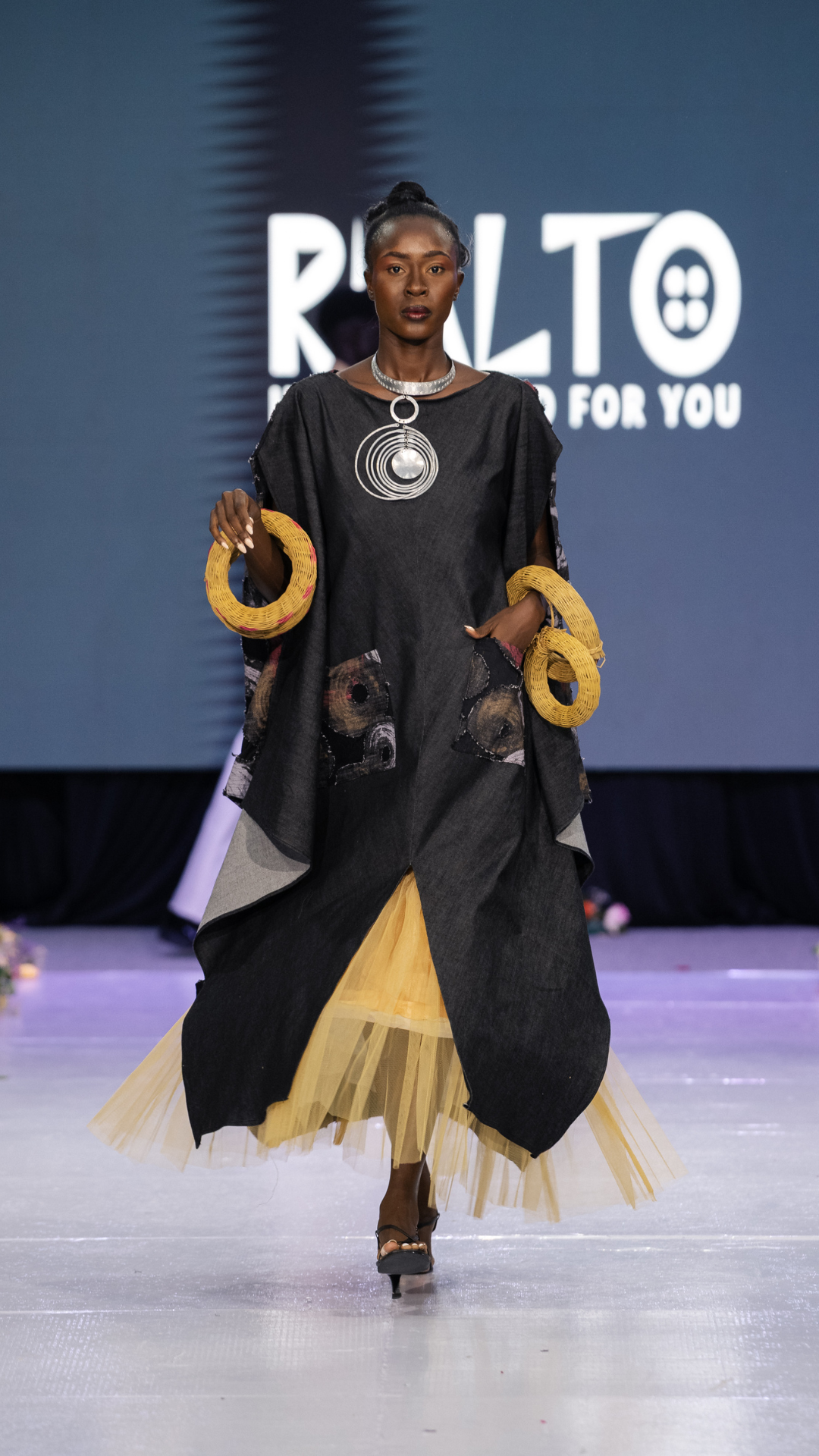
  • Rialto Fashions by Lucy Rao: thirty-eight years of Kenyan pattern-cutting carrying upcycled denim through couture-level finishing.

    Rialto Fashions / Lucy Rao

    Base: Nairobi, Kenya
    Material Position: Couture level denim reconstruction, organic cotton supply, long term Kenyan fashion infrastructure
    Season 8 Reading: Lucy Rao’s Rialto Fashions brought thirty eight years of Kenyan couture practice into the Decarbonize frame. Her Season 8 contribution worked with upcycled denim and sharp architectural tailoring, while her wider role through the Pamba Mali Organic Cotton Collective connects the runway to certified organic cotton supply.
    Why it matters: Rialto is structurally central to the article. Lucy Rao embodies the link between couture house, supply chain work and fashion governance. Her contribution shows that Decarbonize is already operating inside Kenyan fashion infrastructure: in material sourcing, in cotton systems, in pattern cutting and in long term institutional work.


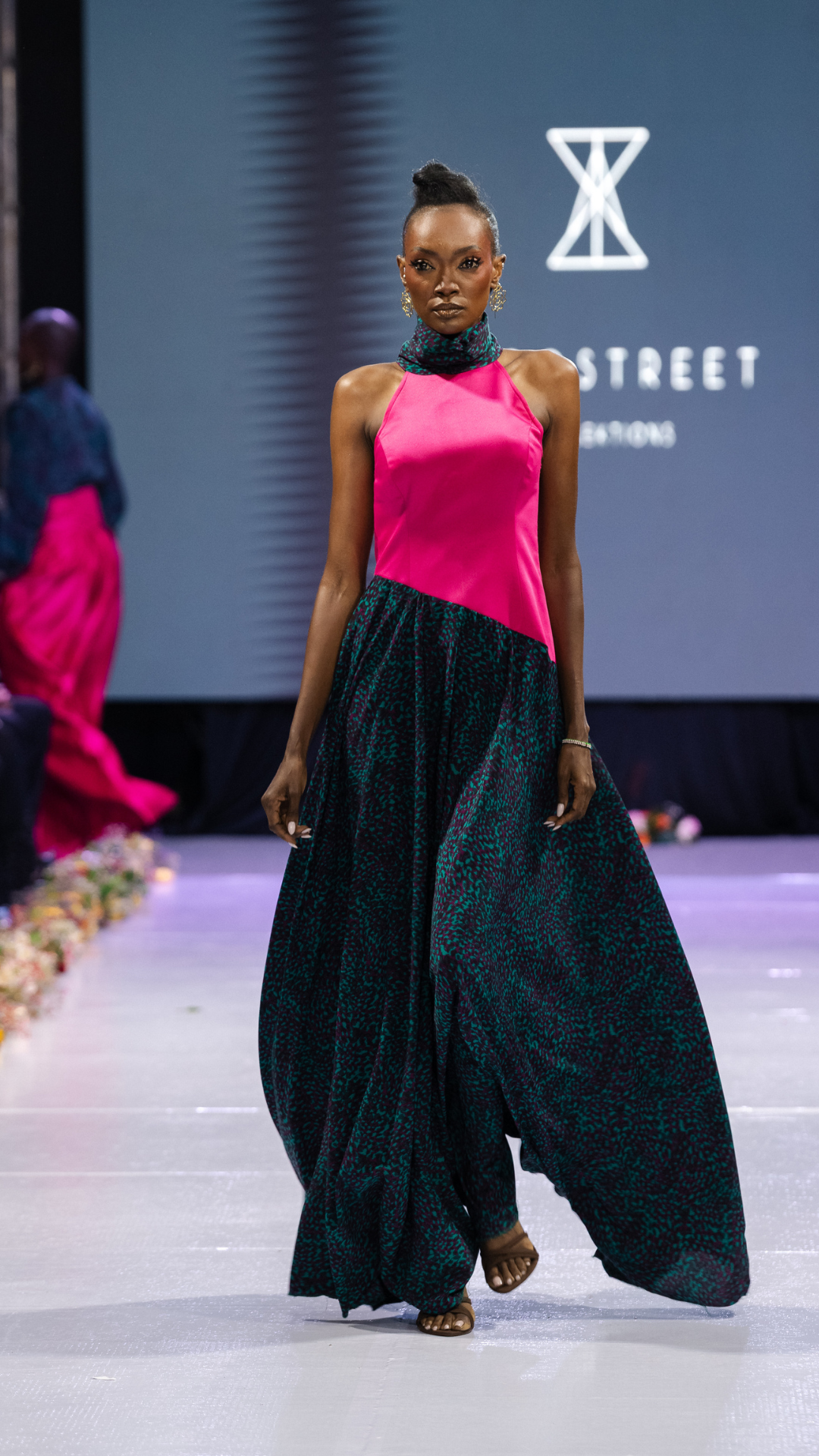
  • AfroStreet Kollections by Yvonne Odhiambo at her third NFW outing: Nairobi urban culture brought into vibrant African-print streetwear.

    AFROSTREET KOLLECTIONS

    Base: Nairobi, Kenya
    Material Position: African print, eveningwear, public cultural visibility
    Season 8 Reading: Founded by Yvonne Odhiambo, AfroStreet Kollections extended its African print signature into refined eveningwear silhouettes. The collection carried colour, print and recognition into a more elevated runway register.
    Why it matters: AfroStreet Kollections represents a design language with strong cultural visibility across Kenya and the wider region. Within the Decarbonize frame, the label shows how recognisable textile identity can be refined through silhouette and occasionwear, giving African print a more formal editorial reading.

    Visit Yvonne Odhiambo

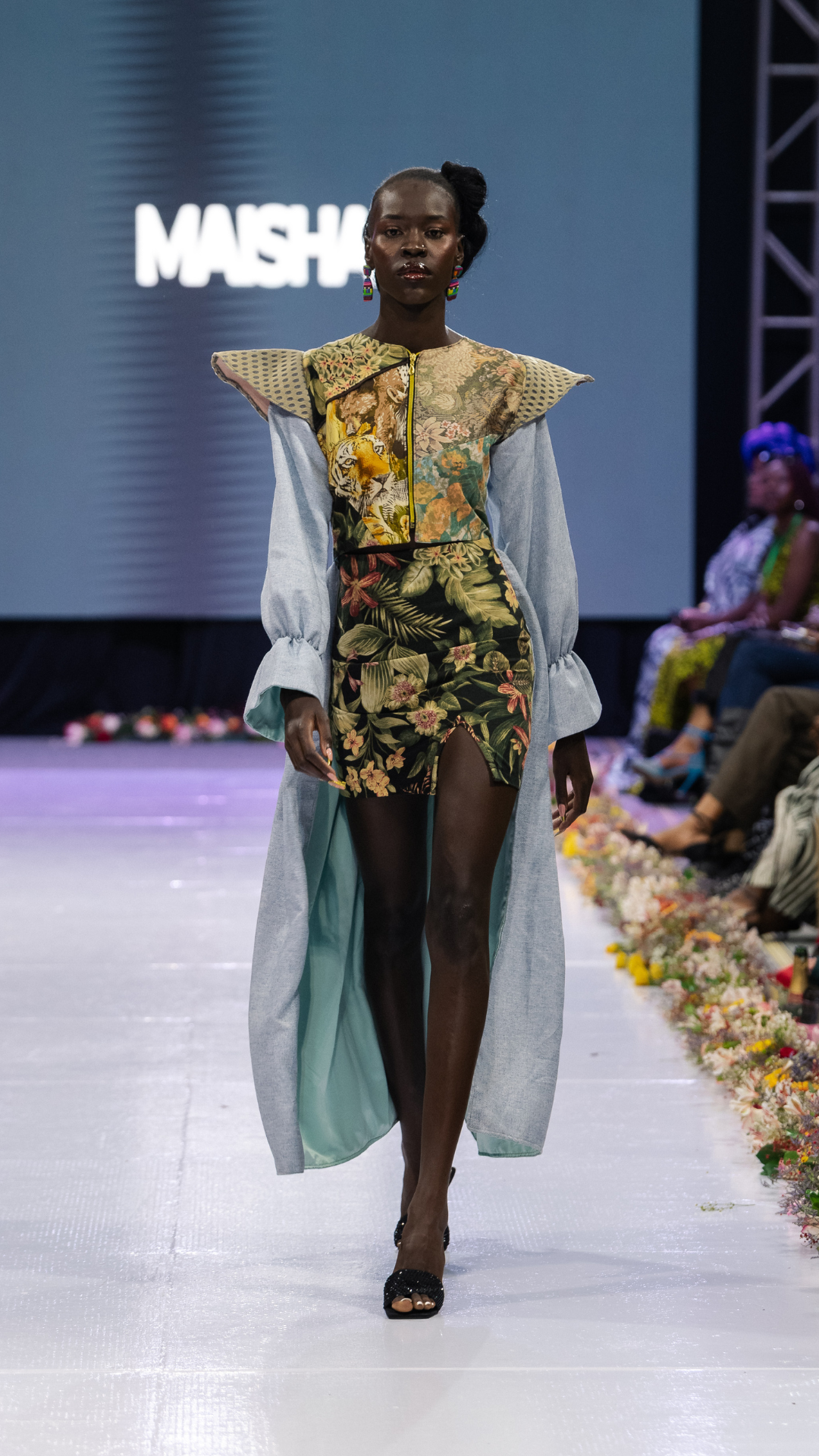
  • Maisha by Nisria's ASILI collection: a Gilgil social-enterprise studio walking salvaged textile as primary couture material on the eighth season's runway.

    MAISHA BY NISRIA

    Base: Gilgil, Kenya
    Material Position: Upcycled cotton, discarded textiles, social enterprise
    Season 8 Reading: Maisha by Nisria walked the ASILI collection with structured garments made from upcycled cotton and discarded textiles. The studio’s work is rooted in a social enterprise model that trains and employs young women from vulnerable communities in the Rift Valley.
    Why it matters: Maisha by Nisria is one of the clearest expressions of Decarbonize as working condition. The studio connects material reuse, employment, training and garment construction in one operating model. This makes its runway contribution important beyond aesthetics. It shows how regenerative fashion can function as production system, social structure and design language at once.

    Visit

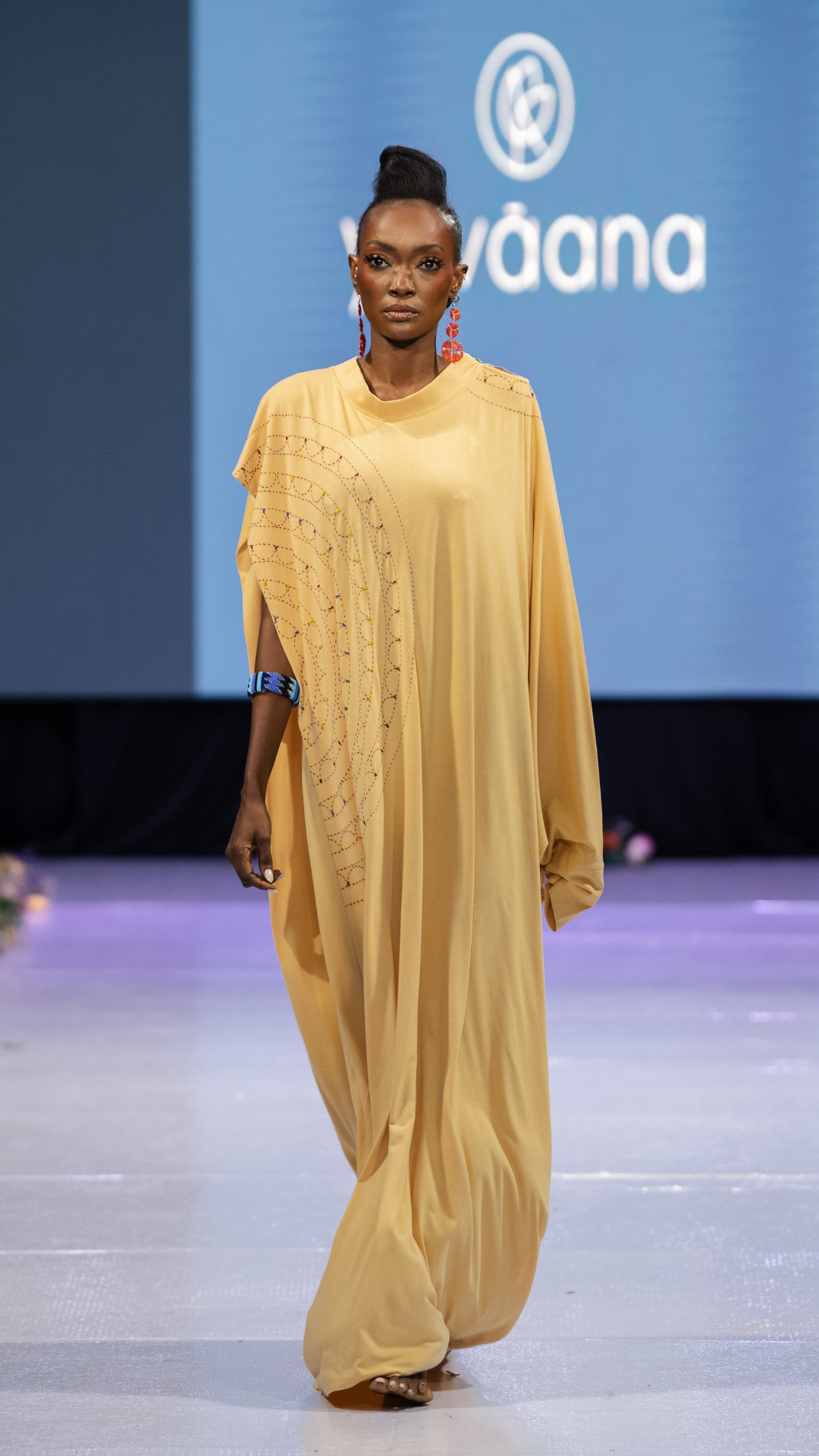
  • Yevaàna at Season 8: Sri Lankan needlework finished by Kenyan hands, two textile cultures travelling in one garment.

    YEVAÀNA

    Base: Sri Lanka and Kenya
    Material Position: Cotton, linen, hemp, hand smocking, hand embroidery, women artisan production
    Season 8 Reading: Yevāana brought a slow craft register to Season 8, working with natural fibres and hand techniques across Sri Lankan and Kenyan artisan communities. The collection placed hand smocking and hand embroidery at the centre of the garment.
    Why it matters: Yevāana expands the Nairobi Fashion Week conversation beyond national geography. The label connects Kenya and Sri Lanka through women led craft production, natural fibres and handwork. In the Decarbonize context, this positions craft as a production method with social and material intelligence, rather than as ornament.

    Visit

  • Naaniya at the eighth edition: a French designer of Malian heritage layering Bogolan and West African ornament into European tailoring.

    NAANIYA

    Base: France, with Malian heritage
    Material Position: Bogolan textile, European tailoring, Malian textile tradition
    Season 8 Reading: Naaniya layered Mali’s Bogolan textile tradition into contemporary European tailoring. The collection brought hand painted mud cloth into refined silhouettes, allowing the textile to travel through cut, proportion and construction.
    Why it matters: Naaniya’s work is important because it treats African textile heritage as living material. In the Season 8 context, Bogolan appears as a contemporary design resource with technical and cultural authority. The collection gives the Decarbonize theme a diasporic reading: material knowledge moves across geographies while retaining its origin.

    Visit

  • Rialto Fashions by Lucy Rao: thirty-eight years of Kenyan pattern-cutting carrying upcycled denim through couture-level finishing.

    ACI NOD

    Base: United States
    Material Position: Streetwear, urban silhouettes, everyday accessibility
    Season 8 Reading: ACI NOD brought a streetwear vocabulary to the Nairobi runway. The collection worked with day to day urban silhouettes and street cut precision, expanding the season beyond couture and heritage craft.
    Why it matters: ACI NOD broadens the Decarbonize conversation by placing everyday garments inside the same runway frame as couture, handwork and textile heritage. The contribution matters because regenerative fashion also needs accessible forms, youth culture and clothing that can circulate through daily life.

    Visit

  • VAST Made by Africa: continental optimism walked barefoot, a Nairobi small-batch studio anchored in West African handwoven cloth.

    VAST MADE BY AFRICA

    Base: Nairobi, Kenya
    Material Position: West African handwoven cloth, architectural silhouettes, short run production
    Season 8 Reading: VAST Made by Africa walked structured silhouettes anchored in handcrafted fabrics, natural hides and upcycled materials. The garments carried a strong architectural presence while staying connected to movement, wearability and identity.
    Why it matters: The label gives Decarbonize an architectural fashion language. Its work shows how handwoven cloth and short run production can enter contemporary luxury through proportion and construction. VAST Made by Africa belongs strongly in the Material Intelligence line because the textile is visibly part of the garment’s authority.


    Visit

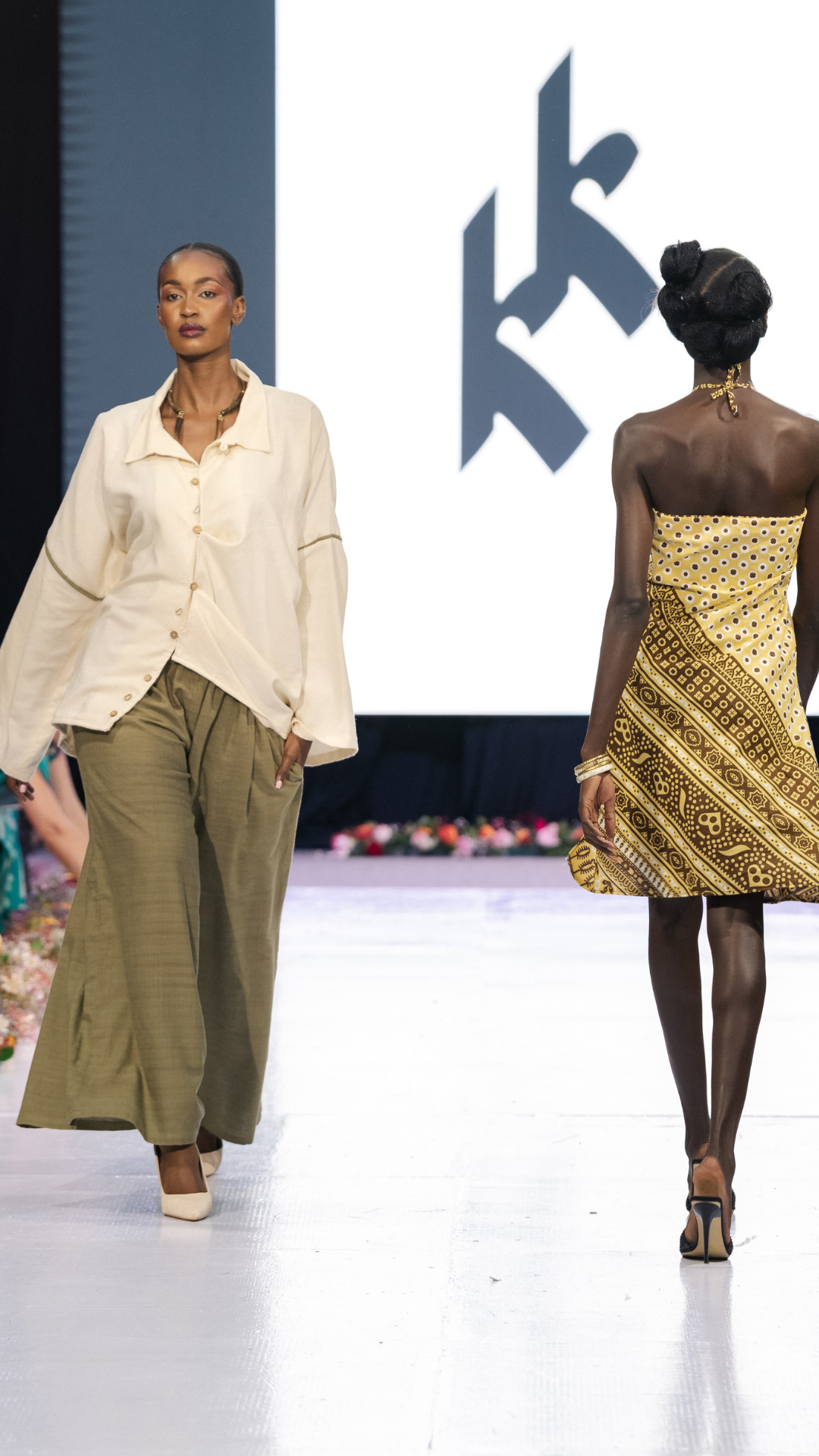
  • Kitu Kidzo at Season 8: a Kilifi studio carrying the textile inheritance of Kenya's Suaheli coast into linen and Ankara construction.

    KITU KIDZO

    Base: Kilifi, Kenya
    Material Position: Linen, coastal textile memory, Suaheli heritage
    Season 8 Reading: Kitu Kidzo brought the textile inheritance of Kenya’s Suaheli coast to the runway. The Season 8 collection worked with fluid linen silhouettes in soft yellow, brown and white, supported by accessories that referenced coastal craft and place.
    Why it matters: Kitu Kidzo is valuable for the article because it gives Decarbonize a geographic and atmospheric register. The work connects material, climate and coastal identity. Linen becomes more than fibre; it becomes a way to translate Kilifi’s movement, heat, air and textile memory into garment form.

    Visit on Instagram

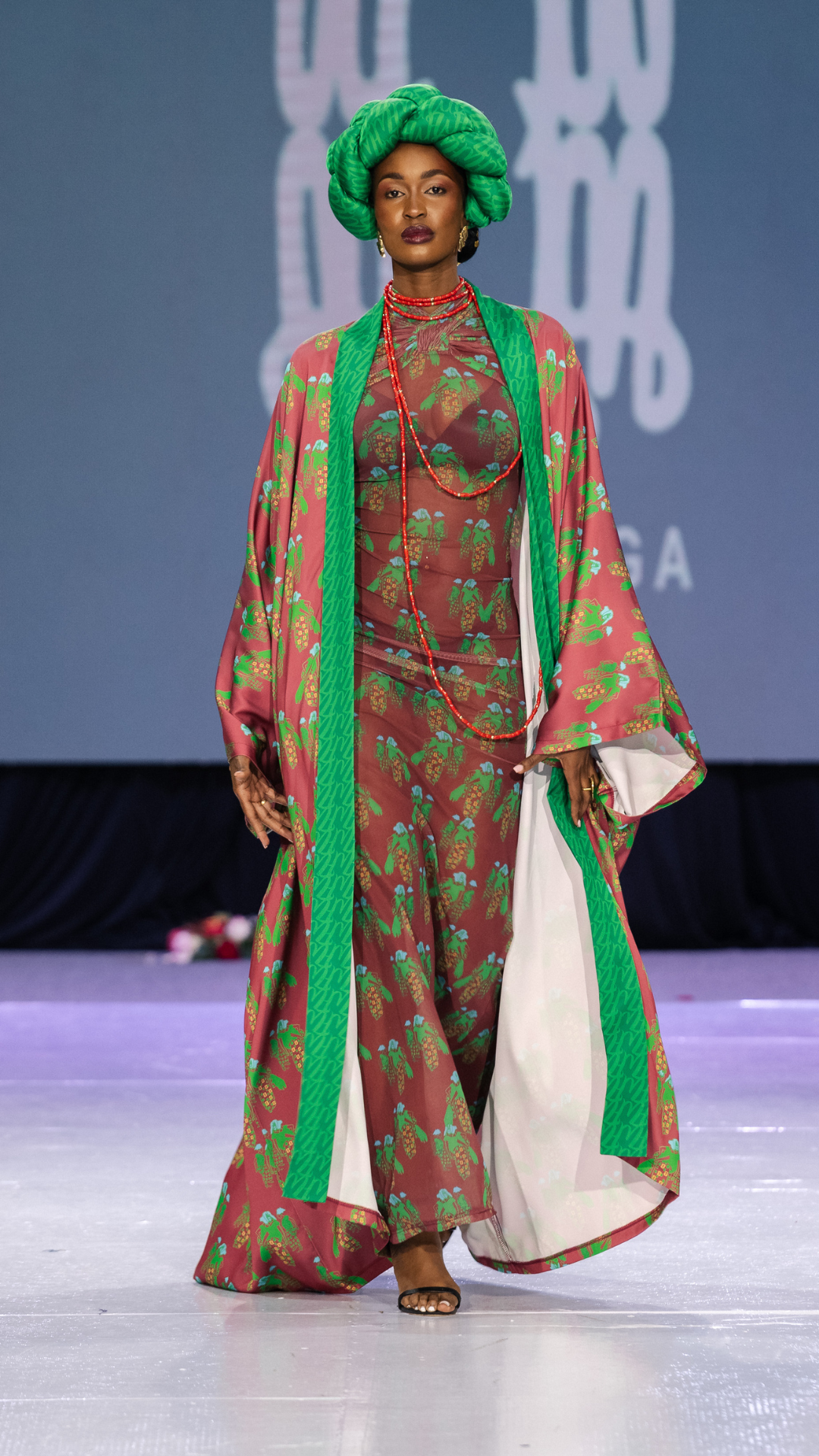
  • Wanni Fuga makes its NFW debut: Toluwani Wabara's Lagos house carrying West African heritage into couture finish.

    WANNI FUGA

    Base: Lagos, Nigeria
    Material Position: Small batch luxury, Nigerian fabric traditions, West African minimalism
    Season 8 Reading: Wanni Fuga made its Nairobi Fashion Week debut with a refined Lagos based luxury language. The label works through small batch production and local artisan partnerships, reading minimalism through West African heritage.
    Why it matters: Wanni Fuga gives Season 8 a strong West African luxury position. In the Decarbonize frame, the label matters because it shows how small batch models, artisan partnerships and controlled production can operate inside a contemporary luxury house. This makes the studio relevant for the larger TSL conversation on new luxury and regional design systems.

    Visit

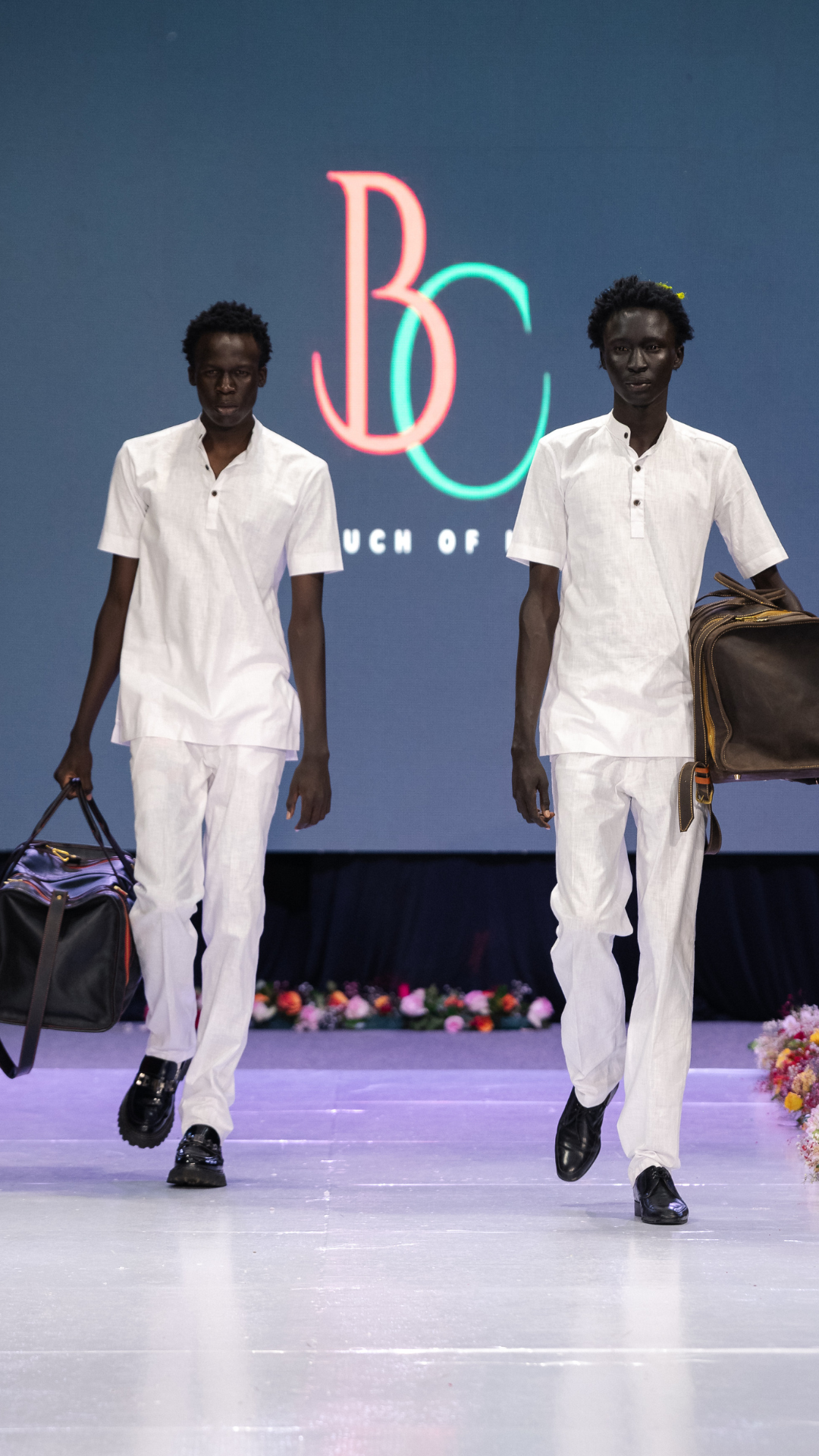
  • A Touch of Kenya: bespoke Kenyan leather and beadwork walked into modern luxury at the eighth season.

    A TOUCH OF KENYA

    Base: Kenya
    Material Position: Bespoke leather, beadwork, heritage craft
    Season 8 Reading: A Touch of Kenya worked at the intersection of bespoke leather and intricate beadwork. The Season 8 collection showed accessory and garment work grounded in Kenyan craft techniques, with detail that requires close reading.
    Why it matters: The label brings the Decarbonize theme into the field of touch, finish and hand skill. Its importance lies in the way ancestral techniques are carried into contemporary luxury objects. This is a natural bridge to Material Intelligence, because the authority of the work is visible in surface, hand, technique and proximity.

    Visit

What the Lookbook makes visible is a system rather than a sequence of shows. Nairobi Fashion Week Season 8 brought together designers working across couture, streetwear, craft, organic cotton, upcycling, leather, beadwork, linen and handwoven cloth. The shared signal was clear: decarbonization in fashion begins where material, labour and origin become part of the garment’s visible intelligence.

Upcycled Material as Couture Primary

Across the four nights, the strongest collections treated waste-stream textile as legitimate primary material for skilled finishing. Maisha by Nisria walked the ASILI collection, with structured upcycled-cotton garments cut from textile remnants the studio sources continuously through its Gilgil supply chain. Bellafricana’s coverage described the collection as exploring “texture and materiality, weaving together denim and unexpected fabrics into cohesive storytelling.” The cotton itself entered the studio carrying the marks of its prior life and left the runway as garments whose pattern discipline read as primary couture. Rialto’s contribution sharpened the same argument. Lucy Rao’s Season 8 collection took upcycled denim through couture-level finishing built up over thirty-eight years of pattern-cutting, with sharp cuts and architectural tailoring resolving familiar material into new construction. This is what Couture Régénérative reads like at industrial scale on the African continent.

Molivian, founded in 2021, walked patchwork constructions assembled from textile waste streams, with the studio’s working process organised around what arrives at the studio door. Studio Lola brought minimalist knitwear made by fair-trade cooperatives across Kenya. VAST Made by Africa walked architectural silhouettes anchored in West African handwoven cloth and produced in short runs. The MOYO Store added garments cut from African prints, upcycled fabrics and organic linens, finished in Nairobi artisan workshops. Each studio carried its own version of one operating principle: that finishing discipline now travels with material whose history is part of the construction.

The lineage runs deeper than upcycling. Kitukizo opened the question of coastal Suaheli memory through fluid linen silhouettes in soft yellow, brown and white drawing on Kilifi’s textile inheritance. John Kaveke, who launched his menswear label in 1999 and has shown at New York and London Fashion Week, presented what FAB L’Style described as “a dialogue between Maasai heritage and Japanese precision.” The continental textile economy that walked across these collections is one in which heritage and waste-stream material both arrive at the studio as primary, with the discipline of cut applied equally.


What readers ask about Nairobi Fashion Week Season 8

Nairobi Fashion Week Season 8, held from 28 to 31 January 2026 at Sarit Expo Centre in Westlands under the editorial title Decarbonize, brought twelve studios from Kenya, Nigeria, Sri Lanka, France and the United States to the runway. Founder and Creative Director Brian Kihindas placed the editorial argument at the head of the platform, with Lucy Rao of Rialto Fashions, Tausi Conde of Maisha by Nisria, John Kaveke, Yvonne Odhiambo of AfroStreet Kollections and Amalie Seneviratne of Yevāana speaking from inside the regenerative practice the title named. Photography by Jenkins Kuyoh.

  • What is Nairobi Fashion Week Season 8?

    Nairobi Fashion Week Season 8 is the eighth edition of the platform founded by Brian Kihindas in 2013 inside the Hilton Nairobi. It took place from 28 to 31 January 2026 at Sarit Expo Centre in Westlands, with Angela Wambui as Master of Ceremonies, under the editorial title Decarbonize.

  • What does Decarbonize mean in the context of Nairobi Fashion Week 2026?

    Decarbonize was the editorial title Brian Kihindas placed at the head of Season 8 to name a regenerative position that established Kenyan and East African studios already operate inside their daily method. It addresses fashion’s role as the second-largest global carbon emitter while framing African studios as leading continental practitioners of upcycling, organic supply and circular construction.

  • What were the Thread Talks at Nairobi Fashion Week 2026?

    Thread Talks were the editorial conversation programme held on 29 and 30 January 2026 at The Social House Nairobi, bringing UNEP, the Gatsby Africa Foundation and the Kenya Fashion Council into open conversation with designers and journalists. The format addressed how Africa decarbonises its fashion supply chain without replicating extractive global models.

  • What is the Fashion Frontier Africa Incubator Programme?

    Fashion Frontier Africa is the incubator programme run alongside Nairobi Fashion Week in partnership with Cultrite, supporting emerging African designers with structured craft and business development. It sits next to the Designer Masterclass powered by Anansi as part of NFW’s broader educational infrastructure.

  • Why does Nairobi Fashion Week matter for the future of fashion?

    Nairobi Fashion Week makes visible an East African fashion economy in which regenerative practice is the working condition of established studios. The Season 8 line-up showed that upcycled and heritage materials carry couture-level finishing, that organic cotton supply collectives sit alongside the couture houses they supply, and that international designers from Lagos to Sri Lanka now travel to Westlands to participate in a continental conversation that has been forming for over a decade.

  • How did Nairobi Fashion Week 2026 approach sustainable fashion?

    Nairobi Fashion Week 2026 approached sustainable fashion through material practice rather than surface aesthetics. Designers worked with upcycled denim, discarded textiles, organic cotton, handwoven cloth, small batch production and social enterprise structures.

  • Why is Nairobi important for regenerative fashion?

    Nairobi is important for regenerative fashion because Season 8 showed a design economy where craft, material reuse, organic sourcing and community based production already operate inside established studios and supply organizations.

Continue reading