The Renaissance of Italian Fashion: Made in Italy in 2026
What is the renaissance of the Italian fashion industry in 2026?
The Italian fashion industry, the country’s second largest by economic weight, stands at a crossroads in 2026. As the broad market polarises and the aspirational middle thins, Made in Italy renews itself by returning to the sources of its value: manufacturing knowledge, regional intelligence, material innovation and family enterprise. The reading runs parallel to the first Florentine Renaissance, a shift from inherited dogma toward renewal, applied now to how luxury defines value.
- •Made in Italy is at a crossroads. The question has moved from what luxury is to what it must deliver in the years ahead.
- •Value returns to its sources. Manufacturing knowledge, regional intelligence, material innovation and family enterprise become the measure again.
- •A parallel to the first Renaissance. As fifteenth-century Florence turned from dogma to renewal, Italian fashion now turns from volume to meaning.
- •The polarising market favours depth. As the middle thins, houses with documented origin and regional knowledge hold their ground.
When the Renaissance began in 15th-century Florence, it was far more than a cultural phenomenon. In retrospect, it marked a societal paradigm shift: away from dogma, toward curiosity. It was the beginning of a cultural renewal—a turning point for Europe. The blend of innovation, humanism, and return to ancient values led to a sustainable flourishing with worldwide impact. Patrons like the Medici invested in art, science, and craftsmanship that became conscious of its own dignity.
Today, around six centuries later, Italy stands once again at a crossroads. The question facing its fashion industry—the country’s second most important industry measured by economic power—is no longer just: What is luxury? But rather: What may luxury be in the future—and what must it deliver? Does it require a second Renaissance, a profound transformation that connects cultural strengths with modern strategies?
In this context—the status quo of an industry in transition and the search for new paths—Silent Luxury will spend the coming weeks addressing the question: What could such a departure look like today?
The Silent Luxury introduces this line of inquiry under the editorial title Il Codice della Rinascita. The phrase describes a cultural and economic reading of Italy’s next value cycle: a renewal shaped by manufacturing knowledge, regional intelligence, material innovation, family enterprises, hospitality, design, fashion and the ability to translate heritage into future relevance.
A Structural Exhaustion
The year 2024 can certainly be described as symbolic. Globally, the long growth-accustomed luxury goods market recorded a decline for the first time. According to the “Luxury Goods Worldwide Market Study” by Fondazione Altagamma and Bain & Company, revenues fell by two percent. In Italy alone, approximately 2,000 businesses in the textile, leather, and clothing sectors had to close—including around 700 in the Marche region and about 300 in Tuscany.
A warning sign that demands attention. Until a few years ago, Italian luxury was considered a reliable promise of origin and authenticity. Now it has increasingly become a component of global brand strategy—shaped by market pressure, international subcontracting structures, and increasingly interchangeable brand staging.
Carlo Capasa, President of the Camera Nazionale della Moda Italiana (CNMI), describes the situation in an interview with McKinsey (May 2025) as a symptom of a deeper problem: “Our supply chains consist of districts where very small, medium, and large companies work together. The advantage of this system is that it produces a lot of creativity. The weakness of the system is that micro and medium-sized enterprises are undercapitalized and often inadequately equipped.” His conclusion: “We need to achieve a certain scale without impairing the creativity of small businesses.”

From Status to Meaning
Emanuela Prandelli, Associate Professor in the Department of Management and Technology and LVMH Associate Professor of Fashion and Luxury Management at Bocconi University in Milan, views it with nuance when asked by Silent Luxury: “Certainly the sector is in a phase of obvious difficulty—whether this is a temporary phenomenon or becomes structural is hard to say. However, I believe there are some changes in consumer behavior that will be permanent.” As an example, she cites the young generation.
This generation, according to Prandelli, is increasingly abandoning the concept of “aspirational consumption” and following “inspirational consumption.” She explains: “A high price alone is no longer enough to generate desirability. The young generation is oriented toward values. They choose a brand not only because of its product characteristics, but for a value that this brand embodies for them and in which they can recognize themselves.”
Another keyword shapes the current debate: Silent Luxury. The quiet, value-based understanding of luxury. A term that runs like a mantra through statements from brands, associations, and analysts. Behind the semantic rebellion against hyperconsumption, logo obsession, and price inflation lies a deeper structural break—especially for the backbone of the Italian fashion industry: manufacturing, craft businesses, and production clusters.
This has tangible consequences: second-hand is growing, experiential consumption replaces impulse purchases, price pressure on mid-range segments increases.
A note from The Silent Luxury
Good reading deserves to find you again.
Add The Silent Luxury as a Preferred Source in Google →Of Hourglasses and the Polarization of Consumption
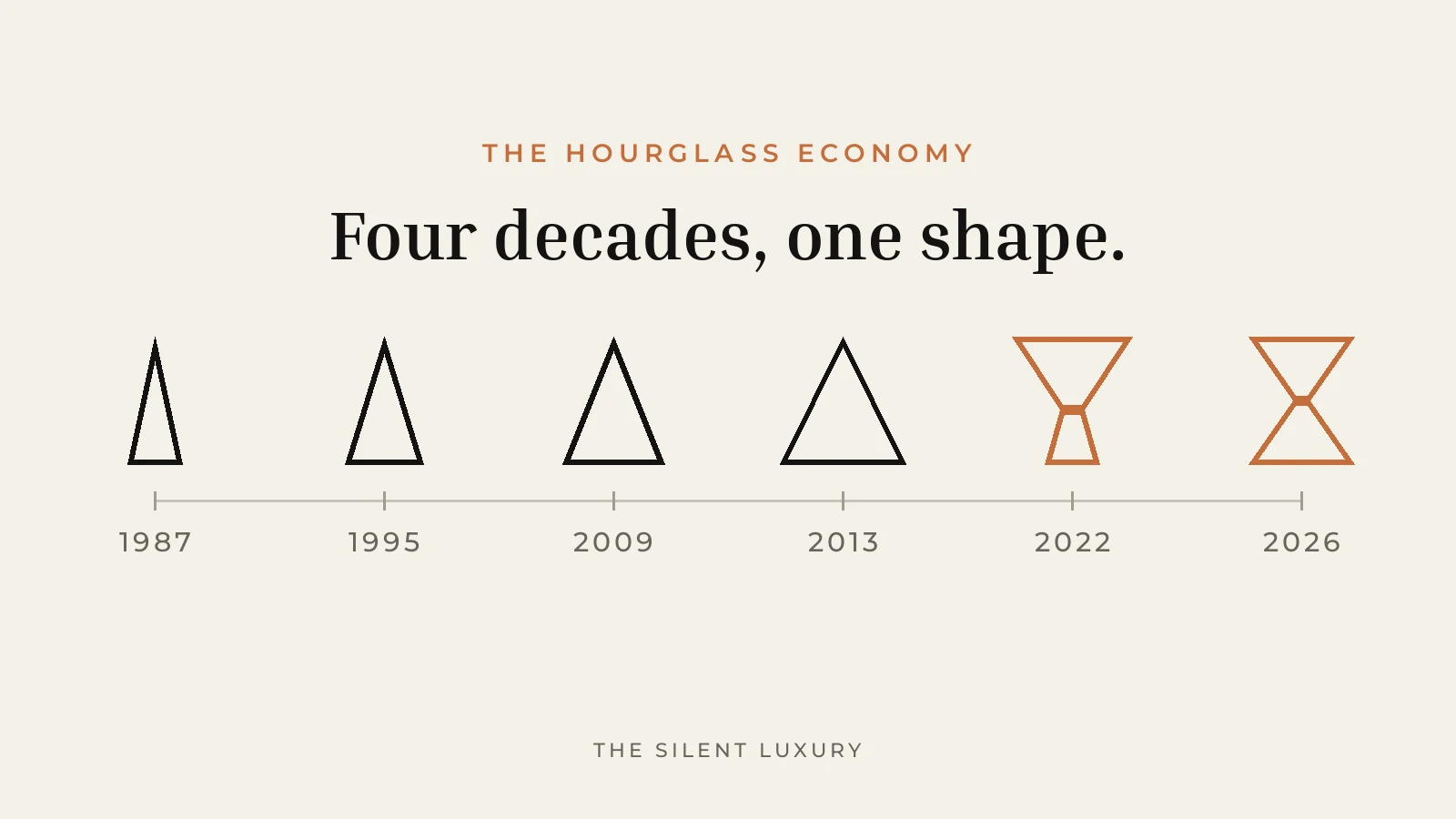
The fashion market in 2025 resembles an hourglass: In the upper price segment, ultra-luxury grows with individualization, rarity, and authenticity. In the lower price segment, functional brands expand, focusing on everyday basics. The middle is becoming increasingly thin.
According to Bain & Company, over 50 million consumers worldwide have withdrawn from the mid-luxury segment—for price reasons, but also because the promise made could no longer be fulfilled. Italy in particular feels the consequences: Many Italian brands, historically anchored in the mid-to-high price segment, are coming under pressure. They are too expensive for the mass market, too generic for the luxury market.
The structural changes of this development are already visible in market form. While the Italian fashion market long followed the model of a pyramid, according to Prandelli it is now taking the shape of an hourglass. The middle segment is becoming increasingly narrow—an effect also of the economic crises of recent years—while the upper segment, the top 1 percent, generates the bulk of revenue.
This polarization, according to Prandelli, is also closely linked to the growing trend of so-called “mix and match”—the combination of garments from different brands and price ranges. “Even consumers with greater purchasing power are moving toward increasing autonomy in shaping their own style.” Prandelli emphasizes that this trend is not limited to the fashion industry.
These are actually ideal conditions for what Capasa describes as the particular strength of Italy’s small and medium-sized fashion industry: its creativity.
The strategic implications are obvious. What’s needed are new positioning concepts and a profound transformation in all areas—a kind of second Renaissance. Experts largely agree: the industry must realign its basic structure. Away from short-term pricing and mass production, toward a sustainable balance of timelessness, quality, cultural substance, and innovative power. A “Made in Italy” concept in the unchanged form of previous decades may no longer be sufficient.
The Second Renaissance: A Historical Parallel with Perspective
The first Renaissance was characterized by shaking off encrusted medieval structures. A cultural awakening that significantly shaped Europe’s art, architecture, science, and economy from Italy. It emerged during a phase of tension between uncertainty and innovation. A parallel to the present is recognizable. Fertile ground for a second Renaissance that could shape coming generations?
An Outlook
In the coming weeks, deep dives will follow on the development of the Italian fashion market, on slow consumption, value-based economics, and structural solution approaches for one of the country’s most important industries.
Further Reading
- The remapping of luxury, the wider value shift behind the Italian renaissance.
- The structural shift reshaping the luxury market, the market context Made in Italy responds to.
- What Silent Luxury means, the value philosophy the renaissance expresses.
Sources: ISTAT and Camera Nazionale della Moda Italiana industry data · Emanuela Prandelli, Università Bocconi · © Silent Communications GmbH. Analyses published by request; backlinking freely permitted; reproduction requires written consent.
Similar Articles
The Counter Becomes a Vault: What Japan’s Jewellery Record Actually Measures

One Country, Two Economies: AI Wealth and the End of an American Illusion
Paris, 1987: How the Luxury Pyramid Became an Hourglass