The Four Seasons and the Crown: Rolex Takes Its Daytonas to Auction
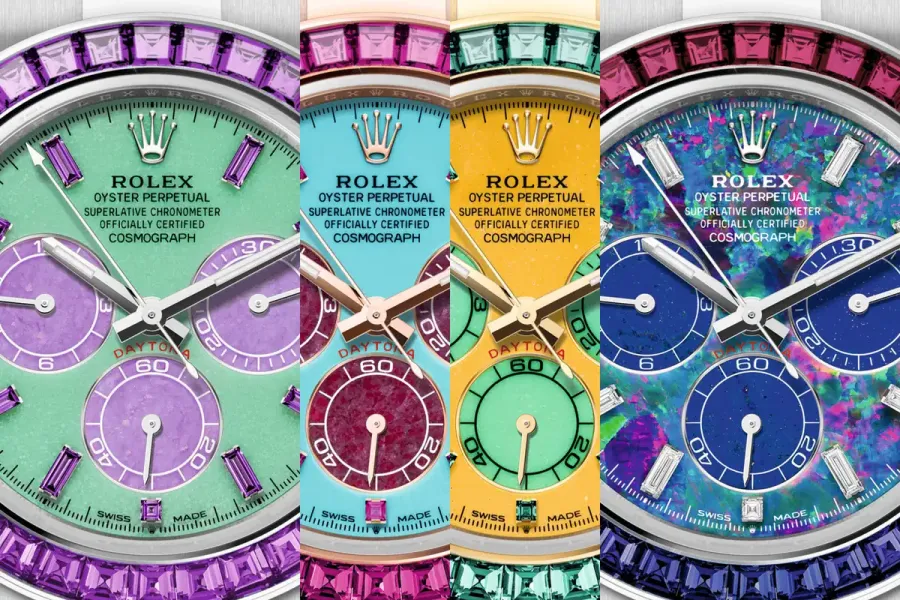
Most of the bidding for Summer came in over the telephone, from buyers who never needed to be seen in the saleroom at Phillips in London, and by the time Aurel Bacs brought down the hammer on Monday evening, a platinum, a white gold, an Everose and a yellow gold Daytona had changed hands for £37.3 million between them. Each carried a dial cut from natural stone, blue opal, chrysoprase, turquoise and mookaite, framed by a bezel of thirty-six trapeze-cut gems, and none of the 41.2 million Swiss francs the evening raised will stay with Rolex or with the auction house. All of it goes to charity.
It was meant to happen far more quietly. In April, on an upper floor of its stand at Watches and Wonders in Geneva, where no photographs were allowed, Rolex showed the four watches to a handful of clients and set a price of about four million francs, for the whole set and for a single buyer. Its retailers were reportedly asked to put forward names, and Rolex would make the choice, as it has made such choices for a century. More than a thousand serious enquiries came back. Faced with a queue it could not shorten without disappointing almost everyone in it, the house that decides who may own its watches handed that decision, for one evening, to a room in London, and the room paid ten times the price.
Rolex’s Four Seasons Auction Raised £37.3 Million
Rolex’s Four Seasons auction at Phillips in London on 28 September 2026 raised £37.3 million for four unique gem-set Cosmograph Daytonas, which Phillips describes as the largest single consignment ever offered at a charity auction. Aurel Bacs called it the first-ever charity auction with Rolex, and the order of the results had its own logic, with the two warmest seasons fetching the most.
The four seasons, as the house described them:
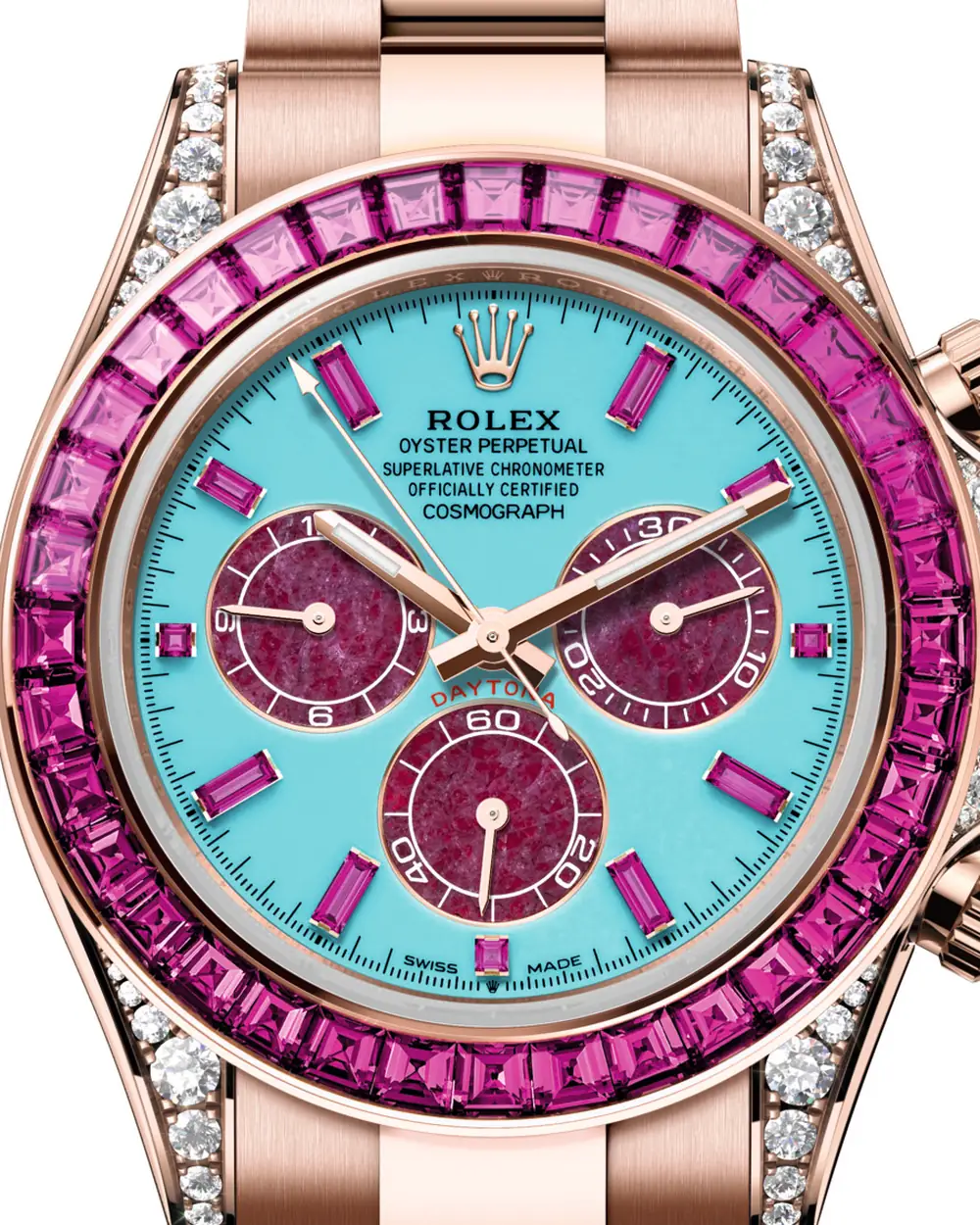
- Summer, in Everose gold, with a turquoise dial, counters in heart of ruby and a bezel of pink sapphires: £10.3 million.
- Autumn, in yellow gold, with a mookaite dial, chrysoprase counters and green tourmalines: £10.2 million.
- Winter, in platinum, with a blue opal dial, lapis lazuli counters and sapphires shading from blue to fuchsia: £10 million.
- Spring, in white gold, with a chrysoprase dial, lepidolite counters and purple sapphires: £6.8 million.
There was no buyer’s premium. The money goes to the Federer Foundation, which supports early learning for children in southern Africa and Switzerland, and to Re:wild, the conservation organisation co-founded by Leonardo DiCaprio. Both men are Rolex ambassadors, and the sale ran under the brand’s Perpetual Planet Initiative. There is a neat symmetry to it, too. Rolex itself has belonged to the Hans Wilsdorf Foundation since its founder’s death in 1960, so on Monday evening a company owned by a foundation sold four watches for the benefit of two more.
Why Rolex Chose an Auction Over Its Waiting List
Rolex ordinarily sells scarcity through a waiting list at a fixed list price, and with more than a thousand candidates for four watches, an auction was the only way to keep hold of the price, the dealer network and the story all at once.
The waiting list is the quietest instrument Rolex owns. It fixes the price and leaves the brand free to decide who buys, but it has always had one weakness, which is the gap between the list price and what the watch is worth the moment it leaves the shop. For years that difference has gone not to Rolex but to whoever resold the watch, and with four unique Daytonas the gap would have been measured in millions.
Three motives came together in the saleroom:
- The price. At auction the market names the figure, but Rolex had already chosen everything around it: the lots, the house, the evening and the cause. A result achieved for children’s education and wild places is a difficult one to argue with.
- The network. Rolex sells only through retailers it has chosen itself. Picking one buyer from among their clients would have left hundreds of them disappointed and set rumours running through the network, so a public sale turned out to be the more discreet course.
- The story. A price ten times the original figure went round the world within hours, and Coronet, which follows the company closely, observed that the sale allows Rolex to publicise its philanthropy as it never had before.
There is a fourth reading, and it comes from the saleroom itself. In conversation with The Silent Luxury this summer, Alexandre Ghotbi, deputy chairman at Phillips and head of watches for Europe and the Middle East, described the watch market as three bands: the new watch bought from its maker, the pre-owned watch resold, and a narrow third band of rare collectibles, the only one in which Phillips deals. The Four Seasons never passed through the first two. They went from Rolex’s workshops straight into the third.
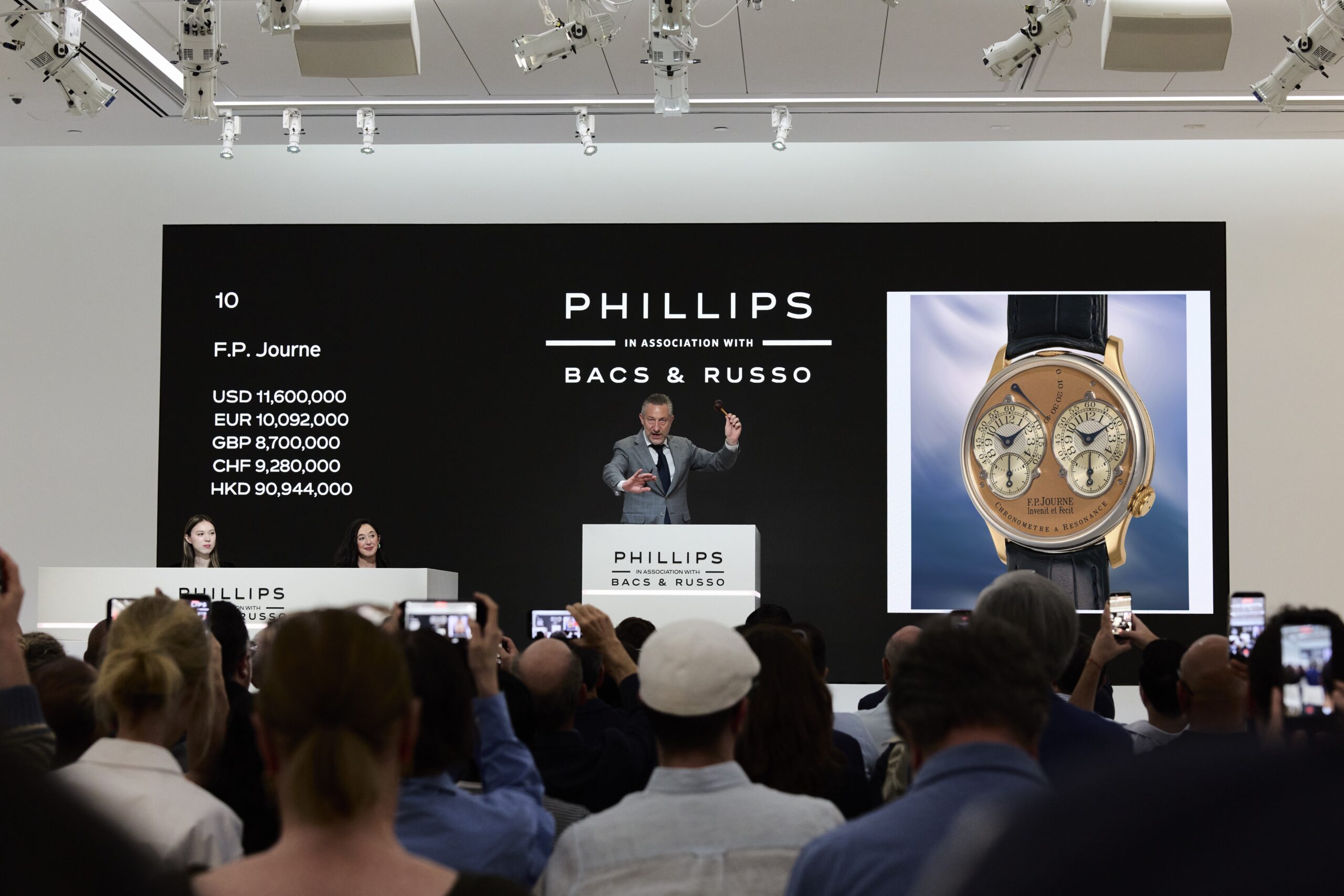
Ghotbi also named the force that keeps that band rising. “The more people you have in the market while the supply stays more or less the same,” he said, “the higher the prices go.” He described, too, a younger generation of collectors who buy the watch rather than the name, which is how an independent F.P. Journe came to fetch 13.9 million dollars at Phillips in June. The Four Seasons were Rolex’s reply, given on its own terms: a watch in which the name and the rarity are one and the same thing.
A note from The Silent Luxury
Good reading deserves to find you again.
Rolex’s Vertical Integration Now Reaches the Resale Market
Over the decades Rolex has drawn its suppliers, its retailers and finally the pre-owned market into its own group, and the Four Seasons auction extends that control to the last link left open, the price a Rolex commands at the very top.
The chain, link by link:
- The workshop. Over the years Rolex has brought long-standing partners, suppliers among them, into the group, and with them more of what goes into its watches.
- The counter. Through Bucherer, whose acquisition was announced in 2023, Rolex owns more than 100 shops, 53 of them Rolex retailers, along with the American chain Tourneau and the watch brand Carl F. Bucherer. In Düsseldorf, Rüschenbeck’s decades-long partnership with Rolex ends at the close of 2026, and a two-storey Rolex boutique run by Bucherer will open on the Königsallee in its place.
- The second life. Bucherer was the first partner in Rolex’s Certified Pre-Owned programme, and together with The 1916 Company and Watches of Switzerland it now holds 48 per cent of all certified pre-owned stock.
- The summit. Since Monday, Rolex also knows what its rarest watches fetch in public.
Within days of the Bucherer deal, the founder of The Silent Luxury, Eva Winterer, argued in the trade magazine Blickpunkt Juwelier that the real prize lay in a detail most commentators had passed over. In 2022 Bucherer had bought Adresta, a Swiss spin-off of the insurer Helvetia and ETH Zurich that issues tamper-proof digital certificates of ownership and authenticity for luxury watches. Her headline was that the new gold is information. A certificate travels with a watch through every change of hands, and whoever issues it knows where the watches go, and for how much.
Three years on, the consequences are plain to see. On 19 August the cantonal court of Zug opened bankruptcy proceedings against the Chronext group, once a pioneer of online trading in luxury watches. WatchTime traces its decline to falling prices for used watches and to brands that now certify their own pre-owned pieces, laying claim to the very promise of authenticity on which independent dealers had built their businesses. A company that answers to a foundation rather than to shareholders can afford to build a chain like this over decades, one link at a time.
Rolex Gains Market Share as the Middle of the Watch Market Shrinks
The auction came eleven days after the Swiss watch industry published its figures for August, and those figures show why that control matters so much now. According to Morgan Stanley and LuxeConsult, Rolex grew its sales by 4 per cent in 2025 to more than 11 billion Swiss francs, roughly a third of the entire Swiss watch industry, in a year in which the market as a whole contracted.
This year the shape of that market has grown sharper still. Swiss watch exports rose by 9.1 per cent in August, but the growth is gathering at either end of the price range:
- Watches under 200 francs: up 13.3 per cent.
- Watches over 3,000 francs: up 10.2 per cent.
- Watches between 500 and 3,000 francs: down 0.9 per cent.
The middle is where aspirational buyers once took their first step into Swiss watchmaking, and it is where brands without Rolex’s grip on distribution are now losing ground. Omega’s sales fell by 8 per cent in 2025, and much of the market share it gave up went to Rolex. The map is shifting as well: exports to the United States dropped by 19.4 per cent in August, while shipments to Britain rose by 46.1 per cent. A brand that decides where every one of its watches goes can follow demand across that map, and the Four Seasons sold at the very top of the hourglass.
Rolex in India: Imports Soar While Prices Stay Put
Swiss watch exports to India rose by more than 31 per cent in the first half of 2026 to 168.7 million francs, some 200,000 watches, and Rolex is among the houses opening boutiques of their own in Mumbai and Delhi. At that pace, exports would end the year at around 340 million francs, according to a projection by The Silent Luxury.
On paper, the trade agreement with Switzerland should have made those watches cheaper, since it cut India’s import duty on them from 22 to 15.71 per cent. On the price tag, very little changed:
- The franc rose by about 23 per cent against the rupee in the year to January 2026, more than wiping out the duty cut.
- Ethos, India’s largest luxury watch retailer, grew its revenue by almost 29 per cent and its boutiques from 73 to 98, while its profit after tax slipped by about 1.5 per cent.
- Its founder, Yasho Saboo, expects most watches to keep their price, because prices in India already follow global levels.
It was the retailer that absorbed the currency, and the brand’s price that held. The Silent Luxury reads the London sale as a price anchor for this market: for the many first-time buyers now walking into Rolex boutiques in Mumbai and Delhi, it shows what the brand is worth at its summit, while the price in the shop remains the list price.
The next Daytona will go back to a waiting list, at list price, to a client Rolex has chosen, as the house has always done. The difference is that Rolex now knows what the room would have paid.

Similar Articles
Global Fibre Production Hits a Record 139 Million Tonnes, and the Growth Is Fossil
2.4 Billion Swiss Francs and a Narrower Truth: The Swiss Watch Rebound

Luxury Supply Chain ESG: Franco-Italian Framework Sets 46 Shared Requirements