The Inversion: Why the Rare Objects Market Now Outvalues the New
The rare-objects market of 2026 moves capital toward the worn, the signed and the documented, as manufactured scarcity loses its hold and biography becomes the measure of value.
In July 2025, in a saleroom in Paris, the original Hermès Birkin sold for roughly ten million dollars. It was the most expensive handbag ever brought to auction, and it was, by any conventional measure, in poor condition. The leather was scuffed and softened, the corners worn, the brass dulled by twenty-five years of a life lived with it. The bag carried by Jane Birkin herself, the prototype that began the line, had every mark that would mark down a contemporary example to a fraction of its retail price. A flawless new Birkin, by comparison, can be acquired for a small percentage of that figure, if one is offered it at all.
Read against the logic of the primary luxury market, this result is incoherent. That market is built on condition: a scratch is a discount, wear is depreciation, the unworn object commands the premium and the used one is marked down. The ten million dollars paid in Paris obeys the opposite rule. The wear was not a deduction from the price. The wear was the price. Each mark on the leather was a year Jane Birkin carried it, and the buyer, a Japanese collector who outbid a room that understood the stakes precisely, was paying for those years and not despite them.
This is the inversion, and once it is visible in the saleroom it becomes visible everywhere. A market that spent a decade manufacturing scarcity is rediscovering what the genuine article looks like, and the genuine article behaves nothing like the imitation. The financial press reads the record auctions of 2025 as trophy anomalies, the eccentric purchases of the very rich. They are better read as a structural diagnosis. Capital is relearning where worth actually lives, and it is moving, deliberately and across four continents, toward the one quality that cannot be reproduced at any volume: the verifiable life an object has already lived.
A note from The Silent Luxury
Good reading deserves to find you again.
Manufactured Scarcity and Genuine Scarcity: Two Kinds of Rarity, and Why Only One Survives Contact With the Buyer
Manufactured scarcity is a decision a house can reverse at will: a withheld supply, a numbered edition, a waitlist. Genuine scarcity cannot be decided, because it is a function of time and singularity, an edition of one, a named maker, a finite material, a history that happened once. The first can be scaled. The second is what the saleroom pays for.
To understand the inversion, two concepts that are routinely confused must first be separated, because the difference between them is the difference between the market that is breaking and the market that is growing.
The first is manufactured scarcity. It is the engine of the primary luxury model built across the 1990s, and its logic is simple: a house withholds supply, numbers an edition for which there is no material reason to stop at that number, maintains a waitlist, releases a drop, and desire follows the restriction. The restriction is a decision, reversible at will, and it can be scaled. Between 2020 and 2024 the major houses ran this engine harder than ever, raising prices in some cases by sixty per cent inside three years on the positional theory that higher meant more exclusive meant more desired.
The second is genuine scarcity. It cannot be decided and it cannot be scaled, because it is a function of time and singularity rather than of strategy. An edition of one. A maker who can be named and is no longer working. A material in truly finite supply. A history that happened once and can be traced. Manufactured scarcity imitates genuine scarcity the way a reproduction imitates an original, convincingly enough to sell, until the two are placed side by side.
“The industry spent a decade selling the imitation and calling it the real thing,” says Eva Winterer, Publisher of The Silent Luxury. “A numbered edition with no reason for its number is a marketing device wearing the costume of rarity. What the saleroom prices is the version that needs no costume, because it cannot be made twice. When buyers finally saw both at once, the imitation lost the only thing it was selling.”
The numbers mark the moment the two diverged. Roughly eighty per cent of luxury’s growth between 2023 and 2025 came from price rather than volume, which is to say the houses sold fewer things for more money to a narrowing band of buyers. Bain & Company has put the contraction of the global luxury customer base at sixty to seventy million people lost since 2022. Those buyers did not leave because they stopped wanting luxury. They left because the manufactured version stopped convincing them, and once it did, the question it had suppressed for thirty years surfaced with full force: when the restriction is artificial, what is actually rare?
These are one and the same trend. As the synthetic becomes infinite and free, the unrepeatable becomes the only thing left to pay for. A generated image and a worn Birkin sit at the two ends of a single value system, and the more weightless one end becomes, the more the other is worth. The object made once, by a named hand, from a material that runs out, is the answer the market reaches for once everything else has become a copy of a copy.
Eva Winterer
Publisher, The Silent Luxury
The biography premium: how an object earns what it earns
The answer the saleroom gives has a precise shape, and it can be measured. The premium a rare object commands over its merely excellent equivalent is the biography premium, and it is paid for everything the primary market cannot supply: not the object, but the documented life the object has lived.
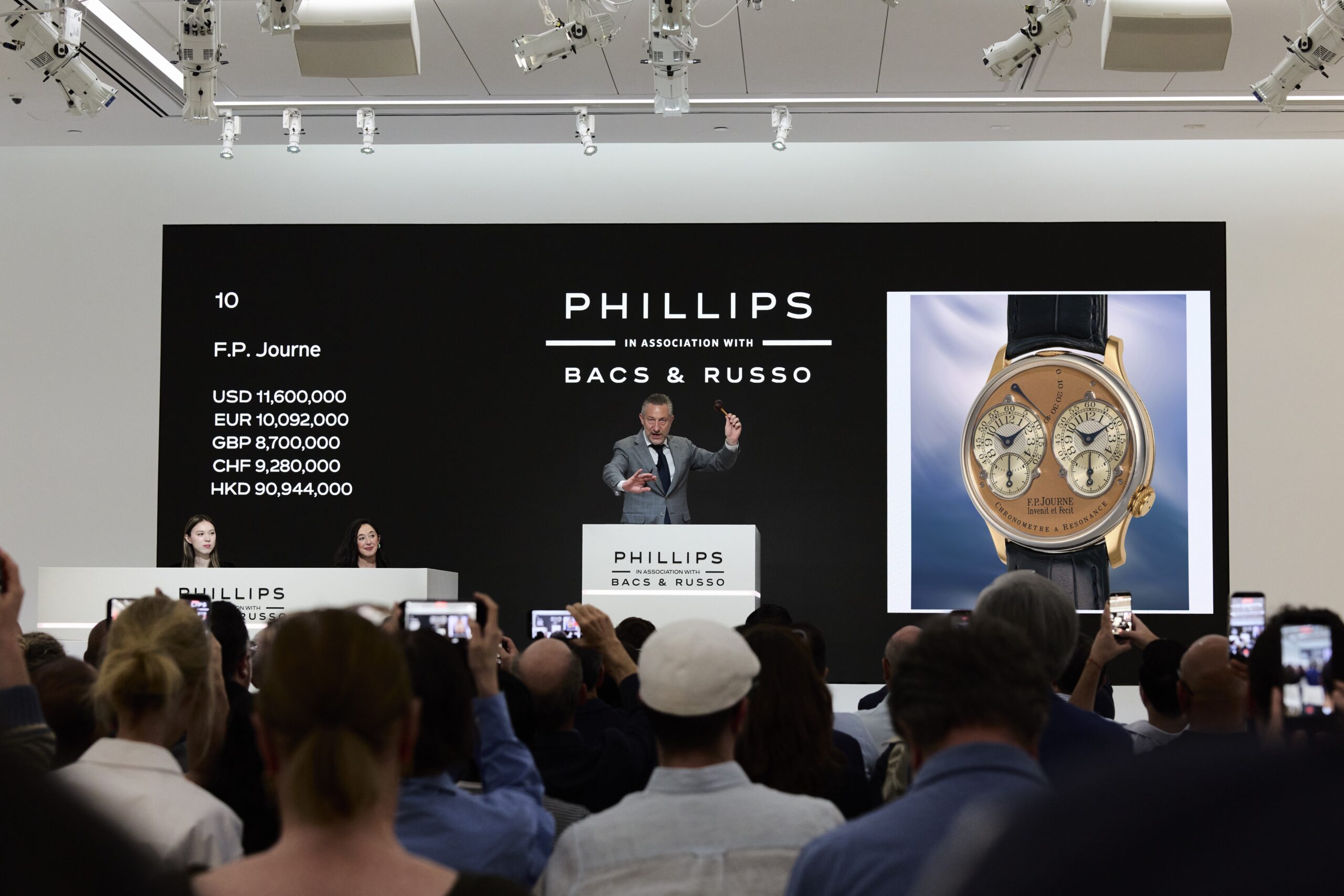
The clearest reading of it came in a New York saleroom in December 2025, when an F.P. Journe FFC sold for 10.8 million dollars, a world record for any watch by an independent maker by a wide margin. The watch was commissioned by Francis Ford Coppola; it carries a sculpted articulated hand in place of numerals, a mechanism François-Paul Journe spent seven years building after the two men discussed the idea over dinner at Coppola’s vineyard in 2012, the hand itself drawn from a sixteenth-century prosthetic by the surgeon Ambroise Paré. Three prototypes exist. Strip away that biography and the same watch is a very fine timepiece worth a fraction of the result. The dinner, the seven years, the single existing object: that was the ten million, and the timekeeping was incidental to it.
The premium has three components, and they compound. The first is authorship, a named maker whose hand is in the object and whose body of work is finite. Weeks before the Coppola sale, Phillips sold the first Philippe Dufour Duality, serial number one, made in 1996 and one of only nine ever produced by hand, for over three million dollars, on authorship alone. The second is provenance, the chain of ownership and use that the worn Birkin carries in its leather. The third is the moment of return, the cultural shift that makes an object legible again precisely now, which is why the same object can sleep in a collection for decades and surface to a record when the moment finds it.
“An object with a biography is the exact opposite of the thing produced on demand,” says Winterer. “It has a maker who stood somewhere, a material that resisted, a single moment of making that cannot be repeated. You are not buying an item. You are buying a life that has already been lived, and verified, and that can be passed on. Patina is the proof that the original decision was right.”
The biography premium: how an object earns what it earns
The answer the saleroom gives has a precise shape, and it can be measured. The premium a rare object commands over its merely excellent equivalent is the biography premium, and it is paid for everything the primary market cannot supply: not the object, but the documented life the object has lived.
The clearest reading of it came in a New York saleroom in December 2025, when an F.P. Journe FFC sold for 10.8 million dollars, a world record for any watch by an independent maker by a wide margin. The watch was commissioned by Francis Ford Coppola; it carries a sculpted articulated hand in place of numerals, a mechanism François-Paul Journe spent seven years building after the two men discussed the idea over dinner at Coppola’s vineyard in 2012, the hand itself drawn from a sixteenth-century prosthetic by the surgeon Ambroise Paré. Three prototypes exist. Strip away that biography and the same watch is a very fine timepiece worth a fraction of the result. The dinner, the seven years, the single existing object: that was the ten million, and the timekeeping was incidental to it.
The premium has three components, and they compound. The first is authorship, a named maker whose hand is in the object and whose body of work is finite. Weeks before the Coppola sale, Phillips sold the first Philippe Dufour Duality, serial number one, made in 1996 and one of only nine ever produced by hand, for over three million dollars, on authorship alone. The second is provenance, the chain of ownership and use that the worn Birkin carries in its leather. The third is the moment of return, the cultural shift that makes an object legible again precisely now, which is why the same object can sleep in a collection for decades and surface to a record when the moment finds it.
“An object with a biography is the exact opposite of the thing produced on demand,” says Winterer. “It has a maker who stood somewhere, a material that resisted, a single moment of making that cannot be repeated. You are not buying an item. You are buying a life that has already been lived, and verified, and that can be passed on. Patina is the proof that the original decision was right.”
Continued Reading
New Geographies: India and the Next Luxury Power Shift
Where the next generation of collectors is emerging, and why the new geographies of demand are matching the old centres in scale.
Read the analysisThe biography premium: how an object earns what it earns
The answer the saleroom gives has a precise shape, and it can be measured. The premium a rare object commands over its merely excellent equivalent is the biography premium, and it is paid for everything the primary market cannot supply: not the object, but the documented life the object has lived.
The clearest reading of it came in a New York saleroom in December 2025, when an F.P. Journe FFC sold for 10.8 million dollars, a world record for any watch by an independent maker by a wide margin. The watch was commissioned by Francis Ford Coppola; it carries a sculpted articulated hand in place of numerals, a mechanism François-Paul Journe spent seven years building after the two men discussed the idea over dinner at Coppola’s vineyard in 2012, the hand itself drawn from a sixteenth-century prosthetic by the surgeon Ambroise Paré. Three prototypes exist. Strip away that biography and the same watch is a very fine timepiece worth a fraction of the result. The dinner, the seven years, the single existing object: that was the ten million, and the timekeeping was incidental to it.
The premium has three components, and they compound. The first is authorship, a named maker whose hand is in the object and whose body of work is finite. Weeks before the Coppola sale, Phillips sold the first Philippe Dufour Duality, serial number one, made in 1996 and one of only nine ever produced by hand, for over three million dollars, on authorship alone. The second is provenance, the chain of ownership and use that the worn Birkin carries in its leather. The third is the moment of return, the cultural shift that makes an object legible again precisely now, which is why the same object can sleep in a collection for decades and surface to a record when the moment finds it.
“An object with a biography is the exact opposite of the thing produced on demand,” says Winterer. “It has a maker who stood somewhere, a material that resisted, a single moment of making that cannot be repeated. You are not buying an item. You are buying a life that has already been lived, and verified, and that can be passed on. Patina is the proof that the original decision was right.”
Geographies of memory
The most instructive part of the signal is that it does not speak in a single voice. Four regions are reading rarity in four different ways, and the differences carry more meaning than the totals. The global art market returned to growth in 2025, rising four per cent to an estimated 59.6 billion dollars with public auction sales up nine per cent, but the recovery is not uniform, and the texture is the diagnosis.
In the Gulf, a collecting culture is being constructed in public and at speed. In February 2025 Sotheby’s held the first major international art and luxury auction in Saudi Arabia, in Diriyah, and the Origins sale reached 17.3 million dollars across 117 lots. Later in the year the house became the first international auctioneer to open a permanent office in the kingdom, in Riyadh. The figure matters less than the composition of the room: roughly a third of buyers were Saudi, thirty per cent of bidders were under forty, and most of the contemporary work sold went to local collectors. This is not a market importing Western trophies. The standout lot was a 1968 painting from the personal archive of Safeya Binzagr, a pioneer of Saudi art who died in 2024 and who seldom sold or gave away her work, a piece whose biography is inseparable from the founding of a national artistic identity. A young base, buying its own memory back into the country. Sotheby’s December Abu Dhabi Collectors’ Week, across watches, jewellery, handbags and cars, added a further 133.4 million dollars and confirmed the depth beneath the debut.
In China, rarity reads as maturity, and the headline conceals the diagnosis. The market contracted hard, falling thirty-one per cent in 2024 to its lowest level since 2009, and the easy story is collapse. The truer story sits in a single counter-figure: as value fell, the number of transactions rose. Fewer speculative trophies at inflated prices, more considered purchases at rational ones. A generation of Chinese collectors is backing local artists and endowing museums with confidence, building collections meant to shape institutions rather than to flip. The market did not so much shrink as sober, and a sobered market is one that has started reading objects for what they mean rather than what they will fetch. It is the same shift The Silent Luxury has tracked in the Chinese luxury buyer, who now purchases more selectively and with a higher demand for traceability, expressed in the language of collecting rather than consumption.
In India, rarity reads as a homecoming, and the trajectory runs directly against the global one. While the worldwide market spent two years contracting, the Indian art market grew from two million dollars a quarter-century ago to 338 million today, with credible projection toward 1.1 billion by 2030. September 2025 alone produced a record month of 97.8 million. The records are falling not for new work but for historic masters: in March 2025 a painting by M.F. Husain sold at Christie’s for around 13.8 million dollars, a benchmark for modern Indian art, bought largely by a domestic and diaspora base reclaiming its own canon at the precise moment the rest of the world had turned cautious. Heritage operating as a live economic force rather than a sentimental one.
Read across all four, the pattern resolves. The established Western houses consolidate around blue-chip luxury and heritage lots; the Gulf builds; China sobers; India reclaims. Four motions, one underlying physics. Worth is moving, everywhere and in different tongues, toward the object whose value can be traced to a person, a place and a moment, and away from the object whose only claim was that it was new.
TSL Insight Magazine
The Magic is Spent: A structural reading of the 2026 luxury shift
The full Q1 2026 analysis as a downloadable edition. Disenchantment, the hourglass economy and why price has stopped being the measure of value.
Download the editionThe objection: is this not simply a market for the very rich?
The obvious objection deserves a direct answer, because it is the reading the financial press defaults to. A ten-million-dollar handbag and a ten-million-dollar watch are, the argument runs, the eccentric purchases of a handful of billionaires, trophy lots that reveal nothing about the broader market and matter to almost no one. Read this way, the inversion is a footnote, not a diagnosis.
The objection mistakes the visible peak for the structure beneath it. The record lots are legible precisely because they are extreme, but the logic they expose runs the full depth of the market. The same shift that sets a record for the original Birkin is what drives a documented vintage watch to several times its retail price, what moves a buyer to choose a piece with a recorded maker over an anonymous equivalent, what makes the resale value of a house its most honest quality audit. The biography premium is not confined to the lots that make headlines. It is a gradient that runs from the saleroom down to the everyday secondary market, and the Digital Product Passport is about to extend it to objects that never had a provenance line at all.
“The trophy is just the place the logic is easiest to see,” says Winterer. “The same instinct that pays ten million for the first Birkin pays a modest premium for the jacket whose maker you can name, the watch whose history you can trace, the piece you intend to keep rather than replace. It is not a market for the rich. It is the return of an older question that the rich can simply afford to answer most loudly: is this real, and can it be proved.”
What this leaves standing
The category that benefits from the inversion answers to no single name in the trade, which is part of why it has been underread. It runs across fashion archives and couture, watches, jewellery, design and interiors, and objects from private collections, and the only thing these share is the one thing that now matters: a worth legible through biography rather than through novelty. A Schiaparelli archive look, a Gio Ponti chair with a recorded commission, a Margiela piece with an exhibition history, the Coppola watch. None of them is valuable because it is old. Vintage is a function of age. This is a function of meaning that survived, and in surviving, gathered weight.
The deeper point is that this is not a nostalgia trade, and not, in the first instance, an investment one, though it returns handsomely to those who treat it as such. It is the market’s correction to a decade of manufactured desire. When the new stopped being a reliable store of worth, capital went looking for worth that had already proved it could last, and found it in the objects that had carried their histories intact. The movement it describes is the same one The Silent Luxury has traced across the whole of the 2026 market: from fast desire toward endurance, from ownership toward relationship, from surface toward origin, from market price toward cultural legibility. The saleroom is simply where it is priced in public.
“Luxury was understood for decades as a transaction: buy, wear, replace, buy,” says Winterer. “What the inversion shows is the end of that model at its very top. The worn Birkin is worth more than the new one because someone lived with it, and that life cannot be manufactured, only accumulated. The rarest thing an object can offer now is the truth of what it is and where it has been. In a world running out of things a machine cannot make, that truth has quietly become the most defensible currency in luxury.”
The watch that sold in New York will be wound, eventually, by someone who knows the story of the hand on its dial. The bag will be carried, or kept, by someone who knows whose marks are in the leather. The market has spent a decade learning that everything can be reproduced. It is now relearning, object by object and record by record, the worth of the things that cannot.
Sources
- Sotheby’s, Jane Birkin’s Original Hermès Birkin sells for $10.1 million, Paris, 10 July 2025. sothebys.com
- Phillips, The Geneva and New York Watch Auctions 2025, including the F.P. Journe FFC Prototype from the collection of Francis Ford Coppola and the Philippe Dufour Duality No. 1. phillips.com
- The Art Newspaper, Christie’s and Sotheby’s end 2025 with increased sales, thanks to luxury goods, trophy lots and private deals, 17 December 2025. theartnewspaper.com
- Sotheby’s, first Collector’s Week in Abu Dhabi generates $133.4 million across automobiles, watches, jewellery, handbags and real estate, December 2025. sothebys.com
- Sotheby’s, Origins, the first international art and luxury auction in Saudi Arabia, Diriyah, February 2025; permanent office opening in Riyadh. sothebys.com
- Christie’s, modern Indian art result for M.F. Husain, March 2025, and the record month for the Indian art market, September 2025. christies.com
- Art Basel and UBS, The Art Market 2026, global art market growth to an estimated $59.6 billion with public auction sales up 9 percent. artbasel.com
- The Business of Fashion and McKinsey, The State of Fashion 2026, on luxury value pressure, hard luxury demand, resale growth and AI authentication. businessoffashion.com
- Fortune, James Murdoch on authenticity as an emerging asset class, May 2026. fortune.com
Similar Articles

2.4 Billion Swiss Francs and a Narrower Truth: The Swiss Watch Rebound

Luxury Supply Chain ESG: Franco-Italian Framework Sets 46 Shared Requirements

The Next Generation of Collectors: Taking the Saleroom Stage