Salone del Mobile 2026: What the 64th Milan Design Week Said About the Future of Design
Milan Design Week 2026 – the 64th Salone del Mobile.Milano, held from 21 to 26 April at Fiera Milano Rho and drew 316,342 visitors from 167 countries – produced three structural signals for the future of design. First: studios from Saudi Arabia, Guatemala, Chile, Brazil and China entered the global design conversation simultaneously, each carrying a production philosophy rooted in its own geography. Second: subtraction was the dominant working method across the most considered work, from Piegatto’s excavated furniture to the SaloneSatellite Award winners’ material transformations. Third: the 5VIE programme and Lina Ghotmeh’s installation at Palazzo Litta expressed a shift in design’s sensory register from the visual toward the full body.
Something shifted at the 64th Salone del Mobile.Milano, and it was visible in the composition of the fair itself before a single product was assessed. Among 1,900 brands from 32 countries, across 316,342 visitors from 167 nations, the most significant presences were studios that had never stood on this floor before: from Riyadh, from Guatemala City, from São Paulo, from Santiago de Chile. Each arrived with a production philosophy rooted in its own place, its own material knowledge, its own economy of time. Together they made an argument the fair’s official theme was already reaching toward: that design’s authority comes from origin, and that origin is growing in many places at once.
“The Salone does not merely bring the world of design together,” said Maria Porro, President of Salone del Mobile.Milano. “It sets it in motion.” In 2026, the direction it moved was outward: toward new geographies entering the global conversation on their own terms, toward a working method that builds through reduction rather than accumulation, and toward a sensory register that design has long underused.
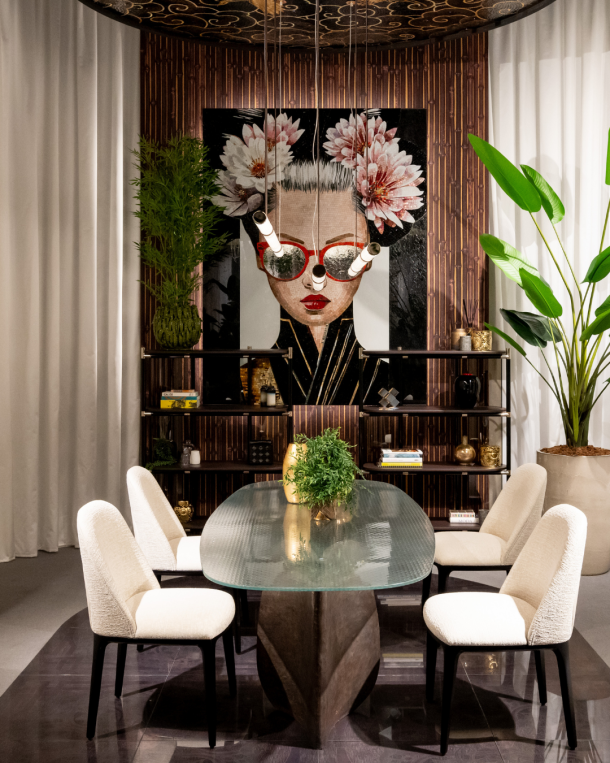
Mosaic as material language: SICIS at Salone del Mobile.Milano 2026.
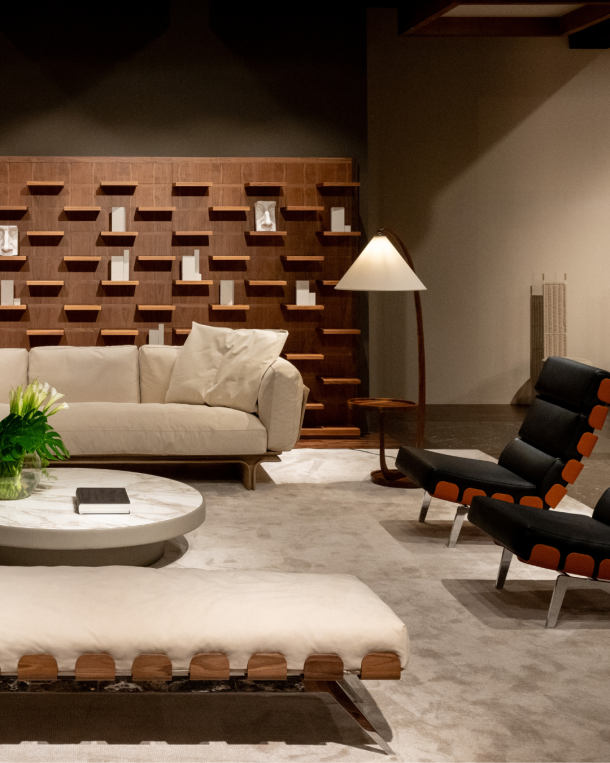
Structure and stillness. MASCHERONI at Salone del Mobile.Milano 2026.
Many New Centres
Salone Raritas, the fair’s newly inaugurated section for collectible design, limited editions and high craftsmanship in Pavilions 9 through 11, was the institutional response to a movement that had been building for years outside the fair’s gates. Curated by Annalisa Rosso and designed by Formafantasma as a large architectural lantern, it gathered 28 galleries from 12 countries around a specific brief: objects whose making can be accounted for, whose origin is part of their meaning. The modular wooden dividers separating each gallery’s space were engineered for three years of reuse, requiring no drilling. The exhibition design argued the same thing its contents argued.
Among the exhibitors was Zaza Maizon by A1 Architects, a Saudi studio showing sculptural pieces for hospitality spaces, among them Gem of the Peninsula, a metallic sculpture whose forms draw from the mountains and valleys of the Arabian peninsula. “We are the first Saudi company since the beginning of Salone to participate in the fair,” said architect and designer Abdulaziz Khalid Al Tayyash. The pieces are produced in runs of under six per year. Saudi Arabia’s presence extended into the city as well: the Architecture and Design Commission presented Jusoor — Arabic for bridges — at the Pinacoteca di Brera, a collaborative exhibition in which five Saudi designers developed work alongside practices from India, Nepal and Spain, the project having passed through studios in Riyadh, New Delhi, Kathmandu and Barcelona before arriving in Milan.
The other new geography arrived from Central America. Fourteen Guatemalan studios, showing across 5VIE and Alcova, the independent exhibition platform that expanded its 2026 programme to Villa Pestarini, the only private Milan residence designed by architect Franco Albini, and the Baggio Military Hospital complex, presented “Guatemala Diseña con las Manos,” anchored by an installation referencing the Temple of the Great Jaguar in Tikal. Among them was Piegatto, a studio whose design philosophy The Silent Luxury has followed, making its first appearance at the Salone with “Carved Landscapes.” The collection treats furniture as inhabitable sculpture, each piece formed through subtraction: shelves appear hollowed, compartments feel excavated, proportions carry the authority of geological strata. The Retiro Sofa is built from a sustainable composite of reclaimed wood residue. “With Carved Landscapes, we are entering the global conversation with clarity,” said Pietro Estrada, founder of Piegatto. “Presenting furniture as architectural presence and material permanence.”
Raritas itself carried the same geographic breadth in concentrated form. Lewis Kemmenoe showed editions of his Patchwork series at Max Radford Gallery, furniture built from wood-yard off-cuts whose material biography is legible in every joint. Mercado Moderno brought Brazilian tropical modernism. Sabine Marcelis presented Plume, a sculpture with air moving through viscose liquid inside a standing polymer wall. Francesco Faccin showed tables and chairs that appeared to be planks of wood and were bronze casts. The visitor data from the six days confirmed what the stands were already showing: China led foreign attendance in absolute terms, Austria grew 15.7 percent, Mexico and Canada posted double-digit increases. The studios and the buyers were moving in the same direction.
Subtraction as the Operating Method
The SaloneSatellite Award, now in its 15th edition, has developed a specific authority over those years. Its jury, chaired since the award’s founding by Paola Antonelli, Senior Curator of Architecture and Design at MoMA New York, looks for work that captures a way of thinking rather than a finished product: insight above market, research above industrial scale. The 2026 winners, selected from 700 designers under 35 representing 39 countries, read as a precise index of where that thinking is going, and in every winning project the operating method was reduction.
First prize went to Russo Betak of Denmark for Nippon, a pendant lamp 3D printed from seashells and then sculpted by hand, material experimentation resolved into a refined and luminous form. Second prize went to IOUS Studio of the Netherlands for 3DP Ceramic Tiles, a ceramic exterior system in which clay is printed under computational control, fusing digital fabrication with material sensitivity. Third prize went to the German studio Jüngerkühn for Soft Touch, a mechanical device that records and responds to object surfaces, emulating the handiwork of a craftsperson and producing porcelain vases in which each piece is carved in layers to reveal a pattern through the inherent qualities of the material. The Special Mentions went to Aiko Design of Chile for Númina Lamp, ancestral wicker and horsehair weaving combined with 3D printing, its symbolic figure embodying both industrial production and meticulous craft in a single object, and to Yixian Wang of China for Foggy, a vessel transforming fibreglass into pure glass without resin, delicate strands capturing light in a material the medium had never previously expressed this way. Both Special Mention recipients received a month-long residency at the Róng Design Library in Hangzhou.
What seashells give a 3D print, what clay does under computational control, what fibreglass becomes without resin: this knowledge is built through years of material practice and it is specific to a studio and a maker. The Salone’s campaign, conceived by Motel409, made the same argument in images: a stone, a laser-cut petal, a piece of wood, a sponge, each presented as origin rather than styling decision.
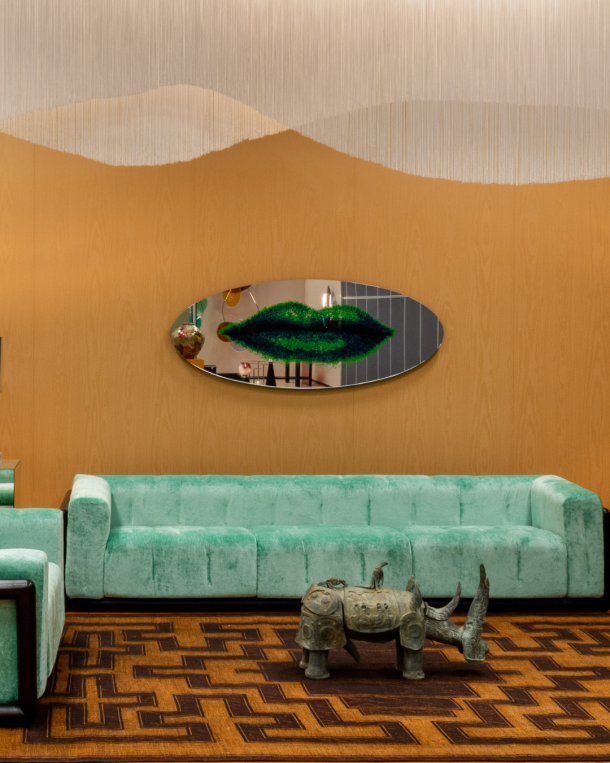
Matta the Collector. Paradisoterrestre at Salone Raritas, Salone del Mobile.Milano 2026.
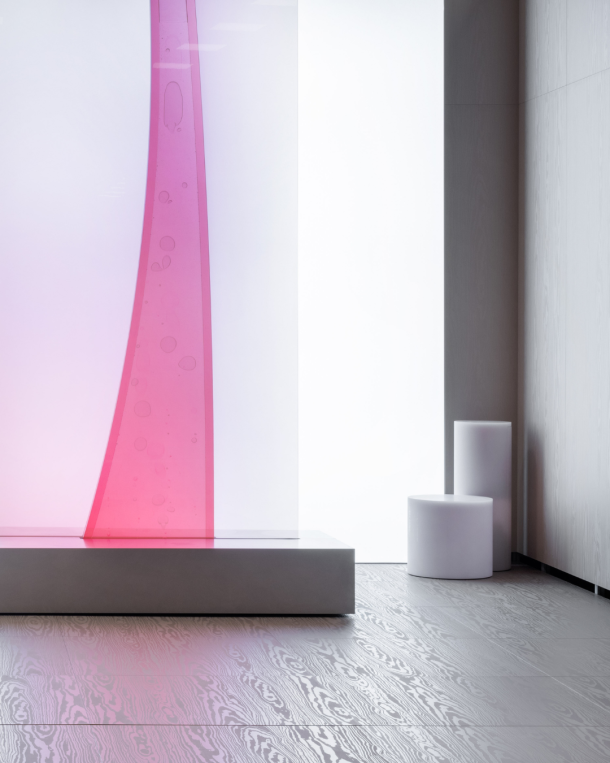
Plume. Studio Sabine Marcelis at Salone Raritas, Salone del Mobile.Milano 2026.
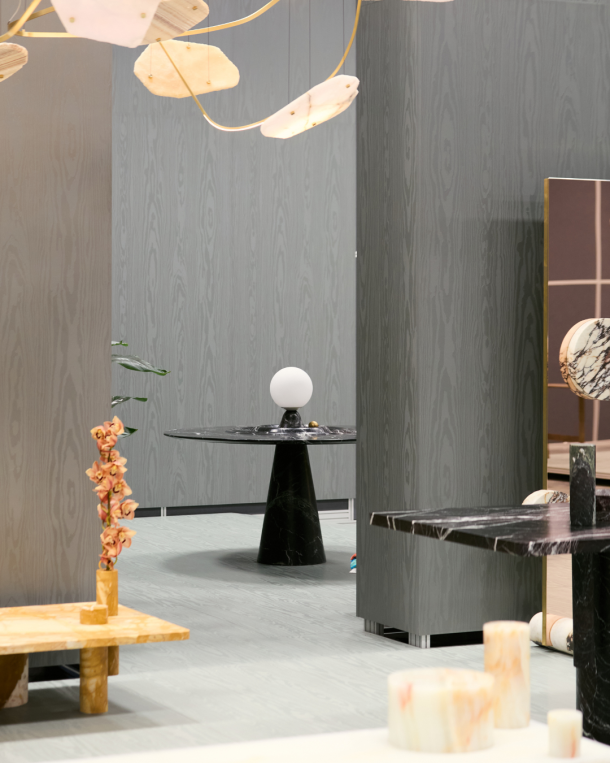
The Sensory Turn
The 5VIE district, one of Milan’s oldest design neighbourhoods and the Fuorisalone’s most curatorially focused quarter, organised its 2026 programme under the theme “QoT: Qualia of Things,” a reference to the philosophical concept of qualia, the subjective felt quality of experience that belongs to the person perceiving rather than to the object perceived. Its exhibitions at Le Cavallerizze at the Museo Nazionale della Scienza e Tecnologia addressed sound, touch, weight and the temperature of materials alongside their visual properties. Marco Guazzini’s “Resonance” connected a landscape of objects through aluminium tubes transmitting vibration between them. Sara Ricciardi Studio’s “ALMA WATER” rendered the quality of the sea through fabric and amplified sound without depicting it. The sensory turn these works described is a response to a buyer who left the logo economy looking for more sensation, encountered at closer range, through materials that change with use.
That reading found its architectural expression at Palazzo Litta, one of Milan’s most significant baroque residences and a recurring venue for the Fuorisalone’s most ambitious spatial programming, where Lina Ghotmeh presented “Metamorphosis in Motion” as part of the MoscaPartners Variations exhibition. Ghotmeh, a Lebanese-French architect whose practice is built on the premise that buildings and objects are living matter carrying biological and cultural histories, extended that argument from the scale of the object to the scale of the room.
The City and What Comes Next
The Fuorisalone is the name for the hundreds of exhibitions, installations and events that take place across Milan’s neighbourhoods in parallel with the fair each April, turning the city into the world’s largest temporary design platform. In 2026 its most concentrated argument came from the same direction the fair itself was pointing: that the object’s meaning begins before it is finished, in the choices made about material, method and maker.
Rem Koolhaas, the Dutch architect and theorist whose studio OMA has shaped some of the past three decades’ most significant cultural buildings, presented the masterplan for Salone Contract 2027 at the Contract Forum together with partner David Gianotten. The initiative, whose full debut is planned for the 65th edition in April 2027, frames the next significant territory of design as the integration of systems rather than the specification of individual objects: hospitality, retail and public space understood as complete fields of spatial intelligence. It is the scale above the object. What the new studios arriving from Guatemala City, Riyadh and Santiago were building from the ground up, Koolhaas named from the top down.
Similar Articles
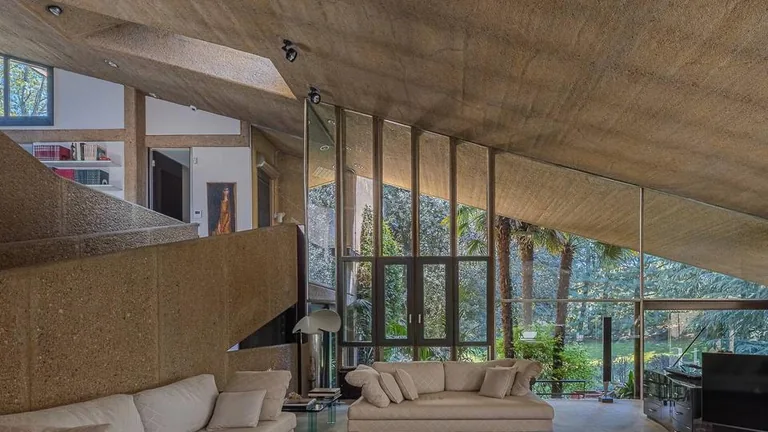
Villa Nava: The Spaceship That Became a Home
The Yellow Oil: How Saudi Arabia Turns Its Landscape into Wealth
Casa all’Italiana: Gio Ponti’s Houses, Where the Soul Finds Peace