Shocking Pink: How Elsa Schiaparelli Taught the World to See a Woman
In January 2021, Lady Gaga stood on the steps of the United States Capitol and sang the national anthem in a coat of midnight-blue cashmere body, a red silk faille skirt four metres wide, and pinned to her chest, an oversized gilded brooch in the shape of a dove carrying an olive branch. The brooch was Schiaparelli. The colour was Schiaparelli. The scale of the gesture — theatrical, unapologetic, historically literate — was Schiaparelli too.
“The perfect dress that never goes out of fashion,” Elsa Schiaparelli had written in her memoirs, “there is only one. The dress of freedom.” Lady Gaga knew exactly which house to call.
When Schiaparelli decorated her Paris salon in 1939, on the eve of war, before she slipped quietly away to America, she had hung doves of peace throughout the rooms. Eight decades later, Lady Gaga posted to the world: “A dove carries an olive branch. May we all find peace with one another.” The symbolism carried across the decades without translation, because Schiaparelli had always understood that clothes are never merely clothes — they are arguments, declarations, questions addressed to anyone willing to look.
The question she spent her career posing was deceptively simple: what does a woman look like when she decides, entirely on her own terms, to be seen?
“The perfect dress that never goes out of fashion — there is only one. The dress of freedom.”
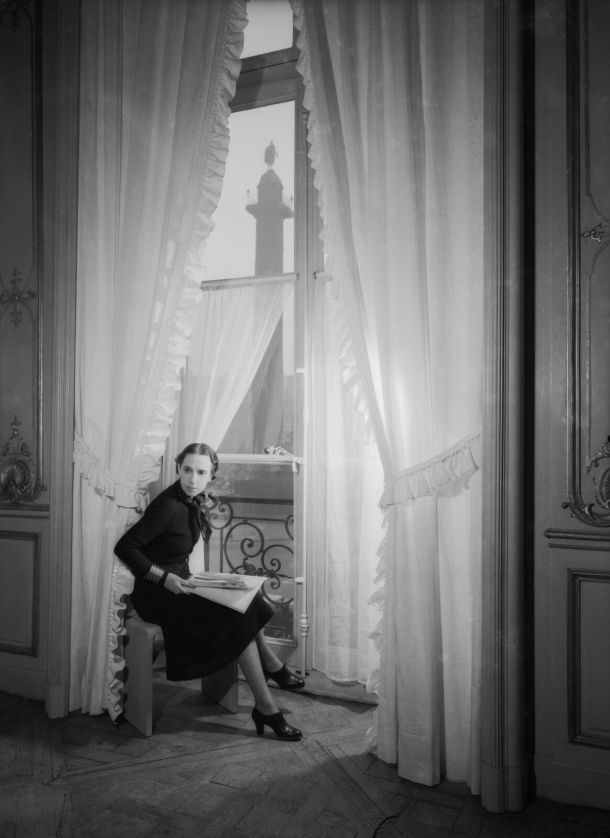
The Bow That Was Not a Bow
Her answer began with a pullover.
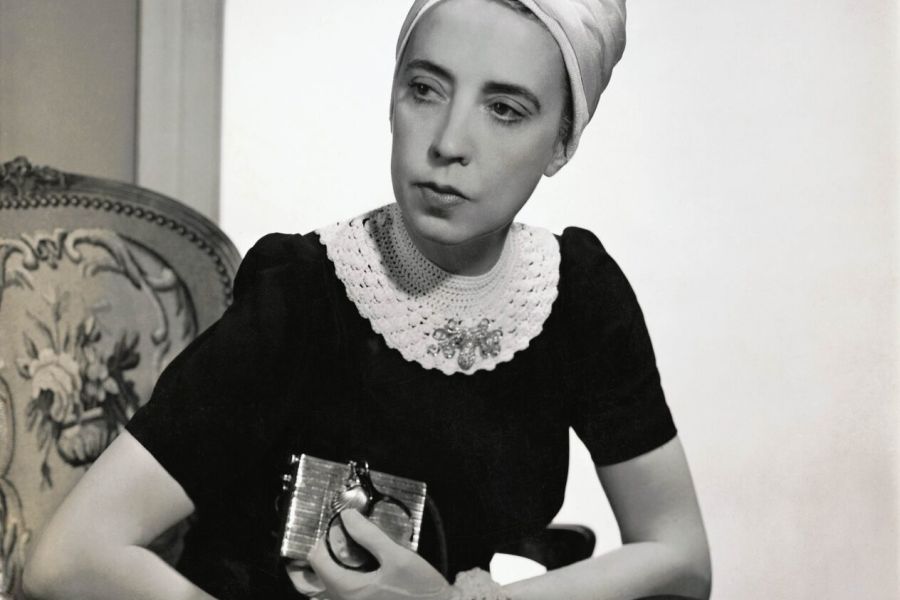
In 1927 she arrived, characteristically a little late, to a dinner gathering of Paris’s fashion world, wearing a hand-knitted black sweater from which a white bow appeared to grow at the neck. The bow was a trompe-l’œil — knitted in a special double stitch by an Armenian craftswoman whose technique Schiaparelli had sought out and understood immediately as something conceptual: an image woven into the fabric of its own impossibility. For a fraction of a second, every eye in the room hesitated. Bow or stitch, illusion or material, real or knitted? The guests held their breath, and placed their orders immediately. The writer Anita Loos, excellently connected in all the right circles, passed the name along: Joan Crawford, Gloria Swanson, Greta Garbo, Mae West. Schiaparelli had to hire dozens of Armenian knitters to meet demand. So began one of the most extraordinary careers in the history of fashion.
Born to Escape
She had grown up in Rome, the daughter of an Orientalist, the niece of the astronomer Giovanni Schiaparelli, who once compared the seven beauty spots on her left cheek to the stars of the Great Bear. She made them her personal trademark — a gesture that describes the woman precisely: take your flaw and make it your mark.
As a girl she had written openly erotic poems on themes from Greek mythology — verses of a frankly sensual character that her conservative family considered a scandal worthy of immediate action — and been exiled to a Swiss convent school as a consequence. She eventually secured her release through a hunger strike. Via London, New York, and a brief turbulent marriage to a count who turned out to be a fraud, she arrived at last in Paris, where she sifted through flea markets and made herself useful to the wealthy women whose salons she moved through with a cool, assessing eye. Those years gave her an exceptionally precise understanding of how power dressed itself — and what it might look like if it dressed differently.
She found the name Elsa too demure, the surname Schiaparelli unpronounceable for Parisian mouths, and so she called herself simply Schiap — pronounced Skiap, with the finality of someone who has decided how the world will address her. As she remarked, with the characteristic calm that never left her: “Nobody has been able to pronounce my name properly, but everybody knows what it means.”
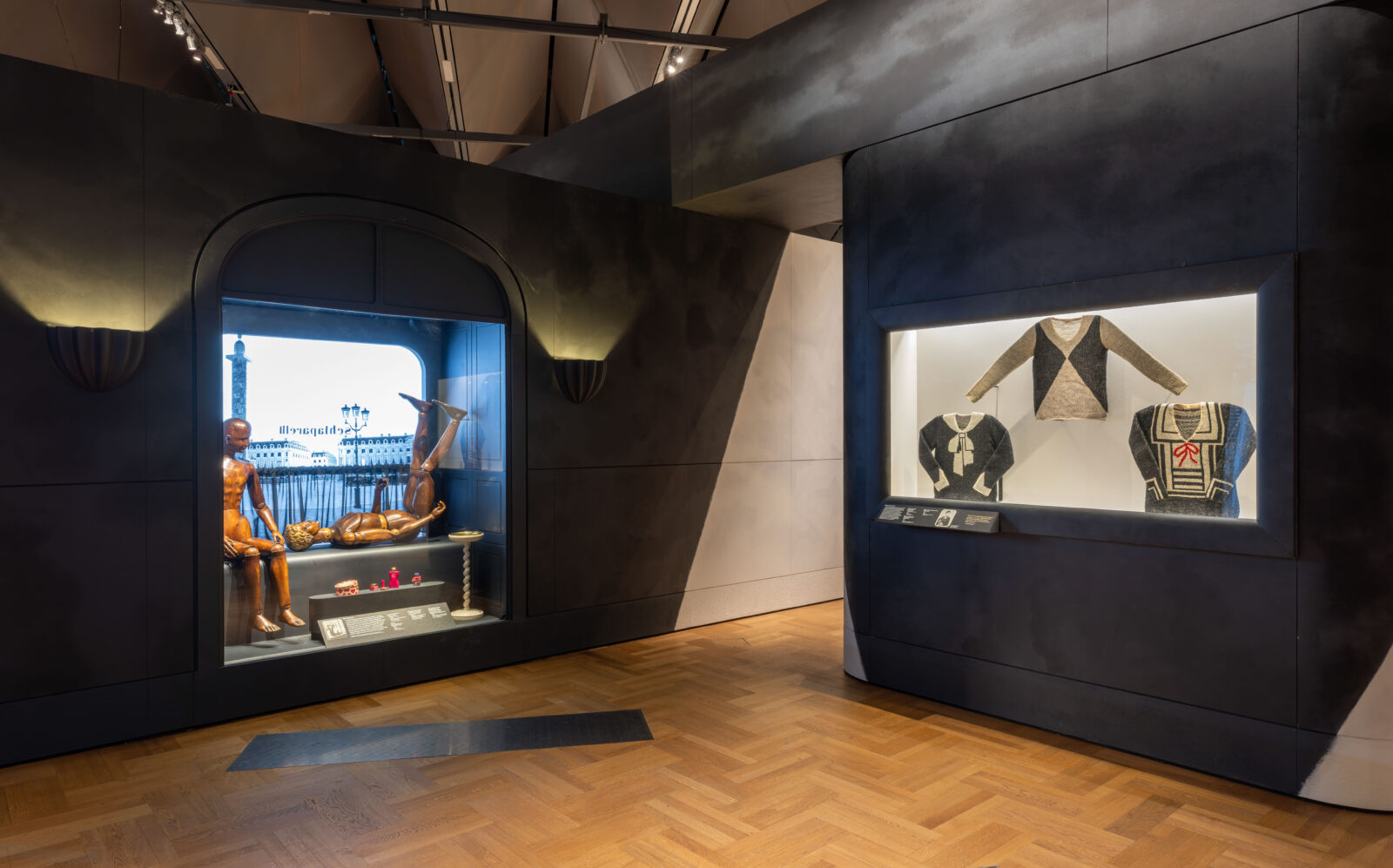
The trompe-l’œil knitted in a special double stitch by an Armenian craftswoman which Elsa Schiaparelli wore an dinner gathering of Paris’s fashion world: the layer for her success. | Photo: Schiaparelli_ Fashion Becomes Art at V&A South Kensington (c) Victoria and Albert Museum, London (3)
The Laboratory on the Place Vendôme
What set Schiap apart from the designers of her generation was that she brought to fashion the thinking habits of someone who had grown up among scholars and beside surrealists, and who treated both as equally productive instruments. Man Ray photographed her in his studio and found himself influenced by her in return. Salvador Dalí brought her the idea of the lobster crawling across the hip of an evening gown in white silk — precisely the dress that Wallis Simpson wore for Cecil Beaton and Vogue in 1937, shortly before her marriage to the former King of England, and which produced the next Schiaparelli scandal on schedule. Jean Cocteau sketched two profiles facing one another, and that line became, through the hands of the embroiderers at Lesage, an evening coat whose back simultaneously read as a vase of roses. The house on the Place Vendôme was, as one critic observed, the beating heart of surrealist Paris. Dalí considered it exactly that; Cocteau called it an otherworldly laboratory.
What both descriptions tend to elide is that Schiaparelli held the commissioning intelligence in every collaboration. She decided what an idea would become. She was the force that turned a surrealist gesture into a garment a woman could actually wear with conviction — and this distinction matters, because it is the distinction between a muse and a director. Schiap directed.
She also possessed an exact understanding of the market, which her surrealist admirers generally lacked. In 1936 she introduced the visible zip fastener into haute couture — until then a detail confined to sportswear and inexpensive ready-to-wear. The couture dress had historically defined its value partly through the invisibility of its own construction: the seam that vanished into the fabric, the closure that disappeared into the lining, the mechanism that dissolved the moment the woman moved. A visible zip was a breach of decorum, a sign of cheapness, a gesture in entirely the wrong direction. Schiaparelli placed hers in metallic prominence on the front of a couture piece and said, in effect: there is no hierarchy of materials. What counts is the intelligence with which something is used.
Two Women, Two Answers to the Same Question
“For me,” Schiaparelli wrote in her memoirs, Shocking Life, “designing clothes is not a profession, it is an art.” The sentence has been quoted so often that what it actually assumes tends to get lost: art takes a position on the world, questions its conditions, refuses to leave things as it found them. Schiaparelli did exactly that, systematically, over almost three decades.
To understand what she changed, and why her work still carries force today, one has to place her beside Coco Chanel. What emerges is not two designers with different tastes, but two entirely opposing conceptions of how a woman should occupy the world.
Both modernised fashion. Both liberated women from constraints that had made getting dressed an act of submission to convention. But the liberation they offered led in opposite directions. Chanel pursued elegance through disappearance — the jersey suit as argument, the little black dress as universal silhouette, the modern woman moving through her day with a frictionless, normative, impeccable ease. Her goal was timelessness; her method was the retreat of the body behind a constructed universal form.
Schiaparelli’s answer was presence. The zipper, perhaps, is the most precise metaphor for the difference between them: Chanel conceals construction; Schiaparelli reveals it. One finds elegance in discretion, the other in deliberate friction.
Chanel once called her “that Italian artist who makes clothes” — meaning it as condescension, placing herself firmly on the side of craft over concept. The remark landed exactly where she intended, and also, without her intending it, described Schiaparelli with perfect accuracy. For Schiap’s clothes did think. They thought in lobsters crawling across silk, in skeletons embroidered in high relief on black crêpe, in shoes placed on top of heads where hats should be. In the same decade she designed trouser suits and dinner jackets for women, Marlene Dietrich wore them and caused a sensation; Katharine Hepburn claimed the same right. Schiap cut the forms without explanation and without apology. Where Chanel wanted the woman streamlined — sleek, functional, quietly elegant — Schiaparelli wanted a woman to be seen, fully and on her own conditions.
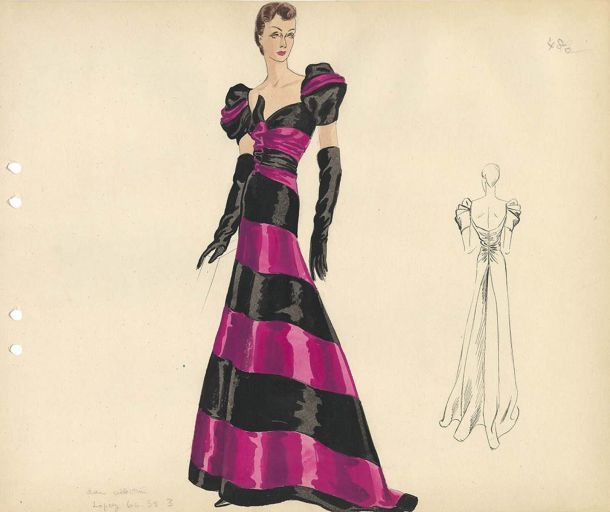
What read as personal rivalry was, at its core, the collision of two complete worldviews. Chanel’s answer to the question of how a woman might appear in the world was: through restraint, through stepping back, through constructing an armour of sobriety. Schiaparelli’s answer was the opposite. She wanted to appear, on her own terms, and she wanted the women who wore her clothes to want exactly the same thing. The lobster on the 1937 silk evening dress, the skeleton on the evening gown — these were declarations. Form was always simultaneously statement, and statement was always simultaneously a position toward a world that preferred its women neatly dressed rather than clearly positioned.
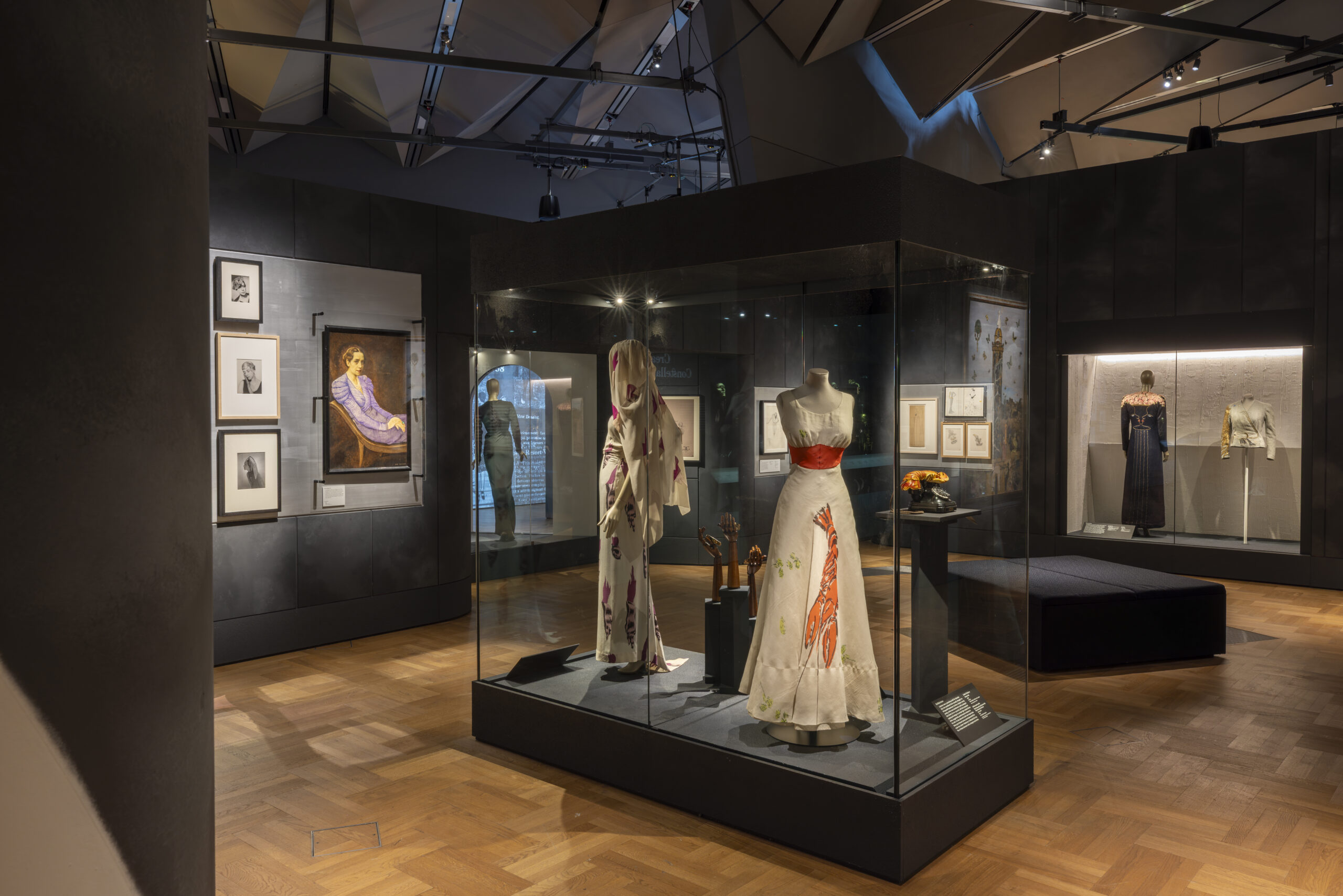
Schiaparelli wanted a woman to be seen, fully and on her own conditions. The lobster on the 1937 silk evening dress, the skeleton on the evening gown — these were declarations. Form was always simultaneously statement, and statement was always simultaneously a position toward a world that preferred its women neatly dressed rather than clearly positioned.
Photos: Schiaparelli_ Fashion Becomes Art at V&A South Kensington (c) Victoria and Albert Museum, London
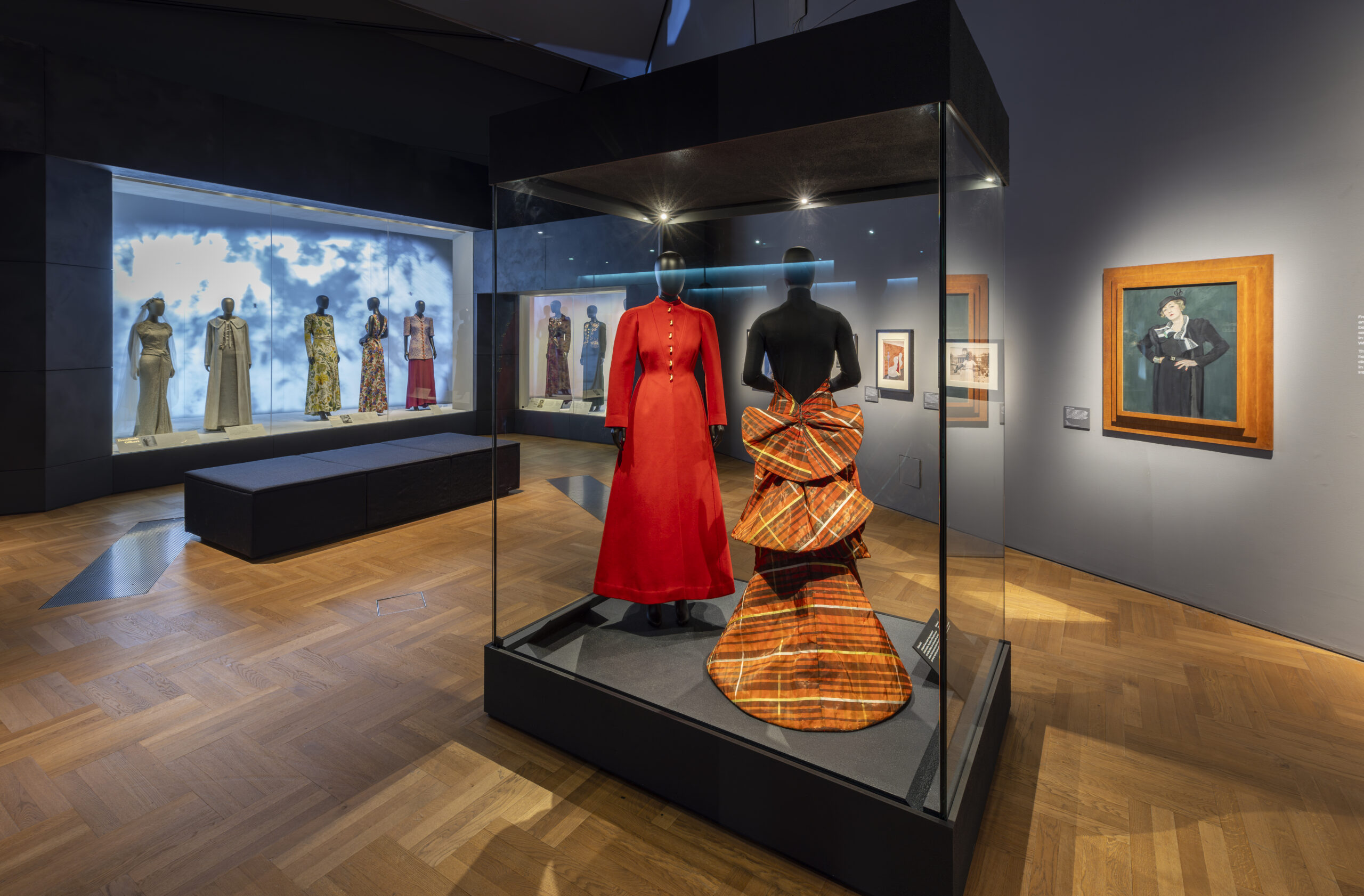
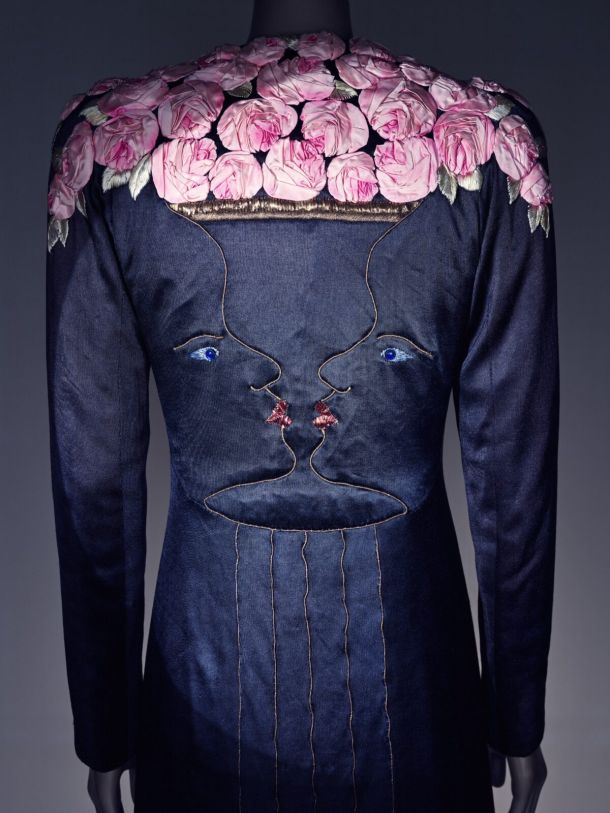
Evening coat, designed by Elsa Schiaparelli and Jean Cocteau, 1937, London, England © 2025 ADAGP DACS Comite Cocteau, Paris. Photograph © Emil Larsson
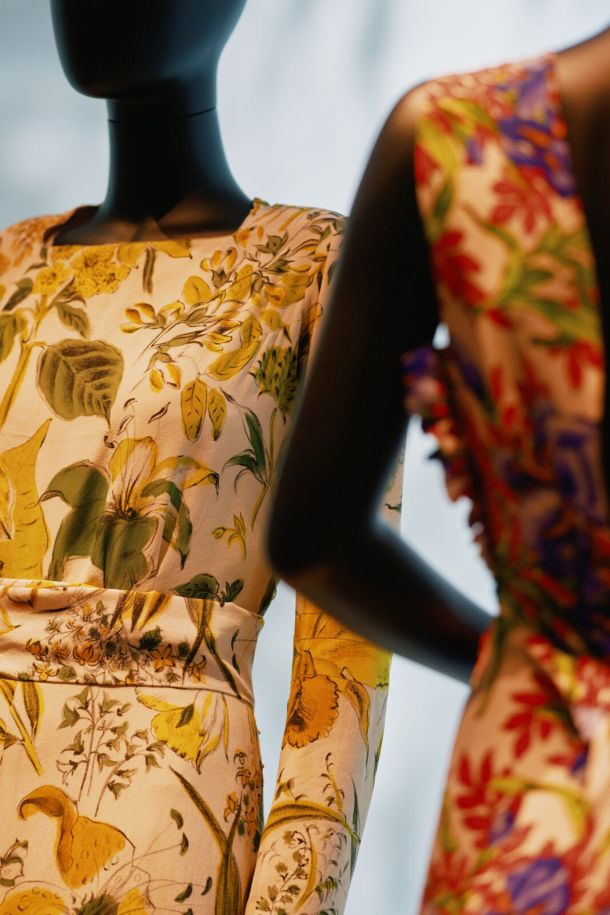
Shocking Pink and the Politics of Colour
She described it the way a painter describes a colour that has been waiting all along to be named: “Bright, impossible, impudent, becoming, life-giving, like all the lights and the birds and the fish in the world put together, a colour of China and Peru but not of the West — a shocking colour, pure and undiluted.”
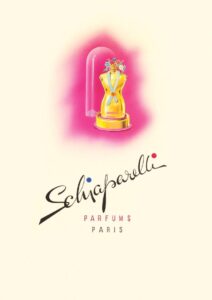
The word gave the perfume its name. In 1937 she launched Shocking, with a bottle designed by the surrealist painter Leonor Fini as a female torso — its curves modelled, according to tradition, on those of Mae West. The bottle was not a container with a pleasing shape. Fini’s sculpted figure held the fragrance inside itself the way a body holds breath, and the colour surrounding it — a pink so saturated and so deliberate that the word “pink” barely covers it — told you immediately what the perfume intended. Shocking was the name that confirmed what the packaging already announced. Schiaparelli had understood from the beginning that the fragrance, the bottle, and the colour were a single, indivisible act. What distinguished Shocking from Chanel’s No. 5, which had appeared sixteen years earlier, lay not in the notes but in the conception: where Chanel’s perfume aspired to abstraction, Schiaparelli’s was unapologetically embodied.
The colour she had chosen in the early 1930s — produced by mixing hot pink with a precise quantity of white, to arrive at something that sat between red’s aggression and pink’s sweetness without fully belonging to either — was entirely her own invention. It eventually became its own Pantone reference, one of the rare instances in fashion history where a designer’s instinct was granted the permanence of a standardised colour system. “What people need,” she said simply, “is colour.”
Where Schiaparelli led, others followed. Diana Vreeland, the doyenne of mid-century taste, liked pairing it with tangerine and crimson. Daisy Fellowes, socialite of international bad-girl repute, loved it. She dressed Zsa Zsa Gabor in it for the 1952 film Moulin Rouge. And when Marilyn Monroe played the role that sealed her reputation as a sex symbol in the 1953 film Gentlemen Prefer Blondes, she wore a shocking-pink strapless gown for the musical number that audiences still remember. Pink may carry a reputation now for sweetness, but for Schiaparelli and the women who wore her colour, it was something altogether different: the colour of potent power, wielded by those who knew what they wanted and were not afraid to go after it. A colour for those who knew their own minds. A colour, as it turned out, for the definitely difficult.
Schiap’s Heritage: The Maison Schiaparelli
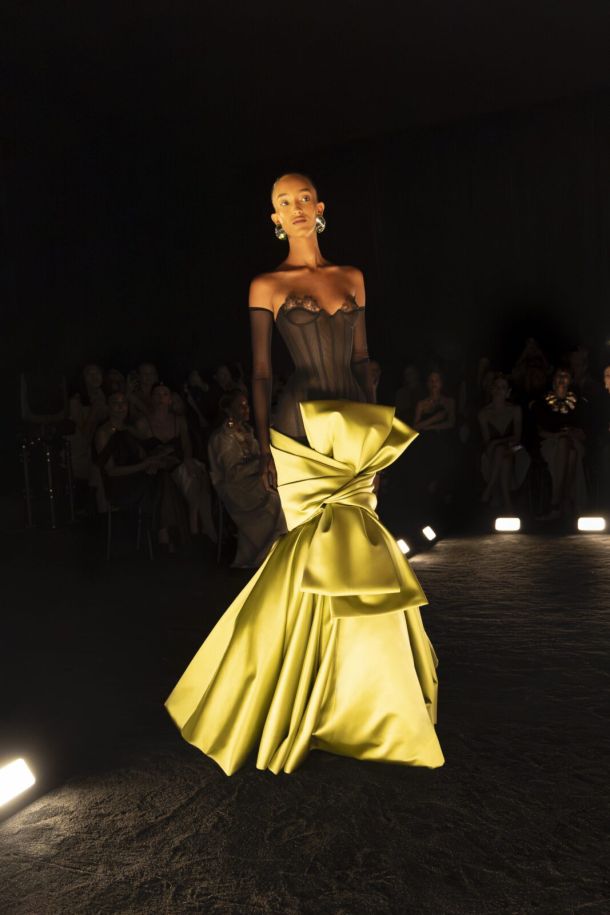
Schiaparelli Haute Couture Fall Winter 2024 Photo © Giovanni Giannoni. Photo courtesy Patrimoine Schiaparelli, Paris
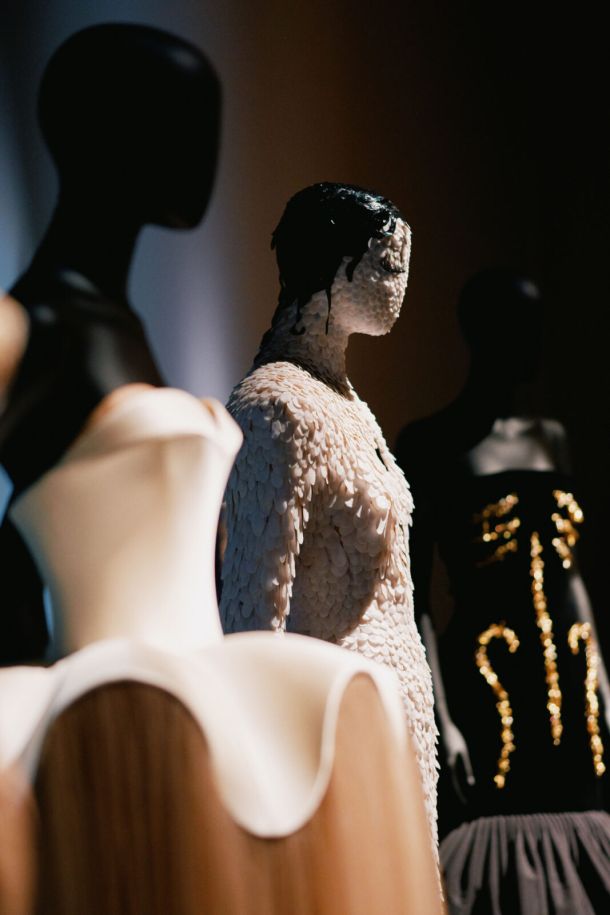
Photo: Fashion-Becomes-Art-at-VA-South-Kensington (c) Jamie-Stoke
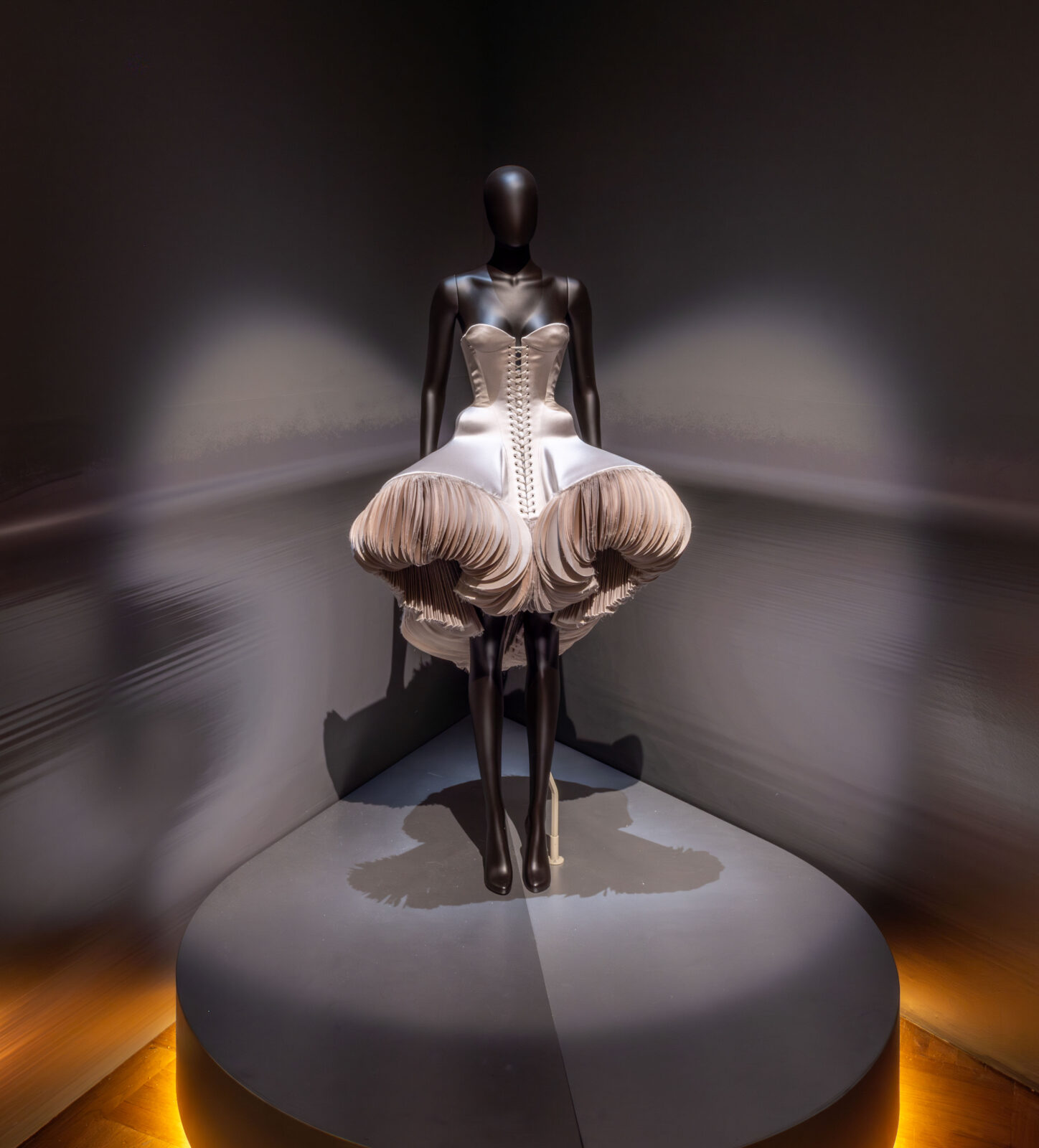
Photo: Fashion Becomes Art at V&A South Kensington (c) Victoria and Albert Museum, London
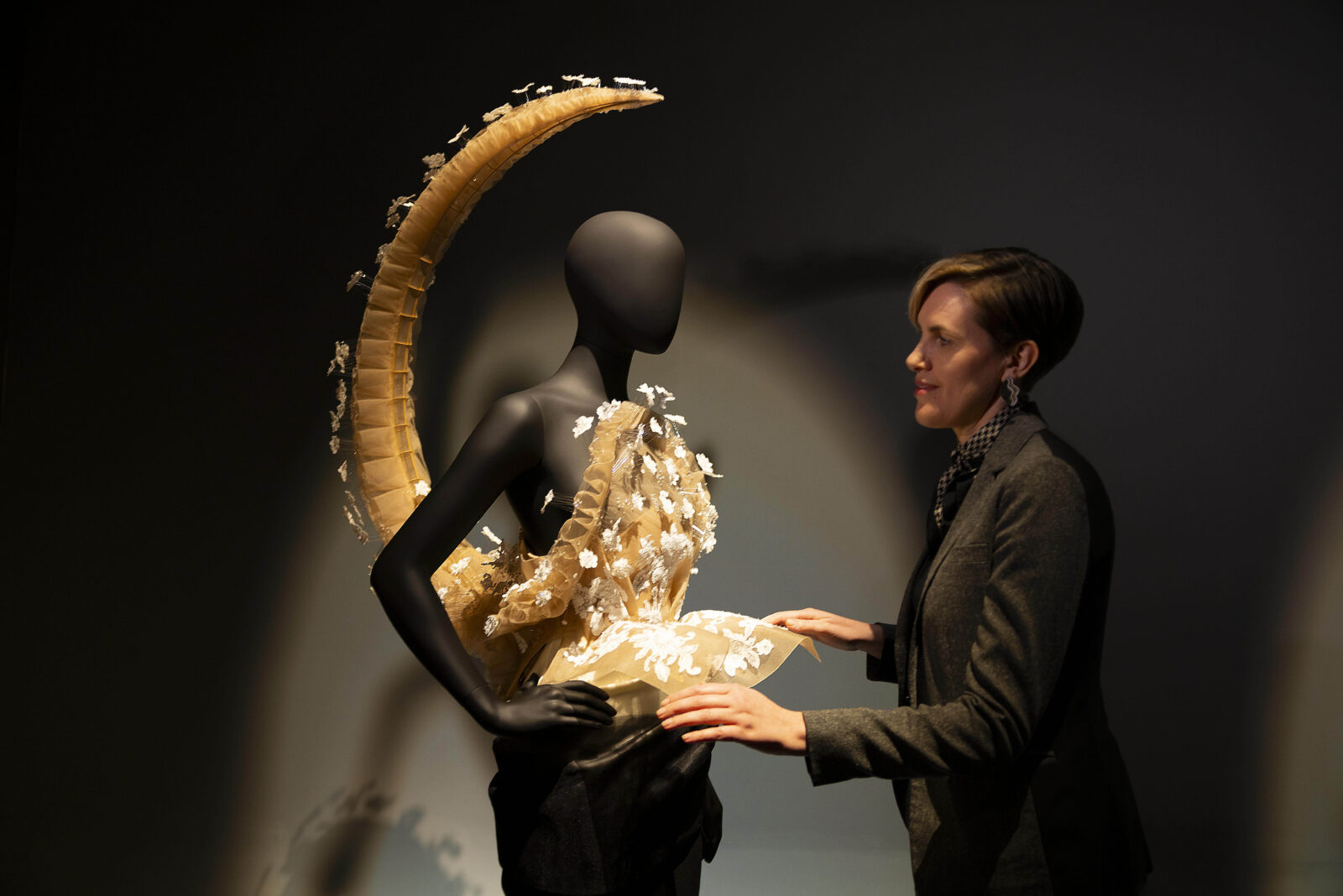
Fashion Becomes Art at V&A South Kensington. (c) David Parry/PA
The Twelve Commandments of a Woman Who Knows Her Own Mind
Her memoirs, Shocking Life, published in 1954, contained twelve principles for fashion that read less like design philosophy than like a manifesto for self-determination, written in the precise language of the atelier because that was the language Schiaparelli trusted. A dress must be connected to the body, not merely hung upon it — it must move with the woman, not around her. Clothes alter posture, mood, inner bearing. A woman need not adapt to what is expected of her; she is permitted to stand out. Elegance is not a question of price but of attitude. Fashion is born from small things — from the zeitgeist, from politics, from the texture of everyday life. And, perhaps most strikingly for its time: women should pay for their own clothes.
That last principle was not a practical suggestion. It was a statement about the relationship between economic independence and aesthetic self-determination. Whoever pays for her own clothes wears by her own choice; whoever wears by her own choice chooses a position, not an affiliation. In the 1920s and 1930s, this was a political act. It remains one today, if the terms have shifted.
She described the spirit behind these principles with the ironic distance she applied to most things: “I merely know Schiap by hearsay. I have only seen her in a mirror. She is, for me, some kind of fifth dimension.” And as a summary of the life itself, she offered something simpler: “Exciting, yes. Pleasant, no.”
What She Left Behind
The Circus Collection of 1938 — elephants and acrobats embroidered on boleros, presented as a burlesque show in the salons of the Place Vendôme — arrived in the year Europe was moving toward war. The Commedia dell’Arte Collection of the following year, with masked figures and harlequin cloaks, followed the Munich Agreement of September 1938. The comedic disguise mirrored the disturbing theatre playing out on Europe’s political stage. One of her twelve principles read: in difficult times, fashion becomes more radical. She was describing what she herself had already begun to do.
What she built in those years extended well beyond a fashion house. She was the first designer to market accessories under her own name — shoes, gloves, watches, jewellery, sunglasses — and the first woman to appear on the cover of Time magazine as a designer. She put Marlene Dietrich and Katharine Hepburn in trouser suits long before Yves Saint Laurent was credited with the same idea. She introduced the asymmetric Diana neckline, baring one shoulder entirely. She designed costumes for film. And she invented the Skeleton Dress of 1938 — a black crêpe evening gown with bones worked in high relief on front and back — of which the Victoria and Albert Museum in London now preserves the only known surviving example.
The V&A is also the venue for the largest Schiaparelli retrospective ever mounted in Britain: Schiaparelli: Fashion Becomes Art, which brings together more than four hundred objects in the Sainsbury Gallery, open until 8 November 2026. It arrives in a moment when the question of whether fashion can think — whether a dress can constitute an argument — feels as urgent as it did when Elsa Schiaparelli first posed it.
The broad shoulders that Armani and Versace claimed in the 1980s, Schiap had cut half a century earlier. The skull motifs that became Alexander McQueen’s signature trace back to the Skeleton Dress. The trouser silhouettes, the visible construction, the idea that a garment might also be a position — all of it was hers first.
Lady Gaga understood this. Standing on the Capitol steps in a skirt the colour of the perfume bottle, in a brooch that quoted Schiaparelli’s own farewell to Paris, she was wearing, among other things, a statement about what it means to be seen — fully, deliberately, on one’s own terms.
The Dossier for Insights on Schiaparelli
Two further readings of Elsa Schiaparelli, her life recovered through a new biography, and a conversation on fashion as a woman’s argument.
Schiaparelli Rediscovered: The Designer Who Made Fashion an Act of Independence
The designer’s life read through Michaela Karl’s biography, the rediscovery of a woman fashion almost forgot.
Smart Women Pay for Their Own Clothes
Michaela Karl in conversation on Schiaparelli, financial independence and fashion as a political instrument.
Similar Articles

When Banks Become Hotels: Stephan Ferenczy on Urban Change, Restaurants and the Life of Old Buildings
A Sicilian Day in Seven Perfumes: Piero Di Pasquale on La Scala del 7

Venetian Glass and Light: “Tradition Is Our Most Sophisticated Technology”