Wildes Moos: The Return of Touch
“One minute,” says Andreas Lichtblau. “Just one minute.” The request is as simple as it is radical: place your hand on the moss wall. Don’t move. Just feel.
But before the hand touches the wall, the moss already reaches the retina. Raw nature itself, unfiltered. And with it something you can’t choose: endorphins that emphatically confirm what’s visible. “You can’t choose this,” says Lichtblau, “it happens just like you get wet when it rains.” The seeing. Then the inner working. And only then: the feeling. Lichtblau sometimes simply has guests sit in front of the moss. Attention. Patience. A connection that’s so often missing today.
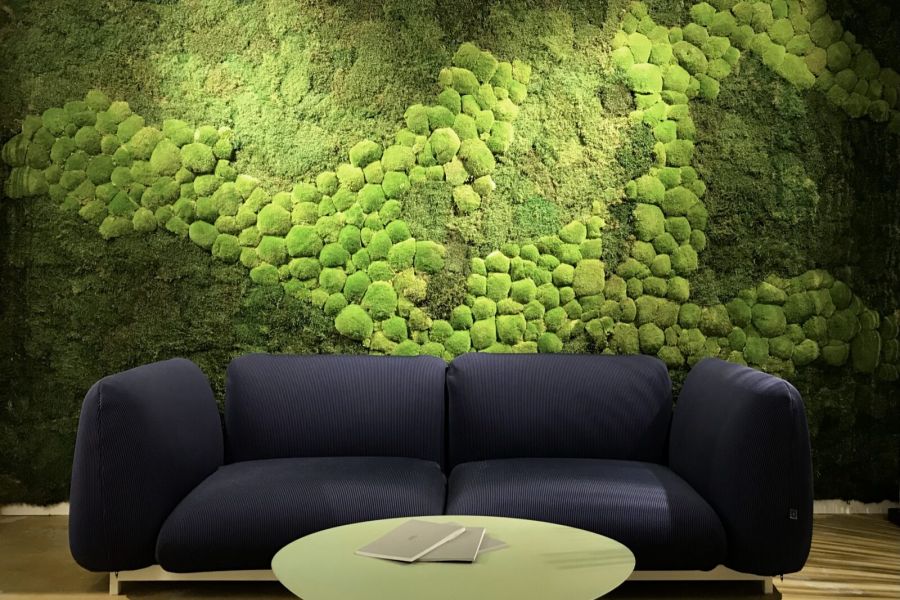
The showroom at Schottenring 31 is bathed in sunlight on this warm late morning, falling through the tall windows. It illuminates a moss circle with a corten steel frame element, 240 cm diameter, 30 cm frame depth. Different shades of green compose themselves – from bright spring green through rich moss green to almost black forest green. The structure appears organic, as if someone had hung a piece of forest floor on the wall.
The first touch surprises. The moss is softer than expected, more yielding than velvet. It’s conserved, preserved through a special process. Technically speaking, it’s no longer alive, but it feels more alive than most houseplants standing in corners of Viennese offices. The city outside, the traffic on Schottenring, the trams. Everything suddenly seems more distant. After 60 seconds, you lift your hand. Something has changed. Minimally, but noticeably.
The Disappearance of Texture: Why Design Forgot Hands
We live in a world that has become smooth. Smartphone screens, laptop surfaces, glass tables, polished door handles – everything designed to leave no traces. No fingerprints, no wear, no visible interaction. Modern design has systematically eliminated texture, in the name of purity, minimalism, supposed elegance. What has been lost in this process, most people only notice when they touch something different. It’s a simple observation, but it strikes at the core of a larger question: What happens when design is made only for the eyes, no longer for the hands?
Geographies of Green: The Philosophies of Nature in Space
Green in interior spaces has become a global phenomenon in recent years, certainly a reaction to a fundamental change: Social development has resulted in over 90 percent of the population in major cities spending their time in enclosed spaces. How does design respond to this?
Tokyo: Kokemusu and the Aesthetics of Mindfulness
“Overgrown with moss” – Kokemusu (苔むす) – is different in Japan than in Europe, not a sign of creeping decay, but a sign of dignity, age, and time. The Saihō-ji Temple in Kyoto, also known as Koke-dera, has cultivated over 120 species of moss since the 14th century. Visitors must reserve months in advance and may only enter the temple garden after a meditative ritual, an exercise in patience and mindfulness.
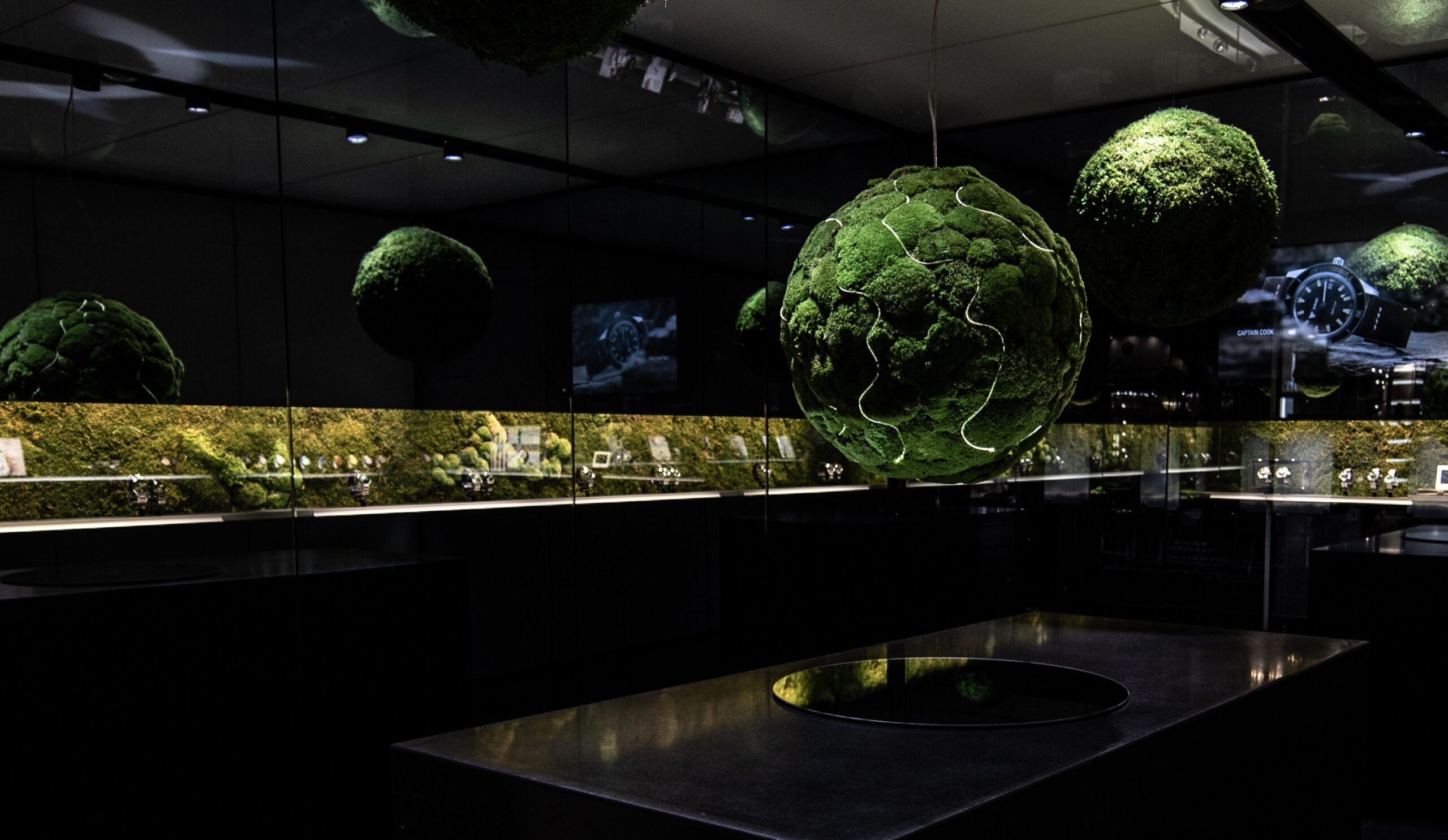
Architecture in Tokyo connects this traditional ritual with hypermodern architecture. MARU. has integrated Kokedama installations – those artful moss balls used in Japanese garden art for centuries – into glass office towers in the new Miyashita Park in Shibuya. The moss is alive, maintained daily, and has become part of the corporate culture. As in the Saihō-ji Temple, the care becomes an exercise in mindfulness.
Brooklyn: Vertical Gardens and the Quantification of Productivity
In Brooklyn, however, the concept of Vertical Gardens dominates. Companies like Biotecture and Naava build hydroponic systems with sensors that measure humidity and CO₂ levels, apps that control irrigation, dashboards that track data. Plants become measurable factors of productivity. Nature becomes Smart Nature, quantifiable optimization. It’s the American way: if we’re having nature, then please, productive nature.
Vienna: Wabi-Sabi on Pause – The Art of Silent Presence
Vienna, or more precisely Andreas Lichtblau’s approach, lies somewhere in between and yet is completely different. Conceptually leaning on the philosophy of Wabi-Sabi (侘寂), Lichtblau turns a crucial screw that reveals a deeply Viennese attitude toward life: The moss is conserved and transience is put on hold. It’s Wabi-Sabi on pause. Thus Wildes Moos requires no ritualized daily care, no water, no measurements, and no optimization. Nature is simply there, comfortable, without great effort.
The Art of Conservation
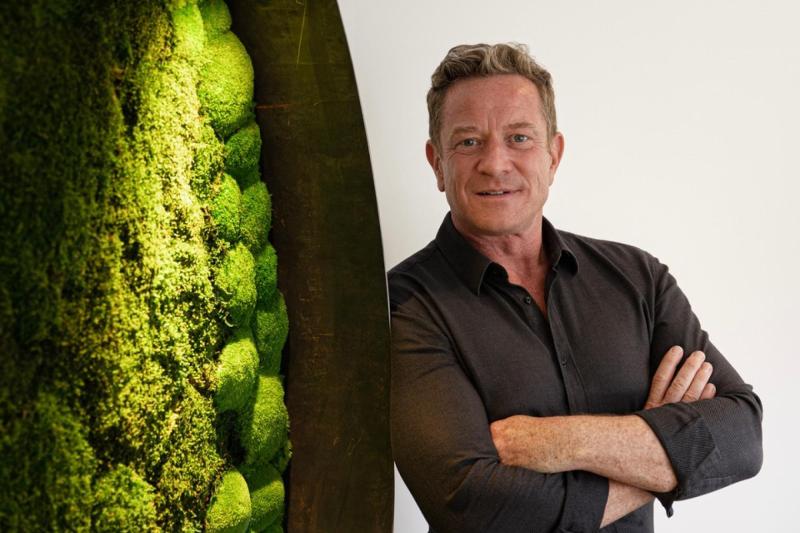
Andreas Lichtblau has been in the field of building greening for over 30 years. Roof greening in the 1990s, facade greening for almost 20 years. The moss landscapes were for him “a logical as well as wonderful addition in the sector.” But Lichtblau sees a significant difference: “A work of art is usually a decorative element. With us it’s different. Our unique pieces represent a work of art.”
This distinction, between decoration and artwork, is not semantic. It describes a fundamentally different approach. Decoration fills gaps, artworks create spaces. And that’s exactly how a moss wall by Wildes Moos works: It creates a new space within space, a tactile and visual layer that didn’t exist before.
Origin and Transformation: How Wilderness Is Conserved
The moss Lichtblau uses comes from France and Scandinavia, where it’s cultivated on plantations and regrows on site. It’s the most expensive option, but also the most sustainable and highest quality. Sustainability isn’t a marketing buzzword for Wildes Moos, but a core value of the company. The moss is hand-harvested, carefully, so the structure remains intact. The harvest areas regenerate.
The moss arrives already conserved in Vienna, at the atelier on Schottenring. There the careful selection and preparation take place. The softness the moss possesses is related to the humidity in the room and makes it particularly endearing. The insight: at about 60 percent it feels wonderfully pleasant. And there’s something else: the “forest breath,” as Lichtblau calls the slight natural scent that dissipates over time. It needs no water, just normal room humidity.
The Color Palette of the Forest: Flat Moss, Ball Moss, Forest Moss
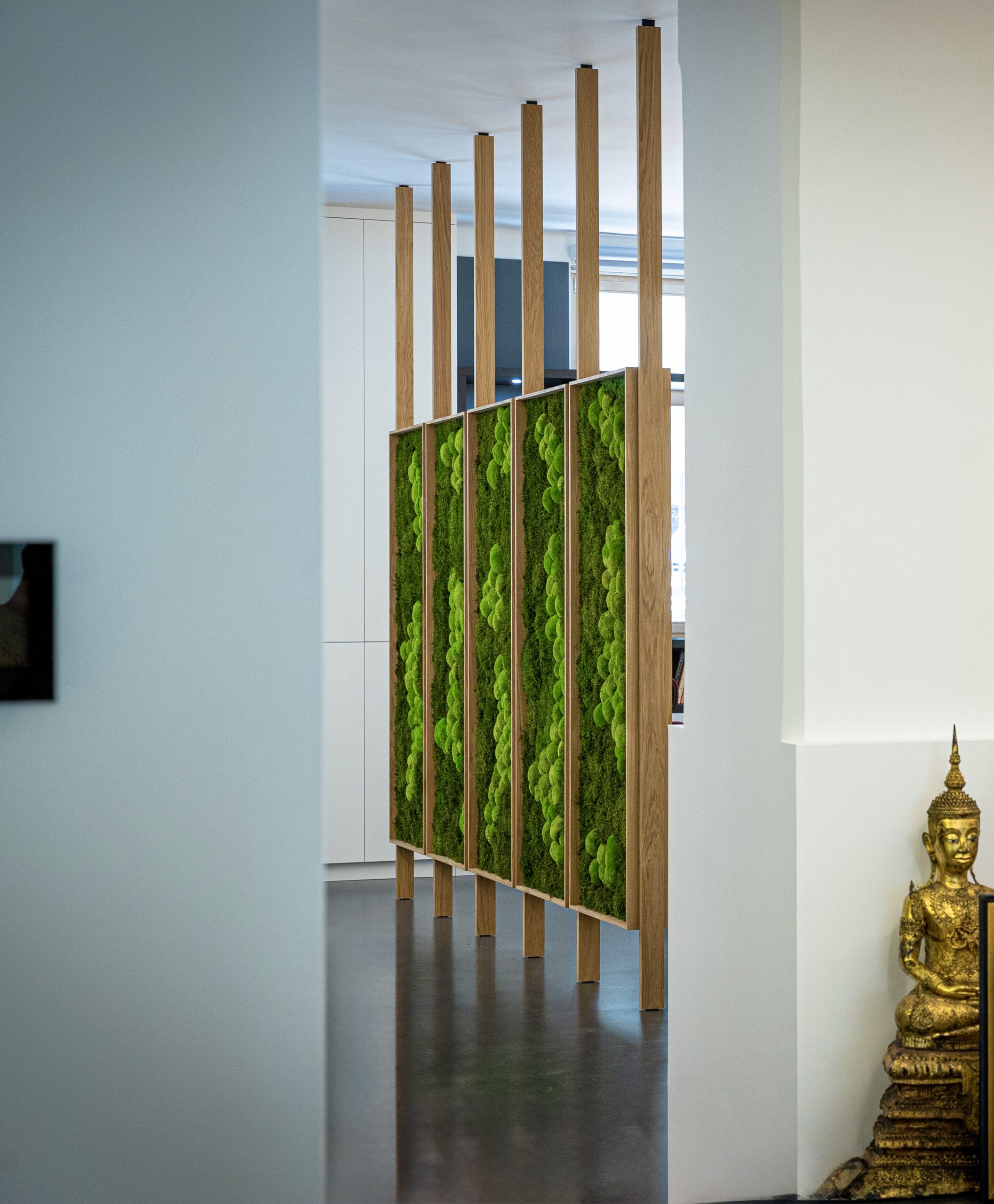
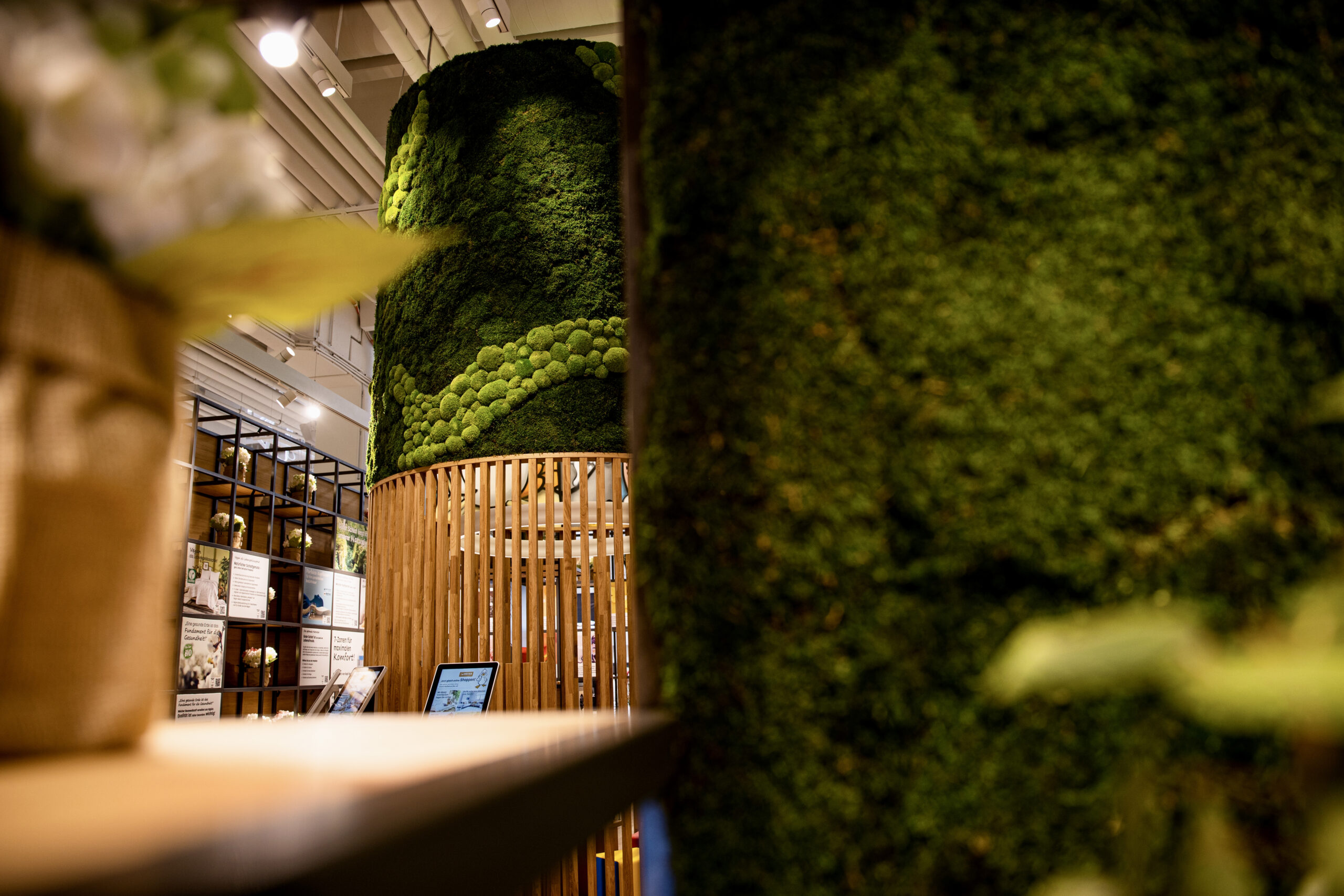
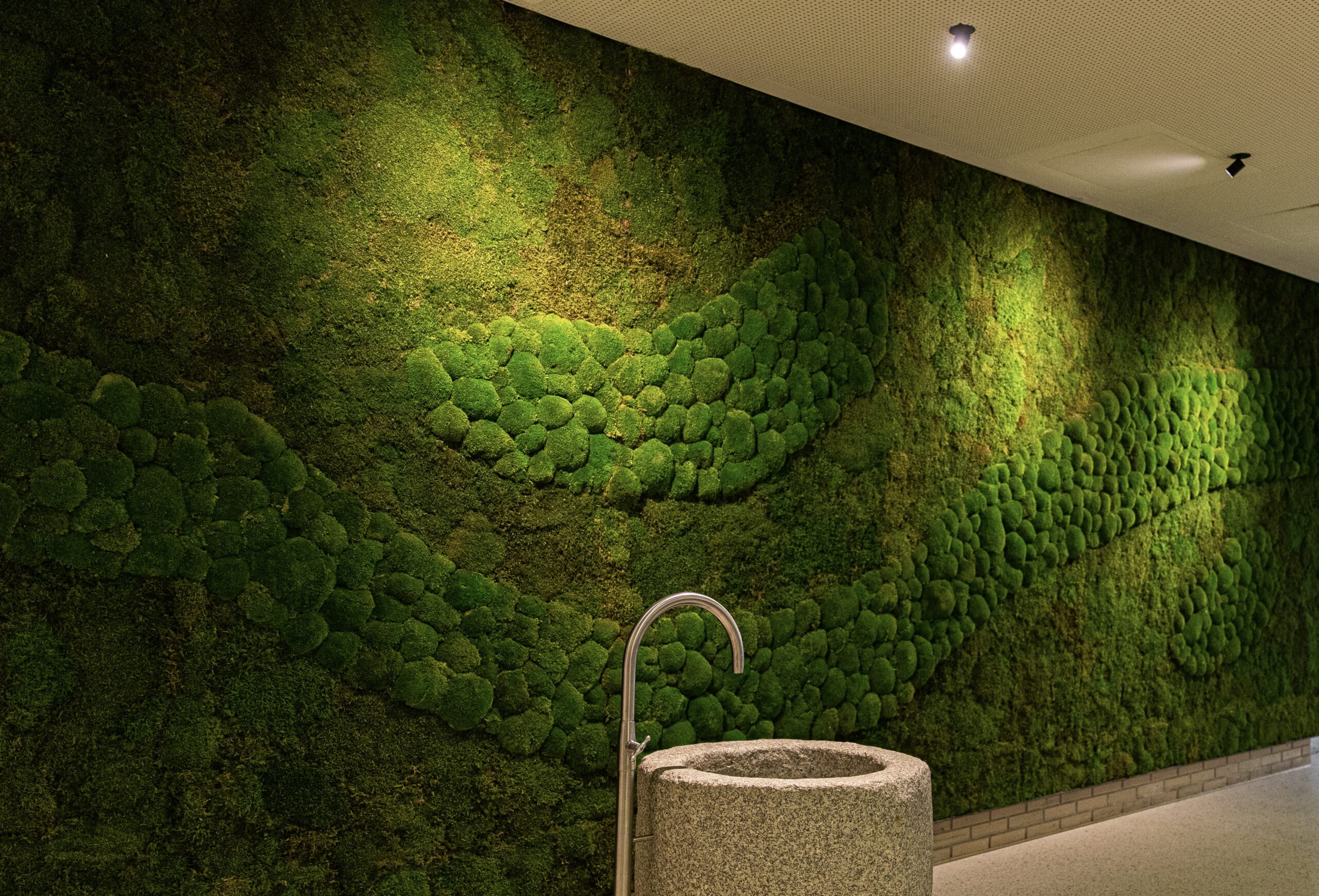
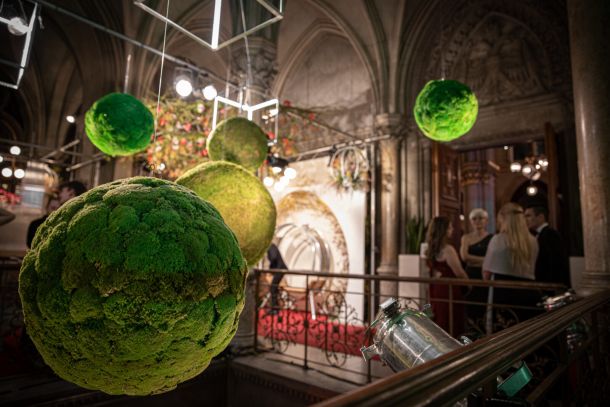
A look at the green artworks shows: Each moss species has its own texture as well as visual and haptic effect. Flat moss is, as the name suggests, flat and soft, like an organic carpet. Ball moss is relief-rich, almost like small hills on a miniature landscape. Forest moss is darker, denser, and deeper in color. Wildes Moos works with six different moss species, the color palette varying from bright spring green through rich moss green to almost black forest green. “We work like painters,” says Lichtblau. “Only our colors have textures.”
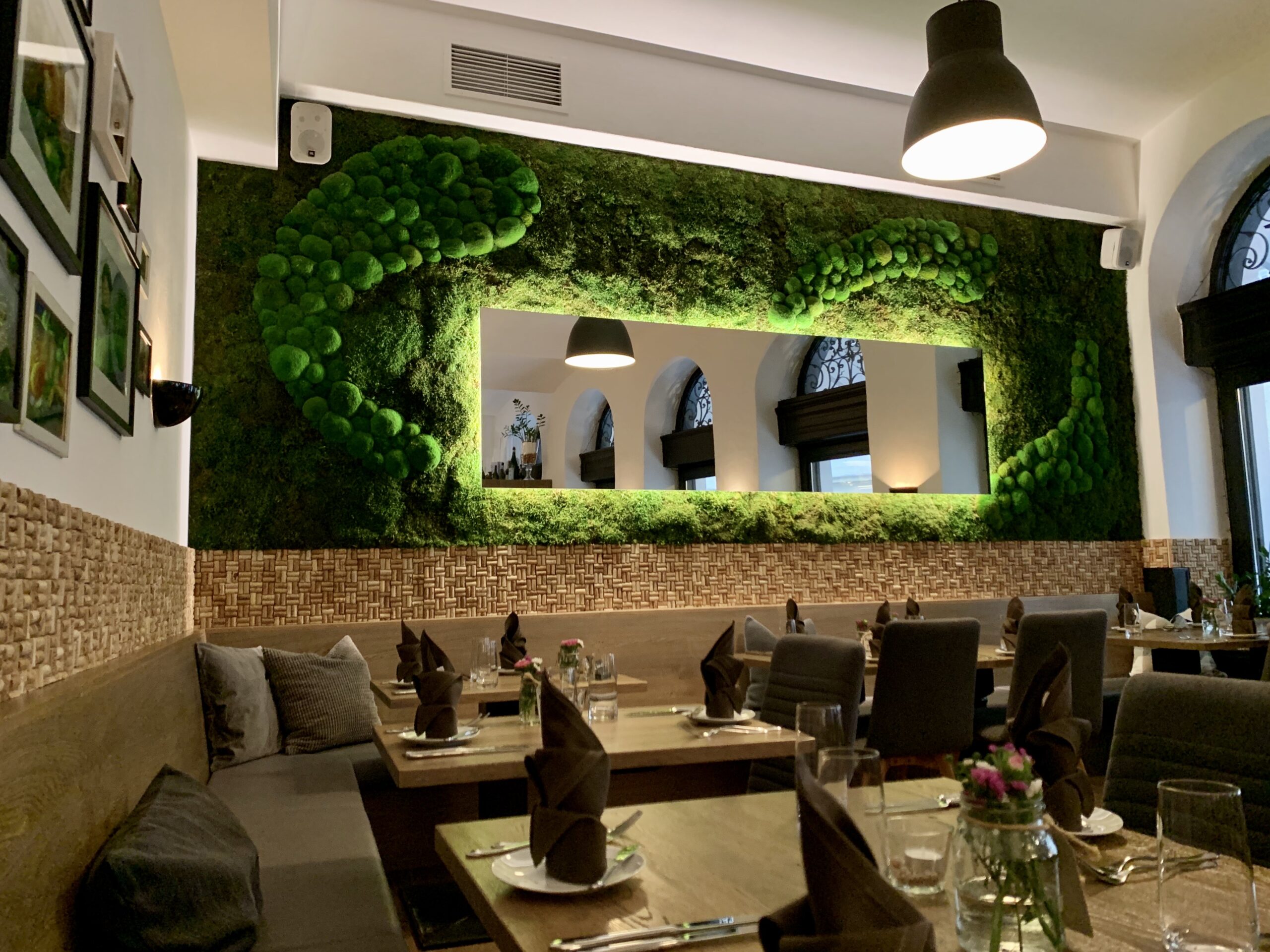
Lichtblau reveals: “For minimalist offices we often choose lighter, more uniform tones. For historic spaces it may be more dramatic, with deeper, darker nuances, with more contrast between the different moss species.”
Composition as Dialogue: From Idea to Landscape
Every installation begins with a relationship. “The most important thing above all is our counterpart, our customer themselves, as well as the spaces available to us for planning,” says Lichtblau. There’s never a standard solution, no product from a catalog. Instead, a symbiosis emerges from the customer’s ideas, the spatial effect, and Wildes Moos’s long experience.
The coordination continues until the ideal design solution for precisely this space has been found. It’s about the drama of the space, questions that can’t be answered purely technically, but require a feeling for the space itself and the people who live or work in it.
Light as Second Composition: The Relief of Depth
A moss wall without light? Unthinkable. This is one of the central insights Lichtblau has gained over the years. “Without the right light, you don’t see what the moss really is,” he says. “With light it becomes landscape.” In the forest there are very shadowy zones, but we all look where the light shines. We all know this moment: Look how beautifully the light falls in there. “I create that deliberately,” says Lichtblau. “Everything considered, planned, and implemented. With light. Then you can have such a moment for yourself. Your moment.”
The demonstration in the showroom is impressive. A wall under diffuse daylight. It appears calm, beautiful, but flat. Then Lichtblau switches on two directed LED spots that fall slightly diagonally onto the wall from above. The effect is immediately visible: The ball moss casts shadows, it appears as if tiny valleys and hills had opened up. The flat moss, previously a uniform surface, develops a special depth. The different shades of green, which merged into each other under daylight, are suddenly clearly separated. The wall takes on completely new forms and appears almost alive.
“Light creates space,” says Lichtblau. “And moss needs space to function.” That’s why Wildes Moos develops a customized lighting concept for every project. It’s not optional. It belongs to the installation like the moss itself.
The spots are planned, coordinated, and deliberately deployed, precisely to achieve this effect. Not left to chance, but precisely composed. He illustrates it with a customer project: “We repositioned the spots several times,” Lichtblau recounts. “Two centimeters in angle changes everything. What’s important is the play of shadow and light, spots with conical beams that cast stripes, like the sun shining through trees in the forest.” It’s this precision, this understanding of the interaction between material and light, that distinguishes a Wildes Moos installation from a simple “green element.”

An Effect with Constancy: Beyond the Measurable
The scientific side of moss walls is quite measurable. The moss consists of real, natural plants that grew in nature. Through the organic-biological conservation process, the enzymes of the forest are preserved. These enzymes have, as studies show, a positive effect on wellbeing. They strengthen concentration, bring more inner peace. Heartbeat and blood pressure can measurably decrease. Added to this are the sound-absorbing properties of moss, which are particularly noticeable in open-plan offices, restaurants, or practices. The moss walls significantly dampen urban noise, improving the room’s acoustics.
However, the effect goes beyond the measurable. It’s the touch itself that counts. In a time when design is becoming increasingly distanceless, everything smooth, everything perfect, everything untouchable, Wildes Moos’s moss walls offer something fundamental: A surface that wants to be touched. The invitation to a tactile experience that has almost disappeared in modern design.
The Concluding Question That Remains
Back in the showroom on Schottenring. The hand has long since lifted from the moss wall, but the memory of the touch remains. Outside the city rushes on – trams, cars, people hurrying past.
In Kyoto, at Koke-dera, the Moss Temple, there’s a ritual: Before you may enter the garden, you must transcribe a sutra. With brush, ink, on handmade paper. It takes at least 20 minutes, often longer. You sit still, concentrate on every stroke, arrive at your own pace. Only then, when you’ve become calm, when you’ve shed the haste, may you see the moss. It’s preparation and an invitation to slow down.
Andreas Lichtblau has created something that recalls this centuries-old practice, without copying it. You don’t have to travel to Kyoto, don’t have to reserve months in advance, don’t have to transcribe a sutra. You can simply place your hand on a wall. One minute. And in that minute something similar happens: You become calmer.
Do we need living nature? Yes. But Wildes Moos doesn’t understand its works as an alternative, but as a complement in our everyday life. In the Zen garden, moss grows slowly, over years, over decades. On Lichtblau’s wall it’s conserved for many years. But in both cases the same thing happens: People pause.
In a world that’s becoming increasingly smooth, Andreas Lichtblau thus offers the most radical thing design can offer: Touch. A moment when the hand lies on a wall and nothing else needs to happen. And his material for this? Is nature that doesn’t fade. Whose memory remains strong enough to remind us: There’s still something between us and the screen. Something we can touch. Something that touches back.
The Living Soul of Nature
When you stand before a wall of Wildes Moos, the questions that arise are rarely about technical specs. They are about the connection we feel when nature touches us back. To understand the philosophy and the effortless presence of Andreas Lichtblau’s work, we have gathered the most essential thoughts on why this radical invitation to touch is changing the way we perceive design.
No. Wildes Moos is nature that doesn’t fade. Its memory remains strong without the need for watering or care. It is raw, unfiltered nature, conserved to maintain its haptics and deep shades for years, offering a living feeling without any maintenance.
More: wildesmoos.at
Yes, it is nature itself. Andreas Lichtblau uses real moss that has been conserved through a specific process. This allows it to keep its organic structure and various shades—from bright spring green to almost black forest green—without growing or changing.
In a world that is becoming increasingly smooth, touch is the most radical invitation. As Andreas Lichtblau says: “Place your hand on the moss wall. Don’t move. Just feel.” It is a moment where nothing else needs to happen—a direct connection between you and the living feeling of the forest.
Just like the ritual at the Koke-dera Moss Temple, Wildes Moos is an invitation to slow down. It’s about shedding the haste of the city. Before you touch it, the moss reaches your retina and calms the senses, preparing you for a deeper, tactile experience.
It brings the soul of the forest floor into spaces that have become too smooth. It isn’t just a design element; it is a dialogue between texture and silence. It creates a connection that is often missing today, reminding us that there is still something real between us and the screen.
Similar Articles
Villa Nava: The Spaceship That Became a Home
The Yellow Oil: How Saudi Arabia Turns Its Landscape into Wealth
Casa all’Italiana: Gio Ponti’s Houses, Where the Soul Finds Peace