Santomiele: The Sweet Taste of Time
Santomiele in Prignano Cilento has worked the white Dottato fig since 1999, when Antonio Longo and Corrado Del Verme founded the company. The figs dry in the sun for ten days without additives, raising sugar content from 16 to over 60 percent. Around a third of Italy’s fig production comes from the Cilento. Santomiele sources from about 30 small farmers.
In a world dominated by haste and efficiency, there are places that teach us to pause. Prignano Cilento, an idyllic place in the hills of Southern Italy, is such a place. Here, since 1999, the company Santomiele has made the white fig—an almost forgotten fruit—into a symbol of conscious slowness.
Time as Raw Material: Longo, Del Verme and the Economics of Waiting
Industrial time logic knows no standstill. Efficiency is measured in throughput per unit of time, optimization in the shortening of waiting times, success in the acceleration of processes. In Prignano Cilento, a small town on the crest of a hill at the entrance to the southern Italian Cilento, a company has been working by completely different standards since 1999. Santomiele has declared time itself as raw material.
The foundation of this attitude is already found in Cicero, who in his Tusculanae disputationes distinguished between chronos and kairos, that is, between measured and experienced time. What Antonio Longo and Corrado Del Verme practice in their fig manufactory is the consistent application of the kairos principle to a production process: they respect time instead of controlling it. Instead of artificial acceleration, they rely on natural ripening. This conscious use of time as raw material transforms the white fig from a nutritious fruit into a possible sign of cultural rethinking.
Historical Roots: Pliny, Plato and a Fruit with Symbolic Power
The historical significance of the fig has strong symbolic power. As one of humanity’s oldest cultivated plants, its cultivation dates back to 5,000 BC. In ancient Greece, it was considered food of the gods—a law even forbade the export of Attica’s best figs. It stood for fertility and peace. For ancient athletes, fig concentrate was a natural means of strengthening before competitions.
In Rome, its meaning changed to a sign of prosperity and civilization. Pliny the Elder described over 30 fig varieties and their properties in his Naturalis Historia. Philosophers like Plato valued them; Pliny praised their effect on youth and their benefit for older generations.
Today, there are only a few areas left in Europe for fig cultivation. The majority of consumed figs come from the Middle East. Yet fig trees fulfill an important task for the landscape beyond their nutritional value: together with olive trees, they naturally stabilize the steep slopes of Southern Italy. In Cilento, a UNESCO World Heritage site, this tradition is blooming anew thanks to initiatives like Santomiele.
The Secret: The White Dottato Fig and Its Roots in Rock
Santomiele works exclusively with the white Dottato fig of Cilento, a local variety that has been considered one of the most valuable fruits of Southern Italy for centuries. These figs are significantly smaller, more delicate, and sweeter than their Middle Eastern relatives, with a finer, yellowish-green skin and tender, light flesh with tiny seeds.
Cultivation threatened to fall into oblivion toward the end of the 20th century, until Antonio Longo, among others, picked up the threads again in 1999. Having grown up in the region, Longo returned and founded Santomiele together with Del Verme in 1999. Longo describes their vision in an interview: “Our idea was not fig production per se. It was their refinement. This begins with the quality of the raw material, the fig, which is strictly selected, sun-dried, and carefully processed by hand.”
Today fig trees are once again an integral part of the slow region of the Cilento. About a third of Italy’s annual production comes from the region. Santomiele as well. The company sources its figs from about 30 small farmers in northern Cilento.
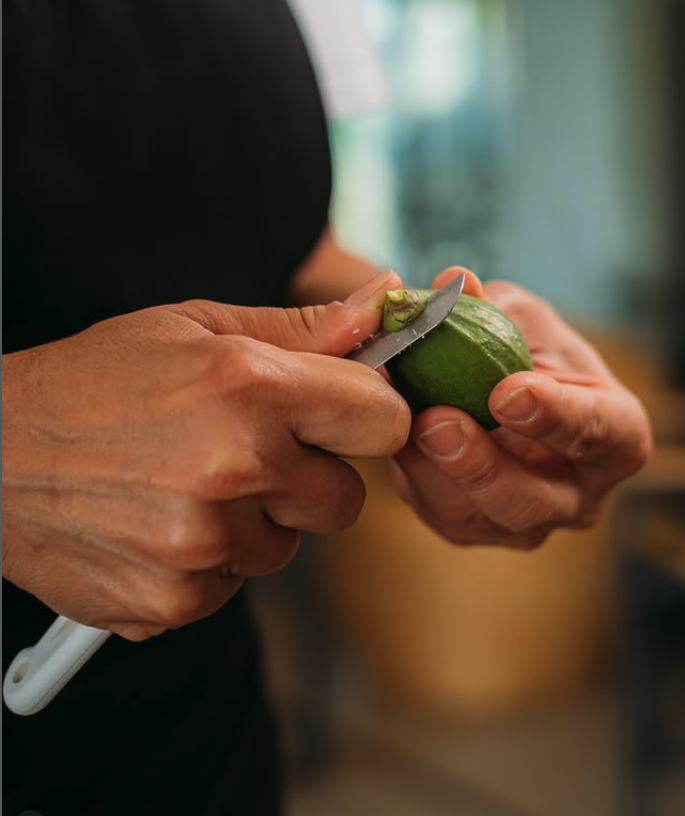
A Perfect Microclimate: Flysch del Cilento at 400 to 800 Metres
The secret of the white figs lies in the soil and climate conditions. Karst soils of limestone dominate in the mountains, which store water well due to their porous structure. Deposits from the primordial Tethys Sea, the so-called “Flysch del Cilento,” are found along the coasts. The soils are slightly alkaline and thus optimal for calcium absorption by the fig roots.
The altitudes between 400 and 800 meters above sea level create a special microclimate for tree growth. Under the protection of the Apennines, summer temperatures averaging between 28-32 degrees provide intense photosynthesis and sugar accumulation, while nighttime cooling through maritime air masses (15-18°C) slows respiration and stabilizes the plant’s energy balance.
The relative humidity of 65-75% in the critical months from June to September prevents premature drying of the fruits, while constant sea breezes provide natural protection against fungal diseases. These conditions make Cilento figs a unique product that Santomiele knows how to interpret.
The Fagottino: A Bundle Full of Meaning
For instance, in the form of the Fagottino, which embodies Santomiele’s philosophy. The name “Fagottino” translates to “little bundle”—a precious bundle. Once a nutrient-rich peasant storage food, Santomiele transforms it into an artful delicacy. Like a treasure chest, the green leaves of the fig tree enclose the fruits. This preserves the aromas and fragrances from the dried figs refined with oranges and grapes.
This transformation of the fruit begins with its harvest in the morning hours between late July and mid-September. After harvest, the fruits are dried in the sun for about ten days—without additives. Then gentle warming at low temperatures occurs in the manufactory to ensure their quality.
During the drying phase, a biochemical transformation takes place: water content drops from over 80 percent to 18-30 percent, sugar content rises from 16-20 percent to 58-63 percent. Simultaneously, new aromatic substances form through natural enzymatic processes, which characterize the typical flavor profile of dried figs. The subsequent wrapping of the fruits for the production of Fagottino, mixed with oranges and grapes, has been used for centuries to preserve the fruit.
Besides the Fagottino, other products emerge: molasses through gentle pressing, concentrates with aromas of caramel, licorice, and hay, as well as chocolate creations. All follow the principle of taking the fruit seriously and translating it into new contexts.
Since July 2025, Santomiele has opened a restaurant at the location that translates the fig theme culinarily into innovative and surprising recipes and interpretations.
Architecture of Time: The Mill at Prignano Cilento
Santomiele’s headquarters is located in a renovated mill building where olive oil was once pressed. The architecture, like the Fagottino, is an expression of the company philosophy: clear lines, bright, transparent spaces—including production—integrated into the hillside with stone from the Flysch as part of the interior design. A grand piano and a photovoltaic system integrated into the roof are additional elements connecting roots of the past, the future, and culture.
The architectural center of the building is a piazza-like circle that once served for olive oil pressing and on which the figs are now laid out on tables to dry.
Radix: La Valorizzazione Territoriale and the Value of Roots
Santomiele can be classified as part of a larger, ongoing discourse in Italy: “la valorizzazione territoriale,” the economic enhancement of regions. The considerations connect economic and cultural questions. They respond to global tendencies toward homogenization of taste and production methods.
The concept of luxury also faces this question. Should luxury only be measured by its material properties? Or will it become a cultural narrative in the future that carries authenticity and appreciation for products and their production? Santomiele has obviously answered this question for itself. The drying of figs is not accelerated by adding additives. Instead, they rely on time and the effect of nature. This is radical—radical in the true sense of the Latin origin of the word from “radix,” the root. In the case of Santomiele, it builds a bridge from traditional production methods to the future.
Patience, the Luxury of Our Time
The white fig, which almost fell into oblivion, has experienced a kind of rebirth here at Santomiele. It tells of a region that preserves its roots and finds new forms of expression. At the center stands the Fagottino: a small form wrapped in leaves that takes up the story of Cilento and carries it into the present. In an accelerated world, it reminds us that true value lies in patience.
Similar Articles
The Great Small Vintage of 2026: A Season of Concentration
The Taste of El Niño: How Drought and Heat Are Rewriting the Chemistry of Wine, Oil and Linen

A Sale That Ends in a Memo: The 2010s Stay at Estée Lauder